
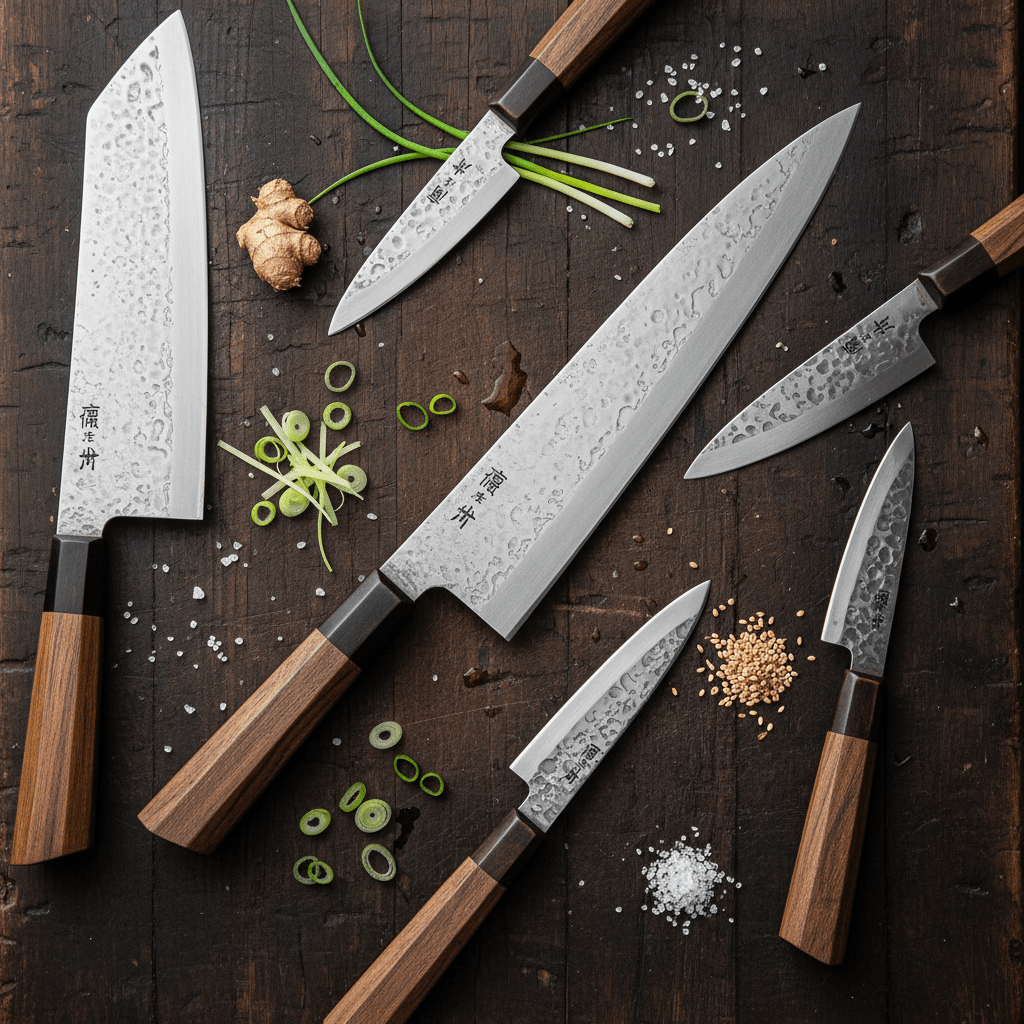
Kitchen knives are the most fundamental tools in any cook’s arsenal. Yet, the world of knives is divided by deep traditions and philosophies, most notably between Western and Japanese styles. Understanding these differences is not just a matter of aesthetics or national pride—it directly impacts how we cook, what we cook, and the pleasure we derive from the process.
Key Differences in Materials and Shapes
Materials: Steel Science and Knife Philosophy
Western Knives: Softer Stainless Steels
Western kitchen knives, especially those from Europe and North America, are most commonly made from softer stainless steel alloys. These steels typically have a Rockwell Hardness (HRC) in the range of 54–58. The composition often includes chromium, which increases corrosion resistance and makes the knives less likely to rust or stain. Popular examples include German steels like X50CrMoV15 (used by Wüsthof and Zwilling) and American stainless steels.
Advantages of Softer Stainless Steels:
- Toughness and Durability: Softer steels are less likely to chip or crack if the knife is twisted, dropped, or used on hard foods (like bones or squash).
- Ease of Maintenance: They are more forgiving of improper technique and can withstand rougher handling, making them ideal for busy home kitchens or professional environments where speed and resilience matter.
- Corrosion Resistance: High chromium content means less worry about rust, even with minimal care.
Drawbacks:
- Edge Retention: Softer steels dull more quickly. The edge rolls or blunts with use, requiring more frequent honing and sharpening.
- Edge Sharpness: They cannot be ground to as acute an angle as harder steels without sacrificing durability, so the ultimate sharpness is somewhat limited.
Japanese Knives: Harder High-Carbon and Advanced Stainless Steels
Japanese knives are renowned for their use of harder steels, often with a Rockwell Hardness of 58–65. Traditional Japanese blades are frequently made from high-carbon steels such as White Steel (Shirogami) or Blue Steel (Aogami), which are prized for their purity and ability to take a razor-sharp edge. Modern Japanese makers also use advanced stainless steels (like VG-10, SG2, or powdered steels) that combine hardness with improved corrosion resistance.
Advantages of Harder Steels:
- Sharpness: Harder steels can be ground to a much finer, thinner edge (as acute as 10–16° per side, or even less for single-bevel knives), resulting in exceptional sharpness and cutting performance.
- Edge Retention: The edge stays sharp much longer, especially when used with proper technique and on appropriate foods.
- Precision: The ability to hold a thin, keen edge allows for extremely precise cuts, which is essential in Japanese cuisine for presentation and texture.
Drawbacks:
- Brittleness: Harder steels are more brittle and prone to chipping if misused (e.g., twisting the blade, cutting through bone, or using improper cutting boards).
- Maintenance: High-carbon steels are more susceptible to rust and require careful cleaning and drying after each use. Even advanced stainless steels, while better, still benefit from attentive care.
- Sharpening Skill: While they hold an edge longer, when sharpening is needed, it requires more skill and patience, especially for single-bevel knives.
Summary Table: Steel Properties
| Property | Western Knives | Japanese Knives |
|---|---|---|
| Hardness (HRC) | 54–58 | 58–65 |
| Edge Angle | 20–22° (double bevel) | 10–16° (often single bevel) |
| Edge Retention | Moderate | Excellent |
| Toughness | High | Moderate to low |
| Corrosion Resistance | Excellent | Moderate to good (varies) |
| Maintenance | Easy | Requires care |
| Sharpening | Frequent, easy | Infrequent, requires skill |
Shapes: Form Follows Function
Western Knife Shapes
Western knives, such as the classic chef’s knife, are designed for versatility. The blade is typically broad and thick, with a pronounced curve (belly) that facilitates a rocking motion for chopping. The tip is pointed, but the overall profile is robust, allowing the knife to handle a wide range of tasks, from mincing herbs to breaking down poultry.
- Chef’s Knife: Curved belly, thick spine, double bevel.
- Utility and Paring Knives: Smaller, but similarly robust and versatile.
Japanese Knife Shapes
Japanese knives are often purpose-built, with shapes optimized for specific tasks. The blades are generally thinner and lighter, with flatter profiles that encourage push-cutting or slicing rather than rocking. Many traditional Japanese knives are single-beveled, meaning only one side is sharpened, which allows for extremely precise, clean cuts.
- Gyuto: Japanese equivalent of the chef’s knife, but thinner and lighter, with a flatter edge.
- Santoku: Shorter, with a sheepsfoot tip and flat edge, ideal for slicing, dicing, and chopping.
- Specialty Knives: Usuba (vegetables), Yanagiba (sushi/sashimi), Deba (fish butchery), Garasuki (poultry butchery), each with unique shapes tailored to their roles.
Why These Differences Matter
The differences in materials and shapes are not arbitrary—they reflect the culinary traditions and priorities of each culture. Western knives are built for durability and versatility, able to handle a wide range of foods and techniques. Japanese knives, by contrast, are designed for precision and specialized tasks, enabling chefs to achieve the delicate cuts and beautiful presentation that define Japanese cuisine.
The choice of steel and blade shape is a direct expression of culinary philosophy. Western knives prioritize resilience and adaptability, while Japanese knives pursue sharpness, precision, and artistry. Understanding these differences allows cooks to choose the right tool for their needs—and to appreciate the craftsmanship and tradition behind every cut.
Shapes: How Form Reflects Culinary Philosophy
Western Knife Shapes: The All-Purpose Workhorse
The most iconic Western knife is the chef’s knife (or “French knife”), typically 8–10 inches long, with a broad, thick blade and a pronounced curve along the cutting edge. This “belly” is not just aesthetic—it’s designed for a rocking motion, where the tip remains on the board while the blade pivots up and down. This technique is ideal for mincing herbs, dicing onions, and chopping vegetables quickly and efficiently. The blade’s thickness and weight also allow it to power through dense foods and even small bones.
Other common Western shapes include:
- Paring Knife: Small, with a pointed tip for peeling and intricate work.
- Bread Knife: Long, serrated edge for slicing through crusty loaves.
- Carving Knife: Long and narrow for slicing roasts and poultry.
Western knives are almost always double-beveled, meaning both sides of the blade are sharpened symmetrically. This makes them easier to use for both right- and left-handed cooks and more forgiving of technique.
Japanese Knife Shapes: Precision and Specialization
Japanese knives are renowned for their diversity of shapes, each tailored to a specific culinary task. The two most “Westernized” Japanese knives are the Gyuto and Santoku:
- Gyuto: The Japanese answer to the chef’s knife, but with a thinner, lighter blade and a flatter edge profile. The tip is more pointed, allowing for delicate work, while the flatter edge encourages push-cutting and slicing rather than rocking.
- Santoku: Shorter and taller than the Gyuto, with a sheepsfoot tip and a nearly flat edge. “Santoku” means “three virtues,” referring to its ability to slice, dice, and chop. Its design excels at up-and-down chopping and precise cuts.
Beyond these, Japanese cutlery includes highly specialized shapes:
- Usuba: Tall, rectangular, and razor-thin, designed for vegetable work.
- Yanagiba: Long and slender, ideal for slicing raw fish in a single, clean pull.
- Deba/Garasuki: Thick and heavy, for breaking down and filleting fish resp. poultry.
A defining feature of many traditional Japanese knives is the single-bevel edge. Only one side is sharpened (usually the right), while the other is flat or slightly concave. This allows for an incredibly acute edge angle (as low as 10°), resulting in unmatched sharpness and the ability to make ultra-precise, clean cuts.
Comparative Table: Shape and Function
| Feature | Western Knives | Japanese Knives |
|---|---|---|
| Blade Profile | Curved belly, thick spine | Flatter edge, thinner blade |
| Cutting Motion | Rocking, chopping | Push-cutting, slicing, up-down chop |
| Bevel | Double (symmetrical) | Often single (asymmetrical) |
| Specialization | Generalist (chef’s knife) | Highly specialized (usuba, deba, etc.) |
| Weight | Heavier, robust | Lighter, more agile |
| Tip Shape | Pointed, robust | Varies: pointed (gyuto), blunt (usuba) |
| Handle | Western (full tang, bolster) | Japanese (wa-handle, lighter) |
Why These Shapes Matter
The shape of a knife dictates not only how it feels in the hand, but also how it interacts with food. Western knives are designed for versatility and durability, able to tackle a wide range of ingredients and techniques. Their curved edge and weight make them forgiving and powerful, suitable for cooks who value speed and robustness.
Japanese knives, in contrast, are shaped for precision and finesse. The flatter edge and lighter build encourage careful, controlled cuts, preserving the integrity of delicate ingredients. The single-bevel design, while requiring more skill, enables chefs to execute techniques impossible with a double-bevel blade—such as katsuramuki (rotary peeling) or the perfect sashimi slice.
Knife shape is a direct reflection of culinary tradition. Western knives embody the spirit of adaptability and strength, while Japanese knives celebrate specialization, sharpness, and artistry. Choosing between them—or learning to use both—opens up new possibilities in the kitchen, allowing cooks to match their tools to their technique and their cuisine.
The Reasons Behind These Differences: History, Cuisine, and Material Realities
Culinary Traditions and Their Demands
The fundamental divergence between Western and Japanese knife design is a direct reflection of each region’s culinary history and the types of food most commonly prepared.
Western Cuisine: Robustness and Versatility
Western (especially European) cuisine has long centered around hearty, often rustic dishes. Large roasts, whole poultry, root vegetables, and crusty breads are staples. Preparing these foods requires knives that can:
- Break down large, tough cuts of meat and poultry, sometimes even cutting through small bones or joints.
- Chop, dice, and slice dense vegetables like potatoes, carrots, and squash.
- Withstand heavy use and occasional misuse in busy kitchens.
As a result, Western knives evolved to be robust, with thicker, heavier blades and a curved edge that facilitates a rocking motion for efficient chopping. The double-bevel edge is forgiving and easy to maintain, suitable for a wide range of tasks and users.
Japanese Cuisine: Precision and Presentation
Japanese cuisine, by contrast, is defined by its emphasis on precision, delicacy, and visual beauty. Dishes like sashimi, sushi, and kaiseki require ingredients to be cut with minimal cellular damage, preserving texture, flavor, and appearance. The knife must:
- Make ultra-clean, single-stroke cuts through delicate fish and vegetables.
- Enable intricate vegetable carving and decorative work.
- Support specialized techniques, such as katsuramuki (rotary peeling) or the perfect sashimi slice.
This led to the development of knives with thinner, harder blades and specialized shapes, often single-beveled for maximum sharpness and control. Each knife is purpose-built for a specific task, reflecting the Japanese philosophy of mastery through specialization.
Material Availability and Metallurgical Traditions
Japan: Swordsmithing Heritage and Harder Steels
Japan’s long history of sword-making (katana, wakizashi, etc.) profoundly influenced its knife-making traditions. Japanese blacksmiths developed advanced techniques for forging and tempering high-carbon steels, resulting in blades that could take and hold an incredibly sharp edge.
However, Japan’s climate is humid, and traditional high-carbon steels are prone to rust. This was less of a concern in professional kitchens, where knives are meticulously cared for, but it did shape the culture of knife maintenance and respect for tools.
The West: Softer, Corrosion-Resistant Steels
In Europe, the focus was on practicality and durability. The development of stainless steel alloys in the 20th century made it possible to produce knives that resisted rust and staining, even with minimal care. Softer steels were easier to mass-produce, sharpen, and maintain, making them ideal for the bustling, sometimes chaotic environments of Western kitchens.
The result was a preference for knives that could handle a wide range of tasks, survive rough treatment, and require less frequent sharpening or special care.
Social and Cultural Influences
Specialization vs. Generalization
Japanese culinary culture values specialization and mastery. Chefs often spend years perfecting their technique with a single type of knife, and each knife is seen as an extension of the chef’s skill and artistry. This is why Japanese kitchens feature a wide array of purpose-built knives, each with a distinct role.
Western kitchens, on the other hand, have traditionally valued versatility and efficiency. The chef’s knife is expected to do it all, from mincing herbs to carving roasts. This generalist approach is reflected in the design and construction of Western knives.
Aesthetics and Ritual
In Japan, the act of cutting is almost ritualistic, with great attention paid to the beauty and uniformity of each slice. The knife is not just a tool, but a symbol of the chef’s dedication and respect for the ingredients. In the West, while skill and presentation are valued, the focus is more on speed, practicality, and getting food to the table.
The differences between Western and Japanese knives are not arbitrary—they are the product of centuries of culinary evolution, shaped by the foods people eat, the materials available, and the values of each culture. Understanding these reasons deepens our appreciation for the tools we use and the traditions they represent.
Purpose-Built vs. ‘Universal’ Knives: Specialization and Versatility in the Kitchen
The Japanese Approach: Mastery Through Specialization
Japanese knife culture is rooted in the idea that each ingredient and technique deserves its own dedicated tool. This philosophy is a direct reflection of Japanese cuisine’s emphasis on precision, aesthetics, and respect for ingredients. As a result, Japanese kitchens—especially professional ones—feature a wide array of highly specialized knives, each meticulously engineered for a specific task.
Examples of Purpose-Built Japanese Knives
- Usuba: Designed exclusively for vegetables, the usuba’s tall, flat blade and single-bevel edge allow for paper-thin slices and intricate decorative cuts. Its geometry is optimized for katsuramuki (rotary peeling) and other advanced vegetable techniques.
- Deba: This thick, heavy knife is used for breaking down and filleting whole fish. Its robust spine and pointed tip make it ideal for cutting through fish bones and cartilage with precision.
- Yanagiba: The quintessential sashimi knife, the yanagiba’s long, slender, single-bevel blade is engineered for slicing raw fish in a single, clean pull, preserving texture and presentation.
- Garasuke: A large, pointed boning knife, the garasuke is used for breaking down poultry and larger cuts of meat with accuracy and minimal waste.
- Kiritsuke: Traditionally reserved for head chefs, the kiritsuke combines features of the usuba and yanagiba, making it a versatile yet demanding knife for both vegetables and fish.
Each of these knives is the product of centuries of refinement, with blade profiles, lengths, and bevels tailored to their intended use. The single-bevel edge, common in many traditional Japanese knives, allows for extremely acute angles and precise control, but also requires skill to use and maintain.
The Cultural Impact
This specialization is not just about efficiency—it’s about mastery. Japanese chefs often dedicate years to perfecting their technique with a single type of knife, viewing it as an extension of their hand and a symbol of their craft. The result is a culinary tradition where the right tool is always matched to the right job, and where the act of cutting is elevated to an art form.
The Western Approach: The Universal Workhorse
In contrast, Western knife culture is defined by versatility and practicality. The chef’s knife (or cook’s knife) is the centerpiece of the Western kitchen, designed to handle a wide range of tasks: chopping, slicing, dicing, mincing, and even carving. Its curved belly and double-bevel edge make it adaptable to different cutting techniques and ingredients.
The Chef’s Knife: Jack of All Trades
The Western chef’s knife is expected to:
- Chop vegetables and herbs
- Slice meats and fish
- Carve roasts and poultry
- Smash garlic, crush nuts, and more
Other Western knives, such as the paring knife, bread knife, and carving knife, offer some specialization, but the chef’s knife remains the primary tool for most kitchen tasks. This universality makes Western knives more forgiving for beginners and more practical for home cooks who may not want to invest in a large collection of specialized blades.
The Trade-Offs
While the Western approach offers convenience and flexibility, it comes at the cost of precision. A chef’s knife can perform most tasks adequately, but it cannot match the specialized performance of a Japanese knife designed for a single purpose. For example, it cannot slice sashimi as cleanly as a yanagiba, nor can it achieve the paper-thin vegetable cuts possible with an usuba.
Comparative Table: Specialization vs. Universality
| Aspect | Japanese Knives | Western Knives |
|---|---|---|
| Number of Knives | Many, each for a specific task | Few, each for many tasks |
| Edge Geometry | Often single-bevel, acute angle | Double-bevel, moderate angle |
| Precision | Extremely high for intended use | Good, but less specialized |
| Learning Curve | Steep (requires skill, knowledge) | Gentle (easy for beginners) |
| Maintenance | More complex (special sharpening) | Simpler (general sharpening) |
| Flexibility | Low (task-specific) | High (multi-purpose) |
The divide between purpose-built and universal knives is a reflection of deeper culinary philosophies. Japanese knives celebrate specialization, precision, and the pursuit of mastery, while Western knives embody adaptability, practicality, and efficiency. Both approaches have their merits, and the best choice depends on your cooking style, the foods you prepare, and the experience you seek in the kitchen. For those who value artistry and precision, Japanese purpose-built knives offer unparalleled performance. For those who prioritize convenience and versatility, the Western chef’s knife remains an indispensable tool.
Daily Use Differences: How Knife Design Shapes Everyday Cooking
Western Knives: The Forgiving Workhorse
In the rhythm of daily cooking, Western knives prove themselves as reliable, all-purpose tools. Their design—thicker, heavier blades made from softer, more resilient stainless steel—means they can handle a wide variety of kitchen tasks with minimal fuss. Whether you’re chopping dense root vegetables, slicing through a roast, or mincing herbs, a Western chef’s knife is up to the job.
Forgiveness and Durability: Western knives are built to withstand the realities of a busy kitchen. They tolerate rougher handling, such as twisting the blade while cutting, scraping food off the board with the edge, or even the occasional contact with bones or hard seeds. Their double-bevel edge is less prone to chipping, and the softer steel can be quickly honed back to sharpness with a steel rod or basic sharpener. This makes them ideal for cooks who value speed, convenience, and low maintenance.
Versatility: A single Western chef’s knife can transition seamlessly from dicing onions to slicing bread (in a pinch), or from breaking down a chicken to chopping chocolate. This universality is especially appreciated in home kitchens, where space and budget may not allow for a large collection of specialized knives.
Japanese Knives: Precision Tools for the Attentive Cook
Japanese knives, by contrast, are precision instruments that reward careful technique and respect for the tool. Their blades are thinner, lighter, and often sharper right out of the box. When used correctly, they glide through ingredients with minimal resistance, producing cleaner cuts and preserving the texture and appearance of delicate foods.
Efficiency and Enjoyment: The sharpness and geometry of Japanese knives make prep work feel almost effortless. Slicing a ripe tomato, filleting a fish, or julienning vegetables becomes a pleasure, with each cut requiring less force and yielding more beautiful results. For those who enjoy the meditative aspect of cooking, Japanese knives elevate the experience.
Attention and Care Required: However, this performance comes with responsibilities. The harder, thinner steel is more brittle, and improper use—such as twisting the blade, cutting into bone, or using the wrong knife for the task—can easily chip or damage the edge. Japanese knives are best used with a gentle, controlled push-cut or slicing motion, and always on a soft cutting board (like wood or end-grain). They also require more attentive cleaning and drying to prevent rust, especially for high-carbon models.
Task-Specific Limitations: Many Japanese knives are highly specialized. Using a yanagiba (sashimi knife) to chop carrots, or a deba (fish butchery knife) to slice bread, is not just inefficient—it risks damaging the blade. This means the cook must select the right knife for each job, and be mindful of the knife’s strengths and limitations.
Comparative Table: Daily Use Experience
| Aspect | Western Knives | Japanese Knives |
|---|---|---|
| Forgiveness | High (tolerates rough use) | Low (requires careful handling) |
| Versatility | Very versatile | Often task-specific |
| Maintenance | Simple, quick honing | More frequent sharpening, care |
| Cutting Technique | Rocking, chopping, rough cuts | Push-cut, slicing, precision |
| Edge Durability | Less sharp, but tough | Razor-sharp, but brittle |
| User Experience | Practical, robust, no-nonsense | Precise, enjoyable, meditative |
In daily use, Western knives are the dependable workhorses—ready for anything, easy to maintain, and forgiving of hurried or imperfect technique. Japanese knives, meanwhile, are the artisan’s tools—rewarding skill, attention, and respect with unmatched sharpness and beauty in every cut. The choice between them is not just about the food you cook, but about the experience you want in your kitchen: rugged practicality, or refined precision.
Sharpening Differences: Technique, Tools, and Philosophy
Western Knives: Practicality and Accessibility
Western knives are typically made from softer stainless steels and feature double-beveled edges (sharpened symmetrically on both sides). This design makes them relatively straightforward to maintain and sharpen, even for beginners.
Sharpening Tools and Methods:
- Honing Rods (Steels): The most common maintenance tool in Western kitchens is the honing rod. Regular use realigns the edge, keeping it sharp between actual sharpenings. This process is quick and can be done daily.
- Pull-Through Sharpeners: These devices, often found in home kitchens, use preset angles and abrasive wheels to quickly restore a serviceable edge. They are convenient but can remove more metal than necessary and may not produce the sharpest or most refined edge.
- Sharpening Stones: While less common among casual cooks, Western knives can also be sharpened on whetstones. The softer steel means the process is faster and more forgiving of mistakes.
Edge Geometry: Western knives are usually sharpened to a 20–22° angle on each side, resulting in a robust edge that prioritizes durability over ultimate sharpness. Because the steel is softer, the edge will dull more quickly, but it can be restored with minimal effort.
User Experience: Sharpening Western knives is accessible and quick. Even if technique is imperfect, the knife will still perform adequately. This matches the Western culinary philosophy of practicality and efficiency.
Japanese Knives: Precision, Skill, and Ritual
Japanese knives, especially traditional ones, are made from harder steels and often feature single-beveled edges (sharpened only on one side, with the other side flat or slightly concave). This allows for a much sharper, more precise edge, but also introduces complexity in sharpening.
Sharpening Tools and Methods:
- Water Stones (Whetstones): The preferred method for sharpening Japanese knives is the use of water stones, which come in various grits for different stages (coarse for repair, medium for sharpening, fine for polishing). The process is slower and requires careful attention to angle and pressure.
- Stropping: After sharpening, some chefs use a leather strop to further refine and polish the edge.
- No Pull-Through Sharpeners: These are generally discouraged for Japanese knives, as they can damage the delicate edge and do not accommodate single-bevel geometry.
Edge Geometry: Japanese knives are sharpened to much more acute angles—often 10–16° per side for double-bevel knives, and even sharper for single-bevel blades. The single-bevel design creates an asymmetric edge, which is capable of making incredibly precise, clean cuts, but requires the user to maintain the correct angle and technique during sharpening.
Skill and Patience: Sharpening a Japanese knife is a meditative, almost ritualistic process. It demands respect for the tool, a steady hand, and an understanding of the blade’s geometry. Mistakes can easily lead to uneven edges or even damage the knife. For single-bevel knives, maintaining the correct flatness on the back (ura) and the precise angle on the bevel is essential for optimal performance.
Edge Longevity: The harder steel of Japanese knives means the edge stays sharp much longer, but when it does dull or chip, restoration is more involved. The reward is an edge that glides through food with minimal resistance and produces beautiful, clean cuts.
Comparative Table: Sharpening Differences
| Aspect | Western Knives | Japanese Knives |
|---|---|---|
| Steel Hardness | Softer (HRC 54–58) | Harder (HRC 58–65) |
| Edge Type | Double-bevel | Often single-bevel |
| Sharpening Angle | 20–22° per side | 10–16° per side (or less) |
| Tools Used | Honing rod, pull-through, stones | Water stones, strop |
| Skill Required | Low to moderate | Moderate to high |
| Maintenance Frequency | Frequent, quick | Less frequent, more involved |
| Edge Quality | Durable, less sharp | Razor-sharp, precise |
Sharpening is not just maintenance—it’s a reflection of each culture’s approach to cooking. Western knives are designed for ease and practicality, with sharpening methods that are accessible to all. Japanese knives, in contrast, invite the user into a deeper relationship with their tools, where sharpening is an act of care, skill, and tradition. The result is a sharper, more refined edge—but one that demands respect and understanding.
Unique and Useful Japanese Knife Designs
Usuba: The Master’s Vegetable Knife
Overview and Shape
The Usuba (薄刃, meaning “thin blade”) is a traditional Japanese vegetable knife, instantly recognizable by its tall, rectangular blade and completely flat edge. Unlike the Western chef’s knife or even the Japanese Santoku, the usuba is a single-bevel knife—sharpened only on one side (usually the right), with the other side flat or slightly concave (ura). This construction allows for an incredibly acute edge angle, making the usuba one of the sharpest and most precise knives in the Japanese kitchen.
Dimensions and Variations
- Blade Length: Typically 180–240 mm (7–9.5 inches)
- Blade Height: Tall (often 50–55 mm), providing ample knuckle clearance and stability
- Thickness: Very thin at the edge, but with enough height to prevent flexing
- Regional Styles:
- Kanto (Tokyo) Usuba: Has a squared-off tip (kakugata usuba), ideal for straight cuts and katsuramuki (rotary peeling).
- Kansai (Osaka/Kyoto) Usuba: Features a rounded tip (kamagata usuba), which allows for more delicate, intricate work and easier tip control.
Primary Uses
The usuba is designed for professional-level vegetable work, especially in kaiseki and other traditional Japanese cuisines where presentation is paramount. Its main roles include:
- Katsuramuki: The signature technique for which the usuba is famous. This involves peeling daikon or cucumber into a continuous, paper-thin sheet, which is then cut into fine julienne or used as a decorative garnish.
- Mukimono: Intricate decorative carving of vegetables and fruits, often used for garnishes or edible art.
- Precision Slicing: The flat edge allows for perfectly straight, even slices of vegetables, minimizing bruising and preserving texture and appearance.
- Fine Dicing and Brunoise: The razor-thin edge makes it possible to achieve extremely fine, uniform cuts, essential for high-end Japanese plating.
Why Single-Bevel?
The single-bevel design is crucial for the usuba’s performance. It allows the knife to make ultra-thin, precise cuts without wedging or cracking delicate vegetables. The flat side helps guide the blade along the cutting surface, while the beveled side creates a natural slicing action. However, this also means the usuba is best suited for right-handed users (unless custom-made for left-handed use) and requires advanced sharpening skills to maintain the correct geometry.
Limitations and Learning Curve
The usuba is not a beginner’s knife. Its thin, brittle edge can chip if twisted or used on hard foods, and the single-bevel design demands careful technique to avoid steering or uneven cuts. Mastery of the usuba is a mark of a skilled Japanese chef, especially in the art of vegetable preparation.
Comparison: Usuba vs. Nakiri
| Feature | Usuba (Single-Bevel) | Nakiri (Double-Bevel) |
|---|---|---|
| Edge | Single-bevel, right or left | Double-bevel, symmetrical |
| Skill Required | High | Low to moderate |
| Typical Use | Professional, decorative | Home/professional, general |
| Cutting Motion | Push-cut, slicing | Up-down chop, push-cut |
| Best For | Precision, katsuramuki | Everyday vegetable prep |
Cultural Significance
In Japanese culinary tradition, the usuba is a symbol of professional skill and dedication. Chefs may spend years perfecting their technique, especially for katsuramuki and decorative work. The usuba’s role in creating visually stunning dishes highlights the Japanese reverence for both the ingredient and the act of preparation.
The usuba is more than just a knife—it is a specialized instrument for transforming humble vegetables into works of art. Its design, rooted in centuries of tradition, enables the highest level of precision and beauty in Japanese cuisine. For those who seek to master the art of vegetable preparation, the usuba is both a challenge and a reward, embodying the spirit of Japanese craftsmanship and culinary artistry.
Kiritsuke: The Executive Chef’s Hybrid Blade
Overview and Shape
The Kiritsuke (切り付け) is one of the most distinctive and prestigious knives in the Japanese culinary tradition. Its name means “slit open” or “cutting open,” and its design is a hybrid, blending the long, slender profile of the Yanagiba with the tall, flat blade of the Usuba. The result is a knife that is both visually striking and functionally versatile.
Blade Characteristics:
- Length: Typically 240–330 mm (9.5–13 inches), longer than most general-purpose knives.
- Profile: Long, flat edge with a slightly angled, “reverse tanto” tip (k-tip), which is both sharp and strong.
- Height: Taller than a Yanagiba, providing knuckle clearance and stability for vegetable work.
- Edge: Traditionally single-bevel (right-handed), though modern versions may be double-beveled for broader appeal.
Primary Uses
The Kiritsuke is designed to perform two of the most demanding tasks in Japanese cuisine:
- Slicing Raw Fish: Like the Yanagiba, the Kiritsuke excels at making long, clean, single-stroke cuts through raw fish for sashimi and sushi. The acute edge and long blade minimize cellular damage, preserving the texture and appearance of delicate proteins.
- Precision Vegetable Work: Inherited from the Usuba, the Kiritsuke’s flat edge and tall blade make it ideal for push-cutting, julienning, and creating decorative garnishes. It can handle katsuramuki (rotary peeling) and other advanced vegetable techniques.
This dual functionality makes the Kiritsuke a true “executive chef’s knife” in high-end Japanese kitchens, where the head chef is expected to master both fish and vegetable preparation.
Symbolism and Tradition
Traditionally, the Kiritsuke is reserved for the head chef (itamae) or executive chef in a Japanese kitchen. Its use is a mark of status, skill, and authority. This is partly because the Kiritsuke is not easy to wield: its single-bevel edge and long, flat profile require advanced technique and precise control. In the hands of a novice, it can be unwieldy and prone to steering off course.
Modern Adaptations
Recognizing the appeal of the Kiritsuke’s aesthetics and versatility, many modern makers now produce double-bevel Kiritsuke-Gyuto knives. These combine the Kiritsuke’s iconic k-tip and flat profile with the user-friendly double-bevel edge of a Western chef’s knife or Japanese Gyuto. This makes them accessible to a wider range of cooks, including left-handed users and those without extensive single-bevel experience.
Strengths and Limitations
Strengths:
- Versatility: Excels at both fish and vegetable prep, reducing the need to switch knives.
- Precision: The flat edge and acute tip allow for highly controlled, detailed work.
- Aesthetics: The Kiritsuke’s dramatic silhouette and k-tip are visually impressive and often a centerpiece in a knife collection.
Limitations:
- Skill Requirement: The traditional single-bevel Kiritsuke is challenging to master and not recommended for beginners.
- Fragility: Like other hard, thin Japanese knives, it is prone to chipping if misused.
- Specialization: While versatile within Japanese cuisine, it is not ideal for heavy-duty tasks like breaking down poultry or cutting through bone.
Comparison: Kiritsuke vs. Gyuto vs. Yanagiba
| Feature | Kiritsuke | Gyuto | Yanagiba |
|---|---|---|---|
| Edge | Single-bevel, flat profile | Double-bevel, curved profile | Single-bevel, long & slender |
| Primary Use | Fish & vegetable precision | All-purpose | Slicing raw fish |
| Skill Required | High | Moderate | High |
| Symbolism | Head chef’s status | Everyday workhorse | Sushi/sashimi specialist |
The Kiritsuke stands as a symbol of mastery and authority in the Japanese kitchen. Its hybrid design bridges the worlds of fish and vegetable preparation, demanding both skill and respect from its user. For those who have the technique to wield it, the Kiritsuke offers unmatched versatility and elegance—a true testament to the artistry of Japanese knife-making.
Deba: The Butcher’s Precision Tool of Japanese Cuisine
Overview and Shape
The Deba (出刃包丁, deba bōchō) is a traditional Japanese knife specifically engineered for butchering and filleting fish, though it is also adept at breaking down poultry and other small animals. The word “deba” means “pointed carving knife,” and its design reflects a blend of power and precision.
Blade Characteristics:
- Length: Typically ranges from 150 mm (6 inches) to 210 mm (8 inches), with larger versions available for bigger fish.
- Thickness: Significantly thicker and heavier than most Japanese knives, especially at the spine, which can be 6–9 mm thick near the handle.
- Profile: The blade is wide and tapers to a pointed tip, allowing for both robust and delicate work.
- Edge: Traditionally single-beveled (right-handed), with a flat or slightly concave back (ura) and a steeply angled front bevel.
Primary Uses
The Deba is purpose-built for tasks that require both strength and finesse:
- Filleting Whole Fish: The Deba’s weight and sharpness allow it to cut cleanly through fish heads, bones, and cartilage, while its acute edge can separate flesh from bone with minimal damage.
- Breaking Down Poultry: The robust spine and pointed tip make it suitable for cutting through joints and small bones in chicken or duck.
- Portioning Meat: While not intended for large red meat butchery, the Deba can handle smaller cuts and precise trimming.
Technique and Handling
The Deba is wielded differently from Western boning knives. Its heft is used to drive the blade through bones and heads with a controlled, downward motion, while the sharp edge is used for delicate slicing along the backbone or rib cage. The single-bevel edge allows for extremely precise, close-to-the-bone cuts, minimizing waste and preserving the integrity of the fillet.
Key Techniques:
- Head Removal: The thick spine is used to chop through the fish’s head with a single, decisive motion.
- Filleting: The sharp, single-bevel edge glides along the bones, separating fillets cleanly.
- Joint Work: The pointed tip is ideal for finding and separating joints in poultry.
Strengths and Limitations
Strengths:
- Power and Precision: The Deba’s unique geometry combines the ability to cut through bone with the finesse needed for delicate filleting.
- Edge Retention: The hard steel and single-bevel edge maintain sharpness for extended periods, crucial for repetitive butchery tasks.
- Minimal Waste: The acute edge allows for close, efficient cuts, maximizing yield from each fish or bird.
Limitations:
- Not for Heavy Bones: The Deba is not a cleaver; it is not designed for splitting large beef or pork bones, which can chip or damage the edge.
- Skill Requirement: Proper technique is essential to avoid chipping the blade or injuring oneself, especially given the knife’s weight and sharpness.
- Single-Purpose: While versatile within its domain, the Deba is not suitable for general vegetable prep or fine slicing tasks.
Comparison: Deba vs. Western Boning Knife
| Feature | Deba | Western Boning Knife |
|---|---|---|
| Edge | Single-bevel, thick spine | Double-bevel, thin and flexible |
| Primary Use | Fish filleting, poultry | Meat and poultry deboning |
| Strength | Cuts through small bones | Flexible for maneuvering |
| Technique | Downward, controlled cuts | Slicing, scraping, flexing |
| Skill Required | High (single-bevel technique) | Moderate |
Cultural Significance
In Japanese cuisine, the Deba is indispensable for chefs working with whole fish—a common practice in both home and professional kitchens. Mastery of the Deba is a rite of passage for sushi and kaiseki chefs, reflecting a deep respect for the ingredient and the craft of butchery.
The Deba is a testament to Japanese specialization in knife design: a robust, razor-sharp tool that empowers chefs to break down fish and poultry with both power and precision. Its unique shape and single-bevel edge make it a symbol of skill and tradition, essential for anyone serious about Japanese fish preparation.
Garasuke: The Heavy-Duty Japanese Boning Knife
Overview and Shape
The Garasuke (ガラスケ) is a specialized Japanese knife designed for butchery, particularly for breaking down large poultry and meat. It is essentially the “big brother” of the Honesuki (the classic Japanese poultry boning knife), but with a larger, heavier, and more robust build. The Garasuke is less common in home kitchens but highly prized among professional butchers and chefs who regularly process whole birds or large cuts of meat.
Blade Characteristics:
- Length: Typically ranges from 210 mm (8 inches) to 270 mm (10.5 inches), making it significantly longer than the Honesuki.
- Thickness: Substantially thicker and heavier, with a sturdy spine for added strength.
- Profile: Triangular blade with a pronounced pointed tip, straight or slightly curved edge, and a tall heel for leverage.
- Edge: Usually double-beveled, but some traditional versions may be single-beveled for right-handed users.
Primary Uses
The Garasuke is engineered for heavy-duty butchery tasks that require both power and precision:
- Breaking Down Large Poultry: Its weight and length make it ideal for cutting through the joints, cartilage, and even small bones of turkeys, ducks, and large chickens.
- Portioning Meat: The robust blade can handle separating primal cuts, trimming fat, and removing sinew from larger pieces of meat.
- Deboning: The pointed tip excels at navigating around joints and bones, allowing for clean separation of meat with minimal waste.
- General Butchery: In professional kitchens, the Garasuke is often used for tasks that would be too demanding for smaller, lighter knives.
Technique and Handling
The Garasuke’s design allows for a variety of butchery techniques:
- Controlled Force: The heavy spine and tall blade provide leverage for cutting through tough joints and cartilage without excessive effort.
- Precision Work: The pointed tip enables detailed work around bones and in tight spaces, while the straight edge allows for clean slicing.
- Grip and Safety: The handle is typically robust, offering a secure grip even when hands are wet or greasy—a crucial feature during butchery.
Strengths and Limitations
Strengths:
- Power and Durability: The Garasuke’s heft and thickness make it capable of handling demanding butchery tasks that would damage more delicate knives.
- Versatility in Butchery: While designed for poultry, it can also be used for pork, lamb, and other meats, making it a versatile tool in the hands of a skilled butcher.
- Precision: Despite its size, the pointed tip and sharp edge allow for detailed, controlled cuts.
Limitations:
- Specialization: The Garasuke is not intended for general kitchen prep or fine slicing; its size and weight make it unwieldy for vegetables or delicate proteins.
- Skill Requirement: Proper technique is essential to avoid accidents or damaging the blade, especially when working around bones.
- Less Common: Due to its specialized nature, the Garasuke is rarely found in home kitchens and is more often seen in professional settings.
Comparison: Garasuke vs. Honesuki vs. Western Boning Knife
| Feature | Garasuke | Honesuki | Western Boning Knife |
|---|---|---|---|
| Size | Large, heavy (210–270 mm) | Small, light (145–150 mm) | Medium, flexible (150–165 mm) |
| Edge | Thick, robust, pointed tip | Thin, triangular, pointed tip | Thin, flexible, curved |
| Primary Use | Large poultry, heavy butchery | Poultry, small game | General meat deboning |
| Strength | Power, durability | Precision, agility | Flexibility, maneuverability |
Cultural and Professional Significance
In Japanese professional kitchens, the Garasuke is a symbol of serious butchery work. It is often used by chefs who regularly break down whole birds or large cuts, such as in yakitori restaurants, butcher shops, or high-volume kitchens. Its presence signals a commitment to whole-animal butchery and respect for the ingredient.
The Garasuke stands out as a heavy-duty, precision butchery tool in the Japanese knife arsenal. Its size, weight, and pointed tip make it indispensable for breaking down large poultry and meat with efficiency and control. While it may be overkill for the average home cook, in the hands of a professional, the Garasuke is a powerful ally—combining the strength needed for tough jobs with the finesse required for clean, skillful butchery.
Yanagiba: The Quintessential Sashimi Knife
Overview and Shape
The Yanagiba (柳刃包丁, “willow blade”) is the iconic Japanese knife for slicing raw fish, especially for sushi and sashimi. Its name comes from its resemblance to a willow leaf—long, narrow, and elegantly tapered. The Yanagiba is a single-bevel knife, traditionally sharpened only on one side (usually the right), with a flat or slightly concave back (ura). This design is essential for achieving the cleanest, most beautiful slices of delicate proteins.
Blade Characteristics:
- Length: Typically ranges from 240 mm (9.5 inches) to 330 mm (13 inches) or even longer for professional use. The longer the blade, the fewer strokes needed for each cut.
- Profile: Long, slender, and slightly curved, with a pointed tip for precision.
- Thickness: Thin at the edge but with enough spine thickness to provide stability and control.
- Edge: Single-bevel, allowing for an extremely acute angle (often 10–12°), which produces a razor-sharp edge.
Primary Uses
The Yanagiba is purpose-built for one of the most demanding and revered tasks in Japanese cuisine: slicing raw fish for sashimi and sushi. Its design enables:
- Single, Clean Pull Cuts: The length and sharpness of the blade allow chefs to slice through a fillet of fish in one smooth, uninterrupted motion. This minimizes damage to the delicate flesh, preserving both texture and appearance.
- Preservation of Texture: The acute, single-bevel edge glides through fish with almost no resistance, preventing tearing or bruising of the flesh. This is crucial for maintaining the mouthfeel and visual appeal of sashimi and nigiri.
- Precision and Presentation: The Yanagiba’s pointed tip and long blade make it possible to create perfectly uniform slices, which are essential for the aesthetics of Japanese plating.
Technique and Handling
Using a Yanagiba requires skill and a specific technique:
- Pull-Cutting: The chef positions the blade at the far end of the fish and draws it back in a single, smooth motion, letting the weight and sharpness of the knife do the work. Sawing or push-cutting is avoided, as it can damage the fish.
- Angle Control: The single-bevel edge allows for extremely thin slices, but also requires precise control to avoid steering or uneven cuts.
- Maintenance: The Yanagiba’s edge must be kept razor-sharp, and the blade should be cleaned and dried immediately after use to prevent rust, especially if made from high-carbon steel.
Strengths and Limitations
Strengths:
- Unmatched Slicing Performance: No other knife produces slices of raw fish as cleanly and beautifully as the Yanagiba.
- Specialization: Its design is perfectly tuned for the demands of sushi and sashimi preparation.
- Aesthetic Appeal: The Yanagiba is often considered one of the most elegant and impressive knives in the Japanese kitchen.
Limitations:
- Single Purpose: The Yanagiba is not suitable for chopping vegetables, cutting through bones, or general kitchen prep.
- Skill Requirement: Mastery of the Yanagiba takes practice, especially in maintaining the correct angle and executing perfect pull cuts.
- Fragility: The thin, hard edge can chip if misused or dropped.
Comparison: Yanagiba vs. Sujihiki vs. Western Slicer
| Feature | Yanagiba | Sujihiki | Western Slicer/Carving Knife |
|---|---|---|---|
| Edge | Single-bevel, acute angle | Double-bevel, thin | Double-bevel, thin |
| Primary Use | Sashimi, sushi | Slicing fish, meat | Slicing cooked meats |
| Technique | Pull-cut, single motion | Push/pull, multi-purpose | Push/pull, multi-purpose |
| Skill Required | High | Moderate | Moderate |
Cultural Significance
The Yanagiba is a symbol of the sushi chef’s craft. In traditional sushi bars, the Yanagiba is often the most prized knife, and its care and use are seen as a reflection of the chef’s dedication to quality and presentation. Mastery of the Yanagiba is a rite of passage for aspiring sushi chefs, who may spend years perfecting their slicing technique.
The Yanagiba is the definitive tool for sashimi and sushi, embodying the Japanese ideals of precision, beauty, and respect for ingredients. Its long, slender, single-bevel blade is unmatched for producing flawless slices of raw fish, making it an essential knife for any chef serious about Japanese cuisine. In the hands of a skilled user, the Yanagiba transforms simple fish into edible art.
Summary Table: Japanese Knife Specialization
| Knife | Primary Use | Key Feature |
|---|---|---|
| Usuba | Vegetable prep, garnishes | Tall, flat, single-beve |
| Kiritsuke | Multi-purpose (fish, veg) | Hybrid, long, angled tip |
| Deba | Fish filleting, poultry | Thick, heavy, single-bevel |
| Garasuke | Large poultry, meat breakdown | Large, pointed, robust |
| Yanagiba | Sashimi, sushi | Long, slender, single-bevel |
The Essence of Specialization
Each of these knives is a product of centuries of refinement, tailored to the demands of Japanese cuisine. Their specialized shapes and edges are not arbitrary—they are the result of a deep respect for ingredients and a desire to elevate every aspect of food preparation. Mastery of these tools allows chefs to achieve levels of precision, efficiency, and artistry that are difficult to match with general-purpose knives.
For the home cook, understanding the role of each knife can inspire greater care and creativity in the kitchen. Even if you only use one or two of these specialized blades, their design and performance can transform everyday cooking into a more mindful and rewarding experience.
My Choice: Japanese Knives
Embracing the Japanese Philosophy
For anyone who enjoys cooking at home, adopting the Japanese approach to kitchen knives can be transformative. Japanese knives are not just tools—they are extensions of the cook’s hand, designed to bring out the best in both the ingredient and the chef. Their purpose-built nature means that each knife is optimized for a specific task, resulting in greater precision, efficiency, and pleasure in food preparation.
Precision and Joy: Using a Japanese knife, even for simple tasks like slicing a tomato or dicing an onion, is a revelation. The thin, sharp edge glides effortlessly through food, preserving texture and flavor. Chopping herbs, filleting fish, or preparing vegetables becomes not just easier, but more enjoyable. The feedback from a well-made Japanese blade encourages better technique and a more mindful approach to cooking (Check out my previous essay on mindfulness/”Wa” in cooking: https://utazcooverland.com/2026/03/02/cultivating-wa-mindful-cooking-in-nature/).
Efficiency: Purpose-built knives, such as the Usuba for vegetables or the Yanagiba for sashimi, allow you to perform specialized tasks with speed and accuracy that generalist knives simply can’t match. This efficiency is especially noticeable when preparing dishes that require uniform cuts or delicate handling—think julienned carrots, paper-thin cucumber slices, or perfectly smooth sashimi.
When Versatility Matters
Of course, not every home kitchen is equipped like a professional sushi bar, and not every meal demands a full suite of specialized knives. For everyday cooking, a more generalist Japanese knife is the perfect solution. My personal favorite is the Kiritsuke. The Kiritsuke’s long, flat edge and sharp tip make it a joy to use for a wide range of tasks.
Other excellent all-purpose options include:
- Gyuto: The Japanese equivalent of the Western chef’s knife, but lighter, thinner, and sharper. It excels at slicing, dicing, and chopping everything from meat to vegetables.
- Santoku: Shorter and taller than the Gyuto, the Santoku is ideal for home cooks who want a nimble, versatile knife for everyday prep.
These knives offer the sharpness and craftsmanship of traditional Japanese blades, but with the flexibility needed for the unpredictable demands of home cooking—whether you’re preparing a quick weeknight stir-fry or a more elaborate meal.
The Importance of Fit and Inspiration
Ultimately, the best knife is the one that feels right in your hand and inspires you to cook. Japanese knives come in a variety of shapes, sizes, and handle styles, so it’s worth trying a few to find the one that matches your grip and cutting style. The tactile pleasure of a well-balanced, razor-sharp blade can turn even routine meal prep into a creative, satisfying ritual.
The Lasting Impact
Once you experience the elegance, performance, and craftsmanship of Japanese purpose-built knives, it’s hard to return to generic, mass-produced blades. The difference is not just in the results, but in the process—the sense of connection to tradition, the respect for ingredients, and the joy of mastering a beautiful tool.
In Summary: Making the Most of Japanese Knives at Home
Use Purpose-Built Japanese Knives for Precision and Presentation
When your cooking calls for exacting cuts, beautiful presentation, or specialized techniques, purpose-built Japanese knives truly shine. For example, the Usuba transforms vegetable prep into an art form, allowing you to create paper-thin slices and intricate garnishes that would be nearly impossible with a Western chef’s knife. The Yanagiba, with its long, single-bevel blade, is indispensable for slicing sashimi or sushi-grade fish, producing flawless, glistening cuts that preserve the delicate texture and appearance of the fish. The Deba, robust and heavy, makes filleting whole fish or breaking down poultry both efficient and precise, minimizing waste and maximizing yield. These knives are not just tools—they are instruments of culinary craftsmanship, designed to elevate both the process and the final dish.
Rely on a Generalist Japanese Knife for Everyday Versatility
For most daily cooking, you don’t need a full arsenal of specialized blades. This is where generalist Japanese knives like the Kiritsuke, Gyuto, or Santoku come into their own. The Gyuto, often called the Japanese chef’s knife, is a versatile workhorse—lighter and sharper than its Western counterpart, it excels at slicing, dicing, and chopping a wide variety of ingredients. The Santoku, with its shorter, taller blade and rounded tip, is perfect for home cooks who want a nimble, easy-to-control knife for vegetables, meats, and fish alike. The Kiritsuke, my personal favorite, offers a unique blend of precision and versatility, handling both fish and vegetables with elegance. These knives bring the sharpness and finesse of Japanese craftsmanship to everyday tasks, making meal prep faster, easier, and more enjoyable.
Choose the Knife That Feels Best in Your Hand
No matter how highly a knife is regarded, the best knife for you is the one that feels comfortable and inspires confidence. Japanese knives come in a variety of shapes, sizes, and handle styles—from the traditional octagonal wa-handle to Western-style grips. The balance, weight, and ergonomics should suit your hand and cutting style. A knife that feels like an extension of your arm will not only improve your technique but also make cooking more pleasurable. Don’t hesitate to try different knives in person if possible, and pay attention to how each one feels during actual use.
The Transformative Experience of Japanese Knives
Cooking with Japanese knives is more than just a matter of efficiency—it’s an invitation to slow down, focus, and appreciate the act of preparing food. The sharpness and precision of these blades encourage better technique and greater attention to detail. The beauty of the knives themselves, often featuring hand-forged patterns and elegant handles, adds a sense of artistry to your kitchen. Over time, you may find that using these knives turns even routine meal prep into a meditative, satisfying ritual.
In essence:
- Reach for your purpose-built Japanese knives when you want to impress with presentation or tackle specialized tasks.
- Let a generalist (Japanese) knife handle your daily chopping, slicing, and dicing with ease and grace.
- Always choose the knife that feels right for you, as comfort and inspiration are just as important as sharpness and design.
With Japanese knives, every meal becomes an opportunity to practice skill, appreciate beauty, and enjoy the art of cooking—transforming the ordinary into something truly special.



 UTAZCO Overland
Leave a Reply