
This is a short essay based on the long-form article of the same name, Fall Camping Safety: Avoid These 10 Critical Errors, available via the “Article section” at the top of the site.
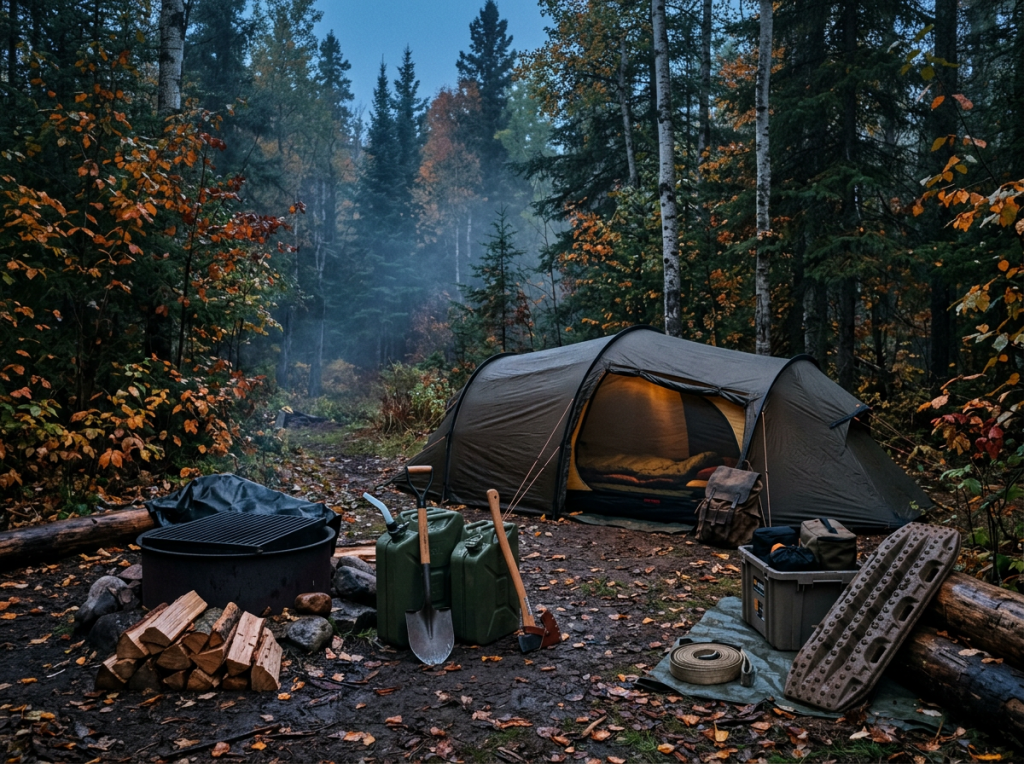
There is a specific kind of overconfidence that belongs to the shoulder of the season. In July, camping is a chore of heat. In October, it feels like a discount — the crowds thin out, the bugs disappear, the nights are merely brisk, and the same gear that got you through August should be more than enough. That feeling is the entire problem. Fall camping is not summer camping with a jacket thrown over the top. It is a different season with a different set of failure modes, and the switch is fast enough, sudden enough, and quiet enough that people walk into it without noticing it happened.
The failures share a shape. Almost none of them are exotic. They are the result of making a decision about comfort in the middle of the day and then living with it at three in the morning, or of treating the two hours in a truck on a forest road as the part of the trip where nothing can go wrong. Both of those assumptions fail in fall specifically, because fall punishes exactly the kind of optimistic thinking that gets away with it in June.
Here are the ten mistakes that recur, roughly in order of how often they end badly.
1. Mistaking a Mild Afternoon for a Mild Night
The single most consequential error in fall camping is a temperature error, and the most common version of it is reading the wrong number off the forecast. People check the high, because the high is the number that decides whether the hike is pleasant, and then pack insulation for the high. But the high is not the number that matters. The overnight low is, and the overnight low in the backcountry in autumn is routinely thirty or forty degrees below the afternoon high.
The mechanism is worth understanding, because it tells you when the gap will be worst. On a sunny afternoon, the sun is putting energy into everything — your clothes, the ground, the rocks. After sunset that energy stops, and the ground, having absorbed a day’s worth of heat all day, becomes a large radiator dumping heat bac
2. Packing for the Day Instead of the Night
This is the same failure as above, seen from the gear side, and it is worth separating out because it is where the money is spent wrong. The instinct is to bring the jacket you use in November at home. That is not the same as bringing the system you need on a mountain at 8,000 feet in late September, because the insulating layers in your closet are rated for a very different problem. The variables that actually decide your warmth at 3 a.m. are the overnight low, the dew point, the wind, and the surface you’re lying on. Rain, altitude, and a wet pad will each independently undo you.
A few things get missed consistently. Insulation compresses. A down bag stuffed into the bottom of a pack for a week has lost a meaningful amount of its loft by the time you need it, and loft is what the insulation actually is. Sleeping on a compressed bag is like sleeping on a thin mattress, regardless of what the label says. If you can carry the bag loosely, do. If you have to compress it, compress it in the morning and let it loft back up while you hike.
Wet insulation is not insulation. This is the old line about cotton, and it is still true, but people hear it as a rule about their base layer and miss the larger point. Cotton is dangerous not because of a chemical property but because it absorbs water, holds it against your body, dries slowly, and produces nothing once it is wet. A wet sleeping bag under a wet shell is a bag full of cold. The practical version of the rule is that everything you plan to sleep in should be something you can get dry again by morning, and ideally something that you never get wet in the first place.
The pad is not a detail. A sleeping pad rated for mild conditions is a pad that is inadequate for the ground in October. The ground is a much larger heat sink than the air, and a lot of fall campers discover this by lying on cold, wet ground and slowly losing the ability to make their hands work. If you are bringing one pad, bring the one you would want in November.
Sleeping clothes are not wearing clothes. Many people wear a fleece to bed because it is warm, and then discover that it is damp by 2 a.m. and that the sweat they generated is now the thing cooling them. Dry, loose-fitting layers inside the bag are warmer than what you wore to the trailhead. This is counter-intuitive enough that it gets abandoned every year in favor of the comfortable choice, and it is one of the cheapest improvements available to you.
3. Picking the Campsite From the Map Instead of the Ground
The site is the decision with the largest gap between a bad choice and a fatal one, and it is usually made in the first five minutes of arriving, by tired people, in failing light. A good campsite is not visible on a topo. It is found by walking around.
The specific things to look for are mostly about water and gravity, because water is where the problems are. Avoid drainages and hollows. Water that falls as rain or snowmelt in the upper watershed ends up in the low ground, and a tent pitched in a shallow gully is a tent pitched in the path of everything running downhill from where you are. In fall, with dead vegetation providing almost no absorption and frozen-thaw soils plugging whatever infiltration exists, a dry-looking gully in the afternoon can be a running creek by midnight. This is the mistake that produces the memorable stories, and it is entirely avoidable by walking uphill ten minutes or by pitching above the obvious bench.
Avoid dead limbs. Fall brings down limbs that failed months ago and were held up by snowpack or by other limbs. The deadfall hazard is not new to fall, but fall increases the load, and a limb big enough to crush a tent usually announces itself first by being in a position where it is clearly going somewhere. Look up, and specifically look at what is directly above where the tent will be.
Pitch on flat or slightly sloped ground, and dig drainage. After a rain, water finds the lowest point. If you have pitched in a slight bowl, that bowl is now a bathtub. Cutting a shallow trench around the perimeter — a few inches deep, a few feet from the tent wall, sloping downhill — keeps water from running under the floor and is one of the most useful two minutes you will spend all weekend. This matters far more in fall than in summer because fall rain is more likely to be heavy and less likely to be absorbed.
Do not pitch right next to the trail, and do not pitch so remote that nobody knows where you are. The site that feels most convenient is the one where you can hear people walk by at 6 a.m., which is not a feature. But the site far enough away that nobody would hear you call is its own failure mode, and in a season with low visitor numbers, the people who would come looking are also not there.
Check what is uphill and above. Loose rock, deadwood, and avalanche terrain all travel downhill. And if the ground looks like it drains toward where you pitched, believe it and move.
4. Treating the Drive In as Free
The road is the most dangerous part of most camping trips, and it is the part that gets the least planning because it feels like transportation rather than wilderness. Every year the reports of serious wilderness accidents are dominated by vehicles rather than by anything that happened in the woods. Fall makes this worse in a specific way: rain falling on leaf litter and on frozen-thawed ground turns forest roads into mud, washouts, and impassable ruts, and a road that was fine in August is not a road in the same condition in October.
Ice forms on bridges first. Bridge decks lose the warmth of the surrounding land and freeze before the approach does, and this holds regardless of the air temperature or the weather forecast. Black ice on a shaded bridge in the early morning is a genuine and completely avoidable accident.
Forest roads are worse than they look on a map. A grade that reads as “gentle” on paper can be a 20 percent grade with a washout at the bottom. A road that crosses a creek may be under water. A road that runs along a hillside may be sliding, and the failure mode is a truck in a place it cannot turn around. The decision to turn around is much cheaper at the top of a bad section than at the bottom.
A few things belong in the vehicle regardless of how short the drive. Extra fuel, more than you think, because a tank at a quarter and a forest road with no cell coverage is a planning failure you cannot recover from. A shovel, traction boards or a bag of sand, a tow strap, and a length of rope. Water and a blanket in case the drive takes three times as long as expected, which it will, on a road you have never seen. A paper map, because a phone with a dead battery is a paper map you did not bring.
Tell somebody. Route, camps, vehicle description, license plate, arrival time, and a check-in time that you will make whether or not anything is wrong. This costs nothing and it is the single highest-value thing on the list.
Do not drive tired, and do not drive the trailhead at night for the first time. A road you have never driven, in the dark, on an unknown surface, with tired people in the vehicle, is one of the highest-risk combinations available. If you arrive after dark, find a place to sleep and drive in the morning.
5. Getting the Fire Wrong in Both Directions
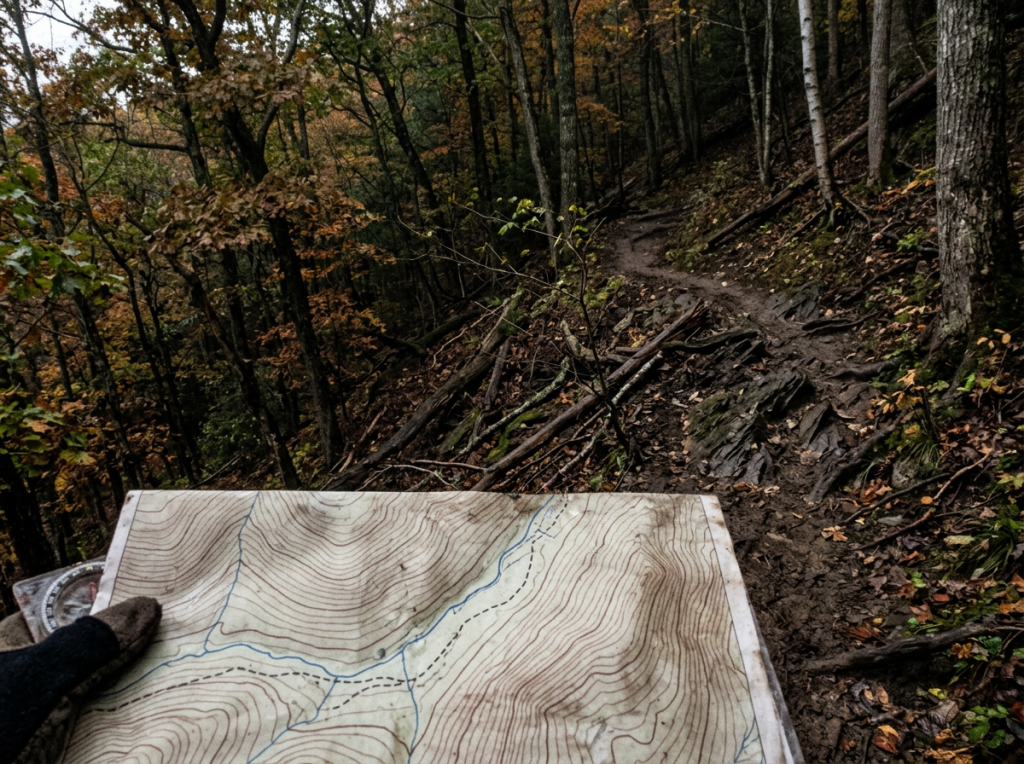
Fall camping produces two opposite fire errors, and the same campers are usually vulnerable to both at different points in the same weekend. Understanding which one is likely to befall you is most of the solution.
The first is the fire that will not burn. You are carrying deadwood, because deadwood is what you have, and it has been sitting on the forest floor in a wet season and it is saturated. Now it is 8 p.m., the temperature is falling, the fire is the only heat source you have, and the wood will not take. The conventional fix — finding a deadfall and breaking it into pencil-thin splinters — takes twenty minutes, produces a small flame, and produces almost no heat, because the heat of a fire is a function of how much fuel you are actually burning. The people who have a warm tent in October are the people who brought a stove, and they treat the fire as a function of the fire rather than as the reason they came. A canister stove and a pot will put hot food and hot water in your hands in four minutes, on any night, in any weather, without a single tree coming out of the ecosystem.
The second is the fire that is too successful. This is the dangerous one, and it is the one that ends seasons. Leaf litter and forest duff — the dry layer of needles, twigs, and decomposed plant material under everything — burn below the surface. A campfire built in organic soil, or a fire ring scraped down to bare dirt, is a fire with a hidden fuel bed that can smolder for feet in every direction, underground, for a surprisingly long time, and it does not look like fire from where you are standing. Never dig a fire ring in organic ground. Carry a stove. If you must have a fire, use an existing fire ring in bare mineral soil, keep it small, keep it inside the ring, and stay with it. The rule in a lot of dry country is the simplest one: build no fire at all.
Check the restrictions before you leave, not at the fire ring. Fire restrictions in the fall shoulder are commonly staged, and the stages change with conditions you cannot see from the valley — a stage two restriction closes the door on exactly the kind of informal, gathered, off-trail fire that people build when they are cold and out of wood. In much of the West, a fall camping trip in September or October happens inside the fire season, not after it. There is no more expensive way to spend a decade of good behavior than to be the person who closes it.
Carry water to the fire. Not for the fire — for the fire that you did not mean to have. And leave nothing that can carry a spark: clear the duff around the ring, and scatter the ashes and the charred remains if the fire was in mineral soil.
6. Assuming the Water Is Fine
Water is the most reliably underestimated risk in the backcountry, and fall does not improve it. Peak pathogen levels in streams are strongly associated with low flows, and low water is the defining condition of a fall trip. Add livestock, beaver activity, and a concentration of human waste at campsites to a stream that is barely moving, and you have the worst combination the year has to offer.
The rule that should replace the rule people actually use is simple: treat all surface water unless you have a reason not to. People treat water that is running fast, water that is coming out of a spring, and water upstream of where they are camping, and they leave untreated the water in the shallow slow reach immediately downstream of the meadow where the previous group was. Every untreated surface water source in the backcountry should be treated, and “it looked clean” is not a category.
Know what your filter does. Most filters remove bacteria and protozoa to different degrees, and the common hollow-fiber models that remove bacteria well are at their limit on protozoa like giardia, which requires a finer pore size. If the label says 0.1 micron absolute, it is designed for protozoa. If it says 0.2 micron and does not say absolute, be more careful. Chemical tablets are a reasonable backup but not a first choice, and they do nothing about some organisms in water that has been sitting in a campsite.
Carry enough. The mistake of treating only when you are thirsty, at the end of a long day, is a setup for treating half a bottle properly and skipping the rest. Treat as you collect. And remember that filters fail — a punctured membrane or a cracked housing leaks clear water, and the symptom is that everyone gets a stomach bug on the same night. Bring a backup method, and treat clear-looking water the same as any other.
7. Forgetting That the Bugs Are Still Bad
The tick. That is the one that matters, and fall is not the end of tick season — for many regions it is the middle of it. Nymph ticks are the size of a pinhead and are frequently missed, and they are the stage most likely to transmit Lyme disease, Rocky Mountain spotted fever, anaplasmosis, and alpha-gal syndrome. They wait on low brush, in leaf litter, and at the height of your lower leg, and they attach without feeling it and feed for a day or more before anyone notices.
A few practices reduce this considerably. Treat your clothing, not your skin. Permethrin, applied to pants, socks, gaiters, and shirt, allowed to dry, and worn over a base layer, kills ticks on contact. It does nothing on skin, it should not be applied to the face or hands, and it does not degrade as fast as DEET. Treating clothes means the protection is where the ticks are.
Check yourself and each other, every day. The areas that matter are the seams, the waistband, the groin, behind the knees, the armpits, and the hairline. Checking each other takes two minutes and finds things you cannot find on yourself. Do it in the evening, not in the morning.
Remove them properly. Fine-tipped tweezers, grasp the tick as close to the skin as you can, pull upward with steady even pressure, and do not twist or squeeze — squeezing can force gut contents into the bite. Do not use petroleum jelly, burn it with a match, or coat it in anything. The old remedies that suffocate the tick are the ones that also rupture it, which is the opposite of the goal. Wash the area afterward and dispose of the tick; a photograph of it is useful if symptoms develop.
Wash and dry the clothes hot on returning, and dry gear in a dryer rather than on a line, since heat is what kills what is left.
There are other insects, and they are less dangerous but more annoying. Mosquitoes persist in drainages and standing water until a hard frost, which in much of the country means they persist for the whole trip. Wasps and hornets take over rotting wood and old stumps, so leave the woodpile alone, and give any stump you are about to step over a wide berth and a look. Deer flies and horse flies are worst in September, are persistent, and are attracted to movement and to dark clothing.
8. Misreading Wildlife — and the Other People in the Woods
Fall is when bears are most likely to cause problems, because bears are not in hibernation in fall. They are in a hyperphagic feeding phase, burning through reserves before winter, and their tolerance of human food is at its seasonal peak. A large share of bear incidents that get someone hurt involve food that was stored where a bear could reach it. If you take one rule from this essay, make it that nothing edible goes in the tent, and that all food, trash, toiletries, and anything with a scent goes in a proper storage system.
On hanging versus canisters: traditional hanging guidance is ten feet high and six feet from the trunk, and it works reasonably well in some forest types and poorly in others, particularly where the food is in a hard-sided cooler or a pack with a strong scent that a bear can reach from the ground. Bears in bear country increasingly climb. A bear canister is more reliable in practice, and if you are going to rely on hanging, use bags designed for it, not a t-shirt on a rope.
On bear spray and firearms. This is the point most worth making clearly, because a great many people get it wrong. Bear spray is substantially more reliable than shooting a bear, and this is not a close call in the practical sense. A bear moving at speed in poor light is a very difficult target, and the most likely outcome of a bear encounter that turns into a gunfight is a wounded bear rather than a stopped one, which is a worse situation than the one you started with. If you carry a firearm in bear country, carry it for what it is good for, and carry spray separately, in a holster on your belt where you can get it out, not buried in the bottom of a pack. Buy an inert training canister and practice drawing and deploying it with a partner.
Distances and behavior. Give bears about a hundred yards, deer and elk twenty-five to fifty. Make noise on blind corners, oncoming trail sections, and near camps where wind or water masks your approach. If a bear is standing and has not noticed you, back away slowly and quietly. If it has noticed you and is standing, talk to it in a calm voice, keep your face toward it, and back away — do not run, and do not climb a tree, which helps with a black bear and is essentially useless against a grizzly. Spray is deployed at charging distance, which for most bears is somewhere around twenty-five to thirty feet. The bear spray guidance in this section is general, and the local guidance for the specific species where you are is better than the general version.
Then there is the season you are most likely to forget: hunting season. In much of the country, fall is open season on deer, elk, and bear, with hunters working the same public land you are camping on. The practical advice is unromantic: in an area with an active hunt, wear blaze orange, and a vest plus a cap is better than a vest alone. Check the state’s rules, because some require it. Do not shout at people whose back is turned, do not assume a person is lost before you consider that they are a hunter, and be aware that some hunts involve dogs.
And the quieter risk of a low-season trip: fewer people on the trail means fewer people who would notice you did not come back, and fewer ranger patrols. The solitude that makes October appealing is the same thing that makes an emergency take longer to become somebody else’s problem.
9. Losing the Light, and Losing the Group
Daylight is a schedule, and in the shoulder of the season it is shrinking on an obvious curve — roughly ninety minutes less than midsummer by the time the season turns, and a shorter day makes every other mistake worse. Everything above gets harder when you are doing it in failing light, and the most common and most preventable version of this is planning the turnaround against sunset instead of against your own headlamp.
Turn around early enough to be back at camp with an hour of light in hand, and set the time before you leave rather than deciding when you feel like turning around. In the backcountry, decision quality degrades in the dark, and a group that is lost does not become un-lost because they kept walking.
Batteries are the failure point. Lithium cells lose a meaningful fraction of their capacity in the cold, and they lose it faster as they drain, so a headlamp that was adequate in September is inadequate in November at the same battery level. Carry a second light — a cheap one is fine, and a single AAA in a pocket weighs nothing. Do not leave the batteries for the morning.
Know the route only in daylight. A descent you would do comfortably at noon is a different proposition at 6 p.m. with a headlamp, and a lot of people discover this in a place where the mistake has consequences. If you are going to be out past dusk, plan the descent for the light you will have.
Dusk is when the wildlife moves, and it is when visibility, contrast, and depth perception are at their worst, which is a bad combination for reading terrain. It is also when a stumble becomes an ankle injury, and an ankle injury in the backcountry is a logistics problem before it is a medical one.
On losing the group specifically: agree before the trip on what happens if someone is not moving at the group’s pace, and on the rule that nobody continues alone out of earshot without saying so. The failure is rarely a fight or a deliberate separation — it is a courteous person slowing down to take a photo, or a kid needing a minute, and a group that reorganizes around the fastest member without a plan. A headcount at every junction is not neurotic.
10. Having No Plan for the Cold That Actually Arrives
The last mistake is the one that converts every other mistake from a bad night into an emergency, and it is the failure of a contingency rather than a skill. The equipment in your main pack assumes the trip goes roughly as planned. It is worth having a small amount of equipment that assumes it does not.
A shelter you can get into in the dark, in the rain, in a hurry. A cheap one-person bivy or a tarp is enough. It does not need to be comfortable, and it will never be used.
Insulation that is not in the bottom of your pack. A pack-compression sack is a real answer to this, but a bag that has been compressed for a week is compromised at exactly the moment you need it, and the moment you need it is not a moment for assembly. If you carry an emergency bag, carry it uncompressed, in a dry bag, and check that it actually fits over you.
A way to be found. A satellite messenger is the current answer and is worth the money for anyone camping alone in cell-less terrain. A personal locator beacon is better still because it does not depend on a paired phone staying alive. At a minimum: a phone in a waterproof case on a lanyard, not in a pack, a known check-in time with a person who will act on a missed check-in, and a stated plan for what that person does.
A way to keep the group together and the core temperature up. Recognize that the people most at risk of a serious cold injury are children, who have a higher surface-area-to-mass ratio, shiver less effectively, and often go quiet rather than complaining. Cold hands and a cold face in a child are the early signs, and the child who is not complaining is not a child who is fine.
Hypothermia is also largely a continuum rather than a cliff. The shivers that people know are the body working correctly, and the point at which shivering stops is the point at which the body has lost the ability to produce heat on its own. By the time someone is confused, stumbling, or unusually quiet, they are in trouble. The intervention for a shivering person is straightforward and almost always available in your pack: get them out of the wind, out of the wet, into dry layers, give them something to eat, and warm them gradually. The intervention for someone who has stopped shivering is an emergency, and it is the reason the contingency gear exists.
The Ten Mistakes at a Glance
| Mistake | The assumption behind it | The fix |
|---|---|---|
| Mistaking a mild afternoon for a mild night | The daytime high predicts the overnight low | Plan from the overnight low and the dew point |
| Packing for the day instead of the night | The insulation in your closet is the insulation you need | Rate layers for the low, keep insulation uncompressed, sleep in dry layers |
| Siting from the map instead of the ground | A flat-looking spot is a safe spot | Walk it first; avoid drainages and dead limbs; dig drainage |
| Treating the drive in as free | The road is transportation, not wilderness | Tell someone your route; carry fuel, a shovel, traction, water, a blanket |
| Getting the fire wrong | Fire is the heat source | Carry a stove; never dig in duff; check staged restrictions first |
| Assuming the water is fine | It looked clear | Treat all surface water; know your filter’s pore rating; carry a backup |
| Forgetting the bugs are still bad | Fall means the end of tick season | Permethrin on clothing; check each other daily; remove ticks with steady pressure |
| Misreading wildlife and other people | Bears are asleep and nobody else is armed | Store food in a canister; spray in a holster, not a pack; wear blaze orange in hunt season |
| Losing the light and the group | You know the route | Turn around against your headlamp; carry a second light; set the group rule before the trip |
| No plan for the cold that arrives | The trip will go roughly as planned | A bivy, an uncompressed bag, a satellite messenger, and a check-in time |
The Common Thread
Every one of these is a decision made in the middle of a comfortable afternoon, and every one of them is paid for at three in the morning. That is the real lesson of fall camping, and it is a lesson about timing rather than about gear. Almost nothing that goes wrong in the backcountry in fall is caused by the absence of equipment. It is caused by a plan that was reasonable when it was made and stopped being reasonable three hours later, in the dark, in wind, with tired people.
The habits that prevent it are unglamorous. Check the overnight low, not the high. Walk the site before you pitch it. Tell somebody where you are going. Carry a stove. Store your food properly. Turn around earlier than you think you need to. And when the group is cold, believe the quiet one.
The people who have a good fall are not better equipped than the people who have a bad one. They are just further along in noticing that the season changed.




Leave a Reply