The Argument in Brief
This is a summary essay of the full article “Harvesting Fresh Protein on Extended Overlanding Trips” available in the ‘Articles section‘ of this site.
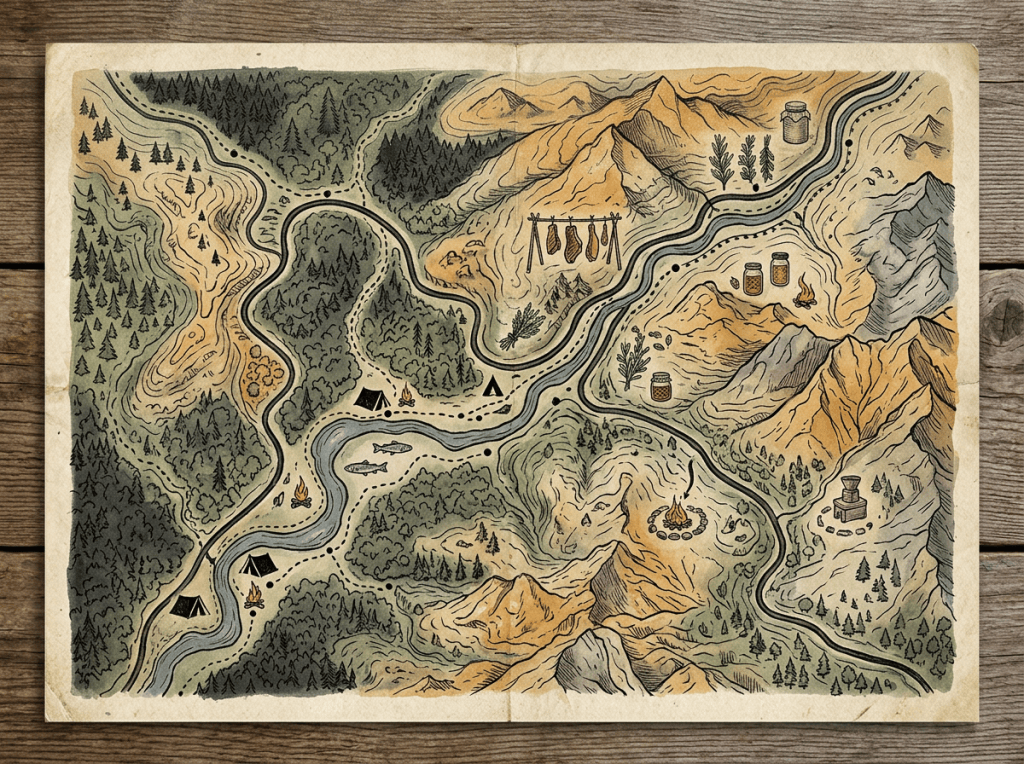
For anyone undertaking extended overland travel, the ability to harvest food along the route — by fishing, hunting, foraging, or trade — is not an exotic hobby but a core travel skill, comparable in importance to navigation, driving, or vehicle recovery. It is a practice that lightens the vehicle, improves morale, cuts costs, builds resilience, and, most fundamentally, changes the traveler’s relationship to the country being crossed. The essay then builds a practical, ethical, and philosophical case: harvesting is a discipline with its own toolkit, its own craft, its own law, and its own code, and mastering it is what turns a trip that is endured into a trip that is lived.
Why Packed Food Fails on a Long Trip
On trips under a week, provisioning is simple arithmetic — count calories, pack them, eat them. Beyond that, the arithmetic stops being linear. A three-week trip for two people requires on the order of sixty thousand calories, arriving as physical mass of roughly a pound of packaged food per person per day, and far more when it comes in cans and frozen blocks that carry their own water. Thirty days of eating becomes forty, sixty, even a hundred pounds of provisions, and every pound competes with fuel, water, tools, and recovery gear for a payload budget no overland vehicle has in surplus. Excess weight degrades everything downstream: fuel economy, suspension, sand crossings, winching, and tipping stability. Food, the essay notes, is the quietest thief of payload because it is consumed silently.
The companion problem is ice. A quality cooler is a marvel of passive engineering but a perishable system: block ice melts, cold leaks out with every lid lift, and the arithmetic of spoilage is brutal. Keeping a cooler below 40°F for a week in summer is doing well; two weeks is a miracle. More importantly, ice is resupply, which means the cooler silently imposes a route — the traveler plans detours around towns that sell block ice, paying fuel and hours for a chore that a single day of successful angling could replace outright. This is the deeper insight of on-road harvesting: it does not merely add food; it subtracts the heaviest, most fragile items from the load. Meat that would travel eight hundred kilometers in a cooler instead travels the final fifty meters from stream bank to campfire.
The Monotony Tax and the Psychological Case
The second cost of packaged provisions never shows up on the scales. Humans are not built to eat the same fourteen meals in rotation for a month, and the body’s response is a quiet, cumulative erosion of appetite the essay calls the monotony tax. Canned stew is hearty in week one, edible in week two, and a chore dressed in tin by week three. Freeze-dried rations are engineered for nutrition and shelf life, not delight — which is why “emergency rations” is such an honest phrase. Overlanders report the same phenomenon again and again: trips do not end because of terrain or breakdowns, but because of the slow wearing-down of the dinner table.
Harvesting interrupts this decline at its root because wild protein is not a repeated flavor but a repeated surprise. Fish differ by watershed and by week; game differs by species and by how the animal lived. The fresh kill is the one food on the trip guaranteed to be at peak quality, alive that afternoon, never frozen, pasteurized, or shipped. Nutritionally, wild fish carry omega-3s that farmed versions dilute, and free-range game is lean by the logic that an animal’s diet and movement are written into its tissue. And the memory of eating something taken yourself from a place you traveled to is qualitatively different from the memory of opening a can — and on a trip that is a collection of days, meal memories are among the days that survive.
The Economics and the Insurance Value
The cost argument is straightforward. Grass-fed, free-range protein of the kind wild game approximates sells well above commodity prices, and processed backpacking protein sits at the premium end of the grocery aisle. Against those benchmarks, a deer handled properly yields forty to sixty pounds of usable meat, and the license, ammo, and tags typically cost less than the market equivalent of a single ham. The real cost is time — hours of glassing, hiking, waiting — and time is exactly what an overlander possesses in surplus. Fishing makes the point with even less overhead: a modest license and an afternoon yield a meal at restaurant prices. Foraging extends the deal to non-animal protein, and village trade costs a negotiation rather than a supply chain.
What the arithmetic leaves out is the insurance value. Extended travel runs on assumptions, and assumptions fail: the resupply town has a single shelf of instant noodles, the fuel stop is closed, the route is washed out and the detour adds four days of empty country. The traveler whose plan depends entirely on external provisioning is one failure away from rationing; the traveler who carries skill instead of only supplies carries a backup pantry that exists everywhere there is water, brush, or a market. Harvesting, then, is not an alternative to packing food but a redundancy layer beneath it.
Eating the Landscape
There is a dimension logistics cannot exhaust: harvested food is place itself, eaten. A trout from a particular bend of a particular river carries the watershed into dinner; venison from a basin you spent a morning glassing tastes of that basin. The habit turns a route on a map into a sequence of meals with address and date attached. Travelers who harvest report the landscape comes into focus differently — rivers read for deep pools and seams, forest edges read for browse and movement, the whole country becoming legible in a layer the windshield never reveals. The meal becomes the proof of having really been somewhere. This is also why harvested meals are memory anchors: the days blur on an extended trip, but the river bend where you landed three fish in twenty minutes does not. A thirty-day trip becomes, in retrospect, a chain of meals as much as a chain of kilometers.
Nobody should plan a trip around hunting or structure a route around a draw tag. The value of harvesting is its opportunism: a trip long enough to be called extended will offer chances a rigid food plan wastes. The harvestable traveler is not the obsessive one but the ready one — equipped, legal, and flexible enough to say yes when the country offers dinner. Readiness has a specific shape: buying licenses before crossing borders, keeping the fishing kit within arm’s reach, keeping the cooler disciplined and leaving space reserved, and adopting the mental posture of the opportunist — the day’s end reserved for the standing question, “What does this country want to feed us?” Under that posture, harvesting becomes what the essay claims: a travel skill that extends range, cuts costs, keeps morale, and turns the road itself into a pantry.
The Legal and Ethical Foundation
No mistake is more expensive than assuming the rules at home travel with you. Overlanding is the crossing of jurisdictions, and game law is the least forgiving of boundaries. State lines divide one country into separate legal universes — a rifle ordinary in one state prohibited in the next, a species fair game on one side of a river fully protected on the other. The harvestable traveler therefore treats law as the first map: checking seasons and bag limits against the route calendar, purchasing licenses in advance in the right jurisdictions, understanding draw tags, over-the-counter tags, and harvest reporting, and carrying the paperwork that proves what the gear is. Three subtleties are singled out as trip-enders: tribal land, where state and national rules do not apply and the right to hunt belongs to the sovereign nation; national parks and similar protected classes, where the boundary is a wall for the rifle; and boundary waters, where a river forming a state line may be governed by different rules on its two banks.
The second layer is land status. Public land is the most permissive ground a hunter can ask for, but “public” is not a permission slip — restrictions multiply at every scale: draw-only units, archery-only units, seasonal closures, gated access roads. Private land is the other country, governed by an absolute and ancient rule: no permission, no access. The legitimate paths are all forms of negotiation, and the old currencies survive — a share of the kill, an afternoon’s help with a chore, gates left as found. What converts a closed gate into an open one is everything that preceded the request: the greeting, the explanation, the clear statement of what would be taken and left behind, and the willingness to accept a no.
No map substitutes for the oldest instrument: the conversation. A fuel station attendant knows where the deer are yarded this year, whose pasture is overrun with hogs and would be grateful for a hunter. The skill is in the asking — specific, open questions like “if you had one evening here, where would you fish?” — and in starting with what you can offer rather than what you need. Answers deserve repayment in kind: a report of what the country yielded, a photo sent to the landowner who gambled on a stranger. This habit collects a network of invisible allies worth more than any access tool.
Legality and ethics are the same discipline. The law encodes the community’s minimum standard; ethics extends it to what the law cannot reach. Clean shots, prompt dispatch, and limited take are ethical and simultaneously the legal logic of fair chase and bag limits. On an extended trip this acquires a sharper edge: a kill that spoils in a warm truck bed is worse than no kill at all — waste is the cardinal sin of the tradition. The traveler must therefore audit honestly before shooting whether the animal can be cooled, processed, preserved, and eaten within the trip’s capacity — and execute that plan with urgency afterward.
Finally, there is the ambassador effect: reputation is a shared resource. One sloppy, wasteful encounter poisons a valley for every traveler who comes after, for years; the overlander who dresses a kill cleanly, leaves camp immaculate, pays for permission, and treats locals with courtesy becomes living evidence that travelers can be trusted. Every harvest is thus a small public event conducted on behalf of everyone who will follow.
The Harvest Toolkit
The equipment question is not “what does a hunter carry?” but “what does this trip’s budget of weight, volume, and attention permit?” The discipline of the extended trip is the discipline of subtraction: each tool must be genuinely multi-purpose, durable, and likely to be used more than once. A kit small enough to fit in one cargo box is not a compromise but the point — a kit within arm’s reach gets used; one buried under the load is no kit at all.
For those who can carry a firearm, the central decision is a single long gun slot. The .308 Winchester and 6.5 Creedmoor are the default traveling calibers because they split the difference between elk-sized power and shootable mildness, backed by ammunition available on any rural shelf. The pump or semiauto shotgun is the true all-rounder — shot for birds and rabbits, slugs for large game, and in some regions the most legally permissive option. Many veterans carry one rifle and one compact shotgun, each occupying a different niche. Whatever the choice, the firearm must earn its keep before departure: zeroed at the exact scope, ammunition, and temperature of the route; carried with documentation; and treated as the one tool whose failure mode is consequence, not inconvenience.
For the many routes where civilian firearms are impractical or illegal, there is an entire parallel school. Modern PCP air rifles generate energies comparable to .22 rimfire, are classified in many places as sporting equipment rather than firearms, and cover small game honestly. Bows and crossbows are quieter, legal where firearms are banned, and demand deeper practice. None of these replaces the rifle; they replace the trip — a traveler who cannot carry a rifle but can carry an airgun is a traveler who can still say yes to a rabbit thicket, and on a long route the yeses are the harvest.
The single most dependable instrument is not a weapon at all: the fishing rod. Fishing is legal on more waters in more countries, cheaper to license, longer in season, and the gear fits in a side pocket. A collapsible rod, compact reel, and a terminal tackle box the size of a coat pocket cover alpine lakes, prairie rivers, estuaries, and village ponds. Fishing is skill-forgiving where hunting is not: an hour of honest effort can produce dinner, where a day with a rifle can produce nothing despite perfect conduct. And where legal, setlines and trotlines deliver more protein per hour of attention than any other method, working overnight while the traveler sleeps.
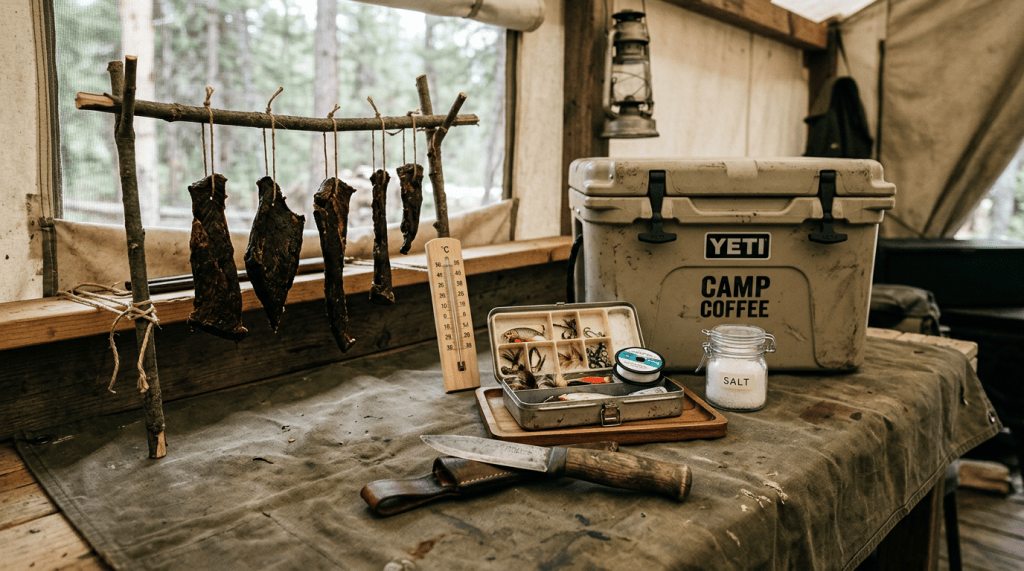
The processing kit is genuinely modest: one good fixed-blade knife, a bone saw, cotton game bags, a meat thermometer, butcher’s paper, and optional gloves, headlamp, and cord locks — less space than a single boot. The classic failure is not missing pieces but missing practice: tool-heavy, skill-light. The fix costs an afternoon — rehearse on store-bought birds and fish before needing it under field conditions. The harvest toolkit is a set of skills with hardware attached, and the one tool no supplier sells is competence.
Field Craft: From Kill to Meal

Everything downstream — taste, keeping quality, whether the meat reaches the table at all — is settled in the first hour after the kill. Shot placement is the opening move: a clean heart-lung shot drops the animal quickly and leaves the meat untroubled by the chemistry of fear, since an animal that dies in stress floods its muscles with adrenaline, changing the meat for the worse. The craft extends to the approach: reload or chamber-check, watch for final breaths, confirm the kill, then close distance — safety first, and the beginning of the meat’s treatment. On a hot September afternoon the clock is measured in minutes.
The most underappreciated fact is that the freshly killed animal is the primary threat to its own meat. A deer-sized animal’s core is near a hundred degrees Fahrenheit — a perfect incubation chamber — so field dressing must happen immediately, venting trapped heat and removing the largest mass of warm, bacteria-rich material. The operative rule deserves its reputation: keep meat below 40°F, and never allow it to dwell in the danger zone between 40°F and 140°F for more than four cumulative hours — cumulative meaning time in the zone does not reset with cooling.
Cooling without a refrigerator is a skill in physics. Hanging a carcass in shade uses moving air as a natural refrigerator; cool earth and shade beat a sun-scorched truck bed; ice applied early to the body cavity accelerates the cooling curve. The destination of cooling effort is quartering, the standard treatment for anything bigger than a goat: dividing the carcass into four load-bearing pieces multiplies surface area, cooling four exposed surfaces far faster than one enclosed carcass, and each quarter is a discrete, carryable, baggable load. The whole carcass is a burrito — dense, insulated, slow to cool at the core — while quartered, bagged meat has already won the battle most spoilage is lost. From the first cut, everything becomes a campaign against a single number — sustained heat — decided by physics rather than recipes: block ice over cubes, the cooler shaded and rarely opened, meat wrapped against frost damage, and every downstream decision read as a temperature decision.
Preservation Without a Fridge
The refrigerator is the one appliance overlanding cannot supply, and its absence reorganizes the entire question of how a harvest becomes meals. The mature answer is a spectrum of four dependable methods, because a single large animal is really a portfolio of products: steaks for this week, jerky for this month, smoked shoulders for the cool stretch, cured pieces for the uncertain one.
Ice management is the baseline, and the baseline is physics. Block ice outlasts cubes because it melts from the outside in; every lid lift is a heat exchange; a pre-chilled box stays cold. Dry ice extends the envelope to ten days or more of freezing temperatures, converting the cooler into a genuine cold chain — but it must never be touched bare-handed, sealed airtight, or ridden in the cab, and it is used as a zoning tool rather than a blanket: this week’s meals on top in ordinary cold, the banked product below in deep freeze.
Drying is the workhorse: jerky keeps for months, weighs a fraction of its fresh weight, and demands nothing from the road — no ice, no electricity, no schedule. It is the original energy bar, food freed from time, and it operates by removing water activity. Smoking does two jobs at once — flavor and preservation — because the phenols and acids in smoke are antimicrobial and the surface drying creates a protective rind; this is why smoked meats predate refrigeration by millennia. The road-scale version is modest: a folding smoker or a drum over a campfire fed with the region’s own wood, which makes the smoke itself an act of place. Curing and salting work by osmosis, lowering water activity until bacteria cannot thrive; the dry cure and the wet brine both transform the meat chemically. The honest limits deserve respect: curing is a chemical process with a narrow range of variables, commercial curing salts exist to prevent the botulism that lurks in improperly cured meat, and the road is no place to improvise with botulism. Fermentation is real but too sensitive to temperature and time for the truck bed; a simple salt cure is the right ambition.
The organizing insight is that the cooler is not the destination of the meat but a staging area, a short-term holding pattern where the harvest waits its assignment. With the four methods working as a pipeline, one animal routinely becomes two weeks of varied meals: fresh steaks at the start, smoked and cured richness in the middle, jerky riding to the end. The refrigerator’s absence becomes an invitation to practice an older and richer form of the craft.
Meat Hygiene and Safety
The dangers of wild protein are real, knowable, and almost entirely controllable by procedure rather than luck. Two sentences govern almost all of it: temperature and time are the masters of every pathogen, and a thermometer is the instrument of their control.
The standard suite — Salmonella, E. coli, Campylobacter and relatives — arrives in game not through industrial contamination but through the field: digestive tract contents, hide, dirt, and the tools and hands that transfer them, plus the temperature abuse that multiplies them. The pathway is where field craft wins: clean incisions that never puncture stomach or bladder, immediate dressing away from the ground, cleaned hands and tools, prompt cooling. A single bacterium is harmless; a billion are not, and the difference is hours at the wrong temperature.
The exotic extras are manageable once named. Trichinella lives in bear and wild boar muscle, and some Arctic strains survive freezing — so the reliable protection is thorough cooking. Fish-borne tapeworms ride in undercooked freshwater fish; the protection is freezing and heat applied with patience. Tularemia can be picked up from handling infected hares and rodents, even through intact skin — gloves or careful hands are the rule around small game. Chronic wasting disease is a prion disease, not bacterial, and changes the entire nature of the response: prions are not destroyed by cooking, freezing, or any ordinary preservation, so the discipline is prophylactic — no nervous tissue, no obviously sick animals, gloves, careful boning, and testing where available. Brucellosis in Greater Yellowstone elk and bison is the strongest argument for thorough cooking of large game from those herds.
Nearly all of these lose to heat, which is why the thermometer is the single most valuable hygiene instrument on the trip. Ground meat is cooked to 160°F because grinding works surface organisms into the interior; whole cuts to 145°F because their surface is the concern, with resting time carrying residual heat through the risk. Cleanliness is the second half: the truck that carries the harvest is also the kitchen, and the line between them must be drawn in practice — a designated processing corner away from the table, dedicated cutting boards and knives, a wash-down ritual that kills residue before tomorrow’s food. And there is a second layer no kitchen manual covers: wildlife. Meat hanging in camp is an announcement that goes to bears, ravens, coyotes, and every omnivore downwind; processing is a dinner bell for a county. The standard backcountry disciplines — process quickly, cool and pack away promptly, dispose of renderings far from camp, hang food in bear country away from the tent — apply double when a carcass is in the equation. The safe overlander plans the processing site as infrastructure, with meat storage, fire, and sleeping arranged as three different answers, because the bear investigating a meat cache is not misbehaving — it is behaving exactly as its species has for a million years.
Managing Surplus and the Rhythm of the Road
The final test is proportion. Harvesting is a conversation with a country that answers sometimes with plenty and sometimes with silence, and both extremes must be managed with the same hand. Travelers plan for famine instinctively; feast is what undoes people, because surplus feels like a solved problem when it is simply the next problem wearing a better costume. The pressure lands hardest on the harvest ethic itself — “take only what will be eaten” — and the lucky week is its stress test. The answer is that eating has more than one tense: meat eaten tonight is eaten; meat converted to jerky and eaten next month is eaten; meat given to a hospitable family is eaten, by someone, on your behalf.
The practical heart is accounting: measuring what the country gives against what the trip can honestly hold and process. The cooler’s honest capacity, the processing rate of a tired traveler, and the horizon of remaining travel days are the three numbers. Surplus beyond all three is not a harvest but a burden — and the unburdening of it is a skill. What cannot be eaten fresh can be smoked; what cannot be smoked can be dried; what cannot be dried can be cured; what exceeds even the converted store is trade goods. Loss is not waste; it is the trip’s own bank.
Beyond the cooler and smoker is a destination older than either: the open hand. Fresh protein is the oldest currency in rural networks — the gift of excess fish to the family at the campground, the smoked shoulder to the ranch that let you cross its land. These are participation in the local economy of generosity, and they compound into permission, advice, and belonging. Trade requires the same proportion as the harvest itself, and one legal caution rides with every act of generosity: some jurisdictions regulate or prohibit sharing game meat outright, so etiquette is checked against the code, and the code against the route.
The famine side completes the cycle. Every feast sets up a stretch of ordinary eating, and the traveler who manages proportion learns to meet both phases without resentment — feasting fully when the country offers, fasting cheerfully when it does not — because both are the same conversation in different keys. Beneath the logistics lies the real yield, and it is not the meat: harvest makes the day’s geography the author of the day’s meal, turning the cooler into a ledger of the route written in the body’s own language. A can of stew is identical on any river in the world; a trout from a specific bend of the Bighorn exists nowhere else. The protein was the excuse that made the traveler pay attention deeply enough to know the country.
Conclusion: The Fluent Traveler
The entire case resolves into a single image: the traveler arriving in a new country with nothing but skill and asking the place what it can provide. Which source dominates is decided not by preference but by three arbiters no traveler negotiates — region, season, and law. The traveler who arrives expecting one fixed answer has misread the question; the traveler fluent in all five sources understands that the answer is the country itself, and the country changes daily. Fluency is the opposite of brittleness: the capacity to switch instruments without losing composure, to read the country’s offer and answer it with whatever hand the country has dealt. The grammar of the conversation is the same everywhere — read the place, respect the rules, take the clean offer, preserve and share the surplus — only the vocabulary changes, and vocabulary is learnable on the spot from the country itself.
Fluency is also the deepest resilience: the traveler who can only hunt is hostage to the absence of game; the fluent traveler holds all five keys in the same pocket, so no single closed door can stop the flow of food. The packed provisions cease to be the plan and become what they were always meant to be: the reserve, the last line. “Never eats out of a bag” is not a promise of perpetual feasting but a promise of a different relationship to food and travel — the bag-fed traveler consumes a route as logistics problems, while the fluent traveler lives a route as encounters whose meals are the trip’s own biography.
The conclusion is a quiet inversion of normal thinking about provisioning: the harvest was never primarily about the food, and the equipment was never primarily about the tools — the meat and gear were the tuition paid for the real education, which is learning to belong, meal by meal, to the country being crossed. Every discipline in the essay — legal homework, ethical restraint, field craft, preservation, hygiene, proportion — compounds into that fluency. The trip that began as a route on a map ends as a chain of meals, each earned rather than purchased, each the country’s own answer to the question of living there. The traveler who arrives at fluency never eats out of a bag, not because the bag is banned but because it has become unnecessary — and the difference between unnecessary and forbidden is the difference between restriction and freedom. That freedom, to feed and be fed by the places one travels through, is the real destination of every extended trip, and the harvest is simply the road that gets the traveler there.
Harvesting food on the road — via fishing, hunting, foraging, and trade — is a core overlanding skill that solves payload and ice problems, defeats the monotony tax, provides economic and insurance value, and transforms travel into a lived relationship with the land. It builds this case through six integrated disciplines: the legal framework (jurisdiction, land status, local knowledge), ethics as law plus the ambassador effect, a minimal and practice-tested toolkit, field craft governed by the 40°F/140°F rule and immediate cooling, four refrigeration-free preservation methods (ice management, drying, smoking, curing), and two layers of hygiene (pathogen control and wildlife management), all finally governed by the master skill of proportion. The conclusion frames the whole practice as the path to “fluency” — the traveler who reads any land in all five food languages and can never be stopped by a single closed door, for whom the harvest is not about the food at all but about learning to belong to the country being crossed.



Leave a Reply