There is a specific kind of overconfidence that belongs to the shoulder of the season. In July, camping is a chore of heat. In October, it feels like a discount — the crowds thin out, the bugs disappear, the nights are merely brisk, and the same gear that got you through August should be more than enough. That feeling is the entire problem. Fall camping is not summer camping with a jacket thrown over the top. It is a different season with a different set of failure modes, and the switch is fast enough, sudden enough, and quiet enough that people walk into it without noticing it happened.
The failures share a shape. Almost none of them are exotic. They are the result of making a decision about comfort in the middle of the day and then living with it at three in the morning, or of treating the two hours in a truck on a forest road as the part of the trip where nothing can go wrong. Both of those assumptions fail in fall specifically, because fall punishes exactly the kind of optimistic thinking that gets away with it in June.
Here are the ten mistakes that recur, roughly in order of how often they end badly.
1. Mistaking a Mild Afternoon for a Mild Night
The single most consequential error in fall camping is a temperature error, and the most common version of it is reading the wrong number off the forecast. People check the high, because the high is the number that decides whether the hike is pleasant, and then pack insulation for the high. But the high is not the number that matters. The overnight low is, and the overnight low in the backcountry in autumn is routinely thirty or forty degrees below the afternoon high.
The reason this error survives contact with reality for so many seasons is that it is not a careless error. It is a reasonable decision made with incomplete information, and the incompleteness is systematic rather than random. The number you have at your disposal is the wrong number, it is the number you can feel the truth of at the moment you consult it, and it is the number that happens to be relevant to the part of the trip you are currently standing in. Everything about the situation pushes you toward the high and away from the low.
The Forecast Is Not About Your Campsite
Before the numbers can be compared at all, they have to be adjusted for two things, and most people adjust for neither.
The first is elevation. A forecast is published for a specific point, usually a town, an airport, a pass, or a grid cell, and that point has a reference elevation that is very often not yours. Air temperature falls with altitude at a standard rate of roughly 3.5 degrees Fahrenheit per thousand feet. If the forecast point sits at four thousand feet and your campsite sits at eight, the temperature you actually experience is materially different from the number you read, and it is different in a direction you cannot argue with. The mountain version of this mistake is checking the weather at the trailhead, driving four hours up to the basin, and unpacking a system rated for the trailhead.
The second is the shape of the land, and this is the correction that gets skipped entirely. Cold air is denser than warm air, and dense air flows downhill. Overnight it collects in valleys, in drainages, in the bottoms of bowls, and it stacks itself there in a layer that can be several degrees colder than the air above it. Meteorologists call this a temperature inversion, and it inverts the intuition that a spot at higher elevation is colder than a spot at lower elevation. For a camper the practical effect is that the site at the bottom of the bowl, the site that looks sheltered and easy to walk into and sits right next to the trail, is very often the coldest place you will be all weekend — colder than the ridge above you, and sometimes colder than the trailhead where you started, on the same map, on the same night, under the same forecast.
A clear, calm night is exactly the condition under which this pooling is most complete, because wind is what normally mixes the layers and keeps them from separating. The two things that make a beautiful, still, starry night — the absence of wind and the absence of cloud — are the same two things that produce the coldest air at the bottom of your site. There is a version of this trip where you spend a clear, still evening admiring the sky and then get into a tent at the bottom of the drainage that is colder than anywhere else within a mile, and the sky over your head is the reason.
The habit that follows from all this is unglamorous and highly effective. Read the hourly forecast, not the daily icon, because the daily icon is a summary of a period rather than a statement about the hours between sunset and sunrise. Read the low for those specific hours, not the trip average. Look up the actual elevation of your site rather than the elevation of the trailhead. And write the numbers down before you leave, because the forecast you consult at two in the afternoon is not the forecast you will be able to reconstruct at seven in the evening when you are standing in the dark deciding which jacket to put on, and reconstructing it is exactly the step where the optimistic version wins.
Why the Night Collapses Faster Than the Forecast Suggests
The mechanism behind the collapse is worth understanding in a little detail, because it tells you when the gap between the afternoon and the pre-dawn will be widest, and that is not evenly distributed across the year or across the map.
On a sunny afternoon, the sun is putting energy into everything — your clothes, the ground, the rocks, the water in the creek. After sunset that input stops, and the ground, having absorbed a day’s worth of heat all day, becomes a large radiator dumping heat back into the sky. That energy leaves as infrared radiation, and the rate at which it leaves depends on what is above you. Water vapor and carbon dioxide in the air absorb some of that outgoing radiation and send part of it back down. A dry, clear sky has little to send it back, so the surface radiates almost freely into space and the temperature falls fast. Clouds do the opposite: an overcast sky at night intercepts the outgoing radiation and returns a portion of it, which is why the temperature drops more slowly and the night bottoms out higher.
This produces the central irony of fall camping, and it catches people who have done it before. The forecast that sounds beautiful — clear, calm, sunny — is the forecast that produces the coldest night, and the forecast that sounds punishing — overcast, damp, unsettled — is the one that actually holds its temperature. The clouds are a blanket. The blanket was doing more work than you thought, and its absence is the reason the high was not the number that mattered.
The regional variation on this is worth understanding, because it produces two versions of the same mistake that look completely different on a forecast and fail in completely different ways. The arid interior West has the largest diurnal temperature swing in North America, with a gap of thirty or forty degrees between the afternoon high and the pre-dawn low being ordinary in the fall, and the reason is the dryness — there is little water vapor to hold the heat in at night. The result is a night that is genuinely, unambiguously cold, and it is announced honestly by the numbers. The humid East has a much smaller swing for the opposite reason: the water vapor holds the heat, so the temperature curve is shallow and the forecast looks unremarkable. The numbers there do not look dangerous at all.
But the humid version is not the safer one. A high dew point means the air is close to saturation, which means moisture is condensing on your clothing, on the inside of your tent, and on anything cold enough to be below the dew point, whether or not it ever rained. So the arid version fails through cold air and the humid version fails through wet clothing, and the two failures present with completely different symptoms and require completely different responses. The uncomfortable part is that you cannot tell which one you are in by looking at the high, and you cannot tell which one you are in by looking at the overnight low either, because in the humid case the overnight low is unremarkable. The dew point is the only number in the forecast that distinguishes them.
Dew Point Is the Number That Actually Decides
A dew point is simply the temperature at which the air would become saturated, and that makes it a direct readout of how much moisture the air is holding rather than a derived comfort figure. The distance between the air temperature and the dew point is called the spread, and it is the spread that governs condensation: as the spread narrows, the temperature of your skin and your clothing approaches the temperature at which moisture in the air becomes liquid water, and it begins to condense on surfaces.
This is the point at which most people’s understanding of cold weather runs out, and it is worth being blunt about it, because insulation does not degrade gracefully. It is entirely possible to be at 45 degrees with a dew point of 32 and stay warm all night, and entirely possible to be at 52 degrees with a dew point of 50 and be miserable, and the second night is the warmer one. In the first case the temperature of your clothing surface stays above the dew point, so your clothes stay dry, the down in your bag keeps its loft, and the insulation does what it is rated to do. In the second case your skin and the outer surface of your layers are at or below the dew point, so moisture condenses onto you and into your clothing in the absence of any rain at all, and a down bag with moisture in it has lost a large fraction of its insulating ability.
The word for that loss is not “reduced.” A damp layer of insulation conducts heat away substantially better than a dry one, and the relationship is not linear, which is the counter-intuitive part worth remembering: a base layer that is merely damp can cost you more than several degrees of air temperature, and it does so silently, because you will not feel the change in the air. You will feel tired, and irritable, and slow to get warm in the morning, and you will attribute that to the hike.
As rough guideposts rather than hard physics, a dew point in the forties means the air is dry and your clothing will stay dry. A dew point in the fifties means condensation has started on anything cold, and you should expect a damp sleeping bag in the morning and a wet shell somewhere in your pack. A dew point at sixty or above, which is unremarkable in the humid Southeast and the coastal Pacific Northwest in early fall, means that essentially everything is damp and nothing dries overnight, no matter what the temperature does. Temperature can partly solve itself over a few hours of dry, windy conditions. Moisture cannot.
Sleeping is where this gets its own complications, and it is worth thinking about even if you have never had a problem with it. The air inside a closed sleeping bag is the air you are breathing, and the moisture in that exhaled breath has nowhere to go. In a cold bag the interior surfaces sit below the dew point of the air inside, so that moisture condenses on the liner, and if the bag is cold enough it will frost. This is why a dry liner matters, why a vapor barrier is a real technique rather than a luxury, and why it is worth cracking the bag’s mouth vented toward your face on the warm end — a small concession to the physics that saves you a wet bag. It is also the reason to store insulation in a dry bag or a waterproof liner rather than in an unprotected compartment, because insulation that packs wet in a bag is insulation that will not work for the rest of the trip, and it will not dry in a bag in a wet week.
Wind Is a Second Thermometer
The other half of the temperature picture is the part most people leave out, and the reason they leave it out is that they think of cold as a number rather than as a rate.
The familiar wind chill figure is calculated for exposed skin, and only under conditions where it is meaningful — roughly an air temperature below about 50 degrees combined with enough movement to matter. So the number on a forecast is not the number for you, because the calculation assumes a person standing or walking with bare skin, and you are a person lying still in a bag behind a wall of fabric. What the number does describe accurately, though, is the mechanism. Your body carries a thin layer of warm air around itself, and insulation works by keeping still air still. Wind strips that layer away and replaces it continuously with air from further out that your body then has to warm, and the rate of that heat loss scales with how much temperature difference exists and how fast the air is moving. This is convection, and it is why a breeze is not a minor nuisance on a cold night but a change in the physics.
The practical consequence is that the two hazards people tend to treat as substitutes are actually independent, and a night can be cold on both counts at once. A still night at 32 degrees can be a far more comfortable problem than a breezy night at 42, because a bag and a parka are designed around trapping air and a breeze is continuously replacing the air that they are holding. A clear, calm night is not automatically the safest clear night, which is worth sitting with, because everything in your planning instinct will tell you that clear and calm means good.
There are ordinary mitigations, and they are cheap. A windscreen across the drive side of a tarp, or a tarp pitched to block the prevailing wind even if it means giving up some view. A site in the lee of a tree or a rock, chosen with the caution that deadfall in fall is a real hazard and that a rock overhang above a tent reflects radiated heat straight back at you through a single layer of fabric and will warm it considerably. Guying out a tent, particularly a dome, because a properly pitched tent holds its shape in wind and a low, slack, un-guyed shelter is the thing that fails. And the simple observation that a person who is warm and dry does not need the wind solved as well as a person who is neither, so the wind management matters most on exactly the night when the other things have already gone wrong.
Cold Enough Without Being Freezing
The other half of this mistake is the belief that you have to be genuinely freezing for cold to become dangerous. You do not.
Hypothermia is defined as a core temperature below about 95 degrees, and that is a medical threshold rather than a weather condition. What produces it is not the number on the thermometer but the imbalance between the heat your body is losing and the heat it is producing, and the autumn conditions that break that balance are ordinary: wet clothing, wind, inadequate insulation for the actual overnight low, and a reserve that has already been spent by a long day on poor food and poor sleep. People with low reserves lose ground faster, which is why the same night can be unremarkable for one member of a group and serious for another.
The combination worth dwelling on is wet plus wind, because the two are multiplicative rather than additive. Wet clothing has already surrendered most of its insulating value, and wind then accelerates evaporation from whatever skin is still exposed, which pulls heat out of you directly and independently of the layer situation. The result is that the danger is not the moment it happens. The danger is the four hours afterward, when you are lying still in the dark in something that is still damp, no longer generating any heat through movement, with the wind still going, and your body quietly losing the ground it recovered during the hike. This is the mechanism that produces the majority of the genuinely serious cold injuries in the shoulder of the season, and it is entirely different from the night that is simply cold.
It is worth knowing what it looks like, because the signals are counter-intuitive. Shivering is the body working correctly. It is involuntary muscle contraction generating heat, and it is the honest signal that you are still on the right side of the ledger, that the muscles are doing what you are asking of them. The serious thing to notice is when shivering stops in a person who ought to be cold. That is not an improvement and it is not the person getting comfortable. It means the body has exhausted the heat it is able to generate on its own and has begun to lose core temperature, and in wilderness medicine it is one of the most serious signs there is. The consequence is the rule: someone who has stopped shivering needs help immediately, not after you have finished making coffee and finished deciding whether it is really that bad.
The reason this gets missed is that the person most in need of help is the least able to report it. The body restricts blood flow to the extremities first, which is a sensible trade — those are the surfaces where losing heat costs the least — but it pays for that trade in finger dexterity, and dexterity is the first thing you need. Cold hands cannot work a zipper, cannot set up a stove, cannot hold a lighter or a phone. Judgment degrades alongside it, and it degrades in a way that is specifically bad for self-assessment, which means the person who is least able to recognize that they have become confused is the person whose confusion is the most advanced. So “I’m fine” is not information, and it never was. Act on what you can observe: shivering, fumbling with simple tasks, slurring, stumbling, confusion, or an unusual change in a person you know well. And treat the intervention as real if the shivering does not stop, because that is the threshold where this stops being a cold night and becomes a medical event.
Children and smaller people deserve specific mention here, for a reason that is anatomical rather than behavioral. Smaller bodies have a higher surface-area-to-mass ratio, which means they lose heat through their skin faster relative to the heat they can generate, and the thermal regulation literature is unkind about this even in temperate conditions. In practical terms, in a group the children and the smaller, lighter adults will be the first to be cold and the first to be in trouble, and the standard adult thresholds you are calibrating your own comfort against do not apply to them.
What to Do About It
The response to all of this is not more gear. It is a better number, and a little margin on top of it.
Plan from the overnight low and the dew point, at your actual elevation, for the specific hours you will be out. Read the hourly forecast, not the icon. Write it down somewhere you will still have it at seven in the evening, when the decision actually gets made. And then add margin deliberately on top of that, because every input into the calculation is optimistic in one direction or another: the forecast is an average over an area rather than a statement about your clearing, the campsite may be a cold pocket in the bottom of a drainage, the wind may not be mentioned at all, and the person who most needs the insulation is usually the one who did not expect to need it. If the numbers come out marginal, treat them as cold rather than as cool. The cost of packing the layer you did not need is a few ounces and a slightly heavier pack. The cost of being wrong is why this mistake is first on the list.
2. Packing for the Day Instead of the Night
This is the same failure as above, seen from the gear side, and it is worth separating out because it is where the money is spent wrong. The instinct is to bring the jacket you use in November at home. That is not the same as bringing the system you need on a mountain at 8,000 feet in late September, because the insulating layers in your closet are rated for a very different problem. The variables that actually decide your warmth at 3 a.m. are the overnight low, the dew point, the wind, and the surface you’re lying on. Rain, altitude, and a wet pad will each independently undo you.
The deeper problem is that the person selecting the gear is not the person who has to use it, and the gap between those two people is where this mistake lives. At two in the afternoon you are warm, moving, dry, fed, and producing heat through the simple act of walking. At three in the morning you are horizontal, at the coldest point on the day’s temperature curve, at the end of a long day of calories you did not fully replace, and generating roughly what your body generates at rest. Those are not the same organism facing the same problem. Movement is itself a form of insulation, and it disappears entirely when you get in the bag, which means every piece of clothing you evaluated on the trail was evaluated under conditions that will not exist when it matters.
There is also the question of what the numbers on your gear are actually describing. An insulation rating is not a property of the object. It is a record of a standardized experiment performed under specified conditions: a specific pad of a known R-value underneath, a subject lying still, dry equipment, a healthy young adult of a standard body shape in good clothing, and no wind. Change any of those variables and the rating is no longer a statement about your night. This is why a bag’s rating and a pad’s rating cannot be considered separately — the bag was tested on a mat, and the mat was part of the test, and the two ratings only mean something added together. It is also why the comfort rating and the limit rating are not marketing distinctions. The limit is the temperature at which a subject of standard size and circulation begins to lose core heat. The comfort rating exists because real people are not standard, and because the distance between the number on the tag and the number of degrees you actually feel is a function of your metabolism, your circulation, how much you ate, how tired you are, and how many hours it has been since you were warm.
The Four Ways a Night Gets Worse
Insulation compresses. A down bag stuffed into the bottom of a pack for a week has lost a meaningful amount of its loft by the time you need it, and loft is what the insulation actually is. Down is not a material so much as a structure — thousands of small clusters of fibers holding still air in place — and compression destroys the geometry rather than the substance. This is worth understanding precisely, because the consequence is neither gradual nor visible. A bag that has spent a week compressed does not feel thin. It feels exactly the same, and it is measurably colder, because its internal air spaces have been squeezed shut and the fibers are matted instead of lofty. Sleeping on a compressed bag is like sleeping on a thin mattress, regardless of what the label says. Loft recovery takes hours, not minutes, which is why the timing matters: if the bag has to go into the pack, compress it in the morning and let it hang out and re-loft while you hike. The part of the week that does the damage is the part where it stays compressed.
Storage makes the same argument in reverse. A bag that comes out of a garage in July may already be a colder bag than the one you used last October, because down that has been packed in a dry bag for a year has had a year to settle, and down that has been stored in a humid closet has had a year to lose fill power. The insulation in your closet is not necessarily the insulation you used last year, which undercuts the whole logic of packing familiar gear. The better habit is to store sleep insulation loose, in a large dry bag with a volume at least twice the bag’s packed size, in a warm dry place, and to take it out and inspect it before the season. Some of the loss is recoverable. Some of it is not.
Wet insulation is not insulation. This is the old line about cotton, and it is still true, but people hear it as a rule about their base layer and miss the larger point. Cotton is dangerous not because of a chemical property but because it absorbs water, holds it against your body, dries slowly, and produces nothing once it is wet. Water conducts heat roughly twenty times better than air, so every molecule of moisture that gets into an insulation replaces a pocket of trapped air with a droplet of conductor, and the thermal penalty is severe rather than marginal. A wet sleeping bag under a wet shell is a bag full of cold.
Down is worse than cotton in this respect, not better, because the same fill power that makes it light and compressible depends entirely on dry clusters, and a wet cluster is a small dense weight with no trapped air in it at all. A damp down bag is not a slightly degraded bag. It is close to a bag full of cold, and it may not recover its loft for the remainder of the trip even after it dries. Synthetic insulation handles this differently and is not simply worse. It retains a meaningful fraction of its insulating value when wet and it dries faster, which is why it is the correct choice in prolonged wet conditions. What it gives up is performance per unit weight, and dry performance per unit weight is exactly what the shoulder season asks you to optimize. Treated and hydrophobic down is a real middle path — it is what you are buying when you see terms like hydrophobic-treated insulation on a premium bag or a jacket — but it delays the failure rather than eliminating it, and it does nothing about wet cotton against your skin. The practical version of the rule is that everything you plan to sleep in should be something you can get dry again by morning, and ideally something that you never get wet in the first place.
A word on the sleep system specifically, because condensation is the version of this problem that occurs without any rain at all. The air inside a closed bag is the air you are breathing, and at a dew point of fifty there is a great deal of water in it. The interior surfaces of the bag sit below that dew point, so the moisture in your exhaled breath condenses on the liner, and if the bag is cold enough it will frost. This is why a dry liner matters, why a vapor barrier is a real technique rather than a luxury, and why it is worth cracking the bag’s mouth vented toward your face on the warm end — a small concession to the physics that saves you a wet bag. Keep insulation in a dry bag or a waterproof liner rather than loose in an unprotected compartment, and do not use the same stuff sack that has been in a wet tent all week.
Wind turns a rating into a suggestion. The wind mechanics belong to the previous section, but the gear consequence belongs here: your ratings assume still air, and a sleeping bag does not stop wind, it traps it. If the air inside the bag is being continuously replaced with cold air from outside, the bag is not insulating you, it is circulating cold air over you, and the trapped-air geometry the rating depends on never gets established in the first place. This is why a taut fly, a vestibule, and properly tensioned guy lines are part of the sleep system rather than tent details, and why a tarp pitched to block the prevailing wind is doing thermal work even if it costs you a view.
The Surface Is the Biggest Variable
The pad is not a detail, and it is the piece of fall sleep gear most likely to have been bought on price, bought for a different season, and never thought about again. The ground is a much larger heat sink than the air, and a lot of fall campers discover this by lying on cold, wet ground and slowly losing the ability to make their hands work.
The reason is that heat leaves you in two directions at once, and only one of them is the one the air temperature describes. Air is a poor conductor, and it is also effectively a thermal blank, because the same air warmed by your body stays in contact with you. The ground is an ordinary conductor by comparison and is effectively semi-infinite, which means it does not warm up in response to your body heat the way air does. It takes everything you give it and keeps going. This is why a night at 38 degrees on a good pad can be entirely manageable and the same 38 degrees with no pad is not, and it is also why the ground can be colder than the air above it, since the surface radiates heat to the sky all night and the vegetation on top of it insulates it from that heat just as effectively as it insulates it from yours.
R-values are logarithmic, which is worth sitting with because it is counter-intuitive. Doubling an R-value does not double the warmth, and the first two points of R-value are worth considerably more than the fifth two points. But every point helps substantially, and this is where R-value and comfort stop correlating with effort or expense. A closed-cell pad in the low R-2 range is roughly equivalent to a thin air mattress and will be on the cold side of adequate for a genuine October night. R-4 to R-5.5 is where the shoulder season actually starts. If you are bringing one pad, bring the one you would want in November.
Two cheap techniques do more for the ground than most people expect, and neither costs meaningful weight. The first is stacking: a closed-cell pad under a self-inflating pad raises the total R-value of the stack, and a pad that would be marginal on its own becomes a good sleep surface when it is the second layer rather than the only one. The second is that a closed-cell pad is a genuinely multipurpose item — inert, incompressible, unpuncturable, and usable as a seat, a windscreen, a table, a splint, or an emergency bivy. A three-quarter-pound piece of foam is the most underused item in fall camping.
And if the ground is wet, the penalty is severe. Water carries heat far better than air, so a saturated pad surface, a wet groundsheet, or a flooded campsite does not merely feel unpleasant — it turns your sleeping surface into a significantly better conductor than the dry version, and it can wick directly into your insulation. Ground conditions and air conditions are separate forecasts, and the fall-specific version of this is a campsite on saturated ground, where what is under you is both colder and wetter than the forecast led you to expect.
Sleeping Clothes Are Not Wearing Clothes
Many people wear a fleece to bed because it is warm, and then discover that it is damp by 2 a.m. and that the sweat they generated is now the thing cooling them. Dry, loose-fitting layers inside the bag are warmer than what you wore to the trailhead. This is counter-intuitive enough that it gets abandoned every year in favor of the comfortable choice, and it is one of the cheapest improvements available to you.
The mechanism is worth understanding, because it explains the specific 2 a.m. signature. Base layers manage moisture by wicking, which means they move it along the fabric and out to the outer surface, where it can evaporate. Evaporation requires heat, and that heat comes from you. So the layer that keeps you dry while you are moving is the layer that cools you if you generate more moisture than the bag can hold. Wear too much insulation inside a bag and you warm past the bag’s rating, you begin to sweat, the sweat is moved to the outer surface where it cannot evaporate out of a sealed bag, and it sits there against your skin. You are now cold in a bag with a 20-degree rating, and the reason is that you got warm in it.
There is also the point about the body you are dressing. Around a core, anything loose works, and loose is better. Around the arms and legs — the parts that make up most of your surface area — skin contact combined with tight cuffs and elastic insulates far less well than the same material worn loose, and socks are the one place where going in a thin wool or synthetic liner under the ones you hiked in is usually worth it. Which is why the answer to whether you should keep your shoes and socks on is usually no. A damp foot is a cold foot, and the socks you insulated while hiking are the socks you should be sleeping in.
The cheap habits that consistently pay out in the shoulder season are worth naming. A wool or synthetic base layer set staged at the top of the bag rather than worn all day, so the layers you sleep in are dry ones. A thin puffy you can get into without unpacking the bottom of your pack, which does two jobs, since it warms you and it is a survival blanket for the worst night of the trip. A dry pair of socks, kept separate from the pair you wake up in. A dry hat, because being woken by a headlamp inside a bag at 3 a.m. is a miserable way to spend a night. And a pair of socks and a chemical hand warmer in a ziplock, activated and shoved into the foot of the bag, which buys a surprising amount of warmth for essentially nothing and is the single most cost-effective item in this entire section.
Two habits with a large return are worth separating out. Dry sleeplessness is a compounding error, because every number in the pack that is wrong — a compressed bag, a damp bag, a thin pad, a cotton layer, a shell that leaked on the ridge — contributes to the same total, and the total is what you experience as a bad night rather than as five separate complaints. Cold creeps in gradually, the body compensates by shivering, shivering produces fatigue, fatigue makes you slow, and slow means you stop adjusting your layers at exactly the moment when adjusting them was the correct response. By the time someone says they were cold all night, the cold is hours old.
And the shape of that failure is diagnostic. A night that is uniformly uncomfortable from the moment you get in the bag is a rating problem. A night that starts fine and then goes wrong at two or three in the morning is almost never a rating problem — it is a wetness problem, a pad problem, or a compression problem, and all three have fixes that cost ounces rather than dollars. The entire discipline here is anticipation rather than adjustment. Every piece of it is decided at two in the afternoon, in dry conditions, with full information, by someone who is not the person who needs it. Get it right there and the night takes care of itself. Get it wrong there and no amount of good decision-making at three in the morning will recover it, because at three in the morning you are lying on the ground in the dark with one lever, and the lever is a layer you brought or did not.
3. Picking the Campsite From the Map Instead of the Ground
The site is the decision with the largest gap between a bad choice and a fatal one, and it is usually made in the first five minutes of arriving, by tired people, in failing light. A good campsite is not visible on a topo. It is found by walking around.
There is a reason this one is worse than the others, and it is not severity so much as timing. Every other mistake in this essay is a mistake you discover. You find out the jacket is wrong when you put it on, and you find out the forecast was wrong while there is still daylight to act on it. You find out the campsite is wrong at two in the morning, when the water is already coming, and at that point the only move left is to get out of a sleeping bag in the dark and relocate a tent in rain, which is a substantially more dangerous operation than the one you skipped. The campsite is also the only decision on this list that acts on you while you are entirely unable to act.
And it is the one decision made by people at the worst possible hour of their own judgment. You arrive having driven, after carrying everything you own, at the end of a long day, and what your body and your vehicle are both signaling is that it is time to stop. Stopping is not neutral. It is a goal state, and once you are in it, the site evaluation you are supposed to be running is competing against a much stronger imperative. That is not a character flaw. It is what happens when the search for a campsite gets scheduled for the same hour as the end of a drive.
Why the Map Cannot Tell You
A topographic map is an excellent document for orientation and a poor document for choosing where to sleep, because it records elevation and almost nothing else. It does not show you pitch, and a slope that reads as gentle from a hundred yards above can be a scramble at the footprint of your tent. It does not show you canopy, and in mature forest the difference between a site under old growth and a site in a clearcut is the difference between shelter and exposure rendered as the same flat green. It does not show you ground cover, and ground cover is the most reliable indicator of where the water goes. And it does not show you the three hundred feet of microtopography around a trailhead, which is the only scale at which campsite selection actually operates.
The deepest problem with the map is that the attractive site is usually the worst one, and it is worst for the same reason it is attractive. Flat, level, green, near water, a short walk from the trail — that combination is the low ground, and the low ground is where water collects and where cold air collects, and in a drainage those are the same place. This is the temperature inversion from the first section showing up again in a different costume. The bench at the bottom of the bowl that looked sheltered and easy to walk into is very often the coldest spot you will occupy all weekend and the spot most likely to be running at midnight, and you chose it because it looked convenient.
The map’s second great lie is the trail. Trails follow grade, and grade follows contours, and contours follow the path of least effort along a slope, which is a path that stays near water because water is the least resistance available through a landscape. So the convenient sites near the trailhead on your topo are very frequently riparian — a wet meadow, a bench beside a creek, a flat stand of willow — and you cannot tell, because on a topo a wet meadow and a dry bench are the same contour interval and the same shade of brown. The map also cannot show you a blowdown, a burn scar, a game trail, a pipeline, or an old road bench, and each of those changes what a site is.
Some sites fail for reasons that were true before you arrived. A bench is flat because it is an old terrace. A meadow is level because it is a filled pond. A clearing is open because a large tree came down. These are not neutral places; they are the residual shape of something that already happened, and the thing that happened is almost always water or gravity. The topo shows you the shape and not the event.
The Ten-Minute Walk Before You Unpack
The practice that replaces the map is unglamorous and universal: walk the site before you pitch it, and give it ten minutes. Ten minutes is long enough to see the drainage and long enough to be irritating. It is the entire fix, it is available in every season to everyone, and almost nobody does it, which tells you something about how it feels to be tired.
What you are looking for is one thing, and it is the water, and every other consideration on this list runs downstream of it. So the walk has a shape. Find the high point of the ground you are considering and stand on it, then look down and trace the routes water would take, because they all go to the same place and that place is where you do not want to be. Then walk to the lowest point you can find nearby — the creek, the bottom of the swale, the low spot in the meadow — and look back up at your intended tent. If there is a visible path between you and it, an incised channel, a strip of sorted gravel, a line of bare soil, a place where the ground dips, you have your answer and you do not need an opinion. A drainage does not look like a drainage from above. It looks like a drainage from the bottom, and the only way to see one is to go stand in it.
The other half of the walk is reading ground cover, which is the closest thing to a hydrological map you can carry with you. Sedges, rushes, moss, and green grass in October mean wet ground, and they mean it more reliably than anything visible from the trailhead. Alder, willow, and cottonwood along a line with no obvious water in it is a creek. Skunk cabbage is standing water. Where the vegetation is dry — oak, ponderosa, manzanita, ceanothus, sage — you are probably on ground that sheds rather than holds. This is a real skill, it takes a season to learn, and it is worth more than any piece of gear in this article.
A useful shortcut inside that walk is to stand in the middle of the site and take a full step. If you sink into spongy, saturated soil, you are on a wet site, and no amount of apparent flatness fixes it. Then note the aspect. A site that takes morning sun will warm you and dry your gear at the hour you most want both, and a west-facing site gets the last of the light and the first of the cold. The caveat from the first section applies even here: sun baked into the ground during the afternoon is radiant heat leaving you at three in the morning, so what you want is a site that gets sun after you have woken up rather than one that was baked all afternoon.
What Falls, and What Runs
Deadfall is the hazard treated most casually and deserving the most attention, because the margin between a tent and a serious injury is one limb’s diameter and it is invisible from underneath.
Fall deadfall is worse than summer deadfall for three separate mechanical reasons, and it is worth having all three. The first is that a great many limbs fail months before they fall. Wood cracks gradually at a crotch, the crack propagates, and the limb is held by the remaining wood around it — sometimes for a year or more, through weather that never applied enough load to finish the job. The second is loading. A limb that survived a dry winter fails under wet autumn snow, and wet snow is several times heavier than dry and accumulates on deadwood and lichen without shedding the way it does off living branches. Lichen is the third mechanism and gets almost no attention at all: a limb sheathed in beard lichen carries a load that looks like a heavy limb and is several times what the wood alone would account for. The third is wind, because fall is peak windthrow season in most of the country, and wind takes out standing dead trees as readily as live ones.
The tells are learnable. A visible crack, a hollow sound, a wound or cavity at the base, a dead top in an otherwise living tree — these are limbs already on their way down. A limb resting on the branch below it is being held up by something that is itself failing. A limb leaning across a gap left by an earlier fall has nothing left to push against. And a recently dead stand, from fire, insects, or disease, is a stand with a high deadfall load and very little living wood left to hold it up; beetle kill across the interior West has put millions of trees into exactly this state, and the hazard persists for years after the trees are down.
The discipline that matters most is looking up at the specific place the tent will be rather than at the general canopy. A forty-foot tree over a ten-foot footprint is not a marginal situation, and a site can be safe on one side of a large trunk and directly beneath a hung limb on the other. That distinction only appears if you walk the footprint instead of glancing up once from where you are standing. When you are not sure, the standard technique is to walk to the edge of the blowdown or the burn and look back through the stand, which is the only view that reliably shows you what is hanging and where.
Rock is the same question on a slower clock. Anything loose above you is waiting for a freeze-thaw cycle or a heavy rain, and in fall you have both. A talus slope, a cliff band, a gully that funnels debris, a slope with an active chute running down it — all one question, which is what comes down this and where does it end up. Avalanche terrain is the version of that question with a much worse answer, and it belongs in the shoulder season because fall is when the first snow of the year arrives and nobody is thinking about it yet. Around thirty degrees is the rough slope number people use, but the terrain features that matter more than the angle are the ones that hold snow above you and the ones that catch you if it moves, which is to say gullies, creek beds, and the benches below an open slope. You do not have to be a skier to be killed by this.
One rock detail inverts an instinct from the first section. A rock overhang is an excellent wind shelter, which is exactly why that section recommends one, and it is also a place where a slab that looked stable in August can let go after three days of freeze-thaw, and where falling ice and falling rock land on a tent with no canopy to catch them. Wind shelter and rockfall are not mutually exclusive, and one does not imply the other.
How Far, and From Whom
The distance question has two failure modes and people reliably get one right and the other wrong.
Too close to the trail is the recognized failure. You hear people walk by at six in the morning, which is not a feature. You have no privacy, foot traffic erodes the ground you are on, and in bear country an established site carries a history — other people have cached food at this spot for years, and a site with a history of food smells is a site that will develop a bear problem you did not cause and cannot fix by hanging better. Two hundred feet is the conventional number and it is a convention rather than a physical threshold, but it is a good one, and the case for it is stronger in the shoulder season than in July because the walking hours are longer and the people passing through are colder and in worse moods.
Too far is the failure recognized only in retrospect, and in fall it is worse than in summer for a reason that has nothing to do with solitude. In a season with low visitor numbers, the people who would come looking for you are not there. A site where nobody would hear you call is a site where a problem that takes four hours to become somebody else’s problem takes longer, and the marginal cost of that extra time is the difference between a cold night and an emergency. The point is not that you should be visible. The point is that remoteness has a cost that comes due at the moment you can least afford it.
There is a version of this written into the site itself. A good campsite is a place you can describe to a stranger and then find again, and in a dim forest at four in the morning in rain, a generic flat spot is not that place. Sites under a distinctive dead snag, at a trail junction, beside a large erratic boulder can be re-found. Sites that look like every other site in the woods cannot. This is not a point about views. It is one of several reasons the most beautiful spot you found in the afternoon is not automatically the right one, and if you find a fire ring, a flattened area, or a scatter of old tent stakes, you are not on a site at all — you are in a developed one, and the flatness you are admiring is thirty years of other people’s use rather than terrain.
The Decision Nobody Is Equipped to Make
Which returns to why this mistake recurs with such regularity, given that nobody has ever not known to look up.
It is that the campsite decision is scheduled for the hour when you are least capable of making it, and it is scheduled there by forces outside your control. You arrive having driven four hours, having unloaded everything you own, having eaten whatever was in the truck. The light is going. Someone has to produce dinner. And the site evaluation you are supposed to be running demands precisely the thing you have run out of, which is the ability to hold a hypothesis about where the water will be at two in the morning and check the ground against it.
The mistake survives so many seasons because it is usually fine. Most sites in most weather are fine. A site that works is invisible, because a successful campsite produces no story, while a site that fails produces one, and memory keeps the story. So the lesson people draw from a decade of fall camping is not that drainage matters. It is that certain sites worked, with no idea why, and next fall they will drive past the same bench and pitch in the same wet meadow because it looked good and nothing happened.
The correction is procedural rather than informational, because nobody needs more knowledge about drainage than they already have. The rule is that the site gets chosen in daylight where that is possible, that nothing comes out of the vehicle until the site has been walked, that arriving after dark means pitching on the flattest defensible ground and reassessing in the morning, and that a site you have been standing at for ten minutes without being able to articulate the reason for is itself the information. Moving a camp is cheap. A site that is ninety percent right is a site that will be one hundred percent wrong in a specific storm, and relocating costs an hour, while a night of wet insulation in October costs you warmth for the remainder of the trip.
4. Treating the Drive In as Free
The road is the most dangerous part of most camping trips, and it is the part that gets the least planning because it feels like transportation rather than wilderness. Every year the reports of serious wilderness accidents are dominated by vehicles rather than by anything that happened in the woods. Fall makes this worse in a specific way: rain falling on leaf litter and on frozen-thawed ground turns forest roads into mud, washouts, and impassable ruts, and a road that was fine in August is not a road in the same condition in October.
The reason for the imbalance is not that drivers are careless. It is that the road is the one part of the trip where the outcome is decided almost entirely by the quality of the decisions rather than by the quality of the equipment, and it is also the one part where almost nobody has any practice. Hikers spend years accumulating judgment about weather, terrain, and gear. Almost nobody accumulates judgment about driving a slowly deteriorating forest road in the dark, because the occasions are rare and the failures are sudden and the successful outcomes teach nothing. There is no feedback loop. The trip where the road was fine in August and terrible in October and you got through anyway is not a lesson, because you never found out how close it came.
There is also a psychological component worth naming, because it operates on everybody and it is strongest on experienced drivers. A forest road is a solved problem as long as it is going well. It is scenic, it is slow, it is a slightly absurd use of a vehicle, and the whole drive functions as a decompression between the ordinary life and the trip. The moment it stops going well, the quality of your attention changes, and it changes in the direction of persistence rather than caution. The road is a small commitment that has already consumed most of a day, and the pull to see it through is not a rational calculation. It is a sunk cost that has attached itself to a steering wheel.
What Rain Does to a Forest Road
The mechanism that ruins forest roads is not water on the surface. It is water in the road structure, and the two are different problems with different fixes.
A gravel road is a graded layer of crushed rock over a compacted subgrade, and it works because water drains through the voids between the stones. What defeats it is the layer beneath. Once the fines and silt that fill those voids are saturated, the road stops being a drainage structure and becomes a smear. Vehicles compact it further on every pass, which reduces the void space, which reduces drainage, which makes the next pass worse, and the road degrades on a curve rather than a threshold. This is why the ruts are the problem. A tire that found the surface in August finds a channel in October, and a channel fills with water, and a channel full of water at 32 degrees is an ice channel with a defined shape that will pull a tire off the road it was already on.
Leaf litter makes it worse in a specific way that surprises people. Wet leaves are not slippery the way wet rock is slippery; they behave more like a lubricant, and a layer of wet leaves over gravel drastically reduces the friction available between tire and road. A forest road that has been rained on recently and is still covered in leaves is among the lowest-traction surfaces a vehicle is likely to encounter anywhere, and it does not look dangerous. It looks like a nice road through nice trees. Freezing rain and the first freeze after a wet spell compound it, because the leaves hold water against the surface and that water freezes into a textured mat that grips in one direction and releases in the other.
The associated failure is the one that ends trips, and it is the undercarriage rather than the traction. A vehicle that sinks into soft road is a vehicle whose axles, driveshaft, and exhaust are all in contact with the material it is trying to escape from, and momentum is no longer available because the tires are not turning. The recovery from that is a piece of equipment and some technique, and if you have neither, the resolution involves a tow truck, a long wait on a road with no cell coverage, and a bill. Which is why the whole subject is worth planning rather than reacting to, and why the equipment section below is not optional.
Ice Forms Where You Are Not Looking
The reason bridge decks freeze first is straightforward physics and it is worth understanding, because the correct behavior depends on understanding it. A bridge deck is elevated above the surrounding land, which means it is not in contact with soil, and soil is a large reservoir of stored heat that resists cooling. The deck also radiates heat directly to the sky for the entire night, and a surface that is exposed to the sky loses heat faster than one that is shaded or in contact with the ground. The result is a surface that sits below the air temperature for most of the night, and it does not need air temperatures below freezing to get there. A deck can hold frost at 34 degrees when the shaded ground beside it is dry.
That is the general case. Freezing rain is the bad one, because it produces clear ice rather than frost. Supercooled water can remain liquid below 32 degrees until it contacts a surface, at which point it freezes on contact and forms a smooth transparent glaze. Freezing rain is the single most dangerous road condition there is, because it does not look like ice. It looks like a wet road. It is not announced by a thermometer in a meaningful way, it does not necessarily produce the visible frost that makes people cautious, and it forms on surfaces that were previously wet, which in a forest means shaded curves, bridges, and low spots. The correct response is to slow down rather than to change direction, because the failure mode of ice is a steering input and a brake input that both go to the wrong place.
The other places ice concentrates are the obvious-in-hindsight ones: shaded curves where the sun has not touched the surface all day, low points where cold air has settled, culvert approaches where water has run and then frozen, and any place the plow does not reach. And it is most common in the hour or two after a wet day that turns cold overnight, which in the fall shoulder season is a very ordinary night.
The Road Is Worse Than the Map
Forest roads are built to a lower standard than almost any road you have driven in a car, and the standard is set by what the road is for. Logging roads are engineered for empty or lightly loaded trucks traveling slowly on wide tires. They have low design speeds, minimal sight distance, no shoulders, no guardrails, often no centerline, and grades that were acceptable when wet under a heavy truck become something else entirely under a two-wheel-drive passenger vehicle in October. The “gentle” grade on the map is a grade measured in the abstract; the grade on the ground includes the camber, the ruts, the wet sections, and the places where the outer edge has been eaten away by a season of runoff.
The specific hazards are the ones that leave you no options. A creek crossing that was a ford in August may be a shoulder-deep run with a current, and a fast creek on a gravel road is a decision rather than an obstacle, because the road continues on the far side and the temptation is to commit. Water above the bottom of the doors on a rising creek means turn around, and if you cannot find a ford, turn around. Do not build a crossing to save a mile. A road that runs along a hillside may be sliding, and the failure mode is not falling off the mountain; it is a truck in a place it cannot turn around, on a shelf narrower than the vehicle, with the uphill side dropping away and no one coming for hours. A washout at the bottom of a bad section means the section is now a dead end, and you need to know that at the top rather than discovering it with a wheel already over the edge.
This is where the turn-around decision lives, and it is worth treating as a rule rather than a judgment call, because judgment is exactly what you cannot afford at that point. The rule is that you turn around at the last place where turning around is easy. Not at the first sign of trouble, because the first sign of trouble is a bad patch you might clear. At the last place where you could still back out, which is a place you have to identify as you pass it, while you are still moving, and remember. The reason for the rule is that traction is a resource you spend, and a road that is getting worse is a road whose weather is still happening. Nothing about continuing makes the next mile better.
There is one more category that the map does not carry, and it is the one that should end the trip. If the road is past the point where you would be willing to turn around on the way in, and you are still going, you are no longer driving to a campsite. You are past the point of easy reversal and into the kind of situation that produces a call to search and rescue, and the only thing standing between that outcome and a fine weekend is a decision made several miles earlier at a place where you could have turned around easily. This is the same failure the whole essay is about, in a different costume: a plan that was reasonable when it was made, made at a low point of information, and no longer reasonable at the moment it mattered.
What Belongs in the Vehicle
The kit list is unglamorous and it is the cheapest insurance in this article, because everything on it costs a fraction of what a single tow or a single missed weekend costs.
Fuel is the one people get wrong. The instinct is a quarter tank, on the assumption that fuel stations exist. They do not, past the pavement, and the ones that do are spaced by the distance a forest road can wander. Bring a full tank at the last place you can buy it, and treat the trailhead as the end of the supply. A detour in a forest road system is routinely twenty to fifty miles of nothing, and a quarter tank is not enough margin for a mistake plus a detour. Carry more than the route requires, and account for the fact that a cold morning with a stuck heater or a stuck tailgate light has a real and completely avoidable fuel cost of its own.
Recovery gear needs to be rated for your vehicle. This is the most common error in the list, and it is a genuine safety issue rather than an inconvenience. A tow strap or a winch cable rated below the gross weight of the vehicle it is attached to will fail under load in exactly the situation you bought it for, and a recoil winch with a weak cable is a projectile. Know the rating, and know where your tow points are. A shovel is for the soft-bottomed case and a traction board is for the slick-bottomed one, and they solve different problems; the sand or the bag of cat litter handles the third problem, which is the case where neither of the other two works because you are sitting in a hole you cannot get traction out of. A good length of rope covers the winching-a-scratched-hood case, which happens more often than people expect on a road with branches at vehicle height. Duct tape has no place in a list of this kind and belongs on it anyway.
A jack and a spare tire are a matched set. A stock jack under a loaded vehicle in soft ground is a decorative object, and a vehicle with no spare and a single flat on a road two hours from a town is a long walk to a phone call. A jump pack solves the dead-battery case that happens more often than anyone expects in cold weather, and a tire pressure check before you leave solves the majority of flats on rough roads. Slow down on washboard sections for the same reason: road noise is destroying your tires, and tire damage is what actually ends drives on forest roads.
Water, a blanket, and food are not camping gear here. They are survival gear, and the version of the emergency that they cover is the one where the drive takes three times as long as expected, which it will, on a road you have never seen, for reasons that are entirely ordinary. A paper map and a compass belong in the same category for a different reason: a phone with a dead battery is a paper map you did not bring, and cell coverage on these roads is frequently absent rather than weak, which is a distinction that matters when you are deciding whether to try a short cut.
Telling Somebody
This costs nothing and it is the single highest-value thing in the article, and the reason is not sentimental. It is that almost every wilderness emergency is resolved by someone noticing a pattern break, and the pattern break is only visible from outside. You cannot tell that you are overdue. You cannot tell that your phone has been off for six hours. Nobody in the backcountry has the vantage point that would reveal a problem, and the entire apparatus of search and rescue is built on the assumption that somebody on the outside noticed something and said so.
The information that matters is specific, because vague information produces a vague search. Route, in enough detail that a person who has never been there could describe it to a dispatcher. Camp coordinates, or a description of the site in terms someone who has never seen it could match to a map. Vehicle description — make, model, color, year — and the license plate, because a plate is how a vehicle gets identified from the air and how a ranger confirms a description without guessing. Number of people. The route you intend to take if the plan changes. And the check-in time.
The check-in is the part that actually does the work, and it is the part that most often does not happen. The failure mode is not that people forget to set a time. It is that they set it, the time arrives, they are having a good time, and they do not make the call, and then the silence means nothing because the person at home did not know a missed call was significant. A check-in only works if it has a stated consequence. The person you told needs to know the time, needs to know what they should do if it passes, and needs to be the kind of person who will actually do it. That means agreeing on a delay, agreeing on a threshold, and agreeing on who gets called — not “I’d probably call somebody” but a name and a number, with the understanding that a search and rescue request for a missed check-in is expensive and embarrassing and completely the right call. Embarrassment is the reason this fails. A check-in protocol with nobody willing to act on it is worse than no protocol at all, because it creates the appearance of a plan.
There is a version of this that is worth building in advance rather than improvising, and it is the version where the trip goes wrong on the road rather than in the woods. A group that has agreed in advance who makes the emergency call, who has a charged phone, and who has the route written down somewhere other than in one person’s head will function in a crisis. A group that is working it out at the time is spending the first ten minutes of an emergency on organization, and ten minutes is a long time in a drainage with rising water.
The Turn-Around and the Night Drive
Two decisions close this section, and they are the two that most often arrive bundled together at the end of a long day.
The first is fatigue, and it deserves more respect than it gets, because a tired driver is not merely slower. In the studies that have looked at crash risk, drowsiness at the wheel performs comparably to driving impaired at a blood alcohol level around 0.05 percent, which is a level well below the legal limit for driving. The mechanism is that attention degrades in ways that are invisible from the inside, and the most dangerous symptom is not drifting, which you notice, but failing to notice that you have not been paying attention for four minutes, which you do not. Alcohol compounds it, and the camping context makes that specific risk real rather than theoretical, because people drink on the first night of a trip and then drive in the morning. A break every two hours, a hard stop if you cannot remember the last stretch of road, and no driving after drinking, are unglamorous rules that address a mechanism rather than a feeling.
The second is the night drive, and the reason to avoid it is not only the road surface. It is that the two highest-risk windows for vehicle-animal collisions are dawn and dusk, and a forest road at dusk is that window exactly, on a road with vegetation close to the shoulder, at the speed you have to travel to stay on it. Add a road you have never driven, at night, on an unknown surface, with tired people in the vehicle, and you have assembled every element of the highest-risk combination this article has described. If you arrive after dark, do not drive the last stretch. Sleep at the trailhead or at a developed site and drive in in the morning, and take the site walk with you, because the version of this trip where you pitch a tent by headlights at the trailhead and walk out to a real site in daylight is the version where you drive the forest road once, rested and in sunlight, instead of twice.
The last piece is the one that only matters in the worst case, and it is the most important sentence in this section. If the vehicle goes off the road, if it sinks, if you are stuck, if the road is closed behind you and you cannot turn around: stay with the vehicle. Stay with it in daylight, put something visible on the roof, and make the vehicle as visible as you can. A vehicle is a large, colored, uniquely identifiable object, and search teams are looking for exactly that, and it provides shelter, storage, and a fixed reference point. People leave vehicles in the backcountry constantly, and a person walking away from a disabled vehicle is a person who has converted a recoverable situation into a search, because now there are two things to find and one of them is moving and does not know where the other one is.
5. Getting the Fire Wrong in Both Directions
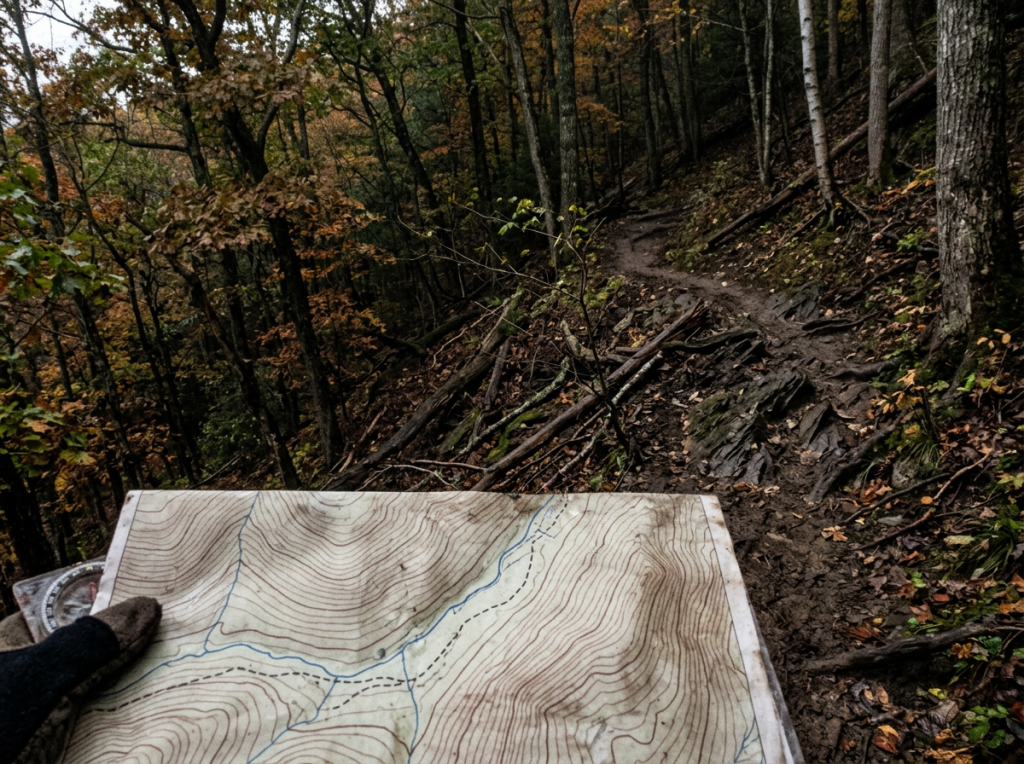
Fall camping produces two opposite fire errors, and the same campers are usually vulnerable to both at different points in the same weekend. Understanding which one is likely to befall you is most of the solution.
The reason both are common is that the underlying assumption is the same, and the assumption is that the fire is the point. People plan fires the way they plan hikes — as an activity, something to do, something that produces an evening. The stove is a backup, a thing you brought in case, something you use to boil water while the fire is the real event. Swap that and everything else in this section follows, because a stove changes the fire from a necessity into a choice, and decisions made from a position of choice are almost always better decisions than decisions made under a cold sky with wet wood.
There is also a seasonal reason the fire matters more in fall than it does in July, which is that the fire is a bigger fraction of the trip. In summer, a fire is atmosphere. In the shoulder season it is heat, and heat is not atmosphere, and the difference shows up in how much of your comfort depends on it. A camper who built their evening around a fire in August discovers in October that the fire is load-bearing, and the evening now has a single point of failure attached to a pile of wet wood that will not light.
The Fire That Will Not Burn
You are carrying deadwood, because deadwood is what you have, and it has been sitting on the forest floor through a wet season and it is saturated. Now it is 8 p.m., the temperature is falling, the fire is the only heat source you have, and the wood will not take.
The physics of why is not complicated, and it explains every frustrating detail of trying to light wet wood. Combustion needs a surface temperature high enough to release flammable gases, and heat comes from a flame, and a flame’s heat goes into whatever it is touching. Wood below about 20 percent moisture content will take a flame. Wood above about 30 percent will not, because so much of the energy of any attempt goes into boiling off water rather than into raising the surface to ignition. The threshold is not a preference, it is a physical property, and the pencil-thin splinters folk remedy is addressing a real problem — thin, dry, exposed wood has a high surface-area-to-volume ratio and reaches ignition temperature quickly — but it addresses it with a technique when what is actually wrong is the fuel.
The convention is to search for the driest wood available, which is the correct instinct and usually an insufficient one, because the driest wood within a hundred yards of a wet campsite is still wet. The fifteen-minute fire that produces smoke and a smell of campfire is the characteristic outcome: enough pyrolysis happening to feel like combustion, not enough exothermic reaction to sustain it. And the reason it feels like a personal failure rather than a weather outcome is that fire-starting is culturally coded as competence. People are good at it in summer, in dry country, with a pile of pencil-thin kindling they assembled in ten minutes. The same technique in October produces nothing, and the natural conclusion is that you did it wrong, when in fact the technique was fine and the wood was wrong.
The honest conclusion is that there is no technique that fixes saturated wood at 8 p.m. in the rain, and the campers who have warm hands and hot water in October are the ones who brought a stove. Heat output is a function of how much fuel you are actually burning, so a fire that is struggling to stay lit is a fire producing a fraction of the heat of a fire that is roaring, and the difference between the two is not one of patience. It is the difference between four minutes with a canister stove and forty minutes of frustration.
The stove deserves its case made more directly, because the objection is always weight and the answer is arithmetic. A canister stove and a pot is under a pound, and a full fuel canister for a weekend is another pound, and against that you are carrying the expectation of a fire — the time, the tending, the failed attempts, the smoke in your eyes, the ten minutes of walking to gather wood at dusk, the fact that you are now dependent on a local resource you have no control over. On a wet night in a burned-over basin with no deadwood within a mile, the stove is not a convenience. It is the difference between a warm evening and a cold one, and it weighs less than the water in the pot.
There is a version of this that is specifically a fall trap, and it is worth naming separately. Deadwood in a recently burned area is not a resource. It is charcoal with the structural integrity of a cracker, and it will sometimes take a flame and then collapse, and it burns with almost no heat and produces ash that looks like the ash of a real fire. People gather it because it is abundant and it is dry-looking, and it is the one wood in the burn scar that is guaranteed to be dry. It is also the one wood that is useless. There is a reason experienced campers carry a stove into burn areas, and it is exactly this reason.
The Fire That Is Too Successful
The second is the fire that is too successful. This is the dangerous one, and it is the one that ends seasons.
Leaf litter and forest duff — the dry layer of needles, twigs, and decomposed plant material under everything — burn below the surface. A campfire built in organic soil, or a fire ring scraped down to bare dirt, is a fire with a hidden fuel bed that can smolder for feet in every direction, underground, for a surprisingly long time, and it does not look like fire from where you are standing.
The mechanism is that organic soils are a continuous fuel network, and they burn slowly enough to be invisible and far enough below the surface to be beyond the range of what people think of as putting a fire out. A flame you can see is a reaction happening at the surface. A smoldering duff layer is a reaction happening inches down, propagating laterally along root channels and buried organic layers, with the surface above it appearing untouched. Water thrown on visible flame does nothing to it, and the water soaks into the duff, which is exactly the material carrying the combustion. The pattern that produces a crown fire — which is what a duff smolder becomes when it reaches a ladder of fuels — starts underground and goes up, and the sequence most people picture, flame climbing into the canopy, is a late stage rather than an early one.
This is why the ring matters and why the standard advice is unusually specific. An existing fire ring in bare mineral soil is a place where the duff has been removed, by whoever built the ring, and often by the fire itself over many previous uses. Building a new ring means digging, and digging means cutting the organic layer’s connection to the surrounding organic layer, and the surrounding layer is where the fire will go. So the rule is not to build a ring but to use one, and a ring you built yourself is a ring in the wrong place. The alternative in dry country is the simplest one: build no fire at all, and it is worth saying that this is not timidity. In genuinely dry conditions a campfire is one of the largest ignition sources in the landscape, and it is worth understanding why. The heat released by a good-sized fire runs to something on the order of a hundred kilowatts, which is comparable to a small building fire and roughly a hundred times what it takes to boil a pot, and even that understates the problem. What matters is not the total but the concentration: almost all of that heat is delivered within a few feet of the flames, onto vegetation that is dry by definition, at several times the intensity that dry fine fuel needs to carry a flame away from a fire. The reason a campfire is so effective is not that it is enormously powerful. It is that it is enormously concentrated.
Which brings up the thing that makes this error asymmetric in a way the previous ones are not. Every other mistake in this article is a bad night. A thin pad, a compressed bag, a wet meadow — you spend the trip uncomfortable and you come home. A fire escape is a different category of consequence, because the loss is not yours. It is a landscape, a season’s worth of regrowth, a drainage that will be scoured, a crew that gets dispatched, a legal outcome, and in the worst cases a life. The people who have watched it happen describe it as permanent in a way that has nothing to do with how long the fire itself burned, and the reason is that the ground is gone. A drainage that carries fire for a mile has lost its topsoil, and topsoil takes centuries to rebuild if it rebuilds at all.
The reason experienced campers are so religious about this, and the reason it is worth being religious about too, is that the cost of the restraint is trivial. A stove boils water in four minutes. A fire gives you something to look at. If the loss asymmetry is total — trivial inconvenience against irreversible and shared damage — then the calculation is not close, and the only reason people get it wrong is that they are standing somewhere pleasant at dusk with a stick in their hand.
The Restriction You Cannot See From the Valley
Fire restrictions in the fall shoulder are commonly staged, and the stages change with conditions you cannot see from the valley.
Staged restrictions are progressive, and the stages are triggered by specific combinations of fuel moisture, wind, temperature, and humidity that the fire restrictions officer is reading off a weather forecast. The point that matters for a fall trip is the timing, which is the reverse of the intuition almost everybody holds. People treat fire season as a spring and early summer thing — the burn ban in July, the season ending in September — and they plan a fall camping trip against the assumption that they are traveling after it. In much of the West that assumption is wrong, and a September or October trip is very often inside fire season, not after it. The moisture that arrives in the fall arrives too late to be a safety margin and too early to be reliable wetness, which is the exact condition that produces a stage two restriction.
The consequence is that the legal question and the practical question are separate, and people answer the practical one and ignore the legal one. You can be in a place where there is abundant deadwood, moderate humidity, and no immediate threat, and be under a restriction that prohibits exactly the fire you were about to build. A stage two typically closes the informal, gathered, off-trail fire — the one you make because you are cold and out of wood — while a stage three prohibits any fire outside a developed campground. Which stage you are under on a given weekend is not knowable from where you are standing, and it is knowable from the agency that sets it. This is the one item on the list that has to be checked before you leave, because it is the only one that is both free and time-sensitive.
There is a second reason the restrictions matter that is less about legality, which is that they are a proxy for real information. An agency that has moved to a stage two is telling you that fuel is dry enough to carry fire across a landscape, and that is a statement about the conditions you are in, not just about the rules. A stage one is not an administrative formality either; it usually means the season has begun and that the drying is ahead rather than behind. People who check the restrictions before they leave tend to be the people who also check the fuel moisture, the wind forecast, and the drainages, and the reason is that all five of those are the same piece of information viewed from different angles.
The stakes on this specific item are not symmetric with the rest of the article. Being wrong about a jacket is a cold night. Being wrong about a fire restriction is a ticket, a fine, a suspended privilege to camp in a national forest, and a permanent record — and in a small number of cases, a conviction. It is also the only item here where the person who makes the mistake is not the only person who pays for it. There is no more expensive way to spend a decade of good behavior than to be the person who closes it.
The Fire You Did Not Mean to Have
Carry water to the fire. Not for the fire — for the fire that you did not mean to have. This is the most practically important sentence in the section, and it is skipped by almost everyone, because the water is carried for the flames you can see and the thing you actually need it for has not produced any flames yet.
A bucket of water at a fire does one thing well, which is knock down a flame. It does not do two other things at all. It does not cool a smoldering organic layer, because water soaks into duff and duff is the fuel. And it does not stop a running fire, which is a moving front of heat ahead of which the fuel is already gone and behind which nothing you can do matters. A person who has watched a fire cross a road in the fall has watched a thing that no bucket in the world is going to stop, and the only variable that determines the outcome is how early somebody noticed. This is the entire reason fire behavior in wildland settings is a professional discipline with its own science, and the reason the professionals’ first action is almost never a bucket.
What actually works in a campground setting is more modest and still much better than nothing. A shovel and a rake, if the ring is a ring you are permitted to use, for breaking the surface of the duff around the perimeter and turning the top layer of mineral soil over the embers so that what is cooling is material that is not going to carry a flame. Stirring, drowning, feeling for heat with the back of your hand held above the ash, and doing it again after a few minutes because the heat is stored and will re-emerge. And time, which is the ingredient nobody budgets, because the fire is not out when it stops looking like a fire. It is out when you cannot feel heat anywhere in the ring with your hand an inch above the surface, which is later than you think.
The other half is not putting the fire in a position where this question gets asked. Most of the safety here is site selection: away from duff, away from roots and stumps, away from brush, away from anything overhead, on mineral soil if at all, and never in a place where the ground is dry organic material no matter how good the location looks. The campers who have had fires escape are overwhelmingly the ones who built a ring, and the campers who have not are overwhelmingly the ones who carried a stove, and the causal chain is shorter than it feels like it should be.
There is a final item that sounds trivial and is not, which is that the fire is not over when you break camp. This is the specific way a contained fire becomes an escape: a ring that was cold enough on the last night, buried or scattered in a hurry in the morning, and re-ignited hours later by a wind event that fans embers into the surrounding litter. If you built it, drown it, stir it, drown it again, and confirm it with your hand before you leave. If you did not build it and you are not staying, do not assume the previous party did either, because a ring that looks cold on arrival can have embers under the ash that a gust will find hours after you have driven away.
6. Assuming the Water Is Fine
Water is the most reliably underestimated risk in the backcountry, and fall does not improve it. Peak pathogen levels in streams are strongly associated with low flows, and low water is the defining condition of a fall trip. Add livestock, beaver activity, and a concentration of human waste at campsites to a stream that is barely moving, and you have the worst combination the year has to offer.
The reason this one survives more seasons than any other on the list is that it has no feedback loop at all. A fire escape is visible within hours. A bad campsite announces itself in the rain. Water gives you nothing. Giardia has an incubation period of one to two weeks, which means a contaminated stream on Friday is a problem that resolves itself in the wilderness and arrives, unexplained, in a city apartment ten days later. Crypto is worse on that axis, with an incubation period up to a month. By the time you know, you are somewhere else, and the mechanism that produced the illness is a hundred miles behind you and unidentifiable. The people who drink untreated water are not making a decision they will be able to evaluate, which is exactly the profile of a mistake that persists.
There is also a diagnostic problem underneath the health one, which is that the most popular piece of advice for identifying safe water is the piece of advice that does not work. Clear water, fast-moving water, water coming out of the ground — these are the signals people use, and they are not weak signals, they are actively misleading. They correlate with things that are real, like the absence of recent human waste input, and they ignore the things that matter more, like what is upstream. What you are looking at is a reach of a few hundred yards of water and inferring from it about a watershed of several square miles.
What Low Flow Actually Changes
The low-flow relationship is not subtle and it is not a matter of degree. The absolute number of organisms in a stream depends on the volume of water carrying them, so a stream at a tenth of its summer flow is concentrating whatever it is carrying roughly tenfold relative to the summer condition. That is before anything changes about the inputs, and the inputs change too. The reasons fall flow is low are the same reasons the water is more dangerous: little snowpack, dry soil, an aquifer that is drawing down, and a catchment that is not moving water fast enough to dilute. A low-flow stream is receiving the same fecal input through a smaller volume of water, and the same livestock or wildlife or human contamination is doing the same amount of work in a smaller container.
The specific thing to know about the fall geography is that the contamination and the low flow are frequently in the same place. Contamination enters at campsites, trail junctions, and livestock allotments, and so does the low flow. The places where the water is worst are the places where people have been, which in a low season means fewer people have been and so the concentration is higher. A meadow that hosted five groups in July has hosted two in October, and the meadow has received roughly the same amount of what camps do to a meadow while the stream below it is carrying a fraction of the water. This is why the popular heuristic about choosing a campsite is actively harmful advice in this specific season: the reasoning is “the water is fine where we are camping because we are not camping at the water,” and the flaw is that the water below your campsite is the water you will drink on the way out, when you are low and moving slowly and the reach is at its lowest.
There is a related pattern worth naming because it is specific to fall and gets nobody’s attention: snowmelt in the shoulder season is not treated, and almost nobody treats it, because the water is coming out of a clean white drift in a clean white basin and it looks more potable than anything else in the backcountry. Early-season snowpack in most mountain catchments is bridging over the ground surface, which means it is picking up whatever is on the surface, and in a fall trip the surface is animal sign, old camps, and wet organic ground. And the amount is small, which means people melt a little and drink it, which is the perfect setup — a small amount of water from a contaminated source, taken when they are thirsty, with no one else drinking it, so the illness has one carrier and no obvious cluster. The rule is the same one as everywhere else, which is that snow is surface water and gets treated like surface water.
The Rule That Replaces the Rule People Actually Use
The rule that should replace the one people actually use is simple: treat all surface water unless you have a reason not to. People treat water that is running fast, water that is coming out of a spring, and water upstream of where they are camping, and they leave untreated the water in the shallow slow reach immediately downstream of the meadow where the previous group was. Every untreated surface water source in the backcountry should be treated, and “it looked clean” is not a category.
The useful reformulation is that the burden of proof is inverted. The default is untreated, and each act of skipping treatment is a small decision that has to be justified with a specific fact about the source. Some justifications survive scrutiny: a stream immediately below a substantial waterfall, where any contamination in the drainage has been diluted, and where the same water is cold and clear for reasons that are physical. A spring that rises through a deep, uncontaminated aquifer and emerges high on a slope. A stream whose entire upstream drainage is protected land with no camps, no grazing, and no human access, which is a real category in some places and is much rarer than people assume. That is the whole list, and it is a short list, and every item on it is about the drainage rather than about the water in front of you.
Which is the point. The variables that predict whether water is safe are almost all upstream variables, and they are the same variables you would be looking at if you were choosing a campsite. Water quality and site selection are the same decision, and a person who understands this has already done the work. The reach that is running fast near your camp may be fed by the same drainage as the shallow slow water four hundred yards downstream, and treating the first while drinking the second is the most common version of this mistake precisely because the two are on the same creek and the difference is not visible from where you are standing.
It is worth being clear about what the water can carry, because the category is wider than most people carry in their heads. The bacteria — E. coli, Shigella, Campylobacter, Salmonella — are the ones that produce the acute gastroenteritis that ends a trip and ruins a week. Giardia is the one that is specifically a wilderness problem, because it exists in beaver and in humans and is shed in quantities that make untreated backcountry water genuinely risky, and it produces a distinctive syndrome of greasy stools, bloating, and weight loss that can persist for months. Crypto is the one that has become the more common diagnosis in recent years and is the reason a “0.2 micron nominal” label is not good enough advice any more. The others include leptospirosis from rodent urine in water, which is rare and serious, and various things that are region-specific and that nobody thinks about until they are somewhere with the relevant ecology. Viruses are also transmissible through water and no filter addresses them, which is a reason to prefer a filter over a tablet and a reason to treat even when the source is good.
The point of the list is not that the risks are exotic. It is that they are indistinguishable from each other and from a bad burrito, and the failure mode is doing a cost-benefit analysis on an invisible input. Which is why the rule has to be unconditional. Nobody makes a good decision about Giardia in the moment, because the moment does not contain any information about Giardia.
Know What Your Filter Does
Most filters remove bacteria and protozoa to different degrees, and the common hollow-fiber models that remove bacteria well are at their limit on protozoa like giardia, which requires a finer pore size. If the label says 0.1 micron absolute, it is designed for protozoa. If it says 0.2 micron and does not say absolute, be more careful.
The single most important word on that label is absolute, and the distinction is not a marketing quibble. A nominal pore rating describes the size at which the filter is most efficient, which for most media is a bell curve rather than a threshold — the actual distribution of pore sizes has a tail, and in a nominal 0.2 micron hollow fiber there are pores larger than 0.2 microns and Giardia cysts are small enough to find them. Absolute means every pore in the media is rated at or below that size, which is a harder manufacturing specification and the reason the label exists. A hollow fiber that is nominally 0.2 micron will do excellent work on bacteria and unreliable work on Giardia and Crypto, and it is the most common filter in the backcountry, which is an uncomfortable combination. The fix is not expensive. Read the label, and if it does not say absolute, treat the water anyway or carry a filter that does.
Pleated membranes are the other design, and the difference in use is worth knowing because it is the reason they are common in Europe and increasingly common here. A pleated membrane is a surface filter rather than a depth filter, which means it holds bacteria and protozoa at the surface of the media rather than throughout its volume, which means the rated pore size is a genuine cutoff, which means it reliably removes Giardia and Crypto and viruses by size alone. The trade-off is that it clogs fast on silty or algae-heavy water, and it has almost no capacity, and the flow rate is low. So the honest comparison is that a hollow fiber is the better tool for dirty water and a pleated membrane is the better tool for protozoa, and in the fall the second case is the one that kills people.
Chemical treatment is a reasonable backup and a poor primary, and the reason is worth being specific about. Tablets work, and they work on bacteria, protozoa, and viruses, which makes them theoretically the most complete option available. They fail for three practical reasons. They need time, fifteen minutes or more in cold water, which means you are standing in the dark waiting. They need the water to be at or near a temperature at which the active ingredient works, and a 40-degree stream in October is not it, so the tablet is being used outside its conditions and delivering an unknown result. And they taste like the chemical, which matters more than it sounds, because the people who are using them in the fall are cold and tired at the end of a long day and a bad taste is a real disincentive and people skip it.
Boiling deserves its own note because it is the traditional answer and it is the most fall-specific trap in this section. Boiling is safe. It kills everything. And in a trip with a canister stove it is the easiest method to execute. What it is not is free of consequences, because boiling kills pathogens and then leaves the minerals behind, and the result on a low-flow stream in a granite basin or a slate drainage is water that tastes flat, or metallic, or faintly of rock, and in the fall the minerals are often sulfides, and sulfides in low-flow water in October routinely produce a taste serious enough that people do not want to drink it. The correct response is to let it cool, aerate it by pouring between containers, and drink it anyway, or to use a filter. The incorrect response is to conclude the water is bad. Nobody has ever gotten sick from flat-tasting boiled water and a number of people have gotten sick from the alternative.
So: filter as the primary, tablets or a second filter as the backup, boiling as the emergency. And the backup matters more than the primary, because the primary is a device that has a failure mode and a rate of failure, and the failure mode is silent.
Filters Fail Quietly and All at Once
The mistake of treating only when you are thirsty, at the end of a long day, is a setup for treating half a bottle properly and skipping the rest. Treat as you collect. And remember that filters fail — a punctured membrane or a cracked housing leaks clear water, and the symptom is that everyone gets a stomach bug on the same night.
The reason the failure mode is silent is that a broken filter produces water that looks exactly like water from a working filter. There is no color, no smell, no turbidity difference, and the person drinking from it has no way to know. That is a different and more dangerous failure mode than a device that stops working, and it is worth understanding that a filter is not a yes-or-no instrument. It is a positive-pressure membrane whose integrity depends on the housing, the seals, and the element, and a housing that has been dropped, frozen, or assembled with a dirty O-ring will pass water that never touched the membrane. Freezing is the common one, and it is a fall-specific one, because a filter left in a bottle in a vehicle or in a pack that spent the night in a cold tent can develop a crack in the housing or damage the element.
The consequence is a specific and recognizable pattern. The group that all gets sick on the same night did not get sick from a contaminated source they each encountered separately, because that would produce a scattered onset. They got sick from one device that was failing, and the onset is clustered in time, and every case in the cluster has a common source, and the common source was the thing the whole group trusted. When you see a whole group go down at once, the filter is the first hypothesis, and the individual water sources are the second, and the order is almost always reversed from what people assume. This is also the argument for treating as you collect rather than in the evening. The reason to treat each bottle as you fill it is partly that treating is faster when you are not tired and partly that a device that fails at hour six has already been used for six hours, and everything filled in that window is suspect.
Two more practical things about the hardware, both of which are fall-specific. Filters are flow-rated, and the rating is measured on clean water, and a filter that moves at a liter a minute on a test bench moves at a third of that when the water is cold — because the membrane is more viscous when cold — which means a cold morning with a group that all need water at once is a slow, frustrating, and easily rushed operation. And filters freeze. A membrane that has frozen is a membrane that has failed, whether or not it looks like it. In a fall trip the practical move is to keep the filter in your jacket or in your sleeping bag rather than in the pack, and to treat the freeze as having destroyed the device rather than as something it will recover from.
The chemistry of the tablets has the same problem in reverse. A tablet that has been frozen or stored in a vehicle through a cold night has an unknown effective concentration, and unlike a filter it will produce water that looks and tastes completely normal and does not work. Keep the tablets where they are not cold and not wet, and treat a water bottle that has been through a freeze with suspicion even though the tablets in it are dry.
The Carried Quantity Is the Actual Decision
There is one more error in this section that is not about treatment at all, and it is the one that ends trips rather than ruins them: running out.
Carrying enough water for a trip is a planning calculation, and the calculation is almost always wrong in the same direction because it is done in terms of what you drink rather than what you need. Two people on a three-day fall trip in the West will plan on four liters a day each, which is eight liters a day for two people, and the packs hold twelve to fifteen liters, and the arithmetic appears to work until you account for the fact that you are carrying treated water from a source that may be an hour off the route, that you are drinking more than four liters because you are working hard in cold air, that some of it is going into cooking rather than drinking, and that the entire calculation assumes you found water when you needed it and found a source you were willing to drink from. Every one of those assumptions is optimistic in exactly the way the first section described for temperature, and the margin argument applies unchanged: add it deliberately, because every input is biased in the same direction.
The number that is actually correct depends on the trip, but the fall version of it is a day of contingency in a separate container rather than in the same one. A collapsible water container or a flat bladder that is not in the pack is both extra capacity and a hedge against a failure, because a group whose main water has a cracked filter or a bottle with a bad cap can refill from a reserve. It is a pound or two, and it is the difference between a bad day and a trip that ends early.
And the treatment question runs through all of it, because water you cannot treat is water you cannot use. A group carrying four liters of capacity and one working filter has an effective capacity of whatever that filter can process in an afternoon, and if the answer is six liters then the trip has six liters of water, not sixteen. Capacity is not supply. Knowing the flow rate and planning around it is the part nobody does, and the version of the mistake that ends the trip is arriving at a good source at dusk with full filters, a working light, and a group that is too tired to stand there for an hour.
7. Forgetting That the Bugs Are Still Bad
The tick. That is the one that matters, and fall is not the end of tick season — for many regions it is the middle of it.
The reason this mistake persists when almost every other one in this article has a mechanism you can name is that insects do not respect the seasonal frame people carry in their heads. The frame is: mosquitoes are a summer problem, ticks are a spring and early summer problem, and by September the season is closing. Every part of that is a reasonable inference from experience and most of it is wrong, because both the biology and the human behavior run the other way. Tick activity tracks temperature and host activity rather than the calendar, and adult ticks in particular are searching for a host before winter, which makes late September and October among the highest-pressure weeks of the year. And the hikers who are in the woods in October are the ones who stopped using repellent in September, which is the single largest contributor to the bites people actually get.
The other reason is structural, and it is the same no-feedback-loop problem that made the water section worth its length. A tick bite is not an event. It is a coin flip whose outcome may not resolve for three weeks or may not resolve for three years, and there is no point at which you learn from it while you are still in the woods. Nobody has ever found a tick in the field, understood what disease it might have been carrying, and adjusted their technique on the spot. The people who do this well are not the ones who had a bad experience. They are the ones who do the same four things every day regardless of what happened the day before, and that regularity is the entire subject.
The Stage That Bites
Nymph ticks are the size of a pinhead and are frequently missed, and they are the stage most likely to transmit Lyme disease, Rocky Mountain spotted fever, anaplasmosis, and alpha-gal syndrome. They wait on low brush, in leaf litter, and at the height of your lower leg, and they attach without feeling it and feed for a day or more before anyone notices.
The biology here is worth understanding because it explains both why the bites happen and why the clothes strategy works. A tick cannot jump and cannot fly, so it does not climb toward you. It is on a blade of grass or a stem at roughly the height of your lower leg, and it detects a host by the carbon dioxide, the heat, and the odor of a body moving past, and then it moves into a position called questing — it holds its front legs out and waits for something to brush it. Everything about that mechanism is good news for prevention and bad news for detection. It is good news because the contact point is a small, specific piece of clothing, and it is bad news because the tick is looking for exactly the part of you most likely to be brushing vegetation, which is the ankle and the lower leg, which is also the part of you least likely to look at.
The adult stage is larger, roughly the size of a lima bean, and easier to see, and the reason people think the season ends in summer is that they think of adult ticks as the stage that matters. That is backwards. Adults are the ones that have already been through a winter, that are in the woods specifically to find a host for reproduction, and that are therefore at maximum motivation and maximum pathogen load. A nymph is the stage that hatches this year, that has not yet been exposed to a winter, and that is why nymphs carry less of most pathogens individually — but there are vastly more of them, they are far less likely to be noticed, and for Lyme specifically the nymph stage is the one that accounts for the large majority of human infections. The people who get Lyme disease are overwhelmingly the people who were bitten by something they could not see.
The four diseases are worth separating out, because the symptoms overlap, the treatment overlaps, and the consequences do not. Lyme presents as a single expanding rash in a minority of cases — and this is the part that catches people, because the majority of cases never develop a rash at all — followed by fever, fatigue, headache, and joint pain that can look like a bad cold until it does not go away. Anaplasmosis and ehrlichiosis, both tick-borne and both common in the same places, present as a flu that is worse than a flu and that responds to nothing, with a low white count and elevated liver enzymes if you get bloodwork. Rocky Mountain spotted fever is the one to know about because it kills, and it kills in the first week, and the thing that reliably delays treatment is that the first few days look like an ordinary illness. It is also the one where a rash appears later rather than earlier, which is exactly backwards from what people expect, and where people who checked their children in the first few days and found nothing wrongly conclude they are fine.
Alpha-gal is a different category of problem from the other three and it is the one that is most likely to be misdiagnosed entirely. It is an immune reaction to a carbohydrate in mammalian meat, and the tick bite is what triggers the sensitization, so a person can go their entire life eating beef with no problem and then, after a tick bite in a particular region, develop immediate hives, swelling, and GI symptoms every time they eat a hamburger. The diagnosis is frequently missed for years because nobody connects the two events, and it is also the one where the site of the bite is geographically important, since alpha-gal reactions are concentrated in the southeastern and south-central United States.
None of this is here to frighten anyone, and the point of the section is that every one of these is preventable with an afternoon of work and a daily two-minute habit, and that the diseases are all far more treatable when caught early than when caught late. The reason people do not do the work is not a weighting of risks. It is that the risk is invisible, the cost of prevention is visible, and the connection between the two never arrives while you are still in the woods.
Treat the Clothes, Not the Skin
A few practices reduce this considerably. Treat your clothing, not your skin. Permethrin, applied to pants, socks, gaiters, and shirt, allowed to dry, and worn over a base layer, kills ticks on contact. It does nothing on skin, it should not be applied to the face or hands, and it does not degrade as fast as DEET.
The reasoning behind this is the most useful thing in the whole section, and it generalizes past insects. Permethrin is a contact insecticide — it kills on contact rather than deterring — which means it works on a tick that has already touched the fabric and is on its way to your skin, and it keeps working for weeks as a residue in the fibers. DEET, the active ingredient in most repellents, works differently: it makes you unattractive to an approaching tick, and it is applied to skin, and it works through odor. Contact is the more reliable mechanism, because it is a chemical kill rather than a negotiation with an insect’s sensory apparatus, and because it covers the exact point of contact. It is also why permethrin-treated clothing can be washed — the residue in the fiber survives laundering that would strip a repellent off skin — and why the two work well together, with permethrin on the pants and DEET on the exposed skin between the cuffs and the socks and the collar.
The application details matter more than the product. Permethrin needs to be on the fabric and dry before the garment is worn, which means the night before, not the morning of. The concentration matters — 0.5 percent for clothing, and the higher concentrations sold for garden use are a different product and will damage some synthetic fabrics. It is applied to the outside of the garment and the seams and cuffs are where it matters most, because that is where the tick crosses the boundary. And it goes on socks, gaiters, and any leg covering, because the lower leg is where the questing tick is waiting, which puts the point of contact squarely on the treated surface.
One warning worth stating plainly, because it is the thing that goes wrong: do not apply permethrin to skin, to the face, or to the hands. It is a contact insecticide and it is toxic to humans in the concentrations intended for fabric. People get this wrong when they are in a hurry, which is exactly when the tick is on them, which is the same failure mode as not checking at all.
The Two-Minute Check
Check yourself and each other, every day. The areas that matter are the seams, the waistband, the groin, behind the knees, the armpits, and the hairline. Checking each other takes two minutes and finds things you cannot find on yourself. Do it in the evening, not in the morning.
The reason the evening is the correct time, and not merely the convenient one, is that a tick that attached during the day has had all day to work in and is likely to be firmly attached and visible, whereas a tick that attaches in camp while you sleep is hours old and has barely begun to feed. The two-hour mark is roughly the threshold where transmission risk starts to become a real conversation, and a tick removed in the evening is a tick removed early. Checking in the morning catches the tick you picked up yesterday afternoon and nothing else. Checking in the evening catches that one and the one that found you while you slept.
Self-checking is necessary and insufficient, and the insufficiency is anatomical. The parts of the body most likely to carry a tick are the parts a person cannot see: the back of the neck, between the shoulder blades, the back of the waistband where the shirt meets the trousers, the inside of the elbows, the back of the knees. A person alone can do all of these with a mirror and some contortion and a fair proportion of them, reliably, in the dark, in a tent. A person with a partner does it in two minutes with a headlamp and finds things that would not have been found. The other reason not to skip it is that the cost of a missed nymph is a delay in treatment measured in weeks, and the cost of a two-minute check is a two-minute check, and that comparison does not require any kind of information about how sick you are about to get.
The specific areas worth naming, because “check yourself” is not an instruction anyone can execute: the waistband and the belt line all the way around, the groin and the crease of the hip, behind both knees, the armpits and the sides of the torso, the hairline at the back of the neck and behind the ears, the front and back of the legs from ankle to knee, and the socks. That last one catches a large fraction of everything, because a tick that got past a sock and a gaiter is on your skin and a tick that got past the cuff is on the sock, and a sock comes off.
Removal Is a Skill
Remove them properly. Fine-tipped tweezers, grasp the tick as close to the skin as you can, pull upward with steady even pressure, and do not twist or squeeze — squeezing can force gut contents into the bite. Do not use petroleum jelly, burn it with a match, or coat it in anything. The old remedies that suffocate the tick are the ones that also rupture it, which is the opposite of the goal. Wash the area afterward and dispose of the tick; a photograph of it is useful if symptoms develop.
The rationale is worth understanding, because most of the folk remedies here are intuitive and the intuition is wrong. A tick is not a spider. It is a blood-feeding animal attached by its mouthparts, and it has essentially no ability to detach on its own once it has committed to a feed, which is why it stays for days — it is feeding, not traveling. The goal of removal is to sever the attachment and remove the mouthparts, without rupturing the body, because the body is what carries the pathogens. Pulling straight up with steady pressure and getting as close to the skin as you can achieves that, and a tick that has been removed cleanly and quickly will not have transmitted anything significant even if it had been attached for a while. The suffocation methods — petroleum jelly, nail polish, kerosene, a match flame — are based on the idea that blocking the breathing apparatus will make the tick let go, and for a creature that can close its spiracles and go dormant for months, it does not. What those methods reliably do is make the tick angry and ruptured. The petroleum remedy is the most widespread and is probably the most harmful, because people apply it and then leave it on overnight.
The technique itself is thirty seconds of practice. Grasp with the tweezers as close to the skin as you can, at the point where the mouthparts enter. Pull up, with steady even pressure, and do not jerk and do not twist — twisting shears the mouthparts and leaves them in the skin, which is not dangerous but is annoying and can produce a local reaction that gets mistaken for an infection. Then wash the area with soap and water, and clean the tweezers, and dispose of the tick. If you want to do the extra step, put the tick on a wet cotton ball in a sealed bag and leave it for a few days, because an engorged tick is identifiable to species afterward and a photo of a flat one often is not. And a photo of the bite site and the removed tick, with a date, is genuinely useful to a clinician three weeks later when you cannot remember which leg it was on.
There is one thing that is worth saying about prophylactic medicine, which is that it exists and it is underused, and it is the only intervention on this list that does anything after the bite. A single dose of an antibiotic, taken within 72 hours of removal, substantially reduces the risk of Lyme, and it is standard recommendation for an identified Ixodes bite in an endemic area. The reasons people skip it are the usual ones — the side effects, the fact that most bites do not transmit, the cost — and the reasoning is a reasonable risk calculation that ignores the specific failure mode this whole section is about, which is that a mild-feeling illness in three weeks is going to be attributed to the flu and not to a tick bite in October that a clinician will not think to ask about unless you mention it. Which is worth saying plainly: if you get a tick off in the fall and you get a fever a month later, tell the doctor about the tick. It is the single most useful sentence in this paragraph.
The Clothes Come Home With You
Wash and dry the clothes hot on returning, and dry gear in a dryer rather than on a line, since heat is what kills what is left.
The mechanism is straightforward and it is the one item on the list that is a genuine deadline rather than a habit. A tick that comes home in a jacket rides through the drive, sits in a laundry basket, and goes into a dryer or onto a line, and the ones that were attached are now attached to a garment in a house with people in it. Clothes dryers run hot enough to kill ticks, and the tumbling is an additional mechanism; a clothesline does not, and a garment that hangs in a warm closet for a week is a garment that may still have a live tick in the seam. Drying first and then washing on cold is the common compromise and it is not a compromise that works.
The two items that reliably get missed are the ones that never get washed at all. A gaiter, a buff, a sun shirt that lives in a pack and is not part of the laundry rotation. A pack liner or a duffel that has been in a wet tent. The pillow from the car. Anything that spent three days in a field vehicle or a bear hang and is now sitting in a bedroom. The item on the list that most consistently fails this test is the one nobody thinks of as clothing, which is the sleeping bag pad cover or the thing you sleep on when you do not have one.
The dryer habit has a second application that gets missed. A car interior in fall is a warm, dry, enclosed environment, which is close to ideal for a tick that came in on a jacket, and the vehicle is where the gear sits while you unpack. A quick sweep of the seats and the footwells before you bring anything inside is a five-minute task that closes the most reliable vector by which the outdoors comes indoors in October.
The Rest of the Insects
There are other insects, and they are less dangerous but more annoying.
Mosquitoes persist in drainages and standing water until a hard frost, which in much of the country means they persist for the whole trip. That is worth taking seriously on the schedule, not the severity. The females that bite need a blood meal to develop eggs, and in the fall they are getting that meal and looking for one with more urgency than a midsummer mosquito has, which means the ones that are still biting in October are the ones that have had the least success and are the most persistent. And they are not distributed the way the July distribution would predict. They are in the drainages and the seeps and the wet meadows, which is exactly where Section 3 told you not to camp, which means a correctly sited camp in October is incidentally a low-mosquito camp, and a badly sited one in a drainage in September is a bad time.
Deer flies and horse flies are the ones that end trips psychologically rather than medically. They are worst in September, which means the peak is just before the fall trips, and a group that has been in the woods in late August establishes a baseline and arrives in September with a different disposition. They are attracted to movement and to dark clothing, and they are persistent in a way that mosquitoes are not — mosquitoes will leave, horse flies will follow a moving target for a sustained period, and they bite hard enough to be painful immediately. The mitigation is the repellent, worn, and light-colored clothing, and honestly, the mitigation is mostly acceptance.
Wasps and hornets are the one on this list that causes acute injury rather than an annoyance, and the fall timing is not about the insects so much as the behavior. Yellowjackets and hornets are scavenging rotting wood and old stumps in the fall because that is where the protein is, and they are aggressively territorial around a food source in a way that is proportionate to how little other food is available. The practical rules are the obvious ones and people skip them anyway: leave the woodpile alone, give any stump you are about to step over a wide look, do not swat, and if a nest is genuinely in the way of a campsite, move the campsite.
Which brings up the insect that is not on anybody’s list and can end a fall weekend faster than any mosquito. Fall is spider season in a lot of the country, the ones that matter medically are almost all in the arid West and the Southeast, and the relevant number is that recluse bites are occasionally necrotic and black widow bites are occasionally serious, and both are extremely rare and both are almost always avoidable by shaking out boots and clothing before putting them on, which is a ten-second habit that exists entirely because people do not put their hands into a boot that has been sitting in a tent all day without checking what is in it.
8. Misreading Wildlife — and the Other People in the Woods
Fall is when bears are most likely to cause problems, because bears are not in hibernation in fall. They are in a hyperphagic feeding phase, burning through reserves before winter, and their tolerance of human food is at its seasonal peak. A large share of bear incidents that get someone hurt involve food that was stored where a bear could reach it.
The two halves of this section are not a list of unrelated concerns, and the reason they belong together is that they are the same error performed on two different subjects. In both cases, a person who is not an expert reads the intent of an animal moving through the woods and gets it confidently, from inadequate information, with no prior experience of having been wrong. In both cases the person is interpreting behavior through the lens of what they would do, which is a lens that produces a confident and frequently incorrect answer. And in both cases the interpretation is made fast, at a distance, in poor light, by someone who is cold and has been walking all day and would very much like the situation to be resolved in the direction that requires no action.
That shared structure is worth stating because it makes the practical advice cohere. The distance guidance, the storage requirements, the blaze orange, and the spray are not separate rules. They are all ways of not having to make the interpretation. A bear that has found your food is a bear that is no longer a question. A hunter in blaze orange at a hundred yards is a person, not a silhouette. Every measure that removes the ambiguity removes the decision, and the decision is the part that goes wrong.
If you take one rule from this essay, make it that nothing edible goes in the tent, and that all food, trash, toiletries, and anything with a scent goes in a proper storage system.
The Bear Problem Is a Food Problem
The reason bears generate the large majority of wildlife incidents in the backcountry is not that bears are unpredictable. It is that a bear that has never found human food will almost always leave you alone, and a bear that has found human food once will come looking for more, and the second bear is the dangerous one. A large share of bear incidents that get someone hurt involve food that was stored where a bear could reach it, and the mechanism runs through a sequence that is worth walking through because each step is a small, ordinary failure. Somebody stores food in a tent, or in a pack at the base of a tree, or in a cooler that is not certified bear-resistant. A bear opens it. The bear eats, and the caloric density of a bag of trail mix or a block of cheese is enormously higher than what it was getting from natural forage, and it associates the location with that. A second bear comes to the same spot, finds nothing, and now that spot has been reinforced as a place worth checking. The escalation is a function of how many times it has been rewarded, and every reward is a camping mistake made by somebody who did not know what was happening.
Which is the reason the storage rule is a hard rule and not a guideline. The failure is not that people are careless with food. It is that a bear habituation is invisible from the inside, because the person whose mistake caused it is not present for the consequence, and the consequence is inflicted on a different person on a different trip. This is the only item in the article with that structure, and it is the reason the answer is a certified canister rather than a judgment call about how careful you are feeling. Nobody is careful enough, because careful is a variable and the bear is not tracking your carefulness, it is tracking the location.
The detail that catches experienced campers is that the list of things that must go in the canister is much longer than food. Trash, obviously. Toiletries — including toothpaste, soap, deodorant, and sunscreen, all of which have scent and all of which a bear is motivated to investigate. The bucket a group used to carry water. Any pet food. Anything that was in a pack that spent time in a car, because a bear that breaks into a car is a bear that has learned that vehicles are worth breaking into, and a car is a much bigger prize than a pack. The rule of thumb that covers all of it is scent, not food. If a bear can smell it, it is a candidate for the canister, and if it is a candidate, it goes in.
Hanging Is Not a Storage System
On hanging versus canisters: traditional hanging guidance is ten feet high and six feet from the trunk, and it works reasonably well in some forest types and poorly in others, particularly where the food is in a hard-sided cooler or a pack with a strong scent that a bear can reach from the ground. Bears in bear country increasingly climb. A bear canister is more reliable in practice, and if you are going to rely on hanging, use bags designed for it, not a t-shirt on a rope.
The reason the traditional numbers fail is worth understanding, because it is a problem with the geometry rather than with the height. A bag hung at ten feet and six feet out is outside the reach of a bear standing on its hind legs, which is the threat model the standard assumes, and the standard was written in an era when that was the threat. A bear that stands on something — a deadfall, a log, a rock, another bear — reaches considerably higher, and bears in developed backcountry have had a long time to learn that hanging food is a thing that people do. Countering a climbing bear with a higher hang produces a cycle rather than a solution, and the more sophisticated camps in high-bear-use country have moved to counter-camps and tripods, which is equipment that costs money and weight and is exactly the thing people skip.
The hard-sided cooler is the failure that catches the least experienced campers, because a cooler feels like a solution. It is a heavy plastic box with a lid, and a bear that cannot open it in the field has learned nothing. Coolers work as bear storage when they are bear-resistant by certification, and they are frequently not. The same is true of a soft-sided cooler bag, which a bear can get into with a claw and a moment, and which is the most common hard-sided-looking failure in campgrounds.
The real answer is a certified canister, and the reason it works is not that it is indestructible. It is that a bear cannot get the food, does not get rewarded at the location, and the whole reinforcement loop never starts. That is the mechanism, and the mechanism is the argument. A canister also removes the cognitive load of a correct hang, which matters for the specific person most likely to make the error — the one who is tired, in the dark, on the last night, and who is trying to be reasonable about a rope.
There is one fall-specific addition that gets missed. Bears are not the only thing that goes looking for your food in October, and the second most common is a rodent — a porcupine, a marmot, a mouse — with a strong incentive and no fear of you, and a canister does not stop it. That is a nuisance rather than a safety issue, and it is worth knowing that a persistently breached canister is a sign of a bear, not a sign of a determined squirrel, and that the second one is a problem with a different solution.
Bear Spray Beats a Gun, and It Is Not Close
On bear spray and firearms. This is the point most worth making clearly, because a great many people get it wrong. Bear spray is substantially more reliable than shooting a bear, and this is not a close call in the practical sense.
The reason is that the two are solving different problems and the firearm is solving the wrong one. A bear encounter is a situation that resolves in a fraction of a second, at a distance of ten to thirty feet, often at dusk, often in brush, often with the bear in motion. That is not a target-acquisition problem that a pistol solves, and the most likely outcome of a bear encounter that turns into a gunfight is a wounded bear rather than a stopped one — which is a worse situation than the one you started with, because a wounded bear is unpredictable, is not going to leave, and is a hard problem for everyone including the people who come to help. Every agency that has looked at this has come to the same conclusion, and the number is not close, and it is not close because the spray does not require accuracy and the gun does.
The mechanism that makes spray work is worth understanding, because it explains why it is effective at ranges where a firearm is not. Bear spray is a cloud, not a projectile. It creates a wall of aerosol between you and the bear, and the bear’s response is to stop, back off, and reassess, which takes several seconds. Those several seconds are the entire margin, and they are available whether or not you can aim. It also works on a bear that is not charging but investigating, and it works on a bear at a distance that you would have already missed, and it works on a surprise encounter at close range, where a firearm is at its worst and spray is at its best. A bear that has been sprayed frequently and successfully in its life is a bear that is more likely to leave, which means the person who carries spray is also more likely to have a second chance in the same trip.
The reason people get it wrong is that it is unintuitive. A gun feels like the serious option and a can of pepper spray feels like the unserious one, and the cultural weight of the firearm is doing the work that the evidence should be doing. There is a version of this decision that gets made once, in a parking lot, by somebody who has never seen a bear, and then defended for twenty years. Bear spray is not a compromise and it is not a deterrent for tourists. In the only data that exists on outcomes, it is the most effective option available to a person on foot.
If you carry a firearm in bear country, carry it for what it is good for, and carry spray separately, in a holster on your belt where you can get it out, not buried in the bottom of a pack. The holster detail is not a minor one. The whole value of spray is the seconds, and a spray can at the bottom of a forty-pound pack is not a spray can in those seconds. It should be on your belt or your chest, it should be on the side you draw with, and the practice of drawing it blindfolded from a holster is worth more than any additional gear, because the failure in a real encounter is fumbling, and fumbling is a technique problem rather than an equipment problem. Buy an inert training canister and practice with a partner until the draw is automatic.
And the guidance in this article is general, which is a real limitation rather than a hedge. Grizzly and black bear behavior differ substantially, the correct response differs, and the local agency guidance for the species where you actually are is better than anything written generically. The National Park Service, the state wildlife agencies, and most large land managers publish species-specific guidance for exactly this reason, and reading the two pages for the species in your drainage before the trip takes less time than reading this section did.
Distances, Behavior, and What to Do When It Is Not Working
Give bears about a hundred yards, deer and elk twenty-five to fifty. Make noise on blind corners, oncoming trail sections, and near camps where wind or water masks your approach. If a bear is standing and has not noticed you, back away slowly and quietly. If it has noticed you and is standing, talk to it in a calm voice, keep your face toward it, and back away — do not run, and do not climb a tree, which helps with a black bear and is essentially useless against a grizzly. Spray is deployed at charging distance, which for most bears is somewhere around twenty-five to thirty feet.
The reason for a hundred yards is that this is roughly the distance at which a bear notices a person, and the entire strategy is to leave before the bear has made a decision. A bear that has not registered you is a bear with no reason to change what it is doing, and a bear that has registered you and is deciding is a situation whose outcome you do not control. The distance is not about safety in a dramatic sense; it is about keeping the decision on the bear’s side of the threshold, where the answer is almost always that the human is not interesting.
The behaviors that get people hurt are the ones that feel correct. Running triggers a chase reflex, and a chase reflex in a bear is a sprint that a human cannot win, so running converts a non-event into a fatal one. Climbing a tree works against a black bear, which is a smaller animal and a poor climber, and does not work against a grizzly, which is a substantially larger animal and a competent one, and a person in a tree is a person who cannot get down. Backpacks have the same problem in reverse, which is why the advice is to keep the pack on and stay still rather than to appear larger. And the shouting, the running, and the climbing are all responses to fear, which is why the single most useful thing a group can do is agree in advance on what the response is, so that the person having the worst moment of the trip is not also the person deciding what happens next.
There is one situation that gets under-discussed, which is a bear that has food. A bear with a bag of food in its mouth is not a bear to be reasoned with and is not a bear to be sprayed at, because the bear is not evaluating you, it is leaving with the food. The correct response is to let it go, to note which direction it went, and to get to your canister, and to consider that the location is now compromised. Trying to recover food from a bear is how people get seriously hurt, and it is one of the very few situations in this article where the advice is simply do not.
Then There Is the Season You Are Most Likely to Forget
Then there is the season you are most likely to forget: hunting season. In much of the country, fall is open season on deer, elk, and bear, with hunters working the same public land you are camping on.
This is the error in the section with the shortest feedback loop, which is what makes it remarkable. If a bear misread goes badly, it is very bad. If a hunter misread goes badly, it is somebody shot, and the consequences are legal, medical, and permanent, and the misread is almost always made by the person who did not know the other person was there. The asymmetry is worth sitting with: the cost of a whole season of blaze orange is a mildly silly-looking hiker, and the cost of getting it wrong is a hospital and a charge, and the calculation is not close.
The practical advice is unromantic. In an area with an active hunt, wear blaze orange, and a vest plus a cap is better than a vest alone — a vest alone can be covered by a pack, a jacket, or a seated position, and a hat is visible from almost every angle and almost every distance, and the two together cover the failure modes neither covers alone. Check the state’s rules, because some require it and some do not, and the requirement is the floor rather than the answer, because a hunter who is legally hunting on land you are legally camping on is a person who has every reason to be startled by you and is holding a rifle. Do not shout at people whose back is turned, do not assume a person is lost before you have considered that they are a hunter, and be aware that some hunts involve dogs — which is the detail that catches experienced hikers, because a dog is a thing that moves fast through brush, is not wearing orange, and belongs to somebody who is not in the frame of your thinking.
The other thing worth knowing is that hunters are out at the times you are not thinking about, and for the same reason you are. They are in the woods before dawn, because the animals are moving, which is the same logic that has you leaving the trailhead at six. The people you are most likely to encounter are the people on the same schedule, in the same drainage, at the same hour, and neither of you is looking for the other.
The Quiet Risk of a Low-Season Trip
And the quieter risk of a low-season trip: fewer people on the trail means fewer people who would notice you did not come back, and fewer ranger patrols. The solitude that makes October appealing is the same thing that makes an emergency take longer to become somebody else’s problem.
This is the one place where the misreading theme applies to nobody being there, and it is a genuinely different failure mode. Every other section in this article is about a hazard that is present. This is about the absence of help, and it is a hazard that is entirely manufactured by the thing that makes the trip appealing. A low season means less competition for campsites, more solitude, no crowds, a better trip by every measure a person consciously evaluates — and a longer time to detection, which is the single variable that most strongly determines whether a bad night becomes an emergency.
The mechanism is unglamorous and it is arithmetic. A fall that is survivable in July resolves in an hour in October, because in July there are forty other groups within an hour of you and a ranger doing a patrol loop, and in October there are two, and one of them is a week away. Section 4 made the same argument from the check-in side, and the two halves of it are the same point: the check-in time exists because the response time is longer than the trip’s failures take to develop. The people who have a good fall are not the ones who had no emergency. They are the ones whose emergency became a bad night instead of a search, and the difference is mostly a matter of how long it took for somebody to notice.
Which is the argument for treating the solitude as a cost rather than a benefit, which is not a romantic position and is the only position the evidence supports. A trip in October with a check-in time, a satellite messenger, a group that knows the plan, and a stated threshold for acting on a silence is a trip where the detection time is bounded. The same trip without those four things has an unbounded one, and there is no amount of good judgment about bears and drainage and rain that improves it.
9. Losing the Light, and Losing the Group
Daylight is a schedule, and in the shoulder of the season it is shrinking on an obvious curve — roughly ninety minutes less than midsummer by the time the season turns, and a shorter day makes every other mistake worse.
The reason this section is two failures rather than one is that the two share a mechanism, and the mechanism is that a plan made at two in the afternoon is paid for at six in the evening by a person who cannot see. Losing the light is losing the ability to act on the decision. Losing the group is losing the people you would act with. Both are the same error — a decision made with information you had and are no longer using — and both are the essay’s own thesis applied to time rather than to temperature, which is why they belong in one section when the other sections are built on a single mechanism.
The thing that makes the shrinking day uniquely dangerous in the shoulder season is that the loss is not gradual in its effect. On a July day you can lose ninety minutes and adapt, because a longer day means the light you lose is the light at the end, and the end is the part that is optional. In October the ninety minutes come out of the middle, and the middle is the part where the trail gets confusing, where the terrain is unfamiliar, and where the decisions with consequences are. A day that was comfortable in July is not a shorter version of a comfortable day. It is the same day with the useful hours removed.
And the loss is invisible until it is not. Nobody feels the day getting shorter. The hike feels normal at noon, and it feels normal at two, and the moment at which it stops feeling normal is generally a switch rather than a gradient, and it is usually the moment somebody says the word dusk, which is the point at which the margin is already spent.
Sunset Is the Wrong Benchmark
Everything above gets harder when you are doing it in failing light, and the most common and most preventable version of this is planning the turnaround against sunset instead of against your own headlamp.
The error is not a matter of optimism, which is what makes it survive. It is a units error. Sunset is a time; headlamp-use is a condition, and the two are separated by a period that is determined by terrain, tree cover, cloud, and the state of your eyes. A clear day with open terrain gives you perhaps forty-five minutes of usable light after sunset. A forested drainage in late October with cloud gives you closer to fifteen, and the fifteen starts when you can no longer read a topo and ends when you cannot see your feet. Planning the turnaround against sunset means planning it against a number that is a description of the sky rather than a statement about your ability to do anything, and the gap between those two things in fall is routinely the whole margin.
The rule that follows is unromantic: be back at camp with an hour of genuine usable light in hand, not an hour before sunset. And set the turnaround time before you leave in the morning, not when you feel like turning around at two in the afternoon. The setting matters more than the number, and the reason is that the moment of deciding is the moment you are most compromised. You are warm, you have been walking for a few hours, you are at a nice place, the light is still good, and the trail ahead looks interesting. Every signal in your body says keep going, and none of them are about the thing that matters, which is that the descent gets longer and the light gets shorter and the number of decisions on it goes up. A turnaround time set in the morning is a commitment made by a well-rested person with full information. A turnaround time decided at two in the afternoon is a negotiation with the person you are at two in the afternoon.
Which is why the failure is so reliably an over-run rather than a wrong turn. Nobody in this article’s experience gets lost by deciding to go a quarter mile further than they planned, in good conditions, with a headlamp and a charged battery. They get into trouble an hour after the decision that put them on a trail at a time they should not have been on it, with a light that is dimmer than it was, on terrain they do not know, a hundred yards above a slope they cannot see the bottom of.
The Battery Is the Failure Point
Batteries are the failure point. Lithium cells lose a meaningful fraction of their capacity in the cold, and they lose it faster as they drain, so a headlamp that was adequate in September is inadequate in November at the same battery level.
The chemistry is worth a paragraph, because the behavior is genuinely counter-intuitive and it is the difference between a lamp that works and a lamp that dies on the trail. A lithium cell’s internal resistance rises as it gets cold, and internal resistance is what limits how much current a cell can deliver. The consequence is a light that is dimmer at the same battery level, that has a shorter runtime, and that recovers some of its output as it warms. A lamp that feels adequate in your hand at 55 degrees is not the same lamp as the one that feels inadequate at 35, and both of them may report the same remaining percentage. The percentages are computed on capacity, not on output, and in the cold they are a measure of a number that is not the one you care about.
The second problem is worse, and it is the reason a spare light is not optional. As a cell drains, its internal resistance goes up, and the combination of cold and depletion means the failure is not graceful. A lamp that is a little dim at full charge is a lamp that is dark at the end of a long evening, and the evening is when you want it. The last twenty percent of a cold battery is the part that behaves unpredictably, and the unpredictability includes going from usable to nothing in a step rather than a fade. Keeping the batteries in a jacket pocket rather than in a pack, and keeping them off the cold ground, is worth doing for exactly the reason that the same advice appears in Section 6 for filters and in Section 10 for the emergency bag: the failure mode of small electronics in the fall is cold, and the mitigation is body heat, and both are free.
Carry a second light — a cheap one is fine, and a single AAA in a pocket weighs nothing. And do not leave the batteries for the morning, which is a specific failure that has ruined more than one trip. A lamp that worked last night is not a lamp that works tonight, and the person who stowed the batteries is the person who is not holding a light. Spare batteries, spare light, both in the same pocket, both accessible without unpacking, is the entire requirement. A headlamp with a fresh battery and no way to have gotten to it is not a light, it is an object in a pack.
Terrain You Do Not Know in the Dark
Know the route only in daylight. A descent you would do comfortably at noon is a different proposition at 6 p.m. with a headlamp, and a lot of people discover this in a place where the mistake has consequences.
The mechanism is that daylight does not just add brightness. It adds contrast, it adds depth perception, it adds the peripheral awareness that lets you see the boulder that is part of the trail and the one that is not. A headlamp gives you a bright spot twenty feet ahead and darkness everywhere else, and a headlamp at dusk in a forest gives you a bright spot that is mostly leaf litter at a slightly different height than the trail. This is why people walk off trails in the first thirty minutes after losing the light, and it is not carelessness. It is a perceptual situation that a headlamp does not solve, because a headlamp solves the problem of seeing light and the actual problem is seeing trail.
The headlamp also fails on the thing that makes a descent difficult, which is that a descent requires you to see where to put your feet and how far the next step goes, and both of those are close-range tasks in the periphery rather than the distance tasks a beam is good at. Tilting your head down to see your own feet throws away the forward view and slows you to a fraction of your normal pace, and a group that turns a hillside into a careful step-by-step descent at 9 p.m. is a group whose arrival at camp is now a trip-ending event rather than the end of a day.
The practical consequence is to know your route before the light goes, not to look at it in better light later. If you are going to be out past dusk, the descent needs to be planned for the light you will have, which means it needs to be scouted in daylight, which means it needs to be scouted on the way up rather than assumed on the way down. The people who have gotten hurt on this section have almost all been on terrain that was familiar to them at noon and unfamiliar to them at dusk, which is a statement about the terrain rather than about their competence.
And the part that is genuinely a medical emergency rather than an inconvenience: dusk is when visibility, contrast, and depth perception are at their worst, which is a bad combination for reading terrain. It is also when a stumble becomes an ankle injury, and an ankle injury in the backcountry is a logistics problem before it is a medical one. The reason is that an ankle injury at 9 p.m., four miles from the trailhead, on a route that is now un-walkable for the person who cannot bear weight, converts a trip into an evacuation — and the evacuation is difficult, slow, and dependent on somebody knowing where you are, which is the check-in argument from Section 4 arriving at its worst possible moment. Every ankle injury in the backcountry is a logistics problem, and in the fall the logistics get worse by a factor of the daylight remaining.
The Group Reorganizes Around the Wrong Member
On losing the group: agree before the trip on what happens if someone is not moving at the group’s pace, and on the rule that nobody continues alone out of earshot without saying so.
The failure is rarely a fight or a deliberate separation. It is a courteous person slowing down to take a photo, or a kid needing a minute, or somebody whose pack is uncomfortable after four hours and who does not say anything because saying something feels like complaining. What happens is a group that has not agreed on a pace gradually becomes a group with a pace set by its fastest member, and nobody made that decision. It happens because the person who is struggling does not announce it, and the people who are not struggling do not notice, and the group as a whole is operating on the assumption that everybody is fine, which is an assumption that survives right up until it does not.
The dynamic that makes it worse is politeness in both directions. The person who is struggling does not want to slow everybody down, and the people who are not struggling do not want to be the one who notices, because noticing makes them the one who says something, and saying something makes them the one who slowed the group down. So both sides take the path of least resistance and the group quietly adopts a pace that the slowest member cannot hold, and the slowest member falls behind without a decision having been made anywhere. The people who fall behind in this scenario are almost never the people who are physically slowest. They are the people who are courteous.
The two agreements that fix it are simple and have to be made before the trip, which is the entire difficulty. One is a rule about pace: a group moves at the pace of its slowest member, and that is not a concession, it is the design. The other is a rule about out-of-earsight: nobody continues alone out of earshot without saying so, and saying so means saying so out loud to a person, not to a group that might not hear it. That second rule is the one that matters most, because the scenario that ends badly is not a person falling behind, it is a person deciding that they are fine and continuing alone through a drainage in failing light because they did not want to slow everybody down.
Which is the version of this section that has nothing to do with pace at all. The people who get hurt alone in the backcountry are disproportionately the people who were considerate, on a trip where the considerate decision and the safe decision were not the same one, and the reason nobody helps them is that nobody knows. A headcount at every junction is not neurotic. It is the cheapest possible insurance against the specific failure where the group is intact and one member is not, and it costs three seconds.
There is a version of this that matters more for children, and it is not a pace issue. A tired child does not complain, does not slow down, and does not ask to be carried, and the reason is that children have been told their whole lives that asking for things is a cost, and the ones who are most likely to be managing that impression are the ones who are having the worst time. By the time a child is visibly struggling, they have been struggling for a while, and the visible part is late. So the rule for a group with children is not to watch the pace. It is to ask directly, at fixed times, in a way that makes the answer easy to give honestly — a specific question about a specific thing, asked on schedule, which is the only way to get an answer from a child who will not volunteer information.
10. Having No Plan for the Cold That Actually Arrives
The last mistake is the one that converts every other mistake from a bad night into an emergency, and it is the failure of a contingency rather than a skill. The equipment in your main pack assumes the trip goes roughly as planned. It is worth having a small amount of equipment that assumes it does not.
The reason this one closes the list is that it is the only section where the failure is not a mistake at all. Every other mistake in this article is a decision somebody made, and decisions can be made better, and a person who reads nine sections of this is going to make nine better decisions on their next trip. A missing contingency is not a decision. It is an absence, and an absence cannot be corrected at two in the morning by a person who realizes what it is. The gear in this section is the only thing in the article that has to be right before the trip and cannot be fixed during it.
There is a second reason it belongs last, which is that it is the section where the other nine converge. The cold that actually arrives is not a separate event from the cold that was forecast. It is the accumulated weight of every other mistake, because a wet bag is a cold bag, a compressed bag is a cold bag, a thin pad is a cold night regardless of the temperature, a missed turnaround is a night in the rain rather than in the tent, and a site in a drainage is a night with a wet floor and a wind channel. The contingency gear is not there for a scenario the trip did not anticipate. It is there for the trip that went as planned and was still not warm.
What the Contingency Is Actually For
The most common misreading of this section is that it is about worst cases. It is not. The bivy and the emergency bag are not there for the night the tent washes away, which is the scenario people picture and the one they are least likely to have. They are there for the ordinary night that went wrong in three small ways — a damp shell that got into the pack liner anyway, a pad that lost more R-value than expected, a group that spent an hour longer on the trail than the plan allowed and arrived after the temperature dropped. That night is not dramatic, it is not a story, and it is by a wide margin the most common bad night in fall camping. It is also the night most likely to be mishandled badly, because the mistake is slow and the deterioration is gradual, and a person does not call an emergency at one in the morning when they are merely, progressively, too cold.
Which is the real argument for carrying anything at all, and it is an argument about the shape of the failure rather than its magnitude. Most cold emergencies in the backcountry are not a moment. They are a slope, and the slope starts at the point where a person first wishes they had brought something, which is a point they are unlikely to notice, and it ends at the point where they can no longer zip a bag. The gear on this list exists to break the slope — to give a person who has already had a bad day one more option than they had, at the moment when options are the only thing that matters.
The three requirements, stated as what they need to be rather than what they are. A shelter you can get into in the dark, in the rain, in a hurry, which means something that goes up in under a minute by someone who is already cold. It does not need to be comfortable, it does not need to be a good tent, and in all likelihood it will never be used. A cheap one-person bivy or a tarp is enough, and the reason it is enough is that its only job is to break the wind and stop the rain while a person gets dry.
Insulation that is not in the bottom of your pack. This is the item that most directly contradicts the advice in Section 2, and the contradiction is the point. Section 2 argued for carrying sleep insulation loose and dry, and the emergency bag is the version of that argument for a night when loose and dry has already failed. A bag in a compression sack is a colder bag, and the moment you need it most is a moment when you are cold enough that a few degrees is the whole question, and it is emphatically not a moment for assembly in the dark. So the emergency bag goes in uncompressed, in a dry bag, near the top of the pack, and before you leave you put it on and check that it actually fits over you. Every one of those clauses exists because of a specific way this goes wrong, and the fit check in particular is the one that gets skipped, because a bag that is a size too small is a bag that fails at the moment of use and cannot be adjusted.
A way to be found, which is where this section’s largest cost is. A satellite messenger is the current answer and is worth the money for anyone camping in cell-less terrain, and a personal locator beacon is better still because it does not depend on a paired phone staying alive — no charging, no app, no partner, nothing to break except the device itself. Both are worth the money because of the argument in Section 8 about detection time, which is that in a low season the interval between something going wrong and somebody noticing it is unbounded unless you bound it yourself. That is the entire argument for an expensive object, and it is an argument about time rather than about comfort.
The minimum version is free and it is not a substitute. A phone in a waterproof case on a lanyard rather than in a pack, because a phone in a pack is a phone you cannot reach. A check-in time with a person who will act on a missed one, which means a person, a number, a stated threshold, and an agreement to escalate — Section 4’s argument, and the part of it that actually works is the part about the stated consequence. And a plan for what that person does, written down somewhere, because the version where the plan is in one person’s head fails exactly when it is needed, which is when that person is also cold.
The Cold Problem Is Not a Gear Problem
Section 1 covered what cold does to a body. What it did not cover is the reason the equipment in this section exists, which is that every intervention described there is a sequence of physical tasks, and every sequence of physical tasks requires somebody who is still capable of performing it.
Take stock of what that means. Out of the wind, out of the wet, into dry layers, something to eat, warm them gradually — each of those needs hands that work. It needs a person who can pick the right layer out of a pack in the dark, work a zipper, get a stove lit, and hold a steady judgment about how long to wait before doing it again. The same process that produces the cold degrades the hands and the judgment, and it degrades them fastest in the person who has been cold longest, which is precisely the person who has needed help longest. A treatment that is trivial in the abstract and impossible in practice is not a treatment. It is an instruction.
Which is what turns the shivering rule from a diagnostic fact into an operational one. Shivering means the ledger is still balanced, and a person who is still shivering can still execute their own rescue — and that is the single most valuable property a cold casualty can have, more valuable than the severity of their condition, because it is the difference between a bad night and an emergency. The moment shivering stops, that property is gone, and it does not come back on its own. So the threshold identified earlier is also a deadline, and past it the group has to supply the capability the person is losing: a shelter that goes up without fingers, an insulation layer that does not have to be found at the bottom of a compressed pack, a stove somebody else lights. Every item in this section is chosen for being deployable by a second person. None of them is chosen for being comfortable.
So the honest description of what any of it does is small. The gear does not prevent hypothermia, because the gear is not aimed at the mechanism — it is aimed at the deployment. It buys time, and time is the variable that decides whether a person in trouble is still recognizable to themselves in twenty minutes. A bivy does not keep somebody alive. It keeps somebody dry and out of the wind while somebody who is fine does the work, and it buys a slow, boring recovery instead of a fast one. That is a less dramatic description of what a bivy does than most people imagine, and it is the accurate one.
And the person least likely to receive any of it is the one who needs it most, because being capable of asking for help and choosing to ask are different things, and the gap between them widens exactly when the need grows. That is the last group this article has to account for.
The Ones Who Cannot Report It
There is one group this entire article has to account for, and it is the reason a section about equipment has to be a section about people.
Children and smaller adults are at a genuine physiological disadvantage that has nothing to do with care or experience. A smaller body has a higher surface-area-to-mass ratio, which means it loses heat through its skin faster relative to the heat it can generate, and it shivers less effectively, and it does not have the reserve to hold a deficit. The standard adult thresholds people calibrate their own comfort against simply do not apply to them, and the reason that matters operationally is that the adult’s threshold is the one that gets watched.
And the behavioral overlay makes it worse rather than better. A child who is cold does not necessarily complain. A child who has been cold for two hours has had time to have decided that saying something is a cost — that the adults will worry, that they will be disappointed, that the trip is about something the child is slowing down. The result is a group monitoring for the loud signals when the quiet ones are the diagnostic ones, and the quietness that gets read as contentment is the symptom. Cold hands and a cold face in a child are the early signs, and a child who is not complaining is not a child who is fine.
The version of this that applies to adults as well, and that the article’s own argument has been building toward, is that the most dangerous person in a cold situation is the considerate one. The person who does not want to slow the group down, who does not want to be the one who says they are cold, who is managing an impression rather than reporting a condition. That is the same person described in Section 9 as the one who falls behind without announcing it, and it is the same person in Section 7 as the parent who checks the child and does not ask the child. The habits that prevent a cold emergency are social, and they consist of asking directly, on schedule, in a way that makes an honest answer easy to give.
So the intervention, in order, for a person who is shivering: get them out of the wind and out of the wet, into dry layers, give them something to eat, and warm them gradually. Almost all of that is already in your pack or is in the group, and the reason it is not applied is usually not that it is unavailable but that it is not started soon enough. For a person who has stopped shivering, there is no gradual version, and the reason the contingency gear exists is that the gear is the only thing that can be deployed by somebody who is not themselves fully functional.
Which is the last point, and it is the one the whole article converges on. The gear on this list is not for you. Your own cold is the version you will feel and notice and act on, at least at first, and the reason you will act on it is the only thing that keeps it from being worse. The gear is for the person who will not feel it clearly, or will not report it, or will not be believed, and every one of those is a description of somebody who is more comfortable than they are, and that is a state the rest of this article has spent ten sections explaining how to prevent.
The Ten Mistakes at a Glance
| Mistake | The assumption behind it | The fix |
|---|---|---|
| Mistaking a mild afternoon for a mild night | The daytime high predicts the overnight low | Plan from the overnight low and the dew point |
| Packing for the day instead of the night | The insulation in your closet is the insulation you need | Rate the whole system for the low, not the jacket; store and pack sleep insulation loose and dry; plan on R-4 to R-5.5 of pad; sleep in dry layers you did not hike in |
| Siting from the map instead of the ground | A flat-looking spot is a safe spot | Walk it before you unpack, ten minutes minimum; stand at the low point and look back up; read the ground cover; look up at the tent footprint, not the canopy; nothing out of the vehicle until the site is walked |
| Treating the drive in as free | The road is transportation, not wilderness | Turn around at the last easy place to reverse; carry fuel, a rated tow strap, a shovel, traction, a jump pack, a spare; tell somebody the route and a check-in time with a stated consequence; if you arrive after dark, sleep at the trailhead |
| Getting the fire wrong | Fire is the heat source | Carry a stove; never dig a ring in duff; use an existing ring in mineral soil and drown it cold; check staged restrictions before you leave |
| Assuming the water is fine | It looked clear | Treat everything, including snowmelt; look upstream rather than at the reach in front of you; know whether your filter is absolute; keep it warm; carry a backup and a day of reserve in a separate container |
| Forgetting the bugs are still bad | Fall means the end of tick season | Permethrin on dry clothing the night before; check each other every evening, socks included; tweezers, straight up, no petroleum; dry hot on return; tell a doctor about a fall tick if you get a fever later |
| Misreading wildlife and other people | Bears are asleep and nobody else is armed | Nothing scented outside a certified canister; spray in a holster, not a pack; blaze orange in hunt season; treat solitude as a cost, because it buys you a longer response time |
| Losing the light and the group | You know the route | Set the turnaround before you leave, against headlamp light rather than sunset; batteries warm, spares in the same pocket; scout the descent in daylight; group moves at the pace of its slowest member, nobody goes out of earshot unannounced |
| No plan for the cold that arrives | The trip will go roughly as planned | A bivy and an uncompressed bag in a dry bag, checked for fit; a messenger or a beacon; a check-in time with a stated consequence; and the group rule that the cold one speaks first |
The Common Thread
Every one of these is a decision made in the middle of a comfortable afternoon and paid for at three in the morning. That is the real lesson of fall camping, and it is a lesson about timing rather than about gear. Almost nothing that goes wrong in the backcountry in autumn is caused by the absence of equipment. It is caused by a plan that was reasonable when it was made and stopped being reasonable three hours later, in the dark, in wind, with tired people.
The reason the timing matters more than the gear is that the two are not equally distributed. A missing piece of equipment can be bought, borrowed, or improvised, and there are people who go fall camping with very little and have perfectly good nights. What cannot be replaced is a decision made at a point where the person making it had stopped being the person who would have to live with it. The afternoon version of you is competent, rested, and has the whole map. The three-a.m. version has none of those, and the only thing you gave him was what you decided in the afternoon. Everything in this article is an attempt to make that handoff better.
So the habits, and they are unglamorous, which is the point: read the overnight low and the dew point, not the high. Walk the site before you pitch it, and stand in the drainage to check. Turn around against your own headlamp, and set the time before you leave. Carry a stove. Store your food in a canister, and everything that smells like food. Check each other every evening, and mean it. Tell somebody where you are going, and when they will hear from you. And when the group is cold, believe the quiet one.
The people who have a good fall are not better equipped than the people who have a bad one. They are just further along in noticing that the season changed.