This essay is based on the long form article “Mastering Single-Bevel Knives: 5 Essential Exercises,” available in the “Articles section” of the site.

A single-bevel Japanese knife is a strange thing to bring into a Western home kitchen. It is directional where a chef’s knife is neutral, delicate where a chef’s knife is forgiving, and demanding in ways that no amount of watching videos can fully prepare the hand for. The literature on these knives tends to concentrate on two moments: deciding which one to buy, and learning how to sharpen it. The months between those moments—the ordinary use that turns a beautiful object into a working skill—receive much less attention.
That gap is where this essay begins. A single-bevel knife does not become useful simply because it has been purchased, displayed, and placed in a block. It becomes useful when a hand learns how to move it. That learning does not require a professional kitchen, a collection of Japanese ingredients, or years of formal apprenticeship. It can begin with a cucumber, a daikon, a stable cutting board, and fifteen minutes of attention. The purpose of the exercises described here is not to produce a showpiece immediately, but to build the physical vocabulary that allows the knife to express what its shape was designed to do.
The single bevel is a geometry of relationships. The blade has a direction, an angle, a way of releasing food, and a particular response to resistance. Those qualities are not merely facts about steel. They become skill only when the cook can feel them through the hand. A tutorial can show the correct angle, but it cannot transmit the feeling of the edge entering a dense piece of daikon. A photograph can show a stack of square rounds, but it cannot show the moment the hand first notices the knife beginning to wander. The education is therefore practical. It happens through repetition, observation, and correction.
The exercises that follow form a ladder. Each drill isolates a capability that the next drill depends upon. The steering drill teaches the hand to hold a line. The whole-edge draw teaches that line to travel. Katsuramuki asks the hand to sustain the line while the angle and the surface change continuously. One-stroke slicing brings the accumulated lessons into the long, controlled passage that gives a single-bevel blade its distinctive cut. Deba work adds a final question: how can a hand remain light when the material and the knife are both heavy?
The ladder is not a performance and not a test of culinary status. It is a way of learning through inexpensive repetition. A workhorse single-bevel blade should be used rather than a treasured yanagiba or kiritsuke while the technique is still forming. A workhorse is not a damaged or neglected knife. It is a maintained blade whose role during this stage is to teach without carrying the emotional weight of something irreplaceable.
Why a Single-Bevel Knife Demands a Different Curriculum
A single-bevel knife, or katana in the broad sense of the term kataba (片刃), is ground primarily on one side. The opposite side is not an identical second bevel. It is a nearly flat surface that may be slightly hollowed toward the edge. That hollow is called the ura (裏), and the narrow strip of steel at the very edge that remains available to contact the food or board is the ura-suki (裏透かし). On the beveled face, the ridge or transition between the working edge and the body of the knife is marked by the shinogi (鎬).
The result is an acute cutting geometry. A single-bevel edge may carry an included angle of roughly ten to fifteen degrees, depending on the knife and the way it is sharpened, rather than the more substantial angle of a typical symmetric European blade. That acute edge can produce an exceptionally clean cut, but it is also less forgiving of impact, lateral force, and careless changes of angle. The geometry that gives a single bevel its remarkable cutting ability is the same geometry that makes its handling so exacting.
The first consequence is steering. Because the cutting force is concentrated on the beveled face, resistance from the food does not cancel evenly on both sides as it does with a symmetrical blade. The knife tends to travel toward its flat side. The direction depends on the handedness and construction of the knife, but the tendency is not random. It is directional, repeatable, and felt by the guiding hand. A cook who presses harder in response often makes the problem worse, because additional downward force can increase the lateral shove that caused the line to wander in the first place.
The second consequence concerns the stroke. A single-bevel edge is best used in a controlled push or draw rather than in the rocking motion associated with a Western chef’s knife. The edge is meant to travel through the food in a continuous line, usually from the heel toward the tip. The flat side can act as a guide against the food or the cut face, helping to preserve the cutting plane. What appears to be a simple difference in wrist movement is actually a different relationship between force, angle, and resistance.
The third consequence is release. The hollow behind the edge allows food to move away from the blade rather than being dragged across the entire flat surface. This is why a well-executed single-bevel cut can produce a glossy, almost polished face. The flat side is not an inert back. It is a working surface, and the ura-suki is a narrow but essential part of the knife’s design.
These qualities demand a different curriculum because they cannot be learned by imitating the visible result alone. The cook must learn to hold a line against a predictable pull, draw the full edge without replacing the motion with a chop, maintain an angle over a long passage, and recognize when resistance calls for adjustment rather than pressure. The companion essays on [[Single Bevel vs. Double Bevel]] and [[Sharpening Japanese Single-Bevel Kiritsuke]] examine the geometry and maintenance in greater detail. Here, the concern is what that geometry asks of the hand.
A Ladder Made of Ordinary Ingredients
The exercises are deliberately simple. The first uses cucumber or firm tofu to expose a wandering cut. The second uses daikon to teach a full-edge draw. The third turns a daikon cylinder into a study of continuous angle control through katsuramuki, or rotary peeling. The fourth applies the same principles to one-stroke slicing on a firm practice block before the cook moves to fish. The fifth introduces the deba and the special problem of bone-adjacent work.
The sequence matters because the later exercises contain the earlier ones within them. A clean sashimi slice is not a new movement invented after the cook has mastered the daikon draw. It is the draw extended, the steering correction held steady, and the katsuramuki angle straightened into a single long passage. A deba cut depends on the same restraint that the cucumber drill teaches, even though the deba is heavier and the consequences of forcing are more serious.
A full cycle may take a little more than two weeks when the cook practices three times a week. That is not important. What matters is that the cook returns to the ladder in order and allows each exercise to establish a physical foundation. Returning to the steering drill after a more advanced exercise is not a retreat. It is a way of testing whether the foundation has survived the pressure of new material.
The practice ingredients are chosen to remove emotional friction. Daikon is firm, inexpensive, and visually honest. Cucumber provides changing densities and a simple surface on which a wandering line can be examined. Firm tofu, chilled cooked fish, pressed fish, or the dense stalk of a leek can stand in for an expensive fillet. The material does not need to be precious. It needs to give reliable feedback.
A stable board matters more than an elaborate ingredient. The hands should be dry, the blade clean, and the work surface large enough to allow the guiding hand to remain stable. The cook should inspect the edge before beginning. A chip, a rolled edge, or a blade that has been bent by prying is not a useful teaching tool. Practice is meant to develop control, not to disguise damage that the hand has already created.
The Steering Drill
The first exercise has little to do with thin slicing, because thin slicing is rarely the first thing that fails with a single-bevel knife. The first failure is usually the line. A cook places the blade against a cucumber or block of tofu, pushes or draws through it, and watches the cut drift sideways. The rounds become wedge-shaped, the row leans, and the cook responds by gripping the handle more tightly. The knife does not straighten. It digs in harder and wanders more decisively.
The wander is easier to understand when the cutting forces are considered. A symmetrical double-bevel blade presents comparable geometry on both sides, so the forces created by resistance tend to balance. The edge can be guided more directly by the intention of the hand. A single bevel concentrates the cutting force on one face. The food pushes against that face, and the knife tends to move toward the flat side. The harder the material or the duller the edge, the more resistance the blade encounters and the more pronounced the lateral pull becomes.
The setup for the steering drill is intentionally modest. An English cucumber is cut into rounds, with each round intended to have two reasonably flat faces and a consistent width. A push cut can make the steering problem especially visible because the straight downward-forward movement amplifies the lateral tendency. A short draw may hide the same problem inside a smoother-looking cut. At the beginning, visibility is more useful than elegance.
The evidence appears in two places. The first is in the guiding hand. When the fingers of the claw are curled and the flat side of the blade rests against the knuckles, the lateral shove of the knife presses against that wall before it becomes visible in the cucumber. The knuckles are therefore not only protective. They are a reference plane and a sensor. The cook can feel the moment the blade begins to ask permission to wander.
The second evidence waits in the stack. Ten rounds placed on top of one another should stand as a compact, square column. If the cut faces are parallel, the rounds align and the stack settles. If it leans, rocks, or shifts from side to side, the drift has accumulated. A single round may appear acceptable even when the pattern is poor. The stack makes the pattern undeniable.
The correction is not to squeeze the handle harder. The handle is far from the edge, and force applied there arrives too late for fine adjustment. The controlling fingers should remain close to the cut, with the thumb and index finger lightly pinching the blade near the heel. The cook gives the flat side a gentle, constant counter-pressure against the food. The intention is not to shove the knife sideways. It is to keep the blade’s inclination settled while the cutting face does its work.
When the correction is right, the knife stops feeling like an opponent. It begins to feel like a surface traveling through a controlled plane. The hand has not eliminated the knife’s disposition. It has learned how to answer it. The difference between force and negotiation is visible in the result: the rounds become more consistent, the stack begins to stand, and the cook’s grip no longer has to compensate for uncertainty.
The beginner’s target is simple: ten even rounds, no persistent veering, and a stack that stands square. Once that result is reliable, the exercise can become more demanding. Smaller rounds ask the hand to maintain the same line with less material to support the blade. Thinner rounds increase the importance of a clean entrance. A cucumber that has been halved and flattened can create a more advanced problem because the knife crosses a firm outer wall and then a watery interior in one stroke. The resistance changes mid-cut, so the correction must change with it.
The deeper reward of this drill is not the stack. It is the discovery that the knife has an inclination and that the hand can learn to hold it true. Every later exercise depends on this capacity. A hand that can answer the pull of the blade will find the draw easier to sustain, the katsuramuki angle easier to hold, and the one-stroke slice less likely to wander. The whole curriculum begins here, with a cucumber and the quiet recognition that steel has a direction.
The Whole-Edge Draw

The steering drill teaches the line. The whole-edge draw teaches the stroke. A single-bevel knife is naturally suited to a draw in which the edge begins near the heel and travels through the food toward the tip. This motion spreads the work along the length of the edge and allows the food to separate as the blade advances. It is a fundamentally different action from bringing the knife down onto the food in a chopping blow.
A chop concentrates force at the point of first contact. The edge may wedge into the material rather than shear across it, and the short section that meets the food absorbs much of the impact. An acute single-bevel edge is not designed to be repeatedly struck in that way. A double-bevel chef’s knife has a thicker, more forgiving edge and can tolerate motions that would be careless with a kataba. The single bevel asks for a continuous passage because that is how its cutting geometry distributes force.
The draw also changes the relationship with the steering tendency. When the flat side rides the face of the food, the surface provides a reference against which the blade can remain stable. The bevel performs the cutting; the flat side helps hold the plane. Instead of fighting the knife’s tendency to move, the cook uses the surface against which that movement would occur. The blade’s character becomes an ally rather than an obstacle.
Daikon is an excellent teacher for this motion. It is firm and relatively uniform, so the knife encounters predictable resistance. Its pale flesh does not hide a tear, drag mark, or uneven cut. The cook can see the result clearly, which is essential when the skill being learned is not a single dramatic movement but the ability to keep a stroke continuous from beginning to end.
Each slice should be treated as one event. The blade engages the near edge of the daikon with presence rather than pressure. It then draws through the vegetable, with the flat side riding the cut face that remains on the board. The motion continues until the tip exits cleanly, without a final press, a squeeze, or a second attempt. No sawing, rocking, or chopping should be added to make the cut finish. The slice should come free because the stroke carried the edge through it.
The result of a failed stroke can be diagnostic. A blade that seems to bounce away from the surface may be dull, although board condition and angle should also be considered. An edge that bites and stalls in the middle may be presented too steeply, causing it to wedge rather than shear. A cut that stops just before the tip may indicate that the stroke ended before the blade did. A stroke that begins with too much resistance may simply be taking too large a bite for one continuous passage. The answer is not always more pressure. Often it is a smaller advance, a flatter presentation, a sharper edge, or a longer finish.
The sound is a useful companion to the eye. A clean draw through daikon produces a low, soft hiss, almost dry rather than juicy or tearing. A continuous stroke has an even resistance. When the cut gathers at the tip, the cook hears or feels the knife being asked to finish more than it can comfortably complete. The ear is not a substitute for observation, but it allows the eyes to remain on the cut face and the hands on the motion.
The beginner’s target is a round of roughly three millimeters, cut in one stroke from heel to tip. The later target is thinner, perhaps two millimeters or less, but thinness should not be pursued before continuity. A thick slice that separates cleanly teaches the hand something more important than a paper-thin slice produced by a wavering sawing motion. The draw is the place where the cook learns to finish an act without panicking at its final inch.
There is also a quiet lesson in how the draw wears an edge. A chopping motion repeatedly uses a short section of the blade near the point of impact. A whole-edge draw distributes the work along the entire cutting line, which can help the edge wear more evenly. The motion is not only a lesson in surface appearance. It teaches the value of distributing force rather than concentrating it.
The whole-edge draw is where a cut stops being an impact and becomes a passage. The cook learns the taste of completing one motion without breaking it into fragments. That lesson will reappear in katsuramuki, where the passage becomes rotary and continuous, and in one-stroke slicing, where it becomes the signature movement of a sashimi slice.
Katsuramuki Groundwork
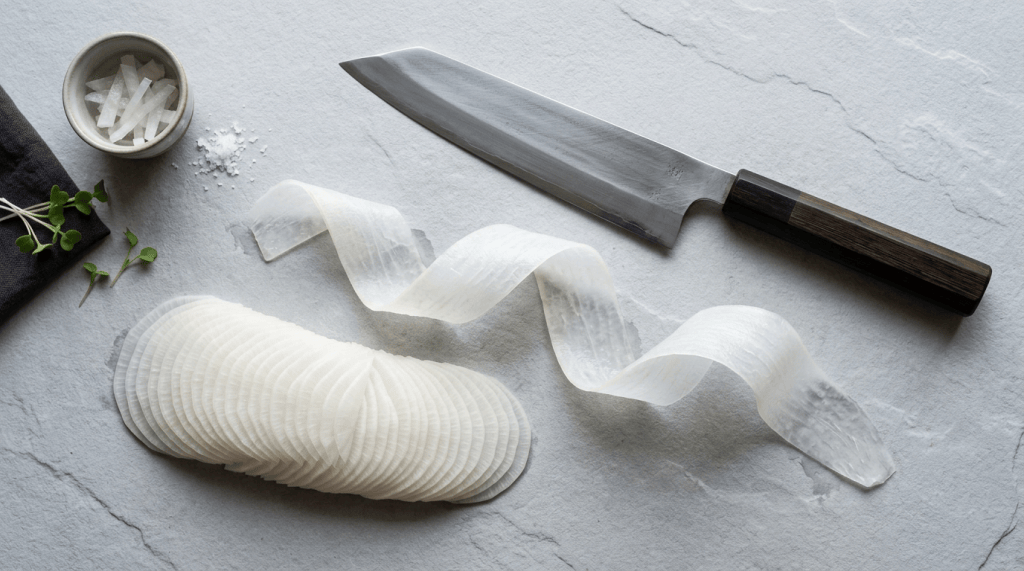
Katsuramuki is the Japanese art of peeling a single unbroken sheet from the circumference of a vegetable by rotating it against a stationary, angled blade. For daikon, the cook holds a peeled cylinder in one hand and uses the other to rotate it while the knife remains relatively still. The sheet should come away in one continuous spiral.
The exercise can be performed with a usuba, a yanagiba, or another suitable single-bevel knife. The exact tool matters less than the relationship between the blade, the vegetable, and the angle. With the flat side riding the surface of the daikon, the ura-suki contacts the sheet along a narrow strip while the hollow behind it reduces the drag that would occur if the entire flat side were rigidly flattened against the food. The sheet should release from the blade rather than bunch against it.
That release is one of the clearest demonstrations of why the ura matters. If the knife has been sharpened carelessly, if the hollow has been ground away, or if the ura-suki has become too broad, the sheet may stick, wrinkle, or tear as it leaves the blade. A ruined sheet can therefore teach something about the back of the knife that no diagram explains as clearly as touch.
The beginner should begin with a sheet thick enough to forgive small movements. A pencil-lead thickness is a useful starting point. The first goal is continuity rather than transparency. The cook wants one unbroken ribbon all the way around the daikon. A thick sheet allows the hand to learn the rhythm of rotation and feeding without every small error becoming an immediate tear. Only after the sheet survives the full turn should its thickness be reduced.
The difficulty is greater than it first appears because the cylinder changes as the peel progresses. At the beginning, the blade is working near a large radius. Toward the center, the surface becomes smaller and the geometry of contact changes. If the hand continues to rotate and feed at exactly the same rate, the sheet may thicken or thin unexpectedly. The cook has to read the shrinking daikon through the fingertips and adjust the pace without interrupting the motion.
That is why katsuramuki is more than an exercise in thinness. It is an exercise in sustained attention. A discrete cut can be corrected between repetitions. A rotary peel has no natural pause. The cook must hold one intention for the entire length of the action, feel the sheet leaving the blade, and continue even when the hand would prefer to stop and inspect the result. The exercise builds the ability to finish what has been begun.
The sound again becomes important. A continuous peel produces a quiet whisper similar to the whole-edge draw but sustained for a much longer passage. A sudden change in sound may signal that the sheet is beginning to catch, that the angle has shifted, or that the hand is moving too quickly for the changing radius. The cook does not need to see the sheet in order to know that the relationship between blade and vegetable is becoming unstable.
Once the sheet runs unbroken, the cook can reduce its thickness gradually. A thinner sheet may become translucent and catch the light, but the achievement should not be confused with speed or showmanship. A thick ribbon that comes off whole demonstrates control. A translucent ribbon demonstrates refinement built upon that control. The ladder matters more than the final display.
Katsuramuki also reveals the relationship between the vegetable knife and the sashimi knife. The sashimi slice is, in a sense, katsuramuki straightened out. The rotation is removed, the full length of the edge is extended, and the continuous peel becomes a single draw across a stationary block. The skill learned in the spiral becomes the foundation for the long, uninterrupted slice that follows.
One-Stroke Slicing
The one-stroke slice, often called hira-zukuri (平造り) in the context of sashimi, brings the earlier lessons together. The blade lies at a shallow angle, the flat side rests against the food, and the edge travels in one continuous draw from heel to tip. There is no pause, no sawing, and no rocking.
This motion matters beyond appearance. A cut through raw fish is not merely a division of material; it is a change in the texture of what is eaten. A crushed or hesitant cut damages the surface and can leave the fish cloudy, curled, or wet with released moisture. A clean single-bevel slice separates the flesh with less destruction and leaves a surface capable of reflecting light. The cook is not merely making a thinner piece. The cook is making a different eating experience.
A home cook does not need to practice on an expensive fillet to learn this motion. In fact, an expensive fillet can make the practice worse. The weight of expectation tightens the grip and encourages hesitation. A firm block of smoked tofu, a chilled slab of cooked fish, pressed fish, or the dense stalk of a leek gives the hand a stable object to cut without the emotional burden of wasting something valuable. The material should be firm enough to offer real resistance and uniform enough to reveal changes in angle.
The guiding hand has a different role in this exercise than it had in the earlier drills. The block remains stationary while each slice becomes a separate plane. The guiding fingers should be flat and steady, providing a wall against the movement of the blade. They do not advance the food between cuts. Their job is to remain still enough that the knife can move without dragging the ingredient sideways.
The first slices will show the common hesitations. A drag mark means the stroke stopped and then began again. A torn surface suggests that the blade was pushed into the food rather than drawn across it. Uneven thickness means the angle changed during the passage. A slice that catches on the blade as it finishes may indicate a food-release problem, sometimes caused by moisture or sometimes by a ura-suki that needs careful maintenance. These flaws are not embarrassments. They are specific lessons written on the surface of the food.
The first target is not a spectacularly thin slice. It is a clean, consistent slice that lies flat and separates in one motion. Once the cook can achieve that on a firm practice block, the same motion can be transferred to a small fillet of fish. The expensive ingredient should behave much like the cheap one because the skill was never in the fish. It was in the hand, in the maintained edge, and in the ability to remain present for the entire stroke.
The one-stroke slice is the point at which the curriculum introduces itself as a unified practice. The steering drill is present in the line. The whole-edge draw is present in the motion. The katsuramuki discipline is present in the sustained angle. The result should feel less like a series of technical corrections and more like one continuous act.
Deba Weight-Work
The deba introduces a different kind of resistance. It is heavier and thicker than the vegetable knives used in the previous exercises, but it remains a single-bevel blade with an acute edge and a hollow-backed geometry. Its weight should not be mistaken for permission to use force. The deba is most useful when the hand can allow its mass to do the work while the blade follows a seam or natural path through the food.
The temptation to press is strongest here. When the blade encounters resistance, the instinctive response is to push harder. A thick spine and a heavy handle make that response feel plausible, but an acute edge is not improved by being forced sideways or driven through bone. Twisting, prying, swinging, and striking are especially dangerous because they attack the edge in directions its geometry cannot absorb.
The exercise can use a small whole fish or a chicken leg, but the work should be slow and exploratory. In a joint, the seam is a place where resistance changes. The cook feels the blade settle toward that change rather than forcing it through the capsule. Along a fish skeleton, the bone becomes a map. The blade follows the curve of the structure instead of trying to defeat it. A quiet pop or whisper is a better sign than a crack or a hammering sound.
The successful deba cut is not necessarily the fastest or most forceful. It is the cut in which the hand recognizes resistance and changes its relationship to it. If the blade will not pass, it is not asking for more pressure. It is asking to be withdrawn, turned, or presented to another seam. The workhorse deba should be used for this lesson only when the cook is comfortable with the tool and the material. A delicate yanagiba should not be substituted simply because it is the knife already in hand.
The progress check is an absence of damage and an increase in ease. The joint opens with a quiet pop, the fish separates in clean sheets, and the blade reaches the end of the session without a chip, bend, or rolled edge. The cook has not proved that the knife is strong. The cook has learned that strength is not the same as force, and that the knife’s weight can be an ally when the hand remains quiet enough to direct it.
The Shape of a Practice Week
None of these exercises needs to become a daily ritual, nor should it be. Three short sessions a week, ten to fifteen minutes each, are enough when each session contains one exercise and a clear purpose. The ladder should be followed in order, but the calendar need not be rigid. A missed session does not require a punishing makeup session. The cook can return to the last exercise that received genuine attention and resume from there.
Spacing the sessions gives the body time to register a correction. It also prevents fatigue from turning practice into repetition without awareness. A short session with one question at its center is more useful than a long session in which the cook tries to complete every exercise at once. The session can begin with easy repetitions, spend its middle portion on one detail, and finish while the intended motion is still clear.
The inexpensive ingredients make this rhythm possible. A daikon, cucumber, block of tofu, or inexpensive fish substitute removes much of the hesitation that surrounds an expensive ingredient. The cook can make an imperfect cut, examine it, and try again without treating the mistake as a loss. The material is a measuring instrument, but it does not need to be precious to provide an honest reading.
A notebook or vault page gives the practice a memory beyond the session. A short record can note the exercise, the target, the thickness achieved, the number of repetitions, and what the hand and edge actually did. The most useful entry may be a sentence about where the cut wandered, where the sound changed, or whether the last repetitions felt more settled than the first. The log is not a report card designed to produce anxiety. It is a way of noticing whether the attention is working.
The knife should be a maintained workhorse, not a test of emotional courage. The ura and ura-suki deserve particular care because they are essential to release and guidance. The flat side may contact food or the board in a controlled way, but it should not slam, scrape, or be used as a lever. The edge should not meet bone as an impact. The deba exercise is the exception, and even there the intention is to follow a seam rather than strike through resistance.
A dull edge is not an invitation to press harder. If the blade begins to skip, tear, or demand increasing pressure, the cook should pause and distinguish between a dull edge and a poor presentation. A properly maintained edge is part of the practice, not an emergency repair after failure. The companion essay on [[Sharpening Japanese Single-Bevel Kiritsuke]] belongs to this same cycle because the exercises and the stones are partners: one builds the hand, while the other restores the geometry that lets the hand learn.
Reading Progress
The gratifying thing about these exercises is how readable they are. The cucumber stack either stands square or it does not. The daikon either separates in one clean passage or it tears and drags. The katsuramuki sheet survives the turn or breaks. The one-stroke slice lies flat or records the hesitation that made it curl. The deba joint opens with a quiet pop or announces the presence of a crack. The material does not flatter the cook or reinterpret an intention. It shows what happened.
The visible result is valuable, but it must be read intelligently. A thick square stack is evidence that the hand preserved a plane, even if thickness has not yet been refined. A very thin slice is not proof of mastery if it was produced by forcing the blade through a wavering path. The first kind of progress is usually the reduction of correction, not the pursuit of spectacle.
Across the exercises, progress appears as fewer interventions. At first, the hand constantly adjusts the wrist, tightens the grip, repositions the food, and stops the stroke. Later, the corrections become smaller. The cook feels the blade begin to pull and answers before the error becomes visible. Eventually, the hand anticipates the change in resistance and the cut remains continuous. Attention begins to operate ahead of failure.
The record makes this gradual change visible. A session that felt poor may have been limited by a dull edge, an unstable board, or fatigue rather than by a lack of ability. A session that looked ordinary may have contained a real breakthrough in continuity. Measurement supports attention, but it should not replace it. The cook can record thickness and count repetitions while also noticing breath, grip, sound, pressure, and the quality of the finished piece.
The most convincing sign of progress is not always a thinner result. It is a growing absence of unnecessary effort. The shoulders loosen. The grip stops whitening around the handle. The guiding hand becomes still without becoming rigid. The cook no longer braces against the knife’s direction and begins to move with it. The blade may feel quieter, not because the work has become effortless in every sense, but because the hand has stopped arguing with the cut.
The final sensation described in these exercises is the moment when the knife feels less like an object being operated and more like a direction through which attention is flowing. This is not a mystical disappearance of skill. The cook still chooses the angle and reads the food. The difference is that the hand, blade, ingredient, and breath no longer feel like separate problems. The stroke becomes one coordinated event.
The older vocabularies of ki (気), wa (和), and pneuma (πνεῦμα) can offer language for that experience, though they are not interchangeable. Ki can suggest the directing force of attention. Wa can describe the harmony among hand, blade, ingredient, board, and moment. Pneuma can evoke breath, continuity, and the capacity to sustain a movement without breaking it into anxious fragments. The words do not teach the cut, but they can help the cook recognize the quality of attention the cut is asking for.
A single-bevel knife is a demanding teacher because it makes inattention visible. It does not literally punish the careless cook, and it does not magically reward patience. It simply refuses to hide the consequences of a hurried grip, an unstable angle, or a dull edge. The patient cook benefits because small corrections have time to accumulate. The rushed cook may complete many strokes, but the knife records the same error in each one.
The Knife Gives Back What You Give It
It is easy to see a single-bevel knife as a purchase: an object to acquire, display, and perhaps keep at a respectful distance. Its steel, maker, finish, price, and provenance may become more compelling than its actual work in the kitchen. A beautiful yanagiba or kiritsuke can remain in a cabinet for years, while a modest single-bevel blade becomes an essential companion in the hands of a cook who has learned how to move it.
The knife is not merely waiting to be owned. It is a skill waiting to be learned. Its direction, angle, release, and relationship with resistance are already present in the steel, but they become usable only when the hand can feel them. The cook must learn when the edge is leading properly, when the flat side is guiding the cut, when the wrist is adding unnecessary pressure, and when the blade is being asked to perform a task it was not designed for.
The exercises make that relationship accessible. A cucumber can reveal a wandering line. A daikon can reveal a draw that stalls or tears. Fifteen minutes of focused practice can turn an abstract principle about steering into a sensation the hand remembers. The ingredients may be inexpensive enough to discard, but the knowledge they produce remains in the fingers, the eyes, and the body’s habit of pausing before applying force.
The knife gives back what the cook gives it, but the exchange is conditional. Attention produces clearer feedback. Care for the ura and ura-suki preserves the geometry that makes release possible. Respect for a dull edge produces a maintained edge rather than a damaged one. Repetition with a record produces a skill that can grow without being destroyed by impatience. The return is made from time, judgment, and the willingness to begin again.
The opposite is equally true. A knife twisted for leverage, dropped onto a hard board, or forced through resistance will return chips, rolling, uneven cuts, and uncertainty. Care does not mean keeping the blade permanently untouched. It means approaching the work with fewer assumptions and more accurate attention. Knowledge reduces needless fear. Respect does not make the knife fragile; it makes its demands intelligible.
A knife left in a drawer remains a purchase. A knife used with attention becomes a capability. The return will not be immediate or spectacular. It will appear in a square stack, a clean whisper, an unbroken sheet, a flat slice, a knife that survives the session without a chip, and eventually in the calm of a cook who no longer feels the need to overpower the tool.
The exercises are therefore not a retreat from real cooking. They are a way of preparing the hand for real cooking. They teach the cook to hold a line, draw an edge, sustain an angle, release food cleanly, and read resistance before it becomes an obstacle. The knife gives back what it is given because use makes it familiar, and attention makes that familiarity capable.
A cucumber, a daikon, and fifteen minutes are enough to begin. The rest is the patient work of returning, observing, adjusting, and returning again.




Leave a Reply