
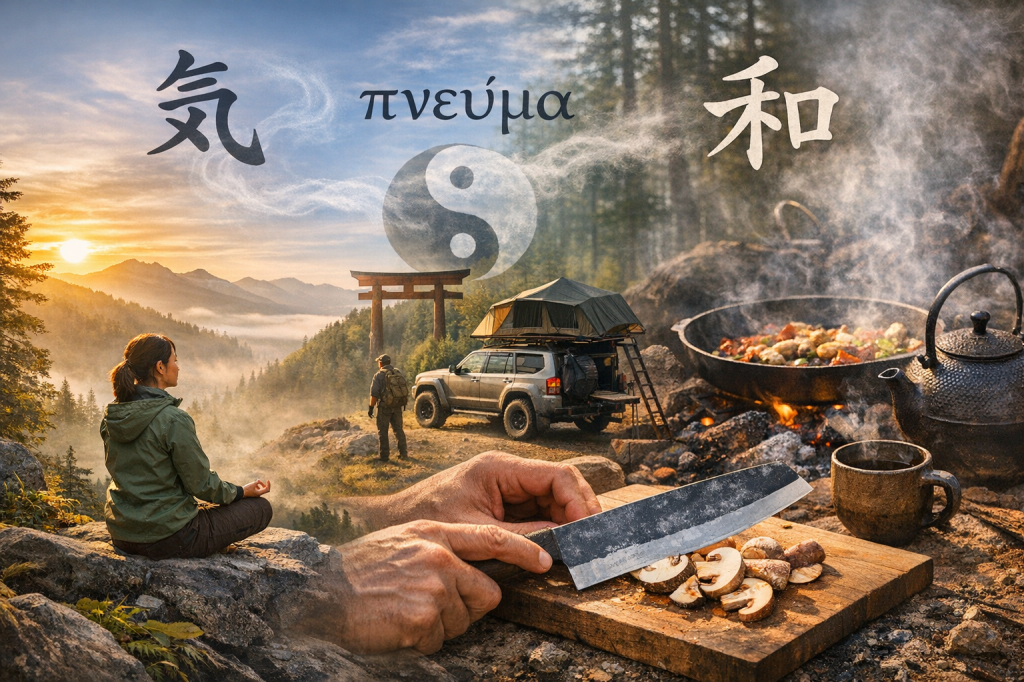
The philosophies of Japanese “Ki” (気) and Greek “Pneuma” (πνεῦμα) both center on the concept of vital energy or breath that animates life. Integrating these ancient ideas into modern activities—such as dispersed camping, overlanding, and camp cooking—can deepen our connection to nature, enhance mindfulness, and foster harmony (“Wa” 和) in our outdoor experiences. This essay explores practical ways to embody these philosophies, with a special focus on the use of Japanese single-bevel high carbon steel knives.
Understanding “Ki” and “Pneuma”
What is “Ki”?
“Ki” (気) is a foundational concept in Japanese philosophy and culture, often translated as “life force,” “energy,” or “spirit.” It is not a physical substance, but rather an invisible, animating essence that permeates all living things and the natural world. The idea of Ki is deeply embedded in traditional Japanese arts, martial disciplines, medicine, and daily life, shaping the way people perceive their relationship with themselves, others, and their environment.
At its core, Ki represents the dynamic flow of energy that sustains life. It is believed to circulate within the body, much like the concept of “Qi” in Chinese philosophy or “Prana” in Indian traditions. This energy is not static; it is in constant motion, interacting with the Ki of other people, animals, plants, and even the landscape itself. In Japanese thought, health, vitality, and harmony arise when Ki flows freely and abundantly, while stagnation or imbalance of Ki can lead to discomfort, illness, or discord.
Cultivating Ki is considered both an art and a discipline. Breathing is one of the most fundamental ways to nurture and regulate Ki. Practices such as deep, mindful breathing—whether in meditation, martial arts, or daily routines—are believed to draw in fresh Ki from the surrounding air and environment, revitalizing the body and mind. Movement is another essential aspect: traditional arts like Aikido, Kendo, and even the precise motions of tea ceremony or calligraphy are designed to harmonize and direct the flow of Ki, fostering a sense of centeredness and presence.
Mindful presence, or being fully engaged in the moment, is also integral to the cultivation of Ki. This means approaching each action—no matter how mundane—with awareness, intention, and respect. Whether preparing food with a single-bevel Japanese knife, walking through a forest, or simply sitting in stillness, the practitioner seeks to align their inner energy with the rhythms of nature and the task at hand. In this way, Ki becomes not just an abstract idea, but a lived experience that infuses daily life with vitality, clarity, and a sense of interconnectedness.
Ultimately, the concept of Ki invites us to recognize the subtle energies that animate our existence and to engage with the world in a way that is attentive, harmonious, and life-affirming. It encourages a holistic approach to living, where body, mind, and spirit are unified, and where every breath and movement becomes an opportunity to cultivate and express the vital force that connects us to all things.
What is “Pneuma”?
In Greek philosophy, “Pneuma” (πνεῦμα) is a profound and multifaceted concept that encompasses breath, spirit, and the very essence that animates living beings. The word itself is rooted in the act of breathing, and in ancient Greek, it literally means “wind” or “breath.” Yet, its significance extends far beyond the physical inhalation and exhalation of air. Pneuma is regarded as the vital force or principle that gives life to the body, a subtle substance or energy that bridges the material and the immaterial, the body and the soul.
Philosophers such as the Stoics and Galen developed the idea of Pneuma into a central tenet of their understanding of nature and human existence. For the Stoics, Pneuma was the active, organizing principle that pervades the cosmos, giving structure, coherence, and vitality to all things. It was seen as the breath of the divine, a rational and creative force that animates not only individual beings but the universe itself. In this sense, Pneuma is both personal and universal, present in every living creature and in the very air that surrounds us.
Within the human body, Pneuma was thought to circulate through the organs and tissues, sustaining life and health. The act of breathing was not merely a biological necessity but a sacred exchange with the world, a way of drawing in the animating spirit of the cosmos. This connection between breath and spirit is echoed in the language itself, where the same word can mean both “air” and “soul.” To cultivate Pneuma, then, is to become aware of the breath as a conduit for life energy, to recognize each inhalation as a renewal of vitality and each exhalation as a release of tension and stagnation.
In daily life, the awareness of Pneuma invites a sense of reverence for the simple act of breathing and for the invisible forces that sustain us. It encourages mindfulness, presence, and a harmonious relationship with the world, reminding us that we are not isolated entities but participants in a greater flow of energy and spirit. Whether through contemplative practices, physical movement, or moments of stillness in nature, the cultivation of Pneuma becomes a way to align oneself with the deeper rhythms of life, to nurture both body and soul, and to experience the world as alive with breath and possibility.
The Principle of “Wa” (Harmony)
The principle of “Wa” (和) is a cornerstone of Japanese culture, embodying the ideal of harmony, balance, and peaceful coexistence in all aspects of life. At its heart, Wa is about fostering a sense of unity and mutual respect, whether among individuals, within communities, or between humanity and the natural world. It is not simply the absence of conflict, but an active, ongoing effort to create and maintain equilibrium—an art of living that values subtlety, consideration, and the beauty of interconnectedness.
Wa manifests in countless ways, from the way people communicate and resolve disagreements to the design of spaces and the rituals of daily life. In social interactions, Wa encourages humility, empathy, and the suppression of ego for the greater good. It is reflected in the Japanese preference for consensus, the careful choice of words to avoid offense, and the gentle choreography of gestures that express gratitude and deference. This pursuit of social harmony is not about erasing individuality, but about recognizing the needs and feelings of others and finding a balance that allows everyone to coexist peacefully.
Beyond human relationships, Wa extends to the natural environment and the objects we use. In traditional Japanese arts—such as tea ceremony, flower arrangement, and calligraphy—there is a deep reverence for materials, tools, and surroundings. Every action is performed with mindfulness and respect, acknowledging the role that each element plays in the creation of beauty and meaning. This attitude is especially evident in the care given to tools like single-bevel high carbon steel knives, which are maintained with meticulous attention, cleaned and sharpened after each use, and handled with a sense of gratitude for their craftsmanship and utility.
In the context of nature, Wa inspires a harmonious relationship with the land, encouraging practices that minimize impact and honor the rhythms of the seasons. Whether camping, cooking outdoors, or simply walking through a forest, the principle of Wa invites us to move gently, to listen and observe, and to act as stewards rather than conquerors. It is a reminder that we are part of a larger whole, and that true fulfillment comes not from domination or excess, but from finding our place within the intricate web of life.
Ultimately, Wa is a living philosophy—a way of being that seeks to cultivate balance, respect, and tranquility in every moment. It teaches that harmony is not a static state, but a dynamic process that requires awareness, intention, and care. By embracing Wa, we learn to approach each interaction, each task, and each encounter with the world as an opportunity to create beauty, foster connection, and nurture the delicate balance that sustains us all1.
Summary
| Concept | Essence | Key Aspects | Practical Expression |
|---|---|---|---|
| Ki (気) | Japanese life force or vital energy | Invisible, animating essence flowing through all living things; cultivated through breath, movement, and mindful presence | Deep, intentional breathing; mindful movement; engaging fully in each action to harmonize inner energy with the environment |
| Pneuma (πνεῦμα) | Greek breath, spirit, or animating principle | Breath as both physical and spiritual sustenance; connects body and soul, individual and cosmos | Awareness of breath as life-giving; seeing each inhalation/exhalation as renewal; aligning with the greater flow of energy and spirit |
| Wa (和) | Japanese ideal of harmony and balance | Peaceful coexistence, respect for others, nature, and tools; ongoing creation of equilibrium | Acting with humility and empathy; caring for tools and surroundings; minimizing impact and fostering unity in all interactions |
Thank you, Izzy, for being a gentle and steadfast teacher of Ki, Pneuma, and Wa throughout your life. In your presence, I learned to sense the subtle energy that flows between beings—the quiet Ki that animated your joyful leaps and the calm you brought to every room. Through your steady breath and the simple rhythm of our days together, you revealed the essence of Pneuma, reminding me to cherish each moment as a sacred exchange of spirit and life. Most of all, you embodied Wa, living each day with harmony, respect, and a boundless capacity for peaceful coexistence—with people, with nature, and with every creature you met. Your companionship was a lesson in balance and gratitude, and though you have moved on, the gifts you shared remain woven into the fabric of my life. Thank you, Izzy, for showing me how to live with energy, spirit, and harmony.
Applying “Ki” and “Pneuma” to Dispersed Camping and Overlanding
Mindful Preparation
Applying the philosophies of Ki and Pneuma to dispersed camping and overlanding begins long before you set foot on the trail or turn the ignition key. Mindful preparation is the first act in this journey, a process that invites you to cultivate awareness and intention from the very outset. Rather than treating trip planning as a checklist of tasks to be completed, it becomes a ritual of attunement—a way to harmonize your inner energy with the adventure ahead.
As you prepare, consider the flow of Ki and Pneuma as a current that connects your home life to the wild spaces you seek. This means pausing to reflect on your motivations, your state of mind, and the kind of experience you wish to create. Packing becomes an act of discernment, where each item is chosen not out of habit or fear of lack, but with a clear sense of purpose. By selecting only what is truly necessary, you honor the principle of balance, ensuring that your load is light and your impact on the land is minimal. This restraint is not about deprivation, but about creating space—both physically and mentally—for the energies of the natural world to flow freely around and through you.
In this way, mindful preparation transforms the mundane details of logistics into a practice of presence. You become attuned to the subtle interplay between your needs and the environment, between comfort and challenge, between self-sufficiency and humility. The journey begins not at the trailhead, but in the quiet moments of intention and care that precede it, setting the tone for an experience where Ki and Pneuma can be felt in every breath, every step, and every encounter with the wild.
Breathing with the Land
Breathing with the land is a practice that bridges the philosophies of Ki and Pneuma, inviting you to become fully present and receptive to the spirit of the place as soon as you arrive. Stepping out into a new landscape—whether it’s a quiet forest clearing, a windswept ridge, or a secluded riverside—offers a moment of transition, a threshold between the world you’ve left behind and the one you are entering. Instead of rushing to set up camp or immediately engaging in activity, you pause and allow yourself to simply be, letting the journey settle within you.
In this pause, you draw in deep, conscious breaths, feeling the coolness or warmth of the air, the scent of earth and foliage, the subtle movements of wind. Each inhalation is an act of communion, drawing the energy of the land—its Ki or Pneuma—into your own body. With every exhalation, you release tension, distractions, and the residue of travel, making space for a new rhythm to take hold. This slow, deliberate breathing is more than a relaxation technique; it is a way of attuning your senses and spirit to the environment, acknowledging that you are now a guest in a living, breathing world.
As you continue to breathe with intention, you may notice your awareness sharpening. The sounds of birds, the rustle of leaves, the play of light and shadow become more vivid. Your heartbeat slows, your mind quiets, and you begin to feel a subtle alignment with the landscape. In this state of presence, you are no longer separate from your surroundings but part of a greater flow of energy and life. Breathing with the land becomes a silent greeting, a respectful introduction, and a foundation for all that follows—whether it’s setting up camp, exploring, or simply sitting in stillness, open to the wisdom and vitality of the wild.
Moving with Awareness
Moving with awareness transforms the practical tasks of setting up camp into a series of intentional, almost meditative rituals. As you unpack your gear and choose a place for your shelter, you do so with a heightened sense of presence, each gesture deliberate and considered. The act of driving a tent stake, unrolling a sleeping mat, or arranging your cooking area becomes more than mere preparation; it is a way of channeling your own Ki or Pneuma into the space, infusing it with calm, focused energy. You notice the texture of the ground beneath your hands, the way the light shifts through the trees, and the subtle interplay of sounds around you.
By moving quietly and respectfully, you signal to the land and its inhabitants that you are not an intruder, but a mindful participant in the ecosystem. Your footsteps are light, your voice subdued, and your actions gentle, all aimed at minimizing disturbance to the delicate balance of the environment. This approach not only protects wildlife and preserves the integrity of the landscape, but also deepens your own sense of belonging and connection. You become attuned to the rhythms of the place, adapting your pace and movements to fit the contours of the land rather than imposing your own will upon it.
In this way, every aspect of camp setup—no matter how routine—becomes an opportunity to practice reverence and gratitude. You are reminded that your presence is temporary and that the land will continue to breathe and flourish long after you have moved on. By moving with awareness, you cultivate a relationship of mutual respect, allowing the flow of Ki and Pneuma to guide your actions and root you more deeply in the experience of wildness and harmony.
Camp Cooking: A Ritual of Energy and Harmony
The Role of the Knife
In the context of camp cooking, the act of preparing food becomes a deeply intentional ritual when approached through the lens of energy and harmony. The Japanese single-bevel high carbon steel knife, with its storied lineage and precise craftsmanship, is not merely a utensil but a conduit for your own Ki and Pneuma. As you hold the knife in your hand, you can feel the balance of its weight, the coolness of the steel, and the subtle memory of the artisan’s touch that shaped it. Before the first ingredient is sliced, there is a quiet moment of acknowledgment—a pause to honor the tool’s history, the skill embedded in its creation, and the generations of cooks and chefs who have wielded similar blades.
This moment of appreciation is more than a gesture of respect; it is a way of aligning your own energy with that of the knife, inviting a sense of partnership between human and tool. The knife becomes an extension of your intention, translating the flow of your breath and movement into each cut. As you begin to prepare your meal, the single-bevel edge glides through vegetables and proteins with a precision that feels almost effortless, yet demands your full attention. Every slice, every motion, is an opportunity to channel your focus and presence, to move in harmony with the materials before you.
The ritual of using such a knife in the wild, surrounded by the sounds and scents of nature, heightens your awareness of the interconnectedness of all things. The food you prepare is not just sustenance, but a celebration of the land’s bounty and the culmination of countless energies—sun, soil, water, and human care. In this way, camp cooking transcends mere necessity, becoming a mindful practice where the boundaries between self, tool, and environment dissolve. The knife, in your hands, is a bridge between tradition and the present moment, a symbol of respect for both the craft and the natural world that provides. Through this ritual, you cultivate not only nourishment but also a profound sense of harmony and gratitude, infusing your meal with the spirit of Ki and Pneuma.
The Significance of “Itadakimasu”: Cultivating Inner Balance and Gratitude
Integral to the ritual of camp cooking and the broader philosophy of harmony is the Japanese practice of saying “itadakimasu” before a meal. More than a simple phrase, “itadakimasu” (いただきます) is a profound expression of gratitude and humility, acknowledging the interconnected web of life that makes nourishment possible. When spoken with intention, it becomes a moment of inner balance—a pause to recognize not only the food itself, but also the hands that prepared it, the natural forces that nurtured it, and the life that was given so that you may be sustained.
In the context of dispersed camping and outdoor cooking, “itadakimasu” takes on an even deeper resonance. Surrounded by the living world, you become acutely aware of the journey each ingredient has taken, from earth and water to your table beneath the open sky. By quietly bowing your head and offering thanks, you align your own Ki and Pneuma with the spirit of the land, reinforcing a sense of respect and responsibility. This act of gratitude is not just directed outward, but also inward, fostering a sense of humility and presence that grounds you in the moment.
“Itadakimasu” serves as a gentle reminder that eating is never a solitary act; it is a communion with nature, with those who came before, and with the energies that sustain all life. By making this practice part of your camp cooking ritual, you cultivate a deeper appreciation for the food you receive and the balance it brings to your body and spirit. In this way, “itadakimasu” becomes a touchstone for harmony, gratitude, and mindful living, infusing each meal with meaning and reinforcing your connection to the world around you2.
Preparing Food with Ki and Pneuma
Preparing food with Ki and Pneuma transforms the simple act of slicing and chopping into a meditative practice, where every movement is infused with intention and awareness. As you stand at your makeshift camp kitchen, the world narrows to the rhythm of your breath and the gentle, precise motion of your hand guiding the knife. The Japanese single-bevel blade becomes an extension of your body, translating the energy within you—your Ki or Pneuma—into each cut. There is a quiet satisfaction in feeling the resistance of a carrot give way beneath the edge, or watching a leaf of cabbage fall away in a perfect, clean slice.
With each motion, you are not simply processing ingredients, but participating in a flow of energy that connects you to the food, the land, and the present moment. Your breathing becomes steady and deep, anchoring your mind and body in the here and now. This conscious breath not only calms the mind but also guides your movements, ensuring that each action is smooth, deliberate, and free from haste. The repetitive nature of chopping and slicing, when approached with this level of mindfulness, becomes almost like a moving meditation, dissolving distractions and allowing you to fully inhabit the task at hand.
In this state, the boundaries between cook, tool, and ingredient begin to blur. You sense the life that once animated the vegetables, the subtle fragrance released with each cut, and the interplay of textures beneath your fingers. The act of preparing food becomes a dialogue—a respectful exchange of energy—where you honor the ingredients by handling them with care and attention. This mindful approach not only enhances the flavors and textures of the meal but also nourishes your own spirit, fostering a sense of gratitude and harmony that lingers long after the meal is finished. In the quiet of the wild, surrounded by the elements, preparing food with Ki and Pneuma becomes a celebration of life’s interconnectedness, a ritual that grounds you in the moment and connects you to something greater than yourself.
Practicing “Wa” in Camp Cooking
Practicing “Wa” in camp cooking is about weaving harmony and mutual respect into every aspect of the meal, from preparation to cleanup. As you gather with companions around the campfire or a makeshift table, the act of sharing tasks becomes a gentle choreography of cooperation. Each person finds their place in the rhythm of the meal—one tending the fire, another washing vegetables, someone else slicing with the cherished Japanese knife. There is an unspoken understanding that everyone’s contribution matters, and this shared effort creates a sense of unity that is both practical and deeply nourishing to the spirit.
The meal itself becomes a celebration of togetherness, where food is passed around, stories are exchanged, and laughter mingles with the sounds of the wild. In these moments, the boundaries between individuals soften, replaced by a collective sense of gratitude and enjoyment. The spirit of Wa is present in the way you listen to each other, accommodate different needs, and savor the meal not just as sustenance, but as a communal experience that strengthens bonds.
After the meal, attention turns to the tools that made it possible. Cleaning and caring for your knife and other utensils is not a chore to be rushed, but a continuation of the same mindful respect that guided the cooking. You rinse the blade carefully, dry it with intention, and perhaps take a moment to admire the subtle sheen of the steel or the warmth of the handle. This act of maintenance is a quiet acknowledgment of the knife’s role in your experience—a gesture of gratitude for its reliability and craftsmanship. By treating your tools with care, you honor the interconnectedness of all things: the people who made the knife, the ingredients it transformed, and the companions who shared in the meal.
In this way, practicing Wa in camp cooking is about more than just efficiency or etiquette. It is a living expression of harmony, where every action—no matter how small—contributes to a sense of balance and respect that lingers long after the fire has burned down and the dishes are put away. Through these rituals, you cultivate a deeper appreciation for the simple joys of shared meals and the quiet beauty of working together in nature.
Integrating Philosophy into Daily Outdoor Life
Morning Rituals
Integrating the philosophies of Ki, Pneuma, and Wa into daily outdoor life begins with the quiet, intentional rituals that shape the start of each day. As dawn breaks and the world stirs to life, you find a moment of stillness, perhaps sitting at the edge of your camp or standing beneath the open sky. The air is fresh and filled with possibility, and you greet the morning not with haste, but with a deliberate pause to center yourself. Drawing in a slow, deep breath, you feel the coolness of the air filling your lungs, awakening your body and mind. With each inhalation, you imagine drawing in Ki or Pneuma—the vital energy that animates all living things—allowing it to circulate within you, replenishing your spirit after the rest of the night.
As you continue this breathing exercise, your thoughts settle and your awareness sharpens. You set a quiet intention for the day, perhaps focusing on harmony, gratitude, or openness to whatever experiences may come. This act of intention is not about rigid goals, but about aligning your inner state with the natural rhythms around you, inviting a sense of balance and receptivity.
After grounding yourself through breath, you turn your attention outward, observing the world in silence. The subtle energies of the land become more apparent: the gentle sway of grasses in the breeze, the distant call of a bird, the shifting patterns of light and shadow. You notice the way the earth feels beneath your feet, the scent of dew on the air, and the intricate web of life unfolding all around you. In this state of quiet observation, you attune your senses to the presence of Ki and Pneuma in the landscape, recognizing that you are part of a living, breathing world.
This morning ritual, simple as it may seem, sets the tone for the rest of the day. It cultivates a sense of presence and harmony that infuses your actions, whether you are hiking, cooking, or simply resting in the shade. By beginning each day with breath and mindful observation, you carry the philosophies of Ki, Pneuma, and Wa with you, allowing them to guide your interactions with nature, with others, and with yourself. The result is a deeper, more meaningful connection to the world, and a daily life that feels both grounded and inspired.
Mindful Movement
Mindful movement in the outdoors is a practice of bringing full awareness to every action, no matter how routine or seemingly insignificant. Whether you are hiking along a winding trail, navigating a rugged road behind the wheel, or preparing a meal at your campsite, you remain attuned to the rhythm of your breath and the subtle flow of energy within your body. Each step, each turn of the steering wheel, each motion of your hands as you chop or stir, becomes an opportunity to cultivate presence and intention.
As you walk through the landscape, you notice the sensation of your feet meeting the earth, the gentle rise and fall of your chest with each breath, and the way your muscles engage and release. Instead of rushing to reach a destination or allowing your mind to wander, you focus on the experience of movement itself, letting it become a form of meditation. The world around you sharpens into focus—the texture of the path, the play of sunlight through the trees, the chorus of sounds that accompanies your journey. This heightened awareness not only deepens your connection to the environment but also helps you move more efficiently and safely, as you become more responsive to the terrain and your own physical state.
When driving, you bring the same sense of mindfulness to the act of guiding your vehicle. You grip the wheel with relaxed attention, feeling the subtle feedback from the road and responding with calm, measured adjustments. The hum of the engine, the shifting scenery, and the interplay of light and shadow outside the window all become part of a larger tapestry of experience. By remaining present, you reduce stress and fatigue, making the journey itself as meaningful as the destination.
In camp cooking, mindful movement is expressed through the deliberate handling of ingredients and tools. You slice, stir, and serve with care, aware of the energy you bring to each task. Distractions and haste fall away, replaced by a sense of flow and satisfaction in the process. This purposeful approach not only enhances the quality of your meals but also infuses the entire experience with a sense of calm and fulfillment.
Ultimately, mindful movement is about honoring the present moment and the energy that animates your actions. By moving with awareness, you avoid the pitfalls of haste and distraction, allowing each activity—no matter how ordinary—to become a source of connection, balance, and quiet joy.
Evening Reflection
As dusk settles and the world softens into twilight, evening reflection becomes a gentle closing ritual that gathers the day’s experiences into a space of calm awareness. The air cools, the light fades, and the landscape takes on a quieter, more contemplative mood. In this tranquil atmosphere, you find a comfortable spot—perhaps by the dying embers of a campfire or beneath a canopy of stars—and allow yourself to look back over the day’s journey. You recall the moments when you felt most attuned to your surroundings, when your actions flowed effortlessly and harmoniously, and when the boundaries between yourself, your companions, and the land seemed to dissolve. These memories might be as simple as the shared laughter during a meal, the silent awe of a sunrise, or the rhythmic cadence of your footsteps along a forest path.
As you reflect, you become aware of the subtle energies that shaped your day—the Ki and Pneuma that moved through your breath, your body, and your interactions. You notice how certain moments felt charged with vitality and presence, while others may have carried tension or distraction. This gentle review is not about judgment, but about recognizing the patterns of harmony and imbalance, and learning from them. It is an opportunity to deepen your understanding of how your intentions, actions, and awareness influence your experience of the world.
With this insight, you turn your thoughts to gratitude. You offer silent thanks to the land that welcomed and sustained you, acknowledging its beauty, resilience, and generosity. You remember your companions, whether human or animal, and appreciate the ways in which their presence enriched your journey—through shared effort, kindness, or simply the comfort of company. You also honor the tools that supported you, from the sturdy boots that carried you over rough ground to the finely crafted knife that transformed raw ingredients into nourishing meals. Each of these elements played a role in the unfolding of your day, and by expressing gratitude, you reinforce the sense of interconnectedness and respect that lies at the heart of Ki, Pneuma, and Wa.
This evening reflection, quiet and unhurried, becomes a way to integrate the lessons and gifts of the day. It prepares you for rest, inviting a sense of closure and peace, and sets the stage for another day of mindful engagement with the world. In this way, the practice of evening reflection transforms the end of the day into a sacred pause—a moment to honor the harmony you have cultivated and to carry its gentle energy forward into tomorrow.
Conclusion
When we intentionally weave the philosophies of Ki and Pneuma into our outdoor adventures—whether dispersed camping in a remote forest, overlanding across rugged terrain, or preparing a simple meal beneath the open sky—we elevate these experiences from mere recreation to acts of mindful living. Ki, the Japanese concept of vital energy, and Pneuma, the Greek notion of animating breath and spirit, invite us to approach each moment with heightened awareness of the life force that pulses through ourselves, our companions, and the natural world. These philosophies encourage us to move, breathe, and act with intention, transforming the ordinary motions of setting up camp, hiking, or cooking into rituals that ground us in the present and connect us to something larger than ourselves.
The spirit of Wa, or harmony, serves as the thread that binds these practices together. It reminds us that our presence in nature is not a solitary endeavor, but a dance of coexistence—with the land, with those who share our journey, and with the tools that support us. The Japanese single-bevel high carbon steel knife, for example, becomes more than a piece of equipment; it is a symbol of respect for tradition, craftsmanship, and the interconnectedness of all things. By caring for our tools, sharing tasks and meals, and moving with awareness, we embody Wa, fostering a sense of balance and unity that enriches every aspect of our outdoor life.
Through this conscious integration, even the most routine activities take on new significance. The act of breathing deeply as we greet the morning, the deliberate movements as we prepare food, the quiet gratitude expressed at day’s end—all become opportunities to cultivate energy, harmony, and presence. These moments of mindfulness ripple outward, shaping not only our time in the wild but also the way we engage with daily life upon our return. We carry with us a renewed sense of connection—to the earth, to each other, and to the quiet, vital energy that animates all things.
By embracing Ki, Pneuma, and Wa, we transform our journeys into ongoing practices of self-discovery and reverence. The wilderness becomes a living classroom, teaching us to move gently, to listen deeply, and to honor the intricate web of relationships that sustain us. In this way, every adventure—no matter how small—becomes a sacred opportunity to nurture the spirit, cultivate harmony, and live with greater intention and gratitude.
- For more on “Wa,” check out my previous essay, “Cultivating ‘Wa:’ Mindful Cooking in Nature” ↩︎
- For more on “itadakimasu,” check out my previous essay, “Exploring ‘Itadakimasu’ in Christian Context” ↩︎




 UTAZCO Overland
Leave a Reply