
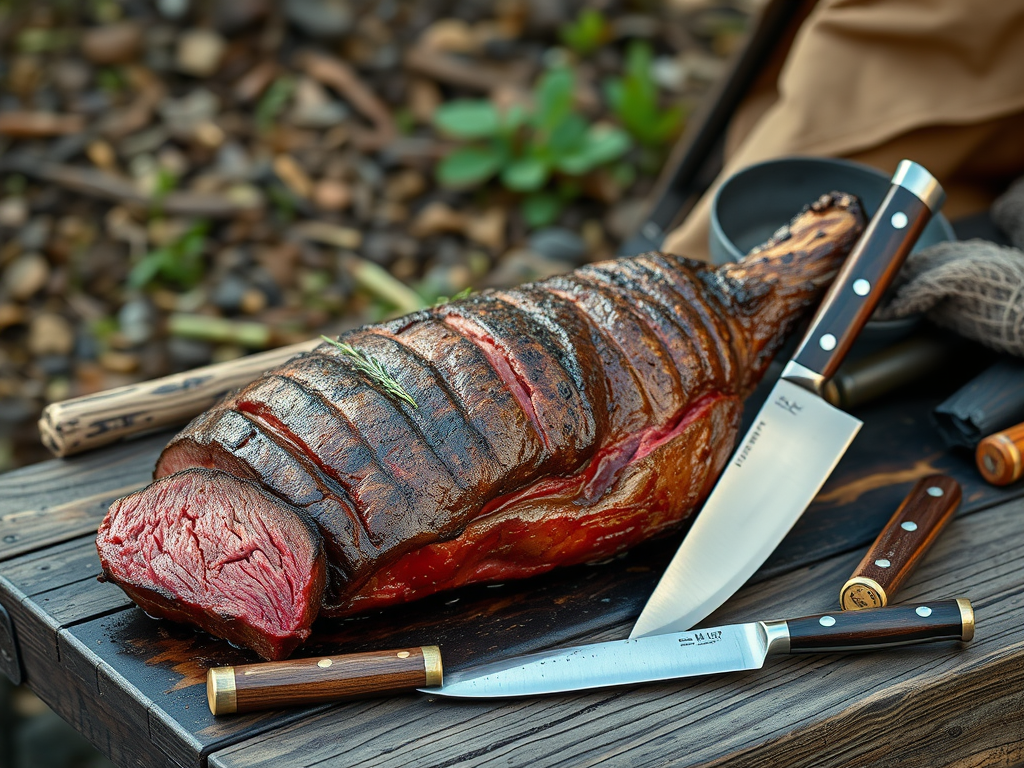
My Preferred Knives: At Home and When Camping
At home, I enjoy using a range of specialized knives tailored to each task for the best culinary results. For proteins, my Deba is indispensable, offering the heft and control needed to break down fish and other meats with precision. When preparing vegetables, I reach for my Usuba, which excels at making clean, delicate cuts and intricate garnishes. For precision slicing—especially for sashimi or fine presentation—I rely on my Yanagiba, while my Kiritsuke serves as a versatile all-rounder when I’m in a hurry and need a blade that can handle both proteins and vegetables efficiently. On busy days when speed and minimal clean-up are priorities, my stainless-steel Chinese cleaver becomes my go-to, allowing me to quickly chop, slice, and transfer ingredients with ease.
When camping, I streamline my kit and bring my Kiritsuke as my primary cooking knife. Its versatility and sharpness make it well-suited for a variety of camp food prep tasks, from slicing proteins to chopping vegetables, while still allowing me to enjoy the precision and tradition of Japanese cutlery in the outdoors. This approach lets me balance efficiency and quality, whether I’m cooking at home or around the campfire.
The world of knives is as diverse as the tasks they are designed to perform. Nowhere is this more evident than in the contrast between high-HRC, thin-ground Japanese kitchen knives and the rugged, thick-bladed Western-style survival knives. When it comes to camp food preparation, the choice between these two traditions is not merely a matter of aesthetics or heritage—it is a question of efficiency, durability, and suitability for the environment.
Japanese Knives: Precision Forged for Culinary Excellence
High-HRC, Thin-Ground Blades: The Hallmark of Japanese Craftsmanship
Japanese knives are celebrated worldwide for their extraordinary sharpness, precision, and beauty. This reputation is rooted in their unique construction: high Rockwell hardness (HRC) steels and thin, finely ground blades. Let’s break down what this means and how it impacts their use in camp cooking.
What is High-HRC and Thin-Ground?
- High-HRC Steels: Japanese knives are often made from steels like Blue (Aogami) or White (Shirogami) carbon steel, which can be hardened to 60–65 HRC or higher. This is significantly harder than most Western knives, which typically range from 55–58 HRC.
- Thin-Ground Blades: The blade is ground to a very acute angle, sometimes as low as 10–15 degrees per side (or even less for single-bevel knives). This creates an edge that is incredibly sharp and can be honed to a near-microscopic fineness.
Advantages in Camp Cooking
Effortless Slicing
- Ultra-Sharp Edges: The combination of high hardness and thin geometry means these knives glide through ingredients with minimal resistance. Whether you’re slicing tomatoes, filleting fish, or prepping delicate herbs, the knife does most of the work.
- Efficiency: This sharpness is especially valuable in camp settings, where you may want to maximize yield from limited ingredients or prepare food quickly after a long day outdoors.
Clean Cuts
- Preserving Texture and Flavor: A sharp, thin blade causes less cellular damage to food. For example, when slicing fish for sashimi or vegetables for salads, the cuts are so clean that the texture remains pristine and the flavors are not muddied by bruising or tearing.
- Aesthetic Presentation: Even in the wild, a Japanese knife allows you to create beautifully presented dishes—thin cucumber ribbons, precise vegetable julienne, or perfectly sliced sashimi.
Lightweight Handling
- Reduced Fatigue: Japanese knives are often lighter and more nimble than their Western counterparts. This makes repetitive prep tasks—like chopping a pile of onions or slicing a catch of fish—less tiring, which is a real benefit after a day of hiking or paddling.
Limitations in Camp Settings
Fragility
- Brittle Edges: The very hardness that gives Japanese knives their sharpness also makes them more brittle. If you hit a bone, frozen food, or a hard surface (like a rock or metal camp table), the edge can chip or even break.
- Not for Heavy-Duty Tasks: These knives are not designed for prying, splitting wood, or cutting through joints and bones—common tasks in some camp kitchens.
Maintenance
- Susceptibility to Rust: High-carbon steels like Blue and White steel are not stainless. They will rust or develop patina quickly if left wet or dirty. In a camp setting, where water and cleaning supplies may be limited, this can be a significant drawback.
- Sharpening Needs: Maintaining the razor edge requires proper sharpening stones and technique, which may not be practical to bring or use outdoors.
Single-Purpose Design
- Specialization: Many traditional Japanese knives are highly specialized:
- Yanagiba: Designed almost exclusively for slicing raw fish.
- Usuba: Meant for precision vegetable work.
- Deba: For breaking down fish, but not for general chopping.
- Limited Versatility: While these knives excel at their intended tasks, they may not adapt well to the unpredictable and varied demands of camp cooking, where one knife often needs to do it all.
Japanese knives with high-HRC, thin-ground blades are marvels of culinary engineering, offering unmatched sharpness, precision, and beauty. In camp cooking, they can elevate your food prep to an art form—if you have the skill, care, and conditions to use them properly. However, their fragility, maintenance needs, and specialized nature mean they are best suited for campers who prioritize gourmet meals and are prepared to handle their knives with respect and diligence. For most, a more robust and versatile blade may be the wiser choice, but for those who value culinary excellence above all, Japanese knives remain the gold standard.
Western-Style Survival Knives: Built for Rugged Versatility
Thick, Tough Blades: The Backbone of Outdoor Utility
Western-style survival knives are the quintessential tools for the outdoorsman, designed with the unpredictability and harshness of wilderness environments in mind. Their construction and materials reflect a philosophy of resilience and adaptability, often at the expense of culinary refinement.
Construction and Materials
- Blade Thickness and Geometry: Survival knives typically feature a thick spine (often 4–6 mm or more), a robust tip, and a wide, wedge-shaped grind. This geometry is engineered to withstand heavy impacts and lateral stresses.
- Steel Choices: Common steels include 1095 high-carbon, various stainless alloys (like 440C, AUS-8, or S30V), and tool steels. These are chosen for their toughness, ease of field sharpening, and resistance to corrosion.
- Edge Profile: The edge is ground at a wider angle (often 20–25 degrees per side), prioritizing edge retention and durability over razor sharpness.
Advantages in Camp Cooking
Durability
- Withstands Abuse: The thick, tough blade can handle tasks that would instantly damage a Japanese kitchen knife—batoning wood for fire, prying open containers, or hacking through bone and cartilage.
- Reliable in Emergencies: If you need to split kindling, dig a hole, or use your knife as a makeshift hammer, a survival knife is up to the challenge.
Versatility
- One Tool, Many Jobs: In a minimalist or survivalist camp setup, a single knife may need to perform food prep, fire-making, shelter construction, and even first aid. The survival knife’s design allows it to transition between these roles seamlessly.
- Reduces Pack Weight: Carrying one robust knife instead of several specialized tools simplifies your gear and lightens your load.
Low Maintenance
- Corrosion Resistance: Many survival knives are made from stainless steel or have protective coatings, making them less susceptible to rust in wet, muddy, or salty environments.
- Field Sharpening: The softer steel and thicker edge can be sharpened with basic tools (even a river stone in a pinch), and minor edge damage is less catastrophic.
Limitations in Camp Cooking
Crude Cuts
- Lack of Precision: The thick edge and lower hardness mean the knife is not optimized for fine slicing. When chopping vegetables, the blade may wedge or crush rather than glide through, resulting in uneven cuts and bruised produce.
- Difficult Fine Work: Tasks like filleting fish, making thin sashimi, or creating decorative garnishes are challenging, if not impossible, with a survival knife.
Weight and Ergonomics
- Heavier Blades: The added mass, while useful for chopping and splitting, can cause hand fatigue during extended food prep. The balance is often forward-heavy, which is less comfortable for delicate kitchen tasks.
- Bulky Handles: Designed for grip and leverage, survival knife handles may feel unwieldy when performing repetitive or precise culinary work.
Overkill for Food
- Not Designed for Culinary Finesse: The survival knife’s primary mission is to keep you alive in the wild, not to produce restaurant-quality meals. Tasks like dicing onions, mincing herbs, or slicing tomatoes thinly are awkward and inefficient.
- Potential for Cross-Contamination: Using the same knife for food, wood, and other camp chores increases the risk of introducing dirt or bacteria into your meals.
Western-style survival knives are the ultimate expression of rugged utility. Their thick, tough blades are built to endure the harshest conditions and the most demanding tasks, making them indispensable for survival and general camp chores. However, this durability comes at the cost of culinary precision. While they can certainly handle basic food prep, they are blunt instruments compared to the surgical sharpness of Japanese kitchen knives. For campers who value simplicity, reliability, and the ability to tackle any challenge with a single tool, the survival knife is unmatched. But for those who aspire to gourmet camp cooking, its limitations in finesse and comfort are significant trade-offs.
Comparative Analysis: Efficiency in Camp Food Preparation
Cutting Performance
Japanese Knives: Masters of Precision and Finesse
- Slicing and Dicing: Japanese knives, such as the santoku, kiritsuke, and usuba, are engineered for exceptional sharpness and control. Their thin, acute edges glide effortlessly through vegetables, meats, and fish, enabling paper-thin slices and uniform dice. This is especially valuable when preparing dishes that rely on precise cuts for even cooking or elegant presentation—think sashimi, stir-fries, or salads.
- Fine Prep and Delicate Tasks: The razor-sharp edge and refined geometry allow for intricate work, such as julienning carrots, chiffonading herbs, or peeling and shaping vegetables for decorative garnishes. Even in a camp setting, these knives can elevate the quality and appearance of your meals, making them ideal for campers who enjoy gourmet cooking or want to impress their companions.
- Texture and Ingredient Integrity: Because Japanese knives cut cleanly rather than crush, they preserve the cellular structure of ingredients. This means crisper vegetables, juicier meats, and more vibrant flavors—qualities that can make a noticeable difference, even in the outdoors.
Survival Knives: Built for Utility, Not Refinement
- Rough Chopping and Basic Prep: Survival knives are designed for durability and versatility, not culinary precision. Their thicker, less acute edges can handle chopping root vegetables, quartering potatoes, or slicing through sausage and cheese. For basic camp meals—stews, grilled meats, or rustic vegetable medleys—they are more than adequate.
- Struggles with Delicate Tasks: The robust edge geometry and heavier blade make it difficult to perform fine prep. Tasks like filleting a fish, making thin tomato slices, or mincing garlic become awkward and imprecise. The knife may wedge or crush soft ingredients, leading to uneven cuts and loss of texture.
- Compromised Presentation: While survival knives can get the job done, the results are often less visually appealing. Chopped vegetables may be irregular, and delicate proteins may tear rather than slice cleanly. For campers who prioritize efficiency and ruggedness over aesthetics, this may be an acceptable trade-off.
Practical Examples
| Task | Japanese Knife Performance | Survival Knife Performance |
|---|---|---|
| Slicing tomatoes | Ultra-thin, clean slices, no crushing | Tends to crush, uneven slices |
| Filleting fish | Precise, smooth cuts, minimal waste | Difficult, risk of tearing flesh |
| Chopping onions | Fast, uniform dice, minimal bruising | Coarse, uneven pieces, more effort required |
| Julienning carrots | Consistent, fine matchsticks | Challenging, often results in thick sticks |
| Cutting through bone | Not recommended, risk of chipping | Handles with ease, designed for such tasks |
| Batoning wood | Not possible, blade will likely break | Designed for it, no problem |
Summary
- Japanese Knives:
- Excel in tasks where sharpness, control, and presentation are important.
- Enable gourmet-level food prep, even in the wild.
- Best for campers who value culinary quality and are willing to care for their tools.
- Survival Knives:
- Sufficient for basic, hearty camp meals and all-around camp chores.
- Struggle with fine prep and delicate slicing.
- Best for those who prioritize durability, versatility, and simplicity over culinary finesse.
In essence, Japanese knives turn camp cooking into an art, while survival knives keep it practical and robust. The right choice depends on your priorities, skills, and the kind of camp experience you seek.
Durability and Maintenance
Japanese Knives: Precision Tools Requiring Care
- Blade Hardness and Fragility: Japanese knives are typically forged from high-carbon steels (such as Blue or White steel) and hardened to a high Rockwell rating (often 60–65 HRC). This hardness allows for an incredibly sharp, fine edge but also makes the blade more brittle.
- Vulnerability: The thin, hard edge is prone to chipping or cracking if it strikes bone, frozen foods, or hard surfaces (like rocks, metal, or even some cutting boards).
- Not for Abuse: Using a Japanese knife for prying, batoning, or chopping through tough materials can easily damage the blade.
- Corrosion and Staining: Many Japanese knives are made from carbon steel, which is highly reactive.
- Rust Risk: If left wet or dirty, these knives can rust or develop unsightly patina very quickly—an issue in the outdoors where water and cleaning supplies may be limited.
- Immediate Cleaning Needed: After each use, the blade should be wiped clean and dried thoroughly. Some users even oil the blade to prevent rust.
- Sharpening and Edge Maintenance:
- Frequent Honing: The ultra-fine edge can dull quickly with use, especially if used on hard or abrasive surfaces.
- Specialized Sharpening: Maintaining the original edge requires water stones and proper technique, which may not be practical to bring or use in a camp setting.
- Handle Materials: Traditional Japanese knives often have wooden handles (such as ho wood or magnolia), which can swell, crack, or harbor bacteria if not cared for properly in damp or dirty environments.
- Summary: Japanese knives are like high-performance sports cars: they deliver exceptional results but demand attentive care, gentle handling, and regular maintenance. In the unpredictable, rough-and-tumble world of camp life, they are best suited for those who are committed to their upkeep and can protect them from abuse.
Survival Knives: Built for Abuse and Minimal Upkeep
- Blade Toughness and Resilience: Survival knives are designed with durability as the top priority.
- Lower Hardness, Greater Toughness: Typically hardened to a lower Rockwell rating (around 55–58 HRC), these blades can flex and absorb shock without chipping or breaking.
- Thicker Blades: The robust spine and edge geometry allow the knife to withstand batoning, prying, and chopping through bone or wood—tasks that would destroy a Japanese kitchen knife.
- Corrosion Resistance:
- Stainless Steels and Coatings: Many survival knives are made from stainless steel or have protective coatings, making them highly resistant to rust and staining.
- Low Maintenance: They can be left wet, dirty, or exposed to the elements for extended periods without significant risk of damage.
- Sharpening and Edge Maintenance:
- Field Sharpening: The thicker, softer edge can be sharpened with basic tools (even a rock or file in a pinch), and minor edge damage is rarely catastrophic.
- Edge Retention: While not as razor-sharp as Japanese knives, survival knives hold a working edge longer under rough use.
- Handle Materials: Survival knives often feature synthetic, rubberized, or full-tang handles designed to withstand moisture, impact, and temperature extremes.
- Summary: Survival knives are the “pickup trucks” of the knife world: rugged, reliable, and ready for abuse. They require little care beyond the occasional cleaning and sharpening, making them ideal for unpredictable, demanding camp environments where tools are often pushed to their limits.
Comparative Table
| Feature | Japanese Knives | Survival Knives |
|---|---|---|
| Blade Hardness | High (60–65 HRC) | Moderate (55–58 HRC) |
| Edge Fragility | Prone to chipping/breaking | Highly resistant to damage |
| Corrosion Resistance | Low (unless stainless) | High (stainless/coated options) |
| Maintenance Needs | High (clean, dry, sharpen carefully) | Low (tolerates neglect/rough use) |
| Sharpening | Requires water stones, skill | Can use basic field sharpeners |
| Handle Durability | Traditional wood, can be delicate | Synthetic/rubber, highly durable |
Conclusion
- Japanese Knives:
- Deliver unmatched sharpness and precision but demand careful handling and regular maintenance.
- Ill-suited for rough, neglectful, or multi-purpose camp use unless you are prepared to care for them meticulously.
- Survival Knives:
- Built to endure abuse, neglect, and the harshest conditions with minimal care.
- Sacrifice some sharpness and finesse for the sake of reliability and longevity—qualities that are often more valuable in the unpredictable outdoors.
Choosing between these knives for camp food prep is ultimately a matter of priorities: do you value culinary excellence and are willing to invest in maintenance, or do you need a tool that will survive anything the wilderness throws at it?
Versatility
Japanese Knives: Specialized Tools for Dedicated Culinary Tasks
- Purpose-Built Design: Traditional Japanese knives are each meticulously designed for a specific culinary role. For example:
- Yanagiba: Long, slender, single-bevel blade for slicing raw fish (sashimi, sushi).
- Usuba: Tall, thin, single-bevel blade for precision vegetable work and decorative cuts.
- Deba: Thick, heavy, single-bevel blade for breaking down and filleting fish.
- Santoku/Nakiri: More general-purpose, but still optimized for slicing, dicing, and chopping vegetables and boneless meats.
- Strengths in Camp Cooking:
- Exceptional Performance in Intended Tasks: When used for their designed purpose, Japanese knives deliver unmatched sharpness, control, and finesse. For example, a yanagiba will produce sashimi slices that are impossible to replicate with a thicker, less refined blade.
- Elevated Camp Cuisine: For campers who want to recreate gourmet meals or traditional Japanese dishes in the wild, these knives can transform the experience.
- Limitations in Versatility:
- Single-Task Focus: Most Japanese knives are not designed for multi-purpose use. Using a yanagiba to chop wood, a usuba to cut through bone, or a deba to baton kindling is likely to damage the blade.
- Need for a Kit: To cover all food prep needs, you may need to bring several specialized knives, increasing pack weight and complexity.
- Not Suited for Non-Culinary Tasks: Japanese knives are ill-equipped for typical camp chores like fire-making, shelter construction, or gear repair.
- Best Use Case: Japanese knives shine as part of a dedicated camp kitchen kit, especially for car camping, base camps, or situations where food is a central focus and you can afford to carry and care for multiple specialized tools.
Survival Knives: The Ultimate Multi-Tool
- All-Purpose Design: Survival knives are engineered to handle a wide range of tasks, both culinary and otherwise. Their features often include:
- Thick, Durable Blade: For chopping, batoning, prying, and splitting wood.
- Robust Tip: For digging, piercing, or even light hammering.
- Full-Tang Construction: For maximum strength and reliability.
- Edge Geometry: Designed to be “good enough” for slicing food, cutting rope, whittling sticks, and more.
- Strengths in Camp Cooking and Beyond:
- One Tool, Many Jobs: A survival knife can chop vegetables, slice meat, open cans, baton firewood, carve tent stakes, and even serve as a makeshift screwdriver or pry bar.
- Reduces Gear Load: Carrying a single, versatile knife simplifies your kit and lightens your pack—crucial for backpackers, thru-hikers, or minimalist campers.
- Ready for Emergencies: In survival situations, having a tool that can handle unexpected tasks (from first aid to self-defense) is invaluable.
- Limitations in Culinary Performance:
- Compromised Food Prep: While a survival knife can handle basic food prep, it lacks the precision and finesse of a dedicated kitchen knife. Slicing tomatoes thinly, filleting fish, or making decorative cuts is challenging.
- Not Optimized for Any One Task: The jack-of-all-trades design means it is a master of none; it will never match the performance of a specialized knife in its intended role.
- Best Use Case: Survival knives are ideal for campers who need a single, reliable tool for all camp chores, especially when weight, simplicity, and durability are top priorities.
Comparative Table
| Feature/Task | Japanese Knives (Specialized) | Survival Knives (Versatile) |
|---|---|---|
| Slicing fish | Exceptional (yanagiba) | Adequate, lacks finesse |
| Chopping vegetables | Excellent (usuba/nakiri/santoku) | Functional, but less precise |
| Breaking down meat | Good (deba, gyuto) | Functional, but rougher cuts |
| Batoning wood | Not recommended (will damage blade) | Designed for it |
| Fire-making tasks | Not suitable | Designed for it |
| Shelter construction | Not suitable | Designed for it |
| Gear repair/prying | Not suitable | Designed for it |
| Decorative food work | Exceptional (usuba, kenmuki) | Not possible |
| Pack weight/complexity | Higher (multiple knives needed) | Lower (one knife for all tasks) |
Summary
- Japanese Knives:
- Offer unparalleled performance for specific culinary tasks, making them the choice for food-focused campers who want to bring restaurant-quality prep to the outdoors.
- Their specialization, however, means you’ll need a set of knives for full versatility, and they are not suited for non-culinary camp tasks.
- Survival Knives:
- Embody the spirit of versatility, serving as a reliable companion for everything from food prep to fire-making and shelter building.
- While they sacrifice some culinary finesse, their ability to tackle any challenge makes them indispensable for minimalist, survivalist, or adventure-focused campers.
Ultimately, the choice comes down to your priorities: culinary excellence and tradition, or rugged, all-around functionality. For many, a combination—such as a santoku for food and a survival knife for camp chores—offers the best of both worlds.
Tradition vs. Function: Which to Choose?
When to Choose Japanese Knives
1. You Prioritize Culinary Quality and Plan to Prepare Elaborate Meals
- Elevating Camp Cuisine: If your camping experience is as much about the food as the adventure, Japanese knives are unmatched. Their razor-sharp, thin-ground blades allow for precise cuts, beautiful presentation, and preservation of ingredient texture and flavor. This is especially important if you plan to prepare dishes that require finesse—such as sashimi, intricate vegetable garnishes, or multi-course meals inspired by Japanese or fine-dining traditions.
- Gourmet Techniques: Japanese knives enable advanced techniques like katsuramuki (rotary peeling), ultra-thin slicing, and decorative carving. For food enthusiasts, chefs, or anyone who sees camp cooking as an opportunity for creativity and skill, these knives are essential tools.
2. You Can Dedicate Space and Care to Your Knives
- Protective Storage: Japanese knives are delicate instruments. To keep them in top condition, you’ll need to transport them in a protective case, saya (wooden sheath), or knife roll. This adds some bulk and weight to your gear, but it’s necessary to prevent chipping or damage.
- Regular Maintenance: These knives require attentive care: immediate cleaning and drying after use, occasional oiling (for carbon steel), and careful sharpening with proper stones. If you’re willing to invest the time and effort, your knives will reward you with exceptional performance.
- Dedicated Prep Area: Using Japanese knives safely and effectively often means having a stable cutting surface and a clean prep area. This is easier to achieve in a well-equipped camp kitchen or base camp than in a minimalist or backcountry setup.
3. You Have a Controlled Camp Environment (e.g., Car Camping, Base Camp)
- Stable, Predictable Setting: Japanese knives are best suited to environments where you can control the conditions—such as car camping, glamping, or a base camp with a dedicated kitchen area. Here, you’re less likely to encounter situations that could damage the blade (like using rocks as cutting boards or needing to chop wood with your food knife).
- Access to Cleaning Supplies: In a controlled camp, you’re more likely to have access to clean water, towels, and perhaps even a small sharpening kit. This makes it much easier to maintain your knives and prevent rust or dulling.
- Time for Food Preparation: Elaborate meals take time and attention. If your camp schedule allows for leisurely cooking and you enjoy the process, Japanese knives will enhance the experience.
The Value of Tradition
Choosing Japanese knives is about more than just function—it’s about embracing a culinary tradition that values craftsmanship, precision, and respect for ingredients. For many, using these knives at camp is a way to bring a sense of ceremony and artistry to outdoor cooking, transforming a simple meal into a memorable event.
Who Should Choose Japanese Knives for Camp?
- Foodies and Culinary Enthusiasts: Those who see camp cooking as an extension of their passion for food and want to replicate restaurant-quality meals in the wild.
- Groups or Families: If you’re cooking for several people and want to prepare a variety of dishes, the efficiency and precision of Japanese knives can make a big difference.
- Longer Stays: At a base camp or during multi-day stays in one location, you can justify bringing and caring for specialized tools.
Summary
Japanese knives are the right choice for campers who:
- Value culinary tradition and excellence.
- Are willing to dedicate space, time, and care to their tools.
- Camp in environments where they can protect and maintain their knives.
- Want to elevate their outdoor meals from basic sustenance to gourmet experiences.
If these points resonate with your camping style, Japanese knives will not only meet your needs—they’ll inspire you to new heights of camp cuisine.
When to Choose Survival Knives
1. You Need One Tool for Everything, Including Non-Food Tasks
- All-in-One Utility: Survival knives are designed to be the Swiss Army knife of the outdoors. Their robust construction and versatile blade geometry mean you can use them for a wide range of camp chores beyond food prep, such as:
- Batoning wood for fire
- Carving tent stakes or feather sticks
- Cutting rope, cordage, or fabric
- Digging, prying, or even light hammering
- Emergency first aid (splinting, cutting bandages)
- Simplified Gear: If you’re backpacking, thru-hiking, or traveling light, carrying a single knife that can handle every task reduces pack weight and complexity. There’s no need to bring a separate kitchen knife, hatchet, or utility blade—your survival knife does it all.
2. You Expect Harsh Conditions and Minimal Maintenance Opportunities
- Weather and Environment: Survival knives are built to withstand rain, mud, snow, saltwater, and grit. Many feature stainless steel or coated blades and synthetic handles that resist corrosion, swelling, or cracking.
- Neglect Tolerance: In situations where you can’t always clean, dry, or oil your knife after every use—such as multi-day hikes in wet climates or expeditions where water is scarce—a survival knife will keep performing. It won’t rust or degrade quickly if left dirty or exposed to the elements.
- Field Sharpening: The edge geometry and steel choice of survival knives allow for quick, effective sharpening with basic tools (pocket stones, files, or even improvised sharpeners like river rocks). You don’t need specialized equipment or advanced technique to restore a working edge.
3. You Value Reliability and Toughness Over Precision
- Built for Abuse: Survival knives are engineered to take punishment. Their thicker blades and lower hardness mean they can flex, absorb shock, and withstand impacts that would destroy a fine kitchen knife. You can baton through knots, pry open containers, or chop through bone without worrying about catastrophic failure.
- Consistent Performance: While they may not offer the razor-sharp precision of a Japanese knife, survival knives maintain a “good enough” edge for most tasks, even after hard use. They’re less likely to chip, snap, or become unusable in the field.
- Peace of Mind: In unpredictable or emergency situations, reliability is paramount. A survival knife is a trusted companion that won’t let you down, even if you have to use it for tasks far outside the kitchen.
The Value of Function
Choosing a survival knife is about embracing practicality and preparedness. It’s a tool designed for the realities of the outdoors, where conditions are unpredictable and needs are varied. For many campers, hikers, and adventurers, the confidence that comes from having a single, indestructible tool outweighs the desire for culinary finesse.
Who Should Choose Survival Knives for Camp?
- Minimalists and Backpackers: Those who want to carry as little as possible and need every item to serve multiple purposes.
- Survivalists and Bushcrafters: Campers who expect to face challenging environments, perform bushcraft tasks, or be self-sufficient for extended periods.
- Adventurers in Harsh or Remote Areas: If you’re venturing into places where weather, terrain, and resources are unpredictable, a survival knife’s toughness and low maintenance are invaluable.
- Anyone Who Values Reliability Over Refinement: If you’d rather have a tool that always works—even if it’s not perfect for every job—a survival knife is the clear choice.
Summary
Survival knives are the right choice for campers who:
- Need a single, versatile tool for all camp and survival tasks.
- Expect to encounter harsh conditions or have limited opportunities for maintenance.
- Prioritize reliability, toughness, and simplicity over culinary precision.
If your outdoor adventures demand adaptability, resilience, and minimal fuss, a survival knife will be your most trusted companion—ready for whatever the wilderness throws your way.
Best Choices of Japanese Knives for Camping
When considering which Japanese knife to bring for camp food preparation, it’s important to balance versatility, durability, and ease of use. Among the many traditional shapes, the Kiritsuke, Kenmuki, and Santoku each offer unique strengths and weaknesses for outdoor cooking.
Kiritsuke: The All-Purpose Chef’s Knife
- Strengths:
- The kiritsuke is a prestigious, multipurpose knife traditionally used by head chefs in Japanese kitchens.
- Its long, thin blade excels at both slicing fish (like a yanagiba) and performing precise vegetable work (like an usuba).
- For camp cooking, it can handle most food prep tasks with elegance—slicing meats, filleting fish, and chopping vegetables.
- Limitations:
- Traditional kiritsuke are single-bevel and can be challenging for beginners.
- The long, thin tip is fragile and may chip if used carelessly or on hard surfaces.
- Best suited for controlled environments and users with good knife skills.
- Camp Verdict:
- Excellent for gourmet camp meals if you have the skill and can protect the blade, but not the most forgiving choice for rough conditions.
Kenmuki: The Specialist’s Utility Knife
- Strengths:
- The kenmuki is a small, single-bevel utility knife designed for intricate vegetable work and fine detail.
- Its compact size makes it easy to pack and maneuver, ideal for peeling, trimming, and delicate slicing.
- Limitations:
- Too specialized for general camp cooking; struggles with larger tasks like breaking down meat or chopping large vegetables.
- Like other single-bevel knives, it requires careful maintenance and sharpening.
- Camp Verdict:
- Useful as a secondary knife for detail work, but not versatile enough to be your primary camp kitchen blade.
Santoku: The Versatile All-Rounder
- Strengths:
- The santoku is a double-bevel, general-purpose knife designed for slicing, dicing, and chopping—a true “three virtues” blade.
- Its moderate length and height make it easy to handle, even for beginners.
- The double-bevel edge is more robust and easier to maintain than single-bevel knives, making it better suited for the unpredictability of camp life.
- Limitations:
- Slightly less specialized than the kiritsuke for ultra-fine slicing or decorative cuts.
- Not as robust as a survival knife for heavy-duty tasks, but more forgiving than other Japanese styles.
- Camp Verdict:
- The best all-around Japanese knife for camp cooking—versatile, easy to use, and durable enough for most food prep tasks outdoors.
Summary Table
| Knife | Versatility | Ease of Use | Durability | Best For |
|---|---|---|---|---|
| Kiritsuke | High | Moderate | Low | Skilled cooks, gourmet prep |
| Kenmuki | Low | Moderate | Moderate | Detail work, small tasks |
| Santoku | Very High | High | High | General camp food prep |
Recommendation
Santoku: The Versatile Workhorse for Camp Cooking
Origins and Design
The Santoku (三徳包丁, “three virtues” or “three uses”) was developed in Japan as a response to the need for a multipurpose kitchen knife. Its name refers to its proficiency in slicing, dicing, and chopping—making it a true all-rounder. The santoku typically features a blade length of 165–180 mm, a flat edge profile, and a sheepsfoot tip, which provides safety and control.
Versatility in the Outdoors
- Wide Range of Tasks: The santoku’s blade geometry and moderate length make it adept at handling nearly every camp kitchen task:
- Slicing meats and fish for grilling or stews
- Chopping vegetables for stir-fries, salads, or soups
- Mincing herbs and aromatics
- Even light butchery or filleting, if needed
- Efficient Cutting: The flat edge allows for full contact with the cutting board, making push-cutting and tap-chopping easy and efficient—ideal for prepping large quantities of ingredients quickly.
Practicality and Durability
- Double-Bevel Edge: Unlike traditional single-bevel Japanese knives (like the kiritsuke or kenmuki), the santoku is double-beveled (symmetrical on both sides). This makes it:
- Easier to use for both right- and left-handed campers
- Less prone to steering or uneven cuts
- Simpler to sharpen and maintain, even with basic sharpening tools
- Robustness: The santoku’s blade is typically thicker and less brittle than high-HRC, thin-ground specialty knives. This means:
- It can handle tougher ingredients and occasional contact with bones or hard surfaces without chipping
- It’s less likely to be damaged by the unpredictable conditions of outdoor cooking (e.g., makeshift cutting boards, uneven surfaces)
- Low Maintenance: Many santoku knives are made from stainless or semi-stainless steels, which are more resistant to rust and staining—an important consideration when water and cleaning supplies are limited.
Tradition Meets Modern Needs
- Cultural Authenticity: The santoku retains the spirit of Japanese craftsmanship and culinary tradition, allowing campers to enjoy the aesthetics and performance of a Japanese blade without the fragility or specialization of more traditional forms.
- User-Friendly: Its forgiving nature makes it accessible to cooks of all skill levels, from beginners to seasoned chefs.
Limitations
- Not a Heavy-Duty Survival Knife: While versatile for food prep, the santoku is not designed for tasks like batoning wood, prying, or other survival chores. It should be paired with a dedicated camp or survival knife for non-culinary tasks.
- Blade Length: The moderate blade length is ideal for most kitchen tasks but may be limiting for very large ingredients or butchery.
Why the Santoku Excels for Campers
- One Knife, Many Jobs: Reduces the need to carry multiple specialized knives, saving weight and space in your pack.
- Easy to Maintain: Less demanding in terms of sharpening and rust prevention, making it practical for the outdoors.
- Safe and Comfortable: The sheepsfoot tip and balanced design reduce the risk of accidents, even on unstable surfaces.
For campers who want to enjoy the tradition and sharpness of Japanese cutlery without sacrificing practicality, the Santoku is the clear winner. It bridges the gap between specialized Japanese knives and rugged Western survival blades, offering a harmonious blend of versatility, durability, and ease of use. Whether you’re preparing a simple stew or an elaborate camp feast, the santoku is ready to meet the challenge—making it the ideal companion for culinary adventures in the wild.
Kiritsuke: The Expert’s Statement Knife
A Symbol of Mastery
The Kiritsuke is often regarded as the “executive chef’s knife” in Japanese culinary tradition. Its use is traditionally reserved for the most skilled chef in the kitchen, symbolizing both status and technical mastery. This reputation is well-earned: the kiritsuke’s long, thin, single-bevel blade demands precise technique and a steady hand.
Performance in Camp Cooking
- Precision and Versatility: The kiritsuke’s hybrid design combines the slicing prowess of a yanagiba (for fish) with the vegetable finesse of an usuba. In a camp setting, this means you can prepare sashimi-grade slices of freshly caught fish, execute katsuramuki (rotary peeling) on daikon, or create intricate vegetable garnishes—all with a single knife.
- Culinary Excellence: For those who want to elevate camp meals beyond the ordinary—perhaps preparing multi-course dinners or impressing fellow campers with restaurant-quality presentation—the kiritsuke is unmatched. Its acute edge allows for ultra-clean cuts, preserving the texture and flavor of ingredients.
- Drawbacks:
- Fragility: The thin, hard blade is prone to chipping if it contacts bone, frozen foods, or hard surfaces (like rocks or metal camp tables).
- Skill Requirement: The single-bevel edge can steer during cuts, making it challenging for those unfamiliar with Japanese knife technique.
- Maintenance: High-carbon steel kiritsuke require careful cleaning and drying to prevent rust, which can be inconvenient outdoors.
Who Should Use It?
- Experienced cooks who value precision and presentation.
- Campers who plan to focus on Japanese or fine-dining-style meals.
- Those willing to carry a protective sheath and maintain their knife meticulously.
Kenmuki: The Specialist’s Detail Knife
Purpose-Built for Precision
The Kenmuki is a small, single-bevel utility knife traditionally used for intricate vegetable work—think peeling, shaping, and decorative carving. Its compact size and pointed tip make it ideal for tasks requiring dexterity and control.
Role in Camp Cooking
- Specialized Tasks: The kenmuki shines when you need to peel root vegetables, trim mushrooms, or create decorative garnishes for plating. Its nimble blade allows for detailed work that would be awkward or unsafe with a larger knife.
- Secondary Tool: While invaluable for fine prep, the kenmuki is not designed for heavy-duty tasks. It struggles with chopping large vegetables, slicing meat, or breaking down fish. In a camp kitchen, it’s best paired with a larger, more versatile knife (like a santoku or kiritsuke).
- Maintenance and Handling: Like other single-bevel knives, the kenmuki requires careful sharpening and can be prone to rust if not properly cared for.
Who Should Use It?
- Campers who enjoy detailed food presentation or traditional Japanese vegetable techniques.
- Those who already carry a primary knife and want a compact, specialized companion.
- Enthusiasts who appreciate the artistry of Japanese knife work, even in the outdoors.
Summary
- Kiritsuke:
- Best for advanced users seeking to replicate high-end Japanese cuisine in the wild.
- Demands skill, care, and respect for its fragility.
- Transforms camp cooking into a culinary showcase, but is unforgiving of mistakes.
- Kenmuki:
- Ideal as a secondary knife for specialized, detail-oriented tasks.
- Not suited for general prep or heavy-duty work.
- Adds finesse to your camp kitchen, but should not be your only blade.
In essence, both knives reward skill and attention to detail, but their roles are distinct: the kiritsuke as the centerpiece for ambitious camp chefs, and the kenmuki as a precision tool for those who want to add artistry to their outdoor meals.
Conclusion
The choice between Japanese kitchen knives and Western survival knives for camp food preparation is a balance between tradition and function. Japanese knives bring unmatched sharpness and precision, elevating camp cuisine to restaurant quality—but demand care and are vulnerable to rough use. Survival knives, by contrast, offer rugged versatility and reliability, but sacrifice finesse.
For the dedicated camp chef, a Japanese knife (protected and maintained) can transform outdoor meals. For the minimalist or survivalist, a sturdy Western blade is the safer, more practical choice. Ultimately, the best tool is the one that matches your priorities, skills, and the realities of your adventure.



 UTAZCO Overland
Leave a Reply