

The development of satellite communication technology has been a game-changer in the realm of global communication, particularly in isolated or remote areas where traditional communication systems are either ineffective or impossible to implement. The technology has enabled real-time, reliable communication across vast distances, overcoming the geographical barriers that once limited our ability to connect.
Two prominent products that exemplify the power of this technology are the SPoT Messenger and the inReach system. Both of these systems leverage the capabilities of satellite communication to provide dependable communication solutions, particularly in areas where conventional communication infrastructure may be absent or inadequate. However, while both systems serve a similar purpose, they utilize different satellite systems, leading to significant differences in their operation, coverage, and overall functionality.
The SPoT Messenger is a product of Globalstar, a company known for its low Earth orbit (LEO) satellites. This system primarily allows for one-way communication, enabling users to send messages to predetermined contacts or emergency responders. The inReach system, on the other hand, is a product of DeLorme (acquired in 2016 by Garmin) and uses the Iridium satellite network. Unlike the SPoT Messenger, the inReach system supports two-way communication, allowing users not only to send messages but also to receive them.
The satellite systems used by these two products are fundamentally different. Globalstar’s network, used by the SPoT Messenger, consists of fewer satellites and provides coverage primarily over North America, Europe, and Australia. On the other hand, the Iridium network, used by the inReach system, is a constellation of 66 satellites that provide truly global coverage.
These differences in satellite systems lead to significant variations in the coverage, reliability, and functionality of the two communication systems. This essay aims to delve into these differences, providing a comparative analysis of the SPoT Messenger and the inReach system, with a particular focus on the satellite systems they employ. Through this comparison, we aim to highlight how the choice of satellite system can significantly impact the performance and capabilities of satellite communication devices.
SPoT Messenger
The SPoT Messenger is a satellite GPS messenger designed to provide communication capabilities in remote locations or during emergency situations. It leverages the Globalstar satellite network, which is composed of Low Earth Orbit (LEO) satellites. LEO satellites are positioned much closer to Earth than traditional geostationary satellites, which allows for quicker transmission of data and lower latency. However, this also means that each satellite covers a smaller area, requiring a larger number of satellites for comprehensive coverage.
The Globalstar network primarily covers North America, Europe, and Australia, providing reliable communication services in these regions. However, its coverage is limited in Africa, Asia, and South America. This means that the SPoT Messenger may not be able to provide reliable communication services in these areas, which could be a significant limitation for users traveling or working in these regions.
One of the standout features of the SPoT Messenger is its ability to send pre-programmed messages. Users can set up these messages before venturing into remote areas and then send them to selected contacts or emergency responders with the push of a button. This can be a lifesaver in emergency situations where time is of the essence.
However, the SPoT Messenger does not support two-way communication. This means that while users can send messages out, they cannot receive messages in return. This can be a significant limitation in situations where ongoing communication is necessary, such as coordinating a rescue effort or receiving updates from a home base.
Another characteristic of the Globalstar network that impacts the functionality of the SPoT Messenger is its “bent-pipe” architecture. In this setup, the satellite functions as a relay, receiving signals from the ground and transmitting them back down. However, for this to work, the satellite must have a ground station within its footprint. If a user is in a remote area that is not within the footprint of a ground station, the SPoT Messenger may not be able to transmit messages. This limitation can restrict the functionality of the SPoT Messenger in certain remote areas.
inReach System
The inReach system, initially developed by DeLorme and later acquired by Garmin in 2016, is a robust satellite communication device that facilitates two-way communication. Unlike the SPoT Messenger, the inReach system allows users to both send and receive messages, providing a more comprehensive communication solution. This two-way communication capability is crucial in many situations, such as coordinating rescue efforts, staying connected with a home base, or simply keeping in touch with loved ones during remote expeditions.
The inReach system utilizes the Iridium satellite network, which is a constellation of 66 LEO satellites. The Iridium network is unique in its truly global coverage, providing reliable communication services in every corner of the world, including oceans, airways, and polar regions. This global coverage is a significant advantage of the inReach system, ensuring users can stay connected no matter where they are.
In addition to two-way messaging, the inReach system also offers other valuable features. Users can send custom text messages, allowing for more specific and detailed communication compared to pre-programmed messages. The system also provides tracking capabilities, enabling users to share their real-time location with others. This can be particularly useful during long expeditions or when venturing into potentially dangerous areas.
In case of an emergency, users can trigger an SOS with the inReach system to contact the GEOS 24/7 emergency response team. This feature can be a lifesaver in critical situations, providing a direct line to professional help. The combination of the Iridium network’s global coverage and the inReach system’s two-way communication and additional features make it a versatile and reliable communication solution, particularly in remote or critical situations.
Comparison of Satellite Systems
The Globalstar network, utilized by the SPoT Messenger, and the Iridium network, utilized by the inReach system, are both satellite networks that enable communication in remote areas. However, they differ significantly in their coverage, architecture, and communication capabilities.
Firstly, the Iridium network boasts a truly global coverage, thanks to its constellation of 66 LEO satellites. This network ensures that users of the inReach system can send and receive messages from any location on Earth. On the other hand, the Globalstar network, while providing coverage over most parts of North America, Europe, and Australia, has limited coverage in regions such as Africa, Asia, and South America. This means that the SPoT Messenger may not provide reliable communication services in these areas, limiting its usefulness for users in these regions or for those who travel extensively.
Secondly, the architecture of the two networks also differs significantly. The Globalstar network employs a “bent-pipe” architecture, where the satellite functions as a relay, transmitting signals from the ground station to the user and vice versa. However, this architecture requires a ground station within the satellite’s footprint, limiting the SPoT Messenger’s functionality in remote areas that are not within reach of a ground station. In contrast, the Iridium network does not have this limitation. Its satellites are capable of communicating with each other, allowing data to be relayed around the globe. This inter-satellite communication ensures that the inReach system can function reliably in any location, regardless of the presence of a ground station.
Lastly, the two networks differ in their support for communication capabilities. The Iridium network supports two-way communication, allowing inReach system users to send and receive messages. This capability is particularly useful in situations that require ongoing communication, such as coordinating rescue efforts or receiving updates from a home base. In contrast, the Globalstar network only supports one-way communication, meaning SPoT Messenger users can only send pre-programmed messages and cannot receive any messages in return.
While both the Globalstar and Iridium networks enable communication in remote areas, they offer different capabilities. The Iridium network’s global coverage, inter-satellite communication, and support for two-way communication make the inReach system a more versatile and reliable communication solution, particularly for users in remote or critical situations.
My Current System and Device of Choice
When I was motorcycle touring, I primarily used a SPoT Messenger as an Emergency Locator Beacon (ELB,) in case of emergency, accident, etc. I found that in some areas of the country, like (deep) valleys or heavily wooded areas in Colorado, Utah, or Arizona, my coverage was spotty at best, which was a concern, given the purpose of me carrying the device.
This was especially concerning to me when I was heading into the wilderness on photo expeditions, where I might be off the grid for weeks at a time. I was looking for alternative options, and found the DeLorme inReach Explorer, which replaced my SPoT Messenger at that time.
My primary reason for the change at the time was the more reliable coverage of the Iridium system, but I quickly appreciated the two-way communication capabilities of the inReach system. After Garmin acquired DeLorme, I switched from the Explorer to the inReach Mini, due to its minimalist footprint and ease of use. My latest device of choice is now the GPSMAP 67i, which replaced both my GPSMAP 66sr and the inReach Mini.
Besides the more comprehensive coverage, reliability, and functionality of the inReach system, I also like the tired pricing model, especially of the Freedom Plan: During the times I am not travelling, I simply suspend my subscription. When I am getting ready to travel, I can decide if I need tracking and more free messages (e.g. weather updates while outside of cell coverage,) or if using the device primarily as an emergency/SOS system is sufficient – based upon my needs, I either restart my subscription for the time I need it on the Safety plan or the Recreation plan – I usually do not need unlimited text or ‘check-in’ messages (SOS messages are always unlimited!,) or 2-minute interval tracking (the standard 10 minutes is adequate.)
Price Comparison (As of September 2024)
The basic subscription prices for the SPoT Messenger and the inReach device vary, reflecting the different capabilities and services offered by each device. As of the latest available information, the basic subscription for the SPoT Messenger is approximately $14.95 per month for the ‘Flex Basic,’ which includes features like messaging, tracking, and SOS functions.
On the other hand, the inReach device, with its more comprehensive range of services, including two-way messaging and global coverage, has a basic subscription cost starting at around $14.95 per month for the Safety Plan, but can go up to $64.95 per month for the Expedition Plan.
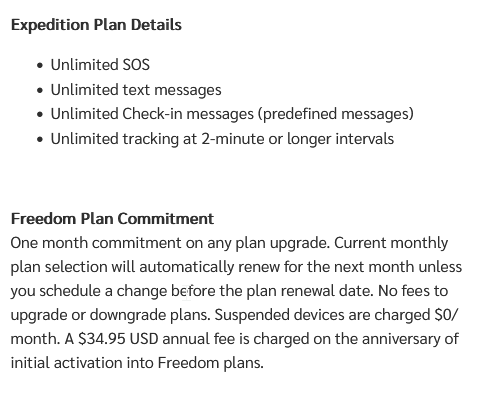
It is important to note that these prices can vary based on the specific plan chosen and any additional services added, and users should check the latest prices from the official sources.
Conclusion
While both the SPoT Messenger and the inReach system provide valuable communication solutions in remote areas, they differ significantly in their satellite systems. The inReach system, with its use of the Iridium network, offers more comprehensive coverage and two-way communication, making it a more versatile and reliable solution compared to the SPoT Messenger that uses the Globalstar network. However, the choice between the two would ultimately depend on the specific needs and location of the user.




 UTAZCO Overland

Leave a Reply