
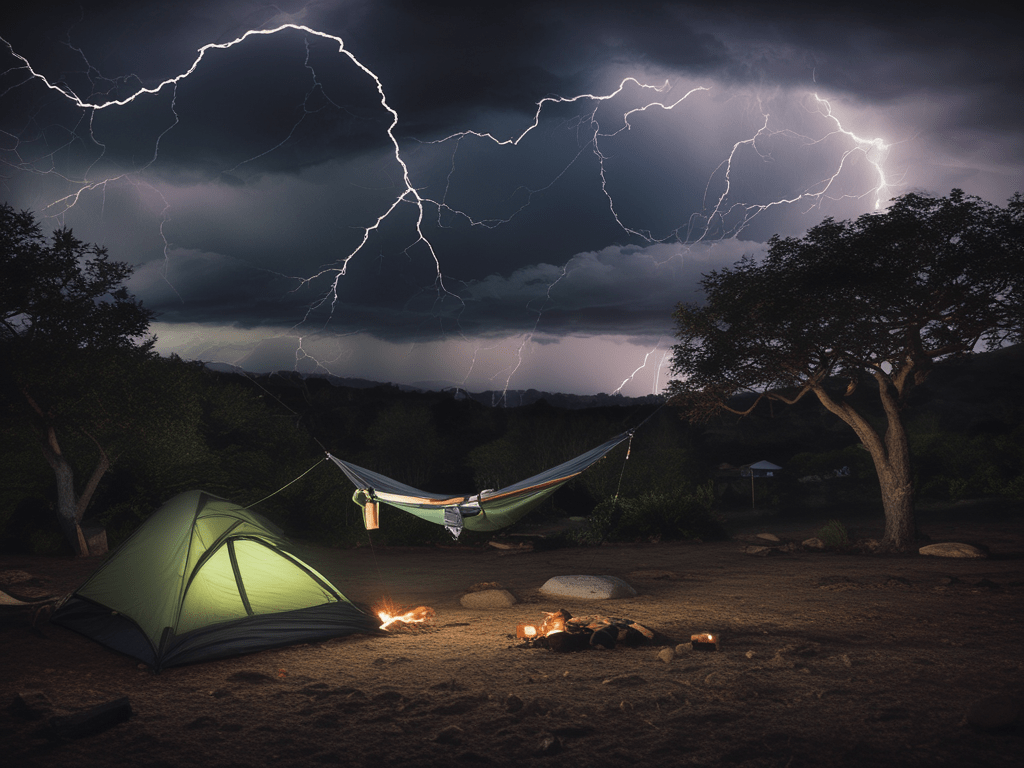
Hammock camping during lightning storms can be risky and requires careful planning and precautions. Here are the key takeaways. DO’s: Seek Shelter; Carry Essential Gear;Choose Your Location Wisely; Use a Lightning Protection System; Stay Informed; Educate Yourself; Follow the “30-30 Rule”. Don’ts: Don’t Hang Your Hammock from Tall or Isolated Trees; Don’t Stay in Your Hammock; Don’t Use Metal Objects. Remember, no measure can guarantee complete safety during a lightning storm. When in doubt, err on the side of caution.
Hammock camping is an exciting and adventurous outdoor activity that allows individuals to connect with nature. However, it can also pose significant risks if not done with caution, especially during lightning storms. This essay aims to provide a comprehensive guide on the dos and don’ts of hammock camping during lightning, including what to seek, what to avoid, and general safety tips.
Do’s of Hammock Camping During Lightning
Seek Shelter
The concept of seeking shelter is fundamental to ensuring safety while camping during a lightning storm. It is a proactive measure that can significantly reduce the risk of being struck by lightning.
When a lightning storm approaches, the safest place to be is indoors. If you are near a sturdy, fully enclosed building with wiring and plumbing, this should be your first choice for shelter. Buildings with these features are grounded, meaning that in the event of a lightning strike, the electrical discharge will travel through the building’s wiring or pipes into the ground, reducing the risk of injury to those inside.
However, it’s important to avoid structures such as picnic shelters, gazebos, or under trees as they do not provide adequate protection. These types of structures can actually increase your risk of being struck by lightning due to their height and isolation.
If you are in a remote area where buildings are not available, a hard-topped metal vehicle can provide a good alternative. The metal frame of a hard-topped vehicle provides a pathway for the lightning strike to flow around the vehicle and into the ground, protecting the occupants inside. It’s crucial to avoid touching metal or other conductive components of the vehicle during a storm.
In situations where neither a building nor a vehicle is available, it becomes necessary to make yourself the smallest target possible and minimize your contact with the ground. Crouch low, with as little of your body touching the ground as possible, and always avoid water, wet items, and metal objects.
The goal is to make the best of what’s available to you. The key is to think ahead, understand the environment you’re in, and make smart, quick decisions about where to take shelter. The more prepared you are, the better your chances of staying safe during a lightning storm while hammock camping.
Carry Essential Gear
Having the right gear is a vital part of ensuring your safety while hammock camping during a lightning storm. Certain items can help you stay informed, protect you from potential lightning strikes, and provide immediate aid if an injury occurs.
- First-Aid Kit: A comprehensive first-aid kit is a must-have for any camping trip. It should include bandages, antiseptic wipes, tweezers, medical tape, pain relievers, and any personal medication. In the event of a lightning strike, immediate first aid can be crucial. It’s also beneficial to have knowledge of basic first aid procedures, including CPR and how to treat burns.
- Lightning Protection System: As discussed earlier, a lightning protection system can help divert lightning away from you and your hammock. These systems usually consist of a series of interconnected conductive materials that are grounded at one end, creating a protective zone around your hammock.
- Weather Radio: A portable weather radio can provide real-time weather updates and alerts, which can be particularly useful in areas with poor cell service. Some models are hand-cranked or solar-powered, ensuring you can use them even without access to electricity.
- Satellite-Based Emergency Transceiver: Devices like SPoT or inReach can provide real-time weather updates, two-way communication, and SOS functionality, making them a valuable tool for staying safe and informed during a storm.
- Non-Metallic Hammock Components: As metal can attract lightning, consider using hammock components made of non-conductive materials, such as non-metallic carabiners or tree straps.
Carrying the right gear can significantly enhance your safety during a lightning storm. By preparing a comprehensive first-aid kit, investing in a lightning protection system, and ensuring you can receive real-time weather updates, you can be better prepared to handle any situation that arises during your hammock camping trip.
Choose Your Location Wisely
The choice of location is a critical safety factor. The environment around you can either increase or decrease your chances of being struck by lightning, so it’s essential to make informed decisions about where to set up camp.
- Avoid High Ground: Lightning tends to strike the highest point in an area. Therefore, camping on a hilltop, ridge, or other elevated areas can increase your risk of being struck by lightning. It’s safer to choose a spot at a lower elevation.
- Avoid Water: Bodies of water are excellent conductors of electricity, and lightning often strikes the surface of water. Avoid setting up camp near lakes, rivers, or other bodies of water during a storm.
- Avoid Isolated Trees: An isolated tree can act as a lightning rod, attracting lightning strikes due to its height. Therefore, it’s dangerous to set up your hammock between isolated trees or to take shelter under one during a storm.
- Avoid Open Fields: In an open field, you or your hammock setup could potentially be the highest point, making you a likely target for a lightning strike.
Instead, the safest location to set up your hammock during a lightning storm is in a low-lying area surrounded by a dense group of small trees. This type of area is often referred to as a “lightning shrub.” The trees in a lightning shrub are typically of similar height, so no single tree stands out as a lightning target. Additionally, being in a lower area can help protect you from lightning strikes that hit higher ground.
However, it’s important to ensure that the area isn’t prone to flash floods, as low-lying areas can quickly become dangerous in heavy rain.
Remember, no place outside is completely safe during a thunderstorm, but some places are much safer than others. By understanding the environment and making wise decisions about where to set up camp, you can significantly reduce your risk of being struck by lightning.
Use a Lightning Protection System
Lightning protection systems have become increasingly popular among outdoor enthusiasts due to their potential to increase safety during thunderstorms. These systems are designed to protect individuals and their equipment by providing a path of least resistance for lightning to follow, diverting it away from people and towards the ground.
A typical lightning protection system consists of a series of interconnected conductive materials, such as copper or aluminum wires, which are grounded at one end. The system is set up so that the conductive materials form a protective zone around the camp site. If lightning strikes, the system provides a direct path to the ground, reducing the likelihood of the lightning passing through the hammock or the person inside it.
Some systems also include a lightning rod, which is a metal rod or conductor mounted on a pole and grounded using a wire. The rod is designed to intercept lightning strikes, directing the electrical discharge safely into the ground and away from the hammock.
However, it’s important to note that while lightning protection systems can significantly reduce the risk of a direct lightning strike, they do not offer 100% protection. Lightning is unpredictable and can still cause injury or damage through side flashes or ground current, even when a protection system is in place.
Furthermore, setting up and using a lightning protection system requires knowledge and experience. It’s crucial to follow the manufacturer’s instructions carefully and to ensure that the system is correctly grounded.
While a lightning protection system can enhance safety during hammock camping in a thunderstorm, it should be used in conjunction with other safety measures, such as choosing a safe location for your camp and seeking shelter in a building or vehicle when possible.
Stay Informed
Staying informed about the weather is a critical aspect of outdoor safety, especially when there is a potential for lightning storms. By keeping a close eye on weather forecasts, you can make informed decisions about when and where to set up camp, and whether to proceed with your camping trip at all.
Before embarking on your camping trip, it’s essential to check the weather forecast for your intended camping location. Look for any warnings or advisories about thunderstorms or severe weather. Pay attention to the timing of any predicted storms – are they likely to occur during your camping trip, or perhaps just before, which could make the ground wet and more conductive to lightning?
During your camping trip, continue to monitor the weather. Many campers use portable weather radios, which provide real-time weather updates and can operate without cell service, making them ideal for remote camping locations. There are also numerous weather apps available for smartphones that can provide updates and alerts, although these may require cell service or WiFi to operate.
In addition to weather radios and smartphone apps, satellite-based emergency transceivers like SPoT or inReach are excellent tools for staying informed about the weather during outdoor activities. These devices provide a reliable means of communication and can be particularly useful in remote areas where cell service is unavailable.
SPoT and inReach devices offer two-way messaging, allowing you to send and receive text messages anywhere in the world using satellite technology. This feature can be invaluable for receiving real-time weather updates directly to your device. Some models also offer weather forecasting services, providing detailed weather reports for your current location or any other waypoint on your route.
In addition to their communication and weather forecasting capabilities, these devices also offer SOS functionality. In the event of an emergency, you can send an SOS message with your GPS location to a 24/7 global monitoring center. This feature can provide a critical lifeline if you get into trouble during a lightning storm or any other emergency situation.
If the forecast predicts a storm, it’s usually best to postpone or relocate your trip. Lightning storms can be dangerous, and it’s often safer to avoid camping in stormy conditions altogether. If you’re already camping when a storm is forecast, consider packing up and leaving before the storm arrives. My personal device of choice is (currently) the inReach GPSMAP 67i, although prior to this, I was carrying an inReach Mini (now the updated inReach Mini 2 is available!) for years. I switched primarily to reduce the number of devices I carry along – with the Mini, I carried it, and a backup GPSMAP 66sr, so by combining the inReach capabilities with the GPSMAP, I was able to reduce my load/number of electronic devices carried1. I f anybody is wondering why I am not carrying a SPoT, let me know in the comments, and I can go into more detail about the differences – and advantages I believe inReach has over SPoT…
Remember, weather forecasts are not always 100% accurate, and storms can sometimes develop unexpectedly. Therefore, in addition to monitoring the weather, it’s essential to be aware of your surroundings and watch for signs of a developing storm, such as darkening skies, increasing wind, or the sound of thunder.
Staying informed about the weather can help you make safer decisions about hammock camping during lightning storms. By monitoring weather forecasts and being aware of your surroundings, you can reduce your risk of being caught in a dangerous situation.
Educate Yourself
Education is a powerful tool in ensuring safety during hammock camping, especially when it comes to understanding the nature of lightning and how to protect yourself during a storm. A solid understanding of how lightning strikes and the associated risks can significantly influence your decision-making process and enhance your safety.
Lightning is a giant discharge of electricity accompanied by a brilliant flash of light and a loud clap of thunder. The discharge may occur within or between clouds, or between a cloud and the ground. Lightning tends to strike the highest object in an area, especially if it’s isolated. This is why tall trees and open fields are particularly dangerous places to be during a lightning storm.
Educating yourself about lightning safety involves understanding these patterns and knowing how to respond. For instance, knowing that lightning can strike the same place twice or strike more than one place at a time can dispel common myths and misconceptions that can compromise safety.
It’s also essential to learn about the 30-30 rule. This rule states that if the time between seeing a flash of lightning and hearing the thunder is 30 seconds or less, the lightning is close enough to pose a threat and you should seek shelter immediately. After the storm, wait at least 30 minutes after hearing the last clap of thunder before leaving shelter.
There are many resources available to learn about lightning safety, including websites, books, and courses. Some outdoor recreation stores and organizations also offer classes on outdoor safety that include sections on lightning safety.
Educating yourself about lightning and lightning safety is a crucial step in preparing for hammock camping during a storm. The more you know, the better you can protect yourself and make safe decisions.
Follow the 30-30 Rule
The 30-30 rule is a simple yet effective guideline for assessing the threat of a lightning storm and determining when it’s safe to resume outdoor activities. This rule is widely recommended by weather and safety experts and can be a lifesaver during a lightning storm.
The first part of the 30-30 rule relates to the onset of a storm. After you see a flash of lightning, start counting seconds until you hear the sound of thunder. If the time gap is 30 seconds or less, the lightning is approximately 6 miles away or closer, posing an immediate threat. In this case, you should seek shelter immediately. This could be a substantial building or a hard-topped vehicle. If neither is available, make yourself a smaller target by crouching low to the ground in a low-lying area.
The second part of the 30-30 rule pertains to the end of the storm. Even after the rain stops, there could still be a risk of lightning. You should wait at least 30 minutes after hearing the last clap of thunder before leaving your shelter. This is because lightning can strike as far as 10 to 15 miles from the area where it is raining, meaning it can strike outside of the thunderstorm cloud itself, in areas where the sky may appear clear.
The 30-30 rule is a valuable guideline for hammock campers during a lightning storm. By understanding and applying this rule, you can make informed decisions about when to seek shelter and when it’s safe to resume your outdoor activities.
[1 ] Please also check out my full Amazon ‘Influencer’ store, where I recommend devices and items related to the outdoors I have personally used, or am currently using. Disclosure: As an Amazon ‘Influencer’, I earn from qualifying purchases. This means that I may receive a small commission at no extra cost to you when you make a purchase through my Amazon affiliate links. This helps me continue to provide valuable content and recommendations. Thank you for your support.
Don’ts of Hammock Camping During Lightning Storms
Don’t Hang Your Hammock from Tall or Isolated Trees
The choice of trees from which to hang your hammock is a crucial factor in ensuring your safety during a lightning storm. Lightning, due to its nature, tends to strike the tallest object in an area as it provides the shortest path to the ground. This makes tall or isolated trees a prime target for lightning strikes.
When you hang your hammock from a tall or isolated tree, you essentially place yourself in the path of a potential lightning strike. The tree acts as a natural lightning rod, and if it gets struck, the lightning can travel down the tree and into your hammock. This can result in severe injuries or even be fatal.
Moreover, even if the lightning doesn’t directly strike your hammock, it can cause the tree to explode or catch fire due to the intense heat generated by the electrical discharge. Falling branches or debris from the tree can pose a significant risk.
Instead of choosing the tallest or most isolated trees, opt for smaller trees that are grouped together. This reduces the chances of any single tree (and by extension, your hammock) being struck by lightning. It’s also advisable to avoid trees that are located on the edge of a forest or stand alone in an open field, as these are more likely to be struck by lightning.
While tall or isolated trees may seem like attractive options for hanging your hammock due to their size and stability, they can significantly increase your risk during a lightning storm. By choosing smaller, grouped trees for your hammock, you can enhance your safety and enjoy a more secure hammock camping experience.
Don’t Stay in Your Hammock
When a lightning storm is imminent, one of the most important safety measures you can take is to leave your hammock. While it might seem like a comfortable and secure place to ride out a storm, a hammock can actually increase your risk of being struck by lightning.
The reason for this is twofold. Firstly, when you’re in a hammock, you’re elevated off the ground, which can make you a more attractive target for a lightning strike. Secondly, hammocks are often hung between two trees, which can act as natural lightning rods, attracting lightning strikes and potentially directing them towards your hammock.
If a storm is approaching and you’re in your hammock, the safest course of action is to get out of the hammock and seek shelter. This could be a nearby building or vehicle, or if these aren’t available, a low-lying area away from tall trees, bodies of water, and other potential lightning attractors.
If no suitable shelter is available, your best option is to make yourself as small a target as possible. This means crouching low to the ground, ideally in a dense area of small trees or shrubs. Avoid lying flat on the ground, as this can increase your risk of being affected by ground current if lightning strikes nearby.
While your hammock might seem like a safe haven during a storm, it’s actually one of the places you’re most at risk. By leaving your hammock and seeking shelter, or at least minimizing your profile, you can significantly reduce your risk of being struck by lightning.
Don’t Use Metal Objects
The use of metal objects during a lightning storm can significantly increase the risk of a lightning strike. This is because metal is a good conductor of electricity, and lightning, being an electrical discharge, is naturally drawn to it.
When you use metal objects such as hammock stands, poles, or even metal components of a hammock like carabiners or metal end bars, you create potential pathways for lightning to travel. If lightning strikes a metal object, the electrical discharge can quickly travel along the object and potentially into anything or anyone in contact with it.
For instance, if you’re using a metal hammock stand and it gets struck by lightning, the electrical discharge can travel along the stand and into the hammock. Even if you’re not directly touching the metal parts of the hammock, the electrical current can still reach you, resulting in severe injuries or even fatality.
Therefore, during a storm, it’s crucial to avoid using metal objects as much as possible. If your hammock setup includes metal components, consider replacing them with non-conductive materials. For instance, metal carabiners can be replaced with non-metallic ones, and metal hammock stands can be substituted with wooden ones or avoided altogether by hanging your hammock between trees using non-metallic straps.
While metal objects can be useful in many camping situations, they pose a significant risk during a lightning storm. By avoiding the use of metal objects during a storm, you can significantly reduce your risk of being struck by lightning and ensure a safer hammock camping experience.
Conclusion
Hammock camping offers a unique way to connect with nature and enjoy the great outdoors. However, when coupled with the unpredictable nature of lightning storms, it can pose significant risks. Understanding these risks and taking appropriate precautions is crucial to ensuring a safe and enjoyable hammock camping experience.
The dangers associated with any outdoor activity during lightning storms are real and should not be underestimated. Lightning strikes can cause severe injuries and even fatalities. Therefore, it’s essential to be proactive in mitigating these risks. This involves careful planning, staying informed about the weather, choosing the right location for your hammock, and having the right gear.
By following the dos and don’ts outlined above, you can significantly reduce your risk during a lightning storm. This includes seeking shelter during a storm, avoiding tall or isolated trees, and not using metal objects. It also involves staying informed about the weather, carrying essential gear like a first-aid kit and a lightning protection system, and following the 30-30 rule.
However, it’s important to remember that no measure can guarantee complete safety during a lightning storm. When in doubt, the best course of action is always to err on the side of caution. If a storm is approaching, consider postponing your trip or relocating to a safer location.
While camping during lightning can be a thrilling experience, it requires a high level of caution and preparedness. By understanding the risks and taking necessary precautions, you can navigate the unpredictability of Mother Nature and enjoy a safe and memorable hammock camping experience.



Leave a Reply