
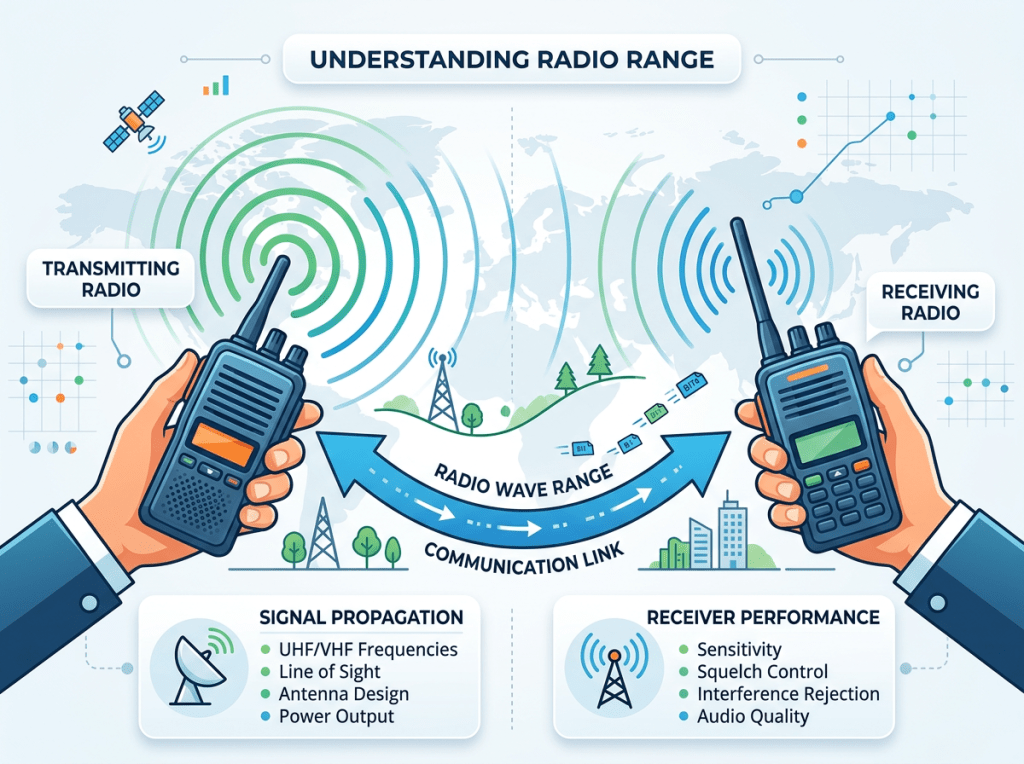
When you leave the comfort of paved roads and cell towers behind, communication becomes more than just a convenience—it becomes a critical component of safety, coordination, and peace of mind. Overlanding and off-roading often take enthusiasts into areas where the landscape is rugged, the weather unpredictable, and the nearest help may be hours or even days away. In these environments, the ability to reach out to others, whether for routine check-ins, logistical coordination, or emergency assistance, can make all the difference between a successful adventure and a potentially dangerous situation.
Among the various communication tools available, two radio services have emerged as the most popular choices for those who travel far from civilization: Ham (Amateur) Radio and GMRS (General Mobile Radio Service). Both are legal, regulated means of two-way radio communication, and both are widely used by outdoor enthusiasts, off-road clubs, and expedition teams. Each offers its own set of strengths and limitations, shaped by regulatory frameworks, technical capabilities, and the communities that support them.
GMRS has gained popularity for its simplicity and accessibility. With no test required for licensing and radios that are easy to operate right out of the box, GMRS appeals to families and groups who want a straightforward way to stay in touch over short distances. Its plug-and-play nature makes it ideal for casual outings or situations where technical expertise is limited. However, this simplicity comes at the cost of flexibility, range, and advanced features, which can become significant drawbacks as the terrain grows more challenging and the need for reliable communication increases.
Ham radio, on the other hand, stands apart for its depth and versatility. While it does require passing a basic exam to obtain a license, this small investment of time and effort opens the door to a world of powerful communication tools. Ham operators have access to a much broader range of frequencies, higher power levels, and a variety of communication modes—including voice, digital, Morse code, and even satellite links. This technical flexibility means that ham radio can adapt to changing conditions, overcome obstacles like mountains or dense forests, and maintain contact over much greater distances than GMRS.
Moreover, the ham radio community is renowned for its spirit of cooperation, technical support, and public service. Local clubs, repeater networks, and emergency nets provide a safety net that can be invaluable when things go wrong far from help. The culture of learning and mutual assistance that defines ham radio ensures that operators are not only better equipped technically, but also more prepared to respond effectively in emergencies.
For the serious overlander or off-roader—someone who values preparedness, self-reliance, and the ability to handle whatever the wilderness throws their way—ham radio offers a suite of advantages that go far beyond what GMRS can provide. It is not just a tool for communication, but a gateway to a global network of knowledge, support, and capability, making it the clear choice for those who truly venture off the beaten path.
Understanding the Basics
What is Ham Radio?
Ham radio, formally known as amateur radio, is a globally recognized and regulated radio service that empowers individuals to communicate across vast distances using a diverse array of frequencies and transmission modes. Unlike unlicensed or lightly regulated services, ham radio requires users to obtain a license, which involves passing an examination that covers technical knowledge, regulations, and operating practices. This licensing process ensures that operators understand the fundamentals of radio technology, safe operating procedures, and the legal responsibilities associated with transmitting on the airwaves.
Once licensed, a ham radio operator gains access to a broad spectrum of frequencies allocated specifically for amateur use. These frequencies span from the high-frequency (HF) bands, which can enable communication across continents and even around the world, to very high frequency (VHF) and ultra-high frequency (UHF) bands, which are ideal for local and regional communication. This wide frequency access is a defining feature of ham radio, allowing operators to adapt to changing conditions, terrain, and communication needs.
Ham radio is not limited to a single mode of communication. Operators can use voice (FM, AM, SSB), Morse code (CW), and a variety of digital modes (such as FT8, PSK31, D-STAR, and APRS), as well as image transmission and even satellite communication. This versatility means that ham radio can be tailored to specific scenarios, whether it’s maintaining contact with a convoy in the backcountry, relaying emergency messages during a disaster, or simply experimenting with new technologies.
Another hallmark of ham radio is its vibrant, interconnected community. Operators often participate in local clubs, national organizations, and international networks. Many regions maintain repeater systems—automated relay stations that dramatically extend the range of handheld and mobile radios. These repeaters, often situated on mountaintops or tall buildings, can link entire regions and provide reliable communication even in challenging terrain.
The culture of ham radio emphasizes learning, experimentation, and public service. Many hams volunteer their skills and equipment for emergency communications, community events, and disaster response. The licensing requirement, while a barrier to entry for some, fosters a sense of responsibility and shared standards among operators, contributing to the service’s reputation for reliability and technical excellence.
Ham radio is a licensed, multifaceted communication service that offers unparalleled flexibility, technical depth, and community support. Its combination of regulatory oversight, broad frequency access, and diverse operating modes makes it uniquely suited for those who value robust, adaptable communication—especially in demanding environments like overlanding and off-roading.
What is GMRS?
GMRS, or General Mobile Radio Service, is a two-way radio service regulated by the FCC in the United States and intended primarily for personal or family communication over relatively short distances. Unlike ham radio, obtaining a GMRS license is a straightforward process that does not require passing any technical examination. Applicants simply pay a fee and receive a license that covers not only themselves but also their immediate family members, making it an attractive option for groups who want a quick and accessible way to stay in touch during activities like camping, hiking, or off-roading.
The equipment used for GMRS is generally designed to be user-friendly and requires minimal setup or technical knowledge. Most GMRS radios are handheld or mobile units that operate on a set of designated UHF frequencies around 462 and 467 MHz. These frequencies are well-suited for line-of-sight communication, which means that GMRS works best in open areas or over short distances where there are few obstacles such as hills, dense forests, or buildings. While GMRS radios can legally transmit at up to 50 watts of power on certain channels, most consumer-grade handhelds operate at much lower power levels, typically around 1 to 5 watts, which further limits their effective range.
One of the appealing aspects of GMRS is its simplicity. The radios often come pre-programmed with all the available channels, and users can start communicating almost immediately after turning them on. Some GMRS radios are also compatible with Family Radio Service (FRS) channels, allowing for communication with unlicensed FRS radios, though at reduced power and range. While GMRS does allow the use of repeaters—devices that can extend the range of communication by relaying signals from one radio to another—these repeaters are far less common and accessible than those found in the ham radio community. In many areas, GMRS repeaters are privately owned and may require permission to use, which can be a limiting factor for those relying on extended coverage.
In terms of flexibility, GMRS is more restricted than ham radio. The service is limited to FM voice communication, with no legal provision for digital modes, Morse code, or experimentation with antennas and equipment beyond what is commercially available and FCC-certified. This makes GMRS a practical and approachable solution for straightforward, short-range communication needs, but it lacks the adaptability and technical depth that ham radio offers.
Overall, GMRS is best suited for users who prioritize ease of use and quick setup over advanced features or long-distance capability. It fills an important niche for families and small groups who need reliable, uncomplicated communication within a limited area, but its regulatory and technical constraints make it less suitable for those seeking the broad capabilities required for more demanding or remote overlanding and off-roading adventures.
Range and Power: The Critical Difference
The disparity in range and power between ham radio and GMRS is perhaps the most decisive factor for overlanders and off-roaders who depend on reliable communication in unpredictable environments. Ham radio’s technical capabilities far surpass those of GMRS, primarily due to its access to a much broader spectrum of frequencies and the ability to legally operate at significantly higher power levels.
Ham radio operators, depending on their license class and the specific frequency band, can use transmitters with output power up to 1,500 watts. While such high power is rarely necessary or practical for most mobile or handheld operations, even the typical 5-8 watt handheld ham radio can outperform a comparable GMRS unit because of the flexibility in antenna choice, frequency selection, and the ability to use repeaters. More importantly, ham radio grants access to the high-frequency (HF) bands, which are capable of long-distance, sometimes even global, communication. HF signals can bounce off the ionosphere, allowing operators to reach others hundreds or thousands of miles away—an invaluable feature if you find yourself in a remote area with no cellular coverage and need to contact someone far outside your immediate vicinity.
In contrast, GMRS radios are limited by regulation to a maximum of 50 watts on mobile units and just 5 watts on handhelds. These radios operate exclusively on UHF frequencies, specifically in the 462 and 467 MHz range. UHF signals are generally well-suited for short-range, line-of-sight communication, but they are much more susceptible to attenuation by obstacles such as hills, dense forests, or buildings. This means that in rugged or heavily wooded terrain—exactly the kind of environment overlanders and off-roaders often encounter—the effective range of GMRS radios can be drastically reduced, sometimes to just a mile or two, even with higher-powered mobile units.
Another key difference is the availability and accessibility of repeaters. Ham radio repeaters are widespread, often publicly accessible, and strategically placed on mountaintops or tall structures to maximize coverage. These repeaters can extend the range of even a low-powered handheld radio to dozens or even hundreds of miles, depending on the terrain and repeater network. GMRS repeaters do exist, but they are far less common, often privately owned, and may require explicit permission to use. This limits the practical range extension that GMRS users can expect, especially in remote or less-populated areas.
Ultimately, the combination of higher allowable power, access to a wide range of frequencies—including those capable of long-distance propagation—and a robust, accessible repeater infrastructure gives ham radio a decisive edge in range and reliability. For those who travel far from civilization, where the ability to reach help or coordinate with others can be a matter of safety, these advantages make ham radio the superior choice for overlanding and off-roading communication.
Flexibility and Capability
The true strength of ham radio lies in its remarkable versatility, both in terms of the technologies it supports and the adaptability it offers to operators in the field. Unlike GMRS, which is strictly limited to analog FM voice communication, ham radio opens up a world of possibilities that can be tailored to the unique demands of any overlanding or off-roading scenario.
Ham radio operators are not confined to a single method of communication. They can choose from traditional voice transmissions, which can be analog or digital, depending on the equipment and preferences. Digital voice modes, such as D-STAR, System Fusion, and DMR, offer clearer audio, better resistance to interference, and the ability to transmit additional data such as GPS coordinates or text messages alongside voice. This can be a game-changer in situations where precise location information or silent communication is required.
Beyond voice, ham radio supports a wide range of digital data modes. Operators can send and receive text messages, emails, images, and even files using protocols like Winlink, FT8, or PSK31. These modes are particularly valuable when voice communication is impractical due to noise, privacy concerns, or the need to transmit detailed information. For example, in an emergency, a ham operator can send a digital message containing medical details, GPS coordinates, or weather updates to a distant station or emergency services, even when cell networks are down.
Morse code, or CW (continuous wave), remains a powerful tool in the ham radio arsenal. It is highly efficient, requiring minimal bandwidth and power, and can often get through when voice or digital signals fail due to weak conditions or interference. Many experienced operators rely on Morse code as a reliable fallback in challenging environments.
Ham radio’s flexibility extends even further with access to satellite communication. Amateur radio satellites, known as OSCARs, orbit the Earth and can be used to relay signals over vast distances, bypassing terrestrial obstacles entirely. This capability is unique to ham radio and can provide a vital link when all other options are unavailable, such as in deep canyons, dense forests, or during widespread infrastructure failures.
In contrast, GMRS is intentionally simple and limited by regulation to analog FM voice only. While this makes it easy to use and accessible for beginners, it also means that GMRS users cannot adapt their communication methods to changing conditions or specialized needs. There is no legal provision for digital modes, data transmission, or satellite use within the GMRS service. If voice communication is compromised by interference, distance, or terrain, GMRS users have no alternative modes to fall back on.
This difference in flexibility and capability is not just a matter of technical curiosity—it has real-world implications for safety, coordination, and efficiency during overlanding and off-roading adventures. Ham radio’s broad toolkit allows operators to overcome obstacles, maintain contact in adverse conditions, and leverage advanced features that simply do not exist in the GMRS world. For those who value adaptability and preparedness, ham radio’s flexibility is an indispensable asset.
Ham radio stands out for its exceptional versatility, offering operators a wide range of communication options—including analog and digital voice, various digital data modes, Morse code, and even satellite communication. This adaptability allows ham users to tailor their methods to changing conditions and specific needs, such as sending GPS coordinates, text messages, or emergency data when voice isn’t practical. In contrast, GMRS is limited by regulation to analog FM voice only, with no support for digital or satellite modes. This lack of flexibility means GMRS users have no alternatives if voice communication fails due to interference or terrain. Ultimately, ham radio’s broad capabilities provide a significant advantage for overlanding and off-roading, where adaptability and reliable communication can be critical.
Community and Support
One of the most distinguishing features of ham radio is the vibrant, deeply interconnected community that surrounds it. This community is not just a loose collection of hobbyists, but a global network of individuals who share a commitment to communication, technical learning, and public service. Across cities, towns, and rural areas, ham radio operators organize themselves into local clubs, regional associations, and national organizations. These groups foster a culture of mentorship, where newcomers are welcomed and guided by more experienced operators, and where knowledge is freely shared through meetings, workshops, and on-air discussions.
A key manifestation of this community spirit is the widespread network of ham radio repeaters. These repeaters, often maintained by clubs or groups of volunteers, are strategically placed on mountaintops, tall buildings, or other high points to maximize their coverage. They serve as communication hubs, dramatically extending the range of handheld and mobile radios and enabling reliable contact across vast areas, even in challenging terrain. In many regions, these repeaters are linked together, forming repeater networks that can span entire states or cross country borders. Access to these systems is typically open to all licensed operators, reflecting the inclusive ethos of the amateur radio community.
Beyond day-to-day communication, the ham radio community excels in organizing and maintaining emergency communication networks, known as “emergency nets.” These nets are activated during natural disasters, severe weather, or other crises when conventional communication infrastructure may be compromised or overloaded. Trained volunteer operators coordinate to relay information, assist with search and rescue, and provide a vital link between affected individuals and emergency services. This tradition of public service is deeply ingrained in ham radio culture, and many operators take pride in their ability to contribute during times of need.
The support structure within ham radio extends to technical assistance as well. Whether it’s troubleshooting equipment, learning new operating modes, or setting up antennas, operators can rely on a wealth of collective experience. Online forums, social media groups, and dedicated websites further enhance this support network, making it easy to find help or advice no matter where you are.
In contrast, the GMRS community is smaller and less organized. While there are enthusiasts who maintain GMRS repeaters, these are far fewer in number and often privately owned, sometimes requiring explicit permission for use. The lack of a formalized club structure or widespread emergency nets means that GMRS users have fewer resources to draw upon, especially in critical situations. The sense of camaraderie and mutual support that defines ham radio is less pronounced in the GMRS world, where the focus is more on simple, family-oriented communication rather than technical exploration or public service.
For overlanders and off-roaders, the difference in community and support can be profound. Ham radio offers not just a means of communication, but a safety net woven from decades of tradition, technical expertise, and a shared commitment to helping others. In remote or emergency situations, this network can make all the difference, providing guidance, reassurance, and, when necessary, a lifeline to the outside world.
Legal and Practical Considerations
The process of becoming a licensed operator is a fundamental difference between ham radio and GMRS, and it has far-reaching implications for how each service is used in practice. To operate on ham radio frequencies, individuals must pass a licensing exam administered by the Federal Communications Commission (FCC) or its authorized representatives. This exam covers essential topics such as radio theory, operating procedures, safety protocols, and the legal responsibilities of an amateur radio operator. The intent behind this requirement is not to create unnecessary barriers, but to ensure that every ham operator possesses a foundational understanding of how radio works, how to avoid interference, and how to communicate effectively and courteously on the air.
This baseline of knowledge has practical benefits, especially in the unpredictable environments encountered during overlanding and off-roading. Licensed ham operators are generally more aware of how to optimize their equipment, select appropriate frequencies, and troubleshoot issues that may arise in the field. They understand the importance of minimizing interference with other users, following established protocols during emergencies, and maintaining clear, concise communication. This shared standard of competence contributes to the reliability and effectiveness of ham radio as a tool for both routine and emergency communication.
In contrast, obtaining a GMRS license is a much simpler process. There is no test or educational requirement; applicants simply pay a fee and receive a license that covers themselves and their immediate family members. While this ease of access is appealing for those who want a quick solution for group communication, it also means that many GMRS users may lack even a basic understanding of radio operation, etiquette, or safety. Without this knowledge, users are more likely to encounter problems such as unintentional interference, improper use of repeaters, or inefficient communication practices. In situations where clear and reliable communication is critical—such as coordinating a group in challenging terrain or responding to an emergency—these shortcomings can have serious consequences.
Furthermore, the regulatory framework for ham radio encourages ongoing learning and engagement. Many operators choose to advance their skills by pursuing higher-level licenses, which grant access to additional frequencies and privileges. This culture of education and self-improvement is less prevalent in the GMRS community, where the lack of a testing requirement can lead to a more casual approach to radio use.
Ultimately, the legal and practical distinctions between ham radio and GMRS shape the way each service is used in the real world. The knowledge and discipline instilled by the ham radio licensing process foster a more responsible, effective, and adaptable approach to communication—qualities that are especially valuable for those who venture into remote or challenging environments. While GMRS offers convenience and accessibility, it does so at the expense of the competence and reliability that come from a more rigorous licensing system.
The licensing process for ham radio requires operators to pass an exam covering technical, operational, and safety topics, ensuring a solid foundation of knowledge and responsible communication practices. This leads to more effective, reliable, and courteous use of radio in the field, which is especially important in challenging or emergency situations. In contrast, GMRS licenses are easy to obtain with no test or educational requirement, making the service accessible but often resulting in users who lack basic radio skills or understanding. This can lead to misuse, interference, and less effective communication when it matters most. Ultimately, the more rigorous ham radio licensing system fosters greater competence and reliability, making it better suited for demanding environments like overlanding and off-roading.
Equipment Availability and Cost
When it comes to sourcing equipment, both ham radio and GMRS users benefit from a robust market filled with a variety of radios and accessories. Walk into any well-stocked outdoor retailer or browse online, and you’ll find GMRS radios prominently displayed, often marketed toward families, off-roaders, and outdoor enthusiasts. These radios are typically straightforward, with fixed antennas, simple controls, and a focus on ease of use. The price range for GMRS equipment is generally modest, with handheld units and mobile radios available at accessible price points, making them an attractive option for those seeking a quick, uncomplicated communication solution.
However, the world of ham radio equipment is far broader and more diverse. Because ham operators are permitted to use a much wider range of frequencies and power levels, manufacturers have developed an extensive lineup of radios to suit every need and budget. Entry-level handheld ham radios, such as those from Baofeng or Yaesu, are often priced similarly to GMRS handhelds, and sometimes even less when considering the vibrant used market. These basic models already offer features like adjustable power output, programmable channels, and the ability to access both VHF and UHF bands, providing greater flexibility right out of the box.
As you move up the spectrum, ham radio equipment expands to include mobile units with higher power, ruggedized designs for harsh environments, and base stations capable of global communication. Many radios are built with advanced features such as digital modes, weather alerts, GPS integration, and customizable programming. The accessory market is equally rich, with a wide selection of antennas, microphones, power supplies, and mounting solutions designed to optimize performance for specific vehicles or expedition setups. This diversity allows ham operators to tailor their equipment to their exact needs, whether that means a compact handheld for hiking, a powerful mobile rig for a 4×4, or a portable HF station for remote basecamp operation.
Another important consideration is the longevity and upgradability of ham radio gear. Because the amateur radio community values experimentation and technical advancement, many radios are designed to be serviceable, modifiable, and compatible with a wide range of accessories. The used market is particularly strong, with well-maintained equipment often available at significant discounts, making it possible to assemble a highly capable station on a modest budget.
In contrast, GMRS radios, while reliable and easy to use, tend to be more limited in terms of features and expandability. Most models are designed for plug-and-play operation, with fewer options for customization or technical experimentation. While this simplicity is a benefit for some users, it can be a limitation for those who want to adapt their communication setup to changing needs or challenging environments.
Ultimately, while both ham and GMRS radios are accessible and affordable, ham radio stands out for the sheer breadth of equipment choices, the potential for customization, and the ability to find high-quality used gear at competitive prices. For overlanders and off-roaders who value adaptability, durability, and long-term value, the ham radio market offers unmatched opportunities to build a communication system that truly fits their adventures.
Both ham and GMRS radios are widely available and affordable, with entry-level models often priced similarly. GMRS radios are simple, easy to use, and marketed for quick, straightforward communication, but they offer limited features and customization. In contrast, ham radio equipment spans a much broader range, from basic handhelds to advanced mobile and base stations with features like digital modes, GPS, and weather alerts. The ham radio market also provides extensive accessory options and a strong used equipment scene, allowing for greater customization, upgradability, and long-term value. For overlanders and off-roaders seeking adaptability and durability, ham radio offers far more flexibility and equipment choices than GMRS.
Summary Comparison Table
| Feature | Ham Radio | GMRS |
|---|---|---|
| License Required | Yes (test) | Yes (no test) |
| Power Limit | Up to 1,500W (varies by band) | 50W (mobile), 5W (handheld) |
| Frequency Bands | VHF, UHF, HF, more | UHF only (462/467 MHz) |
| Communication Modes | Voice, digital, Morse, satellite | Voice (FM) only |
| Repeater Access | Extensive, public | Limited, often private |
| Community Support | Strong, global | Limited, local |
| Equipment Variety | Extensive | Moderate |
| Range | Local to global | Local to regional |
Conclusion
In the demanding world of overlanding and off-roading, where the terrain is unpredictable and the stakes can be high, the choice of communication tools is far more than a matter of convenience—it can directly impact safety, coordination, and the overall success of an expedition. Ham radio distinguishes itself as the superior option in these environments, offering a combination of technical capability, adaptability, and community support that is simply unmatched by GMRS.
The extended range of ham radio, made possible by access to a wide spectrum of frequencies and higher power levels, ensures that operators can maintain contact even when separated by miles of rugged landscape or when traveling through remote regions where cell service is nonexistent. This ability to reach out—whether to a nearby convoy, a distant basecamp, or even emergency services hundreds of miles away—provides a level of security and peace of mind that is invaluable when venturing off the grid.
Equally important is the flexibility that ham radio brings to the table. The capacity to switch between voice, digital, Morse code, and even satellite communication means that operators are never limited to a single mode or method. This adaptability allows for creative problem-solving and ensures that communication can continue even when faced with interference, equipment failure, or challenging environmental conditions. The technical depth of ham radio also encourages users to learn, experiment, and refine their skills, resulting in a more competent and prepared community of operators.
Perhaps the most overlooked yet vital advantage of ham radio is the strength of its community. The network of repeaters, emergency nets, and experienced operators forms a safety net that can be relied upon in times of need. Whether it’s sharing real-time information about trail conditions, coordinating a group recovery effort, or calling for help in an emergency, the ham radio community is there to support its members, often going above and beyond what is expected.
While GMRS remains a practical and accessible choice for families or groups seeking simple, short-range communication, it lacks the range, versatility, and depth of support that ham radio provides. For those whose adventures take them far from civilization, where self-reliance and robust communication are essential, ham radio is not just a hobby—it is an indispensable tool, a lifeline, and a gateway to a global network of fellow explorers and problem-solvers. In the world of overlanding and off-roading, ham radio stands as the clear choice for those who demand the very best in reliability and capability.






 UTAZCO Overland
Leave a Reply