
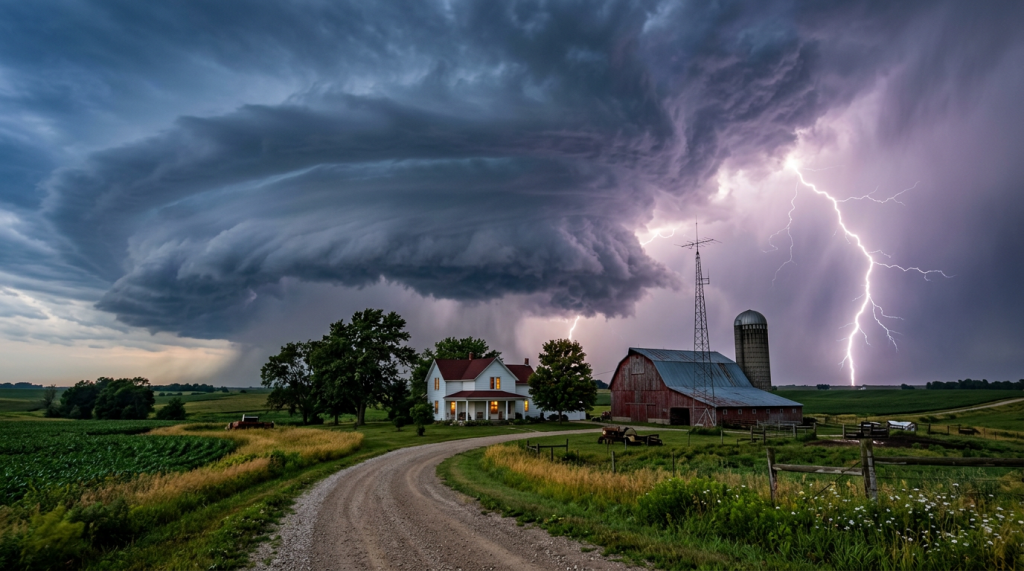
Western Iowa, where I live, is prone to severe weather events, including tornadoes, derechos, blizzards, and flooding. These hazards can rapidly disrupt critical infrastructure, making reliable communication both a challenge and a necessity. A robust P.A.C.E. (Primary, Alternate, Contingency, Emergency) communications plan is essential for families, organizations, and emergency responders in this region. This essay outlines a comprehensive P.A.C.E. plan tailored to Western Iowa, integrating modern and traditional communication systems—Ham, GMRS, MURS, LMR, DMR, Starlink, and inReach—while addressing the region’s highest risk factors.
Risk Factors in Western Iowa
Western Iowa’s communication vulnerabilities stem from several key risk factors:
- Severe Weather: Tornadoes and thunderstorms can destroy cell towers and power lines, causing widespread outages.
- Rural Geography: Large areas with low population density mean fewer cell towers and longer distances between communities.
- Infrastructure Limitations: Landline and internet infrastructure may be outdated or sparse in rural zones.
- Power Outages: Extended blackouts are common after major storms, affecting all electrically powered communication devices.
- Flooding: Can isolate communities and damage both physical and wireless infrastructure.
Understanding these risks is crucial for designing a layered, redundant communications plan.
P.A.C.E. Plan Overview
The P.A.C.E. framework ensures that if one communication method fails, others are available. Each layer is chosen for its reliability, independence from vulnerable infrastructure, and suitability for Western Iowa’s unique challenges.
| Level | System(s) | Strengths | Limitations |
|---|---|---|---|
| Primary | Cell Phone, LMR, DMR | Ubiquitous, easy, fast, group comms | Dependent on infrastructure/power |
| Alternate | Starlink, Landline (if available,) GMRS | Satellite bypasses local outages, simple | Needs power, setup, or licensing |
| Contingency | Ham (VHF/UHF), MURS, GMRS | Local/regional, independent, flexible | Range, licensing, user training |
| Emergency | Ham (HF), inReach, Physical Link | Long-distance, global, last-resort options | Complex, slow, weather dependent |
Primary: Everyday and Routine Communications
Cell Phones
Cell phones serve as the cornerstone of everyday and routine communications for nearly everyone in Western Iowa. Their ubiquity and ease of use make them the natural first choice for staying in touch with family, friends, and emergency services. With a single device, users can make voice calls, send SMS and group texts, and access a wide range of messaging apps that facilitate both one-on-one and group communication. This versatility is further enhanced by the integration of weather alert applications, which can provide real-time notifications about severe weather, tornado warnings, or other hazards specific to the region.
In the more densely populated urban and suburban areas of Western Iowa, cellular coverage is generally robust. Multiple carriers compete to provide reliable service, and the infrastructure is designed to handle the communication needs of the population under normal circumstances. This means that, for most people, reaching out to loved ones or receiving critical updates is as simple as picking up their phone.
However, the situation changes as one moves into the rural stretches that characterize much of Western Iowa. Here, cell towers are spaced farther apart, and coverage can be spotty or even nonexistent in certain low-lying or remote areas. These “dead zones” present a significant challenge, especially during emergencies when reliable communication is most needed. Even in areas with good coverage, the system’s reliability is contingent on the integrity of the supporting infrastructure. Severe weather events—such as tornadoes, derechos, or ice storms—can damage cell towers, disrupt power supplies, and overload networks as large numbers of people attempt to communicate simultaneously.
Power outages are another critical vulnerability. Cell phones, no matter how advanced, are only as useful as their battery life allows. Extended blackouts, which are not uncommon after major storms, can quickly render phones useless unless users have access to backup power sources like portable chargers or generators. Additionally, if the outage affects the cell towers themselves, even a fully charged phone may be unable to connect to the network.
Despite these vulnerabilities, cell phones remain the primary communication tool because of their convenience, portability, and the wide array of functions they offer. They are the first line of defense in any emergency communication plan, but their limitations underscore the importance of having alternate and contingency methods in place, especially in a region as geographically and meteorologically challenging as Western Iowa.
Cell phones are the primary means of everyday and emergency communication in Western Iowa due to their convenience, versatility, and widespread use. They enable voice calls, messaging, and access to weather alerts, making them essential for staying connected and informed. While urban and suburban areas generally enjoy reliable coverage, rural regions often face spotty service and dead zones. Severe weather and power outages can further compromise cellular networks, highlighting their vulnerability. Despite these challenges, cell phones remain the first choice for communication, but their limitations make it crucial to have backup methods in place, especially given Western Iowa’s geographic and weather-related risks.
LMR and DMR Systems
Land Mobile Radio (LMR) and Digital Mobile Radio (DMR) systems play a critical role in the communications landscape of Western Iowa, particularly for organizations that require reliable, coordinated group communication. These systems are the backbone for first responders such as police, fire, and EMS, as well as for utility companies and certain businesses that need to maintain operational continuity during both routine and emergency situations.
LMR systems operate on analog or digital frequencies and are designed for robust, mission-critical communication. DMR, as a digital evolution of LMR, brings additional features such as improved audio clarity, greater spectrum efficiency, and the ability to support multiple conversations on a single frequency through time-division multiplexing. Both systems allow for the creation of talk groups, enabling teams to communicate simultaneously without cross-talk or interference from unrelated users. This is especially valuable during emergencies, when clear, direct communication can mean the difference between a coordinated response and chaos.
One of the key advantages of LMR and DMR systems is their use of dedicated channels, which are often reserved for specific agencies or functions. This exclusivity reduces the risk of congestion and ensures that critical messages get through even when public networks are overloaded. Encryption capabilities further enhance security, protecting sensitive information from interception—a crucial consideration for law enforcement and emergency management.
However, the effectiveness of LMR and DMR systems is closely tied to the integrity of their supporting infrastructure. Most systems rely on a network of repeaters—fixed radio stations that receive and retransmit signals, greatly extending the range of handheld and mobile radios. In Western Iowa, where distances between communities can be significant, repeaters are essential for maintaining coverage across wide areas. These repeaters, in turn, depend on a stable power supply and, in some cases, network connectivity for linking multiple sites.
Severe weather poses a significant threat to this infrastructure. Tornadoes, ice storms, and high winds can damage repeater towers, disrupt power lines, and even knock out backup generators if the event is prolonged. When repeaters go offline, the effective range of LMR and DMR radios is drastically reduced, often limiting communication to line-of-sight distances. In such scenarios, agencies may have to revert to simplex (radio-to-radio) operation, which is far less effective for wide-area coordination.
Despite these vulnerabilities, LMR and DMR systems remain indispensable for organized response efforts in Western Iowa. Their ability to provide clear, secure, and immediate group communication makes them a cornerstone for public safety and critical infrastructure operations. However, their dependence on physical infrastructure and power highlights the need for additional layers of redundancy in any comprehensive communications plan, especially in a region where severe weather is a persistent threat.
LMR and DMR systems are essential for coordinated group communication among first responders, utilities, and businesses in Western Iowa, offering secure, dedicated channels and advanced features for mission-critical operations. Their effectiveness relies on repeater infrastructure and stable power, which can be compromised by severe weather, reducing their range and reliability. While these systems are vital for public safety and operational continuity, their dependence on physical infrastructure underscores the importance of having backup communication methods in place, especially given the region’s frequent severe weather threats.
Alternate: Satellite and Simple Radio Solutions
Starlink Satellite Internet
In the absence of a landline, Starlink satellite internet emerges as a crucial alternate communication solution, particularly well-suited to the unique challenges of rural Western Iowa. Unlike traditional internet services that rely on local cables, fiber, or telephone lines, Starlink operates by connecting directly to a constellation of satellites orbiting the Earth. This means that even if local infrastructure is damaged by severe weather—such as tornadoes, ice storms, or flooding—Starlink can continue to provide a reliable internet connection as long as the user has power and an unobstructed view of the sky.
The ability to bypass terrestrial infrastructure is a significant advantage in a region where cell towers and wired networks are vulnerable to both environmental hazards and geographic limitations. In many rural areas, cell coverage can be inconsistent, and internet options may be limited or unreliable. Starlink fills this gap by offering high-speed broadband that is not dependent on the local grid of towers and cables. This independence is especially valuable during widespread outages, when traditional communication channels may be overloaded or completely offline.
With Starlink, users can maintain access to a wide range of internet-based communication tools. Messaging apps, email, and VoIP services like Zoom or Skype remain available, enabling both personal and group communication. This is not only important for staying in touch with family and friends but also for receiving real-time updates from emergency services, accessing weather alerts, and coordinating with neighbors or community groups. For those who work remotely or need to manage critical tasks during a disaster, Starlink can also support business continuity by keeping essential online services operational.
However, the effectiveness of Starlink is closely tied to the availability of power. Since the system requires both the satellite dish and a modem/router to function, users must plan for backup power solutions such as generators, battery banks, or solar panels. This ensures that the system remains operational even during extended outages. Additionally, the Starlink dish must have a clear line of sight to the sky, free from obstructions like trees or buildings, to maintain a strong and stable connection.
Starlink satellite internet stands out as a robust and flexible alternate communication method for Western Iowa, particularly in rural settings where traditional infrastructure is either lacking or prone to failure. Its ability to provide high-speed connectivity independent of local networks makes it an invaluable asset in any comprehensive disaster communications plan, provided that users are prepared with adequate power solutions and proper dish placement.
Landline Phones
Traditional landline phones have long been a staple of reliable communication, especially during emergencies when other systems might fail. Their operation is independent of cellular networks, which means that even if cell towers are rendered inoperable by severe weather or power outages, a landline can still function—provided the physical phone lines themselves remain intact. This independence has historically made landlines a valuable backup, particularly in rural areas where cellular coverage can be inconsistent.
However, the landscape is changing. The prevalence of landline phones is steadily declining as more households and businesses transition to mobile phones and internet-based communication. Many new homes are built without landline infrastructure, and telecommunications companies are gradually phasing out traditional copper wire networks in favor of digital and wireless alternatives. As a result, fewer people have access to a functioning landline, and those who do may find that their service is now delivered over fiber or cable systems that are just as vulnerable to power outages as other modern technologies.
Even when a traditional landline is available, its reliability is not absolute. The physical wires that connect homes and businesses to the telephone network are susceptible to damage from falling trees, ice accumulation, flooding, or even accidental cuts during construction work. Severe storms, which are common in Western Iowa, can easily bring down telephone poles or snap overhead lines, severing the connection and rendering the landline useless at the very moment it is most needed.
Despite these vulnerabilities, landlines can still offer a measure of resilience in certain scenarios, particularly if the phone itself does not require external power (as is the case with many older, corded models). In situations where both cellular and internet-based communications are unavailable, a functioning landline can provide a vital link to emergency services or distant family members. However, given the ongoing decline in landline infrastructure and the increasing risks posed by physical damage, relying solely on this method is no longer advisable. Instead, landlines should be viewed as one potential layer in a broader, more diversified communications strategy—one that also incorporates mobile, radio, and satellite-based solutions to ensure true redundancy and resilience.
Traditional landline phones have historically provided reliable communication during emergencies, functioning independently of cellular networks and often remaining operational when other systems fail. However, their use is declining as more people switch to mobile and internet-based options, and modern landline services are increasingly vulnerable to power outages and physical damage from storms or accidents. While landlines can still offer resilience in certain situations, especially with older corded models, their limitations and decreasing availability mean they should only be one part of a broader, multi-layered communications strategy that includes mobile, radio, and satellite solutions for true redundancy.
GMRS Radios
GMRS radios occupy a unique and practical niche in the landscape of local emergency communications, particularly in regions like Western Iowa where severe weather and rural geography can disrupt more conventional systems. The General Mobile Radio Service is designed for personal and family use, making it especially well-suited for coordinating with household members, neighbors, or small community groups during both routine activities and crisis situations.
One of the most appealing aspects of GMRS radios is their accessibility. Unlike amateur (ham) radio, which requires a more involved licensing process and technical knowledge, obtaining a GMRS license is straightforward and does not require passing an exam. Once licensed, all members of a family can legally operate GMRS radios, which encourages widespread adoption and makes it easier to integrate these devices into family preparedness plans.
In terms of functionality, GMRS radios offer a significant improvement over basic walkie-talkies (such as those operating on the Family Radio Service, or FRS). They typically provide higher power output, which translates to greater range—often several miles under ideal conditions, and even more when used with repeaters. This extended range is particularly valuable in rural or semi-rural areas, where homes and properties may be spread out and cellular coverage can be inconsistent or nonexistent. The ability to use repeaters, which are available in some communities, further enhances the reach of GMRS radios, allowing users to communicate across towns or even between distant farms.
Reliability is another key strength of GMRS radios. Because they operate independently of cellular networks and internet infrastructure, they remain functional even when storms, power outages, or network congestion render other systems unusable. This makes them an excellent tool for maintaining contact during severe weather events, coordinating evacuation or shelter-in-place efforts, and relaying information when other channels are down. Their simplicity and durability also mean that even those with limited technical experience can quickly learn to use them effectively.
GMRS radios are particularly effective for organizing group activities, whether it’s managing a neighborhood watch, coordinating search and rescue efforts, or simply keeping in touch during outdoor events and travel. Their ability to support both direct (radio-to-radio) and repeater-assisted communication provides flexibility for a variety of scenarios, from close-range conversations to broader community coordination.
While GMRS radios do have some limitations—such as dependence on battery power and potential interference from other users on shared channels—their combination of accessibility, reliability, and range makes them an indispensable component of any comprehensive local communications plan, especially in areas where other options may be compromised.
GMRS radios are a practical and accessible solution for local emergency communication in Western Iowa, especially where severe weather and rural distances can disrupt cell service. They are easy to license and use, making them ideal for families and small groups to coordinate during both everyday activities and crises. With greater range and reliability than basic walkie-talkies, and the ability to use repeaters, GMRS radios function independently of cellular and internet infrastructure, ensuring communication even during outages. Their flexibility and ease of use make them a vital part of any local communications plan, particularly when other systems may fail.
Contingency: Amateur and License-Free Radio
Ham Radio (VHF/UHF)
Ham radio, particularly on the VHF and UHF bands, stands out as a powerful contingency communication tool for individuals and communities in Western Iowa. Unlike commercial systems that depend on cellular towers or internet connectivity, amateur radio operates on its own frequencies and infrastructure, making it highly resilient in the face of widespread outages or disasters. This independence is one of its greatest strengths, especially when severe weather or other emergencies disrupt conventional communication networks.
VHF (Very High Frequency) and UHF (Ultra High Frequency) ham radios are especially effective for local and regional communication. These radios can operate directly from one unit to another, known as simplex communication, which is ideal for short-range contact within a neighborhood, town, or event site. However, their true potential is unlocked through the use of repeaters—community-operated radio stations that receive a signal and retransmit it over a much wider area. With repeaters, ham radio operators can easily communicate across entire counties or even between distant towns, bridging the gaps that rural geography often creates.
A unique aspect of the ham radio community is its culture of preparedness and mutual assistance. Many towns and counties in Western Iowa have organized emergency nets—structured groups of operators who monitor specific frequencies and are ready to relay information, coordinate resources, or provide updates during disasters. These nets can be activated quickly, providing a reliable backbone for emergency communication when other systems are down. Ham radio operators are often trained in emergency protocols and can serve as vital links between local residents, emergency services, and even state or national agencies.
Licensing is a requirement for operating on amateur radio frequencies, which ensures that users have a basic understanding of radio operation, regulations, and etiquette. While this adds a layer of complexity compared to license-free options, it also fosters a community of knowledgeable and responsible operators. The process of obtaining a license is straightforward and accessible, and many local clubs offer training and support for newcomers.
Technical skill is another consideration. Setting up and operating a ham radio, especially when using repeaters or more advanced features, requires some familiarity with radio equipment and procedures. However, the learning curve is manageable, and the ham community is known for its willingness to mentor and assist new operators. Once these skills are acquired, users gain access to a robust, flexible, and highly reliable means of communication that can function entirely independent of commercial infrastructure.
In summary, VHF/UHF ham radio provides a resilient and community-oriented contingency option for communication in Western Iowa. Its ability to operate independently, connect people across wide areas, and integrate into organized emergency response networks makes it an invaluable asset when other systems are compromised. The requirement for licensing and technical knowledge is balanced by the reliability and versatility it offers, ensuring that those who invest in ham radio are well-prepared for both everyday communication and crisis situations.MURS Radios
Multi-Use Radio Service (MURS) radios are license-free and operate on VHF frequencies. They are suitable for short-range, local communication and are less crowded than FRS/GMRS channels.
Ham radio on VHF and UHF bands is a highly resilient contingency communication option for Western Iowa, operating independently of commercial networks and remaining functional during widespread outages or disasters. It enables both local and regional communication, especially when using repeaters, and benefits from a strong community culture of preparedness and mutual aid through organized emergency nets. While licensing and some technical skill are required, these are balanced by the system’s reliability, flexibility, and ability to connect people across wide areas, making ham radio a valuable asset for both routine and emergency situations.
GMRS (as fallback)
GMRS radios serve as an effective fallback option for local communication when Ham or MURS systems are unavailable or impractical. This is particularly relevant for individuals or families who do not possess Ham licenses or who may find the technical requirements of amateur radio daunting. In the context of Western Iowa, where severe weather or infrastructure failures can disrupt primary communication channels, having a reliable and accessible backup is essential.
The appeal of GMRS as a fallback lies in its balance between accessibility and capability. Unlike Ham radio, which requires passing a licensing exam and a deeper understanding of radio operation, GMRS licensing is straightforward and does not involve a test. Once a single family member obtains a license, all household members are permitted to use GMRS radios, making it a practical solution for group preparedness and coordination.
Functionally, GMRS radios offer more power and range than basic license-free options like FRS, and they can be used with repeaters to extend their reach even further. This makes them suitable for maintaining contact across a neighborhood, between vehicles during travel, or among dispersed family members during an emergency. In situations where Ham repeaters are offline, frequencies are congested, or not everyone in the group is licensed for Ham, GMRS provides a dependable alternative that keeps communication lines open.
Another advantage of GMRS as a fallback is its simplicity. The radios are generally easy to operate, with intuitive controls and minimal setup required. This user-friendliness is especially valuable in high-stress situations, where clear and immediate communication is critical and there may not be time for troubleshooting or technical adjustments.
While GMRS does have some limitations—such as dependence on battery power and potential interference from other users on shared channels—its strengths as a backup system are significant. It bridges the gap between more advanced radio systems and basic walkie-talkies, ensuring that even those without specialized training or licensing can maintain reliable local communication when it matters most. In a comprehensive emergency communications plan for Western Iowa, GMRS stands out as a practical and inclusive fallback, ready to support families and communities when other options are unavailable.
GMRS radios are a practical and accessible fallback for local communication when Ham or MURS systems aren’t available, especially for those without Ham licenses or technical expertise. Their straightforward licensing, ease of use, and ability to provide reliable communication—even with repeaters for extended range—make them ideal for families and groups during emergencies in Western Iowa. While they have some limitations, GMRS radios effectively bridge the gap between advanced radio systems and basic walkie-talkies, ensuring dependable communication when other options fail.
Emergency: Long-Range and Last-Resort Options
Ham Radio (HF Bands)
Ham radio operation on the High Frequency (HF) bands represents one of the most powerful and resilient emergency communication options available, especially when all other systems have failed or are inaccessible. Unlike VHF and UHF radios, which are generally limited to local or regional communication, HF radios can transmit signals over hundreds or even thousands of miles. This capability is invaluable in a true emergency, allowing individuals in Western Iowa to reach out-of-area relatives, coordinate with emergency services far beyond the local region, or connect with national and international amateur radio networks that are specifically organized to relay emergency traffic.
The unique strength of HF communication lies in its independence from local infrastructure. HF signals are capable of bouncing off the ionosphere, a phenomenon known as skywave propagation, which allows them to travel vast distances without relying on repeaters, cell towers, or internet connectivity. This makes HF radio particularly robust in scenarios where severe weather, natural disasters, or widespread power outages have crippled terrestrial communication networks. Even if local infrastructure is completely destroyed, a properly equipped and powered HF station can still make contact with the outside world.
However, the advantages of HF radio come with certain challenges. Operating on these bands requires more substantial equipment than handheld or mobile VHF/UHF radios. HF transceivers are typically larger, require external antennas—often strung outdoors or mounted on towers—and need a reliable power source, such as deep-cycle batteries, generators, or solar panels, to function during extended outages. The setup and maintenance of an HF station demand a higher level of technical knowledge, both in terms of radio operation and understanding the nuances of propagation, antenna tuning, and emergency protocols.
Licensing is another consideration. While entry-level amateur radio licenses in the United States grant access to VHF and UHF bands, operating on HF requires a General Class license or higher, which involves a more comprehensive examination. This ensures that operators are well-versed in the technical and regulatory aspects of HF communication, which is critical for effective and responsible use during emergencies.
Despite these hurdles, the HF bands are a cornerstone of global emergency communication. During disasters, amateur radio operators often form the backbone of long-distance information relay, passing messages between affected areas and the outside world when no other means are available. National and international emergency nets are regularly activated on HF frequencies, providing a structured and reliable way to request aid, report conditions, or simply reassure distant family members of one’s safety.
HF Ham radio is the ultimate last-resort communication tool, offering unmatched range and independence from vulnerable infrastructure. While it requires significant investment in equipment, power, and operator skill, its ability to maintain contact across vast distances makes it an essential component of any comprehensive emergency communications plan, particularly for those committed to preparedness in the face of Western Iowa’s most severe disasters.
inReach Satellite Communicators
Garmin inReach satellite communicators represent a transformative advancement in personal emergency communication, especially for those who may find themselves in remote, rural, or otherwise isolated areas of Western Iowa. Unlike traditional radios or cell phones, inReach devices are not dependent on local infrastructure, cell towers, or repeaters. Instead, they connect directly to the Iridium satellite network, which provides truly global coverage. This means that as long as the device has a clear view of the sky, it can send and receive messages from virtually anywhere on Earth.
The core functionality of inReach centers around its ability to transmit and receive text messages, even in locations where all other forms of communication have failed. This is particularly valuable during severe weather events, natural disasters, or when traveling in areas far from population centers—scenarios where cell service is unreliable or completely unavailable. Users can send updates to family, friends, or colleagues, letting them know their status or location, and can also receive replies, which is a significant advantage over one-way emergency beacons.
Perhaps the most critical feature of inReach devices is the integrated SOS function. With the press of a button, users can trigger an emergency alert that is transmitted directly to a 24/7 global monitoring center. This center can coordinate with local emergency services, relay the user’s exact GPS coordinates, and facilitate a rescue response tailored to the situation. For individuals who are hiking, farming, working, or traveling in isolated parts of Western Iowa, this capability can be life-saving, providing peace of mind that help is always within reach, no matter how dire the circumstances.
In addition to emergency use, inReach devices support location tracking and sharing, allowing users to send their real-time position to designated contacts. This is especially useful for groups who may become separated or for families wanting to monitor the whereabouts of loved ones during a crisis. The devices are designed to be rugged and portable, with long battery life and weather-resistant construction, making them suitable for use in harsh conditions.
While inReach does require a subscription plan to access the satellite network, the investment is often justified by the security and flexibility it provides. The ability to communicate independently of terrestrial infrastructure makes inReach an essential tool for anyone who values preparedness, whether for outdoor recreation, agricultural work, or disaster response. In the context of a comprehensive emergency communications plan, inReach fills a critical gap, ensuring that even in the most isolated or infrastructure-compromised scenarios, a direct line to help and information remains open.
Garmin inReach satellite communicators provide a vital emergency communication solution for remote or isolated areas, such as rural Western Iowa, by connecting directly to the Iridium satellite network and functioning independently of local infrastructure. They allow users to send and receive text messages from almost anywhere with a clear sky view, making them invaluable during disasters or in areas without cell service. The integrated SOS feature enables immediate contact with a global monitoring center for emergency response, while location tracking and sharing add further safety. Although a subscription is required, inReach’s reliability, portability, and independence make it an essential part of any comprehensive emergency communications plan.
Physical Link-Up
When every form of electronic communication has failed—whether due to prolonged power outages, catastrophic infrastructure damage, or overwhelming network congestion—the importance of a prearranged physical link-up becomes paramount. In such scenarios, the ability to regroup at a designated meeting point can be the difference between confusion and coordinated action, especially in the aftermath of severe weather or other disasters common to Western Iowa.
A physical link-up is more than just a fallback; it is a foundational element of any resilient emergency plan. By establishing a specific location in advance—such as a local shelter, community center, church, or even a trusted neighbor’s home—families and groups create a reliable point of contact that does not depend on technology. This arrangement provides a clear course of action when uncertainty is at its highest. Everyone involved knows exactly where to go if they are unable to reach each other by phone, radio, or any other means, reducing anxiety and the risk of missed connections.
The choice of meeting point should be strategic. Ideally, it is a place that is centrally located, easily accessible on foot if necessary, and likely to be safe and structurally sound even after a disaster. Community centers and public shelters are often chosen because they may also serve as hubs for official information, relief supplies, and emergency services. In rural areas, a neighbor’s home or a local landmark might be more practical, especially if travel is restricted by debris or flooding.
Physical link-ups also facilitate the sharing of information and resources. Once gathered, group members can exchange news, assess everyone’s well-being, and make collective decisions about next steps—whether that means seeking further help, relocating, or simply waiting for conditions to improve. In the absence of outside communication, these face-to-face interactions become the primary means of support and coordination.
Moreover, the act of physically coming together can provide significant emotional reassurance. In times of crisis, the presence of familiar faces and the knowledge that a plan is being followed can help reduce panic and foster a sense of control. For families with children, elderly members, or those with special needs, a physical link-up ensures that no one is left isolated or uninformed.
Ultimately, while technology offers many powerful tools for staying connected, it is the simple, time-tested strategy of meeting in person that provides the ultimate safety net. By planning and practicing a physical link-up, individuals and groups in Western Iowa can ensure that, even in the most extreme circumstances, they have a dependable way to reunite, share information, and move forward together.
A prearranged physical link-up serves as a crucial safety net when all electronic communication fails, ensuring families and groups in Western Iowa can regroup and coordinate at a designated meeting point. This strategy provides clear direction during uncertainty, reduces anxiety, and enables the sharing of information and resources face-to-face. Choosing a safe, accessible location in advance allows everyone to reconnect, support each other, and make collective decisions, making physical link-ups a foundational element of any resilient emergency plan.
Summary Table: System Comparison
| System | Range | Power Needs | Licensing | Infrastructure Dependence | Best Use Case |
|---|---|---|---|---|---|
| Cell Phone | Regional | High | None | High | Everyday, fast, group comms |
| LMR/DMR | Local/Regional | Medium | Org/Agency | Medium | First responders, business |
| Starlink | Global | High | None | Low (needs sky view) | Internet/email/VoIP in outages |
| Landline | Regional | Low | None | High | Backup if cell fails |
| GMRS | Local | Low | Simple | Low | Family/neighborhood comms |
| MURS | Local | Low | None | Low | Short-range, license-free |
| Ham (VHF/UHF) | Local/Regional | Low | Yes | Low | Community, emergency nets |
| Ham (HF) | Global | Medium | Yes | Very Low | Long-distance, last resort |
| inReach | Global | Low | None | Very Low | Remote, SOS, text in emergencies |
Implementation Considerations
Effective implementation of a comprehensive communications plan in Western Iowa hinges on several key considerations that go beyond simply acquiring the right equipment.
Training is foundational; every participant, whether a family member or a member of a larger group, must be comfortable operating their devices under pressure. This means not only knowing how to turn on and use a cell phone, GMRS radio, or inReach device, but also understanding the basic protocols for radio communication—such as how to call for help, how to identify oneself, and how to use emergency channels. For those utilizing ham radio, the need for formal licensing adds another layer of preparation, as operators must pass an exam and gain practical experience to communicate effectively and legally. Regular practice ensures that these skills remain sharp and that users are not left fumbling with unfamiliar technology during a crisis.
Power reliability is another critical aspect. All electronic communication systems, from cell phones to satellite internet and radios, are only as dependable as their power sources. Extended outages are common during severe weather events, so it is essential to have backup batteries, solar chargers, or generators available and ready to deploy. This preparation should include routine checks to ensure batteries are charged, fuel is available for generators, and solar panels are positioned for optimal use. Without reliable power, even the most sophisticated communication devices become useless.
Pre-planning is equally important. Before an emergency ever occurs, frequencies, channels, and contact lists should be programmed into radios and phones, and this information should be distributed to all participants in both digital and hard-copy formats. This step eliminates confusion and wasted time when quick action is needed. Additionally, physical meeting points must be selected and agreed upon in advance, with clear instructions provided to all group members. This ensures that, even if all electronic communication fails, everyone knows where to go to regroup and receive information.
Finally, regular drills are vital to the success of any emergency communications plan. Reviewing and rehearsing the plan at least once a year—ideally before the onset of storm season—helps identify weaknesses, refreshes everyone’s memory, and builds confidence in the procedures. These drills should simulate realistic scenarios, including power loss, equipment failure, and the need to use backup systems or physical link-ups. By practicing together, families and groups can ensure that their plan is not just theoretical, but a living, functional system ready to be deployed when it matters most.
Conclusion
A comprehensive P.A.C.E. communications plan for Western Iowa is far more than a checklist or a bureaucratic formality—it is a living, dynamic strategy that directly addresses the realities of life in a region where severe weather and infrastructure failures are not just possible, but expected. The unpredictable nature of tornadoes, blizzards, derechos, and floods means that any single communication method can be rendered useless in an instant. This is why the P.A.C.E. approach—layering Primary, Alternate, Contingency, and Emergency options—is so vital: it transforms vulnerability into resilience by ensuring that when one system fails, others are ready to take its place.
The true strength of this plan lies in its deliberate redundancy and flexibility. Under normal circumstances, cell phones and LMR/DMR radios offer the speed, convenience, and familiarity that people rely on for daily communication and rapid response. However, the plan does not stop there. It anticipates the inevitable: cell towers can be toppled, power can be lost, and networks can be overwhelmed. By integrating satellite-based solutions like Starlink and inReach, the plan provides a lifeline that is independent of local infrastructure, capable of functioning even when the ground-based systems are crippled. The inclusion of GMRS, MURS, and Ham radio adds further depth, offering both license-free and licensed options that can bridge gaps at the neighborhood, community, and regional levels. Each layer is intentionally chosen for its ability to operate autonomously, ensuring that no single point of failure can sever all lines of communication.
Physical link-up points, such as community centers or predetermined safe locations, serve as the ultimate safety net. They guarantee that, even in the most extreme scenario—a total communications blackout—families and groups have a clear, actionable plan for reuniting and sharing information. This element of the plan is as much about psychological reassurance as it is about logistics, providing a sense of control and continuity when uncertainty is at its highest.
The effectiveness of such a plan, however, is entirely dependent on preparation and practice. It is not enough to simply own the right devices or write down a list of frequencies. Every participant must be trained and confident in using their equipment, understand the protocols for each communication layer, and know their specific responsibilities. Devices must be kept charged and in working order, with backup power solutions readily available. The plan itself must be revisited and rehearsed regularly, adapting to changes in technology, infrastructure, and the unique risks that each season brings. Drills and reviews transform the plan from a static document into a reflexive, reliable system that can be counted on when it matters most.
Ultimately, a well-crafted P.A.C.E. communications plan tailored to Western Iowa’s hazards is a source of peace of mind and practical security. It empowers individuals, families, and organizations to maintain contact, coordinate response, and support one another through the region’s most challenging moments. By blending the best of modern technology with proven radio practices and community-based strategies, such a plan fosters true resilience—ensuring that, no matter how severe the disruption, the lines of communication remain open and the path to safety is always within reach.




 UTAZCO Overland
Leave a Reply