After deep reflection while fasting, praying, and penance during the 40-day season of Lent, then celebrating our Lords’ resurrection on Easter, I thought it might be a good time to revisit some of the most compelling thought experiments on why God must exist, as well as one of the best physical proofs of Jesus’ resurrection.
In honor of the resurrection of our Lord, I am posting this a day early – on Easter.
The Five Ways: Aquinas’ Proofs for God’s Existence
Saint Thomas Aquinas, a 13th-century Dominican friar and one of the most influential theologians in Christian philosophy, presented his proofs for the existence of God in his seminal work, the Summa Theologica (1265–1274). These proofs, known as the “Five Ways” (Quinque Viae), are not empirical proofs in the modern scientific sense but rather philosophical arguments grounded in Aristotelian metaphysics, aiming to demonstrate that the existence of God is a necessary conclusion of reason. Each of the Five Ways starts with an observable feature of the world and argues that it can only be explained by the existence of a first cause, which Aquinas identifies as God. Below, I’ll outline the Five Ways, explain their reasoning, and critically assess their implications, focusing on their logical structure and relevance.
- The Argument from Motion (First Way)
- Premise: Aquinas observes that things in the world are in motion (e.g., a rock rolling down a hill). Drawing on Aristotle’s concept of motion (change), he argues that everything in motion must be moved by something else—nothing can move itself.
- Reasoning: This chain of movers cannot regress infinitely; there must be a “First Mover” that is itself unmoved, initiating all motion without being moved by anything prior. Aquinas concludes this First Mover is God.
- Example: A stick moves a rock, the wind moves the stick, and the sun’s heat moves the wind—tracing this back, there must be an initial unmoved mover, which is God.
- The Argument from Efficient Causation (Second Way)
- Premise: Everything in the world has a cause—nothing can be the efficient cause of itself (i.e., nothing can create itself).
- Reasoning: Like the First Way, Aquinas rejects an infinite regress of causes. There must be a “First Efficient Cause” that causes everything else without itself being caused. This uncaused cause, which exists necessarily, is God.
- Example: A child is caused by parents, who were caused by their parents, and so on—ultimately, there must be a first cause, God, to start the chain.
- The Argument from Contingency (Third Way)
- Premise: Aquinas notes that many things in the world are contingent—they exist but could just as easily not exist (e.g., a tree exists now but might die).
- Reasoning: If everything were contingent, there would have been a time when nothing existed, and thus nothing would exist now (since nothing can come from nothing). But since things do exist, there must be a necessary being whose existence is not contingent and who causes all contingent beings to exist. This necessary being is God.
- Example: If all beings were contingent, the universe could have been empty at some point—but it isn’t, so a necessary being (God) must exist to explain the existence of contingent things.
- The Argument from Degrees of Perfection (Fourth Way)
- Premise: We observe varying degrees of qualities in the world—things are more or less good, true, or beautiful.
- Reasoning: For there to be degrees of perfection, there must be a maximum standard of perfection against which all things are measured. This maximum, the cause of all perfections, must itself be perfect and is what we call God. Aquinas builds on Plato’s idea of ideals, arguing that imperfect things participate in a perfect standard.
- Example: A painting is more beautiful than another because beauty exists in a maximum form—God, the ultimate source of all beauty.
- The Argument from Design (Fifth Way)
- Premise: Natural things, even those without intelligence (e.g., plants, animals), act in ways that achieve an end or purpose (e.g., a seed grows into a tree).
- Reasoning: This purposeful behavior cannot be random; it requires an intelligent design directing all things toward their ends. This intelligent design must come from a being with knowledge and purpose, which Aquinas identifies as God.
- Example: The way a flower turns toward the sun suggests a purposeful order, which can only be explained by an intelligent designer—God.
Explanation and Logical Structure
Aquinas’ Five Ways are rooted in metaphysical principles rather than sensory evidence, aiming to show that the existence of God is a logical necessity to explain observable phenomena. Each argument follows a similar structure: (1) an observation about the world (motion, causation, contingency, perfection, or design); (2) a rejection of infinite regress (an unending chain of causes or movers is impossible); and (3) the conclusion that a first, uncaused, necessary being—God—must exist to account for the observed phenomenon. Aquinas draws heavily on Aristotle’s concepts of causality and motion, adapting them to a Christian framework. For instance, the First Way uses Aristotle’s idea of a “prime mover,” but Aquinas equates this with the Christian God, a monotheistic, personal deity, rather than Aristotle’s impersonal “Unmoved Mover.”
The arguments are not meant to prove God’s attributes (e.g., omnipotence, omniscience) but to establish His existence as the necessary foundation of reality. Aquinas assumes a medieval worldview where causality and purpose are inherent in nature, and his rejection of infinite regress aligns with his belief that an infinite series of dependent causes cannot explain the existence of the universe. He concludes each argument with “and this everyone understands to be God,” reflecting his audience’s shared Christian context, though this leap has been criticized by modern philosophers for assuming the conclusion.
Critical Assessment
The Five Ways have been both influential and contested. They were foundational in medieval theology, shaping Catholic doctrine, and remain a cornerstone of natural theology, as seen in the Catholic Church’s continued endorsement (e.g., in the Catechism of the Catholic Church, 1992). However, they face significant philosophical challenges:
- Infinite Regress: Critics like David Hume and Immanuel Kant argue that an infinite regress of causes might be possible, or that the universe itself could be the necessary being, negating the need for a God. Modern cosmology, with theories like the Big Bang, complicates Aquinas’ assumption that the universe must have a temporal first cause—some physicists, like Stephen Hawking, suggest the universe could be self-contained with no beginning.
- Naturalism: The Fifth Way’s argument from design is weakened by naturalistic explanations like evolution, which Darwin’s theory (1859) showed can account for apparent purpose in nature without invoking a designer. A flower’s heliotropism can be explained by genetic adaptations, not divine intent.
- Perfection and Contingency: The Fourth Way assumes a maximum standard of perfection, but this Platonic idea is abstract—why must perfection be a being rather than a concept? The Third Way’s claim that all contingent things require a necessary being is questioned by atheists who argue the universe itself might be necessary, as Bertrand Russell posited in his 1948 BBC debate with Frederick Copleston.
- Cultural Bias: Aquinas’ conclusion that the first cause is “God” as understood in Christian terms reflects a medieval bias. A Hindu or pantheist might interpret the first cause differently, highlighting the argument’s reliance on a specific theological framework.
Relevance and Modern Context
In the 21st century, Aquinas’ arguments remain relevant in theological and philosophical circles but are less persuasive in a secular, scientific age. The rise of naturalism and alternative cosmological models (e.g., multiverse theories) challenges the necessity of a first cause, while the problem of evil—why a perfect God allows suffering—complicates Aquinas’ framework. Debates about the Five Ways often mirror broader cultural divides, with some users praising their logical rigor and others dismissing them as outdated. Philosophers like William Lane Craig have adapted Aquinas’ arguments, using modern science to argue for a temporal beginning (e.g., the Kalam Cosmological Argument), but these adaptations face similar critiques about infinite regress and the nature of causality.
Saint Thomas Aquinas’ proof of God’s existence, encapsulated in the Five Ways, argues that the observable features of the world—motion, causation, contingency, degrees of perfection, and design—require a first, uncaused, necessary being, which he identifies as God. These arguments are logically structured within a medieval Aristotelian framework, rejecting infinite regress and positing God as the ultimate explanation for reality. While influential in Christian theology, they face challenges from modern science, philosophy, and cultural shifts, particularly around the assumptions of causality and purpose. Aquinas’ Five Ways remain a profound attempt to reconcile faith and reason, but their persuasive power depends on one’s willingness to accept their metaphysical foundations—a debate as contentious as any on politics or religion, especially in the echo chambers of the internet.
Descartes’ Proof of God’s Existence: A Philosophical Exploration
René Descartes, a 17th-century French philosopher, mathematician, and scientist, is often hailed as the father of modern philosophy. In his seminal works, particularly Meditations on First Philosophy (1641) and Discourse on the Method (1637), Descartes sought to establish a foundation for knowledge that could withstand the skepticism he applied to all beliefs. Among his most famous contributions are his proofs for the existence of God, which he presents as a necessary step in grounding his epistemological framework. Descartes offers two main arguments for God’s existence: the Ontological Argument and the Causal Argument (also known as the Trademark Argument). These proofs are not empirical but rational, relying on clear and distinct ideas and logical deduction. This essay will outline Descartes’ arguments, explain their reasoning, and critically assess their strengths and weaknesses, situating them within the broader context of philosophical and theological debates.
The Ontological Argument
Descartes’ Ontological Argument, presented in the Fifth Meditation, is a deductive proof that hinges on the concept of God as a “supremely perfect being.” The argument begins with Descartes’ assertion that he has a clear and distinct idea of God as a being possessing all perfections—attributes like omnipotence, omniscience, and infinite goodness. He argues that existence is a perfection, meaning that a being that exists is more perfect than one that does not. Therefore, if God, by definition, is a supremely perfect being, He must necessarily exist; to conceive of God as not existing would be a contradiction, as it would mean conceiving of a supremely perfect being lacking a perfection (existence). Descartes likens this to the idea of a triangle: just as a triangle must have three sides by definition, God must exist by virtue of His essence as a perfect being.
The logical structure of the Ontological Argument can be summarized as follows: (1) I have a clear and distinct idea of God as a supremely perfect being; (2) Existence is a perfection; (3) A supremely perfect being must possess all perfections, including existence; (4) Therefore, God must exist. Descartes emphasizes that this is not a mere conceptual exercise—his method of clear and distinct perception, established earlier in the Meditations, guarantees the truth of ideas that are perceived with absolute clarity, such as mathematical truths. For example, just as 2+2=4 is necessarily true, God’s existence is necessary once we understand His essence. Descartes argues that denying God’s existence is as incoherent as denying that a triangle has three sides.
The Causal (Trademark) Argument
Descartes’ second proof, the Causal or Trademark Argument, appears in the Third Meditation. This argument focuses on the cause of Descartes’ idea of God, using his causal principle: every effect must have a cause with at least as much reality as the effect itself. Descartes begins by examining his own mind and the ideas within it. He notices that he has an idea of God as an infinite, perfect being, which he, as a finite and imperfect being, could not have created. Since he is imperfect—subject to doubt and error—the idea of a perfect being must have been “imprinted” on his mind by a cause greater than himself, namely, a being that actually possesses infinite perfection. This cause, Descartes concludes, must be God, who placed the idea of Himself in Descartes’ mind as a kind of “trademark” of His creation.
The reasoning can be broken down as: (1) I have an idea of God as an infinite, perfect being; (2) Every idea must have a cause with at least as much reality as the idea itself; (3) As a finite being, I cannot be the cause of an infinite idea; (4) Therefore, the cause of my idea of God must be an infinite, perfect being; (5) This being must exist and is God. Descartes illustrates this with an analogy: a stone cannot produce the idea of a stone in someone’s mind unless it exists or something with the reality of a stone causes the idea. Similarly, the idea of an infinite God can only come from an actually existing infinite being. This argument also serves a broader purpose in Descartes’ philosophy—it establishes God’s existence as a guarantee of the reliability of clear and distinct perceptions, ensuring that the external world and mathematical truths are not illusions created by a deceptive “evil demon.”
Critical Assessment
Descartes’ proofs have been both influential and heavily debated. The Ontological Argument, while elegant, faces significant criticism, most famously from Immanuel Kant in his Critique of Pure Reason (1781). Kant argued that existence is not a predicate or perfection that adds to a concept—saying something exists does not make it “more perfect” than if it doesn’t. For example, imagining a “perfect island” doesn’t mean it must exist; existence is a condition of instantiation, not a quality like beauty or power. This critique suggests that Descartes equivocates between conceptual necessity (God’s essence includes existence) and real-world necessity (God actually exists), a leap that many modern philosophers, like Bertrand Russell, reject as a logical error.
The Causal Argument also faces challenges. David Hume, in his Dialogues Concerning Natural Religion (1779), questioned the causal principle itself, asking why an idea of infinity couldn’t arise from human imagination rather than an external cause. A finite mind might conceive of infinity by negating finitude (e.g., “not limited”), without requiring an infinite being to implant the idea. Additionally, the argument assumes that the idea of God must have a cause proportional to its grandeur, but this relies on a medieval metaphysical framework that modern science often rejects. For instance, evolutionary psychology might explain the idea of God as a byproduct of human cognition, not a divine “trademark.” Critics also note that Descartes’ argument risks circularity—known as the “Cartesian Circle”—because he uses clear and distinct perceptions to prove God’s existence, then uses God’s existence to validate clear and distinct perceptions, a point raised by philosophers like Antoine Arnauld in the 17th century and still debated on platforms like Reddit’s r/philosophy.
Historical and Modern Context
Descartes’ proofs were revolutionary in their time, aiming to reconcile faith with reason during an era of scientific upheaval, following the Copernican revolution and preceding Newton’s laws. Unlike Aquinas’ Five Ways, which rely on observable phenomena like motion, Descartes’ arguments are a priori, starting from the mind’s ideas rather than the external world, reflecting his rationalist philosophy of doubting everything except what can be known with certainty (“I think, therefore I am”). This made his proofs appealing in a skeptical age, as they sought to ground knowledge in an indubitable God who ensures the reliability of human reason. The Catholic Church, while initially wary of Descartes’ method (his works were placed on the Index of Forbidden Books in 1663), later embraced elements of his philosophy, as seen in neo-Thomist interpretations of the 19th century.
In the modern context, Descartes’ arguments are less persuasive in a secular, scientific world but remain influential in philosophy of religion. The Ontological Argument has been revived in various forms, notably by 20th-century philosopher Alvin Plantinga, who uses modal logic to argue that if a maximally great being is possible, it must exist in some possible world, and thus in all worlds, including ours. However, this reformulation still faces Kant’s critique. The Causal Argument aligns with contemporary cosmological arguments, like those of William Lane Craig, but struggles against naturalistic explanations of human cognition. Debates often mirror these tensions, with some users praising Descartes for his rational approach, while others dismiss him as “a product of his time, irrelevant to modern science.” The arguments also fuel online discussions about the nature of existence, often as contentious as those over politics or religion, reflecting their enduring philosophical weight.
Descartes’ proof of God’s existence, through the Ontological and Causal Arguments, seeks to establish God as a necessary being whose existence is logically required by the concepts of perfection and causality. The Ontological Argument deduces God’s existence from His essence as a supremely perfect being, while the Causal Argument infers God as the cause of the idea of perfection in a finite mind. Both rely on Descartes’ method of clear and distinct perception, aiming to provide a rational foundation for knowledge in a skeptical framework. However, they face significant critiques—Kant’s rejection of existence as a predicate undermines the Ontological Argument, while Hume’s skepticism about causality challenges the Causal Argument. Historically significant, these proofs shaped modern philosophy but struggle in a scientific age dominated by naturalistic explanations. Like debates over politics or religion, Descartes’ arguments remain divisive, their value depending on one’s willingness to accept their rationalist premises—a question as alive on the internet today as it was in the 17th century.
The Shroud of Turin: A Genuine Relic Proving Jesus’ Resurrection
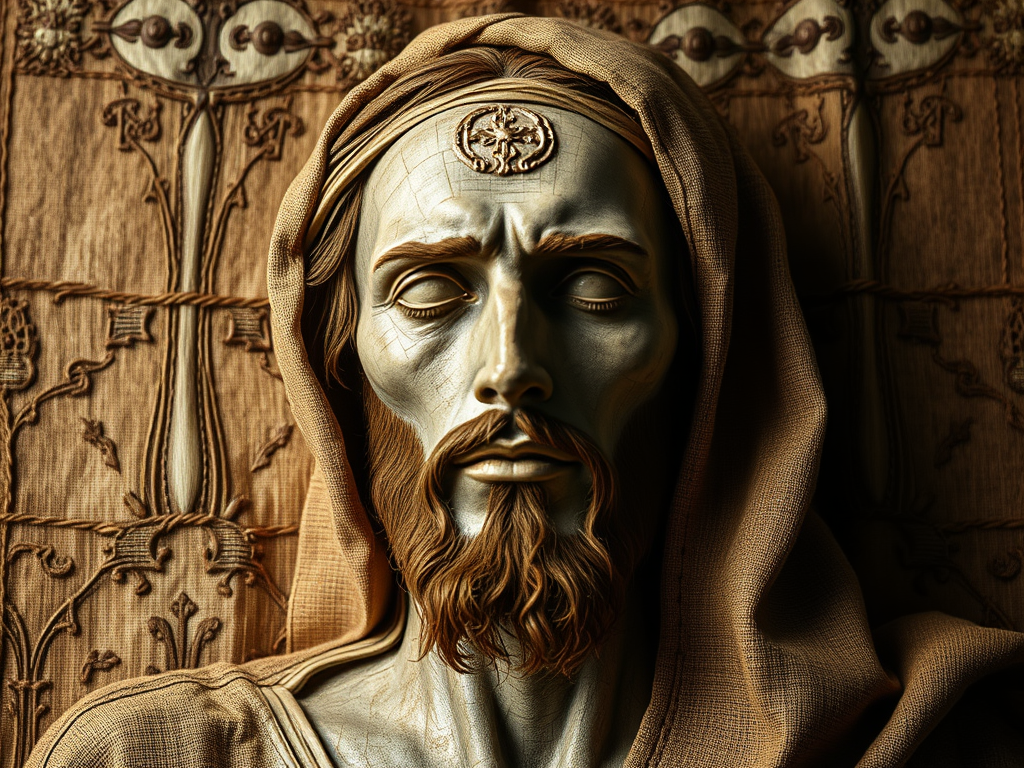
The Shroud of Turin, a 14-foot linen cloth bearing the faint image of a crucified man, has been a subject of fascination, skepticism, and reverence for centuries. Housed in the Cathedral of Saint John the Baptist in Turin, Italy, it is believed by many to be the burial cloth of Jesus Christ, imprinted with His image at the moment of His resurrection. Critics, including scientists and historians, often dismiss the Shroud as a medieval forgery, citing radiocarbon dating from 1988 that placed its origin between 1260 and 1390 AD. However, a closer examination of historical, scientific, and theological evidence suggests that the Shroud is genuine, providing compelling proof that Jesus indeed rose from the dead. This essay argues that the Shroud’s authenticity is supported by its historical context, forensic details, recent scientific reevaluations, and the unique nature of its image, collectively pointing to a miraculous event consistent with the resurrection narrative.
Historical Context Supports an Earlier Origin
The Shroud’s history aligns with a first-century origin, predating the medieval dating often cited by skeptics. Historical records suggest the Shroud’s existence long before the 13th century. The Codex Pray (1192–1195), a Hungarian manuscript, contains an illustration of a burial cloth with a herringbone weave and burn marks matching the Shroud’s pattern, alongside a depiction of Christ’s body, indicating its veneration as early as the 12th century. Additionally, early Christian texts like the Gospel of the Hebrews (2nd century) mention a burial cloth given to the “servant of the priest,” which some scholars link to traditions of the Shroud being preserved by early Christians. Byzantine icons from the 6th century, such as the Mandylion of Edessa, show a face with features remarkably similar to the Shroud’s—high cheekbones, long nose, and a forked beard—suggesting a continuous tradition of veneration. Critics argue that the lack of definitive records before the 14th century disproves its authenticity, but this ignores the chaotic history of early Christianity, where relics were often hidden during persecutions, as well as the Shroud’s possible journey through Edessa and Constantinople before arriving in Europe.
Forensic Details Match Crucifixion Accounts
Forensic analysis of the Shroud reveals details that align precisely with the crucifixion of Jesus as described in the Gospels, suggesting it is not a medieval forgery but a genuine artifact of a first-century execution. The Shroud shows a man who endured a brutal crucifixion: over 120 scourge marks from a Roman flagrum, puncture wounds on the head consistent with a crown of thorns, and nail wounds in the wrists (not the palms, as medieval art often depicted), matching historical Roman crucifixion practices as confirmed by archaeological finds like the 1968 discovery of a crucified man in Jerusalem with a nail through his wrist. Bloodstains on the Shroud, identified as human AB blood by forensic pathologist Pierluigi Baima Bollone in 1995, contain high levels of bilirubin, a chemical produced under extreme stress, consistent with severe torture. The Shroud also shows a side wound matching the Gospel account of a spear piercing Jesus’ side (John 19:34), with postmortem blood flow patterns indicating the body was upright for hours before being laid flat. These details are so anatomically accurate that medieval forgers, lacking modern forensic knowledge, would have been unlikely to replicate them with such precision, as argued by Dr. Alan Whanger, a Shroud researcher who noted the image’s anatomical fidelity surpasses medieval understanding.
Scientific Reevaluations Challenge the 1988 Carbon Dating
The 1988 radiocarbon dating, which placed the Shroud in the medieval period, has been widely debunked by subsequent studies, reinforcing its potential first-century origin. In 2013, Italian researchers at the University of Padua, using infrared spectroscopy and Raman spectroscopy, dated the Shroud’s linen to between 300 BC and 400 AD, consistent with a first-century origin. This study, published in Vibrational Spectroscopy, suggested the 1988 results were skewed by contamination from a medieval repair patch, as the tested sample came from a corner of the cloth rewoven after a 1532 fire, a finding supported by textile expert Mechthild Flury-Lemberg. Further, a 2024 study using Wide-Angle X-ray Scattering (WAXS) by the Institute of Crystallography in Italy dated the Shroud to around 55–74 AD, aligning with Jesus’ crucifixion around 30–33 AD. Critics of these studies, like those cited in Nature, argue that contamination and methodological flaws persist, but the convergence of multiple dating methods—alongside the Shroud’s pollen grains from Middle Eastern plants like Zygophyllum dumosum, identified by botanist Avinoam Danin—strengthens the case for an earlier origin, challenging the medieval forgery narrative.
The Image’s Unique Formation Points to a Miraculous Event
The Shroud’s image itself defies naturalistic explanations, supporting the hypothesis of a miraculous event like the resurrection. The image is a superficial, negative imprint—only penetrating the top 200 nanometers of the linen fibers—showing a crucified man with photographic realism, a concept unknown in medieval times. Studies by the Shroud of Turin Education and Research Association (STERA) using 3D imaging reveal that the image encodes three-dimensional information, unlike any known painting or photograph, as the intensity of the image correlates with the distance between the body and cloth. No pigments, dyes, or brushstrokes have been found, as confirmed by the 1978 Shroud of Turin Research Project (STURP), which concluded the image was not painted but formed by an unknown process involving oxidation and dehydration of the linen fibers. Physicist John Jackson proposed that the image could have resulted from a burst of radiant energy, consistent with a resurrection event, as the body appears to have dematerialized without disturbing the bloodstains, which show no signs of smearing. Skeptics, like Joe Nickell, suggest medieval techniques like bas-relief rubbing, but these fail to replicate the Shroud’s microscopic and three-dimensional properties, leaving the image’s formation an enduring mystery that aligns with a supernatural event.
Theological Implications and Resurrection Evidence
Theologically, the Shroud’s authenticity as Jesus’ burial cloth provides tangible evidence of His resurrection, a cornerstone of Christian faith. The Gospels (e.g., John 20:6–7) describe the burial cloths left behind in the empty tomb, and the Shroud’s lack of decomposition products—unlike typical burial cloths, which show decay after 40 hours—suggests the body was removed or transformed within a short time, consistent with the resurrection timeline of three days. The image’s formation, requiring a process unknown to science, supports the idea of a miraculous event where Jesus’ body, at the moment of resurrection, emitted energy that imprinted the cloth, a theory endorsed by theologians like Father Robert Spitzer. Critics argue that even if the Shroud is first-century, it doesn’t prove the resurrection—it could be the cloth of another crucified man. However, the Shroud’s unique features, like the crown of thorns (a detail specific to Jesus’ crucifixion, not a standard Roman practice) and the absence of any other historical candidate with matching wounds, make Jesus the most plausible subject, as argued by historian Ian Wilson in The Shroud of Turin (2010).
The Shroud of Turin is a genuine relic, not a medieval forgery, and its authenticity provides compelling evidence that Jesus rose from the dead. Historical records trace its existence to before the medieval period, forensic details align with the Gospel accounts of Jesus’ crucifixion, recent scientific studies challenge the 1988 carbon dating, and the image’s inexplicable formation points to a miraculous event. Theologically, the Shroud supports the resurrection narrative, offering a tangible link to the central event of Christianity. While skeptics continue to debate its origins, their arguments often rely on outdated data or fail to account for the Shroud’s unique properties, which defy naturalistic explanations. Like arguments over politics or religion, the Shroud debate may persist on the internet, but the weight of evidence—historical, scientific, and theological—suggests that this ancient cloth is indeed the burial shroud of Jesus, bearing witness to His resurrection. The Shroud invites us to reconsider the intersection of faith and reason, challenging us to see the miraculous in the material world.






 UTAZCO Overland
Leave a Reply