
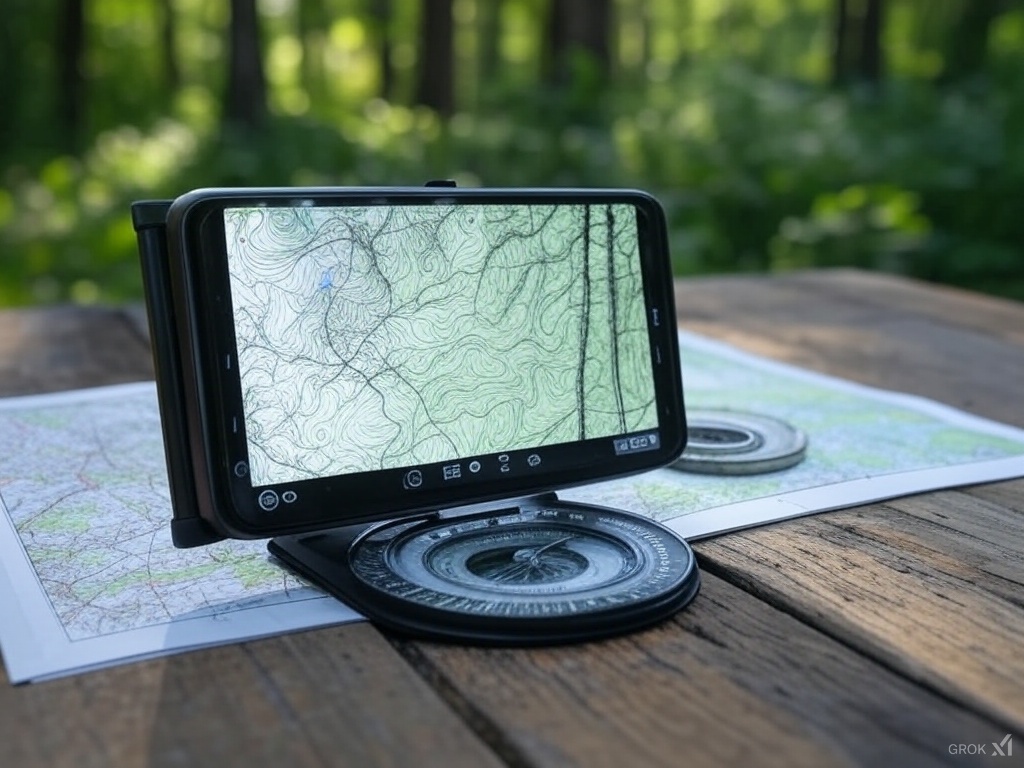
Part One of a two-part series about map and compass. Stay tuned for next week’s installment as well!
The Global Positioning System (GPS) has indeed revolutionized navigation, embedding itself into the fabric of daily life with such subtlety that its presence often goes unnoticed. This technology, with its ability to provide real-time, precise location data, has transformed how we move through the world. Whether it’s navigating through complex urban landscapes or optimizing routes to avoid traffic congestion, GPS has made the once daunting task of finding one’s way almost effortless. However, despite its convenience and accuracy, there is a compelling argument for maintaining proficiency in traditional map and compass navigation. These skills offer a range of benefits that extend beyond mere navigation, touching on practical, psychological, and philosophical dimensions.
Practically speaking, map and compass skills serve as a crucial backup when technology fails. GPS devices, while reliable, are not infallible. They depend on batteries, satellite signals, and electronic components, all of which can malfunction or become unavailable, especially in remote or challenging environments. In contrast, a map and compass are immune to such failures. They require no power source and can function under any conditions, providing a dependable alternative when electronic devices falter. For outdoor adventurers, this reliability is not just a convenience but a necessity, ensuring safety and self-sufficiency in the wilderness.
Psychologically, using a map and compass can enhance one’s sense of independence and confidence. Navigating without the aid of technology requires critical thinking, spatial awareness, and problem-solving skills. These cognitive processes engage the brain in ways that passive reliance on GPS does not. Successfully finding one’s way using traditional methods can boost self-esteem and foster a sense of accomplishment. Moreover, it encourages mindfulness and presence, as individuals must pay close attention to their surroundings and actively engage with the environment.
Philosophically, the practice of map and compass navigation offers a deeper connection to the world. GPS technology, while efficient, can create a sense of detachment from the environment. It reduces navigation to a series of digital instructions, often leading users to focus more on the screen than the landscape around them. In contrast, reading a map and using a compass requires an intimate understanding of the terrain, encouraging individuals to observe and appreciate the natural features and landmarks. This engagement fosters a greater appreciation for the complexity and beauty of the natural world, promoting a sense of stewardship and connection to the environment.
Furthermore, traditional navigation skills offer educational value, providing insights into geography, cartography, and the Earth’s magnetic properties. Learning to use a map and compass can deepen one’s understanding of the world and its physical characteristics, offering a tangible connection to the planet’s geography. This knowledge is not only practical but enriches one’s perspective, fostering a holistic understanding of the relationship between humans and the environment.
While GPS technology has undeniably transformed navigation, the traditional skills of map and compass navigation remain invaluable. They offer practical reliability, psychological benefits, and philosophical insights that technology alone cannot replicate. By preserving and practicing these skills, we maintain a connection to the natural world and cultivate a deeper understanding of our place within it. In an increasingly digital age, these time-honored methods remind us of the value of self-reliance, mindfulness, and environmental awareness.
The importance of maintaining proficiency with a map and compass is underscored by the fundamental need for safety, particularly in environments where reliance on technology can become precarious. GPS technology, while advanced and widely accessible, is not immune to failure. This vulnerability becomes especially pronounced in remote or challenging terrains where environmental factors can compromise electronic devices. Understanding how to navigate using a map and compass provides a critical safety net, ensuring that individuals are not left helpless when technology falters.
Consider the scenario of a hiker exploring a remote wilderness area. In such settings, the reliability of GPS devices can be compromised by several factors. Dense forests can obstruct satellite signals, deep canyons can create dead zones, and adverse weather conditions can exacerbate these issues. Moreover, electronic devices are susceptible to physical damage, such as being dropped or exposed to water, and their batteries can deplete rapidly in cold temperatures. In these situations, the comforting guidance of a GPS can disappear in an instant, leaving the user without direction.
Without the skills to read a topographic map or use a compass, a hiker in this predicament could quickly become disoriented. The ability to interpret a map allows individuals to understand the terrain, identify landmarks, and determine their position relative to their destination. A compass, meanwhile, provides a reliable means of determining direction, unaffected by environmental conditions that might disrupt electronic devices. Together, these tools enable individuals to navigate effectively, even in the absence of technology.
Traditional navigation skills empower individuals to take control of their situation, transforming potential crises into manageable challenges. By understanding how to use a map and compass, individuals can plot a course to safety, retrace their steps, or find alternative routes. This self-reliance is not only practical but also psychologically reassuring, providing a sense of confidence and autonomy in the face of uncertainty.
Moreover, the ability to navigate without technology fosters a deeper connection with the environment. It encourages individuals to engage with their surroundings, observe natural features, and develop an intuitive understanding of the landscape. This awareness can be invaluable in emergency situations, where quick thinking and adaptability are crucial.
In essence, traditional navigation skills serve as a low-tech lifeline, offering a reliable means of interpreting the landscape when technology fails. They provide a crucial safety net, ensuring that individuals are not left vulnerable in remote or challenging environments. By maintaining proficiency with a map and compass, individuals can navigate with confidence, knowing that they have the skills to safely explore and enjoy the natural world, regardless of technological limitations.
Navigating with a map and compass offers a profound opportunity to connect with the environment in ways that GPS technology often cannot. While GPS provides convenience and efficiency, it can inadvertently create a barrier between us and the natural world. The digital interface of a GPS device reduces navigation to a series of instructions, focusing our attention on the screen rather than the landscape around us. This transactional interaction can diminish our awareness of the environment, transforming the richness of the terrain into a mere backdrop for our journey.
In contrast, using a map and compass requires active engagement with the environment. This method of navigation transforms the journey into an immersive experience, where the landscape becomes a dynamic participant rather than a static setting. When navigating with a map, individuals must interpret contour lines, correlate them with the physical features they observe, and adjust their path accordingly. This process demands a heightened awareness of the surroundings, encouraging individuals to observe the natural world with curiosity and attentiveness.
For instance, a hiker using a map and compass might trace ridgelines and valleys, noticing how the topography influences the distribution of ecosystems. They might observe where water collects, how it shapes the land, and where different types of vegetation thrive. This awareness fosters a deeper understanding of the interconnectedness of natural systems, revealing the intricate relationships between landforms, climate, and living organisms. Such insights are often lost when following a GPS, which abstracts the landscape into a series of digital cues.
Moreover, this active engagement with the environment cultivates a sense of stewardship for the natural world. By developing an intimate understanding of the landscape, individuals are more likely to appreciate its beauty and complexity, fostering a desire to protect and preserve it. This connection can inspire a sense of responsibility and care for the environment, encouraging sustainable practices and conservation efforts.
Navigating with a map and compass also enriches the experience of exploration. It transforms the journey into a dialogue with the land, where each decision is informed by the natural features and conditions encountered along the way. This interaction enhances the sense of adventure and discovery, making the journey as rewarding as the destination itself.
Using a map and compass fosters a deeper connection with the environment by encouraging active engagement and observation. It transforms navigation into an immersive experience, revealing the richness and complexity of the natural world. This connection not only enriches the experience but also cultivates a sense of stewardship, inspiring individuals to appreciate and protect the landscapes they explore. In an age where technology often mediates our interactions with the world, traditional navigation skills offer a valuable opportunity to reconnect with the environment and deepen our understanding of the natural world.
The cognitive benefits of using a map and compass are significant, offering a stark contrast to the passive navigation often associated with GPS technology. While GPS devices provide convenience and ease, they can inadvertently diminish our spatial awareness and problem-solving abilities. This reliance on digital navigation tools can lead to a weakening of the brain’s capacity to form mental maps, a skill that has been crucial to human survival and development for millennia.
When navigating with a map and compass, individuals engage in a complex cognitive process that exercises various mental faculties. This method requires the visualization of distances, the interpretation of symbols, and the construction of a three-dimensional mental image of the terrain. Such tasks demand active engagement and critical thinking, sharpening memory and attention to detail. The process of orienting a map, identifying landmarks, and plotting a course involves a dynamic interplay of spatial reasoning and analytical skills.
For example, when plotting a course across a mountain range, a navigator must anticipate potential obstacles such as steep inclines, river crossings, and dense vegetation. This requires not only an understanding of the map’s topographical features but also the ability to devise solutions based on the information available. Navigators must consider various factors, such as elevation changes, weather conditions, and the availability of resources, to make informed decisions about their route. This mental workout enhances cognitive flexibility and problem-solving skills, fostering a deeper understanding of the environment and one’s capabilities.
In contrast, GPS navigation often encourages a more passive approach, where users follow prompts without fully understanding the rationale behind their route. This can lead to a diminished sense of spatial awareness and a reliance on technology for decision-making. Over time, this passive obedience can erode confidence in one’s ability to navigate independently, reducing the development of critical thinking and self-reliance.
Traditional navigation, on the other hand, builds confidence in one’s reasoning abilities and fosters a sense of self-reliance that extends beyond the trail. By developing the skills to navigate using a map and compass, individuals gain a greater sense of autonomy and empowerment. This confidence in one’s abilities can translate to other areas of life, enhancing decision-making and problem-solving skills in various contexts.
Moreover, the cognitive engagement required by traditional navigation can have long-term benefits for brain health. Studies have suggested that activities that challenge the brain, such as learning new skills or engaging in complex problem-solving, can help maintain cognitive function and reduce the risk of cognitive decline with age. By regularly practicing map and compass navigation, individuals can keep their minds sharp and agile, contributing to overall mental well-being.
The cognitive dimension of using a map and compass offers significant benefits, enhancing spatial awareness, problem-solving skills, and critical thinking. This active engagement contrasts with the passive navigation often associated with GPS, fostering confidence and self-reliance. By maintaining proficiency in traditional navigation skills, individuals can enjoy the cognitive benefits of a mental workout, contributing to lifelong learning and brain health.
Mastering the skill of using a map and compass offers a unique sense of satisfaction and pride, rooted in a rich historical tradition that predates modern technology. This practice connects us to the legacy of explorers and travelers who navigated the world long before the advent of digital tools. From ancient mariners who charted unknown seas using the stars and rudimentary maps, to mountaineers who conquered formidable peaks relying solely on their wits and observational skills, traditional navigation is a testament to human ingenuity and resilience.
This connection to the past serves as a powerful reminder of the capabilities inherent in human observation and problem-solving. In an age where algorithms and digital devices often dictate our actions, the ability to navigate using a map and compass underscores the enduring value of human skills and intuition. It highlights the triumph of human ingenuity over reliance on technology, showcasing the potential for self-reliance and adaptability in challenging situations.
The satisfaction derived from mastering these skills is not merely about nostalgia or romanticizing the past. It is about recognizing the intrinsic value of being able to navigate the world using one’s own abilities. This mastery fosters a sense of accomplishment and confidence, reinforcing the idea that we are capable of understanding and interacting with the environment on our own terms.
While GPS technology is undeniably a remarkable tool that offers convenience, efficiency, and accessibility, supplementing it with traditional navigation methods creates a more well-rounded navigator. This dual approach allows individuals to toggle between the speed and ease of digital navigation and the resilience and depth of analog skills. It equips them with the versatility to adapt to various situations, whether they are navigating urban environments or exploring remote wilderness areas.
By integrating both modern and traditional navigation techniques, individuals can enjoy the best of both worlds. GPS can save time, reduce stress, and make travel more accessible to those who might otherwise hesitate. Meanwhile, map and compass skills provide a reliable backup, enhance spatial awareness, and foster a deeper connection with the environment.
The combination of these skills enriches the experience of exploration, offering a more comprehensive understanding of navigation. It empowers individuals to navigate with confidence, knowing they have the tools to handle any situation that arises. This blend of technology and tradition not only enhances practical navigation skills but also cultivates a sense of pride and accomplishment in mastering a timeless craft.
Blending modern GPS technology with traditional map and compass skills creates a versatile approach to navigation that leverages the strengths of both systems while addressing their respective weaknesses. This hybrid mindset is about adaptability and preparedness, ensuring that individuals are equipped to handle a variety of situations, whether in urban settings or remote wilderness areas.
Consider the scenario of a driver using GPS to reach a trailhead. The GPS provides real-time directions, optimizing the route to avoid traffic and ensuring a timely arrival. However, once the driver transitions from the vehicle to the backcountry, the reliance on GPS may become less practical. Dense forests, rugged terrain, and limited satellite signals can compromise the effectiveness of digital navigation tools. Here, the map and compass come into play, offering a reliable means of exploring the wilderness. By reading topographic maps and using a compass to maintain direction, the hiker can navigate trails, identify landmarks, and explore the natural environment with confidence.
Similarly, a sailor might rely on satellite navigation for precise positioning and route planning at sea. GPS technology provides invaluable data on location, speed, and course, making it an essential tool for modern maritime navigation. However, in the event of a system failure, such as a loss of satellite signal or electronic malfunction, having a nautical chart and a compass on hand becomes crucial. These traditional tools allow the sailor to plot courses, identify hazards, and navigate safely to their destination, even when digital systems are unavailable.
This hybrid approach acknowledges the strengths of both GPS and traditional navigation methods. GPS excels in providing convenience, speed, and accuracy, particularly in environments where digital signals are strong and reliable. It simplifies navigation, reduces stress, and opens up travel opportunities for many. On the other hand, map and compass skills offer resilience and reliability, functioning independently of electronic systems and power sources. They encourage active engagement with the environment, enhancing spatial awareness and problem-solving abilities.
By combining these approaches, individuals can mitigate the weaknesses inherent in each system. GPS devices, while powerful, are vulnerable to technical failures and environmental limitations. Traditional navigation, while reliable, can be more time-consuming and requires a certain level of skill and practice. Together, they create a comprehensive toolkit that equips individuals to adapt when conditions change or tools fail.
This versatility is particularly valuable in dynamic environments where conditions can shift rapidly. Whether it’s a sudden weather change, unexpected terrain challenges, or technological malfunctions, having the ability to switch between navigation methods ensures that individuals remain in control of their journey. It fosters a sense of preparedness and confidence, knowing that they have the skills and tools to navigate effectively, regardless of the circumstances.
In essence, blending GPS technology with map and compass skills is about embracing a mindset of adaptability and resilience. It empowers individuals to navigate with confidence, leveraging the best of both worlds to enhance their exploration and ensure their safety. This hybrid approach not only enriches the experience of navigation but also cultivates a deeper understanding of the environment and one’s capabilities.
The enduring value of map and compass navigation lies in its ability to preserve fundamental human qualities such as agency, awareness, and a tangible connection to the world around us. While GPS technology provides precise location data and directions, it often does so in a way that can distance us from the deeper understanding of our surroundings. In contrast, traditional navigation skills offer a more holistic approach, fostering a sense of place and self that transcends mere coordinates on a screen.
Agency is a key aspect of map and compass navigation. By relying on these tools, individuals take an active role in their journey, making decisions based on their observations and interpretations of the environment. This active engagement fosters a sense of empowerment and self-reliance, as navigators are responsible for their own path. It contrasts with the passive experience of following GPS instructions, where the route is predetermined and the user simply follows along. The ability to navigate independently reinforces confidence in one’s abilities and cultivates a mindset of problem-solving and adaptability.
Awareness is another crucial element preserved by traditional navigation. Using a map and compass requires individuals to engage with their environment in a meaningful way. They must observe the landscape, identify landmarks, and interpret topographical features. This process enhances spatial awareness and encourages a deeper connection with the natural world. It transforms navigation from a transactional task into an immersive experience, where the journey becomes an opportunity for discovery and learning.
Moreover, map and compass navigation provides a tactile link to the world we move through. The physical act of unfolding a map, tracing routes with a finger, and aligning a compass needle with magnetic north creates a sensory experience that digital navigation lacks. This tactile interaction grounds us in the present moment, fostering mindfulness and a sense of presence. It reminds us of the simplicity and elegance of traditional tools, which have guided explorers and adventurers for centuries.
In an era where technology promises to solve every problem, there is something profoundly grounding about knowing we can still find our way with nothing more than a folded sheet of paper and a magnetized needle. This knowledge connects us to the enduring wisdom of the past, reminding us of the resilience and ingenuity that have defined human exploration throughout history. It serves as a bridge between the convenience of the present and the timeless skills that have enabled us to navigate the world for generations.
As we continue to advance into a tech-saturated future, the skills of map and compass navigation remain not just relevant but essential. They offer a counterbalance to the digital tools that dominate our lives, preserving the qualities that make us human—our curiosity, our adaptability, and our capacity for independent thought. By maintaining these skills, we ensure that we remain connected to the world around us, capable of understanding not just where we are, but where we stand in a broader sense—physically, mentally, and existentially.
Conclusion
While GPS technology offers unparalleled convenience and accuracy, the importance of understanding how to use a map and compass cannot be overstated. These traditional navigation skills provide a reliable backup in case of technological failure, foster a deeper connection with the environment, enhance cognitive abilities, and offer valuable educational opportunities. In a world increasingly dominated by technology, maintaining these skills ensures that we remain connected to the natural world and capable of navigating it with confidence and independence.



 UTAZCO Overland
Leave a Reply