
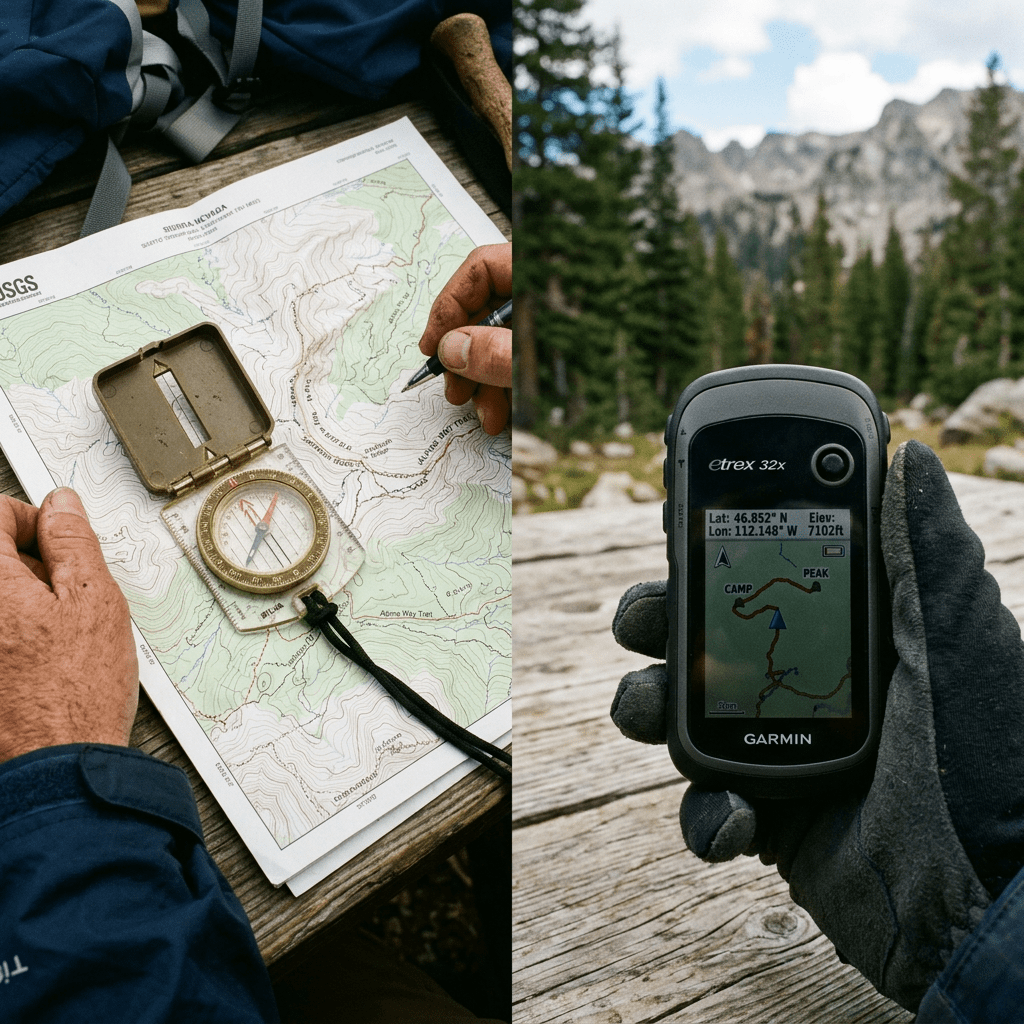
In an era dominated by GPS devices, smartphones, and even satellite internet services like Starlink, the traditional skills of map and compass navigation might seem obsolete. Yet, for those who venture off-grid—whether hikers, overlanders, or dispersed campers—these analog tools remain not only relevant but essential. This essay explores why map and compass skills are still needed, how they complement modern technology, and what unique advantages they offer in the wild.
Why Map and Compass Are Still Needed
Technology Is Not Infallible
The allure of modern navigation technology is undeniable. With a few taps on a screen, GPS devices and satellite-based systems like Starlink can pinpoint your location with astonishing precision, overlaying your position on detailed digital maps and even providing real-time weather updates or emergency communication. Yet, beneath this veneer of reliability lies a fundamental vulnerability: technology, for all its sophistication, is not immune to failure.
Batteries, the lifeblood of all electronic devices, are inherently limited. In cold environments, battery life can plummet, sometimes draining within hours. Extended trips off-grid often outlast the charge of even the most robust power banks or solar chargers, especially when devices are used frequently for navigation, communication, and photography. Once the battery is depleted, the device becomes little more than dead weight.
Beyond power concerns, hardware itself is susceptible to the rigors of the wild. A sudden downpour can seep into supposedly water-resistant casings, rendering screens unreadable or short-circuiting delicate electronics. A dropped device on rocky terrain can shatter screens or damage internal components, making navigation impossible. Even dust, sand, or extreme temperatures can degrade performance or cause outright failure.
Connectivity, often taken for granted in urban settings, is another Achilles’ heel. While satellite networks like Starlink promise global coverage, real-world conditions can interfere. Dense forests, deep canyons, or mountainous terrain can block signals, leaving devices unable to update maps, communicate, or even determine location. Atmospheric disturbances, solar activity, or simple technical glitches can further disrupt service, sometimes at the very moment when reliable navigation is most critical.
Perhaps most importantly, an overreliance on digital navigation introduces a single point of failure. When all navigational confidence is placed in a device, the loss or malfunction of that device can leave travelers disoriented and vulnerable. In the backcountry, where help may be hours or days away, this can escalate from inconvenience to genuine danger. The consequences of being lost without a backup plan are magnified by the remoteness and unpredictability of wild places.
In contrast, map and compass are immune to these technological pitfalls. They require no batteries, are impervious to signal loss, and can withstand a surprising amount of environmental abuse. Their simplicity is their strength, providing a steadfast means of orientation when technology falters. This enduring reliability is why, even in the age of GPS and Starlink, the map and compass remain essential companions for anyone venturing off the grid.
Modern navigation technology offers remarkable convenience and precision, but it is fundamentally vulnerable to failure. Batteries can quickly drain—especially in cold or remote environments—while devices themselves are susceptible to damage from weather, drops, or harsh conditions. Connectivity issues, such as blocked signals in dense forests or canyons, further undermine reliability. Relying solely on digital navigation creates a single point of failure, which can be dangerous in the backcountry where help is far away. In contrast, map and compass require no power, are immune to signal loss, and remain dependable in challenging conditions, making them indispensable tools for safe off-grid travel.
Maps and Compasses Are Immune to Power Loss
Maps and compasses possess a unique resilience that sets them apart from their digital counterparts. Unlike electronic devices, which are tethered to the constant need for charging and the uncertainty of battery life, a paper map and a magnetic compass operate entirely free from the constraints of electricity. This independence from power sources is not just a matter of convenience; it is a fundamental advantage in the unpredictable and often unforgiving environments encountered off-grid.
When you unfold a topographic map, you hold in your hands a complete, unchanging record of the landscape—one that will not flicker out when the temperature drops or the sun sets. The compass, with its simple magnetized needle, remains steadfastly reliable whether you are navigating at sea level or atop a windswept mountain pass. There are no software updates to install, no risk of corrupted files, and no anxiety about whether your device will last until the journey’s end. This constancy is especially vital in remote regions, where the nearest opportunity to recharge or replace equipment may be days or even weeks away.
The physical durability of maps and compasses further enhances their value. A well-made compass can withstand rough handling, moisture, and temperature extremes that would quickly disable most electronics. Maps, especially when laminated or stored in waterproof cases, can survive rain, snow, and repeated folding and unfolding. Even if a map becomes worn or torn, its essential information remains accessible, and it can often be repaired with simple materials at hand.
This robust reliability transforms map and compass from mere backups into primary tools for serious off-grid navigation. Their ability to function in all weather conditions and at any altitude means that, regardless of the challenges posed by the environment, you retain the means to orient yourself and make informed decisions. In situations where every ounce of gear must justify its place in your pack, the enduring utility of map and compass is clear: they are not just relics of a bygone era, but essential instruments for safe and confident exploration, immune to the vulnerabilities that accompany modern technology.
Maps and compasses stand out for their complete independence from power sources, making them uniquely reliable in off-grid environments where charging is impossible and battery life is uncertain. Unlike electronic devices, they never require electricity, software updates, or worry about malfunctioning due to cold, moisture, or rough handling. Their physical durability and constant readiness mean they can be trusted in any weather or terrain, providing a stable and unchanging reference when navigating remote areas. This resilience elevates map and compass from mere backups to essential, primary tools for safe and confident exploration, immune to the vulnerabilities of modern technology.
Deepening Situational Awareness
Navigating with a map and compass is an immersive process that transforms the act of travel into a dialogue with the landscape. Rather than simply following a digital arrow or a prescribed route, you become an active participant in your own journey. Every contour line, symbol, and landmark on the map becomes a clue to be interpreted, inviting you to read the story of the terrain and anticipate what lies ahead. This engagement demands that you look up from your tools and truly observe your surroundings—identifying ridgelines, valleys, watercourses, and subtle changes in vegetation or elevation.
As you move through the environment, you are constantly comparing the physical world to its representation on the map, estimating distances by pacing or timing, and using the compass to confirm your bearings. This ongoing process of observation and interpretation deepens your spatial awareness, allowing you to build a mental map that is far richer and more nuanced than any digital display. You begin to notice how the land undulates, how the light shifts across a hillside, or how the sound of a stream can help orient you when visibility is poor.
This heightened awareness does more than just keep you on course; it fosters a sense of connection and respect for the natural world. You become attuned to the rhythms and patterns of the landscape, developing an intuitive sense of direction and an appreciation for the subtle cues that guide experienced navigators. In challenging or unfamiliar terrain, this skillset becomes invaluable. When faced with an unexpected obstacle—a washed-out trail, a sudden change in weather, or a navigational error—you are equipped not just with tools, but with the confidence and critical thinking needed to adapt and find solutions.
Moreover, the discipline of analog navigation encourages self-reliance and mindfulness. Each decision—whether to follow a ridgeline, descend into a valley, or skirt around a marsh—requires careful consideration of the map, the compass, and the environment itself. This process sharpens your problem-solving abilities and prepares you to respond effectively in dynamic or emergency situations, where quick thinking and a clear understanding of your surroundings can make all the difference. In this way, navigating with map and compass is not just a means of reaching your destination, but a practice that enriches your experience and deepens your relationship with the land.
Navigating with a map and compass turns travel into an active, immersive experience, requiring you to interpret the landscape and engage deeply with your surroundings. This process builds spatial awareness and a nuanced mental map, as you constantly compare the terrain to its representation on paper and use the compass to confirm your direction. Such engagement fosters a strong connection to the natural world, sharpens intuition, and develops critical thinking and problem-solving skills. Ultimately, analog navigation not only keeps you on course but also cultivates self-reliance, mindfulness, and a richer, more meaningful relationship with the land.
Universal Compatibility
The universality of maps and compasses is one of their most enduring strengths. Unlike digital navigation tools, which often require specific software, compatible devices, or ongoing subscriptions, these analog instruments are free from technological boundaries. A topographic map, whether produced decades ago or printed yesterday, can be read and understood by anyone familiar with its symbols and scales. There is no need to worry about file formats, app updates, or whether your device supports a particular mapping service. The language of contour lines, elevation marks, and natural features is consistent and accessible, making the map a truly democratic tool.
Similarly, the magnetic compass is a marvel of simplicity and reliability. Its operation is based on the Earth’s magnetic field, a constant that does not depend on satellites, cell towers, or any external infrastructure. Whether you are in the dense forests of North America, the highlands of Scotland, or the deserts of Central Asia, a compass will always point north. There are no regional restrictions, no licensing agreements, and no risk that a change in technology will render your compass obsolete. This global functionality means that once you have mastered the basic skills of map and compass navigation, you can apply them anywhere in the world.
This universal compatibility also fosters a sense of continuity and tradition. The skills you develop are not tied to a fleeting technological trend, but are part of a lineage of exploration and self-reliance that stretches back centuries. Whether you are sharing a map with a fellow traveler from another country or teaching navigation to a new generation, the tools and techniques remain the same. This transferability ensures that your knowledge is always relevant, regardless of changes in technology or the specifics of your journey.
In a world where digital platforms can become obsolete overnight and proprietary systems can lock users into narrow ecosystems, the map and compass stand apart as tools that belong to everyone. Their universal design and enduring functionality guarantee that, wherever your adventures may lead, you will always have the means to find your way.
Maps and compasses are universally compatible tools, free from the limitations of software, device compatibility, or subscriptions that constrain digital navigation. A topographic map can be read by anyone, anywhere, and a compass will always work, regardless of location or technological changes. This enduring simplicity means the skills you develop are timeless and transferable across regions and generations. In a world where digital systems can quickly become obsolete or restricted, map and compass remain reliable, accessible, and relevant for all explorers, ensuring you always have the means to navigate.
Essential for Emergency and Rescue
In the unpredictable world of wilderness travel, emergencies can arise with little warning—an injury, a sudden change in weather, or simply becoming disoriented far from established trails. In these moments, the reliability of your navigation tools becomes a matter of safety, not just convenience. Electronic devices, for all their sophistication, are vulnerable to loss, damage, or power depletion, especially in the chaos of a survival situation. A dropped GPS unit can shatter on rocks, a phone can slip into a river, or batteries can be drained after days of use. When these devices fail, the ability to navigate and communicate your location must not vanish with them.
This is where the enduring value of map and compass becomes most apparent. Search and rescue teams, despite having access to advanced technology, continue to rely on these analog tools for both planning and field operations. In many remote or rugged regions, digital maps may be incomplete, outdated, or simply unavailable, leaving rescuers to depend on detailed paper maps that accurately depict the terrain. The compass, immune to environmental extremes and technological glitches, allows rescuers to plot bearings, triangulate positions, and move efficiently through challenging landscapes.
For those in distress, being able to read a map and use a compass can mean the difference between waiting helplessly and taking proactive steps toward safety. Communicating your position using map coordinates—such as grid references or latitude and longitude—enables rescuers to pinpoint your location quickly and accurately, even if electronic communication is impossible. Navigating toward a known landmark, such as a river, road, or ridge, without the aid of electronics, can lead you to safety or make you more visible to searchers.
Moreover, the confidence and clarity that come from understanding your surroundings can help prevent panic and poor decision-making, both of which are common in high-stress situations. The map and compass provide not only practical guidance but also a psychological anchor—a tangible sense of control and direction when circumstances are at their most uncertain. In this way, these traditional tools remain indispensable in emergency and rescue scenarios, offering a lifeline that technology alone cannot guarantee.
In wilderness emergencies, when injuries, sudden weather changes, or disorientation occur, the reliability of navigation tools becomes critical for safety. Electronic devices can easily fail due to loss, damage, or dead batteries, especially in chaotic or prolonged survival situations. In contrast, map and compass remain dependable, allowing both rescuers and those in distress to navigate, communicate precise locations, and move toward safety even when technology is unavailable or digital maps are incomplete. These analog tools not only provide practical guidance but also instill confidence and a sense of control, making them indispensable lifelines in rescue and survival scenarios where technology may falter.
Comparing Map & Compass with Modern Navigation Tools
| Aspect | Map & Compass | GPS/Starlink Devices |
|---|---|---|
| Power Requirement | None | Requires batteries/electricity |
| Durability | High (waterproof, shock-resistant) | Vulnerable to damage, water, cold |
| Signal Dependency | None | Needs satellite or cellular signal |
| User Engagement | High (active interpretation) | Low (passive, automated directions) |
| Learning Curve | Steeper (requires practice) | Easier (intuitive interfaces) |
| Data Privacy | Complete (no tracking) | May transmit location data |
| Universality | Works anywhere with a map | Limited by device compatibility, coverage |
| Failure Modes | Physical loss/damage only | Battery, software, hardware, signal loss |
Creating Custom Maps with CalTopo
CalTopo has fundamentally changed the landscape of trip planning for those who venture off the beaten path. Unlike the static, one-size-fits-all nature of traditional paper maps, CalTopo offers a dynamic and interactive platform where you can craft a map that is uniquely suited to your adventure. The process is intuitive yet remarkably powerful: you begin by zeroing in on the precise region you intend to explore, whether it’s a remote mountain range, a winding river valley, or a network of seldom-used trails. This ability to focus on your exact area of interest means that your map is never cluttered with irrelevant details, nor does it omit the subtle features that could prove crucial during your journey.
What truly sets CalTopo apart is its rich array of map layers and overlays. You can seamlessly switch between classic USGS topographic maps, high-resolution satellite imagery, shaded relief, and even specialized layers that reveal slope angles or recent wildfire boundaries. This multi-layered approach allows you to visualize the terrain from multiple perspectives, making it easier to anticipate challenges such as steep ascents, avalanche-prone slopes, or areas with limited water availability. For those navigating public lands, overlays showing property boundaries and land management designations help ensure that your route respects both legal and environmental considerations.
Customization is at the heart of the CalTopo experience. As you plan your route, you can drop waypoints at key locations—perhaps marking a reliable spring, a scenic overlook, or a potential bailout point in case of emergency. Drawing your intended path on the map not only helps you estimate distances and elevation gain, but also provides a visual reference that can be shared with your group or left with a trusted contact for safety. The ability to annotate your map with notes, symbols, and color-coded lines transforms it from a generic navigation aid into a living document that reflects your intentions, priorities, and contingency plans.
Collaboration is another strength of CalTopo. When planning a group expedition, you can invite others to view or edit the map, fostering a shared understanding of the route and allowing everyone to contribute their insights or concerns. This collective approach to planning enhances safety and ensures that all participants are equally informed, reducing the risk of miscommunication once you are in the field.
Perhaps most importantly, CalTopo bridges the gap between digital convenience and analog reliability. After finalizing your map, you can print it at a scale that suits your navigation style, whether you prefer a broad overview or a detailed close-up of a tricky section. Laminating the printed map or storing it in a waterproof sleeve ensures that it will withstand the rigors of the backcountry, remaining legible and intact even in harsh conditions. By carrying a CalTopo-generated map, you benefit from the latest data and the precision of digital planning, while retaining the independence and resilience of traditional paper navigation.
In essence, CalTopo empowers you to enter the wilderness with a map that is both a product of modern technology and a steadfast companion in environments where technology may falter. It is this synthesis—of innovation and tradition, of customization and reliability—that makes CalTopo an invaluable tool for today’s off-grid explorer.
CalTopo has transformed trip planning for off-grid adventurers by offering a customizable, interactive mapping platform that goes far beyond traditional paper maps. Users can focus on their exact area of interest, overlay multiple map types and data layers, and add personalized waypoints, routes, and notes, ensuring every map is tailored to the journey’s unique demands. The platform’s collaborative features allow groups to plan together and share critical information, enhancing safety and preparedness. Once finalized, maps can be printed at any scale and protected for field use, combining the up-to-date detail and flexibility of digital planning with the reliability of paper navigation. Ultimately, CalTopo bridges the gap between modern technology and traditional tools, making it an essential resource for anyone navigating remote or challenging terrain.
Practical Scenarios Where Map and Compass Excel
Navigating in Dense Forests or Canyons
Navigating through dense forests or winding canyons presents unique challenges that often expose the limitations of electronic navigation devices. In these environments, the thick canopy of trees or the towering walls of rock can severely degrade or even block GPS signals, causing devices to lose accuracy or fail altogether. The digital map on your screen may freeze, your position may jump erratically, or the device may simply display a “searching for satellites” message, leaving you uncertain of your location at the very moment when clarity is most needed.
In contrast, a map and compass remain steadfast allies in such terrain. The magnetic compass is impervious to the physical barriers that confound satellite signals; it will always indicate magnetic north, regardless of how dense the forest or how narrow the canyon. With a reliable compass bearing and a detailed topographic map, you can orient yourself to the landscape, identify key features such as ridgelines, streams, or clearings, and make informed decisions about your route. Even when visibility is limited and landmarks are obscured, you can use the map’s contour lines and the compass’s steady guidance to track your progress and avoid becoming disoriented.
The process of navigating with map and compass in these settings also encourages a heightened awareness of your surroundings. You learn to recognize subtle changes in the terrain, the direction of water flow, or the feel of the ground underfoot—clues that help confirm your position and direction. This active engagement with the environment not only keeps you on course but also builds confidence and self-reliance, qualities that are invaluable when technology falters.
Ultimately, in the shadowed depths of a forest or the twisting corridors of a canyon, the enduring reliability of map and compass ensures that you are never truly lost. They provide a constant, unyielding reference point, empowering you to navigate safely and effectively where digital tools may fail.
Dense forests and canyons often block or degrade GPS signals, making electronic navigation unreliable or unusable just when precise location is most critical. In these challenging environments, map and compass remain unaffected by physical barriers, allowing you to orient yourself, track progress, and make informed decisions even with limited visibility. This method not only ensures reliable navigation but also fosters greater awareness, confidence, and self-reliance, providing a dependable way to stay on course when technology cannot.
Long-Duration Expeditions
Long-duration expeditions, whether they span several days or stretch into weeks, place unique demands on both equipment and planning. In these scenarios, the practicality of relying solely on electronic navigation quickly comes into question. The cumulative weight and bulk of carrying spare batteries, power banks, or solar chargers can add up, especially when every ounce matters for efficiency and comfort. Even the most robust charging solutions are vulnerable to the unpredictability of weather—cloudy days can render solar panels ineffective, and cold temperatures can sap battery life at an alarming rate.
As the days pass and the miles accumulate, the risk of running out of power grows, particularly if you are using your devices not just for navigation, but also for communication, photography, or emergency signaling. The anxiety of watching battery levels dwindle can become a constant companion, distracting from the experience and potentially influencing decisions about route and pace. In remote areas, the opportunity to recharge may be nonexistent, and the consequences of a dead device can be serious, especially if you are far from help or traveling through complex terrain.
Map and compass, by contrast, offer a solution that is both elegant and enduring. A single topographic map, carefully folded and protected, weighs almost nothing and takes up minimal space in your pack. A quality compass is similarly compact and robust, immune to the effects of weather and time. These tools require no external power, no maintenance beyond basic care, and no reliance on favorable conditions. They are always ready, day after day, regardless of how long your journey lasts.
The reliability of map and compass on extended expeditions fosters a sense of security and independence. You can plan ambitious routes, explore remote regions, and adapt to changing circumstances without the constant concern of technological failure. This freedom allows you to immerse yourself more fully in the landscape, confident that your ability to navigate will not be compromised by the limitations of modern electronics. In the context of long-duration travel, the simplicity and dependability of map and compass become not just practical advantages, but essential companions for true self-sufficiency in the wild.
On long-duration expeditions, relying solely on electronic navigation is often impractical due to the weight and limitations of carrying enough batteries or chargers, and the unpredictability of weather affecting power sources. As days pass, the risk of running out of power grows, which can cause anxiety and compromise safety, especially in remote areas. In contrast, map and compass are lightweight, require no external power, and remain reliable regardless of conditions or trip length. Their enduring simplicity and dependability provide security, independence, and true self-sufficiency, making them essential tools for extended journeys in the wild.
Teaching and Learning Navigation
Teaching and learning navigation with a map and compass is a deeply enriching process that goes far beyond simply finding your way from point A to point B. At its core, this practice cultivates a fundamental literacy in reading the landscape—an ability to interpret the language of contour lines, symbols, and scales that represent the physical world on paper. As you learn to orient a map, take a bearing, and plot a course, you begin to see the terrain not just as a backdrop, but as a living, three-dimensional puzzle that invites exploration and understanding.
This hands-on approach to navigation fosters a direct connection to geography and topography. You come to appreciate how rivers carve valleys, how ridgelines define watersheds, and how subtle changes in elevation can influence both your route and your experience. These insights are not limited to a single environment or activity; the principles you master with a map and compass are equally applicable whether you are hiking in the mountains, paddling across a lake, or traversing open desert. The universality of these skills means that, once learned, they become a toolkit you can draw upon in any landscape, anywhere in the world.
Moreover, the process of learning navigation instills a sense of self-reliance and confidence that is difficult to achieve through passive reliance on technology. Each successful journey, each moment of reorienting yourself after a wrong turn, reinforces your ability to solve problems and make decisions independently. This empowerment is especially valuable in group settings, where teaching others to use map and compass not only spreads knowledge but also builds trust and resilience within the team.
The act of teaching navigation is itself a powerful educational experience. Instructors must break down complex concepts into understandable steps, fostering patience and clarity. Learners, in turn, are encouraged to ask questions, experiment, and learn from mistakes in a supportive environment. This collaborative process strengthens communication and critical thinking, qualities that extend well beyond navigation and enrich all aspects of outdoor adventure.
Ultimately, mastering map and compass navigation is about more than technical proficiency. It is about developing a mindset of curiosity, adaptability, and respect for the natural world—a mindset that transforms every journey into an opportunity for discovery and growth.
Teaching and learning navigation with a map and compass is a transformative process that builds a deep understanding of the landscape and the principles of geography and topography. It encourages you to interpret terrain features, appreciate natural patterns, and apply these skills across any environment. This hands-on learning fosters self-reliance, confidence, and problem-solving abilities, while also strengthening group trust and communication when taught collaboratively. Ultimately, mastering these skills nurtures curiosity, adaptability, and a respectful, exploratory mindset, turning every journey into an opportunity for growth and discovery beyond mere technical proficiency.
Navigating in Areas with Poor or Outdated Digital Maps
The journey of teaching and learning navigation with a map and compass is transformative, shaping not only how one moves through the world but also how one perceives and interacts with it. As you delve into the intricacies of topographic maps, you begin to decode the subtle language of the land—reading the rise and fall of hills through contour lines, recognizing the significance of a blue line meandering across the page as a river, or understanding how a cluster of tightly packed lines signals a steep ascent. This process is not merely academic; it is tactile and experiential, requiring you to match what you see on paper with what you observe in the environment around you.
Through repeated practice, you develop an intuitive sense for the terrain. You start to notice how the shape of a valley or the direction of a slope can influence your path, your pace, and even your safety. This awareness is not confined to a single landscape or activity. Whether you are navigating a dense forest, crossing open tundra, or paddling along a winding shoreline, the foundational skills of map and compass navigation remain constant, adaptable to any setting. This universality is empowering, giving you the confidence to explore unfamiliar places with the assurance that you possess the tools to understand and interpret them.
Learning navigation also fosters a profound sense of independence. Unlike following a GPS track, which can feel passive and detached, using a map and compass requires active decision-making and engagement. Each time you successfully identify a landmark, correct your course, or reach your destination, you reinforce your ability to think critically and solve problems on your own. This self-reliance is invaluable, especially in situations where technology fails or when you are responsible for the safety of others.
In group contexts, the act of teaching navigation becomes a shared adventure. Instructors must distill complex ideas into clear, manageable lessons, often using real-world scenarios to illustrate concepts. Learners are encouraged to experiment, make mistakes, and ask questions, creating an environment where curiosity and collaboration thrive. This dynamic not only builds technical skills but also strengthens bonds within the group, as members learn to trust both themselves and each other.
Ultimately, the mastery of map and compass navigation is about cultivating a deeper relationship with the world. It encourages you to slow down, observe, and appreciate the nuances of the landscape. It invites you to approach each journey with a spirit of inquiry and adaptability, knowing that every challenge is an opportunity to learn and grow. In this way, navigation becomes more than a means to an end—it becomes a lifelong practice of discovery, resilience, and respect for the natural world.
Navigating in areas with poor or outdated digital maps highlights the enduring value of map and compass skills. Mastering these tools allows you to interpret the landscape directly, using contour lines and natural features to guide your way even when digital information is lacking or inaccurate. This hands-on approach fosters a deep, intuitive understanding of terrain, builds self-reliance, and encourages critical thinking and adaptability. Whether in unfamiliar or remote regions, these foundational skills empower you to confidently explore and respond to challenges, making navigation a meaningful and resilient practice beyond the limitations of technology.
Integrating Map and Compass with Modern Tools
Integrating map and compass skills with modern digital navigation tools creates a synergy that elevates both safety and the overall experience of travel in remote areas. Rather than viewing analog and digital methods as mutually exclusive, skilled navigators recognize that each brings unique strengths to the table, and that their combined use offers a level of preparedness and adaptability that neither could achieve alone.
Digital devices such as GPS units and smartphones excel in providing real-time location data, allowing you to pinpoint your position with remarkable accuracy. They are invaluable for recording tracks, marking waypoints, and quickly calculating distances or elevation changes. In emergency situations, these devices can transmit your coordinates to rescuers or allow you to communicate with the outside world, features that have saved countless lives. The convenience and speed of digital navigation are undeniable, especially when traveling through complex or unfamiliar terrain.
However, the reliability of these devices is always subject to the limitations of battery life, signal availability, and hardware durability. This is where the enduring value of map and compass becomes apparent. By carrying and knowing how to use these analog tools, you ensure that your ability to navigate does not hinge on the continued functioning of your electronics. A paper map provides a broad, contextual overview of the landscape that is often missing from the small screens of digital devices, while a compass offers a simple, fail-safe method for maintaining direction.
The integration of both approaches is not just about redundancy; it is about cross-verification and enhanced situational awareness. For example, you might use your GPS to confirm your exact location, then reference your map to understand the terrain ahead and plan your route accordingly. If your device’s reading seems inconsistent with your surroundings, the map and compass allow you to double-check and resolve discrepancies, reducing the risk of navigational errors. This practice of cross-checking information from multiple sources fosters a more active engagement with the environment and sharpens your critical thinking.
Moreover, the combination of analog and digital tools allows for greater flexibility in adapting to changing circumstances. If weather conditions deteriorate, batteries run low, or technology fails, you can seamlessly transition to navigating with map and compass alone. Conversely, when conditions are favorable, you can take advantage of the efficiency and precision of digital navigation. This adaptability is especially important on longer expeditions or in challenging environments, where the unexpected is always a possibility.
Ultimately, the integration of map and compass with modern navigation technology is about maximizing your capacity to respond to whatever the landscape presents. It is a holistic approach that honors both the wisdom of traditional skills and the advantages of innovation, ensuring that you are prepared, informed, and confident—no matter where your journey leads.
Combining map and compass skills with modern digital navigation tools creates a powerful, adaptable approach to off-grid travel. While GPS devices and smartphones offer real-time accuracy, convenience, and emergency communication, they remain vulnerable to battery, signal, and hardware failures. Map and compass provide a reliable, independent backup and a broader perspective of the landscape. Using both methods together allows for cross-verification, greater situational awareness, and flexibility to adapt if technology fails or conditions change. This integrated strategy maximizes safety, preparedness, and confidence, blending the strengths of tradition and innovation for any remote journey.
Ki, Wa, and Pneuma: The Spirit of Navigation with Map and Compass
The philosophies of Ki (気), Wa (和), and Pneuma (πνεῦμα) offer profound insights into the art of navigation, especially when using traditional tools like map and compass. These ancient concepts, rooted in Japanese and Greek thought, speak to the vital energy, harmony, and breath that animate both the individual and their relationship with the world. When applied to navigation, they enrich the experience, transforming it from a technical exercise into a mindful, harmonious journey.
Ki, often described as the life force or energy that flows through all things, can be felt in the attentive presence required to read a map and interpret the land. As you orient yourself with a compass, you are not simply following a bearing; you are attuning your own awareness to the subtle cues of the environment—the slope of a hill, the sound of water, the feel of the wind. This mindful engagement channels your Ki, focusing your energy and attention on the present moment, which is essential for safe and effective navigation.
Wa, the principle of harmony and balance, is reflected in the way map and compass navigation fosters a respectful relationship with the landscape. Unlike passive reliance on digital devices, analog navigation requires you to move in concert with the terrain, to adapt your route in response to natural features, and to make decisions that honor both your own abilities and the realities of the environment. This practice cultivates a sense of unity between navigator and nature, encouraging cooperation, patience, and adaptability—qualities that are vital for group travel and for responding to unexpected challenges.
Pneuma, the Greek concept of breath and spirit, resonates in the rhythm of movement and reflection that accompanies traditional navigation. Each pause to consult the map, each moment spent aligning the compass, becomes an opportunity to breathe, to center yourself, and to reconnect with the world around you. This cyclical process of observation, decision, and movement mirrors the ebb and flow of breath, grounding you in the present and infusing your journey with a sense of purpose and vitality.
By embracing the philosophies of Ki, Wa, and Pneuma, the act of navigating with map and compass becomes more than a means of reaching a destination. It becomes a holistic practice—one that integrates energy, harmony, and spirit—deepening your connection to the land and to yourself. In this way, traditional navigation is not just about finding your way; it is about moving through the world with awareness, respect, and a sense of belonging.
The philosophies of Ki, Wa, and Pneuma bring a deeper dimension to navigating with map and compass, transforming it from a purely technical task into a mindful and harmonious experience. Ki represents the focused energy and attentive presence needed to interpret the land, while Wa embodies the harmony and balance achieved by moving in concert with the terrain and respecting the environment. Pneuma, the spirit or breath, is reflected in the rhythm of pausing, observing, and moving with intention. Together, these philosophies encourage navigation as a holistic practice that fosters awareness, unity with nature, and a sense of belonging, making each journey both purposeful and enriching.
Conclusion
The evolution of navigation technology has undeniably transformed the way we move through the world, offering unprecedented convenience, precision, and connectivity. Yet, even as GPS devices and digital maps become ever more sophisticated, the enduring value of the map and compass stands out with remarkable clarity. These analog tools, unburdened by the need for batteries or a signal, offer a level of reliability that is unmatched in the unpredictable environments of the backcountry. Their simplicity is their strength: a compass will always point north, and a well-crafted map will always reveal the contours and features of the land, regardless of weather, remoteness, or technological setbacks.
Beyond their practical dependability, map and compass navigation invites a deeper, more mindful engagement with the landscape. The process of interpreting a map, aligning it with the terrain, and plotting a course fosters a sense of presence and connection that is often lost when following a digital arrow on a screen. This active participation not only sharpens your awareness and critical thinking but also cultivates a richer appreciation for the natural world and your place within it. The skills you develop—reading topography, estimating distances, orienting by landmarks—become part of your intuition, empowering you to move with confidence and curiosity through unfamiliar territory.
In a world where technology can falter without warning, the ability to navigate with map and compass is more than a nostalgic nod to the past; it is a vital safeguard and a mark of true self-reliance. These skills ensure that you are never wholly dependent on devices that can fail, and they provide a foundation for safe and meaningful exploration. Whether used as a primary method or as a trusted backup, the map and compass remain essential companions for anyone who seeks not just to travel off-grid, but to do so with confidence, adaptability, and a spirit of discovery.
The enduring relevance of map and compass navigation is not only rooted in their practical reliability but also in the way they invite us to engage with the world on a deeper, more intentional level. This is where the philosophies of Ki, Wa, and Pneuma become especially meaningful. Ki, the vital energy that animates all things, is present in the focused attention and presence required to read a map and interpret the subtle cues of the landscape. When you navigate with these tools, you are not simply moving through space; you are channeling your awareness, attuning your senses to the environment, and allowing your energy to flow in harmony with the land.
Wa, the principle of harmony and balance, is reflected in the relationship you cultivate with the terrain as you navigate. Unlike the passive following of a digital route, using a map and compass requires you to move in concert with the natural world, adapting your path to its contours and respecting its challenges. This practice fosters a sense of unity and mutual respect, not only between you and the landscape but also among companions who share in the journey. The act of navigating together, making decisions, and overcoming obstacles as a group embodies the spirit of Wa, transforming travel into a collaborative and harmonious experience.
Pneuma, the breath or spirit, is woven into the rhythm of analog navigation. Each pause to consult the map, each moment spent aligning the compass, becomes an opportunity to breathe, reflect, and reconnect with your surroundings. This cyclical process of observation and movement mirrors the ebb and flow of breath, grounding you in the present and infusing your journey with a sense of purpose and vitality. Pneuma reminds us that navigation is not just about reaching a destination, but about being fully present and alive to the experience of moving through the world.
In embracing Ki, Wa, and Pneuma, the use of map and compass transcends mere technique. It becomes a holistic practice that integrates energy, harmony, and spirit, deepening your connection to both the land and yourself. In a time when technology often mediates and sometimes distances us from direct experience, these philosophies invite us to slow down, observe, and participate actively in our journeys. Ultimately, the map and compass are not just tools for finding your way—they are instruments for cultivating awareness, resilience, and a profound sense of belonging in the natural world.




 UTAZCO Overland
Leave a Reply