
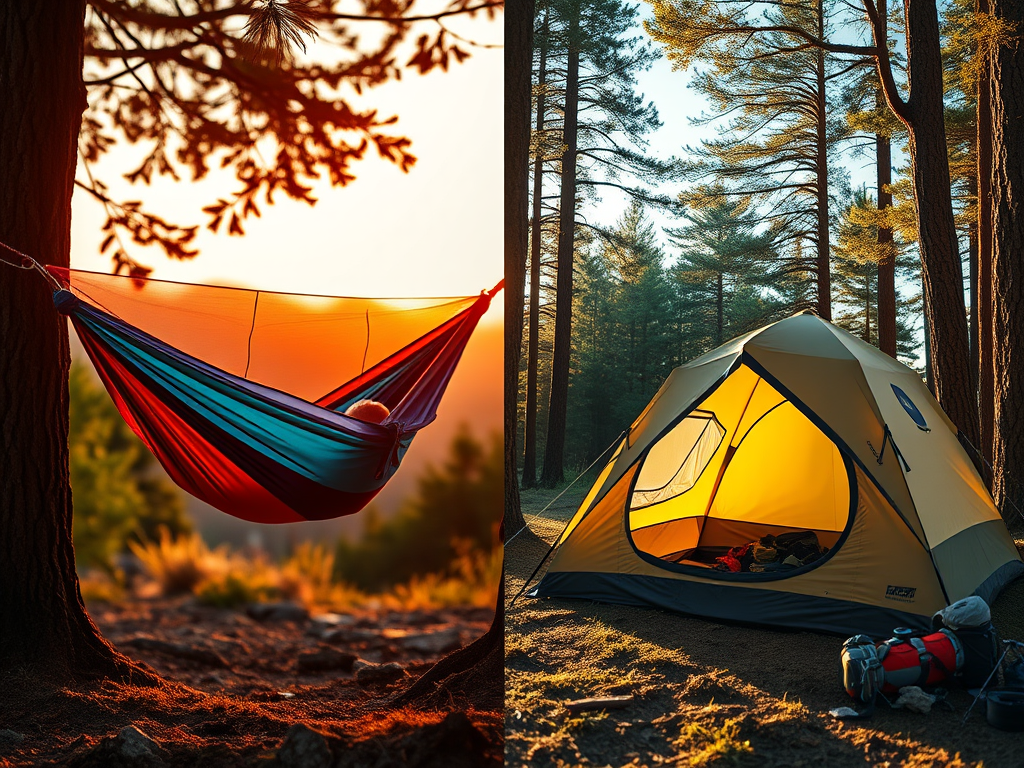
Camping is a beloved outdoor activity, but the way you sleep under the stars can dramatically affect your experience. Two popular options are hammock camping and tent camping. Each has unique advantages and drawbacks, and the best choice depends on your preferences, environment, and camping style.
Key Differences: Shelter Structure
Hammock Camping Shelter Structure
1. Suspension System
Hammock camping relies on suspending a fabric sling—typically made of durable nylon or polyester—between two anchor points, most commonly trees. The suspension system consists of straps, ropes, or webbing that wrap around the trees and attach to the hammock ends. Modern hammock straps are designed to be tree-friendly, wide enough to prevent bark damage, and adjustable for different distances.
2. Sleeping Platform
The hammock itself serves as the sleeping platform. It cradles the camper above the ground, conforming to the body’s shape. This eliminates the need for a ground pad, though insulation (like an underquilt or sleeping pad) is often added for warmth.
3. Weather Protection
To shield against rain and wind, hammock campers use a rainfly or tarp, which is suspended above the hammock and anchored to the ground or nearby trees. The rainfly must be large enough to cover the entire hammock and gear underneath. For insect protection, a bug net is either integrated into the hammock or added as a separate enclosure, creating a cocoon around the sleeper.
4. Modularity
Hammock setups are highly modular. Campers can choose different hammocks, tarps, bug nets, and insulation systems based on weather and personal preference. This allows for customization but may require more planning and gear knowledge.
5. Ground Independence
Because the hammock is suspended, it does not rely on ground conditions. Rocky, wet, or uneven terrain is not an issue, as long as there are suitable anchor points.
Tent Camping Shelter Structure
1. Frame and Fabric
Tents use a framework of poles—made from aluminum, fiberglass, or carbon fiber—to create a rigid or semi-rigid structure. The poles are inserted into sleeves or clips on the tent body, giving it shape and stability.
2. Enclosed Space
The tent body is made of fabric (usually nylon or polyester) and includes a sewn-in floor, mesh panels for ventilation, and solid panels for privacy and weather protection. The floor keeps campers and gear off the ground and provides a barrier against moisture, insects, and dirt.
3. Weather Protection
Most tents have a separate rainfly that covers the tent body, providing an extra layer of waterproofing and wind resistance. The rainfly is staked out to prevent water from entering the tent and to create vestibules for gear storage.
4. Insect and Wildlife Protection
Tents offer full enclosure, with zippered doors and windows that keep insects and small animals out. The solid walls and floor provide a sense of security and privacy.
5. Ground Dependency
Tents must be set up on relatively flat, clear ground. Rocks, roots, and uneven surfaces can make sleeping uncomfortable and may damage the tent floor. Site selection is crucial for comfort and tent longevity.
Summary Table
| Feature | Hammock Camping | Tent Camping |
|---|---|---|
| Support | Suspended between trees or posts | Ground-based, uses poles and stakes |
| Sleeping Surface | Fabric sling, above ground | Tent floor, on ground |
| Weather Protection | Rainfly/tarp above hammock | Rainfly over tent body |
| Insect Protection | Bug net (integrated or separate) | Fully enclosed with mesh panels |
| Site Requirements | Two sturdy anchor points | Flat, clear ground |
| Modularity | Highly modular, customizable | Mostly fixed, some add-ons possible |
| Privacy | Minimal, open design | High, fully enclosed |
The shelter structure is a fundamental difference between hammock and tent camping. Hammocks offer a lightweight, modular, and ground-independent solution, ideal for areas with abundant trees and challenging terrain. Tents provide a fully enclosed, private, and weather-resistant shelter that can be set up almost anywhere with suitable ground. Understanding these structural differences helps campers choose the best shelter for their needs and environment.
Sleeping Position
Hammock Camping
1. Suspended Sleeping In a hammock, you are suspended above the ground, supported by a fabric sling stretched between two anchor points. This creates a unique sensation of “floating” or gentle rocking, which many campers find soothing and conducive to sleep.
2. Body Alignment and Curvature The natural shape of a hammock causes your body to rest in a slightly curved, cradled position. However, with proper setup—hanging the hammock with a slight sag and lying diagonally—you can achieve a relatively flat sleeping surface. This diagonal lay is key to comfort, as it allows your back to straighten and reduces pressure points.
3. Pressure Relief Because the hammock conforms to your body, there are fewer pressure points compared to sleeping on the ground. This can be especially beneficial for people with joint or back pain, as it reduces stress on hips, shoulders, and the spine.
4. Sleeping Positions
- Back Sleepers: Most comfortable, as the hammock naturally supports the back.
- Side Sleepers: Possible with a wide enough hammock and proper diagonal lay, though some may find it less comfortable than back sleeping.
- Stomach Sleepers: Generally not recommended, as the curved shape makes it difficult to lie flat on your stomach.
5. Movement and Stability Hammocks can sway with movement, which some find relaxing and others may find unsettling. Entering and exiting a hammock requires balance and practice, especially at night.
Tent Camping
1. Ground-Based Sleeping In a tent, you sleep directly on the ground, typically on a sleeping pad, foam mat, or inflatable air mattress. The quality of sleep is heavily influenced by the ground surface and the type of padding used.
2. Sleeping Surface and Flatness The ground provides a flat, stable surface, but its comfort depends on site selection. Rocks, roots, and uneven terrain can cause discomfort unless adequately padded. A good sleeping pad or mattress is essential for insulation and cushioning.
3. Sleeping Positions
- Back Sleepers: Can sleep comfortably with a suitable pad.
- Side Sleepers: Often prefer thicker or softer pads to cushion hips and shoulders.
- Stomach Sleepers: Tents accommodate all sleeping positions, making them more versatile for different preferences.
4. Pressure Points Sleeping on the ground can create pressure points, especially if the pad is thin or the ground is uneven. This can lead to soreness or stiffness, particularly after multiple nights.
5. Movement and Accessibility Tents offer a stable, unmoving platform. It’s easy to roll over, sit up, or get in and out without worrying about balance. This stability is especially helpful for those who move a lot during sleep or need to get up at night.
Summary Table
| Feature | Hammock Camping | Tent Camping |
|---|---|---|
| Sleeping Surface | Suspended fabric sling | Ground (pad/mattress) |
| Body Position | Slightly curved, cradled; best when lying diagonally | Flat, determined by ground and pad |
| Pressure Points | Minimal, conforms to body | Can be significant, depends on pad and ground |
| Sleeping Positions | Best for back, possible for side; not ideal for stomach | Accommodates back, side, and stomach sleepers |
| Movement | Sways with movement, requires balance | Stable, easy to move and get in/out |
| Comfort Factors | Dependent on hang angle, hammock width, and insulation | Dependent on ground surface and pad quality |
The sleeping position is a major factor in choosing between hammock and tent camping. Hammocks offer a unique, pressure-relieving, and cradled sleep experience, best for back and some side sleepers, but require proper setup and may not suit everyone. Tents provide a familiar, stable, and versatile sleeping environment that accommodates all sleep positions, but comfort depends on ground conditions and the quality of your sleeping pad. Your preferred sleeping style and comfort needs should guide your choice of shelter.
Site Requirements
Hammock Camping
1. Anchor Points
- Trees: The most common anchor points for hammocks are trees. Ideally, these should be healthy, living trees with a diameter of at least 6 inches (15 cm) to ensure they can support your weight without damage.
- Distance: The optimal distance between trees is typically 12–18 feet (3.5–5.5 meters), depending on the length of your hammock and suspension system. Too close, and the hammock will be tight and uncomfortable; too far, and your straps may not reach or the hammock will sag excessively.
- Alternative Anchors: In treeless environments, some campers use posts, boulders, vehicles, or specialized hammock stands, but these are less common in backcountry settings due to weight and practicality.
2. Terrain Flexibility
- Ground Conditions: Hammocks are not dependent on ground conditions. You can set up over rocks, roots, uneven, wet, or sloped terrain—anywhere you can find suitable anchor points.
- Elevation: Hammocks keep you elevated above mud, puddles, insects, and small critters, which can be a significant advantage in certain environments.
3. Environmental Considerations
- Tree Health: Always use wide, tree-friendly straps to minimize bark damage and follow Leave No Trace principles.
- Regulations: Some parks or wilderness areas restrict hammock use to protect trees or due to limited suitable anchors. Always check local regulations before your trip.
4. Space Requirements
- Minimal Footprint: Hammocks require very little ground space, making them ideal for dense forests or crowded campsites where tent space is limited.
Tent Camping
1. Flat, Clear Ground
- Surface: Tents must be pitched on a flat, level area to ensure comfort and prevent rolling or sliding during sleep.
- Clearing Debris: The site should be cleared of rocks, sticks, and other debris that could puncture the tent floor or make sleeping uncomfortable.
- Size: The area must be large enough to accommodate the tent’s footprint, which varies by tent size (solo, two-person, family, etc.).
2. Drainage and Exposure
- Water Runoff: Avoid low spots or depressions where water could pool during rain. Slightly elevated ground is preferable for drainage.
- Wind and Sun: Consider wind direction and sun exposure when choosing a site. Natural windbreaks (bushes, rocks) can provide shelter, while shade can keep the tent cooler.
3. Environmental Impact
- Vegetation: Avoid pitching tents on fragile vegetation or in sensitive environments. Use established campsites or durable surfaces (gravel, sand, bare soil) whenever possible.
- Leave No Trace: Minimize impact by rotating tent sites and restoring the area after use.
4. Accessibility
- Proximity to Water and Trails: Choose a site that is conveniently located but not too close to water sources (at least 200 feet/60 meters away) to protect riparian habitats.
Summary Table
| Feature | Hammock Camping | Tent Camping |
|---|---|---|
| Anchor Points | Requires two sturdy trees/posts | None needed; ground-based |
| Distance Needed | 12–18 feet between anchors | Area matching tent footprint |
| Ground Conditions | Irrelevant; can be rocky, wet, sloped | Must be flat, clear, and dry |
| Environmental Impact | Minimal if using tree-friendly straps | Potential for vegetation damage |
| Regulations | May be restricted in some areas | Generally allowed, but site-specific rules apply |
| Setup Flexibility | High in wooded areas, limited in open terrain | High in open areas, limited in dense forests or rocky terrain |
Site requirements are a crucial consideration when choosing between hammock and tent camping. Hammocks offer exceptional flexibility in challenging terrain but are limited by the availability of suitable anchor points. Tents, on the other hand, can be set up almost anywhere with enough flat, clear ground, but are more affected by ground conditions and can have a greater environmental impact if not used responsibly. Understanding these requirements helps ensure a comfortable and low-impact camping experience.
Pros and Cons
Hammock Camping
Pros
Comfort
- Pressure Point Relief: Hammocks naturally conform to the shape of your body, distributing weight evenly and eliminating the pressure points that often occur when sleeping on the ground. This can be especially beneficial for people with joint or back pain.
- Sleeping Position: While hammocks are most comfortable for back sleepers, a properly hung hammock (with a diagonal lay) can also accommodate side sleepers. The gentle rocking motion can also promote relaxation and deeper sleep for some people.
- No Ground Disturbances: You’re suspended above rocks, roots, and uneven surfaces, so you don’t feel lumps or bumps beneath you.
Lightweight & Compact
- Packability: Hammocks, along with their suspension systems, bug nets, and rainflies, are generally lighter and more compact than most tents and their required accessories (poles, stakes, groundsheet, etc.).
- Backpacking Advantage: For ultralight backpackers or those looking to minimize pack weight and bulk, hammocks are a popular choice. Some complete hammock setups weigh less than 2 pounds (about 900 grams).
- Space Saving: Hammocks compress down to a small size, freeing up valuable space in your backpack for other essentials.
Versatility
- Terrain Independence: Hammocks can be set up over terrain that would be unsuitable for tents, such as rocky outcrops, steep slopes, marshy ground, or dense underbrush.
- Elevation: Being off the ground keeps you away from mud, puddles, crawling insects, and small animals.
- Adaptability: With the right accessories (like underquilts for warmth or larger tarps for rain protection), hammocks can be adapted for a wide range of weather conditions.
Ventilation
- Airflow: Hammocks offer excellent airflow above and below the sleeper, which helps prevent overheating and reduces condensation—a common issue in tents.
- Humidity Management: The open design allows moisture from your breath and sweat to dissipate quickly, keeping you and your bedding drier in humid conditions.
- Bug Nets: While bug nets are often necessary, they don’t significantly impede airflow, so you still benefit from good ventilation.
Leave No Trace
- Minimal Ground Impact: Hammocks don’t compress or damage ground vegetation, soil, or delicate ecosystems, as they don’t require clearing a patch of earth.
- Tree-Friendly Straps: Modern hammock straps are wide and designed to avoid damaging tree bark, further reducing environmental impact.
- Restoration: After breaking camp, the site typically looks untouched, which is ideal for preserving natural areas and following Leave No Trace principles.
Summary Table
| Pro | Hammock Camping Details |
|---|---|
| Comfort | Eliminates pressure points, supports natural body alignment, gentle rocking motion |
| Lightweight & Compact | Less weight and bulk than tents, ideal for backpacking |
| Versatility | Can be set up over any terrain with anchor points, adaptable to conditions |
| Ventilation | Superior airflow, less condensation, stays cooler in warm weather |
| Leave No Trace | Minimal impact on ground and vegetation, tree-friendly straps |
Hammock camping offers significant advantages in comfort, weight, versatility, ventilation, and environmental stewardship. These benefits make hammocks an excellent choice for many campers, especially those prioritizing lightweight travel, minimal impact, and adaptability to challenging terrain. However, it’s important to consider the specific environment and your personal preferences to determine if hammock camping is the best fit for your adventure.
Cons
Limited Shelter
- Exposure to Elements: Standard hammock setups (just a hammock and basic tarp) offer less protection from wind, rain, and cold compared to a fully enclosed tent. Wind can blow underneath and around you, and rain can splash up from the ground.
- Accessory Dependence: To achieve tent-like protection, you need to add accessories such as larger tarps, doors, underquilts, and weather shields. These add weight, cost, and complexity.
- Severe Weather: In storms, heavy snow, or high winds, even advanced hammock setups can be less secure and comfortable than a well-pitched tent. Sideways rain or snow can enter under the tarp, and strong winds can make the hammock sway uncomfortably.
Tree Dependency
- Anchor Point Requirement: Hammocks require two sturdy anchor points (usually trees) at the right distance apart. In environments without suitable trees—such as deserts, alpine tundra, grasslands, or above the treeline—hammocks simply cannot be used.
- Crowded or Overused Areas: In popular campsites, suitable trees may be scarce or already occupied by other hammock campers.
- Regulations: Some parks and wilderness areas restrict or prohibit hammock use to protect trees or due to limited anchor points, further limiting where you can camp.
Learning Curve
- Setup Complexity: Properly hanging a hammock involves understanding the right height, angle (about 30 degrees from horizontal), and tension. Incorrect setup can lead to discomfort, sagging, or even falls.
- Sleeping Technique: Achieving a flat, comfortable lay requires sleeping diagonally and adjusting your position. Beginners often experience calf ridge (a pressure line under the legs) or shoulder squeeze until they learn the right technique.
- Accessory Management: Using tarps, bug nets, and insulation adds steps to setup and takedown, which can be confusing for new users, especially in the dark or bad weather.
Cold Butt Syndrome
- Heat Loss: When suspended in a hammock, your underside is exposed to moving air, which quickly wicks away body heat. This is known as “cold butt syndrome.”
- Insulation Needs: Even in mild weather, you’ll need an underquilt, insulated pad, or other bottom insulation to stay warm. Standard sleeping bags are compressed under your weight and provide little insulation from below.
- Extra Gear: Underquilts and pads add weight, bulk, and cost to your setup, partially offsetting the lightweight advantage of hammocks.
Summary Table
| Con | Hammock Camping Details |
|---|---|
| Limited Shelter | Less protection from wind, rain, and cold; requires extra accessories for severe weather |
| Tree Dependency | Not usable in treeless areas; limited by anchor point availability and regulations |
| Learning Curve | Requires practice for comfortable setup and sleeping; more complex than tents |
| Cold Butt Syndrome | Underside gets cold without special insulation; requires underquilt or pad |
While hammock camping offers many advantages, it also comes with notable drawbacks. Limited shelter from harsh weather, dependence on trees, a steeper learning curve, and the need for specialized insulation can make hammocks less suitable for some environments and users. Understanding these challenges is essential for safe, comfortable, and enjoyable hammock camping. Proper preparation, practice, and gear selection can mitigate many of these cons, but they remain important factors when choosing your camping shelter.
Tent Camping
Pros
Full Enclosure
- Weather Protection: Tents are designed to shield campers from the elements. The combination of a waterproof rainfly, solid fabric walls, and a sewn-in floor creates a barrier against wind, rain, and snow. This makes tents suitable for a wide range of weather conditions, from summer showers to winter storms.
- Insect Defense: The fully enclosed design, with zippered doors and mesh windows, keeps out mosquitoes, flies, spiders, and other insects. This is especially important in buggy environments or areas with disease-carrying pests.
- Thermal Insulation: While not as warm as a cabin, tents trap some body heat, providing a warmer microclimate compared to open shelters like tarps or hammocks. This can be crucial in cold or windy conditions.
- Dust and Debris: The floor and walls keep out dirt, sand, and debris, helping you and your gear stay cleaner.
Privacy
- Changing and Personal Space: The opaque walls of a tent allow you to change clothes, organize gear, or simply relax without being visible to others. This is especially valuable in crowded campgrounds or public areas.
- Security for Belongings: You can store your gear inside the tent, out of sight and protected from opportunistic theft or curious animals.
- Personal Retreat: The tent provides a private retreat for reading, napping, or unwinding, even during the day.
Versatile Locations
- Ground-Based Setup: Tents can be pitched on almost any flat, clear patch of ground—fields, beaches, forest clearings, mountain meadows, or even rocky plateaus (with the right tent and stakes).
- No Anchor Points Needed: Unlike hammocks, tents don’t require trees or posts, making them suitable for deserts, alpine zones, grasslands, and other treeless environments.
- Established Campsites: Tents are compatible with most established campsites, which often have tent pads or cleared areas specifically for pitching tents.
Group Accommodation
- Multiple Occupants: Tents come in a wide range of sizes, from solo shelters to large family tents that can sleep six or more people. This makes it easy to camp with friends, family, or pets.
- Shared Space: Inside a tent, campers can share sleeping space, gear storage, and even play games or socialize during bad weather.
- Pet-Friendly: Tents provide a secure, enclosed space for pets, keeping them safe and contained at night.
Summary Table
| Pro | Tent Camping Details |
|---|---|
| Full Enclosure | Superior protection from weather, insects, and debris; warmer microclimate |
| Privacy | Opaque walls for changing, gear storage, and personal space |
| Versatile Locations | Can be set up almost anywhere with flat ground; no need for trees or posts |
| Group Accommodation | Wide range of sizes for families, friends, and pets; shared shelter and storage |
Tent camping excels in providing a secure, private, and weather-resistant shelter that can be used in almost any environment. The full enclosure offers peace of mind against the elements and insects, while the versatility and range of sizes make tents ideal for solo adventurers, families, and groups alike. These advantages make tents the go-to choice for many campers, especially in challenging weather or treeless landscapes.
Cons
Heavier & Bulkier
- Weight: Tents, especially those designed for multiple people or harsh weather, can be significantly heavier than hammock setups. Even lightweight backpacking tents often weigh more than a hammock, tarp, and suspension system combined.
- Bulk: In addition to the tent body, you must carry poles, stakes, guylines, a rainfly, and often a groundsheet. Sleeping pads or air mattresses are also necessary for comfort and insulation, adding further bulk.
- Backpacking Impact: For backpackers and those traveling long distances on foot, the extra weight and bulk can be a major drawback, limiting mobility and increasing fatigue.
- Storage: Tents and their accessories take up more space in your pack, leaving less room for other gear or food.
Ground Conditions
- Site Selection: Tents require a flat, clear area large enough for the tent’s footprint. Finding such a spot can be challenging in rocky, root-filled, sloped, or densely vegetated terrain.
- Comfort: Even with a sleeping pad, you may feel rocks, roots, or uneven ground beneath you, leading to discomfort or poor sleep.
- Water Issues: If the ground is wet, muddy, or prone to pooling water, you risk getting wet or having water seep into the tent. A poorly chosen site can lead to a soggy and miserable night.
- Environmental Impact: Setting up a tent on delicate vegetation or soft soil can damage the environment, leaving lasting traces.
Condensation
- Moisture Buildup: Tents, especially those with limited ventilation, can trap moisture from your breath, sweat, and wet gear. This moisture condenses on the tent walls and ceiling, leading to damp sleeping bags, clothing, and gear.
- Weather Factors: Condensation is worse in cold, humid, or rainy conditions, and in tents with poor airflow or when all vents are closed to keep out rain or cold.
- Mitigation: While many tents have vents or mesh panels to improve airflow, using them can let in cold air or rain, forcing campers to choose between staying dry and staying warm.
Setup Time
- Complexity: Pitching a tent involves multiple steps: laying out the tent, assembling and inserting poles, staking out corners and guylines, attaching the rainfly, and sometimes adding a groundsheet. This process can be time-consuming, especially for larger or more complex tents.
- Packing Up: Taking down a tent, cleaning off dirt and moisture, and packing all components back into their bags can also be tedious, particularly in bad weather.
- Learning Curve: While most modern tents are designed for easier setup, beginners may still struggle with unfamiliar designs, especially in low light or adverse conditions.
- Weather Challenges: Wind, rain, or snow can make setup and takedown even more difficult, increasing the risk of wet gear or frustration.
Summary Table
| Con | Tent Camping Details |
|---|---|
| Heavier & Bulkier | More weight and pack space required for tent, poles, stakes, pads, and accessories |
| Ground Conditions | Requires flat, clear ground; uncomfortable or impractical on rocky, sloped, or wet sites |
| Condensation | Moisture buildup inside tent can dampen gear and reduce comfort, especially in poor ventilation |
| Setup Time | More steps and time needed for pitching and packing, especially in bad weather or with complex tents |
While tents offer robust shelter and versatility, they come with notable drawbacks. Their weight and bulk can be a burden for backpackers, and finding a comfortable, suitable site can be challenging in rough terrain. Condensation issues can affect comfort and gear, and the setup and takedown process is often more involved than with hammocks. These factors are important to consider when choosing a shelter, especially for those prioritizing lightweight travel, speed, or camping in challenging environments.
Conclusion
Both hammock and tent camping are excellent ways to experience the outdoors, but they offer fundamentally different experiences, each with its own set of strengths and limitations. Understanding these differences is key to making the best choice for your adventure.
Hammock Camping: When and Why It Excels
- Comfort: Hammocks are often praised for their comfort, especially for back and side sleepers. The suspended design eliminates pressure points and allows you to sleep above rocks, roots, and uneven ground.
- Weight Savings: Hammock setups are typically lighter and more compact than tents, making them ideal for backpackers, ultralight hikers, and anyone looking to minimize pack weight and bulk.
- Adaptability to Rough Terrain: Hammocks can be set up over challenging terrain—steep slopes, rocky outcrops, marshy ground, or dense underbrush—where tents would be impractical or impossible.
- Ventilation and Leave No Trace: The open design provides excellent airflow, reducing condensation and keeping you cool in warm weather. Hammocks also have minimal impact on the ground and vegetation, aligning well with Leave No Trace principles.
Limitations:
- Tree Dependency: Hammocks require two sturdy anchor points, usually trees, at the right distance apart. In treeless environments (deserts, alpine zones, grasslands), hammocks are not a viable option.
- Weather Protection: While modular, hammocks generally offer less protection from wind, cold, and severe weather unless you invest in advanced accessories (large tarps, underquilts, weather shields).
- Learning Curve: Proper setup and sleeping technique require practice, and beginners may face a steeper learning curve.
Tent Camping: When and Why It Excels
- Robust Shelter: Tents provide a fully enclosed, weather-resistant space that protects against wind, rain, insects, and cold. This makes them suitable for a wide range of environments and weather conditions.
- Privacy and Security: The solid walls of a tent offer privacy for changing, sleeping, and storing gear. They also provide a sense of security and a barrier against insects and small animals.
- Flexible Site Selection: Tents can be pitched almost anywhere with enough flat, clear ground, making them suitable for deserts, alpine meadows, beaches, and established campsites.
- Group Accommodation: Tents come in various sizes, making it easy to camp with family, friends, or pets in a shared shelter.
Limitations:
- Weight and Bulk: Tents, along with necessary accessories (poles, stakes, sleeping pads), are often heavier and bulkier than hammock setups, which can be a disadvantage for backpackers.
- Ground Comfort: Sleeping on the ground can be uncomfortable if the site is rocky, uneven, or wet, even with a sleeping pad.
- Condensation and Setup Time: Tents can suffer from condensation issues and often require more time and effort to pitch and pack up, especially in bad weather.
Choosing the Right Shelter: Factors to Consider
- Destination: Are you camping in a forest with plenty of trees, or in a treeless desert or alpine zone? The environment may dictate your options.
- Weather: Will you face heavy rain, strong winds, or cold temperatures? Tents generally offer better protection in harsh weather, while hammocks excel in mild, warm conditions.
- Personal Preferences: Do you prioritize comfort, weight savings, privacy, or ease of setup? Your camping style and priorities will influence your choice.
- Group Size: Are you camping solo or with others? Tents are better for groups, while hammocks are typically solo shelters.
- Experience Level: Are you comfortable with the learning curve of hammock camping, or do you prefer the familiarity of a tent?
Many Campers Use Both
Experienced campers often own both hammocks and tents, choosing the best tool for each trip. For example, a hammock might be perfect for a solo backpacking trip in a wooded area, while a tent is better for a family outing or a trip to a treeless region.
Final Thoughts
There is no universally “better” option—only the best choice for your specific adventure. By understanding the unique advantages and challenges of both hammock and tent camping, you can make informed decisions that enhance your comfort, safety, and enjoyment in the outdoors. Whether you swing between the trees or settle down on the ground, the most important thing is to get outside and enjoy nature in a way that suits you best.



 UTAZCO Overland
Leave a Reply