
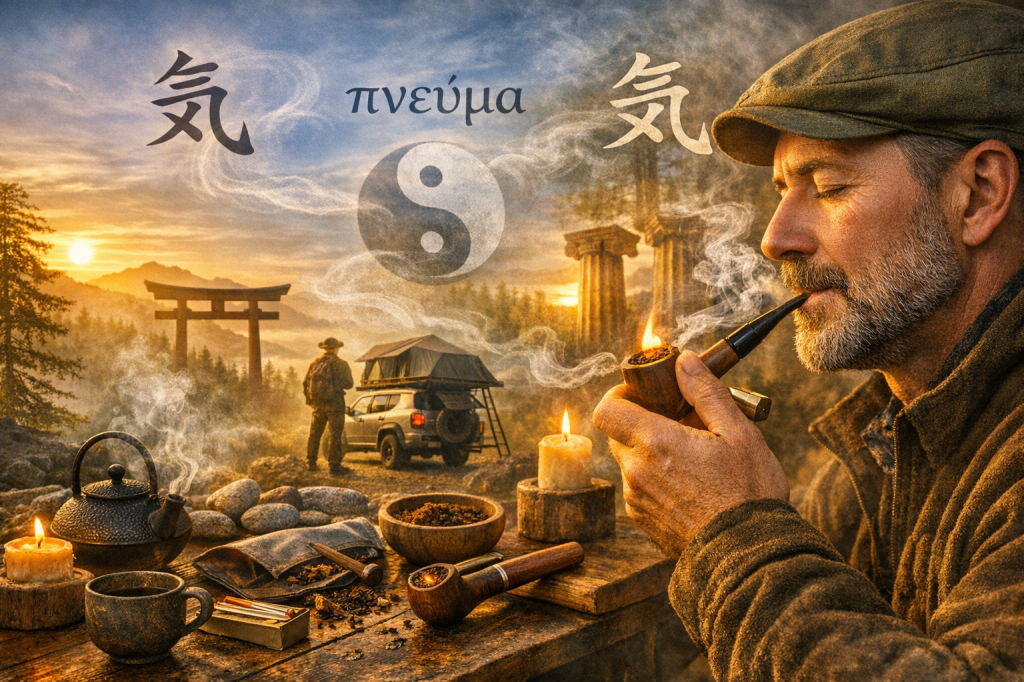
Expanding on last Monday’s essay, which delved into the integration of Ki, Pneuma, and Wa within the context of dispersed camping, this week’s installment turns to the unique synergies that arise when these philosophies are woven into the ritual of pipe smoking—both in everyday life and amidst the solitude of the wild. While last week’s exploration focused on how mindful breath, vital energy, and harmonious presence can transform the routines of camping, overlanding, and camp cooking into meaningful practices, this week we extend that inquiry to the contemplative art of pipe smoking. By examining how Ki, Wa, and Pneuma infuse the act of preparing, lighting, and savoring a pipe, we discover new layers of connection and presence, whether gathered around a campfire with companions or sitting alone beneath a canopy of stars. In both settings, pipe smoking becomes a living expression of these philosophies, deepening our appreciation for ritual, breath, and the subtle energies that animate our lives.
Pipe smoking, when approached with intention and mindfulness, becomes a living expression of profound philosophical principles. The Japanese ideals of Wa (harmony, 和) and Ki (vital energy, 気), together with the Greek concept of Pneuma (breath, spirit, animating force, πνεῦμα), find a unique convergence in the ritual of pipe smoking. This practice, far from being a mere pastime, offers a pathway to cultivate presence, balance, and a deeper connection to oneself, to others, and to the world. Through the careful preparation, lighting, and savoring of a pipe, the smoker can embody these philosophies, transforming a simple act into a ritual of harmony, energy, and spirit.
Wa: Harmony in Ritual and Atmosphere
Wa, as the pursuit of harmony, is deeply woven into the ritual of pipe smoking, where every action is an invitation to cultivate balance, respect, and tranquility. The process begins with the mindful selection of tobacco, an act that can be as simple or as elaborate as the smoker desires, but always carries with it a sense of intention. Preparing the pipe—cleaning the bowl, packing the tobacco with care, and ensuring the draw is just right—becomes a meditative sequence, each step performed with quiet attention. Lighting the pipe is done patiently, coaxing the tobacco to life rather than rushing, and this deliberate pace sets the tone for the entire experience. As the pipe is smoked, the slow, rhythmic puffs and the gentle swirl of smoke create a space where time seems to slow, allowing for deeper reflection and a sense of order.
At home, the harmony of Wa in pipe smoking is often shaped by the familiar comforts of one’s personal environment. The ritual might take place in a favorite chair, by a window, or in a quiet corner of the garden. The surroundings are known and controlled, and the smoker can curate the atmosphere to suit their mood—perhaps with soft music, a good book, or the gentle hum of household life in the background. In this setting, pipe smoking becomes a sanctuary, a way to carve out a pocket of peace within the rhythms of daily life. When shared with family or friends, the home setting encourages thoughtful conversation or companionable silence, reinforcing bonds and creating a sense of unity. The pipe, in this context, is a gentle anchor, grounding the individual in the present and fostering a harmonious relationship with both self and others.
In contrast, practicing Wa through pipe smoking while dispersed camping brings a different, yet equally profound, dimension to the ritual. Here, the environment is shaped not by human design but by the wildness of nature. The act of preparing and smoking a pipe in the open air—perhaps beside a crackling campfire, under a canopy of stars, or with the sounds of wind and water as a backdrop—heightens the sense of connection to the world beyond oneself. The materials at hand may be fewer, the comforts more rustic, but this simplicity only deepens the appreciation for each step of the ritual. The pipe becomes a bridge between the individual and the landscape, a way to harmonize with the rhythms of the natural world. In the company of fellow campers, the ritual fosters camaraderie and mutual respect, as the shared experience of the outdoors and the pipe creates a unique bond. Conversation tends to be more reflective, shaped by the grandeur and quiet of the setting, while silence is filled with the subtle music of the wild.
Even in solitude, pipe smoking while camping offers a profound sense of balance. The absence of familiar comforts is replaced by the immediacy of the elements—the feel of the earth beneath you, the scent of pine or sage in the air, the dance of firelight on your hands. The ritual becomes a way to find one’s place within the larger tapestry of nature, to acknowledge both the fragility and resilience of life. In this setting, Wa is not just an internal state but a living relationship with the land, the weather, and the creatures that share the space. The peace found in these moments radiates outward, infusing the entire camping experience with a sense of harmony that lingers long after the pipe is finished.
The ritual of pipe smoking offers a tangible way to practice Wa, transforming a simple act into a meditation on harmony, respect, and the quiet joy of being present. The differences in setting only serve to highlight the adaptability and depth of this principle, showing that true harmony can be cultivated wherever one finds themselves—so long as there is intention, respect, and a willingness to be fully present in the moment.
Ki and Pneuma: Vital Energy and the Breath of Spirit
Ki and Pneuma, though born from different cultural lineages, both articulate the invisible yet palpable forces that animate and sustain life. In the context of pipe smoking, these concepts find a natural convergence, as the act itself is fundamentally rooted in breath, rhythm, and the mindful circulation of energy. Each slow draw from the pipe is more than a mechanical inhalation; it is an invitation to become aware of the vital energy (Ki) and animating spirit (Pneuma) that flow through and around us. The deliberate pace of smoking—a gentle inhalation, a pause, a measured exhalation—mirrors the cycles of nature and the ebb and flow of life itself. This rhythm encourages the smoker to become attuned to their own internal state, to the sensations in the body, and to the subtle shifts in mood and awareness that accompany each breath.
At home, the experience of Ki and Pneuma during pipe smoking is often shaped by the familiar boundaries of one’s personal space. The environment is controlled and predictable, allowing the smoker to focus inward, using the ritual as a means of centering and recharging. The steady cadence of breath, the warmth of the bowl in the hand, and the gentle swirl of smoke create a cocoon of calm, insulating the smoker from the distractions and stresses of daily life. In this setting, the act of pipe smoking becomes a private meditation, a way to restore balance and vitality by consciously circulating Ki and Pneuma within the safe confines of home. The familiar scents, sounds, and comforts of the domestic environment support a deep inward journey, where the breath becomes a tool for self-regulation and renewal.
In contrast, when pipe smoking is practiced while dispersed camping, the experience of Ki and Pneuma is profoundly shaped by the immediacy and unpredictability of the natural world. Here, each breath is drawn not just from the pipe, but from the living landscape itself—the crispness of mountain air, the scent of pine or earth, the subtle dampness of a nearby stream. The boundaries between self and environment become more porous, and the act of breathing feels like a direct communion with the energies of the land. The rhythm of the pipe aligns with the rhythms of wind, water, and wildlife, and the smoker becomes acutely aware of their place within the larger web of life. In this setting, Ki and Pneuma are not only internal forces but are experienced as part of a dynamic exchange with the world, reinforcing a sense of interconnectedness and humility.
Pipe smoking offers a unique opportunity to explore the interplay of Ki and Pneuma. At home, the ritual is introspective, a way to gather and replenish energy within a sanctuary of comfort. In the wilderness, it becomes expansive, a way to participate in the living breath of the earth itself. In both cases, the mindful attention to breath and energy transforms pipe smoking from a simple habit into a profound practice of presence, balance, and spiritual renewal.
The Pipe as a Vessel of Harmony, Energy, and Spirit
The pipe, in its elegant simplicity and thoughtful construction, is far more than a mere implement for smoking; it is a vessel that gathers and expresses the intertwined principles of Wa, Ki, and Pneuma. Its shape, weight, and material invite the hand to hold it with intention, and its function naturally slows the pace of consumption, encouraging the smoker to linger in the moment. The ritual of preparing the pipe—selecting the right tobacco, packing it with care, and lighting it with patience—becomes a meditation on harmony and presence. Each step is an act of respect, not only for the object itself but for the energies and traditions it embodies.
At home, the pipe often takes on the role of a trusted companion, a familiar presence that anchors the smoker in a space of comfort and routine. The environment is controlled, the lighting and seating chosen for maximum ease, and the pipe becomes part of a personal sanctuary. Here, the act of cleaning and maintaining the pipe is woven into the fabric of daily life, a quiet ritual that reinforces the values of care and continuity. The pipe’s presence on a shelf or table is a reminder of moments of reflection and calm, and its use is often accompanied by other comforting rituals—a favorite chair, a cup of tea, or a well-loved book. In this setting, the pipe is a vessel for personal harmony, a tool for gathering and focusing one’s Ki and Pneuma in the midst of the familiar rhythms of home.
In the context of dispersed camping, the pipe’s role as a vessel of harmony, energy, and spirit is both heightened and transformed by the wildness of the surroundings. The tactile experience of the pipe—its warmth in the hand, the contrast of smooth wood against rough bark or stone—becomes more vivid against the backdrop of nature. The act of smoking a pipe in the open air, with the scents and sounds of the landscape all around, deepens the sense of connection to the world. Cleaning and maintaining the pipe in camp takes on new significance, as resources are fewer and each action must be performed with greater mindfulness and respect. The pipe, in this setting, becomes a bridge between the cultivated rituals of civilization and the raw energies of the earth. It is a companion not only in solitude but also in the shared experience of the outdoors, where passing a pipe among friends around a campfire can foster a unique sense of camaraderie and mutual respect.
The pipe serves as a tangible focal point for the cultivation of Wa, Ki, and Pneuma. It gathers the energies of the moment, channels them through ritual and breath, and returns them as a sense of calm, presence, and connection. In its quiet, unassuming way, the pipe becomes a vessel for the harmonious interplay of body, mind, and spirit—a companion on the journey toward a more balanced and mindful life.
Pipe Smoking and the Japanese Tea Ceremony
At first glance, pipe smoking and the Japanese tea ceremony (chanoyu) may seem worlds apart—one rooted in the leisurely enjoyment of tobacco, the other in the refined preparation and sharing of tea. Yet, beneath the surface, both practices are profound rituals that elevate the ordinary into the extraordinary through mindfulness, intentionality, and a deep respect for tradition, materials, and the present moment.
Both pipe smoking and the tea ceremony begin with a careful, almost meditative preparation. In the tea ceremony, every movement is choreographed: the selection of utensils, the cleansing of the tea bowl, the measured scooping of matcha, and the precise whisking of the tea. Each gesture is performed with full attention, embodying the principles of Wa (harmony), Kei (respect), Sei (purity), and Jaku (tranquility). Similarly, pipe smoking, when practiced as a ritual, involves the thoughtful selection of tobacco, the gentle packing of the bowl, the patient lighting, and the slow, rhythmic enjoyment of the smoke. The pipe smoker, like the tea master, is fully present in each step, honoring the materials and the lineage of the practice.
Central to both rituals is the vessel—the tea bowl in chanoyu and the pipe in smoking. These objects are not merely functional; they are cherished for their craftsmanship, history, and the tactile pleasure they provide. The act of holding the bowl or the pipe becomes a grounding experience, a way to connect physically and spiritually with the moment. In both traditions, the care and maintenance of these vessels are acts of reverence, reinforcing the values of continuity, respect, and gratitude.
The social dimension of both practices further reveals their shared spirit. In the tea ceremony, the host and guests engage in a silent dialogue of gestures and glances, each participant attuned to the needs and presence of the others. The sharing of tea is an offering, a moment of unity that transcends words. Pipe smoking, too, can be a communal ritual, where the pipe is passed among friends, conversation flows at a gentle pace, and silences are comfortable and meaningful. Both settings foster an atmosphere of mutual respect, attentive listening, and the gentle dissolution of boundaries between self and other.
Even in solitude, both pipe smoking and the tea ceremony offer a path to inner harmony and reflection. The solitary tea drinker finds tranquility in the quiet repetition of the ritual, just as the lone pipe smoker discovers peace in the slow rhythm of breath and smoke. In both cases, the ritual becomes a meditation, a way to circulate Ki and Pneuma, to ground oneself in the present, and to cultivate a sense of balance that radiates outward into daily life.
Both pipe smoking and the Japanese tea ceremony demonstrate how ordinary acts—when approached with mindfulness, reverence, and a spirit of harmony—can become profound expressions of Wa, Ki, and Pneuma. They remind us that the sacred is not confined to temples or special occasions, but can be found in the simple rituals of everyday life, in the sharing of a bowl of tea or the gentle curl of smoke, and in the quiet moments of connection with ourselves, with others, and with the world around us.
Conclusion
The natural synergies between Wa, Ki, Pneuma, and pipe smoking are most fully realized when the act is undertaken with a spirit of mindfulness and reverence. When approached in this way, pipe smoking transcends its surface pleasures and becomes a living ritual—a practice that harmonizes the body, mind, and environment. The deliberate pace, the attention to breath, and the care given to the pipe itself all serve to cultivate a sense of balance and vitality. Each inhalation and exhalation becomes a conscious exchange with the world, a way of circulating energy and spirit, and each moment of maintenance or preparation is an act of respect for the tools and traditions that support the experience.
At home, these synergies are often nurtured within the familiar boundaries of personal space. The rituals of pipe smoking become woven into the fabric of daily life, offering a sanctuary of calm and reflection amid the routines and responsibilities of the household. The pipe smoker may find that the gentle rhythm of breath and the slow unfolding of smoke provide a welcome respite, a chance to gather one’s energies and restore inner harmony. The presence of the pipe, the comfort of a favorite chair, and the quiet of a familiar room all contribute to a sense of continuity and rootedness. Here, Wa, Ki, and Pneuma are cultivated in a space that is safe and known, allowing the smoker to deepen their connection to self and to the subtle energies that sustain them.
In contrast, when pipe smoking is practiced while dispersed camping, the experience is shaped by the immediacy and unpredictability of the natural world. The rituals remain, but they are set against a backdrop of wildness and wonder—the scent of earth and pine, the play of wind and firelight, the chorus of birds or the hush of night. The pipe becomes a bridge between the cultivated harmony of human tradition and the raw vitality of the landscape. Each breath drawn through the pipe is mingled with the living air of the outdoors, and the act of smoking becomes a way to participate in the larger rhythms of nature. The challenges and simplicities of camp life demand greater mindfulness and adaptability, and the rituals of pipe smoking take on new meaning as acts of grounding and gratitude. In this setting, the smoker is reminded of their place within the web of life, and the principles of Wa, Ki, and Pneuma are experienced as living forces that connect them to the land, to companions, and to the unfolding moment.
Drawing a parallel to the Japanese tea ceremony further illuminates the transformative potential of pipe smoking when approached with intention and reverence. Both rituals, though distinct in their materials and cultural origins, share a devotion to mindfulness, harmony, and the elevation of the everyday into the sacred. Just as the tea ceremony turns the preparation and sharing of tea into an artful meditation on Wa, Ki, and the spirit of the moment, so too does pipe smoking become a contemplative practice—one that honors breath, presence, and the subtle interplay of energy and environment. In both traditions, the vessel—whether a tea bowl or a pipe—serves as a focal point for gratitude and connection, while the ritual itself fosters a sense of unity, tranquility, and respect for the passage of time. Ultimately, the comparison reveals that, across cultures and contexts, it is the mindful attention to simple acts that allows us to access deeper layers of meaning, belonging, and harmony in our lives.
Whether at home or in the wild, the mindful practice of pipe smoking offers a profound opportunity to celebrate harmony, energy, and spirit. The ordinary is transformed into the extraordinary, and the solitary act becomes a shared celebration of the sustaining forces that flow through all things. By embracing Wa, Ki, and Pneuma, the pipe smoker finds not only pleasure, but also a deeper sense of belonging—to themselves, to others, and to the quiet, enduring energies of the world.


 UTAZCO Overland
Leave a Reply