
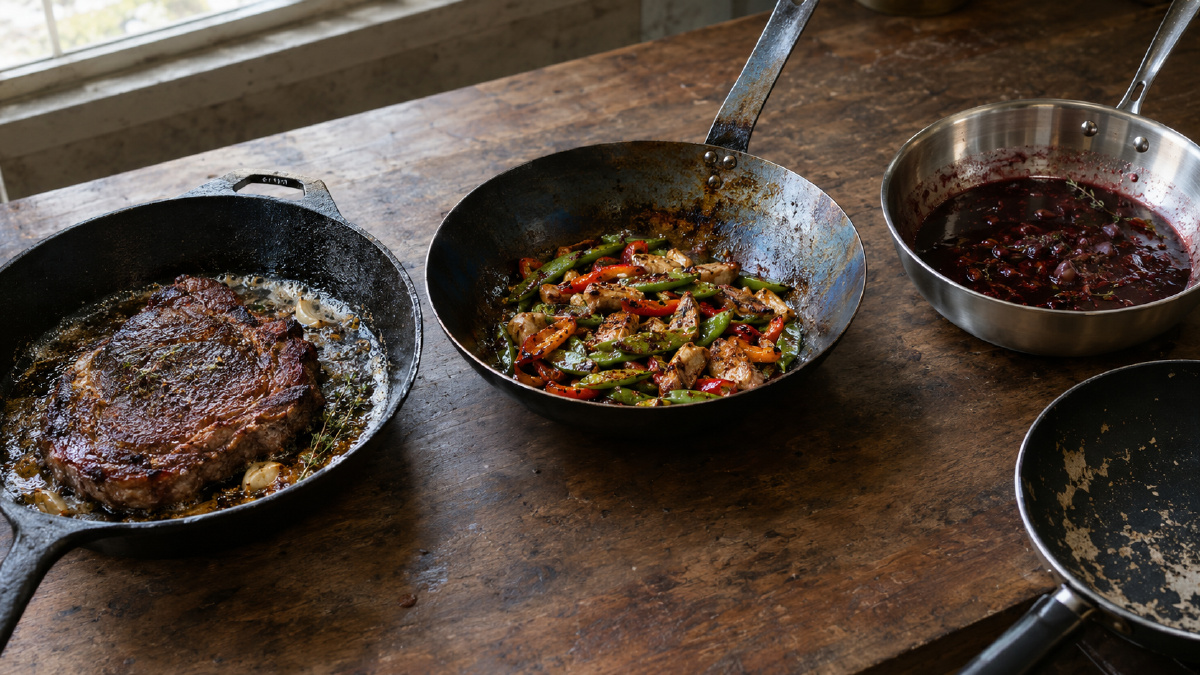
When it comes to choosing cookware, the debate between traditional materials like cast iron, carbon steel, and stainless steel versus chemically treated non-stick pans is a common one. Each type of cookware has its own set of advantages and disadvantages, but there are compelling reasons why many people prefer the former over the latter.
Durability and Longevity#
The durability and longevity of cookware are crucial factors for both home cooks and professional chefs, as they directly impact the cost-effectiveness and sustainability of kitchen tools. W:hat makes this dimension of cookware choice so significant is that durability is not merely a question of how long a pan survives before it breaks; it is a measure of how consistently a pan performs throughout its life, how much maintenance it demands along the way, and how much money and material it consumes in the form of replacements. A pan that costs a modest amount but must be discarded every eighteen months is, over the span of a decade, considerably more expensive than a heavier pan that was purchased once and remains in service for decades. When the calculation is extended across a lifetime, the economics of traditional cookware become difficult to ignore.
Cast iron, carbon steel, and stainless steel are renowned for their robustness and ability to endure the rigors of daily cooking, making them superior choices compared to chemically treated non-stick pans. Each metal owes its resilience to a fundamentally different mechanism, which is why they complement one another rather than simply duplicating one another’s strengths. Cast iron is essentially a single, thick, monolithic piece of metal, and there is very little in it that can fail; it tolerates the high heat of a grill, the direct flame of a campfire, and the thermal whiplash of a hot pan meeting cold water, and its seasoning layer, though it can be stripped away by neglect or harsh scrubbing, can always be rebuilt. Carbon steel is forged rather than cast, giving it a finer, denser grain that permits a thinner profile while remaining extraordinarily tough, so it resists the warping that afflicts cheap lightweight pans even as it delivers the responsiveness professionals prize. Stainless steel is a departure from both, because its durability comes not from brute thickness but from metallurgy: chromium in the alloy forms a self-renewing oxide layer that shields the metal beneath it from rust and corrosion, so the pan’s very surface is designed to repair and protect itself rather than to wear away.
That last distinction is the crux of the comparison with chemically treated non-stick pans. A non-stick pan’s defining feature is a bonded coating, typically polytetrafluoroethylene, that sits on top of the metal substrate, and it is precisely this coating that makes the pan convenient and precisely this coating that determines how long the pan is functional. Coatings thin with use, scratch under metal utensils, degrade more quickly when they are subjected to the high heat that so many cooking techniques require, and are often diminished by dishwasher cycles. Once the coating has worn through in even a small area, the pan loses the property that justified buying it, and it usually cannot be refinished or repaired in any practical household sense. The pan is not broken in the way a cracked cast iron skillet would be broken, yet it has reached the end of its useful life all the same, and it is discarded. Because this happens on a cycle of a few years rather than a few decades, the non-stick pan quietly imposes a recurring cost on its owner and a recurring stream of discarded cookware on the waste stream.
Traditional metals invert this relationship between surface and substance. Their cooking surfaces are not consumable layers applied to something else but are either the metal itself or, in the case of seasoned cast iron and carbon steel, a renewable film of polymerized oil that the cook can restore at will with a little fat and heat. Nothing about these pans is engineered with an expiration date, and because they can be scuffed, scorched, reseasoned, scoured, or even re-tinned and returned to service, they age rather than expire. This is why cast iron skillets are found in antique shops and inherited in wills, why carbon steel pans in restaurant kitchens are often the oldest objects in the room, and why stainless steel pots from the mid-twentieth century are still perfectly usable today. A pan with that kind of life is also, almost incidentally, a sustainable one: the most environmentally responsible piece of cookware is the one that never needs to be replaced at all.
Durability, in other words, is not simply a property of the metal; it is the outcome of a relationship between the material, its construction, and the person using it. Thickness of gauge, quality of the bond between layers, the strength of the rivets or welds, and the way a handle is attached all determine whether a pan will loosen, warp, or delaminate long before its metal has given out. This is why the longevity argument rewards care and attention rather than blind brand loyalty, and why the traditional cookware that survives for generations tends to be the well-made kind. A cook who understands this arrives at the same conclusion from two directions at once, because the most durable pan is also, over time, the cheapest and the least wasteful. In that sense the choice between traditional materials and chemically treated non-stick pans is not really a trade-off between quality and convenience so much as a decision about whether one prefers to buy cookware repeatedly or to buy it once.
Cast Iron#
Cast iron is celebrated for its exceptional durability, and the reason lies in what the material fundamentally is. A cast iron pan begins as molten iron with a high carbon content poured into a sand mold, and what emerges is a single, continuous, monolithic object — walls, cooking surface, handle, and helper handle all one piece of metal. There is no coating bonded to the surface, no cladding layered over a core, no rivets holding a separate handle in place, and therefore no seam or joint or film that can fail, flake, separate, or loosen. This material is incredibly resilient, capable of withstanding high temperatures that would damage other types of cookware, because the pan’s whole structure is simply a thick slab of iron that has nothing inside it to degrade. A cast iron skillet will happily go under a broiler, onto a grill, over a campfire, and onto an induction hob, since the iron is ferromagnetic and the hob never asks anything of the pan that the pan was not built to give.
What makes this resilience so unusual is how narrow the window of genuine failure actually is. Cast iron does not wear out in any ordinary sense; it is brittle rather than ductile, so its realistic failure mode is cracking, and that requires a specific kind of mistreatment, such as dropping it onto a hard tile floor or subjecting it to abrupt thermal shock, plunging a screaming hot pan into cold water or setting a cold one into a roaring fire. But those are accidents, not the slow attrition of daily use. This is the crucial contrast with a coated pan, whose surface is consumed simply by being used as intended. A cast iron pan can be scorched, rusted, neglected in a damp garage for a decade, and still be brought back, because nothing about its core has been worn away.
Its ability to retain heat makes it ideal for tasks such as searing meats and slow-cooking stews, and here again the physics rewards its mass. Because a cast iron pan contains so much iron, it absorbs an enormous amount of thermal energy and releases it slowly, so when a cold steak hits the surface the temperature barely dips, and the meat gets the sustained, brutal heat that produces a proper crust rather than a gray, steamed surface. That same reservoir of stored heat makes it the natural vessel for braises and stews that need to hold a steady temperature for hours, for deep frying that must recover quickly when food goes in, and even for baking, where a preheated skillet delivers a cornbread or a deep-dish pizza with a bottom crust no thin pan can match. The virtue is not just that the pan gets hot but that it stays hot on its own terms. The flip side is that mass is inertia, so the pan heats up slowly and, once hot, cools down slowly, which makes it a clumsy tool for anything requiring nimble adjustments of temperature, and the sheer weight of it, especially at larger sizes, is tiring to lift, toss, and maneuver.
With proper care, which includes regular seasoning to maintain its non-stick surface and prevent rust, cast iron can last for generations. Seasoning is a genuinely elegant mechanism: thin films of cooking oil are heated past their smoke point until they polymerize into a hard, slick, carbon-rich layer bonded to the iron, and that layer is gradually built up over months and years rather than applied once at a factory. The pan therefore becomes more non-stick the more it is used, so the property the cook depends on is not a finite resource being spent but a surface being cultivated. It also serves as the pan’s armor, sealing the iron away from the moisture and oxygen that would otherwise create rust, which is the material’s only real enemy and is a purely superficial condition rather than structural damage.
That restorability is the quiet superpower of the material. A rusty, abandoned pan can be scoured back to bare metal, soaked in vinegar, run through an electrolysis bath, or taken to a wire wheel, and then reseasoned into a perfectly functional piece of cookware; a scorched patch of carbon can be scrubbed away without consequence; a pan whose seasoning was ruined by a well-meaning relative and a bottle of dish soap is not lost, only temporarily set back. Almost nothing that happens to a cast iron pan short of cracking it is permanent, whereas a chemically treated pan is finished the moment its coating is breached, and no amount of effort will restore it.
This longevity is not just a testament to its physical durability but also to its timeless utility in the kitchen, because the design of the tool has not meaningfully changed in a century and does not need to. A pan forged a hundred years ago works identically on a modern gas range, and there is no obsolescence mechanism in it at all: no model year, no proprietary fitting, no electronic component, no coating technology that a later generation decided was unsafe. Its form is a settled answer to a settled problem. Many families pass down cast iron cookware as heirlooms, a practice that underscores its enduring value and reliability, and the secondhand market for vintage pieces reflects the same judgment from strangers, since older pans from makers like Griswold and Wagner, prized for the smoother machined cooking surfaces of that era, often sell for more than their modern equivalents cost new.
The economics follow directly from this. A cast iron pan asks for a modest outlay and then, with a minimum of attention spread across decades, serves for a period that can exceed its owner’s tenure in the kitchen, so its cost amortizes almost to nothing. The pan that outlives the person who bought it is not a marketing fantasy but a normal outcome, and the practical conclusion is that a cook who chooses cast iron is buying once rather than buying repeatedly. What lingers beyond the arithmetic, though, is a quality that is harder to price: a skillet that has cooked a grandmother’s cornbread and a grandchild’s first fried egg carries a record of meals and a continuity between generations that no disposable pan can hold, and in that sense its durability is not only a property of the metal but a form of memory.
Carbon Steel#
Carbon steel shares many of the same properties as cast iron, including its durability and heat retention capabilities, and the family resemblance is not a coincidence, since both materials are fundamentally iron seasoned with a little carbon. The difference lies in how that iron is made. Where cast iron is poured molten into a sand mold and left thick and massive, carbon steel is rolled and forged into a much thinner sheet, typically only two or three millimeters thick, with a smoother, denser grain. The result is a pan that weighs roughly half what its cast iron equivalent does and that handles in a completely different way. However, it is lighter and more responsive to temperature changes, making it a favorite among professional chefs who require precision in their cooking, because that responsiveness is precisely what the professional kitchen demands. A carbon steel pan answers the burner almost as soon as the dial moves, letting a cook drop the heat the instant a sauce threatens to break or raise it to rescue a sear, and it can be shaken, tilted, and flipped one-handed all service long without the wrist fatigue that a heavy skillet imposes.
The heat retention story is more subtle than a simple claim of equivalence. Because carbon steel has far less mass than cast iron, it holds less thermal energy, so when a batch of cold food lands in the pan the temperature dips more and takes longer to climb back — a real drawback for searing several pieces of meat in succession. What the material offers instead is the ability to preheat to a genuinely ferocious temperature and to do so quickly, and that combination of high achievable heat with fast response is why it dominates the restaurant line. A carbon steel pan can be brought to a smoking sear for a steak and then, moments later, walked down to a gentle temperature for eggs, a range of control that neither a sluggish cast iron skillet nor a heat-limited coated pan can match.
Like cast iron, carbon steel requires seasoning to maintain its surface and prevent rust, and the mechanism is identical, because thin films of oil heated past their smoke point polymerize into a hard, slick layer bonded to the iron. Carbon steel actually accepts that seasoning eagerly, darkening and turning genuinely non-stick within a surprisingly short time, which is one reason cooks grow attached to their pans as the surface improves. But there is a trade-off hidden in the thinness of the metal. The bare iron is more reactive than cast iron, so simmering acidic ingredients like tomatoes, wine, or vinegar in an unseasoned pan will strip the very layer the cook has been building, and the steel may even impart a metallic taste to the food. The seasoning is therefore not merely a surface to be maintained but a state to be protected, and carbon steel rewards a certain discipline about what is cooked in it and for how long.
The rust problem follows the same logic and is, if anything, more urgent here. Cast iron’s mass gives it a certain buffer against moisture, whereas a thin sheet of carbon steel will flash to orange if it is left wet in a sink or stacked damp in a cabinet, and given how thin the metal is, prolonged neglect can eventually eat through it rather than merely staining the surface. The care routine that prevents this is simple but non-negotiable: wipe the pan dry the moment it is washed, warm it briefly on the burner to drive off residual moisture, and wipe on a whisper of oil before putting it away. For a cook willing to build that habit, the material is forgiving in every other respect, and even a rusted pan can be scoured back to bright metal and reseasoned, so mistakes are recoverable rather than terminal.
Their ability to withstand high heat without warping makes them suitable for a variety of cooking methods, from frying to baking, though the caveat here is that gauge matters enormously. A heavy forged carbon steel pan of the sort made for serious cooking will shrug off high heat and repeated thermal cycling without distorting, and this resistance to warping is what allows it to be used across an unusual range of tasks: shallow frying, sautéing, making crêpes in a purpose-built thin pan, stir-frying in a wok, searing on the stovetop and finishing under a broiler, and even serving as a baking steel for pizza and bread, where a slab of carbon steel preheated in the oven radiates heat with an intensity that a stone struggles to match. Cheaper, thinner pans of the kind sold as starter cookware, by contrast, can warp under the same treatment, so the material’s virtues are only realized in a well-made pan, and the difference is one of construction rather than of chemistry.
When properly maintained, carbon steel pans can last just as long as cast iron, offering a lifetime of use, and the professional kitchen is the best evidence for this claim. Restaurant pans are bought cheaply and abused relentlessly, stacked, scrubbed, scorched, and flung onto burners that would ruin lesser cookware, and yet the same pans remain in service for decades, only growing darker and more non-stick with each passing year. The seasoning layer can be destroyed and rebuilt indefinitely, and nothing about the pan’s structure has a shelf life, so the tool simply ages rather than expiring. Because it is also inexpensive relative to its service life, carbon steel delivers a version of cast iron’s economics with less weight and more agility, and a cook who buys one good pan and takes reasonable care of it can reasonably expect to hand it on rather than replace it.
Taken together, the material’s appeal is that it resolves a tension that otherwise governs cookware choice. Cast iron sacrifices responsiveness for mass, and coated pans sacrifice every kind of performance for convenience, but carbon steel keeps the seasoned iron surface and the near-indestructibility that make traditional cookware worthwhile while shedding the dead weight that makes cast iron awkward to use. It asks a little more of the cook in return, since it demands that the pan be kept dry and the seasoning be respected, but what it gives back is the responsiveness of a professional tool with the longevity of an heirloom, and that combination is why so many cooks who try it never go back to anything else.
Stainless Steel#
Stainless steel is another material known for its durability, but it earns that reputation by an entirely different route than the two iron-based metals, and understanding the difference explains almost everything else about how it behaves in the kitchen. Where cast iron and carbon steel are essentially pure iron protected by a layer of polymerized oil that the cook applies and renews, stainless steel is an alloy in which chromium, typically at around eighteen percent, is blended directly into the metal itself. That chromium is the whole secret, because it reacts with oxygen in the air to form a microscopically thin, invisible, and self-healing oxide film across the surface of the steel. When that film is scratched or abraded, the chromium beneath it simply re-exposes itself to the air and rebuilds the layer within moments. The material’s protective barrier is therefore not a coating that sits on top of the metal and can be worn through or flaked away, but a property of the metal all the way down, which is why it does not fail in the way that a bonded non-stick surface does.
Unlike cast iron and carbon steel, stainless steel does not require seasoning and is resistant to rust and corrosion, thanks to its chromium content, and this single fact reshapes the whole relationship between cook and pan. There is no seasoning layer to build, protect, or mourn, so there is nothing to strip by accident and no accumulated surface to lose through neglect. A stainless steel pan left dirty overnight, scrubbed aggressively, or put through the dishwasher will suffer no meaningful harm, while the same treatment would leave a carbon steel pan spotted with rust and a well-seasoned skillet diminished. This makes it particularly low-maintenance and ideal for cooking acidic foods that might react with other metals, since the same non-reactive surface that resists corrosion also refuses to interact with the food itself. Tomatoes, wine, citrus, vinegar, and long-simmered sauces that would strip the seasoning from an iron pan or pick up a metallic tang from a reactive one can be cooked in stainless steel without either consequence, and they can be deglazed in the same pan without fear, since the fond left behind after searing is an asset rather than a threat to the surface.
The durability of stainless steel cookware is also a more nuanced proposition than a simple claim of hardness, because the metal that makes the pan has to be understood in relation to how the pan is constructed. Stainless steel by itself conducts heat poorly and unevenly, so a good pan is rarely a slab of the stuff; it is usually a layered composite, with a core of aluminum or copper bonded between two sheets of stainless steel, or with a conductive disc bonded to the base, and the quality of that bond determines whether the pan will heat evenly or develop hot spots. The longevity of the pan therefore rests on two things at once: the corrosion resistance of the alloy and the integrity of a cladding that must survive years of heating and cooling without separating or delaminating. A well-made clad pan accomplishes both, and the layers can be bonded so thoroughly that nothing short of catastrophic abuse will separate them.
Stainless steel cookware can maintain its appearance and functionality for decades, even with frequent use, and this is a resilience that shows itself in ordinary, unglamorous ways. The pans do not need to be dried the instant they are washed, they do not require oiling before storage, they do not develop rust in a damp cabinet, and they do not lose their performance if a household member runs them through the dishwasher. Their resistance to scratching and denting further enhances their longevity, allowing them to withstand the use of metal utensils and abrasive cleaning tools, which means a cook can reach for a whisk, a spoon, or a pair of tongs without the reflexive caution that a coated surface demands. There is a real trade-off concealed in this toughness, since stainless steel is not naturally non-stick and demands fat or liquid to release food, and the proudest, most permanent surface in the kitchen is also the one most prone to visible scratches and the stubborn browning that has to be scrubbed away. But those scratches are cosmetic rather than structural, and the pan that emerges from them is unimpaired, whereas the same treatment would destroy a coated pan outright.
Set against the other traditional materials, stainless steel occupies a distinct position: it is the least demanding of care and the most chemically inert, but it is also the least responsive to heat and the least naturally non-stick, which is why serious kitchens tend to keep it for the tasks where its inertness matters most. It is the pan for reducing a pan sauce, simmering a tomato ragù, blanching vegetables, or boiling pasta, and for the long, wet, acidic cooking that would ruin the seasoning of iron and eventually degrade the coating of a treated pan. In that role it is close to indestructible, since it is the one piece of cookware in the kitchen that can be used heedlessly, cleaned carelessly, and still be found working perfectly a generation later.
Comparison with Chemically Treated Non-Stick Pans#
In contrast, chemically treated non-stick pans, while convenient, often have a limited lifespan, and the reason is structural rather than incidental. The defining feature of such a pan is a bonded coating, usually polytetrafluoroethylene, applied over an aluminum or steel substrate and fused to it in a factory process that a home cook cannot replicate. That coating is what makes the pan useful: it is the whole reason the food slides free without fat. But it is also a finite film of a few tens of microns, and everything that happens to the pan in normal use works against it. The non-stick coatings, typically made from polytetrafluoroethylene (PTFE), can degrade over time, especially when exposed to high heat or metal utensils, and each of those two threats attacks the surface by a different mechanism. Metal utensils abrade it, cutting through the polymer and exposing the rougher metal beneath, while heat begins to break the polymer down chemically at temperatures that a searing steak or a preheated pan can easily approach, so the coating softens, dulls, and gradually loses both its slickness and its grip on the underlying metal. Dishwashers compound the damage, since the combination of hot water, aggressive detergents, and repeated thermal cycling stresses both the polymer and the bond that holds it in place.
This degradation not only reduces the pan’s effectiveness but can also lead to the release of potentially harmful chemicals, which is a second and more troubling dimension of the same problem. As the coating thins and the bond weakens, small flakes can detach and end up in the food, and while those particles are generally considered inert, their presence is a clear signal that the surface has passed the end of its useful life. Overheating is the sharper concern, because PTFE begins to decompose at elevated temperatures and the resulting fumes have been associated with the flu-like symptoms of polymer fume fever, a subject we will return to under health considerations. The practical point here is that the very property that defines the pan, its slickness, is the property that is being consumed with every use, and there is no way for a cook to restore it.
Once the coating begins to wear, the pan’s performance diminishes, often necessitating replacement, and this is the decisive difference from the metals we have been discussing. A scratched cast iron skillet is reseasoned, a rusted carbon steel pan is scoured, a stainless steel pan is simply used harder, and in each case the material itself is unaffected because the material is the cooking surface. In a coated pan the cooking surface is a separate, consumable component, so when it fails the pan does not become diminished or ugly or demanding; it becomes non-functional, and because re-coating a pan is an industrial process rather than a household one, there is no repair path to take. The pan fails as a pan while remaining perfectly sound as a piece of metal, which is exactly why so many of them are thrown away rather than fixed.
This cycle of frequent replacement contributes to environmental waste and can be more costly over time compared to investing in durable cookware like cast iron, carbon steel, or stainless steel. The economics are easy to lose sight of because the sticker price of a non-stick pan is low, and the true cost only becomes visible when the purchases are added up across a decade or a lifetime. A pan bought every two or three years because its surface has worn out may cost several times over what a single heavy pan costs to own for the same period and beyond, and unlike the traditional materials, a worn non-stick pan has no residual value whatsoever: it cannot be handed down, resold, or reclaimed, and even the vintage market that prices old iron cookware above new has no equivalent for a spent coated pan. The environmental ledger reads the same way, since each replacement represents another round of mining, manufacturing, shipping, and eventually landfilling, and the mixed construction of aluminum or steel bonded to a synthetic coating makes coated pans awkward for recyclers in a way that a single clean metal is not. The convenience is real, and for gentle low-fat cooking or delicate foods a coated pan is genuinely pleasant to use, but it is convenience purchased on a subscription.
The durability and longevity of cast iron, carbon steel, and stainless steel cookware make them superior choices for those seeking reliable, long-lasting kitchen tools. Their ability to withstand high temperatures, resist wear and tear, and maintain functionality over decades makes them a wise investment measured not against a single purchase but against the accumulated receipts of a lifetime of replacements. In contrast, the limited lifespan of chemically treated non-stick pans highlights the advantages of choosing more traditional, durable materials, because the comparison is not merely between two kinds of pan but between two kinds of purchase. One is a durable good whose surface is the metal itself, renewable, repairable, and enduring, and the other is a consumable whose defining feature is designed to be spent. Choosing traditional materials is therefore a decision about total cost of ownership, material throughput, and lasting value, and by every one of those measures the older materials still come out ahead.
Health Considerations#
When selecting cookware, health considerations play a pivotal role in determining the best options for safe and nutritious cooking, and the reason is that a pan is not a neutral bystander to the food inside it. Cookware is a surface that food rests against for minutes or hours, often at high temperatures, frequently in the presence of fat, salt, acid, and moisture, and those conditions are precisely the ones that encourage materials to migrate. A pan is therefore not merely a container but a participant in the cooking process, and the question worth asking is not whether a given material can shed anything into the food, since under the right conditions almost any material can, but what it sheds, in what quantity, by what mechanism, and with what consequence for the person eating. The materials used in cookware can have direct implications on health, particularly when it comes to the potential release of harmful substances during cooking, and those implications are best understood as a matter of dose and mechanism rather than of simple presence or absence.
It helps to recognize that there are two distinct routes by which a pan can affect health, because conflating them makes the whole subject murkier than it needs to be. The first is migration into the food itself: metals can leach from a cooking surface into acidic or salty dishes, and a degraded coating can shed particles that end up on the plate. The second is release into the air, which is a concern specific to synthetic coatings that can decompose when overheated and fill a kitchen with fumes nobody intended to breathe. The two routes have different causes, different evidence, and very different urgency, and the physically acute hazard of the second is often quite separate from the slow, cumulative question of the first. A cook thinking carefully about health has to hold both in view at once.
What makes the comparison between materials genuinely difficult is that the risks do not all point in the same direction, and some of them are benefits depending on who is doing the cooking. Cast iron, for instance, releases small amounts of iron into food, which for a person with an iron deficiency is a modest nutritional bonus and for a person with hemochromatosis is something to weigh carefully. Stainless steel can leach trace quantities of chromium and nickel, usually at levels far below any threshold of concern but not necessarily zero, and a small number of people are genuinely sensitive to nickel. The synthetic coatings on non-stick pans raise questions of an entirely different character, involving fluorinated compounds whose persistence in the body and environment has made them a subject of sustained regulatory attention. This is where the choice between chemically treated non-stick pans and traditional materials like cast iron, carbon steel, and stainless steel becomes significant, because the materials do not simply offer different degrees of the same hazard. They offer different kinds of hazard, and they raise different kinds of reassurance.
It is also worth being honest about the state of the evidence, because this is a field where confident claims tend to outrun the underlying research. The most notorious compound associated with non-stick coatings, perfluorooctanoic acid, was largely eliminated from American manufacturing in the mid-2010s under an industry stewardship program, and has been restricted internationally, yet the family of chemicals it belongs to remains under active scrutiny, with newer substitutes themselves increasingly called into question. The result is a moving target, and a reader who encounters a claim about cookware safety should ask when it was written and what it was measuring. The traditional materials have their own long histories of scrutiny, but they are simpler objects chemically, and much of what can be said about them rests on well-characterized elements rather than on proprietary polymer formulations.
None of this is meant to suggest that the traditional materials are beyond examination, only that the examination has a clearer shape. Their principal health considerations involve trace metals entering food, in amounts that depend on the age of the pan, the acidity of the dish, and the length of the cooking time, and for the vast majority of cooks those amounts are unremarkable. The coated pans, by contrast, present a surface whose defining property is a consumable polymer layer, and the health questions attached to them arise precisely at the moments that layer is stressed, worn, or overheated. The sections that follow take up each material in turn, beginning with the coatings themselves, and then examining what the iron-based and stainless materials actually contribute to the food they cook.
Chemically Treated Non-Stick Pans#
Non-stick pans are popular for their convenience, allowing for easy food release and minimal use of cooking oils, and the technology behind that convenience is more interesting, and more complicated, than the phrase “non-stick coating” suggests. The active material is polytetrafluoroethylene, known as PTFE and sold for decades under the trade name Teflon, a fluoropolymer whose defining feature is the carbon-fluorine bond. That bond is among the strongest in organic chemistry, and it is the source of both the polymer’s virtues and its complications: it makes the surface extraordinarily inert and its friction almost vanishingly low, which is why food slides off it, and it also makes the molecule resistant to breaking down, which is why the broader family of related chemicals, the per- and polyfluoroalkyl substances, has become an enduring environmental concern. In cookware the polymer is applied as a liquid dispersion and then cured at high temperature so that the particles fuse into a continuous film, often in several layers with fillers added for scratch resistance, and the finished coating is thin enough to be measured in tens of microns.
One clarification is worth making, since it is a frequent source of confusion: perfluorooctanoic acid (PFOA) is not an ingredient of the coating itself. It was formerly used as a processing aid, an emulsifier in the manufacture of PTFE dispersions, and because of health and environmental concerns over the chemical it was largely eliminated from American manufacturing by the mid-2010s under an industry stewardship program, and was later restricted internationally. Residue in finished cookware is therefore not the central issue that it was once reported to be, although the wider family of fluorinated compounds remains under active regulatory scrutiny, and some of the substitutes introduced in its place have themselves drawn questions. The point to carry forward is that the modern concern about non-stick coatings rests less on what the coating is made of than on what happens to it under heat and wear.
When non-stick pans are overheated, typically above 500°F (260°C), PTFE can begin to break down and release fumes, and this is precisely where the material’s famous inertness stops protecting anyone. In ordinary cooking the coating is stable, since sautéing, frying, and simmering all stay comfortably below that range; the danger lies in the empty-pan preheat, the forgotten pan left on a high burner, or a pan used under a broiler set hotter than its rating. At those temperatures the polymer begins to decompose, and the resulting fumes, when inhaled, have been linked to “polymer fume fever,” a condition that causes flu-like symptoms in humans: chills, fever, headache, muscle aches, and a tightness in the chest that typically appear within hours of exposure and resolve on their own over a day or two. The condition is generally self-limiting and rarely serious in healthy adults, which is why it is less alarming than the phrase “toxic fumes” can make it sound, but it remains a wholly avoidable consequence of a pan pushed beyond its design.
The effects can be even more severe in birds, which are highly sensitive to these fumes and can suffer fatal consequences, and this is not a marginal footnote but one of the best-documented veterinary hazards of the home. A bird’s respiratory system is built for flight, with a network of air sacs and an extremely efficient exchange of gases across very thin membranes, and its small body mass and high metabolic rate mean that a dose of fumes which barely registers with a human can overwhelm it. Owners of pet birds are routinely advised never to heat a non-stick pan empty in a kitchen a bird shares, and deaths have been reported from exposures the human occupants did not even notice. Birds are not a fringe concern in this discussion; their sensitivity acts as an early warning about a hazard that humans underestimate precisely because it is usually mild for them.
Away from the acute question of overheating lies the slower matter of wear. As the coating is scratched, thinned, and gradually compromised, it can flake, and small particles of the polymer may then end up in the food. The available evidence suggests that ingested PTFE particles pass through the body largely unchanged and are not a significant toxicological worry in the quantities a worn pan produces, which is why the concern here is less about poisoning than about the signalling function of those flakes: they indicate that the pan is no longer performing the job it was bought to do. A worn coating also tends to expose the metal beneath, which can then react with acidic foods, and the practical response is the same one the durability argument reached from a completely different direction, which is that the pan has arrived at the end of its service life.
Set beside the traditional materials, the health profile of a coated pan is unusual in that its risks cluster around misuse and deterioration rather than around routine use. A well-made non-stick pan used at moderate heat and replaced before its surface fails is a safe and convenient tool, and the guidance its makers offer, no empty high-heat preheating, no metal utensils, good ventilation, is not mere protective boilerplate but a fair description of how the coating wants to be treated. The trouble is that the safe envelope is narrow and easy to leave by accident, that the coating is a consumable designed to be spent, and that a cook who discovers the limits only after the damage is done has already lost the pan. Alternatives marketed as ceramic or mineral non-stick avoid fluoropolymers altogether and address the specific worry about fumes, but they too rest on a coating that wears, so they change the chemistry without changing the underlying structure of the problem.
Cast Iron#
Cast iron cookware is free from synthetic coatings, making it a safer choice from a chemical standpoint, and the simplicity of the material is the whole of the argument. A cast iron pan is iron and carbon, with no polymer film bonded to it and no proprietary formulation involved in its manufacture, so there is nothing that can decompose under heat or flake away into the food. The only layer that ever sits between the food and the metal is the seasoning, which is polymerized cooking oil rather than an industrial product, and it is built and rebuilt from edible fat. Where a coated pan invites the cook to trust a surface whose composition is not visible, cast iron presents a surface the cook can inspect directly: rust, bare iron, and seasoning all announce themselves plainly, and each can be purged, replaced, or reinforced without any question of whether something synthetic has been left behind.
One of the unique health benefits of using cast iron is its ability to leach small amounts of iron into food during cooking, and this is a genuine chemical interaction rather than a marketing claim. The metal is mildly reactive with moisture and acid, so a tomato sauce simmered for an hour in an unseasoned or lightly seasoned pan will pick up a measurable quantity of iron, whereas the same dish cooked in a pot of stainless steel or coated aluminum will not. The amount varies widely with the acidity of the food, the length of the cooking time, the condition of the seasoning, and the age of the pan, with newer and more worn pans releasing more and a thoroughly blackened pan releasing less. What matters nutritionally is that the iron enters the food in a form the body can absorb at least partly, which is why the effect has been studied rather than merely assumed, and why dishes like long-simmered tomato sauces, applesauce, and stews tend to yield the largest increases.
This can be particularly beneficial for individuals with iron deficiencies, as it provides a natural way to increase dietary iron intake, and iron deficiency is common enough that the benefit is not hypothetical. It is one of the most widespread nutritional shortfalls in the world, affecting particularly women of reproductive age and children, and the observation that food cooked in iron vessels carries more absorbable iron has led to deliberate public health experiments in which iron pots and ingots are distributed as a low-cost intervention. The results are encouraging but should be described accurately: the contribution is meaningful and additive to a diet, not a replacement for treatment, and it is too variable to be relied upon as a measured dose. A cook with diagnosed anemia still needs medical care and dietary change; the pan is a modest assist rather than a cure.
However, for those with conditions like hemochromatosis, where iron accumulation is a concern, this aspect should be considered carefully, and the caution runs wider than that single diagnosis. Hereditary hemochromatosis causes the body to absorb more iron than it needs and to store the excess in organs where it can eventually do damage, so any additional dietary iron, including the modest amount a cast iron pan contributes, is worth minimizing rather than welcoming. Similar care applies to people with other forms of iron overload, to those receiving repeated transfusions, and to anyone whose bloodwork has shown elevated ferritin or transferrin saturation. It is worth keeping the scale of the concern in perspective, since the quantity of iron a pan donates in ordinary cooking is small and clinically significant overload from cookware alone would be unusual, but for a person already managing a high iron burden the sensible course is to reserve the pan for non-acidic, quick-cooking tasks or to avoid it, and to defer to a physician rather than a general article.
Two smaller points complete the health picture. The rust that a neglected pan develops is iron oxide, which is unpleasant to taste and ruins the pan’s performance but is not a meaningful toxicological hazard, and it can be scoured away and the pan restored. The seasoning itself, when a pan is heated very hard, produces smoke and volatile compounds just as any oil does at its smoke point, which is a matter for kitchen ventilation rather than for the food. It is also worth noting that the safety of a cast iron pan depends somewhat on its provenance: the material is simple, but the supply chain is not, and inexpensive or decorative imported cast iron has occasionally been found to contain undesirable contaminants, so a pan from a reputable maker is the sounder choice. None of that changes the central point, which is that cast iron’s health profile is the profile of iron and oil, substances the body understands, rather than of a manufactured film whose behaviour under heat and wear the cook has to take on trust.
Carbon Steel#
Similar to cast iron, carbon steel cookware does not contain harmful chemical coatings, and the reassurance this offers is unusually clean because the pan is so chemically simple. A carbon steel pan is iron with a small amount of carbon, and essentially nothing else of consequence, which means there is no polymer film bonded to the surface, no fluorinated compound, and no proprietary formulation that can decompose, flake, or volatilize as the pan is used. Nothing about the material has to be engineered to be food-safe in the first place, since the cooking surface is the iron itself and the seasoning that develops on it, both of which are substances the human body has been encountering in kitchens for millennia.
It offers a safe cooking surface that, when properly seasoned, can develop natural non-stick properties, and it is worth being precise about what that seasoning actually is, because the word can sound like a technical process. The slick black layer on a well-used pan is polymerized cooking oil, a film created whenever fat is heated past its smoke point, in the same chemistry that browns the surface of a well-used sheet pan or the inside of a cast iron dutch oven. It is made from edible material, by heating that material, and it is refreshed with more of the same, which means the non-stick surface is food-safe by construction rather than by certification. This eliminates the need for synthetic non-stick coatings and their associated health risks, and it also removes the awkward situation in which a pan’s performance depends on a layer whose formulation the cook cannot inspect.
The trace-metal picture is similarly straightforward, though it cuts both ways just as it does with cast iron. A carbon steel pan will donate a small amount of iron into food, particularly when the dish is acidic or long-simmered, and that contribution is generally smaller than what an equivalent cast iron pan provides, because the metal is thinner and the seasoning layer shields more of the surface from the food. For someone with low iron stores this is a mild benefit, and for someone with hemochromatosis or another condition involving iron accumulation it is a reason for care rather than alarm, since the quantities involved are modest and can be managed by not cooking acidic dishes in the pan. What carbon steel does not bring to the table is the stainless steel question of chromium and nickel, since those elements are not present in meaningful amounts in a plain carbon steel pan, and cooks who react to nickel therefore have one fewer variable to consider.
The wear story is where the absence of a coating matters most, and it is the clearest contrast with the coated pans discussed above. A carbon steel pan cannot shed synthetic particles into food, because it has none to shed; when its surface is damaged the damage involves only polymerized oil and iron. The seasoning can be scrubbed off with steel wool, the pan can be left to rust, and the worst outcome is a layer of iron oxide that tastes unpleasant and looks alarming but has no meaningful toxicity, since iron oxides are even approved as food colourings in many jurisdictions. The pan can then be scoured back to bare metal and reseasoned, and it emerges functionally identical to a new one. Nothing in that cycle exposes the cook to a material that was not already present in the kitchen, which is precisely the kind of transparency a health-conscious cook should value.
Carbon steel is also lightweight compared to cast iron, making it easier to handle while still providing a safe cooking environment, and while that reads as a matter of convenience, weight is genuinely a safety variable in a kitchen. A heavy pan that is awkward to lift, tilt, or drain is a pan more likely to be dropped, spilled, or handled carelessly, and a pan whose temperature responds quickly to the burner gives the cook more control over whether food scorches or oil begins to smoke. The honest caveats are worth stating alongside those advantages, because a “safe cooking environment” is not the same as a risk-free one. Carbon steel handles conduct heat and grow very hot in the oven or over a flame, so burns are a real hazard that requires a towel or a removable sleeve, and the seasoning process itself involves heating oil to its smoke point, which fills the kitchen with smoke and volatile compounds and makes good ventilation a practical necessity rather than a nicety. The safety argument for carbon steel is not that it carries no risk at all, but that the risks it does carry are simple, visible, and entirely within the cook’s control, which is more than can be said for a surface whose failure modes are hidden beneath a bonded polymer layer.
Stainless Steel#
Stainless steel is another excellent choice for health-conscious cooks, and the place to start is the passive layer that gives the metal its name. When chromium is alloyed into steel, it reacts with oxygen to form a microscopically thin oxide film across the surface, and that film is chemically inert and self-repairing, so the metal underneath is kept out of contact with the food. It is non-reactive, meaning it does not leach chemicals or metals into food, even when cooking acidic ingredients like tomatoes or citrus, and in ordinary use that description is close enough to the truth to be practical. The precise version is a shade more careful, because no stainless steel is absolutely inert: cooking acidic food for a long time, particularly in a new or heavily scratched pan, can release trace quantities of chromium and nickel into the dish, and those amounts have been measured and are generally far below any level of established health concern. The exception worth knowing about is nickel, to which a small number of people are genuinely sensitive, and who may find that even trace release is enough to matter.
What the non-reactive surface buys the cook in practice is a kind of dependable neutrality, and it is easiest to appreciate by contrast. An iron pan reacts with acidic food by design, donating iron and a faint mineral taste, and uncoated aluminum reacts with the same ingredients in ways that can discolour the food and pit the metal, which is why aluminum pans are usually coated or clad. Stainless steel does neither, so a tomato sauce, a wine reduction, a citrus marinade, or a long-simmered ragù tastes of what went into it and nothing else, and the pan itself can be deglazed with wine or vinegar without any concern for the surface. This makes stainless steel a versatile and safe option for a wide range of cooking applications, because the same quality that suits it to acidic dishes also suits it to poaching, blanching, boiling, reducing, and deep frying, and it can move from the stovetop into the oven without any surface to scorch or coating to overheat. Its tolerance of high heat is a health point rather than only a convenience one, since the metal has no layer that decomposes into fumes when it gets hot, and no moment at which the surface that touches food stops being what it was intended to be.
Additionally, stainless steel does not require any coatings, eliminating the risk of chemical exposure from degraded surfaces, and this is the structural advantage rather than a happy accident. The protective film is not applied to the steel from outside; it is generated by the alloy’s own chemistry and regenerates itself within moments of being damaged, so there is no consumable functional layer whose failure would introduce foreign material into the food. There is nothing to flake, nothing to inhale as the pan heats, and no proprietary formulation standing between the cook and the surface. The same construction that removes the coating also makes the pan the most easily and aggressively cleaned object in the kitchen, since it can be scrubbed with steel wool, scoured with abrasive powder, and put through the dishwasher without damage, and a pan that is genuinely easy to keep clean is a small but real food-safety asset. It also means the surface can be inspected honestly: scratches show plainly, and they are cosmetic.
The one honest counterpoint is fat. Stainless steel is not naturally non-stick and demands oil, butter, or liquid to release food cleanly, which is precisely the convenience that coated pans provide and the reason a cook watching dietary fat may find a non-stick surface appealing. That is a legitimate advantage for the coated pan and it deserves to be stated rather than glossed over, though it is a matter of how much fat goes into the dish rather than of what comes out of the pan, and a cook who learns to preheat stainless properly can release most foods with a modest amount of oil. Against that trade-off sits the whole rest of the picture: no coating to degrade, no fumes when the pan runs hot, no trace-metal question of any consequence for most cooks, and a surface whose state is always visible. For the cook who wants a pan that is chemically quiet and stays that way, stainless steel is the least ambiguous option in the kitchen.
The health considerations associated with cookware materials are crucial in making informed choices, because what a pan is made of determines what it can put into the food and into the air. While chemically treated non-stick pans offer convenience, their coatings can degrade with heat and wear, releasing fumes that pose a real if largely avoidable hazard, one that is especially dangerous to birds. In contrast, cast iron, carbon steel, and stainless steel provide safer alternatives, free from synthetic coatings, though not free from every consideration, since the iron-based pans donate small amounts of iron and the stainless variety releases trace chromium and nickel well below established thresholds of concern. These materials not only ensure a healthier cooking environment but also offer additional benefits, such as increased dietary iron from cast iron. What distinguishes them is not perfection but legibility: their risks are known elements with known mechanisms, visible on the surface and manageable in an ordinary kitchen, rather than a film whose failure is hidden until it is already under way. By choosing cookware that prioritizes health, individuals can enjoy both the culinary and nutritional benefits of their meals with peace of mind.
Cooking Performance#
The cooking performance of cookware is a critical factor for both amateur and professional chefs, as it directly influences the quality and outcome of the dishes prepared, and the reason is that nearly every transformation in cooking is really a question of how heat reaches food. Heat is the actual tool in the kitchen, and the pan is the instrument that delivers it, so the material of the pan determines how quickly heat arrives, how evenly it spreads, how forcefully it is applied, and how much of it can be commanded and held. Those differences show up directly on the plate. Food cooked on a surface hot enough to drive off moisture quickly browns and crisps, while the same ingredients on a pan that is too cool release water and steam instead, producing grey meat, pale vegetables, and crusts that never form. The fond that becomes a pan sauce, the crackle on a roasted chicken, the sear on a steak, the texture of a stir-fry, and the even rise of a cornbread all depend on heat being managed well, and a pan that manages heat badly will not compensate for good technique any more than good technique can rescue a pan that heats unevenly.
The material properties that produce good performance are worth naming, because they explain every preference in this section. Thermal conductivity determines how fast heat moves through the metal, and it is why an aluminum or copper core is bonded into pans that would otherwise heat sluggishly. Thermal mass, or heat capacity, determines how much stored energy the pan carries, which is why a heavy skillet barely flinches when a cold steak lands on it. Responsiveness, which is really the absence of mass, determines how quickly the pan answers a change in the burner, which is why professionals prize thin steel for delicate work. Evenness of distribution determines whether a pan has hot spots that scorch one corner of the food while another stays pale, and a pan that is thick enough is not necessarily a pan that heats uniformly, since a slab of steel is not the same as a bonded three-layer construction. Surface reactivity determines whether the pan stays silent while an acidic sauce cooks or quietly alters it, and surface release determines how readily food lifts from the metal. These qualities trade off against one another by simple physics, and that is why no single material is best at everything; each represents a different bargain struck between speed, stability, and silence.
Cast iron, carbon steel, and stainless steel are often preferred for their superior cooking performance, which stems from their unique material properties and versatility, and the phrase earns its weight once each material is considered against that list of properties. Cast iron buys heat retention at the cost of responsiveness, making it the choice for searing, frying, and long braises where sustained temperature matters more than agility. Carbon steel buys agility and high achievable heat at the cost of some retention, making it the choice for sautéing, stir-frying, and the fast, precise work of a restaurant line. Stainless steel buys chemical inertness and unlimited tolerance of heat at the cost of natural release, making it the choice for sauces, reductions, and deglazing, and for acidic cooking that would react with other surfaces. Read this way, the three metals are not competing answers to the same question but complementary answers to different ones, and a cook who understands the trade-off each one makes can reach for the pan that actually suits the task rather than the pan that happens to be nearest.
Performance is also a collaboration between the pan, the cook, and the heat source, and the material sets the ceiling on what that collaboration can achieve. A pan has to be preheated properly before food touches it, and the right moment depends on how the metal signals its readiness, which is why an experienced cook reads the shimmer of oil or a bead of water rather than trusting a timer. The heat source matters too, since induction demands a ferromagnetic base, gas offers instantaneous control that electric elements cannot match, and the oven imposes its own logic on a pan that must survive being moved into it. None of that freedom exists, however, if the pan itself cannot take the heat: a surface that degrades at high temperature caps what any technique or burner can deliver, no matter how skilled the cook. This is where the performance question becomes a comparison rather than a survey, because a pan optimized for release and low-fat convenience is deliberately tuned to a narrower band of temperatures than the materials this article has been discussing, and that narrowness is felt most acutely in the techniques that produce the deepest flavour.
The sections that follow take each material in turn and ask what it can actually do in the kitchen, beginning with cast iron, then carbon steel, and then stainless steel, before returning to the coated pans to examine where their convenience gives out. What will emerge is not a single winner but a set of capabilities distributed across three old materials, and a sense of which cooking tasks depend on which of them. The thread running through all of it is that heat is the medium of cooking, that a pan’s usefulness is measured by how well it controls that heat, and that the traditional materials are valued precisely because each one controls it in a way that some technique depends on.
Cast Iron#
Cast iron is celebrated for its exceptional heat retention and even heat distribution, and the two deserve to be separated, because the first is the source of the second. Iron is a mediocre conductor of heat when judged alongside copper or aluminum, conducting only a fraction as well, so a pan made of it heats slowly and would develop hot spots if it were thin. What saves it is that it is never thin: the walls are thick, the mass is large, and a great reservoir of iron absorbs the burner’s irregularities all by itself. The pan’s evenness is therefore not a matter of the heat travelling across it beautifully but of there being so much metal that any local excess is diluted before the food ever feels it. Read correctly, cast iron is not a fast pan but a patient one, and its performance depends on a cook using it the way it wants to be used, which means heating it gradually and giving it time to become uniformly hot before anything touches it.
These properties make it ideal for a variety of cooking techniques, particularly those that require consistent heat over extended periods, and the underlying logic is the same in every case. A cast iron pan carries its heat in storage rather than in flow, so when cold food lands on the surface, the temperature barely dips; instead of the pan cooling to meet the food, the food warms to meet the pan. This is what makes a proper sear possible, since the crust of a steak depends on the surface staying hot enough to vaporize moisture rather than being dragged down to simmering temperatures by the meat’s own mass. It is also what makes repeated batches feasible, because the pan recovers its working temperature between rounds instead of needing to be nursed back up, and it is what makes the pan forgiving during the long, low stretches of cooking in which nothing much appears to be happening but a great deal is.
For instance, cast iron is perfect for slow-cooking stews and braises, as it maintains a steady temperature that allows flavors to meld and develop, and a heavy dutch oven is essentially a small oven in its own right. Seared meat can be moved from the burner into a moderate oven and left for hours, and the mass of the vessel buffers the temperature swings that a thin pot would transmit to its contents, which is what allows the connective tissue in a pot roast to break down gently rather than seize. The same holding power suits the unattended work of long-simmered sauces and stocks, and it extends to the modern practice of baking bread in a covered dutch oven, where the preheated iron delivers a blast of heat to the bottom of the loaf and the lid traps steam. In every one of these uses, the pan’s virtue is that it does not have to be tended, because it remembers its temperature long after the burner has been turned down.
Its ability to retain heat also makes it excellent for frying, as it can maintain the high temperatures needed for achieving a crispy, golden crust on foods like fried chicken or potatoes, and frying is the technique where a heavy pan’s advantage is most visible. Deep frying demands that the oil sit in a narrow band of temperature, warm enough to drive off surface moisture quickly and brown the crust, but not so hot that the oil degrades or the outside burns before the inside cooks. When a batch of battered chicken goes into the pot, the oil temperature plummets, and the recovery time decides the outcome: a thin pan takes so long to climb back that the coating soaks up oil and turns soggy, while a cast iron vessel’s stored heat pushes the temperature back into range almost immediately. The same logic governs shallow frying, where a reservoir of heat produces the golden, blistered crust on fried potatoes that a light skillet struggles to match, and it is why a well-used iron pan is treated as a dedicated frying vessel in many kitchens.
Additionally, cast iron’s versatility extends to baking, where it can be used to make everything from cornbread to deep-dish pizzas, thanks to its ability to provide even heat distribution, and there is a second mechanism at work here that pure conduction does not explain. A dark, matte, thoroughly preheated surface radiates heat strongly in the infrared, so food sitting in it is cooked both from below and by the warmth thrown off by the walls around it, which is precisely what a crisp cornbread crust, a deeply browned pizza base, or a caramelized upside-down cake depends upon. Because the pan can go under a broiler or onto a grill, the same vessel that bakes can also finish a dish with direct overhead heat, and a cast iron griddle extends the same radiant and reservoir qualities to flatbreads, pancakes, and seared sandwiches on the stovetop.
The same property that makes the pan excel is also the source of its limits, and an honest account has to include them. Because the pan holds heat so well, it cannot shed that heat quickly: a cook who has driven the surface too hot cannot fix the problem by lowering the burner, since the metal will simply go on radiating what it has stored, and sauces or butter that need immediate relief from the heat will scorch before the pan responds. Delicate foods that demand fine control, such as fish, eggs, and cream sauces, are therefore demanding customers for cast iron, and its weight rules out the tossing and flipping that light pans make easy. Nothing about this contradicts the pan’s strengths; it simply means that the skill of cooking in cast iron lies in managing what has been stored up, which is why the guidance is always the same, to heat it slowly, to let it reach temperature, and to treat the burner as a tool for charging the pan rather than as a throttle to be adjusted moment to moment.
Carbon Steel#
Carbon steel shares many of the heat-related benefits of cast iron but with added responsiveness, and that single difference in temperament is what separates the two in practical use. Both are iron, both take the same polymerized-oil seasoning, both can be used on any heat source including an induction hob, and both are comfortable at temperatures that would ruin a coated pan. The divergence comes from how much metal there is: a carbon steel pan is forged to a fraction of the thickness a cast iron pan requires, and because heat capacity follows mass, that thinner wall holds far less stored energy and therefore answers the burner far more directly. Where cast iron is a reservoir, charged slowly and then drawn upon, carbon steel is closer to a throttle, and the cook sets it where the dish needs it rather than adapting to what the pan has already stored.
It heats up and cools down more quickly, offering cooks greater control over cooking temperatures, and this responsiveness is the whole point of the material rather than a minor convenience. A pan that follows the burner means a dish can be seared hard and then walked down to a gentle finish without changing vessels, and it means a mistake is recoverable, since dropping the heat actually lowers the surface temperature within seconds instead of leaving the pan radiating yesterday’s setting. The cost of that agility is the loss of the thermal buffer, so a large batch of cold food will pull a carbon steel pan down noticeably and it will take longer to climb back than a heavy skillet would. The trade is deliberate: what the cook gives up in stored heat they gain in command, and the pan is built for cooks who would rather hold the reins than be carried.
This makes carbon steel particularly well-suited for tasks that require precise temperature adjustments, such as sautéing or stir-frying, and it is why the material dominates professional kitchens despite its humble appearance. A restaurant line depends on pans that can be driven hot for a quick sear, emptied, wiped, and brought back down for the next order without a pause, and carbon steel is the cheapest and lightest way to get that behaviour. It is the pan for a wok full of vegetables that must char without steaming, for a skillet of sliced onions that need to be browned and then slowed before they catch, for fish and cutlets that want a hard crust and a tender interior, and for crêpes, omelets, and pancakes where a fraction of a degree decides whether the result is golden or scorched. Care has to be taken with acidic deglazing, since wine or vinegar poured into a hot carbon steel pan can lift the seasoning the cook has spent months building, and on that score the pan is more demanding than stainless steel rather than less.
Its lighter weight compared to cast iron also makes it easier to handle, which is advantageous for techniques that involve tossing or flipping ingredients, and this is a performance matter rather than merely a comfort one. A pan that can be lifted, shaken, and rotated with one hand lets the cook keep food moving, which spreads the heat evenly across the surface and prevents any single piece from sitting still long enough to burn. Tossing a sauté is only possible with a pan light enough to snap forward and back at the wrist, and flipping a crêpe or an omelet without a spatula depends on the same lightness. Weight also accumulates into fatigue over a long service, and a tired arm produces slower reactions and sloppier technique, so the difference between a heavy pan and a light one is visible in the food by the end of the night.
Like cast iron, carbon steel can develop a natural non-stick surface with proper seasoning, enhancing its cooking performance without the need for synthetic coatings, and this is where the material’s long-term trajectory differs sharply from that of a coated pan. A factory-coated pan begins at its peak slickness and declines from its first use, while a seasoned carbon steel pan begins modestly and improves with every meal, as layer upon layer of polymerized oil is bonded to the iron and the surface gradually darkens into something genuinely slick. The cook ends up with the release properties of a non-stick pan and none of its temperature ceiling, along with the ability to restore the surface from scratch if it is ever damaged. The trade is that the seasoning must be respected: acidic dishes, long simmers, and impatient washing will strip it back, so carbon steel rewards consistency in the way it is used and returned to the cupboard.
Where carbon steel gives way to its heavier cousin is in the work that depends on stored heat. Frying a large batch of chicken or searing several steaks in succession is easier in cast iron, which will not be dragged down by each addition, and the deep, radiant mass that crisps a cornbread crust in a preheated skillet is not something a thin pan can fully reproduce. It is also worth noting that the material’s advantages depend on the quality of the forging, since a cheap pan made of thin steel will warp under high heat and behave nothing like a well-made one. Within those limits, carbon steel occupies the precise middle of the three traditional materials: lighter and faster than cast iron, hotter and more forgiving than stainless, and the natural choice whenever the cook’s priority is not what the pan remembers but what it can be made to do right now.
Stainless Steel#
Stainless steel is prized for its non-reactive surface, which makes it ideal for cooking acidic foods that might otherwise react with other metals and alter the taste of the dish, and in performance terms this is a matter of chemistry rather than of heat. The chromium in the alloy forms a passive oxide layer that seals the metal off from the food, so the iron, chromium, and nickel in the pan stay where they are instead of entering the dish, and nothing in the food is altered in return. The practical consequences are easy to taste: a tomato sauce cooked in carbon steel or bare cast iron picks up a faint minerality as the acid attacks the metal, and acidic food left in an uncoated aluminum pan will both discolour the food and pit the pan, whereas stainless steel leaves the dish exactly as it tasted before it went in. That neutrality is why a cook reaches for stainless whenever a recipe calls for wine, vinegar, lemon, tomatoes, or a long reduction, since none of those ingredients can damage the surface or be changed by it.
This property is particularly important for making sauces or dishes that involve ingredients like tomatoes, wine, or citrus, and the reason goes beyond avoiding off flavours. Sauce work is the place where a pan’s reactivity is tested hardest, because the whole point of a pan sauce is to dissolve what the cooking left behind into a liquid and concentrate it, and any reaction between that liquid and the vessel would be magnified by the reduction rather than diluted. Because stainless steel contributes nothing of its own to the mixture, a sauce built in it tastes of the wine, the stock, and the browned meat, and nothing else, which is exactly what the technique is meant to achieve. The metal’s pale interior is a quiet advantage as well, since a cook can see the colour of the fond developing and judge when the reduction has reached the right consistency, an assessment that is harder to make against the black surface of a seasoned pan.
Stainless steel’s ability to withstand high temperatures without warping or degrading makes it suitable for a wide range of cooking techniques, including searing and browning meats, and here the material’s virtue is that it has no vulnerable component. There is no polymer layer to overheat, no seasoning to scorch off, and no phase in which the cooking surface stops being what it was, so the pan can be heated empty, taken to the highest setting a domestic burner offers, moved under a broiler, or slid into a hot oven without any of the caution that a coated or seasoned surface requires. Its melting point sits far above anything a kitchen can produce, so the metal itself is effectively immune to the temperatures of cooking, and the pan can therefore handle searing, browning, sautéing, braising, shallow frying, deep frying, and the finishing pass in the oven in the same vessel. The caveats are about construction rather than chemistry, since a thin pan can still warp under a hard and uneven flame, and a polished, shiny surface absorbs and radiates heat less readily than a dark one, so it will not brown the underside of food in an oven quite as aggressively as a black cast iron skillet.
The one thing stainless steel does not do well is conduct heat, and any honest account of its performance has to start there. The alloy is a poor conductor compared with aluminum or copper, which is precisely why good stainless pans are not solid stainless at all but bonded composites, with a conductive core layered between sheets of the inert metal or a heavy disc welded to the base, and the number of layers and the quality of the bond are what determine whether the pan heats evenly or develops hot spots that scorch one part of a steak while the rest stays pale. Even in a well-made pan the response to the burner is only middling: stainless has neither the stored heat of cast iron nor the agility of thin carbon steel, so it sits in the middle of the two, steady enough for a sear and a braise but not the tool a cook would choose to fine-tune a delicate sauce over a live flame. Its weight reinforces the same point, since a heavy clad pan is awkward to toss and slow to move.
Its smooth surface is perfect for deglazing, a technique used to create flavorful sauces by dissolving the caramelized bits left in the pan after searing, and this is the technique that best explains the material’s role in a kitchen. Searing meat in stainless produces a layer of browned protein and sugar stuck fast to the bottom of the pan, and rather than being a nuisance, that fond is the concentrated flavour of the whole dish. Pouring wine, stock, or vinegar into the hot pan and scraping with a wooden spoon lifts the fond into the liquid, which can then be reduced, seasoned, and finished with a knob of cold butter to produce a glossy sauce in the same pan the meat was cooked in. The smooth, non-porous, non-reactive surface makes this work: the fond releases cleanly without the risk of lifting any seasoning along with it, the wine is free to reduce without picking up a metallic note, and the pan can be put straight back on the heat without a coating to protect. The very stickiness that makes a stainless pan frustrating for eggs is thus the foundation of its greatest strength, and cooks who understand that distinction stop treating the sticking as a defect.
Where stainless steel gives ground is in release and in speed, and the two limitations are related. It is not naturally non-stick, so delicate foods such as fish, eggs, and anything breaded demand that the pan be properly preheated and lubricated and that the cook leave the food alone until a crust forms and it releases of its own accord, a discipline that can be checked with a bead of water skittering across the surface but that cannot be skipped without the food tearing. Its responsiveness is unremarkable for the reasons already given, which makes it a poor choice for the fast, tossing work of a wok, and its weight makes long sessions of that work tiring in any case. Set against those limits, the material’s performance case is not thermal at all but chemical: it is the pan that lets a cook use wine, acid, and stock freely, see the colour of a reduction, deglaze without fear, and bake, broil, and fry in the same vessel, and it earns its place in a kitchen less by outperforming the iron pans at their own tasks than by doing the things they cannot.
Comparison with Non-Stick Cookware#
Non-stick cookware, while convenient for low-fat cooking and easy cleanup, often falls short in terms of cooking performance due to its temperature limitations, and the important word in that sentence is limitations, because a coated pan is not simply a lesser pan but a pan deliberately optimized for one property at the expense of others. Its whole design exists to release food cleanly, and everything else has been subordinated to that goal: the body is thin, the surface is a polymer film rather than metal, and the safe operating range is set by the coating’s tolerance for heat rather than by the cook’s ambition. A non-stick pan is therefore not an all-purpose tool that happens to be convenient. It is a specialist that has traded the upper end of the cooking range for its release, and the moment a technique needs that upper end, the trade becomes visible.
Non-stick coatings can degrade at high temperatures, which restricts their use for techniques like searing or browning that require intense heat, and the arithmetic here is unusually unforgiving because the coating’s ceiling sits almost exactly where searing begins. A proper sear needs a dry surface hot enough to flash moisture away instantly, generally somewhere around 450°F (230°C) and often higher, while PTFE coatings are typically rated only to about that same figure before they begin to soften and break down. The techniques used to reach searing temperature make the problem worse, since the usual approach is to heat the pan empty until it is genuinely hot, and an empty non-stick pan on a high burner is precisely the misuse that accelerates coating degradation and releases fumes. The coated pan is thus caught between two incompatible requirements: the heat that produces flavour is the heat that destroys the surface, and the cook who wants the sear has to abandon the coating to get it.
This limitation can prevent the development of complex flavors and textures that are achievable with cast iron, carbon steel, or stainless steel, and the consequences reach further than a missing crust. Searing and browning are chemical events, the reactions between proteins and sugars that generate the hundreds of new aroma compounds that make cooked food taste cooked, and they simply do not occur at the temperatures a coated pan can safely reach. What remains in the pan is a gentler process in which food releases its moisture and simmers in it rather than browning through it, which is why meat cooked this way comes out grey rather than mahogany, vegetables soften and steam rather than blister, and the surface of a piece of fish stays pale instead of crisping. The difference is not a matter of degree but of kind, and a cook who has only ever used non-stick may not realize that a properly heated iron pan produces something the coating cannot.
Additionally, non-stick surfaces are not suitable for deglazing, as the coating can be damaged by the process, and this closes off the whole family of dishes built on pan sauces. Deglazing depends on two things a non-stick pan cannot provide at once: a layer of browned fond stuck to the bottom of the pan, which never forms because nothing sticks, and a surface able to survive wine, vinegar, or stock poured in over high heat and scraped with a spoon, which the coating cannot. The browned bits are the concentrated flavour of the meal, and if the pan cannot produce them, then the sauce has to be built somewhere else, in a separate vessel, which means the coated pan has not merely limited one technique but severed the link between searing and saucing that defines much of Western cooking. For a dish like a pan-roasted chicken with a wine reduction, the coated pan cannot even begin.
The limitations of the coating also compound with the limitations of the body it sits on, because non-stick pans are almost always built on thin aluminum. Aluminum conducts heat well but holds very little of it, so a light coated pan drops sharply in temperature when food is added and takes time to recover, which undermines frying, and thin bodies are also prone to hot spots and to warping under hard heat. Many such pans are not designed for the broiler or for a hot oven at all, whether because the coating cannot take the radiant heat or because the handle is not oven-safe, so the pan cannot be moved from the stovetop to the oven in the way the traditional materials can. Where the iron and stainless pans answer to a cook’s technique, the coated pan answers to its own prescription, and the prescription is narrow.
None of this means the coated pan is useless, and the fair version of the argument says so plainly. It is genuinely excellent at what it was designed for, which is releasing delicate foods such as eggs, fish, and crêpes, and it makes low-fat cooking and cleanup easier than any of the alternatives, advantages that are real and that explain why so many kitchens contain one. The difficulty is that those advantages occupy a narrow band, while a sear, a fond, a deglaze, a broil, and a bake all sit outside it, so a kitchen that relies on coated pans alone is a kitchen in which a whole category of technique has quietly become unavailable. The traditional materials are valued in performance terms not because they beat a coated pan at releasing an egg, but because each of them can do the things a coated pan cannot, and between them they cover the whole range that a serious cook needs.
The cooking performance of cast iron, carbon steel, and stainless steel makes them superior choices for a wide range of culinary applications, because between them they span the entire useful temperature range rather than a single convenient slice of it. Their ability to retain and distribute heat evenly, combined with their versatility and durability, allows for the execution of various cooking techniques that enhance the flavor and texture of food, from a hard sear and a blistered crust to a deglazed pan sauce and a loaf baked in a preheated skillet, and each of those techniques depends on heat that a coated surface cannot survive. While non-stick cookware offers convenience, it often lacks the performance capabilities needed for more advanced cooking methods, and the reason is structural rather than incidental, since a surface engineered to release food is a surface that resists the browning and sticking on which the deepest flavours depend. By choosing cookware that excels in cooking performance, chefs can achieve better results and elevate their culinary creations, keeping a coated pan for the delicate jobs it does best while reaching for iron or steel whenever the dish asks for heat, colour, and the flavour that develops when food meets a genuinely hot surface.
Environmental Impact#
The environmental impact of cookware is an increasingly important consideration for consumers who are mindful of sustainability and ecological responsibility, and cookware is a more significant category than its quiet presence in the kitchen might suggest. Almost every household in the developed world owns several pieces, they are made from metal that had to be mined, smelted, and shipped, and they are replaced on cycles measured in years rather than decades, so the aggregate of all those individual purchases is a substantial flow of material and energy. The footprint of any particular pan is best understood in three phases, which are the making of it, the using of it, and the disposing of it, and the traditional materials and the coated pans differ dramatically in the first and third of those phases even though they are broadly comparable in the second.
The single most important variable in that accounting is how often the pan is replaced, because the environmental cost of manufacture can be spread across however many years of use the pan delivers. A heavy skillet that serves a household for thirty years carries an annual footprint that is a small fraction of its manufacture, while a coated pan that is discarded and replaced every three years restarts the entire chain of mining, production, and shipping ten times over the same period. This is why durability functions as an environmental property in its own right rather than merely a financial one: preventing waste in the first place sits at the top of the waste hierarchy, above recycling, because the most efficient way to deal with a discarded pan is not to have discarded it. Longevity also compounds in a second way, since a pan that can be repaired rather than replaced, reseasoned or scoured or restored, defers its own disposal indefinitely and keeps the material in service.
Cast iron, carbon steel, and stainless steel stand out as more environmentally friendly options compared to chemically treated non-stick pans, primarily due to their longevity, recyclability, and the nature of their production processes, and each of those three terms is doing real work. Their longevity means they are not replaced often, so the embodied cost of their manufacture is amortized over decades and their contribution to landfill is negligible. Their recyclability means that even at the end of that long life the material does not become waste, since iron and steel can be remelted indefinitely without losing their properties and scrap steel is among the most recycled commodities in the world, which reduces both the demand for virgin ore and the energy required to produce new metal. And their production processes avoid an entire class of chemistry, since these pans require no fluorinated compounds, no polymer coatings, and no proprietary formulations whose manufacture and disposal carry their own burdens.
The coated pans, by contrast, are poorly placed on all three counts. Their service life is short by design, since the coating degrades and cannot be renewed by the owner, which means each replacement begins the manufacturing footprint anew. Their construction is awkward to recycle, because a thin polymer coating bonded to an aluminum or steel body cannot be separated economically by ordinary recycling equipment, so the pan tends to be rejected by the scrap stream and landfilled instead. And their chemistry is the most problematic element in the whole comparison, since the fluorinated compounds involved in coating production are persistent in the environment and their manufacture has been associated with pollution in the communities where it occurs. The pan itself may be cheap and its replacement routine may feel trivial, but the environmental ledger is written in the cumulative throughput of metal, energy, and chemicals rather than in the price of a single purchase.
An honest account has to acknowledge that the metals are not environmentally free. Producing iron and steel is energy intensive, the extraction of ore disturbs landscapes, smelting has historically been a major source of emissions, and stainless steel adds chromium and nickel to the supply chain, whose mining carries its own social and ecological costs. The argument for these materials does not rest on their production being clean, because it is not. It rests on the fact that a pan made from them is bought once, kept for decades, repairable rather than disposable, resalable rather than rubbish, and ultimately recyclable back into new metal, so the impact of making it is divided across a long service life while the impact of making a coated pan is divided across a short one. Measured per meal, or per decade of ownership, the traditional materials come out far ahead precisely because the measure rewards the thing they do best. The sections that follow separate this case into its parts, beginning with longevity and the reduction of waste, then recyclability, and then the production processes themselves.
Longevity and Waste Reduction#
One of the most significant environmental benefits of cast iron, carbon steel, and stainless steel cookware is their durability and longevity, and the benefit is easiest to see in the arithmetic of replacement. A household does not buy cookware once; it buys it repeatedly, and the interval between purchases is the number that determines how much material and energy passes through a kitchen over a lifetime of cooking. Non-stick coatings typically wear out within a few years of ordinary use, with two to five years being a commonly cited span, so a cook who relies on them may buy somewhere between six and fifteen pans across three decades. A cast iron skillet, a carbon steel pan, and a stainless steel saucepan, bought once and maintained, cover the same thirty years without replacement, so the real comparison is not between one pan and another but between a single manufacturing event and a dozen of them.
These materials are designed to withstand the test of time, often lasting for decades or even generations with proper care, and the significance of that endurance lies in where it sits on the ladder of waste management. Preventing waste ranks above recycling in that hierarchy, because a pan that is never discarded generates no collection, no transport, no landfill burden, and no reprocessing cost at all, and durability operates at precisely that level. Cookware makes the point vividly, since a discarded skillet is heavy, bulky, and metallic: it takes up landfill space while representing ore that was mined, coke that was burned, metal that was smelted and formed and finished, and a pan that crossed an ocean to reach the kitchen, all of it buried with the embodied energy still locked inside. The traditional materials defer that moment by decades, and because the environmental cost of cookware is dominated by the making rather than the using, deferral is not a bookkeeping trick but the central fact of the analysis.
This durability means that they do not need to be replaced frequently, significantly reducing the amount of waste generated from discarded cookware, and it also means the material stays in circulation rather than in the ground. Because iron and steel pans keep both their function and their value, they are handed down, sold at estate sales, discovered in charity shops, and traded on a secondhand market where old pieces from respected makers command real prices. A cast iron pan forged a century ago is still cooking today, which means the metal has served several successive owners, each of whom inherited a pan instead of commissioning the mining and smelting of a new one, and the vintage trade extends that chain rather than ending it. In contrast, non-stick pans typically have a shorter lifespan due to the degradation of their coatings, leading to more frequent replacements and increased waste in landfills, and a worn coated pan has no such second act. Its coating is the reason for its existence and the reason for its failure, so once the surface has gone the object is refuse, and charity shops routinely decline it.
The other half of the longevity story is repairability, which decides whether a neglected pan is restored or scrapped. Cast iron and carbon steel can be scoured back to bare metal and reseasoned, stripping away rust and burnt-on carbon and returning the pan to full working condition, and stainless steel can be scoured, descaled, and polished, so none of the three fails irreversibly. A coating cannot be renewed by anyone outside a factory, which means the ordinary wear of cooking moves a coated pan in one direction only, toward the bin. The practical consequence is that the traditional materials turn what would otherwise be a disposal event into an afternoon of maintenance, and a pan that has been rescued in this way is one more pan that never needed to be manufactured.
What makes the waste problem of coated pans larger than the count of discarded pans is what those pans are made of, since a typical non-stick vessel is a thin aluminum body carrying a polymer film that cannot be separated by ordinary recycling equipment. That composite construction is why they are often landfilled rather than reclaimed, and it means the volume arriving at the tip is not clean metal that could be remelted but a fused pairing that will not be broken apart in practice. It is also worth noting that worn pans tend to sit unused in cupboards for years before they are finally thrown out, which delays the disposal without preventing it, and that a small stack of exhausted skillets in the back of a cupboard is a familiar feature of ordinary kitchens. The traditional materials never arrive at that end point, which is the substance of the environmental case for durability.
Recyclability#
Cast iron, carbon steel, and stainless steel are fully recyclable materials, and the word fully is doing important work here because metals do not degrade when they are recycled. A plastic that is remelted loses strength with every cycle and is usually downcycled into a lesser product, whereas an iron or steel pan that reaches the scrapyard is remelted and returned to a material indistinguishable from the one that came out of the ground, at least chemically speaking. This is why scrap steel and scrap aluminum are genuine commodities with global markets rather than waste streams of last resort, and why a worn skillet of any of these three metals has some residual value to a scrap dealer even if it has none to a cook. The metal that composed a pan is therefore never truly lost; it simply changes shape, and the next object it becomes may be a bridge or a bicycle or another pan.
At the end of their long life cycle, these metals can be melted down and repurposed into new products, minimizing their environmental footprint, and the saving comes mostly from the front end of production. Making steel from ore requires mining the ore, preparing it, and smelting it in an energy-hungry furnace often fired with coke, whereas making steel from scrap uses electric arc furnaces and skips the extraction and the ore preparation entirely, with the energy requirement commonly cited at well under half of the primary route. This recyclability is a crucial factor in reducing the demand for raw materials and the energy consumption associated with producing new cookware, because every ton of scrap that goes back into the furnace is a ton of virgin ore that does not have to be mined, shipped, and smelted, along with the disturbance, the emissions, and the fuel that those steps would have required. The savings are not absolute, since collection, sorting, and transport all consume energy of their own, but they are substantial and they repeat indefinitely.
On the other hand, non-stick pans pose challenges in recycling due to their synthetic coatings, and the difficulties are practical rather than theoretical. A coated pan is not a single material but a sandwich of thin aluminum, a polymer film, often a primed or multi-layer coating, and sometimes a steel base disc or a handle of a different metal, and recycling depends on separating materials that were deliberately bonded together. The polymer has to be removed before the metal can be remelted cleanly, since burning the coating off in a furnace releases fumes that smelters would rather not produce, and many facilities therefore decline coated scrap outright or accept it only where the coating can be mechanically stripped first. These coatings can complicate the recycling process, often leading to non-stick pans being discarded rather than recycled, and the outcome is doubly wasteful, since the pan represents both a metal that could have been recovered and a coating that cannot.
The irony is that the metal underneath the coating is usually perfectly recyclable. Aluminum is one of the most economically attractive materials in the recycling stream, and the difficulty posed by a non-stick pan lies almost entirely in the film bonded to it rather than in the body it protects. This is why the fate of a coated pan depends so much on local practice: some municipal and commercial programs do accept them, or accept them with a warning that the coating will be burned off, while many simply will not, and the householder has no reliable way to tell from the outside whether the pan will be reclaimed or buried. The uncertainty itself is part of the problem, because a metal that lands in landfill because nobody could confirm it was acceptable is just as lost as one that was refused, and the recirculation that the traditional materials can count on becomes a matter of chance.
The larger point is that recyclability is best understood as a safety net rather than as an achievement in its own right. A pan that lasts for decades and is then recycled has exercised that safety net once, having spent its whole life as a working object, and the traditional materials reach the end of their usefulness only after extraction, production, and shipping have been amortized across a very long service life. A pan that must be replaced every few years arrives at the recycling question again and again, and each arrival requires the entire chain of collection and reprocessing to run once more, with the receiving facility’s willingness to take it never guaranteed. Durability and recyclability therefore work together rather than independently, since the first keeps the material in use and the second ensures that its eventual departure is a return to the material economy rather than a loss to it, and the traditional metals possess both properties while the coated pan can claim the second only imperfectly.
Production Processes#
The production of non-stick coatings involves chemicals such as polytetrafluoroethylene (PTFE) and perfluorooctanoic acid (PFOA), which have raised environmental concerns, and the concern attaches less to the finished pan than to the factory and the water downstream of it. Making PTFE means polymerizing gaseous tetrafluoroethylene under pressure, and doing that at industrial scale historically required a fluorinated processing aid, with PFOA being the best known, to keep the reaction under control. The manufacturing process for these chemicals can release harmful pollutants into the environment, contributing to air and water pollution, and the record shows what that looks like in practice: fluorinated compounds escaping into rivers and groundwater around production sites, accumulating in soil and in the tissue of fish and livestock, and a corresponding body of litigation, regulatory enforcement, and community health studies in the regions where the plants operated. The pollution of concern is therefore not something a household produces by cooking, but something released at the point of manufacture and carried outward from there.
Additionally, PFOA has been identified as a persistent environmental pollutant, meaning it does not break down easily and can accumulate in the environment over time, and persistence is what makes this family of chemicals so difficult to contain. The carbon-fluorine bond that gives these compounds their useful inertness in a pan is the same bond that makes them resist degradation in the environment, so they are not metabolized, not broken down by sunlight, and not consumed by soil organisms, which is why they have acquired the nickname forever chemicals. They travel: fluorinated compounds have been detected far from any industrial source, carried by water and air, and they have been found in wildlife and in human blood across the general population. What has changed over time is the specific chemistry rather than the category, since PFOA was largely eliminated from American manufacturing in the mid-2010s and restricted internationally, and replacement processing aids from the same chemical family have themselves come under scrutiny, which is why the safest statement about this sector is that the compounds involved are persistent by design and the substitutes are not obviously benign.
In contrast, the production of cast iron, carbon steel, and stainless steel is generally less harmful to the environment, though the more precise claim is that its harms are of a different kind rather than absent. Smelting iron requires enormous heat, historically supplied by coke, and the process releases carbon dioxide, sulphur dioxide, particulates, and slag, while producing stainless steel adds the mining of chromium and nickel and the emissions that come with them. These are serious impacts, and they are the reason the phrase generally less harmful rather than harmless is the honest one. But they are conventional industrial impacts: they are localized, monitored, and regulated, they arise from well-characterized chemistry rather than from novel synthetic compounds, they can be reduced by scrubbers, filters, and process controls, and the substances released do not persist in the biosphere for centuries or accumulate up the food chain in the same way. The waste streams have uses as well, with slag finding its way into cement and road base, so the byproducts are not simply dumped.
While the extraction and processing of metals do have environmental impacts, these are mitigated by the long lifespan and recyclability of the products, and this is where the accounting becomes favourable. A given quantity of smelting emissions is amortized across decades of daily cooking, which reduces the impact per meal to something small, and the metal itself is not consumed in the process but merely borrowed, since the pan can be remelted into new steel and the ore it came from never needed to be dug a second time. Furthermore, advancements in manufacturing technologies and increased use of recycled materials in production are helping to reduce the environmental footprint of these traditional cookware materials, as scrap-based electric arc furnaces displace ore-based smelting, dust and fume capture improves, energy sources shift toward electricity, and a portion of what goes into a new cast iron or steel pan is likely to be metal that has already served another purpose. It is worth stating plainly that primary steel production remains a substantial source of global emissions, so the argument here is comparative rather than absolute: the claim is not that these pans arrive without environmental cost, but that their cost is of a kind the environment can absorb, is steadily declining as the industry improves, and is paid once rather than repeatedly.
From an environmental perspective, cast iron, carbon steel, and stainless steel are more sustainable choices compared to chemically treated non-stick pans, because the two categories differ not in the amount of impact they carry but in its character and its duration. Their longevity reduces waste, their recyclability minimizes their environmental impact, and their production processes are generally less harmful, in the specific sense that iron and steel production produces ordinary industrial pollution that regulators can measure and engineers can reduce, while coating production involves persistent fluorinated chemistry that disperses globally, resists breakdown, and accumulates in living things. The metals are also recirculated rather than spent, so their return to the material economy is a normal outcome rather than a best-case hope. By choosing cookware made from these materials, consumers can contribute to a more sustainable and environmentally friendly kitchen, aligning their cooking practices with broader ecological goals, and the mechanics of that contribution are unglamorous but real: buy once, keep it in service, repair it rather than replace it, pass it on when its work is done, and let it be melted down at the very end.
Versatility and Maintenance#
Versatility and maintenance of cookware are crucial factors that influence a cook’s choice of kitchen tools, because they describe the two variables that determine whether a pan’s theoretical advantages ever reach the stove. Versatility is what the pan can be asked to do, and maintenance is what it asks of the cook in return, and a pan fails in practice if either answer is poor: an object that cannot handle the technique in question gets bypassed in favour of something that can, while an object that demands more attention than the cook is willing to give sits in the cupboard and contributes nothing at all. The materials discussed in this article are often praised for properties that only become real through use, and the qualities in this section are the ones that decide whether those properties are actually drawn upon day after day.
Versatility in cookware means, concretely, the range of heat sources a pan can sit on and the range of techniques it can perform without being swapped out. The traditional materials are unusually generous on both counts, since they can be used on gas, electric, and induction hobs, moved into a hot oven or under a broiler, placed on a grill, or set over a bed of coals in a campfire, which allows a single vessel to begin a dish on the stovetop and finish it in the oven or the other way around. That adaptability accounts for a large share of the range of cooking techniques themselves, since frying, searing, sautéing, braising, roasting, and baking all depend on the pan surviving the heat each one requires. There is also an efficiency buried in the idea, because a pan that performs three jobs well reduces the number of specialized pans a kitchen needs, and a smaller collection of objects that are used constantly is a better use of money, cupboard space, and material than a larger collection of which most sits idle.
While non-stick pans are often favored for their ease of use and cleaning, and that reputation is deserved within limits, the convenience they offer is narrower than it first appears. Their virtue is that they are forgiving: food does not stick, fat can be reduced, cleanup is quick, and none of it requires skill or attention, which genuinely lowers the barrier for anyone learning to cook or cooking in a hurry. What the same coating cannot do is accept heat, so the ease of use comes bundled with a ceiling that rules out the searing, browning, and deglazing discussed earlier, and with a fragility that rules out metal utensils, empty preheating, and often the oven. The coated pan is convenient at the tasks it was designed for and unavailable for the rest, so its versatility is not broad but deep in one direction.
Cast iron, carbon steel, and stainless steel offer a level of versatility and performance that can surpass these conveniences, making them valuable assets in any kitchen, though the trade is that they ask the cook to do something in return. Cast iron and carbon steel want to be dried promptly and wiped with a film of oil, and they want their seasoning maintained, which in practice means cooking in them regularly rather than following a procedure; stainless steel asks almost nothing beyond ordinary washing and benefits from being the one traditional material that tolerates a dishwasher. What is being exchanged is a small, recurring habit for the removal of a ceiling, and for many cooks the habit quickly stops registering as work at all. It is also worth recognizing that maintenance is not merely a price paid to keep a pan from deteriorating but the mechanism that preserves its performance, since rust and burnt-on carbon are conditions that grow in the absence of attention, and a pan that is dried and oiled, or scoured and reseasoned when it needs it, is one whose working surface actually improves as the years pass.
The difference between the two approaches comes down to when the cost is paid. A coated pan charges nothing up front, in time or attention, and then presents its bill as a finite service life, since the surface cannot be renewed and the pan must eventually be replaced. A pan of iron or steel charges a little attention along the way and, in exchange, does not expire, so the effort compounds into a longer and better-run instrument rather than dissipating. There is an aesthetic and even an emotional dimension to that bargain as well, since the maintenance is what produces the deepening patina and the sense that a pan is being improved rather than consumed by use, and cooks who have kept a skillet for years describe the relationship in terms of familiarity rather than obligation. Both the trade and the results differ by material, so the pages that follow consider versatility and maintenance first for the iron pans and then for stainless steel, and the pattern that emerges is consistent: the more a cook is willing to do, the more the pan is able to give back.
Versatility#
Cast Iron and Carbon Steel#
Cast iron and carbon steel are renowned for their versatility in cooking, and they earn that reputation together because chemically they are nearly the same object. Both are iron with a small amount of carbon, both carry the same polymerized-oil seasoning, and both behave identically at the extremes of heat, which is why a cook who understands one generally understands the other. What the two share is not merely a set of properties but a freedom: because the cooking surface is the metal itself and is protected by nothing more fragile than seasoning, there is very little that can be done to these pans that ruins them.
These materials can be used across various heat sources, including stovetops, ovens, and even open flames, such as campfires or grills, and the list of places they can be put is unusually long for cookware. They sit happily on gas, electric, and induction hobs, since iron is ferromagnetic and answers to an induction coil; they can be moved into a hot oven or under a broiler; they can be set on a grill grate or directly over coals; and they can be placed in the embers of a campfire, which is somewhere almost no coated or clad pan can go. Because the surface is the metal rather than a film bonded to it, a pan that comes back from a fire blackened with soot and resin is not damaged but merely dirty, and it cleans up to work again. The same mass that makes them heavy also means they hold their temperature after leaving the burner, so they can double as serving vessels that keep a dish warm on the table.
This adaptability makes them ideal for a wide range of cooking techniques, from frying and sautéing to baking and roasting, and the range is wider than that phrase suggests. A skillet will sear, pan-fry, shallow-fry, deep-fry, sauté, braise, stew, roast, and toast, while a dutch oven extends the same material into long braises, soups, and no-knead bread, and a flat griddle or a paella pan extends it further along the stovetop. Because thickness and shape are the only real variables, one material covers what would otherwise require several different pans, and a well-chosen pair of a skillet and a dutch oven can cook most of a Western repertoire without a single substitution. There is also an edge worth noting for the cook who works outside, since the durability that makes these pans indifferent to flame is what makes them usable over a campfire or a wood stove at all.
For example, a cast iron skillet can seamlessly transition from searing a steak on the stovetop to finishing it in the oven, providing consistent heat and excellent results, and the seamlessness is the point rather than a convenience. The pan does not notice being moved, because it has no cladding to delaminate, no coating to crack, and no handle assembly loosened by heat, and its stored warmth carries through the transfer so the cooking continues without a pause while the oven comes into play. The same sequence underlies roast chicken, cornbread, deep-dish pizza, and countless other dishes that begin on a burner and end in the oven, and it means the cooking vessel is also the pan the dish is finished and often served in, which reduces both the washing and the number of pans a kitchen needs to own. The one place the cook has to think ahead is the sauce, since wine and vinegar poured into a seasoned pan will attack the very layer that makes it non-stick, so an acidic reduction is better built in stainless steel or moved to a separate vessel.
Similarly, carbon steel pans are favored for their quick responsiveness to temperature changes, making them perfect for tasks like stir-frying or making delicate omelets, and this is where the lighter sibling adds something cast iron cannot provide. Because carbon steel is forged thin, it both heats and cools quickly, so the cook can drive it to a fierce heat for a stir-fry and then bring it down almost at once for eggs, crêpes, or a piece of fish, and its weight makes the tossing and swirling these techniques require easy on the wrist. The professional kitchen’s attachment to the material rests on precisely this combination, and a wok or a thin skillet in carbon steel gives a cook a control that no heavy pan can match. Taken together, the two iron materials extend the range further than either alone, and the constraint they share is chemistry rather than heat: neither is the pan for a long simmer of tomatoes or a wine reduction, which is the domain that stainless steel covers.
Stainless Steel#
Stainless steel cookware is equally versatile, capable of handling a broad spectrum of cooking tasks, though its versatility is of a different kind from the iron pans, since it rests on chemistry and on indifference rather than on heat. What the material offers is not the ability to hold a sear better than anything else but the ability to be used for almost anything without a second thought: it has no seasoning to protect, no coating to shield, and no reaction to the food, so there is no class of ingredient or technique it must be kept away from. A cook can sear in it, braise in it, boil in it, deep-fry in it, reduce in it, and then scrub it without ceremony, in the same pan, on the same day, which is a form of versatility that the other materials cannot claim.
Its non-reactive surface makes it suitable for cooking acidic foods, such as tomato-based sauces or dishes with citrus, without altering their flavor, and that neutrality is a distinct capability rather than a small refinement. An iron pan cooked with tomatoes or wine will taste faintly of iron and will lose its seasoning in the process, while an uncoated aluminum pan will discolour both the food and itself, so stainless steel is the one material that can handle a tomato ragù, a lemon butter sauce, a vinaigrette, or a long wine reduction and leave the dish tasting of nothing but its ingredients. The same inertness allows the pan to hold acidic food after cooking, as in marinating or refrigerating leftovers, without any reaction taking place, and it is why the pan can be taken from a sear to a deglaze and then into a reduction without the cook having to account for the surface at all.
Stainless steel’s ability to withstand high temperatures without warping allows for techniques like searing and browning, which are essential for developing rich flavors and textures, and it can do those things in more places than a coated pan ever could. It tolerates an empty preheat, so the cook can bring it to heat properly before food touches it; it can be moved under a broiler or into a hot oven; and it can be used for deep frying and for the sustained boiling, poaching, blanching, and reducing that occupy a great deal of kitchen time. Because there is no polymer layer to soften, no upper limit below the smoke point of cooking oil is imposed, so the pan is as useful at the top of a domestic range as at the middle. Its limitations are in release rather than in heat, since it is not naturally non-stick and will grip eggs, fish, and anything breaded unless the technique and the fat are right, and its weight and middling responsiveness make it a poor choice for the fast tossing a stir-fry wants. Within those bounds it is the generalist of the group, and it covers the wet, acidic, and high-heat tasks that the iron pans handle less comfortably or not at all.
Additionally, stainless steel is often compatible with induction cooktops, further expanding its versatility in modern kitchens, and because induction asks only that the base be ferromagnetic, the material’s suitability depends on how the pan is built rather than on the alloy itself. Most quality stainless pans are constructed to work on induction by incorporating a magnetic layer or a steel base, and the clad construction that provides this also spreads heat across the base so the pan does not develop the hot rings that a cheap single-layer body would. The practical result is a pan that suits almost any modern hob, moves into the oven, tolerates the dishwasher, and can be scoured with abrasives when the fond has dried on hard. Between them, a stainless saucepan or skillet, a cast iron skillet, and a carbon steel pan cover essentially every task a home kitchen faces, which is the genuine answer to the question of versatility: the traditional materials do not compete over the same ground but between them occupy nearly all of it, while a coated pan, whatever it does well, occupies only a narrow strip.
Maintenance#
Cast Iron and Carbon Steel#
While cast iron and carbon steel require more maintenance than non-stick pans, the process of seasoning these materials is a small trade-off for their benefits, and it is worth being precise about both halves of that sentence. The extra work is real and does not need to be minimized: these pans want to be dried after washing, wiped with oil before storage, and kept away from the dishwasher, and they dislike being left wet or soaked. But the work is small in absolute terms, consists of a few habits rather than a procedure, and is far more forgiving than its reputation suggests, since almost nothing that happens to one of these pans in ordinary use is unrecoverable. Against that, the coated pan asks for nothing at all and then presents a bill in the form of a surface that cannot be renewed, so the comparison is not between maintenance and no maintenance but between maintenance now and replacement later.
Seasoning involves applying a thin layer of oil to the cookware and heating it, creating a natural non-stick surface that improves with use, and the chemistry behind it explains why the layer behaves so differently from a coating. When a thin film of cooking oil is heated past its smoke point, the fatty acids polymerize, linking into long chains that bond to the iron and harden into a slick, carbon-rich surface rather than remaining greasy. Each round of cooking or deliberate seasoning adds another of these layers, and because the oil is applied sparingly and worked into the metal, the surface becomes smoother and more effective the more it is used. The most common mistake is applying too much oil, which produces a sticky, gummy film rather than a hard one, and the reliable method is to wipe a little oil on, then wipe most of it back off before heating the pan, whether on the burner or in an oven for the better part of an hour.
This process not only enhances the cooking performance but also protects the cookware from rust, and the protective function is the reason the material is practical at all. Bare iron reacts readily with moisture and oxygen to form rust, and an unseasoned pan left damp will bloom orange overnight; a seasoned one is sealed against both by its own slick black shell, so the layer that makes food release is the same layer that keeps the pan from corroding. The two benefits reinforce each other, since a well-protected pan is used more often and a frequently used pan is better protected, which is why the standard advice to cook in a new pan regularly is more effective than any regimen of deliberate seasoning sessions.
The care routine that follows from this is short and mostly a matter of timing rather than effort: wash the pan, dry it immediately rather than leaving it in the rack, return it to the burner briefly to drive off the last of the moisture, and wipe on a whisper of oil before putting it away. Beyond that, the cook should treat acids and long simmers with respect, since tomatoes, wine, vinegar, and even a lengthy stew of vegetables will lift the seasoning and leave a metallic taste, and should skip the dishwasher for the same reason. What makes the routine tolerable is that lapses are cheap. A pan that has been soaked, scrubbed with soap, or left in a damp cupboard can be scoured back to grey metal, reseasoned, and returned to service, and even a badly rusted pan found in a garage can be restored with vinegar, an abrasive pad, or electrolysis, so the consequence of neglect is an afternoon of work rather than the loss of the pan.
With regular seasoning and proper care, cast iron and carbon steel can develop a patina that rivals the non-stick properties of synthetic coatings, without the associated health risks, and the patina deserves its reputation even though the comparison is not perfectly symmetrical. A well-seasoned pan will release eggs, fish, and pancakes cleanly, fry an omelet, and slide a browned piece of meat free, and on many tasks the performance is indistinguishable from a coated surface. The difference is in degree and in direction: a new coated pan is slicker than a new iron pan, and the gap narrows only if the cook does nothing to maintain it, whereas the iron pan starts slightly behind and improves indefinitely, which means the two objects move in opposite directions over time. The patina is also a record rather than a residue, since it is built out of the meals the pan has cooked, and a pan that has been in steady use for years carries a surface no factory can produce and no coating can imitate.
Stainless Steel#
Stainless steel is relatively low-maintenance compared to cast iron and carbon steel, and the difference is not one of degree but of obligation. Iron pans require the cook to participate in their upkeep: they must be dried, oiled, and kept away from acid, and their protective layer has to be maintained by someone who understands it. Stainless steel asks for none of that, because its protection is alloyed into the metal rather than applied to it, so neglect carries no penalty and there is no layer that a hurried cook can inadvertently destroy. The pan can be washed whenever it is convenient, left to drain, dried in a rack, or forgotten overnight in the sink, and the passive chromium oxide film will simply reform once the surface is exposed to air again.
It is dishwasher safe, making cleanup straightforward and convenient, and this matters more than the phrase suggests in a kitchen shared by several people. Dishwasher detergents are alkaline and aggressive, and the drying cycle subjects the pan to sustained heat, which is precisely the treatment that strips the seasoning from a carbon steel pan and accelerates the breakdown of a coated one. Stainless steel tolerates both without consequence, which means its care can be delegated: a housemate, a partner, or a dishwasher can be trusted with it, and the pan does not depend on any one person remembering a ritual. In practice this is what makes it the pan people actually use, since cookware that demands special handling tends to be avoided by everyone except the person who has internalized the rules.
However, to maintain its appearance and performance, it is advisable to avoid harsh abrasives that can scratch the surface, and the qualification here is about polish rather than function. A scratch in stainless steel is cosmetic, and the pan will keep cooking exactly as it did before; the passive layer restores itself within moments, and no corrosion follows the damage the way it would on a painted or coated surface. What heavy abrasion does cost is the smoothness that makes the pan easy to clean and comparatively easy to release food from, so a pan that has been scoured repeatedly with coarse pads will show fine scratches, hold onto cooked-on residue a little more readily, and lose the bright finish that makes it satisfying to look at. The practical guidance is therefore to reach for abrasives when they are genuinely needed and not as a default, which keeps both the appearance and the release properties intact.
For stubborn residues, soaking and using a gentle scrubber can effectively clean the cookware without damaging it, and most of what seems impossible to remove yields to a little patience. Hot soapy water left in the pan for a quarter of an hour will loosen most burnt-on food, and a simmer of water with vinegar or a spoonful of baking soda will lift the fond that has baked hard onto the base. Discolouration is a separate matter and usually harmless, since the bluish and brownish tints that appear on stainless after high heat are a thin oxide film on the surface rather than damage, and they can be removed with a mild acidic cleanser or a proprietary stainless polish if the bright finish is wanted back. None of these steps involves protecting a delicate layer or restoring a worn one, which is the essential difference from maintaining a seasoned pan.
Stainless steel’s durability means it can withstand frequent use and cleaning without losing its functionality, so its maintenance burden stays essentially flat for the life of the pan. This is the quiet advantage that the other materials cannot match: a coated pan needs progressively gentler handling as its surface thins, a seasoned pan needs its layer rebuilt whenever it is damaged, but a stainless pan is no more demanding in its twentieth year than in its first, and the cook never has to adjust their habits in response to its condition. The trade is that the release is never quite as effortless as a seasoned pan’s or a fresh coating’s, and the pan will not forgive inattentive cooking the way the others do. Within the three traditional materials the maintenance spectrum runs from the near-zero upkeep of stainless, through the small recurring habits of the iron pans, to the absorbent rituals of a carefully seasoned skillet, and a cook can hold any point on that spectrum knowing that all of them cost far less than replacing a worn-out pan every few years.
While non-stick pans offer ease of use and cleaning, the versatility and maintenance of cast iron, carbon steel, and stainless steel provide significant advantages, because the convenience of a coating is purchased with a built-in expiry date while the qualities of the traditional materials are permanent. These materials can handle a wide range of cooking environments and techniques, making them indispensable in the kitchen, and they can do so on a stovetop, in an oven, under a broiler, over a fire, and on an induction hob, which is a breadth of capability no coated pan approaches. Although they require more maintenance, and the stainless variety far less than the iron, the benefits of enhanced cooking performance, durability, and safety make them worthwhile investments for those who value quality and versatility in their cookware. The maintenance is best understood as a small recurring payment rather than a price, since the habits involved are learned in a week and become automatic within a month, and what they buy is a pan whose performance improves with use rather than declining from the first day. By embracing the maintenance routines of these traditional materials, cooks can enjoy their superior performance and longevity, ultimately enhancing their culinary experiences, and the routines themselves become part of the craft rather than an obstacle to it.
Conclusion#
In the realm of cookware, the choice between chemically treated non-stick pans and traditional materials like cast iron, carbon steel, and stainless steel is a decision that impacts not only the cooking experience but also health, environmental sustainability, and long-term value, and the argument of this note has been that those wider consequences deserve more weight than they usually receive at the moment of purchase. While non-stick pans are often lauded for their convenience, and the praise is deserved rather than hollow, the comprehensive benefits of traditional cookware materials make them a superior choice for discerning cooks, provided the case is understood as a comparison between two models of ownership rather than between good cookware and bad. A coated pan is optimised for its first weeks, when its surface is flawless, cleaning is effortless, and nothing is asked of the cook, while the traditional materials are optimised for a decade, when the coating has begun to wear and the iron pan has become measurably better than it was on the day it was bought.
That distinction matters because the two models fail in different ways, and only one of them fails recoverably. A worn coating cannot be renewed, so the useful life of a coated pan is effectively decided when it is made and cannot be extended by any amount of care, whereas a neglected iron pan can be scoured back to bare metal and reseasoned, and a stainless pan cannot be meaningfully worn out at all. It is also worth keeping in mind that the traditional materials are not one alternative but a small family that divides the work between them, with cast iron holding heat, carbon steel responding to it quickly, and stainless steel refusing to react to anything placed in it, so the case for them rests on what the three cover together rather than on any single one of them outperforming a coating at every task. The sections that follow take up each of the advantages in turn, and each is best read with the same qualification in mind, that the comparison is about which trade-offs a cook can live with rather than about a material with no drawbacks.
Durability and Longevity#
The durability of cast iron, carbon steel, and stainless steel is unmatched among materials that a domestic kitchen can actually justify buying, and the reason is structural rather than a matter of good manufacturing. None of the three depends on a sacrificial layer, so there is no component whose gradual consumption defines the life of the pan: the cooking surface is the metal itself, and the only things that can end a pan’s life are an accident or abandonment rather than normal use. These materials are built to last, often enduring decades of use without significant degradation, and a pan that has been in a family for two generations has usually outlived several sets of the pans that replaced it. This longevity means that they do not need to be replaced frequently, offering a cost-effective solution over time, and the economics improve the longer the horizon is drawn, since the higher purchase price is amortised across years in which no further money is spent. In contrast, non-stick pans typically have a shorter lifespan due to the wear and tear of their coatings, leading to more frequent replacements and increased waste, and the wear begins from the first use rather than after any period of good service.
The honest qualification is that “unmatched” describes the category rather than the physical world, since these pans do have failure modes and they are not indestructible. Cast iron can crack if it is dropped onto a hard floor or shocked with cold water while very hot, thin carbon steel can warp if it is mistreated on a fierce burner, and any bare iron will rust if it is left wet and forgotten for long enough. What separates these from a worn coating is that they are accidents rather than expiries: they follow from something that was done to the pan rather than from the passage of time, and in most cases the pan can be repaired or returned to service afterwards. The designed-in quality of the coated alternative is the opposite, since its failure is not a mishap but the intended end of the product, which is why the repeated expense of replacing coated pans is often treated as an ordinary cost of cooking rather than as the recurring loss it is.
Health Safety#
Health considerations are paramount when choosing cookware, and the clearest advantage of the traditional materials is subtractive rather than additive: there is simply no coating present, so an entire category of possible failure disappears with it. Traditional materials like cast iron, carbon steel, and stainless steel do not contain the synthetic coatings found in non-stick pans, which can release harmful fumes when overheated, and because there is nothing bonded to the surface there is nothing to flake into food, nothing to degrade under a metal spatula, and nothing whose chemistry changes as the pan ages. This makes them a safer choice for cooking, free from the risks associated with chemical exposure, and the safety is a property of the material rather than of careful handling, which is a meaningful difference in a kitchen where several people cook and not all of them will read the label. Additionally, cast iron can contribute beneficial dietary iron, enhancing nutritional intake naturally, since acidic and long-cooked foods take up small amounts of iron from the pan, a quantity that is generally welcome and occasionally significant for people with low iron intake.
Honesty requires softening that claim in two places, however, because the risk being avoided is smaller and more conditional than the strongest versions of the argument suggest. The coating used on modern non-stick pans is largely inert at ordinary cooking temperatures, and the scare compound most associated with it, PFOA, was a processing aid in its manufacture rather than an ingredient of the coating itself and has been largely out of United States manufacturing since the middle of the last decade, though the replacement chemistries are less thoroughly studied and therefore less thoroughly reassuring. The overheating hazard is real but largely avoidable: a pan left empty on a hot burner will fume, the resulting polymer fume fever is generally self-limiting and passes within a day, and birds are far more sensitive than people, which is the strongest practical reason to keep coated pans out of high-heat cooking entirely. The trace metals released by stainless steel and the iron released by cast iron are likewise real but small, both falling below thresholds of dietary concern in ordinary use, though the iron is a benefit rather than a hazard only for those who need it, since people with iron overload conditions should not be cooking acidic food in a cast iron pan. The defensible conclusion is therefore risk reduction rather than risk elimination, achieved mainly by not asking a coated pan to do the one thing it cannot safely do.
Superior Cooking Performance#
The cooking performance of cast iron, carbon steel, and stainless steel is another compelling reason for their preference, and the advantage shows up most clearly in the techniques that produce the flavours people actually want. These materials excel in heat retention and distribution, allowing for precise temperature control and a wide range of cooking techniques, though the three divide that strength between them: cast iron supplies the raw thermal mass that keeps a sear going when cold food hits the surface, carbon steel supplies the responsiveness that lets a cook adjust the heat as they go, and clad stainless supplies the evenness that comes from a conductive core spreading heat across the base. From searing and browning to baking and roasting, traditional cookware provides the versatility needed to achieve professional-quality results, and because a metal surface can run far hotter than a polymer one, it also allows the reactions that develop a browned crust and the fond that a pan sauce is built from. Non-stick pans, with their temperature limitations, often fall short in delivering the same level of performance, since a surface that must stay below the point at which its coating degrades cannot be driven hard enough to brown properly, and a pan that releases everything leaves nothing behind to deglaze.
The case is stronger when it is stated as coverage than as superiority, because a coated pan genuinely wins a few specific contests and pretending otherwise would be a poor argument. Nothing beats a fresh non-stick surface for eggs, delicate fish, crêpes, and any low-fat cooking where fat cannot be relied on to provide release, and the cleanup advantage in those cases is real. Stainless steel, for its part, has poor heat retention compared with the iron pans and is not a good tool for the fast tossing a stir-fry wants, so it carries its own limitations into the comparison. What the traditional materials offer overall is not the best performance at every task but adequate-to-superior performance across nearly all of them, with the coatable tasks being the narrow exception, which is why they can form the foundation of a kitchen while a coated pan is better understood as a specialised accessory within it.
Environmental Sustainability#
From an environmental perspective, traditional cookware materials are more sustainable, and the strongest form of the claim is about consumption over time rather than about production. Their longevity reduces waste, since a pan that serves for thirty years displaces perhaps a dozen coated pans that would otherwise have been bought, used to the end of their coatings, and thrown away, and the reduction is in both material and manufacture. Their recyclability minimises their environmental footprint further, because steel and iron are among the most recycled materials in circulation, command real scrap value, and can be melted down and reformed without meaningful loss of quality, so a retired pan re-enters the material stream rather than a landfill. The production of non-stick coatings, on the other hand, involves chemicals that can be harmful to the environment, contributing to pollution and ecological harm, and a coated pan compounds that problem at disposal, since the polymer layer bonded to the metal is difficult to separate and the resulting scrap is often rejected or simply not worth recovering. By choosing cast iron, carbon steel, or stainless steel, consumers can make a more environmentally responsible choice, and it is one of the rare cases where the more durable object is also the easier one to recycle at the end.
The honest qualification is that traditional cookware is not footprint-free, and the argument is one of amortisation rather than of clean production. Iron and steel begin as mined ore and are smelted in processes that consume a great deal of energy and generate substantial emissions, and stainless steel adds alloying metals such as chromium and nickel whose extraction carries its own impacts, so a newly made pan arrives with a real environmental debt attached. What makes the debt tolerable is that it is paid once and spread across decades of use, while the coated pan’s smaller but repeated debt is paid again with every replacement, along with the extraction and manufacturing that each new pan requires. There is also a growing concern attached specifically to the coated option, since a coating that wears away has to go somewhere, and the polymer particles shed through normal use and washing are an emerging question rather than a settled one. The environmental case therefore rests on three concrete advantages, a long service life, a genuine end-of-life recycling path, and the avoidance of a coating whose manufacture and disposal are both problematic, rather than on any claim that iron and steel are extracted and produced without cost.
Versatility#
The versatility of traditional cookware is another significant advantage, and here the summary is short because the argument has been made at length above. Cast iron and carbon steel can be used across various heat sources, including stovetops, ovens, and open flames, making them suitable for diverse cooking environments, while stainless steel’s non-reactive surface allows for cooking a wide range of ingredients without altering their taste, from an acidic tomato sauce to a wine reduction. This adaptability makes traditional cookware an invaluable tool in any kitchen, and because the three materials specialise in slightly different ways, they extend each other’s range rather than duplicating it.
The practical upshot for anyone deciding what to own is that a modest set covers what a much larger collection of coated pans cannot. A stainless skillet or saucepan, a cast iron skillet, and a carbon steel pan between them handle searing, browning, frying, braising, boiling, reducing, baking, and roasting, and they do it on any heat source a home kitchen is likely to have, which leaves the coated pan in the role it actually suits, a narrow specialist for eggs, fish, and low-fat cooking rather than the foundation of the kitchen. Nothing in that arrangement requires the cook to give anything up, and a cook who keeps one coated pan for those specific tasks while building everything else on traditional materials is making a choice that is defensible on performance, health, environmental, and financial grounds at the same time.
While chemically treated non-stick pans offer convenience, and that convenience is genuine rather than a marketing claim, the benefits of using cast iron, carbon steel, and stainless steel cookware are numerous and compelling, with the difference being that one is rented by the purchase and the other is owned outright. Their durability, health safety, superior cooking performance, environmental sustainability, and versatility make them a better choice for those who value quality and longevity in their kitchen tools, not because a coated pan is worthless but because it answers only a narrow set of questions that a kitchen asks. Investing in these traditional materials not only enhances the cooking experience but also contributes to a healthier lifestyle and a more sustainable planet, and the investment tends to repay itself in ways the buyer did not anticipate, through pans that improve with use, require fewer replacements, and can be passed on rather than discarded. By choosing cookware that aligns with these values, individuals can enjoy the art of cooking while making a positive impact on their health and the environment, and the maintenance these materials ask for turns out to be less a burden than a set of skills that make the cooking itself better.