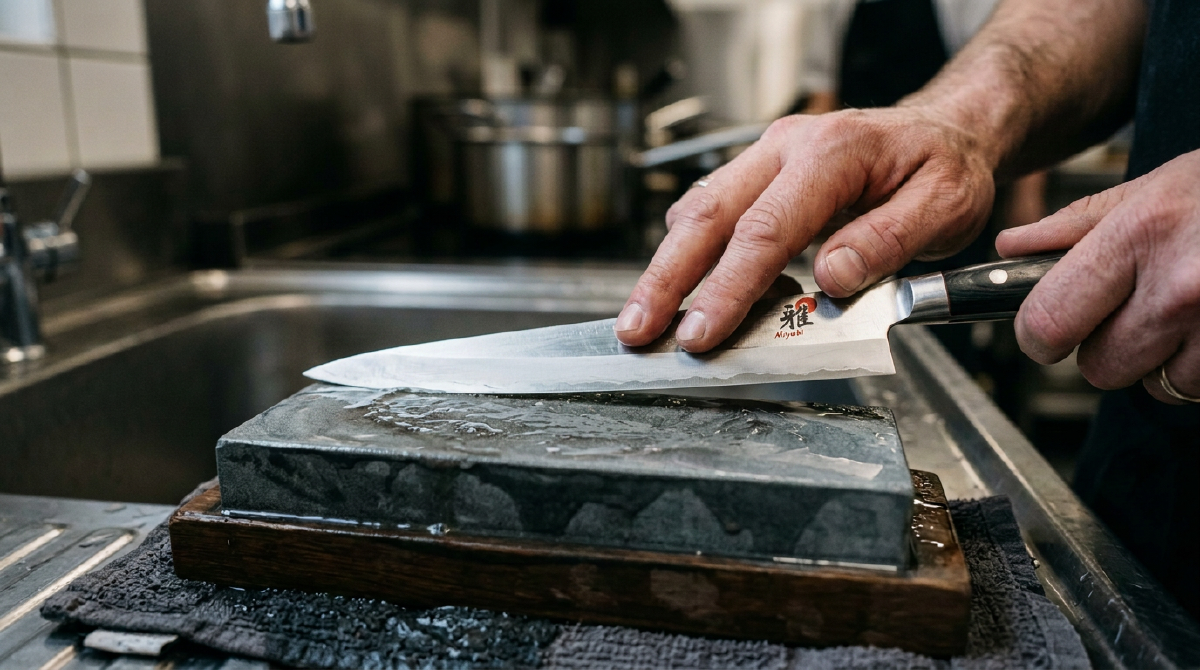
Sharpening is both a practical skill and a meditative craft, transforming dull blades into precise instruments. Whether in the kitchen or the wild, understanding the nuances of sharpening different knives and steels is essential for performance and longevity. This essay explores sharpening techniques and tools for Western chef’s knives, Japanese single-bevel knives, and bushcraft knives, before delving into the differences between stainless, Damascus, and carbon steels.
Sharpening Western-Style Chef’s Knives#
Tools#
Sharpening Western-style chef’s knives (‘Chef’s knives’) is a foundational skill for anyone serious about cooking, and the choice of tools plays a pivotal role in both the quality of the edge and the longevity of the blade. Among the various options, whetstones—also known as waterstones or oilstones—are widely regarded as the gold standard. These stones come in a range of grits, from coarse to ultra-fine, allowing for a gradual refinement of the blade’s edge. Waterstones, in particular, are favored for their fast cutting action and ease of maintenance, as they require only a brief soak before use and can be easily flattened when they become uneven. Oilstones, while less common in modern kitchens, offer a slower, more controlled sharpening experience and are often chosen for their durability and traditional appeal. The tactile feedback and precision offered by whetstones make them ideal for those who wish to develop a deep understanding of their knives and the sharpening process.
In contrast, honing rods—made from steel or ceramic—serve a different purpose. Rather than removing material to create a new edge, honing rods realign the microscopic teeth along the blade, correcting minor bends and maintaining sharpness between true sharpenings. Steel rods are traditional and effective for softer stainless blades, while ceramic rods are harder and can be used on a wider variety of steels. However, it’s important to recognize that honing is not a substitute for sharpening; over time, even a well-honed knife will require the restorative action of a whetstone or other abrasive tool.
For those seeking convenience, pull-through sharpeners offer a quick solution. These devices typically feature preset angles and abrasive wheels or rods, allowing users to drag the blade through a slot to achieve a sharper edge. While undeniably fast and easy to use, pull-through sharpeners often sacrifice precision and can be harsh on the blade, removing more material than necessary and sometimes creating an uneven or serrated edge. Over time, repeated use can shorten the life of a knife and degrade its performance, making these tools best reserved for inexpensive or utility knives rather than prized chef’s blades.
Electric sharpeners represent another category of convenience-focused tools. These machines use motorized abrasive belts or wheels to grind a new edge onto the blade, often in a matter of seconds. While they can produce a sharp edge quickly, electric sharpeners carry the risk of overheating the blade, which can compromise the temper of the steel and reduce its hardness. Additionally, the aggressive material removal can shorten the lifespan of the knife, and the preset angles may not be suitable for all blade profiles. For those who value speed above all else, electric sharpeners are tempting, but for enthusiasts and professionals who care about the long-term health and performance of their knives, manual sharpening with whetstones remains the preferred method.
Ultimately, the choice of sharpening tool for Chef’s knives reflects a balance between convenience, control, and respect for the blade. Whetstones offer unmatched precision and the opportunity to truly connect with the craft, while honing rods help maintain that edge day-to-day. Pull-through and electric sharpeners provide speed, but often at the cost of the knife’s integrity. Understanding these differences empowers cooks to make informed decisions and keep their knives performing at their best.
Sharpening Chef’s knives is essential for serious cooks, and the choice of tool greatly affects both edge quality and blade longevity. Whetstones (waterstones or oilstones) are considered the best option, offering a range of grits for precise, gradual sharpening and a tactile connection to the process. Honing rods, made of steel or ceramic, help maintain sharpness by realigning the blade’s edge but do not replace true sharpening. Pull-through sharpeners and electric sharpeners offer speed and convenience but can damage the blade over time by removing too much material or overheating the steel. Ultimately, while convenience tools have their place, whetstones remain the preferred choice for those who value precision and the long-term health of their knives.
Techniques#
Sharpening Chef’s knives effectively requires careful attention to technique, with each step building upon the last to create a keen, durable edge. One of the most critical aspects is maintaining a consistent sharpening angle, typically between 15 and 20 degrees per side. This angle strikes a balance between sharpness and edge durability, and consistency is key—any wavering can result in an uneven edge that dulls quickly or even chips. Many sharpeners develop muscle memory for this angle, sometimes using angle guides when learning, but with practice, the hand naturally finds the correct position.
The sharpening process itself follows a progression through different grit levels on the whetstone. For a knife that has become quite dull or has minor damage, starting with a coarse grit, usually in the 400 to 800 range, is necessary to reestablish the edge geometry. Once the basic shape is restored, the process moves to a medium grit, typically between 1000 and 2000, which refines the edge and removes the deeper scratches left by the coarse stone. The final stage involves polishing the edge with a fine grit stone, ranging from 3000 up to 8000 or even higher. This step smooths the microscopic teeth along the edge, resulting in a blade that not only feels sharper but also glides more easily through food and resists dulling.
The motion used during sharpening is equally important. Smooth, sweeping strokes that cover the entire length of the blade, from heel to tip, ensure that the edge is evenly sharpened. Some prefer a circular motion, while others use a back-and-forth or sweeping diagonal stroke; the key is to maintain the chosen angle and apply even pressure throughout. Inconsistent motion or pressure can lead to a wavy or uneven edge, so focus and patience are essential.
A crucial indicator of progress is the formation of a burr—a tiny, raised edge of metal that appears on the opposite side of the blade as you sharpen. The burr signals that you have removed enough material to reach the very apex of the edge. Once a burr is felt along the entire length of one side, it’s time to switch to the other side and repeat the process. This ensures that both sides of the edge are equally sharp and that the edge itself is centered.
The final step is deburring, which involves removing the fragile burr to reveal the true, sharp edge beneath. This is done with lighter, alternating strokes on the fine stone, reducing pressure to avoid creating a new burr. For an even finer finish, many sharpeners use a leather strop, sometimes loaded with a polishing compound, to further refine and align the edge. Proper deburring not only improves sharpness but also increases edge retention, as the delicate burr would otherwise break off during use, leaving a rough or jagged edge.
Mastering these techniques transforms sharpening from a chore into a rewarding ritual, ensuring that Western-style chef’s knives perform at their best and last for years to come.
Sharpening Chef’s knives requires maintaining a consistent angle, usually between 15 and 20 degrees, to balance sharpness and durability. The process involves moving through progressively finer whetstone grits, starting coarse to restore the edge, then medium to refine it, and finishing with a fine stone for polishing. Using smooth, even strokes is essential to achieve a uniform edge, and forming a burr signals that the edge is properly sharpened. After sharpening both sides, deburring with light strokes or a strop reveals the true sharp edge and improves edge retention. Mastering these steps turns sharpening into a satisfying practice that keeps knives performing at their best.
Sharpening Japanese Single-Bevel Knives#
Tools#
Sharpening Japanese single-bevel knives (‘Japanese knives’) is a process that demands both precision and respect for the unique geometry and metallurgy of these blades. The primary tool for this task is the whetstone, which is indispensable due to the hardness and fine grain structure of traditional Japanese steels. Unlike many Western knives, single-bevel Japanese knives are often crafted from extremely hard carbon steels, such as white (shirogami) or blue (aogami) steel, which can take and hold an exceptionally sharp edge but require careful handling during sharpening.
The sharpening process typically begins with a medium or fine grit whetstone, as the hard steel rarely needs aggressive material removal unless the edge is damaged. The focus is on maintaining the precise angle of the primary bevel, which is usually much shallower than that of Western knives—often around 10 to 15 degrees. Because the bevel is so wide, it is laid flat against the stone, allowing the entire surface to make contact and ensuring the edge remains true to its original geometry. The hard steel responds best to stones in the 1000 to 6000 grit range for routine sharpening, with even finer stones—up to 8000 or higher—used for polishing and finishing the edge to a mirror-like sharpness.
A nagura stone is often used in conjunction with fine whetstones. This small, soft stone is rubbed on the surface of the main stone to create a slurry, which not only cleans the stone of metal particles but also enhances its cutting and polishing action. The slurry produced by the nagura stone helps to refine the edge further, allowing for a smoother, more controlled sharpening experience and a finer finish on the blade.
After the main sharpening is complete, the final refinement of the edge is achieved with a strop. Stropping, often done on leather and sometimes loaded with a fine abrasive compound, aligns and polishes the very apex of the edge, removing any remaining microscopic burrs and imparting a level of sharpness and smoothness that is difficult to achieve with stones alone. This step is particularly important for single-bevel knives, as it preserves the delicate, razor-thin edge that is prized for tasks like slicing sashimi or making precise vegetable cuts.
Throughout the sharpening process, attention must also be paid to the flat side of the blade, known as the ura. This side is not completely flat but has a slight concavity, which helps reduce sticking and makes sharpening more efficient. Light passes on the whetstone are used to maintain this surface, ensuring that the edge remains perfectly straight and that the knife’s unique cutting characteristics are preserved.
Sharpening Japanese knives is a meticulous process that relies on high-quality whetstones, the use of a nagura stone for stone maintenance and edge refinement, and careful stropping for the final polish. Each tool and step is chosen to respect the blade’s geometry and steel, resulting in an edge that is both incredibly sharp and true to the knife’s traditional design.
Sharpening Japanese knives requires precision and respect for their unique design and hard carbon steel. The process centers on using high-quality whetstones, starting with medium or fine grits to maintain the shallow, wide bevel and progressing to very fine stones for a polished edge. A nagura stone is used to clean and enhance the whetstone’s surface, creating a slurry that refines the edge further. Final edge refinement is achieved with a leather strop, which polishes and aligns the edge for exceptional sharpness. Special care is also given to the slightly concave flat side (ura) to preserve the knife’s geometry and cutting performance. Each step and tool is chosen to maintain the blade’s traditional sharpness and integrity.
Techniques#
Sharpening Japanese knives is a nuanced process that begins with a deep understanding of the blade’s unique geometry. Unlike double-bevel Western knives, single-bevel knives such as the yanagiba or usuba feature one side that is flat (the ura) and another that is beveled, typically at a shallow angle of 10 to 15 degrees. This asymmetrical design is what gives these knives their legendary sharpness and precision, but it also means that sharpening must be approached with careful attention to each side’s role.
When sharpening the beveled side, the goal is to maintain the original factory angle as closely as possible. This is achieved by laying the wide bevel flat against the whetstone, ensuring full contact along its surface. Because the bevel is so broad, it provides a stable platform, making it easier to keep the angle consistent throughout the sharpening process. The motion should be smooth and controlled, moving the blade along the stone in a way that covers the entire length of the edge. This method not only sharpens but also polishes the bevel, gradually refining it to a razor edge.
Attention must also be paid to the flat side, or ura, which is not perfectly flat but slightly concave. This subtle hollow grind is a hallmark of traditional Japanese craftsmanship, designed to reduce sticking and facilitate easier sharpening. The process of uraoshi involves gently placing the flat side on the stone and making light, even passes. The aim here is not to remove much material but to polish the surface, remove any burr formed during sharpening, and maintain the integrity of the hollow grind. Overworking the ura can flatten the concavity, diminishing the knife’s performance, so restraint and delicacy are essential.
Throughout the sharpening process, it’s important to regularly check the edge for consistency and quality. This can be done visually, using a loupe to inspect for a continuous, mirror-polished line along the edge, or by gently feeling for any rough spots or remaining burrs. A well-sharpened single-bevel knife will have a flawless, highly reflective edge on the bevel and a clean, burr-free ura, ensuring it performs with the precision and ease that Japanese knives are renowned for.
Mastering these techniques requires patience and practice, but the reward is an edge that not only slices with remarkable finesse but also honors the craftsmanship and tradition behind every single-bevel Japanese knife.
Sharpening Japanese knives requires careful attention to their unique geometry, with one flat (slightly concave) side and one shallow-angled beveled side. The process involves laying the wide bevel flat on the whetstone to maintain the original angle and using smooth, controlled strokes to sharpen and polish the edge. The flat side, or ura, is gently polished to remove burrs and preserve its hollow grind, which is essential for optimal performance. Regularly checking the edge for consistency and a mirror finish ensures the knife is sharpened correctly. Mastery of these techniques results in a razor-sharp edge that reflects the precision and tradition of Japanese knife-making.
Sharpening Outdoor/Bushcraft Knives#
Tools#
Sharpening outdoor and bushcraft knives presents a unique set of challenges and priorities compared to kitchen knives. These blades are often used in rugged environments for tasks ranging from wood carving and fire preparation to food processing and even light prying. As a result, the sharpening tools chosen must be both effective and practical for use in the field.
Diamond stones are a favorite among bushcrafters and outdoor enthusiasts due to their exceptional durability and portability. Unlike traditional whetstones, diamond stones consist of a metal plate embedded with industrial diamond particles, making them extremely hard and capable of cutting through even the toughest steels, including those found in high-end bushcraft knives. Their resilience means they do not wear down or dish as quickly as other stones, and they can be used dry or with a small amount of water, which is a significant advantage when sharpening away from home. Compact diamond stones can easily fit into a backpack or pocket, allowing for quick edge maintenance during extended trips in the wilderness.
Ceramic rods serve as an excellent tool for touch-ups and maintaining an edge between more thorough sharpening sessions. These rods are lightweight and can be used to quickly realign the edge or remove minor nicks and dullness that accumulate during heavy use. While they do not remove as much material as diamond stones, ceramic rods are gentle on the blade and can restore a working edge with just a few passes. Their simplicity and effectiveness make them a staple in many outdoor kits, especially for those who value minimalism and efficiency.
The final step in achieving a truly sharp and resilient edge is the use of a leather strop, often loaded with a fine abrasive compound. Stropping not only polishes the edge to a razor finish but also removes any lingering burrs left from sharpening on stones or rods. In the field, a leather belt or improvised strop can serve this purpose, but dedicated strops with compound provide the best results. Stropping is particularly important for bushcraft knives, as it refines the edge without removing significant material, preserving the blade’s geometry and extending its lifespan. A well-stropped edge will slice cleanly through rope, wood, and food, making tasks safer and more efficient.
Together, these tools—diamond stones for robust sharpening, ceramic rods for maintenance, and leather strops for finishing—form a comprehensive system that meets the demands of outdoor life. They allow users to keep their knives in peak condition, no matter how far they are from the comforts of a workshop, ensuring that their most essential tool is always ready for the next challenge.
Sharpening outdoor and bushcraft knives requires tools that are both effective and practical for rugged, off-grid environments. Diamond stones are highly valued for their durability, portability, and ability to sharpen even the hardest steels without needing water or oil, making them ideal for field use. Ceramic rods are lightweight and perfect for quick touch-ups, helping to maintain a sharp edge between more intensive sharpening sessions. The process is completed with a leather strop, often treated with abrasive compound, which polishes the edge and removes any remaining burrs, preserving the knife’s geometry and extending its life. Together, these tools ensure that bushcraft knives remain sharp and reliable, ready for any outdoor challenge.
Techniques#
Sharpening techniques for outdoor and bushcraft knives are shaped by the demands of rugged environments and the need for a blade that can withstand hard use. Unlike kitchen knives, which often prioritize razor sharpness, bushcraft knives are typically sharpened at a slightly wider angle, usually between 20 and 25 degrees per side. This broader angle sacrifices a bit of ultimate sharpness in favor of increased durability, ensuring the edge can handle tasks like batoning wood, carving, and even light prying without chipping or rolling.
In the field, sharpening often relies on compact, portable stones—diamond stones being a popular choice due to their effectiveness and resilience. However, the realities of outdoor life sometimes require improvisation. If a proper sharpening stone isn’t available, resourceful users may turn to smooth river rocks or other hard, flat surfaces to restore a working edge. While these improvised methods may not produce a perfect finish, they can be invaluable for keeping a knife functional until proper sharpening tools are available.
A key technique for maximizing edge retention in bushcraft knives is the creation of a micro-bevel. After establishing the primary edge, a micro-bevel is formed by slightly increasing the sharpening angle and making a few light passes on each side. This secondary bevel reinforces the very tip of the edge, making it more resistant to rolling and dulling during heavy use. The micro-bevel is especially useful for knives that see frequent contact with hard materials like wood or bone, as it helps the edge stay sharper for longer periods between full sharpenings.
Maintenance is an ongoing process in the field, and regular stropping plays a crucial role in keeping the edge keen. A leather strop, sometimes loaded with abrasive compound, is used to realign and polish the edge, removing minor burrs and restoring sharpness without removing significant material. Stropping can be done frequently, even daily, and is often performed with whatever is available—such as a leather belt—when a dedicated strop isn’t at hand. This habit of regular maintenance ensures that the knife remains ready for demanding tasks and extends the intervals between more intensive sharpening sessions.
Altogether, these techniques—maintaining a robust angle, adapting to field conditions, employing a micro-bevel, and practicing regular stropping—combine to keep bushcraft knives reliable and effective, no matter how challenging the environment.
Sharpening outdoor and bushcraft knives involves using a wider angle, typically 20 to 25 degrees, to prioritize edge durability over extreme sharpness, making the blade better suited for tough tasks like wood processing and carving. In the field, sharpening is often done with portable diamond stones or, when necessary, improvised surfaces like river rocks. Adding a micro-bevel by slightly increasing the angle at the edge helps the knife resist dulling and damage during heavy use. Regular stropping, even with makeshift tools like a leather belt, keeps the edge aligned and sharp between full sharpenings. Together, these techniques ensure bushcraft knives remain dependable and effective in demanding outdoor conditions.
Sharpening Stainless Steel: Regular vs. Damascus#
Regular Stainless Steel#
Sharpening regular stainless steel knives presents a unique set of challenges and considerations, largely due to the properties that make stainless steel so popular in the first place. Stainless steel is prized for its toughness and resistance to corrosion, which makes it ideal for kitchen and outdoor use where exposure to moisture and acidic foods is common. However, these same alloying elements—such as chromium, molybdenum, and vanadium—that provide corrosion resistance and toughness also increase the steel’s hardness and wear resistance. As a result, sharpening stainless steel can be more labor-intensive compared to carbon steels.
When approaching the sharpening of a regular stainless steel knife, the choice of sharpening stone becomes particularly important. Traditional waterstones or oilstones can be used, but the process may be slow, especially with harder stainless alloys. Diamond stones, with their superior abrasive power, are often the preferred choice for stainless steel. The industrial diamond particles embedded in these stones cut efficiently through tough alloys, significantly speeding up the sharpening process and reducing fatigue for the user. This is especially helpful when restoring a very dull edge or working with high-end stainless steels that are engineered for maximum edge retention.
A notable characteristic of stainless steel during sharpening is its tendency to form a stubborn burr—a thin, wire-like edge of metal that develops as the blade is abraded. This burr can be more persistent and difficult to remove than with softer steels, partly because of the alloying elements that increase the steel’s ductility and toughness. If not properly addressed, a lingering burr can fold over during use, giving the false impression of sharpness while actually reducing cutting performance and edge longevity.
To counter this, thorough deburring is essential. After progressing through the sharpening grits, it’s important to use lighter, alternating strokes on the finest stone to minimize the burr. Some sharpeners also employ a strop, either leather or synthetic, sometimes loaded with a fine abrasive compound, to polish away the last remnants of the burr and refine the edge. This final step not only ensures a truly sharp and clean edge but also helps maintain the knife’s performance over time.
Sharpening regular stainless steel knives requires patience, the right choice of abrasive—often diamond stones for efficiency—and a careful focus on deburring. Mastering these aspects allows the user to overcome the inherent challenges of stainless steel, resulting in a blade that is both sharp and resilient, ready to take full advantage of the material’s corrosion-resistant properties.
Damascus Stainless Steel#
Sharpening Damascus stainless steel knives is a process that blends both functional and aesthetic considerations, owing to the unique construction and visual appeal of these blades. Damascus stainless steel is typically made by layering different types of steel—often a hard, high-performance stainless core sandwiched between softer, more ductile stainless layers. This layered construction not only provides a striking, wavy pattern on the blade’s surface but also combines the best qualities of each steel: the core delivers cutting performance and edge retention, while the outer layers add toughness and flexibility.
When sharpening a Damascus stainless steel knife, the primary goal is to focus on the hard core steel, as this is what forms the actual cutting edge. The outer layers, while contributing to the blade’s overall strength and resilience, are not responsible for the knife’s sharpness. As you work the blade on the sharpening stone, you’ll notice that the feel can be slightly different compared to a monosteel blade. The transition between the hard core and the softer outer layers can create subtle variations in resistance, especially if the stone is coarse or if the blade has a pronounced cladding line. This is generally more noticeable on the initial passes and becomes less pronounced as the edge is refined.
A key consideration when sharpening Damascus stainless is the preservation of its distinctive pattern. Coarse stones or aggressive sharpening can scratch or dull the etched surface, diminishing the visual appeal that makes these knives so desirable. For this reason, it’s best to use fine-grit stones, especially in the finishing stages, to minimize surface abrasion and maintain the clarity of the Damascus pattern. Gentle, controlled strokes help avoid unnecessary wear on the softer layers and keep the blade looking its best.
Additionally, because the core steel is often quite hard, patience is required to achieve a keen edge. Diamond stones can be used for initial sharpening if the blade is very dull, but for routine maintenance and finishing, waterstones in the higher grit range are ideal. After sharpening, some users choose to re-etch the blade with a mild acid solution to restore the contrast in the Damascus pattern, though this is more of an aesthetic step than a functional one.
Ultimately, sharpening Damascus steel is about balancing performance with preservation. By focusing on the core steel for the edge, using fine stones to protect the pattern, and employing a gentle touch, you can maintain both the cutting ability and the beauty of these remarkable knives.
Sharpening Carbon Steel: White and Blue#
White Steel (Shirogami)#
Sharpening carbon steel knives made from white steel, or shirogami, is a process that rewards both skill and attention to detail. White steel is renowned for its purity and fine grain structure, which allows it to take an exceptionally keen, razor-sharp edge. This steel is favored by many traditional Japanese knife makers and chefs for its ability to achieve a level of sharpness and precision that is difficult to match with most stainless steels. However, this purity comes at a cost: white steel is highly reactive and prone to rust, requiring careful maintenance both during and after sharpening.
When sharpening a white steel blade, the process is often more responsive and satisfying than with harder, more wear-resistant steels. The fine grain structure means that the steel abrades smoothly and quickly on waterstones, allowing the sharpener to feel the edge developing with each pass. Even with relatively little pressure, the steel yields to the stone, making it possible to restore a dull edge or refine an already sharp one with minimal effort. This responsiveness is especially noticeable when using high-quality Japanese waterstones, which pair perfectly with the characteristics of shirogami.
To bring out the best in white steel, it’s important to progress through finer grits as the sharpening process advances. After establishing the edge with a medium-grit stone, moving to higher grits—such as 3000, 6000, or even 8000—will polish the edge to a mirror finish, enhancing both sharpness and cutting smoothness. The fine grain of shirogami allows for a highly refined edge that glides effortlessly through food, making it a favorite for tasks that demand precision, such as slicing sashimi or fine vegetable work.
Because white steel is so reactive, special care must be taken immediately after sharpening. The blade should be thoroughly wiped dry to remove any residual water or slurry from the stones, as even a small amount of moisture can lead to rust spots. Many users go a step further by applying a thin layer of food-safe oil to the blade, creating a protective barrier against oxidation. This simple step is crucial for preserving the edge and appearance of the knife, especially in humid environments or when the knife will be stored for any length of time.
Sharpening white steel is a rewarding experience that highlights the steel’s purity and responsiveness. With the right technique and attention to post-sharpening care, a shirogami blade can deliver unmatched sharpness and performance, while remaining protected from the ever-present threat of rust.
Blue Steel (Aogami)#
Sharpening knives made from blue steel, or aogami, is a process that reflects the steel’s unique blend of toughness, edge retention, and traditional craftsmanship. Blue steel is an alloy that builds upon the purity of white steel by adding elements such as tungsten and chromium. These additions significantly enhance the steel’s durability and ability to hold a sharp edge, making it a favorite among professional chefs and serious enthusiasts who demand both performance and resilience from their blades.
The presence of tungsten and chromium in blue steel increases its hardness and wear resistance, which means that sharpening aogami blades requires a bit more effort and patience compared to white steel. The steel does not abrade as quickly, so the process of raising a burr and refining the edge can take longer, especially if the blade has become quite dull. However, this extra work is rewarded with an edge that remains sharp through extended use, even when tackling tougher ingredients or more demanding cutting tasks.
The sharpening process for blue steel typically begins with a medium-grit stone to reestablish the edge geometry and remove any nicks or dullness. Because blue steel is harder, it’s important to use high-quality stones that cut efficiently and provide good feedback. As the edge takes shape, the progression moves through finer grits, with each stage further refining the sharpness and smoothness of the blade. Finishing on a high-grit stone—such as 6000, 8000, or even higher—polishes the edge to a fine, mirror-like finish, maximizing both cutting performance and edge retention.
Throughout sharpening, it’s essential to maintain a consistent angle and use even, controlled strokes. The increased toughness of blue steel means that it can be less forgiving of mistakes, so attention to technique is crucial. The final edge produced on aogami is not only incredibly sharp but also robust, capable of withstanding the rigors of professional kitchen work or intensive home use without frequent touch-ups.
After sharpening, blue steel, like all high-carbon steels, remains susceptible to rust and discoloration, though the added chromium offers a slight improvement in corrosion resistance over white steel. It’s still important to thoroughly dry the blade and, if desired, apply a thin coat of oil to protect the edge. With proper care and a thoughtful sharpening routine, a blue steel knife will reward its owner with exceptional performance and longevity, embodying the best qualities of traditional Japanese steelmaking with the added benefits of modern alloying.
Sharpening blue steel (aogami) knives requires more effort than sharpening white steel due to the added tungsten and chromium, which make the blade harder and more wear-resistant. This increased toughness means the sharpening process takes longer, but the resulting edge is exceptionally sharp and holds up well to heavy use. The process involves starting with a medium-grit stone and progressing to finer grits, finishing with a high-grit stone for a polished, durable edge. Consistent technique is important, as blue steel is less forgiving of mistakes. After sharpening, the blade should be dried and oiled to prevent rust, since it is still a high-carbon steel despite its slightly improved corrosion resistance. With proper care, blue steel knives offer outstanding sharpness, edge retention, and durability.
Key Differences in Sharpening: Stainless vs. Carbon Steels#
| Steel Type | Sharpening Ease | Edge Retention | Rust Resistance | Notes |
|---|---|---|---|---|
| Stainless | Harder to sharpen | Good | Excellent | Use diamond stones for speed; deburr thoroughly |
| Damascus | Similar to core steel | Good | Excellent | Avoid scratching pattern; focus on core |
| White Carbon | Very easy | Moderate | Poor | Use fine stones; oil after sharpening |
| Blue Carbon | Moderate | Excellent | Poor | Requires more effort; rewards with long-lasting edge |
Sharpening as Living Ritual: The Harmony, Energy, and Spirit of the Blade#
When sharpening is undertaken with true mindfulness, it transcends mere maintenance and becomes a living expression of ‘Wa’ (和), ‘Ki’ (気), and ‘Pneuma’ (πνεῦμα). The principle of ‘Wa’ is not just about achieving a sharp edge, but about cultivating a sense of harmony throughout the entire process. This harmony is evident in the way the sharpener aligns their movements with the natural resistance of the stone, adjusting pressure and angle in response to the subtle feedback of steel against grit. The rhythm of sharpening—steady, unhurried, and attentive—mirrors the inner balance of the practitioner, who must remain patient and receptive, neither forcing the blade nor rushing the process. In this way, ‘Wa’ is realized as a dynamic equilibrium, a dance between intention and adaptation, where every stroke is both purposeful and responsive.
At the same time, ‘Ki’ infuses the act with a palpable sense of energy and presence. The sharpener’s focus is not scattered but gathered, channeled through their hands and into the blade. This vital spirit animates the entire process, transforming what could be a mechanical task into a creative and almost meditative engagement. The sharpener becomes attuned to the blade’s needs, sensing when to shift pressure, when to change stones, and when the edge has reached its potential. The flow of ‘Ki’ is felt in the seamless connection between mind, body, and tool—a unity that brings the blade to life and, in turn, enlivens the sharpener.
‘Pneuma’ (πνεῦμα), the breath or spirit, weaves through the act as a subtle but essential presence. The sharpener’s breathing often synchronizes with the motion of the blade, each inhale and exhale grounding the mind and steadying the hand. The repetitive nature of sharpening becomes a kind of moving meditation, where the outside world recedes and the practitioner enters a state of quiet awareness. In this space, the act of sharpening is not just about refining steel, but about cultivating clarity, patience, and a sense of inner stillness. The finished edge, then, is more than a physical accomplishment; it is a testament to the harmony, energy, and spirit invested in its creation.
In this convergence of ‘Wa’, ‘Ki’, and ‘Pneuma’, sharpening becomes a ritual that honors both the tangible and intangible—the material blade and the spirit of the one who sharpens it. The result is an edge that not only cuts cleanly, but also carries within it the quiet strength and vitality of mindful craftsmanship.
When sharpening is approached with mindfulness, it becomes more than maintenance—it transforms into a ritual that embodies ‘Wa’ (和), or harmony, through balanced and attentive movements; ‘Ki’ (気), or vital energy, by channeling focused intent and presence into the process; and ‘Pneuma’ (πνεῦμα), or spirit, through rhythmic breathing and meditative repetition. This convergence of harmony, energy, and spirit turns sharpening into an act that honors both the blade and the sharpener, resulting in an edge that reflects the quiet strength and vitality of mindful craftsmanship.
Conclusion#
Sharpening is far more than a mechanical task; it is a craft that weaves together knowledge, skill, and a deep appreciation for the tools at hand. Each type of knife—whether a Western chef’s knife, a Japanese single-bevel, or a rugged bushcraft blade—presents its own set of challenges and requirements, dictated by the blade’s geometry, the tasks it is designed for, and the environment in which it is used. A Western chef’s knife, with its double-bevel and moderate hardness, calls for a balanced approach that emphasizes both sharpness and durability, often achieved through a careful progression of grits and a consistent angle. Japanese single-bevel knives, on the other hand, demand an almost meditative attention to the unique asymmetry of their design, with precise work on both the wide bevel and the subtly concave ura to preserve their legendary cutting performance. Bushcraft knives, built for resilience in unpredictable outdoor conditions, require robust angles and practical field techniques that prioritize edge retention and reliability over a mirror polish.
The type of steel further shapes the sharpening experience. Stainless steels, with their corrosion resistance and toughness, often require more aggressive abrasives and meticulous deburring to achieve a keen edge. Damascus blades, with their layered construction and aesthetic appeal, invite a gentle touch and fine stones to protect their intricate patterns while honing the hard core. Carbon steels, whether the pure, responsive white steel or the tough, long-lasting blue steel, reward the sharpener with unmatched edge quality but demand vigilance against rust and careful post-sharpening care.
Ultimately, true mastery of sharpening is not achieved through rote repetition, but through attentive practice and a willingness to observe and learn from each session. It is about feeling the feedback from the stone, noticing the formation of a burr, and understanding how subtle changes in angle or pressure affect the final edge. It is about respecting the blade—not just as a tool, but as a product of craftsmanship and tradition—and striving to bring out its best qualities. When approached with patience and understanding, sharpening transforms from a chore into a deeply satisfying ritual, ensuring that every cut is not only effortless and precise, but also a testament to the care invested in the blade.
When sharpening is undertaken with true mindfulness, it transcends mere maintenance and becomes a living expression of ‘Wa’ (和), ‘Ki’ (気), and ‘Pneuma’ (πνεῦμα). The principle of ‘Wa’ is not just about achieving a sharp edge, but about cultivating a sense of harmony throughout the entire process. This harmony is evident in the way the sharpener aligns their movements with the natural resistance of the stone, adjusting pressure and angle in response to the subtle feedback of steel against grit. The rhythm of sharpening—steady, unhurried, and attentive—mirrors the inner balance of the practitioner, who must remain patient and receptive, neither forcing the blade nor rushing the process. In this way, ‘Wa’ is realized as a dynamic equilibrium, a dance between intention and adaptation, where every stroke is both purposeful and responsive.
At the same time, ‘Ki’ infuses the act with a palpable sense of energy and presence. The sharpener’s focus is not scattered but gathered, channeled through their hands and into the blade. This vital spirit animates the entire process, transforming what could be a mechanical task into a creative and almost meditative engagement. The sharpener becomes attuned to the blade’s needs, sensing when to shift pressure, when to change stones, and when the edge has reached its potential. The flow of ‘Ki’ is felt in the seamless connection between mind, body, and tool—a unity that brings the blade to life and, in turn, enlivens the sharpener.
‘Pneuma’ (πνεῦμα), the breath or spirit, weaves through the act as a subtle but essential presence. The sharpener’s breathing often synchronizes with the motion of the blade, each inhale and exhale grounding the mind and steadying the hand. The repetitive nature of sharpening becomes a kind of moving meditation, where the outside world recedes and the practitioner enters a state of quiet awareness. In this space, the act of sharpening is not just about refining steel, but about cultivating clarity, patience, and a sense of inner stillness. The finished edge, then, is more than a physical accomplishment; it is a testament to the harmony, energy, and spirit invested in its creation.
In this convergence of ‘Wa’, ‘Ki’, and ‘Pneuma’, sharpening becomes a ritual that honors both the tangible and intangible—the material blade and the spirit of the one who sharpens it. The result is an edge that not only cuts cleanly, but also carries within it the quiet strength and vitality of mindful craftsmanship.