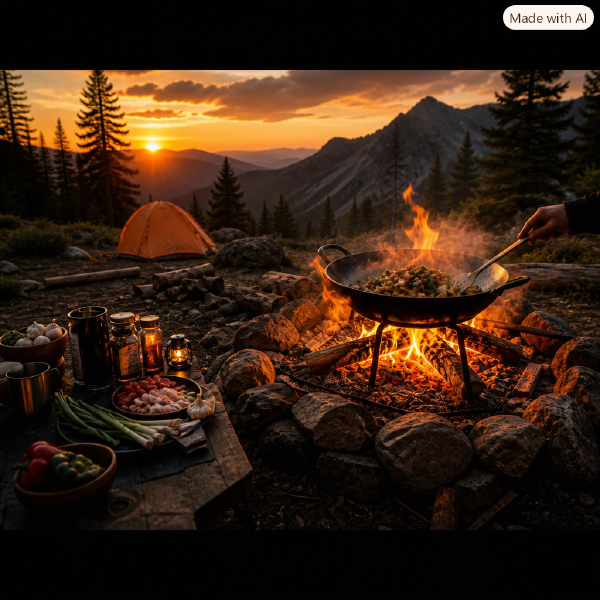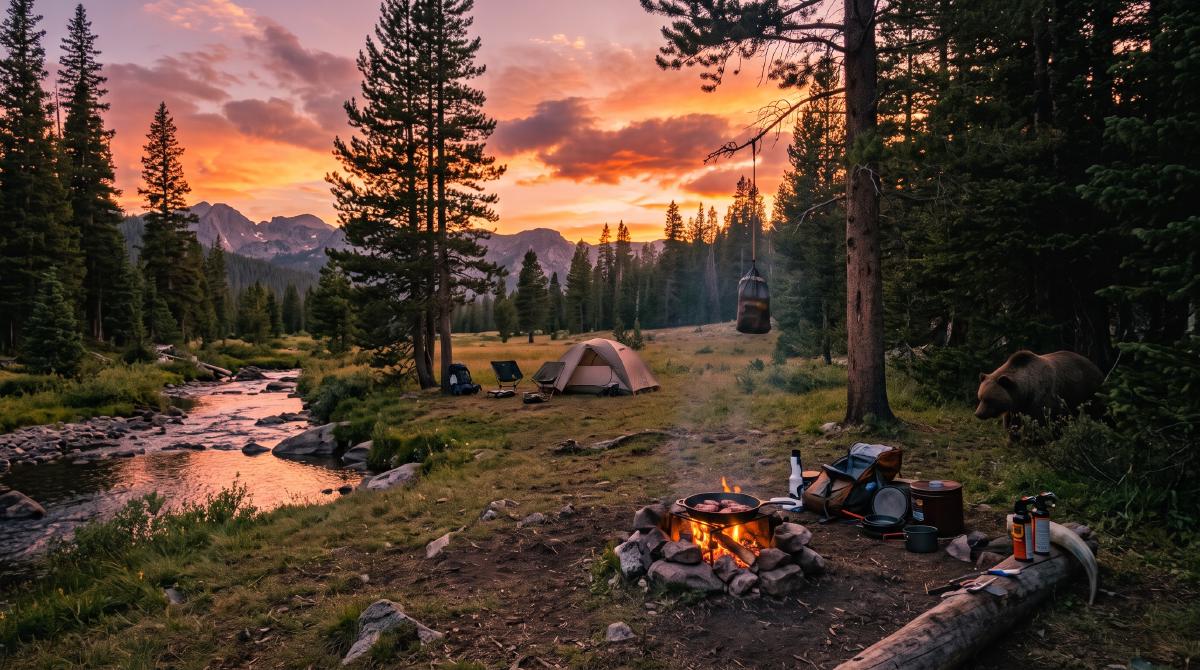
Cooking at camp is one of the most rewarding parts of outdoor life, but it also concentrates smells, food, and activity that attract wildlife. The following essay explains how to reduce risk, prepare for encounters, and respond safely if a dangerous animal approaches while you cook. The guidance combines practical campsite setup, food-handling best practices, situational awareness, and clear response steps so you can enjoy meals outdoors with far less chance of a hazardous encounter.
Why Cooking Attracts Animals#
Sensory Signals: How Cooking Communicates Food Is Nearby#
Cooking in the backcountry becomes an unintentional broadcast, a sensory beacon that radiates far beyond the boundaries of your campsite. The moment heat touches fat, protein, or spice, the chemistry of scent changes. Molecules that were once inert inside sealed containers volatilize and lift into the air, riding thermal currents and wind patterns in ways humans rarely appreciate. To us, a simmering pot may smell pleasant but localized; to a bear, fox, or coyote, it becomes a vivid plume stretching across ridgelines, drifting through timber, and settling into low basins where animals travel. Their olfactory systems are so sensitive that what feels subtle to you becomes a clear, directional signal—almost a map—pointing straight toward your camp.
The visual dimension of cooking reinforces this signal. Smoke rising from a fire or stove is not just a byproduct of combustion; it is a visible marker of human activity. Animals that have learned to associate smoke with food—especially in heavily used parks—interpret it as a cue worth investigating. Steam rising from pots, the glow of a flame at dusk, and the rhythmic movement of people around a cooking area all create a scene that stands out sharply against the stillness of the natural environment. Even the flicker of a headlamp or lantern can act as a visual attractant, not because animals seek light, but because light often accompanies food preparation.
Sound adds yet another layer. The clink of utensils, the scrape of a pot lid, the rustle of packaging—these noises are distinct from the ambient sounds of the wild. Over time, animals in popular camping regions learn to associate these human-made sounds with the possibility of calories. Raccoons, in particular, are notorious for responding to the auditory cues of food handling; they recognize the crinkle of a wrapper or the thump of a cooler lid the way a dog recognizes the sound of kibble hitting a bowl. Even larger animals, like bears, may investigate after hearing repeated human activity if they have previously been rewarded by unsecured food.
These sensory channels—smell, sight, and sound—do not operate independently. They combine into a multi-layered attractant that makes a cooking area far more conspicuous than any other part of your camp. In the quiet of a forest or the openness of a desert, a cooking site becomes a sensory hotspot, a place where signals converge and radiate outward. Animals navigating the landscape encounter these cues the way humans notice a lit window in a dark neighborhood: unmistakable, intriguing, and potentially rewarding.
Understanding this interplay helps explain why cooking is one of the most critical moments for wildlife safety. It is not just the food itself but the entire sensory footprint of cooking that draws animals in. When you recognize how strongly your presence communicates through scent, sight, and sound, you begin to appreciate why careful cooking practices—distance from tents, scent control, immediate cleanup, and awareness—are essential for keeping wildlife at a respectful distance.
Learning and Conditioning: Why One Meal Can Change Animal Behavior#
When an animal succeeds in obtaining food from a campsite, the moment becomes far more than a simple feeding event—it becomes a powerful neurological imprint. In the wild, calories are hard‑won, and animals constantly evaluate the relationship between effort and reward. Human food, dense in fat, sugar, and protein, represents an unusually high payoff for very little work. The instant an animal discovers that a campsite can provide such a reward, its internal map of the landscape changes. What was once neutral terrain becomes a place of opportunity.
This shift is what wildlife biologists call food conditioning, and it happens with remarkable speed. A bear that breaks into a cooler or finds scraps left behind may return the very next night, not because it is desperate, but because it has learned that humans can be outsmarted. The energetic logic is simple: why forage for berries or dig for roots when a single visit to a campsite yields more calories than hours of natural foraging. Over time, the bear’s daily movements begin to orbit around human spaces, and its natural feeding patterns erode. The same process occurs with raccoons, foxes, coyotes, and even birds—species that quickly learn to associate human scent, cooking sounds, or camp structures with food availability.
Conditioning does not remain confined to a single individual. In many regions, animals communicate opportunity through behavior rather than language. A raccoon that repeatedly raids campsites may be followed by others who observe its movements. A bear that frequents campgrounds may leave scent trails that draw additional bears into the area. In this way, conditioning spreads through local populations, creating clusters of animals that expect human food and behave accordingly. This is how entire campgrounds become “hotspots” for wildlife conflict.
As conditioning deepens, habituation follows. Habituated animals lose their natural wariness of humans. They approach more boldly, linger longer, and test boundaries they once avoided. A bear that has learned humans provide food may walk directly into a cooking area even while people are present. A raccoon may attempt to open containers while campers watch. These animals are not acting aggressively out of malice—they are acting with confidence born from experience. They have learned that humans are not a threat, and that human spaces contain reward.
This is where danger emerges. Animals expecting food may push into tents, vehicles, or storage areas. They may approach people directly, interpreting human movement not as a warning but as part of the familiar pattern surrounding food access. Wildlife agencies document countless cases where a single successful food raid leads to escalating encounters—first curiosity, then boldness, then aggression. Once an animal reaches this stage, reversing the behavior becomes extraordinarily difficult. Wildlife managers often have no choice but to relocate or euthanize the animal, not because it is inherently dangerous, but because conditioning has taught it to rely on humans.
Preventing that first successful raid is therefore the most important act of wildlife stewardship a camper can take. Every sealed canister, every clean cooking area, every properly stored scented item is part of a larger effort to keep animals wild. When you deny animals access to human food, you preserve their natural foraging patterns, protect your campsite, and prevent the tragic cycle that begins with a single unsecured meal.
Species Differences: Which Animals Are Drawn and Why#
Different species respond to cooking in profoundly different ways, and understanding these differences turns wildlife safety from guesswork into informed strategy. A campsite is not a neutral space in the eyes—or noses—of wild animals. It is a sensory hotspot, and each species interprets that hotspot through its own biology, instincts, and ecological role.
Bears are the most dramatic example of this. Their sense of smell is so powerful that they can detect food odors from miles away, and cooking scents—especially fats, oils, and aromatic spices—create a plume that acts like a beacon. A bear doesn’t simply smell “food”; it smells type, fat content, distance, and sometimes even direction. Their intelligence compounds the problem. Once a bear learns that humans sometimes store food poorly, it begins to treat campsites as predictable opportunities. Strength then becomes the final ingredient: a bear can peel open a car door, crush a cooler, or tear through soft‑sided storage with ease. This combination of sensory acuity, cognitive ability, and physical power makes them uniquely dangerous around cooking areas.
Smaller mammals such as raccoons and foxes operate on a different logic. They are nocturnal or crepuscular, slipping into campsites when human vigilance naturally drops. Raccoons, in particular, are astonishingly dexterous; their paws function almost like hands, capable of opening latches, unzipping tents, and manipulating containers that seem secure to humans. They are drawn not only by scent but by the sounds of cooking—wrappers, clinking utensils, the thump of a cooler lid. Foxes tend to be more cautious, but they are opportunists, and the scent of grease or scraps can pull them in from the edges of camp.
Coyotes and feral dogs respond to a blend of cues. They are attracted to cooking smells, but they are equally drawn to the rodents that gather around food waste. A campsite with crumbs, scraps, or poorly stored trash becomes a miniature ecosystem: rodents arrive first, and predators follow. Coyotes may approach quietly, testing the boundary between curiosity and caution. Feral dogs, depending on their history with humans, may be bolder, sometimes approaching directly if they associate people with food.
Snakes enter the picture indirectly. They are not attracted to human food, but they are attracted to the rodents that thrive on scraps and spills. A campsite with poor waste management becomes a feeding ground for mice, and where mice gather, snakes follow. In desert regions, rattlesnakes may move toward rodent activity at dusk or dawn; in forests, non‑venomous species may hunt along the edges of clearings where rodents forage. The danger here is subtle: you may never see the rodents, but the snakes that hunt them can appear suddenly and silently.
These species differences matter because they dictate which precautions are effective. A bear‑heavy region demands hard‑sided canisters and strict scent control. A raccoon‑dense campground requires latching containers and vigilance at night. A desert canyon calls for immaculate waste management to avoid attracting rodents and, by extension, snakes. A place with coyotes or feral dogs may require keeping cooking areas farther from camp and minimizing nighttime food activity.
Understanding which animals inhabit the region transforms your approach to safety. You begin to see your campsite not as a static location but as a node in a living ecosystem, where each species responds to your presence in its own way. When you tailor your precautions to those species—rather than relying on generic rules—you create a cooking environment that is safer, calmer, and far less likely to invite unwanted visitors.
Ecological Context: Why Campsites Stand Out in the Landscape#
A campsite is not just a temporary human shelter; it becomes a distinct ecological feature that animals quickly learn to recognize. In the wild, calories are scattered across vast areas, hidden in plants, carcasses, insects, or seasonal fruiting cycles. Animals spend most of their lives navigating this dispersed, unpredictable food web. But a campsite compresses calories, scents, and structures into a single, concentrated point. To an animal moving through the landscape, this concentration is extraordinary—almost unnatural—and it immediately alters how the surrounding ecosystem behaves.
Human food is especially disruptive because it is dense, reliable, and often far richer than anything animals find naturally. A single cooler can contain more fat and protein than acres of berry bushes or hours of rooting for insects. When drought shrivels vegetation, when winter starves herbivores, or when mast failures reduce nuts and seeds, the contrast becomes even sharper. In these lean seasons, the energetic payoff of investigating a campsite skyrockets. Animals that might normally ignore human presence begin to take risks, drawn by the promise of calories that could mean survival.
This attraction is not just about food; it is about predictability. Natural food sources fluctuate with weather, season, and competition. Human food, by contrast, appears with remarkable consistency. Campers return to the same sites year after year, often at the same times, creating a rhythm that animals learn to anticipate. A bear that discovers unsecured food one summer may return the next, guided by memory rather than scent alone. Raccoons, foxes, and coyotes develop spatial maps of campgrounds, knowing which areas yield scraps, which dumpsters overflow, and which fire pits hide half‑burned leftovers. Over time, these patterns become embedded in the local wildlife community.
Repeated human use also creates a kind of ecological “echo.” Even when no campers are present, the lingering scents of past meals, spilled grease, or improperly buried waste remain detectable to animals with sensitive noses. These residual cues act like breadcrumbs, guiding wildlife toward places where food has been found before. The landscape itself becomes marked by human presence, and animals begin to treat campsites as part of their foraging territory.
This landscape‑scale learning increases both visitation and boldness. Animals that repeatedly find food at campsites begin to approach more directly, sometimes even during daylight. They lose the natural caution that keeps them at a distance, replacing it with confidence born from experience. As more individuals learn the pattern, the behavior spreads through the population, creating a feedback loop: campsites become known feeding grounds, and animals visit them more frequently, reinforcing the association.
In this way, a campsite becomes an ecological anomaly—an artificial hotspot of calories and cues that reshapes animal movement and behavior. Understanding this context helps explain why strict food storage, scent control, and waste management are not merely personal safety measures but essential acts of stewardship. When campers break the cycle of reward, they help restore the natural balance, keeping wildlife wild and reducing the likelihood of conflict.
Human Factors: Practices That Amplify Attraction#
Human behavior is often the strongest predictor of whether wildlife will approach a campsite, because animals respond not only to the presence of food but to the patterns of human activity surrounding it. A single lapse—an unattended pot, an open cooler, a forgotten wrapper—can transform a neutral campsite into an irresistible opportunity. In the wild, animals constantly evaluate risk versus reward, and human mistakes dramatically shift that balance. When food is left exposed or scented items are stored casually, the energetic cost of investigating drops to almost nothing, making your camp far more attractive than the surrounding landscape.
Leaving food unattended while cooking is one of the most common triggers for wildlife visits. The moment you step away from a simmering pot or an open container, you create a window in which animals can approach without confrontation. Opportunistic species like raccoons and foxes excel at exploiting these moments, slipping in silently and disappearing before you return. Bears, guided by scent rather than stealth, may approach more boldly, especially if they have previously succeeded in obtaining human food. In these cases, your behavior—not the food itself—becomes the attractant.
Failure to clean cookware amplifies this effect. Grease, crumbs, and residue continue releasing scent long after cooking ends, and animals interpret these lingering odors as evidence of recent human activity and potential reward. A pot left unwashed beside a tent or a plate drying on a picnic table becomes a beacon for nocturnal foragers. Even small traces—oil film, sauce droplets, a few grains of rice—can draw animals whose noses are far more sensitive than ours. In ecosystems where natural food is scarce, these residues can be enough to pull wildlife directly into camp.
Discarding scraps nearby creates an even more complex attractant. Food waste doesn’t just lure animals directly; it also attracts rodents, which in turn draw predators such as coyotes, foxes, and snakes. A single scrap tossed into the bushes can set off a chain reaction of ecological signals, turning your campsite into a miniature feeding ground. Animals follow these cues instinctively, and once they discover that human spaces provide calories, they begin returning with increasing confidence.
Storing scented items in tents is another subtle but significant mistake. Humans often underestimate how strongly everyday products—lip balm, toothpaste, sunscreen, deodorant—broadcast odor. To animals, these scents are not “cosmetic”; they are simply food-like signals. A tent containing scented items becomes a target, and animals conditioned to human presence may attempt to enter it. This is especially dangerous with bears, who can interpret any strong scent as a potential food source.
Even the convenience of leaving food in a vehicle or an unlocked cooler can be deceptive. Many animals have learned to open soft-sided coolers, manipulate latches, and even access car interiors. Bears in some regions have mastered the art of opening car doors by pulling handles, and raccoons can pry open lids with surprising strength. What feels secure to a human may be trivial for an animal that has learned to exploit human storage habits.
Ultimately, human practices are the most modifiable part of the wildlife–camp interaction. Animals behave according to instinct, conditioning, and ecological pressure; humans have the ability to change their habits. When campers store food properly, clean immediately, manage waste meticulously, and treat every scented item as a potential attractant, they dramatically reduce the likelihood of wildlife encounters. Most conflicts begin not because animals are bold, but because humans are careless. By adjusting behavior, you reshape the sensory footprint of your camp, making it less interesting, less rewarding, and far safer for both people and wildlife.
Why Scent Minimization and Secure Storage Work Long Term#
Scent minimization and secure storage work over the long term because they intervene at the exact points where animal behavior begins to change. Wildlife does not approach campsites out of curiosity alone; it approaches because the sensory environment tells it that food might be available. When you reduce odors and eliminate access, you disrupt both the signals that draw animals in and the reinforcement that teaches them to return. Over time, this reshapes how animals perceive your campsite, turning it from a potential feeding ground into an unremarkable part of the landscape.
The first mechanism is sensory. Airborne odors are the earliest and most powerful attractants. When fats, oils, and aromatic foods volatilize, they create scent plumes that travel far beyond human perception. Animals with highly developed olfactory systems—bears most famously—use these plumes as navigational cues. By minimizing scent, you shrink the radius within which your camp can be detected. A clean pot, a sealed spice jar, and a properly stored trash bag don’t just reduce smell; they reduce the distance at which animals can identify your presence. Over repeated nights, this consistent absence of strong odors teaches wildlife that your campsite is not worth investigating.
The second mechanism is behavioral reinforcement. Animals learn through reward, and human food is an exceptionally potent one. When an animal succeeds in obtaining calories from a campsite, the experience becomes a powerful memory that alters its movement patterns. It begins to return, sometimes repeatedly, and may even shift its home range to include human areas. Secure storage—bear canisters, lockers, hard-sided containers—removes the possibility of reward. Even if an animal approaches, it finds nothing accessible. Without reinforcement, the learned association fades. The campsite becomes a place of failed opportunity rather than reliable food, and the animal eventually stops visiting.
This combination of reduced detection and absent reward works across ecosystems because it addresses the root causes of wildlife attraction. Whether you are in a desert canyon with rodents and snakes, a coastal forest with raccoons, or a mountain range with black bears, the principles remain the same: animals follow scent, and animals repeat successful behaviors. Interrupt both pathways, and you break the cycle.
In regions with persistent scavengers or large predators, these measures must be paired with strict adherence to local regulations. Certified bear-resistant containers, wildlife-proof trash receptacles, and mandatory storage zones exist because they have been tested against real animal behavior. When campers combine scent control with proper storage, immediate waste management, and compliance with park rules, the effect compounds. Campsites become less predictable sources of calories, and wildlife gradually shifts back toward natural foraging patterns.
Over months and years, this consistency has landscape-scale effects. Animals that repeatedly fail to obtain human food stop treating campsites as part of their foraging territory. Younger animals never learn the association in the first place. Entire populations become less habituated, less bold, and less likely to approach humans. What begins as an individual practice—cleaning a pot, sealing a bag, locking a canister—becomes part of a broader ecological correction that keeps wildlife wild and reduces dangerous encounters for everyone who visits the area
Psychological and Social Dimensions: Perception, Risk, and Responsibility#
The human side of wildlife safety is often the most complex, because it deals not with instinct or ecology but with perception—how people think wildlife behaves, how they interpret risk, and how willing they are to adjust their habits. Many campers underestimate the reach of scent, imagining that a sealed cooler or a closed tent is enough to contain odors. Others assume that animals will avoid humans simply because humans are present. These assumptions create blind spots, and blind spots create attractants. When someone believes a cooler is “bear‑proof” because it feels sturdy, or assumes a raccoon won’t bother a tent because it looks zipped, they unintentionally set the stage for wildlife encounters.
There is also a psychological tendency to treat wildlife as charming or harmless, especially in popular parks where animals appear habituated. Some people intentionally feed wildlife—tossing scraps to chipmunks, leaving leftovers for foxes, or encouraging raccoons to approach for photos. These actions feel small in the moment, but they accelerate conditioning dramatically. A single rewarded interaction teaches an animal that humans are a source of food, and that lesson spreads through the local population. What begins as a moment of novelty becomes a long‑term behavioral shift that increases risk for everyone who camps there afterward.
Social norms at a campsite amplify or mitigate these risks. When one group cleans thoroughly, stores food properly, and keeps scented items secured, they create a safer environment not only for themselves but for neighboring campers. Conversely, a single careless group can draw wildlife into an entire campground. Animals do not distinguish between campsites; they follow scent gradients and learned patterns. If one tent pad consistently offers scraps or unsecured food, animals learn to patrol the area, increasing the likelihood of encounters for everyone nearby. In this way, individual behavior becomes communal risk.
The social dimension also includes how campers respond to signs of wildlife activity. When people report sightings, share information about tracks or scat, or warn others about a bold animal in the area, they contribute to a culture of awareness. When they ignore signs, dismiss concerns, or assume that wildlife encounters are inevitable, they weaken that culture. Campsites function best when people treat wildlife safety as a shared responsibility rather than an individual preference.
Education plays a crucial role in shaping these norms. Clear signage at trailheads and campgrounds—explaining proper food storage, waste management, and local wildlife behavior—helps correct misconceptions before they become dangerous habits. Ranger programs, visitor‑center briefings, and online advisories reinforce the message that wildlife safety is not optional. Consistent enforcement by land managers further strengthens these norms. When regulations are applied uniformly—mandatory bear canisters, fines for feeding wildlife, strict waste rules—campers learn that these practices are not arbitrary but essential for protecting both people and animals.
Ultimately, the psychological and social dimensions of wildlife safety reveal that human behavior is the most malleable part of the equation. Animals act according to instinct, conditioning, and ecological pressure; humans act according to perception, habit, and social influence. When campers understand how their actions shape wildlife behavior—and when communities reinforce responsible practices—the entire landscape becomes safer. One person’s vigilance protects not only their own camp but the camps of everyone who follows.
Practical Implication: Focus on Prevention Rather Than Reaction#
Prevention becomes the central pillar of wildlife‑safe cooking because it intervenes before an animal has any reason to approach. Once an animal receives a reward—whether a scrap, a spilled pot, or an unlatched cooler—the relationship between wildlife and campsite changes permanently. Reaction, by contrast, is always too late. Chasing an animal away, shouting, waving lights, or trying to scare it off only addresses the moment, not the underlying cause. The animal has already learned that your campsite contains food, and that lesson is far more durable than any deterrent you apply afterward.
Focusing on prevention means shaping the sensory footprint of your camp so that animals never identify it as a food source in the first place. When scents are minimized, the radius of attraction shrinks dramatically. A clean pot or sealed trash bag doesn’t just reduce odor—it reduces discoverability. Animals navigating the landscape rely on scent gradients to decide where to investigate. If your cooking area produces only faint, transient smells, it blends back into the background of the ecosystem rather than standing out as a hotspot.
Secure storage reinforces this invisibility. Even if an animal wanders close, the absence of accessible food prevents reinforcement. Without reward, there is no conditioning; without conditioning, there is no return visit. Over time, this consistency teaches wildlife that human campsites are unprofitable. Animals shift their attention back to natural foraging patterns, and the campsite becomes just another neutral patch of terrain rather than a predictable feeding ground.
This preventive approach also protects the broader landscape. When campers consistently deny animals access to human food, they help maintain natural behavior across entire populations. Young animals never learn to associate humans with calories. Older animals lose interest when repeated attempts yield nothing. The result is a long‑term reduction in conflict, not just for one group of campers but for everyone who uses the area.
Wildlife agencies and experienced backcountry travelers emphasize prevention because it is the only strategy that works across species, seasons, and ecosystems. Reaction varies—different animals respond differently to noise, light, or human presence—but prevention is universal. A campsite that offers no reward and emits minimal scent is uninteresting to bears, raccoons, coyotes, foxes, rodents, and even the snakes that follow them. It is a strategy that aligns human behavior with ecological reality, reducing risk not through confrontation but through absence.
In practice, prevention means treating your cooking area as a place where every action either increases or decreases attraction. Every sealed container, every cleaned utensil, every properly stored scented item contributes to a sensory environment that discourages wildlife. When you make your campsite unprofitable and unnoticeable, you are not just protecting yourself—you are protecting the animals from the dangerous cycle of conditioning that begins with a single unsecured meal.
Camp Setup and Cooking Location#
Choose a Safe Cooking Spot#
Selecting a safe cooking spot is not just a matter of convenience; it is a deliberate act of shaping the “behavioral landscape” around your camp. When you place your cooking area at least 100 yards from your sleeping quarters, you create a buffer zone that separates the strongest food odors from the place where you will be most vulnerable. This distance is not arbitrary. Wildlife agencies recommend it because scent plumes travel unpredictably with wind shifts, temperature changes, and humidity. A pot of stew simmering at dusk can broadcast its presence far beyond what a human nose perceives, and animals—especially bears—navigate toward these signals with astonishing precision. By pushing your cooking zone outward, you ensure that any curious animal follows the scent trail to a location where you are alert, upright, and equipped, rather than to your tent where you are horizontal, unarmed, and unaware.
The separation of cooking and sleeping areas also changes how animals interpret your camp. A tent surrounded by food smells becomes a single, unified attractant. But a tent that is quiet, dark, and odor‑neutral is far less interesting to wildlife. Animals do not understand human categories like “kitchen” and “bedroom”; they respond to scent gradients and patterns of activity. When your food storage, cooking, and cleaning all occur in a distinct zone, you create a predictable scent boundary that animals learn to associate with human presence rather than reward. Over time, this reduces the likelihood of nighttime investigations, because animals tend to approach areas where humans are active only when they expect a payoff.
In bear country, the choice of cooking spot becomes even more strategic. Designated food‑storage lockers are placed where land managers know bears are least likely to wander during peak human activity. Using these lockers is not simply compliance—it is participation in a larger wildlife‑management system designed to keep bears wild and people safe. When lockers are unavailable, hanging a bear bag from a high, sturdy branch forces bears to work harder for a reward they may never obtain. The height, distance from the trunk, and difficulty of access all matter. A properly hung bag shifts the cost‑benefit equation for the bear: the calories spent attempting to reach the food outweigh the calories gained. This discourages repeat attempts and helps prevent the dangerous cycle of food conditioning.
Local park or forest service guidance is essential because different ecosystems produce different animal behaviors. In dense conifer forests, scent can linger under the canopy and travel along drainage lines, making a cooking spot farther from camp more important. In alpine zones, wind can disperse odors quickly, but the lack of trees makes bear‑bag hanging impossible, requiring canisters instead. In desert environments, the primary concern may be coyotes or rodents rather than bears, and the recommended distance may be shorter but the emphasis on sealed containers stronger. These variations reflect the intimate knowledge land managers have of local wildlife patterns, seasonal food availability, and historical encounter data.
Choosing a safe cooking spot is therefore an act of reading the landscape. You are looking for terrain that gives you visibility in all directions, so you can see animals approaching before they are close. You are seeking ground that is not part of a natural travel corridor—no game trails, no creek edges, no berry patches, no dense brush. You are also shaping the sensory footprint of your camp, placing the strongest odors where you can manage them and keeping your sleeping area quiet, clean, and uninteresting. When done well, this setup transforms your camp from a tempting opportunity into a neutral presence in the ecosystem, reducing risk not through confrontation but through thoughtful design.
Create a Clear Perimeter#
A clear perimeter around your cooking area is not just a matter of neatness—it is a deliberate act of shaping visibility, scent flow, and animal behavior. When you remove brush, tall grass, or fallen branches, you are essentially removing hiding places that allow animals to approach silently. Many species, especially predators and opportunistic scavengers, rely on cover to investigate human activity without being detected. A raccoon slipping through undergrowth or a bear emerging from dense vegetation can be upon you before you have time to react. By opening the space, you transform the cooking zone into a place where movement is immediately noticeable, giving you precious seconds to respond, reposition, or deter an approaching animal.
A single, well‑lit cooking surface reinforces this sense of controlled space. Light changes the behavior of many nocturnal animals; illumination disrupts their natural advantage and makes them more cautious. When your cooking area is lit evenly—whether by a lantern, headlamps, or the fire itself—you create a visual field where shadows cannot conceal motion. This is especially important at dusk, when animals are most active and human vision is least reliable. Light also signals human presence in a way animals understand instinctively. Even species that are not afraid of humans tend to avoid brightly lit areas because they lose the ability to approach undetected.
Avoiding dense vegetation, water sources, and animal trails is part of reading the landscape rather than imposing your own logic on it. Dense vegetation is a natural corridor for wildlife, offering both cover and a sense of security. Water sources attract animals of every size, from rodents to large predators, because they are essential for survival. Animal trails are highways of the wilderness—predictable routes used repeatedly by creatures who know the terrain better than any human. Cooking near any of these features places you directly in the path of wildlife movement. Even if animals are not drawn by the smell of food, they may encounter you simply because you are standing where they already intend to travel.
Cooking after dark introduces a different dynamic. Night amplifies scent, reduces human awareness, and increases animal confidence. Maintaining adequate lighting is not just about seeing; it is about projecting presence. Animals interpret light, sound, and movement as signs of human activity, and most species prefer to avoid active humans unless they are already conditioned to seek food. A small group presence strengthens this effect. Multiple voices, shifting silhouettes, and shared movement create a pattern that animals recognize as unpredictable and potentially threatening. A lone camper is far easier for an animal to assess and approach than a group whose behavior is harder to anticipate.
A clear perimeter, then, is a form of environmental communication. You are telling animals: this space is occupied, visible, and not worth investigating. You are also telling yourself: this is a place where I can cook, clean, and move with awareness. The perimeter becomes a boundary between the controlled human zone and the wild beyond it. When established thoughtfully, it reduces the likelihood of surprise encounters, gives you time to react, and subtly shifts the behavior of wildlife around your camp. It is one of the simplest yet most powerful ways to make cooking in the backcountry safer, calmer, and more predictable.
Avoid Cooking Near Dense Vegetation, Water Sources, or Animal Trails#
Continuing from the previous section, the idea of avoiding dense vegetation, water sources, and animal trails is really about understanding how animals move through their environment and how your cooking space can either intersect with or avoid those natural pathways. Dense vegetation acts like a veil—an animal can approach silently, shielded by foliage, and you may not notice until it is already close enough to be a problem. Many species rely on cover not only for stalking prey but also for feeling secure while exploring unfamiliar scents. When you cook beside thick brush, you essentially invite animals to investigate from a position of advantage, where they can observe you without being seen. A clear perimeter removes that advantage and shifts the encounter dynamic in your favor.
Water sources introduce a different kind of risk. Lakes, rivers, creeks, and even seasonal streams are magnets for wildlife activity. Every creature, from deer to raccoons to bears, must visit water regularly, and predators often patrol these areas because prey congregates there. Cooking near water means placing yourself in a high‑traffic zone where animals are already moving with purpose. Even if your food smells do not attract them, your presence may intersect with their routine, creating a surprise encounter. The tranquility of water can be deceptive; it is often the busiest ecological intersection in the area.
Animal trails are even more predictable. These narrow, worn paths are the highways of the wilderness, carved by repeated use over months or years. Animals follow them because they represent the most efficient routes between feeding areas, bedding sites, and water sources. Setting up a cooking station near one of these trails is like placing a kitchen in the middle of a road. Wildlife may pass through simply because that is where they always travel. When your cooking area overlaps with a trail, you increase the chance of close encounters that neither you nor the animal intended.
Cooking after dark intensifies all of these dynamics. Night is when many animals feel most confident approaching human spaces, especially if they have learned that food is sometimes available. Adequate lighting becomes your primary tool for shaping the environment. Light pushes back the darkness, revealing movement and discouraging animals from venturing too close. It also helps you maintain situational awareness, allowing you to see eye shine, shadows, or subtle shifts in the landscape that signal an approaching animal. A well‑lit perimeter is not just illumination—it is a psychological boundary that animals recognize.
The presence of a small group reinforces this boundary. Animals are far less likely to approach multiple humans than a solitary camper. The combined voices, shifting silhouettes, and unpredictable movements of a group create a pattern that wildlife interprets as active and potentially dangerous. Even species that have become somewhat habituated to humans tend to avoid groups because the risk of confrontation is higher. Cooking together, especially after dark, transforms your cooking area into a zone of human dominance rather than vulnerability.
Avoiding dense vegetation, water sources, and animal trails—and maintaining light and group presence when cooking at night—creates a cooking environment that is predictable for you and unpredictable for wildlife. You reduce the number of ways an animal can approach unseen, minimize the chance of intersecting natural travel routes, and project a clear signal that the space is occupied. These choices do not eliminate wildlife risk, but they dramatically shift the odds in your favor, turning your cooking area into a place where you can focus on preparing food rather than worrying about what might be watching from the shadows..
Food Handling and Waste Management#
Store Food Securely#
Storing food securely is one of the most consequential actions you take in camp, because it directly shapes how wildlife perceives your presence. When food, utensils, and scented items are sealed away in animal‑proof containers or approved lockers, you remove the single strongest incentive that draws animals into human spaces. Bears, in particular, are extraordinarily quick learners: once they obtain human food even once, they begin to associate campsites with calories, returning repeatedly and becoming increasingly bold. This shift in behavior is well‑documented by wildlife agencies, which note that bears who access human food lose their preference for natural foods, lose their fear of people, and often become aggressive or unpredictable. Such bears are frequently euthanized for public safety, meaning that improper storage harms both campers and wildlife.
Secure storage also involves recognizing that “food” includes far more than meals. Anything with a scent—sunscreen, toothpaste, lip balm, trash, wrappers, even the clothes you cooked in—registers as food to a bear’s nose. A bear’s sense of smell is estimated to be several times stronger than a bloodhound’s, making even sealed items detectable. This is why experienced backcountry travelers emphasize storing all scented items together, away from tents, and never relying on the assumption that something “doesn’t smell enough” to matter. The wrapper forgotten in a jacket pocket is a classic cause of tent break‑ins.
Hard‑sided bear canisters and metal food‑storage lockers are the gold standard in areas with bears or persistent scavengers. Canisters are legally required in many national parks and wilderness areas because they work regardless of terrain, weather, or tree availability. They prevent bears from accessing food, prevent conditioning, and protect future visitors by ensuring no bear learns that a campsite is a reliable food source. Wildlife safety guides consistently stress that proper use of canisters—locking them, storing them away from tents, and placing them on flat ground where they cannot be rolled off cliffs or into water—is one of the most effective long‑term deterrents available.
Where canisters or lockers are not available, hanging a bear bag becomes the fallback, but it must be done correctly to be effective. Bags hung too low, too close to the trunk, or over branches strong enough for a bear to climb are easily defeated. Proper hangs require height, distance, and technique, and even then, they are less reliable than canisters. Many backcountry incidents trace back to poorly hung bags that provided easy access to food, leading to dangerous encounters and long‑term bear habituation.
The consequences of improper storage are not theoretical. Field reports describe how a single unsecured food bag can draw a bear into camp, resulting in destroyed gear, tense encounters, and the beginning of a pattern that often ends with the bear’s removal by wildlife agencies. In contrast, campers who consistently store all food and scented items in canisters, cook and clean far from sleeping areas, and maintain strict scent discipline often experience zero bear incidents even in high‑density bear habitats.
Secure food storage is therefore both a personal safety measure and an ethical responsibility. It protects your camp, protects future visitors, and protects wildlife from the tragic consequences of food conditioning. When you store food properly, you are not just preventing an encounter tonight—you are shaping the long‑term behavior of animals who share the landscape with you
Manage Waste Immediately#
Managing waste immediately is one of the most powerful ways to prevent wildlife encounters because waste—especially food waste—continues releasing scent long after cooking is finished. The moment scraps, grease, or packaging are left exposed, they begin broadcasting odor cues that animals can detect from surprising distances. Wildlife‑safety guidance emphasizes that trash left on tables or around camp is one of the most common triggers for animal intrusions, particularly from raccoons, bears, and rodents, all of which are adept at exploiting even small amounts of food residue . When you collect and seal waste as soon as it is generated, you interrupt this scent plume before it becomes an attractant.
Sealed bags or containers serve two functions: they contain odor and they prevent access. Odor‑proof bags, which outdoor experts recommend for food scraps, dramatically reduce the likelihood that animals will associate your camp with food smells . Even a small amount of grease on a wrapper can draw scavengers, and once an animal succeeds in obtaining human food, it becomes conditioned to return. This conditioning is a major cause of campsite closures and wildlife conflicts, as noted by park‑management summaries that link improper trash handling to repeated animal incidents across dozens of national parks campchap.comcampchap.com. How Do I Store Trash Safely In The Wilderness? 7 Essential Steps. By sealing waste immediately, you prevent the first step in that conditioning cycle.
Packing out trash when required—or using wildlife‑proof receptacles when available—is not only a safety measure but also a legal and ecological responsibility. Improperly disposed waste harms wildlife through ingestion and entanglement, and field studies have documented alarming consequences, such as microplastic ingestion in alpine mammals and increased soil contamination near high‑use campsites . These impacts show that waste management is not just about keeping animals away from your camp tonight; it is about preventing long‑term ecological damage that affects entire habitats.
Cleaning cookware and utensils promptly is equally important. Even small residues of food left on pots or plates can attract persistent animals, especially in areas where natural food sources are scarce. Wildlife‑friendly camping guidelines emphasize that proper disposal of waste—including graywater and food particles—is essential for preventing animals from associating human campsites with feeding opportunities . When you wash dishes away from sleeping areas and strain out food particles before disposing of wastewater, you reduce both scent concentration and the chance of attracting animals to your tent.
Burying or burning food waste may seem like a quick solution, but both methods are unreliable and often counterproductive. Burning scraps leaves greasy residues and partially burned food that continue to attract animals, while burying waste can lead to soil contamination and still allow animals to detect and dig up the buried material. Leave No Trace and wilderness‑sanitation guidance consistently warn that burying or burning waste can attract wildlife, pollute water sources, and fail to decompose properly, making pack‑out the safest and most responsible option .
Managing waste immediately is therefore a form of active environmental stewardship. It protects wildlife from harmful conditioning, preserves the ecological integrity of the area, and maintains the safety of your camp. When every scrap is sealed, every wrapper contained, and every dish cleaned promptly, you create a campsite that is far less interesting to animals and far more harmonious with the surrounding wilderness.
Behavior While Cooking#
Minimize Strong Odors#
Minimizing strong odors while cooking is one of the most subtle yet powerful ways to reduce wildlife attraction, because scent is the primary language of the backcountry. Animals navigate their world through smell far more than sight or sound, and cooking transforms ingredients into airborne signals that can travel astonishing distances. Research and outdoor‑safety guidance consistently emphasize that food odors—especially from aromatic spices, oils, and high‑fat foods—are among the strongest attractants at a campsite. Even faint smells can draw curious animals, and highly aromatic meals can broadcast a scent plume far beyond what humans perceive.
Avoiding strongly scented foods when wildlife is nearby is therefore not simply a matter of convenience; it is a strategic choice that shapes how animals interpret your presence. Frying, sautéing with garlic or onions, simmering curries, or cooking oily meats all release dense, persistent odors that cling to clothing, gear, and the surrounding air. Outdoor odor‑control guides note that grease and aromatic residues linger long after cooking ends, continuing to attract animals even when the cooking area appears clean. Keeping spice jars sealed and oils tightly closed prevents accidental spills and reduces the diffusion of scent molecules that would otherwise settle into soil, vegetation, or gear.
Rinsing and storing pots and plates immediately after use is equally important. The moment cookware cools, fats and food particles begin to solidify, creating concentrated scent patches that animals can detect with ease. Campsite odor‑control recommendations stress that immediate cleanup—washing dishes, wiping surfaces, and sealing scraps—dramatically reduces lingering smells and prevents animals from associating your cooking area with food rewards. Even small residues, such as a thin film of oil or a few grains of rice, can attract persistent scavengers like raccoons or foxes, and in bear country, these residues can be enough to trigger an investigation.
The National Park Service reinforces this principle by noting that smelly or odorous foods are a major attractant for wildlife, particularly bears, whose sense of smell is extraordinarily acute. Bears can detect food odors from miles away under the right conditions, meaning that minimizing scent is not merely precautionary—it is essential. When you reduce the intensity and duration of cooking smells, you shrink the radius within which animals can detect your camp, making it far less likely that your presence will intersect with their natural movement patterns.
Ultimately, minimizing strong odors is about shaping the sensory footprint of your camp. Every sealed spice jar, every rinsed pot, and every promptly stored plate contributes to an environment that feels less like a feeding opportunity and more like a neutral space. This practice does not eliminate scent entirely—nothing can—but it dramatically reduces the strength and persistence of the signals you send into the landscape. In doing so, you make your cooking area safer, quieter, and less interesting to wildlife, allowing you to enjoy your meal without inadvertently inviting the wild to join you.
Maintain Group Presence and Noise#
Maintaining group presence and a steady, human‑sounding level of noise while cooking is one of the simplest ways to signal to wildlife that your campsite is occupied and alert. Animals interpret sound as part of the “behavioral landscape” of a place, and human voices, movement, and conversation form a pattern that most species instinctively avoid. Research on wildlife responses to human noise shows that even moderate, conversational sound can alter animal behavior, causing them to retreat, pause feeding, or avoid approaching altogether . This effect is especially pronounced during early morning and late evening, when animals rely heavily on acoustic cues to detect threats. In these quiet periods, human voices carry farther than expected, creating a protective auditory boundary around your cooking area.
Group presence strengthens this boundary. Multiple people moving, talking, and shifting positions create a dynamic soundscape that animals find difficult to interpret. Wildlife‑behavior studies note that unpredictable human noise—voices overlapping, utensils clinking, footsteps shifting—signals active human occupation, which most animals choose not to investigate . Even species that have become somewhat habituated to humans tend to hesitate when confronted with a group rather than a solitary camper. The combined presence of several people projects vigilance, making the cooking area feel less like a potential feeding opportunity and more like a zone of human dominance.
Noise, however, must be balanced with respect for other campers. Leave No Trace guidelines emphasize keeping noise levels low enough to preserve the natural soundscape and avoid disturbing nearby visitors, noting that excessive noise disrupts both wildlife and fellow campers seeking quiet enjoyment of nature . The goal is not to shout or create commotion, but to maintain a steady, conversational presence—enough to signal occupancy without overwhelming the environment.
In areas with large predators, the importance of group presence becomes even more pronounced. Predators such as bears, wolves, and mountain lions are far less likely to approach groups, especially at night, when their natural confidence increases and human awareness decreases. Wildlife‑safety guidance stresses that cooking alone after dark increases risk because solitary humans are easier for predators to assess and approach, while groups present a more complex and intimidating profile . At night, even small movements—shifting a lantern, adjusting a stove, walking between cooking tasks—create motion cues that reinforce the message that humans are active and alert.
Recognizing Animal Signs and Risk Levels#
Know Local Species and Behavior#
Knowing the species that inhabit the region you’re entering—and understanding how they behave—turns the wilderness from an unpredictable backdrop into a readable environment. Each animal leaves clues in its movement patterns, feeding habits, and daily rhythms, and learning these before your trip allows you to anticipate risks rather than react to them. Wildlife‑safety guidance consistently emphasizes that preparation begins with research: park websites, ranger stations, and regional wildlife agencies publish species lists, seasonal behavior notes, and current advisories that help campers understand what animals are active and why . This knowledge becomes the foundation for every decision you make at camp.
Different species respond to human activity in different ways, and these differences matter. Bears, for example, are strongly attracted to food odors and are known to investigate campsites when they detect unsecured food or scented items. Their behavior shifts seasonally—during hyperphagia in fall, black bears may feed up to twenty hours a day, pushing deeper into campgrounds in search of calories . Raccoons, by contrast, are nocturnal opportunists. They rely on dexterity rather than strength, opening coolers, unzipping packs, and exploiting any container that isn’t fully secured. Their nighttime activity means that even a brief lapse in food storage can lead to a visit.
Snakes behave differently still. They are not drawn to human food directly but are attracted to rodents, which in turn are drawn to scraps, crumbs, and improperly stored waste. In desert regions, rattlesnakes may shelter under rocks or brush near campsites, while in forested areas, non‑venomous species may hunt along the edges of clearings. Understanding these ecological relationships helps you see how one attractant—such as food waste—can cascade into multiple layers of wildlife presence.
Regional differences amplify these behavioral nuances. A strategy that works in a mountain forest with black bears may be ineffective or even dangerous in a desert canyon where snakes and coyotes dominate. Wildlife field guides emphasize that species‑specific behavior and terrain shape risk: dense vegetation, water sources, and game trails increase the likelihood of encounters with large mammals, while rocky outcrops and warm surfaces attract reptiles . Knowing which species are present allows you to tailor your precautions—choosing appropriate food‑storage methods, adjusting campsite placement, and modifying your cooking behavior.
Consulting park rangers or official park websites is one of the most reliable ways to gather this information. Rangers track recent wildlife activity, report food‑conditioned animals, and update guidance based on seasonal changes. Many parks publish daily alerts, including bear sightings, trail closures, and predator‑activity warnings, giving campers real‑time insight into local risk levels . These sources also clarify legal requirements, such as mandatory bear‑canister zones or restrictions on campsite placement, ensuring that your precautions align with regional regulations.
Recognizing local species and their behavior transforms your relationship with the landscape. Instead of treating wildlife encounters as random events, you begin to see them as predictable outcomes of terrain, season, scent, and human activity. This awareness allows you to move through the wilderness with confidence—choosing safer cooking spots, managing attractants more effectively, and interpreting signs such as tracks, scat, or movement patterns with informed eyes. In doing so, you create a campsite that respects the animals who live there while protecting yourself and your group from unnecessary risk.
Watch for Tracks and Scat#
Reading tracks, scat, and other subtle signs around your cooking area is one of the most reliable ways to understand what has moved through the space before you—and how recently. Tracks and droppings are not abstract clues; they are direct evidence of an animal’s presence, behavior, and sometimes even its intentions. When you notice these signs near your cooking setup, you are essentially seeing the “footprints” of the local food chain intersecting with your camp, and that information should immediately influence how you position yourself, your gear, and your vigilance.
Scat is often the most informative sign because it reveals not only who passed through but what they were doing. Guides on scat identification emphasize that shape, size, and contents are the fastest ways to determine species: pellet scat points to herbivores like deer or elk, tubular droppings with fur or bone fragments indicate carnivores or omnivores, and loose piles often come from animals that recently ate berries or soft vegetation . Freshness matters as well—wet, dark scat suggests an animal passed through recently, while pale, crumbly scat indicates older activity. When fresh scat appears near your cooking area, it means an animal was present within hours, and you should relocate your setup immediately.
Tracks tell a complementary story. Wildlife‑tracking guides explain that tracks reveal movement patterns, gait, and even emotional state—whether an animal was walking calmly, trotting with purpose, or moving erratically in search of food . The number of toes, presence of claw marks, and depth of the impression help distinguish species: canines leave four toes with visible claws, felines leave four toes without claw marks, and many omnivores—including raccoons and bears—leave five distinct toes Atlas ObscuraAtlas Obscura. How to Read Wildlife Tracks and Signs. When these prints appear near your cooking area, especially in soft substrates like mud or sand, they indicate that animals are using the space as a travel corridor or foraging zone.
Other signs—overturned logs, chewed containers, disturbed soil—add context. Wildlife‑sign frameworks emphasize that animals leave clues when feeding, moving, nesting, or sheltering, and repeated signs in the same location often indicate a habitual route or a food‑conditioned animal that has learned to associate human presence with reward . Chewed containers or torn packaging are particularly concerning because they suggest an animal has already succeeded in accessing human food, which dramatically increases the likelihood of return visits.
When you encounter multiple signs—fresh scat, clear tracks, disturbed vegetation—you are not just seeing isolated evidence; you are reading a pattern. Tracking guides note that interpreting these patterns is essential for understanding risk, because repeated signs often indicate that an animal is actively using the area and may return soon, especially if it has learned that campsites provide easy calories . In such cases, relocating your cooking setup is not optional—it is a necessary step to break the cycle of attraction.
Recognizing tracks and scat transforms your relationship with the landscape. Instead of waiting for an encounter, you learn to anticipate one. You begin to see the ground as a record of recent activity, a map of invisible movement that tells you when to be cautious, when to relocate, and when to increase vigilance. In doing so, you shift from reacting to wildlife to understanding it—an essential skill for safe, respectful backcountry cooking.
If an Animal Approaches While You Cook#
Non‑Aggressive Encounters#
When a small or non‑threatening animal approaches while you’re cooking, the safest and most effective response is calm, deliberate assertiveness. These animals—raccoons, foxes, jays, camp‑habituated songbirds—are not usually interested in you as a threat; they’re interested in the possibility of food. Their approach is often quiet, exploratory, and opportunistic. The way you respond in those first moments teaches them whether your campsite is worth investigating again.
Remaining calm is essential. Sudden movements or panic can confuse the animal and escalate the situation. Standing tall shifts the visual dynamic immediately: most small mammals interpret height and upright posture as dominance. Speaking firmly or clapping adds a layer of auditory deterrence, signaling that you are aware, alert, and unwilling to share. These cues mimic the signals animals use among themselves to establish boundaries—assertive presence without aggression.
Keeping the animal in view while you retreat slowly reinforces control of the space. Turning your back or running can trigger curiosity or chase instincts, especially in species like foxes or feral dogs that are accustomed to pursuing moving objects. A slow, steady step backward communicates that you are repositioning, not fleeing, and it gives you time to secure food, trash, and cooking gear. The moment you remove access to food, you remove the reward that brought the animal close in the first place.
Securing food immediately is the critical follow‑through. Even if the animal leaves, the scent and accessibility of food remain powerful attractants. Closing coolers, sealing bags, and removing scraps from the cooking area interrupts the sensory cues that encouraged the approach. Animals learn quickly, and if they discover that your campsite offers no easy calories, they are far less likely to return.
What you must avoid is passive tolerance. Ignoring the animal, allowing it to linger, or—worst of all—feeding it creates a pattern that the animal will repeat. Wildlife that receives food from humans becomes bolder, more persistent, and more likely to approach future campers. A raccoon that is allowed to sniff around a stove tonight may attempt to open a cooler tomorrow. A fox that receives a scrap may begin approaching people directly. These behaviors spread through local populations, turning a single moment of indulgence into a long‑term problem for the entire area.
A calm, assertive response teaches the animal that your cooking area is occupied, defended, and unprofitable. In the long run, this protects both you and the wildlife, preserving natural behavior and preventing the slow slide toward habituation that makes animals vulnerable.
Large Predators and Bears#
When a large predator or bear approaches your cooking area, the situation shifts from simple deterrence to deliberate, species‑specific safety behavior. These animals operate on a different scale of strength, perception, and motivation than smaller wildlife, and your response must reflect that reality. The first and most universal principle is to avoid running. Running can trigger pursuit instincts in predators and can signal vulnerability to bears. Even a bear that was merely curious may become more engaged if it interprets your movement as prey behavior. Remaining grounded—physically and psychologically—helps you maintain control of the encounter.
Making yourself appear larger is not about intimidation in the human sense; it is about communicating dominance and confidence in a language animals understand. Standing tall, raising your arms, and keeping your posture open signals that you are not an easy target. Speaking loudly and firmly adds an auditory cue that reinforces your presence. Large predators are highly attuned to tone and cadence; a steady, assertive voice conveys awareness and strength, whereas silence or frantic noise can communicate confusion or fear.
Slowly backing away creates space without ceding control. The goal is to increase distance while maintaining visibility and composure. Backing away also helps you move toward a safer location—a vehicle, a building, or an elevated platform—without triggering a chase response. These structures provide barriers that large animals cannot easily breach, and reaching them transforms the encounter from a dynamic situation into a contained one.
In bear country, carrying bear spray is not optional; it is a core safety tool. Bear spray works because it interrupts the bear’s sensory processing at close range, creating a powerful deterrent without causing permanent harm. Knowing how to use it—removing the safety clip, aiming slightly downward, deploying in a controlled burst—is essential. Bear spray is most effective when used before physical contact occurs, creating a protective cloud between you and the bear.
If a bear makes contact, the correct response depends entirely on species and context. Defensive attacks—often by grizzlies—occur when a bear feels threatened, surprised, or protective of cubs. In these situations, playing dead can reduce the bear’s perception of you as a threat, allowing the encounter to end more quickly. Predatory attacks—more commonly associated with black bears—require the opposite response: fighting back with everything available. Predatory bears are testing you as a food source, and submission increases danger. Understanding these distinctions before you travel is critical, because the wrong response can escalate the encounter.
Large predator encounters are rare, but they demand preparation. When you know how to interpret behavior, how to respond calmly, and how to use deterrents effectively, you transform a potentially dangerous moment into one you can navigate with clarity and control.
Tools and Gear That Improve Safety#
Bear Spray and Noise Devices, and the Role of Firearms in a Tiered Defensive Framework#
In some regions, campers consider a firearm as part of a tiered defensive strategy, but its place in that hierarchy is fundamentally different from tools like bear spray or noise devices. Bear spray is designed specifically for wildlife encounters; it creates a powerful sensory barrier that stops an approaching animal without causing lasting harm. Noise devices serve as early‑stage deterrents, shaping the acoustic environment so animals understand that the space is occupied. Both tools work by interrupting the encounter before it becomes dangerous, preserving the safety of both humans and wildlife.
A firearm, by contrast, occupies a far more serious and consequential tier. It is not a deterrent in the ecological sense, nor is it a tool for shaping animal behavior. It is a last‑resort option that exists outside the normal spectrum of wildlife‑safe practices. Land‑management agencies consistently emphasize that firearms should never be relied upon as a primary method of wildlife protection, because their use carries profound ethical, legal, and ecological consequences. The discharge of a firearm in a wildlife encounter is not simply a personal decision; it affects the entire landscape, the safety of other visitors, and the long‑term behavior of animals in the area.
Including a firearm in a defensive framework therefore requires a different mindset. It demands an understanding that every preceding layer—scent minimization, secure storage, noise deterrence, group presence, bear spray—exists precisely to prevent the situation from ever reaching the point where a firearm becomes relevant. The firearm is not part of routine wildlife management; it is a recognition of extreme, unlikely scenarios in which all other preventive measures have failed and a human life is in immediate danger. In this sense, it is less a wildlife‑interaction tool and more a symbol of the gravity of backcountry responsibility.
The psychological dimension is equally important. Carrying a firearm can create a false sense of security, leading some campers to relax their preventive habits—cooking closer to tents, storing food casually, or neglecting scent control. This shift in behavior increases the likelihood of wildlife encounters, making the presence of the firearm counterproductive. Experienced backcountry travelers often note that the most dangerous wildlife situations arise not from the absence of a firearm but from the erosion of vigilance that sometimes accompanies it.
Social norms also shape how firearms function in a campsite environment. In many parks and protected areas, discharging a firearm is illegal except in the most extreme self‑defense circumstances. Other visitors may not know whether a gunshot signals danger, an accident, or a violation of regulations. The sound can trigger panic, disrupt wildlife far beyond the immediate area, and create cascading safety concerns. For these reasons, agencies stress that firearms should be treated not as a wildlife‑management tool but as a last‑tier emergency measure that ideally never needs to be used.
When viewed within this broader framework, the role of a firearm becomes clearer. It is not a substitute for bear spray, nor a replacement for prevention, nor a shortcut around responsible food handling. It is a recognition that wilderness carries inherent unpredictability, and that human safety sometimes requires layered preparation. But the most effective layers—the ones that shape wildlife behavior, reduce attraction, and prevent conflict—are the ones that come long before a firearm is ever relevant. A campsite that is clean, scent‑controlled, and uninteresting to animals is far safer than one that relies on reactive tools, no matter how powerful those tools may be.
In this way, the firearm becomes part of a larger philosophy: the goal is not to confront wildlife but to avoid creating the conditions that make confrontation possible. Prevention remains the foundation, bear spray the primary defensive tool, noise devices the early warning system, and the firearm a final, rarely needed safeguard that underscores the seriousness of backcountry responsibility rather than replacing it.
Adding an OODA Loop to the Defensive Framework#
Expanding the OODA loop within this context reveals how deeply it transforms the way you inhabit a campsite. It shifts you from a passive occupant of the landscape into an active participant in its rhythms, someone who is continuously reading, interpreting, and shaping the environment rather than simply reacting to it. Observation becomes more than glancing around; it is a deliberate sensory posture. You begin noticing how sound carries through the trees, how the wind shifts and pulls cooking odors downslope, how birds fall silent when larger animals move nearby, and how your own actions—opening a cooler, stirring a pot, disposing of scraps—alter the acoustic and olfactory signature of your camp. This heightened awareness is not anxious vigilance but practiced attentiveness, the same kind that experienced outdoorspeople cultivate over years of moving through wild places.
Orientation deepens this awareness by tying it to memory and context. You integrate what you’ve observed with what you know about the species in the area, the season, the terrain, and the behavior patterns you’ve already established at camp. If you’ve seen fresh tracks on the trail or heard a distant vocalization earlier in the evening, that information becomes part of your mental map. Orientation is where raw sensory input becomes meaning—where a rustle in the brush is interpreted not as generic “movement” but as likely raccoon, unlikely bear, and almost certainly drawn by scent. It is the moment where you understand not just that something is happening, but why it is happening and what it implies for the next few minutes.
Decision is the pivot point where awareness becomes strategy. Instead of reacting impulsively, you choose deliberately from the layered defensive options you’ve prepared. You might decide that a firm voice and a few steps forward will redirect a fox, or that securing food immediately is the priority, or that you should position yourself closer to bear spray because the wind has shifted and a stronger scent plume is forming. Decision is where the tiered framework becomes dynamic: noise deterrence, repositioning, securing gear, preparing spray, or moving toward a safer structure are no longer abstract steps but tailored responses chosen in real time based on the situation unfolding around you.
Action completes the loop by turning intention into movement. The value of the OODA framework lies in how fluidly you transition from one phase to the next. You act with clarity rather than panic, because your actions are grounded in observation and orientation rather than fear. You clap, speak firmly, secure a cooler, or shift your stance with purpose. Even the presence of a last‑tier defensive tool like a firearm fits into this structure—not as a reactive impulse but as a carefully considered element of a broader, anticipatory mindset. The firearm remains dormant unless every other layer has failed, and even then, its role is governed by the same clarity and deliberation that guide the rest of the loop.
The true strength of the OODA loop is its continuity. You do not complete it once and relax; you cycle through it repeatedly as you cook, clean, and move around camp. It becomes a quiet rhythm, a mental cadence that keeps you ahead of wildlife behavior rather than behind it. In this way, the OODA loop transforms your defensive framework from a collection of tools into a living practice—one that keeps you grounded, prepared, and attuned to the landscape, ensuring that every layer of defense functions within a coherent, thoughtful, and anticipatory approach rather than a frantic scramble.
Animal‑Proof Containers and Cookware#
Animal‑proof containers and thoughtfully chosen cookware reshape the sensory footprint of your campsite by controlling both odor and accessibility. When food is sealed inside odor‑resistant containers, the volatile molecules that normally drift outward during cooking or storage are trapped, reducing the radius at which animals can detect your presence. Hard‑sided canisters and lockable coolers add a second layer of protection by denying animals the physical reward that drives conditioning. A bear may investigate a scent, but when it encounters a container it cannot pry open, the experience becomes a failed attempt rather than a learned opportunity. Over time, these repeated failures teach wildlife that human campsites are not worth the effort, gradually shifting their foraging patterns back toward natural food sources.
The design of your cookware also plays a role in shaping attraction. Lightweight pots and pans with smooth surfaces are easier to clean thoroughly, preventing the residue that continues releasing scent long after a meal is finished. A pan that wipes clean in seconds leaves far fewer olfactory cues than one with textured surfaces or baked‑on grease. This matters because animals interpret even faint traces—oil films, starch residue, the aroma of cooked meat—as evidence of recent human activity. When cookware is easy to clean and consistently maintained, your cooking area becomes less conspicuous, blending back into the ambient scentscape of the environment.
Animal‑proof containers and efficient cookware work together as part of a broader strategy: they reduce the sensory signals that draw animals in and eliminate the rewards that teach them to return. In doing so, they help create a campsite that is not only safer in the moment but also contributes to long‑term wildlife stewardship, ensuring that animals remain wild, wary, and focused on natural food sources rather than human camps.
After an Encounter: Reporting and Prevention#
What happens after an encounter often matters just as much as what happens during it, because your response shapes not only your future safety but the safety of everyone who camps in that area after you. When an animal becomes aggressive, persistent, or begins making repeated visits to campsites, reporting the behavior to park staff or wildlife authorities becomes an act of stewardship rather than inconvenience. Rangers and biologists rely on these reports to understand patterns of animal movement, identify individuals that are becoming food‑conditioned, and intervene before the situation escalates into something dangerous. A single report can help them track a bear that has begun testing coolers, a fox that has lost its fear of humans, or a raccoon that has started entering tents. These early warnings allow managers to respond with education, hazing, relocation, or enforcement—tools that protect both people and wildlife.
Reporting also carries a sobering weight. Animals that become heavily food‑conditioned often face lethal outcomes because they begin approaching humans with confidence, entering campsites aggressively, or testing boundaries that cannot safely be ignored. By alerting authorities early, you help prevent an animal from reaching that point. In many cases, timely intervention—closing a campsite, increasing patrols, installing bear‑proof infrastructure—can redirect an animal’s behavior before it becomes dangerous. In this way, reporting is not merely a bureaucratic step; it is a direct contribution to keeping wildlife wild.
The personal dimension of post‑encounter reflection is equally important. Every wildlife interaction, even a harmless one, offers insight into how your practices shaped the moment. Perhaps a cooler latch wasn’t fully secured, or cookware wasn’t cleaned immediately, or scented items were left in a tent. Learning from these details allows you to tighten your food‑storage habits, refine your cooking setup, and adjust your waste‑management routine on future trips. Over time, these incremental improvements transform your campsite into a place that emits fewer attractants, offers fewer opportunities, and communicates clearer boundaries to wildlife.
In this way, the aftermath of an encounter becomes part of a long‑term cycle of prevention. You protect future campers by sharing information, you protect wildlife by preventing conditioning, and you protect yourself by refining your practices. The encounter becomes not a moment of fear or frustration but a catalyst for deeper awareness and more responsible backcountry behavior.
Summary Table#
| Risk Area | Key Action | Why it Matters |
|---|---|---|
| Cooking location | Cook away from sleeping area; clear perimeter | Reduces chance animals find tents |
| Food storage | Use lockers, bear canisters, sealed containers | Prevents food conditioning |
| Waste management | Seal and pack out trash; clean cookware | Eliminates attractants |
| Behavior | Cook in groups; make noise; avoid strong odors | Discourages approach |
| Response tools | Carry bear spray; air horn; flashlight | Immediate deterrence if needed |
| Reporting | Notify rangers of aggressive animals | Protects people and wildlife |
Final Thoughts#
Cooking in the backcountry becomes far safer when it is approached as an intentional practice rather than an improvised one. The wilderness is not inherently hostile, but it is attentive, and animals respond to the signals we create—scent, movement, sound, and the patterns of our behavior. When you treat cooking as an activity that requires awareness and structure, the risks diminish dramatically. Separating food from sleeping areas reshapes the spatial logic of your camp, ensuring that the place where you rest is not also the place where animals expect reward. Securing food and scented items tightens the sensory footprint of your presence, reducing the cues that travel outward on the wind. Managing waste immediately prevents the slow accumulation of attractants that can draw animals hours after a meal is finished. Staying aware of local wildlife behavior—seasonal patterns, species differences, recent sightings—allows you to anticipate rather than react.
Deterrents and defensive tools fit into this mindset not as symbols of fear but as instruments of preparedness. Bear spray, noise devices, and species‑specific knowledge give you confidence to navigate encounters without escalating them. They reinforce the idea that safety is not about confrontation but about clarity: knowing what to do, how to stand, how to respond, and when to disengage. When these habits become routine, cooking at camp shifts from a point of vulnerability to a point of competence.
The deeper truth is that these practices protect more than just you. They protect the animals by preventing the conditioning that leads them toward dangerous behavior. They protect future campers by ensuring that your site does not become part of a learned foraging route. They protect the landscape by keeping wildlife focused on natural food sources rather than human ones. In this way, deliberate cooking practices become an act of stewardship—an agreement between people and place that preserves the freedom, beauty, and safety of the outdoors for everyone who follows.