Introduction to Quantum Entanglement#
The Basics of Quantum Entanglement#
Quantum entanglement is a fundamental aspect of quantum mechanics, the branch of physics that governs the behavior of matter and energy at the smallest scales — atoms, electrons, photons, and other subatomic particles. At this scale, the rules that describe everyday objects give way to a stranger set of principles in which particles do not possess definite properties until they are measured, and in which a system of several particles can be described only by a single, shared wavefunction rather than by separate descriptions of each part. Entanglement arises directly from this framework: when two particles interact in a suitable way — for instance, by being produced together in a single decay event or by scattering off one another — their quantum states can become intertwined so thoroughly that neither can be described independently of the other. From that moment on, the pair behaves as one composite system, no matter how far apart they drift. Separated by the width of an atom or by billions of light-years, the entangled particles remain facets of a single quantum description.
What this linkage means in practice is that the properties of one particle are not merely similar to the properties of the other, as two gloves might be left and right counterparts of each other; rather, the correlations are stronger than anything classical physics permits. If the entangled property is spin, polarization, or momentum, a measurement performed on one particle fixes the outcome that will be found for its partner, and the outcomes across many repeated trials obey statistical correlations that cannot be reproduced by any account in which the particles carried pre-assigned values from the moment they separated. This distinction matters: classical correlations, however precise, always fall short of the correlations quantum mechanics predicts, and experiments have repeatedly confirmed that entangled systems sit firmly on the quantum side of that divide.
Crucially, this connection does not involve any signal or force traveling between the particles. No message is sent and no energy is exchanged, so the correlation, however tight, cannot be used to carry information faster than light: entanglement produces correlations without causal influence, and measuring one particle does not push the other into a state so much as reveal a joint state the pair already shared. It was this feature — so alien to the classical assumption that separated things are genuinely separate, and so resistant to any sense of mechanism — that troubled Einstein deeply and that he disparaged as “spooky action at a distance.”
The deeper implication is that at the quantum level, the universe does not decompose neatly into independent little objects each carrying their own private properties. A composite quantum system can hold information that resides nowhere in its individual parts but only in the relationships between them. This is why entanglement is regarded not as an exotic quirk of particular particles, but as a general organizing principle of quantum theory — one that underpins phenomena from chemical bonding to the behavior of superconductors, and whose technological uses are examined later in this note. Understanding the basics of entanglement, then, is really about accepting a revised picture of reality: one in which correlation is fundamental, separability is not guaranteed, and the whole can be genuinely irreducible to the sum of its parts.
The Nature of Entangled Particles#
Entangled particles share a single quantum state, and this sharing is the whole essence of the phenomenon. Where classical physics would describe two separated objects with two separate sets of properties — one position, one momentum for each — quantum mechanics describes an entangled pair with one combined wavefunction that belongs to neither particle individually but to the pair as a whole. The standard test of whether a state is entangled is precisely whether it fails to factorize: writing the state of the pair as |Ψ⟩AB, the two particles are independent when it can be written as a product of a state for each,
|Ψ⟩AB = |ψ⟩A ⊗ |φ⟩B
and an entangled state is by definition one for which no such decomposition exists. The individual particles do not have well-defined properties of their own while they remain unmeasured; what exists instead is a set of correlations encoded in the shared state, waiting to be actualized. The moment a measurement is performed on one particle — of its spin, its position, its polarization, or any other observable — the shared description resolves along one branch of the alternatives it contained, and the outcome obtained for that particle goes together with a definite outcome for its partner. The two results are correlated whether the particles stand millimeters apart or light-years apart, and no preferred notion of simultaneity is needed to explain why: there are not two separate states to be reconciled but one common state, and a single state has no need to propagate anything across space. What such a “resolution” amounts to at a deeper level, and whether it is a physical process at all, is a question taken up in the discussion of superposition and collapse below.
Because the correlation holds at any distance, entanglement appears to defy classical physics, and in a precise sense it does: it violates the inequalities that John Bell derived in 1964, which any theory assigning pre-existing local properties to the particles must obey. Experiment has since confirmed those violations beyond reasonable doubt, though the details of the tests belong to the section on verification below. What the results show is that an entangled pair behaves as a genuinely unified system whose properties are relational rather than intrinsic: the values are not carried by the particles like letters in addressed envelopes, but arise in the act of measurement itself, in a way that no hidden recipe traveling with the particles could reproduce.
It is tempting to read this as a form of instantaneous communication, but no signal travels between the particles and no usable information can be sent from one to the other this way. Each measurement, viewed in isolation, produces a random result, so a physicist on the far side of the galaxy would see nothing but noise until the two records were compared by ordinary, light-speed-limited means; the correlation lives in the joint record, not in either arm alone. Put into symbols, the no-signaling condition states that the probability of a given outcome on one side is independent of the setting chosen on the other,
p(a | â, b̂) = p(a | â)
so no choice made on one side can be read off from the data on the other, while the joint statistics remain strongly correlated; for two spins in the singlet state measured along unit vectors â and b̂, that correlation reads
E(â, b̂) = −â ⋅ b̂
perfect anticorrelation for parallel axes and no correlation at all for perpendicular ones. Entanglement therefore leaves relativity’s prohibition on faster-than-light signaling untouched. What it rules out is the subtler classical assumption that the particles must each carry their own definite properties all along, independent of any measurement.
This distinction points to what is genuinely strange about entangled particles. They are not two objects secretly exchanging messages, nor are they two objects with matching hidden instructions. They are, in the most literal sense available to the theory, parts of one system that spatial separation has failed to divide. The properties we attribute to each particle are then best understood as aspects of a relationship: spin “up” here and spin “down” there are not two facts but one fact, expressed twice. Entanglement is exclusive in a way that classical correlations are not: monogamy of entanglement holds that if a particle A is maximally entangled with B, it cannot at the same time be entangled with a third particle C. For three qubits this constraint takes the compact form
τAB + τAC ≤ 1
where τ is the tangle, a standard measure of how much entanglement two qubits share. Ordinary correlations can be shared out with no such accounting, so this exclusivity is a specifically quantum trace of the fact that an entangled pair is a single system rather than two agreeing ones — and it is what makes entanglement a usable resource, since a party holding one half of a maximally entangled pair can be certain that no third party shares that same link. This is why entanglement is often described not as a peculiar interaction but as a revision of what it means for things to be separate at all — and why it sits at the heart of modern debates about whether space itself is fundamental, or merely an emergent shadow of a deeper web of quantum correlations.
Challenging Classical Physics#
The physics that grew out of Newton, Maxwell and Einstein — the classical framework, as it is usually called, though its two halves lie two centuries apart — rests on two deeply entrenched convictions about how the world is put together. The first is locality: an object is influenced only by what is immediately around it, and any influence must propagate outward through space step by step, like a ripple crossing a pond. Nothing, in other words, “reaches out” across a distance without something crossing the distance in between. Newton’s own theory of gravity violated that rule, treating the Sun as pulling on the Earth across empty space with no medium and no delay, and it fell to Einstein’s relativity to supply the second, stricter conviction: that nothing whatsoever — no signal, no force, no causal influence — can travel faster than the speed of light, a ceiling drawn from Maxwell’s electromagnetism and made structural by special relativity. Locality and the light-speed ceiling together paint a picture of a universe of separate things, each nudged only by its neighbors, with no influence reaching across a gap and the speed of light setting the ultimate pace at which anything can happen from one place to another. Sober, intuitive, and extraordinarily successful: in this relativistic form the picture accounted for essentially everything physicists could measure.
Quantum entanglement presses directly against both convictions at once, and it does so not as speculation but as a matter of experimental record. When two particles are entangled, a measurement made on one — here, now, in this laboratory — is found to be perfectly correlated with the measurement made on the other, even if that second particle sits in a distant galaxy. The correlation is undiminished across arbitrarily large distances, and there is no delay to be found in it. Indeed, when the two measurements are spacelike separated, there is not even a frame-independent fact about which one came first, so the results cannot be ordered into a cause and an effect in the way a classical influence would be. Yet between the two particles there is no medium trembling, no force propagating, no signal being broadcast. Nothing physical crosses the gap. Classically this should be impossible: either some hidden message is racing between the particles faster than light, which relativity forbids, or the particles carried instructions with them from the start, which the Bell inequalities and the experiments that violate them rule out. Nature, it appears, offers a third option that classical physics did not anticipate — correlations that are neither carried nor communicated, but simply there, belonging to the pair as a whole.
The precise way physicists have learned to state this challenge is worth spelling out, because the popular framing so easily misleads. What the experiments violate is not any ban on influence but the assumption, so natural to classical thinking, that each particle possesses its own definite properties all along, independent of measurement, and that the correlations we see are merely the comparison of pre-existing facts. The inequalities themselves are compact to state: any account of pre-existing local properties must satisfy the bound
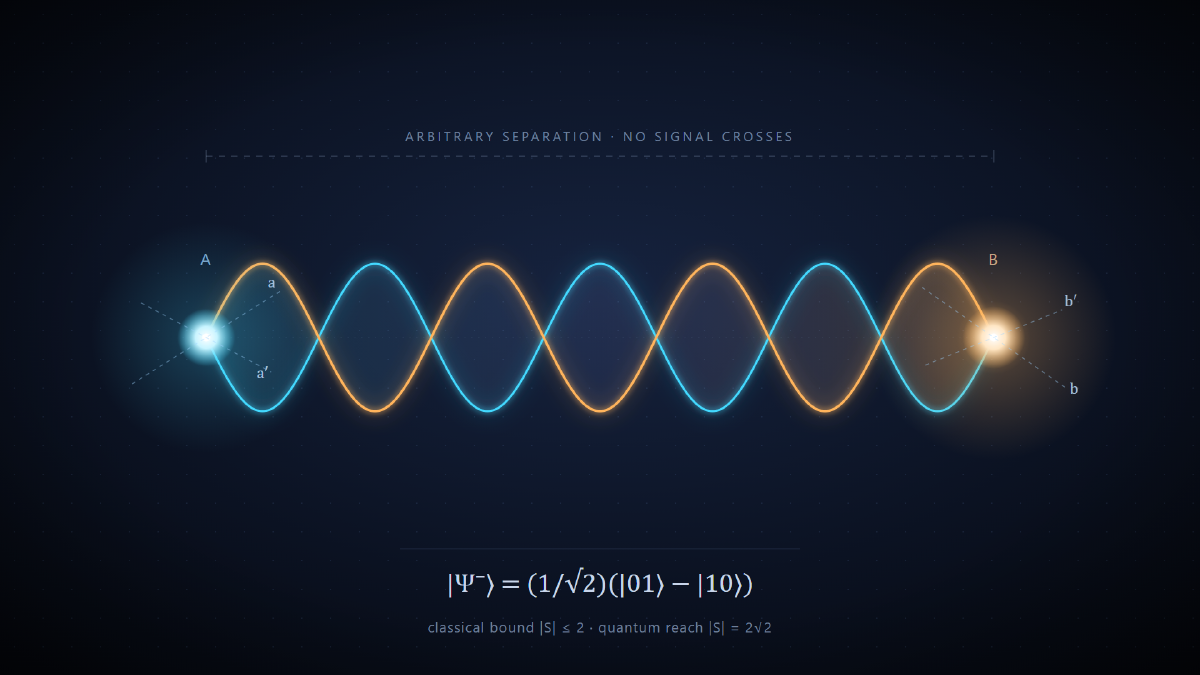
|S| ≤ 2
where
S = E(â, b̂) − E(â, b̂′) + E(â′, b̂) + E(â′, b̂′)
is assembled from correlation measurements made with two freely chosen settings on each side, whereas quantum mechanics permits a larger value,
|S| = 2√2
which the singlet state attains for suitable choices of the four axes. The disagreement, in other words, is not a matter of degree but a clean numerical gap between a classical bound and a quantum prediction, and it is a gap that experiment closes in quantum mechanics’ favor. The locality that such a result challenges is therefore not the locality of signals, which survives intact, but the locality of reality itself: the idea that physical properties can be pinned down piece by piece, place by place, without reference to the system as a unified whole.
What remains genuinely unresolved, and what keeps this a live issue rather than a settled curiosity, is how to interpret that finding. One response is to keep locality for signals but abandon it for properties — accept that the world’s quantum state is irreducibly global, that the pair is one thing even when far apart, and that separability is an approximation rather than a foundation. Another is to retain definite local properties at the price of giving up a single shared, observer-independent reality, as some interpretations do. Others still modify the theory itself, at the cost of extreme fine-tuning to avoid sending faster-than-light messages. All of these agree on the predictions and on the experimental record; they differ in what they say reality is like underneath. What no serious position can do any longer is dismiss the phenomenon as a mere gap in our knowledge. The challenge entanglement poses to classical physics is therefore not that it breaks the speed limit in any usable sense — it does not — but that it demonstrates the classical picture of a world made of independently existing, locally determined things to be, at bottom, the wrong picture. The universe tolerates a kind of togetherness that has no classical analogue, and any adequate account of nature must find room for it.
The Role of Superposition#
Superposition is the principle that a quantum system, left to itself, need not sit in any one definite condition. Instead it can be described by a wavefunction that is a weighted combination of several possibilities at once — not a statement of ignorance about which one is really the case, as when we say a tossed coin is “either heads or tails” without knowing which, but a genuinely indefinite state in which the distinct outcomes coexist as components of a single quantum description. For a single two-level system the description is written
|ψ⟩ = α|0⟩ + β|1⟩
with complex amplitudes satisfying
|α|2 + |β|2 = 1
These amplitudes are not probabilities but weights, whose squared magnitudes give, by the Born rule, the probabilities |α|2 and |β|2 of observing the two outcomes. These components are not merely imagined; their mutual relationships can be measured through interference, and it is precisely this interference that distinguishes a true superposition from a classical mixture of alternatives. Applied to an entangled pair, this means that before any measurement the pair occupies a combined state in which the possible outcomes come in linked sets. If the particles are correlated in their spin, the superposition contains both the possibility “first up, second down” and the possibility “first down, second up,” woven together in one shared expression. In symbols, one of the standard maximally entangled two-qubit states — the singlet — is
|Ψ−⟩ = (1/√2)(|01⟩ − |10⟩)
where the first label refers to the first particle and the second to the second, and where exchanging the two labels changes the state only by an overall minus sign, so the expression cannot be split into an independent state for each particle. Neither particle has a definite spin, and the only structure the state supplies is the pairing between the two — the correlations, not the individual values. Restricted to one particle alone the state is completely uninformative, since tracing out the partner leaves the maximally mixed state
ρA = TrB |Ψ−⟩⟨Ψ−| = (1/2) I
which is the formal statement that no spin value is written into the pair’s description for either particle, only the relation between them. How much entanglement a state carries can even be given a number: the von Neumann entropy of the reduced state,
S(ρA) = −Tr(ρA log2 ρA)
which is zero for a product state and maximal for a Bell pair, where it equals one ebit. That each particle on its own looks maximally mixed while the pair remains perfectly correlated is the quantitative form of the claim that the information lives in the correlation rather than in the parts.
Measuring one of the particles changes this situation, and the change is what the word “collapse” tries to capture. Once the first particle is interrogated, the outcome comes back definite — say, “up” — and from that point on the description of the pair is no longer a superposition of linked alternatives but a single one of them. The second particle’s spin is thereby fixed as “down,” not because anything was sent to it, and not because it was disturbed, but because the shared description that had contained both alternatives has now been narrowed to one. What looked like the first particle “choosing” a state is really the joint state resolving; the partner’s outcome is fixed as part of the same narrowing, which is why the correlation is perfect and why no delay has to be accommodated — nothing propagates, and a single state reduced to a single branch simply leaves both particles’ values determined together, however far apart they lie.
Two clarifications are worth making, because this is where popular accounts most often mislead. First, the notion that particles “simultaneously hold multiple states” is best read as shorthand for a description that is not expressible as any ordinary mixture of definite states. Superposition is a feature of the wavefunction, a precise mathematical object, and interpreting it as a particle doing several contradictory things at literally the same moment imports classical imagery that the theory does not require. Second, the collapse itself is not a mechanism in the theory so much as a rule for updating the wavefunction when a measurement occurs. Whether it describes something that physically happens to nature, something that happens to the observer’s knowledge, or something that a broader account of the world would replace with branching or hidden structure is contested and remains one of the open questions at the foundations of quantum mechanics. Competing interpretations disagree sharply about what collapse means, and some dispense with it entirely, but they agree on the operational facts: the pre-measurement state carries the correlations, and the measurement yields definite, perfectly paired outcomes.
So superposition is the ingredient that makes entanglement more than simple correlation, and collapse is the step that turns its linked possibilities into actual results. The pair’s indefiniteness is not incidental to entanglement but constitutive of it — it is why the correlations cannot be credited to properties the particles held all along, and why the outcomes arrive together rather than one after the other. Read this way, the collapse of the superposition is not a mysterious transmission between distant particles but the resolution of a single, shared quantum state, a state that had no separate parts to reconcile in the first place.
Implications for Reality#
Entanglement forces a blunt question about what kind of world we live in, and the answers have unsettled physicists and philosophers alike. The classical picture described above packages three commitments together: that objects have definite properties whether or not anyone measures them, that widely separated things are genuinely separate, and that a single observer-independent description of reality underlies what we observe. Entanglement is incompatible with that package taken whole, and the results of the Bell tests leave no room to keep all three; something must give. Which commitment one abandons is precisely what separates the competing interpretations, and there the disagreement concerns not the data but what the data reveal. What can no longer be maintained is the comfortable combination that classical physics took for granted.
The most striking way to state the situation concerns separability, the notion that a composite system is nothing beyond its parts and their state. Entangled systems appear to be counterexamples: their state is irreducibly relational, holding information that resides in the correlations between the particles rather than in either particle alone. This has led many physicists to speak of a kind of holism at the quantum level, in which the whole is genuinely prior to and not exhausted by its parts. It also recasts what we mean by a property. Rather than reading “spin up” as a label that a particle carries around with it, one may read it as a relation between the particle and the measurement outcome, or between the particle and its partner — a view in which properties are more like relationships than like private possessions. Such relational accounts of quantum mechanics dissolve some of the apparent paradox by denying the premise that particles have definite local properties waiting to be discovered, and they sit comfortably with the experimental facts while sacrificing a certain classical notion of what “real” means.
Running alongside these debates is a deeper speculation about space and time themselves. If distant systems can be correlated without anything traveling between them, then perhaps spatial separation is not the fundamental arena of reality that it appears to be, but a feature that emerges from a more basic structure of quantum information and entanglement. Certain lines of research in quantum gravity and black-hole physics have given this idea real content, suggesting that the geometry of spacetime might be built out of, or at least mirrored by, patterns of entanglement among underlying degrees of freedom. This is speculative and far from settled, but it suggests that entanglement’s philosophical significance may be greater than its role in any particular experiment: rather than merely disturbing our picture of matter, it hints that the stage on which matter acts — space and time themselves — may be derivative rather than given. If so, then the classical understanding of space and time is not just temporarily incomplete but structurally misleading about what is fundamental.
Alongside these metaphysical questions run epistemological ones, concerning the limits of human knowledge and what it means to know the world. Quantum theory supplies the most precisely tested predictions in science, yet it resists a single, agreed interpretation of what it says about reality, and this gap between predictive success and conceptual clarity is unusual in physics. Entanglement’s “no-signaling” feature sharpens the point: the deep correlations it produces are invisible to any single observer, who sees only random results, raising questions about the role of observers, of information, and of the difference between knowledge and reality. Some interpreters treat the wavefunction as a description of an agent’s information, others as a real physical object, and the choice colors everything about how one reads the measurement problem. The upshot is that entanglement does not merely prompt philosophical reflection as an afterthought; it directly exposes unresolved questions about realism, causality, and knowledge that standard scientific practice normally leaves implicit. It is one of the few places in modern physics where the foundational questions are not merely philosophical garnish but are entangled — the pun is hard to resist — with the physics itself.
Applications and Future Prospects#
Entanglement has moved decisively out of the realm of thought experiment and into engineering, and its applications fall into a few broad families that share the same underlying resource. In quantum computing, entanglement is not a peripheral trick but the engine of the machine’s power. A quantum processor manipulates collections of quantum bits that, through entanglement, occupy a state of the whole register that cannot be factored into independent descriptions of the individual qubits. It is this irreducible togetherness that lets a quantum computer explore many computational paths in a coordinated superposition and then arrange for the wrong answers to cancel through interference while the right ones reinforce. The advantage is therefore not simply raw speed, as though one were swapping in a faster classical chip; it is a change in how information is represented, allowing certain problems — factoring large numbers, simulating quantum chemistry and materials, and searching unstructured data — to be attacked by algorithms whose complexity is fundamentally different from the best classical approaches. For a great many ordinary tasks a quantum computer offers no benefit at all, and the dramatic claims of universal exponential speedup apply only to specific problem classes. What entanglement reliably provides is the correlated structure those algorithms exploit, without which the register would collapse into the equivalent of an ordinary probabilistic classical machine.
In communication, entanglement underpins quantum cryptography in the form of quantum key distribution, which uses quantum states to let two parties establish a shared secret key with a guarantee rather than a hope of security. The essential feature is that an eavesdropper cannot measure a quantum signal without disturbing it, so interference leaves detectable traces and any compromised key is discarded before it is used. The obstacle standing in the eavesdropper’s way is the no-cloning theorem, which forbids any process that would copy an arbitrary unknown state,
U|ψ⟩|0⟩ = |ψ⟩|ψ⟩
for every |ψ⟩; unitarity preserves inner products, whereas duplication would square them,
⟨ψ|φ⟩ ↦ ⟨ψ|φ⟩2
which is impossible for two states that are neither identical nor orthogonal. Unable to copy a signal and pass the original along untouched, an eavesdropper must measure it, and measuring leaves a footprint. Entanglement-based protocols extend this by tying the security of the key to the observed correlations themselves, and their violation of Bell’s inequalities, meaning that even an adversary who controls the devices cannot reproduce the statistics without being caught. It is worth being precise about the word “unbreakable”: the encryption is not unbreakable in the abstract, but the key distribution is secure against eavesdropping in a way that no purely mathematical scheme can certify, and it is bounded by the practical limits of the hardware and by assumptions about authentication and device behavior. Beyond key distribution, entanglement enables quantum teleportation, in which the quantum state of one particle is transferred to a distant particle using a shared entangled pair plus an ordinary classical message — a process that transfers no matter and no usable information faster than light, but that is the fundamental primitive for linking quantum devices into networks. This points toward a future quantum internet, in which entangled links, extended by quantum repeaters, allow distributed quantum computation and provably private communication across cities and eventually continents.
A third family of applications exploits entanglement not to compute or to encrypt but to measure with unprecedented precision. Entangled states of atoms, photons, or ions can be arranged so that their quantum noise cancels in exactly the way that leaves the signal intact, sharpening the performance of atomic clocks, gravimeters, magnetometers, and interferometers beyond what classical statistics would permit. Because many of the most demanding tests of fundamental physics, from the search for gravitational-wave signatures to the measurement of fundamental constants, are limited by how finely one can measure, this “quantum metrology” is already finding use in navigation, geophysics, and laboratory tests of relativity, and it may prove to be the first place where entanglement’s advantages become routine rather than headline-grabbing. In quantum simulation, related benefits allow physicists to build small, controllable entangled systems that mimic the behavior of materials and molecules too complex to calculate or to study directly, offering a way to understand superconductivity, exotic magnetism, and chemical reactions from the inside.
The future prospects are genuinely promising, but they hinge on problems that are as much engineering as they are physics. Entangled states are fragile: any interaction with the surrounding environment degrades the correlations in a process called decoherence, and the larger or the longer-lived the entangled system, the harder it is to keep intact. Quantum error correction, which distributes a single logical qubit across many physical ones, is the leading strategy for fighting this decay, but it demands error rates and physical qubit counts far beyond what today’s machines achieve at useful scale. Practical quantum computers of the kind that threaten existing cryptography remain years to decades away on most expert estimates, and commercial quantum key distribution today has security and cost trade-offs that keep it confined to specialized uses. Quantum repeaters, the components needed to stretch entanglement over long distances, are likewise still largely experimental. What is already clear, however, is that entanglement has become a working resource rather than a philosophical puzzle: it has been used to compute, to encrypt, to teleport, to sense, and to simulate, and each of those uses traces back to the same strange fact about the world that Einstein found so troubling. The open question is no longer whether entanglement is useful, but how quickly and how broadly that usefulness can be scaled before decoherence and engineering complexity impose their limits.
Quantum entanglement is a fascinating and complex phenomenon, and it earns both adjectives for related reasons. It is fascinating because it touches something fundamental: the intuition that objects are separate, self-contained things, each carrying its own properties and interacting only when they touch or when something travels between them. That intuition is not a fringe belief or a philosophical taste but the working assumption of classical physics, and it survives every contact with the everyday world. Entanglement quietly contradicts it. Two particles prepared together can remain bound into a single quantum description even when separated by an enormous distance, so that what we measure here stands in perfect correspondence with what is measured there, with no signal passing between them and no delay to be found in the correspondence. It is complex because nothing in this picture can be made to behave like a smaller version of familiar machinery. The correlations are not messages; the particles have no definite properties to carry with them; the unity they share cannot be reduced to two separate agreements. Each attempt to draw an intuitive analogy — hidden instructions, faster-than-light telepathy, a cosmic ledger — either fails against experiment or smuggles back in the very classical assumptions entanglement denies.
What makes the phenomenon more than an intellectual curiosity is the way it presses on our traditional understanding of physics from several directions at once. It challenges locality, the classical principle that an object is influenced only by its immediate surroundings, by producing correlations that no local account can reproduce — a conclusion forced, not merely suggested, by Bell’s theorem and the experiments that have violated his inequalities. It challenges realism in its naive form, the assumption that particles possess definite properties whether or not anyone measures them, because the measured outcomes resist any explanation in terms of values that were sitting there all along. And it challenges the assumption that space and time are the fundamental stage on which reality unfolds, since the ability of distant systems to be correlated without any intervening influence at least raises the possibility that separation is not as basic as it looks. In doing all this, entanglement does not merely add a curious item to the catalog of physical effects; it revises the framework in which such items are cataloged.
Alongside that conceptual upheaval runs a technological promise that grows more concrete every year, and the two are inseparable, because the same strange correlations that unsettle our intuitions about reality are exactly what make the technologies possible. Entangled systems are the raw material of quantum computing, which exploits the irreducible togetherness of qubits to represent and manipulate information in ways no classical machine can match for certain problems, from factoring and cryptanalysis to the simulation of molecules and materials. They underpin quantum cryptography, where the fragility of quantum states becomes a security feature rather than a defect: an eavesdropper cannot disturb a signal without leaving detectable traces, so two parties can establish a shared key with guarantees that no purely mathematical method can offer. They enable quantum teleportation, the transfer of a quantum state from one place to another using a shared pair and an ordinary classical message, and they sharpen measurement itself through quantum metrology, where carefully arranged entanglement suppresses noise and wrings out precision that classical statistics forbids. In each case, the philosophical oddity and the practical utility are two faces of the same fact: entanglement is a resource that nature hands us along with the puzzle.
Above all, entanglement enlarges our comprehension of the universe by showing that reality is stranger and more unified than classical intuition could ever have anticipated. It reveals that the world is not a heap of independent fragments but contains genuine relationships that bind distant parts into wholes, that information and correlation may be as fundamental as matter and energy, and that the classical picture, for all its daily success, is an approximation whose edges become visible precisely where quantum effects dominate. This does not mean that everyday intuition is useless or that physics has descended into mysticism; it means that the universe contains structural features for which no classical analogue exists, and that understanding them requires replacing analogies with mathematics and inherited assumptions with experimental test. The philosophical debates it provokes — about the nature of properties, the meaning of measurement, whether the world is local, whether space emerges from something deeper — remain largely unresolved, and that unresolved quality is part of what makes the phenomenon so compelling: it sits at the frontier where our best theory of the small meets our deepest questions about what it means to exist at all. To study entanglement is therefore to do more than solve a puzzle in quantum mechanics; it is to reconsider what kind of universe we inhabit, and to discover that the answer is at once more interconnected and more subtle than the world of classical physics ever allowed us to imagine.
The EPR “Paradox”#
What is the EPR “Paradox”?#
The EPR argument is a thought experiment rather than a paradox in the ordinary sense — not a muddle or a contradiction, but a tightly constructed demonstration, and it is best read as a proof by elimination. Its authors were not confused about quantum mechanics; they were asking whether it could be true in the strong sense of telling the whole story, and they aimed to show that it could not. Their title states the question exactly: Can Quantum-Mechanical Description of Physical Reality Be Considered Complete? A theory is called complete if every element of the physical reality it describes has a counterpart in the theory; if there exist real features of the world that the formalism cannot represent, then the description is incomplete. The argument’s strategy was to exhibit a case in which quantum mechanics predicts the outcomes of measurements with certainty while, on the authors’ own reading, failing to assign those outcomes any definite values beforehand — leaving either an incomplete theory or a deeply unwelcome conclusion: that reality itself waits on measurement, or that distant events influence one another with no mechanism to carry the influence.
The paper, published in Physical Review in May 1935 and signed by Albert Einstein, Boris Podolsky and Nathan Rosen, hence the acronym EPR, was drafted with minimal input from Einstein himself; Podolsky wrote it up, Einstein later judged the presentation misleading, and the argument he actually endorsed leaned more heavily on separability — the assumption that systems which are spatially separated have their own independent physical states — than on the published wording suggests. What the published argument does is establish a criterion of reality: if, without in any way disturbing a system, one can predict with certainty the value of a physical quantity, then there exists an element of physical reality corresponding to that quantity. It then considers two quantum-mechanical particles that have interacted and separated. Because the two were once in contact, their properties remain correlated, and by choosing which observable to measure on the first particle — position or momentum — an experimenter can determine with certainty the corresponding value for the second, at a distance, without touching it. Since neither measurement disturbs that second particle, and since both choices may be made freely at the last moment, the reality criterion seems to force the conclusion that the second particle possesses both a definite position and a definite momentum, whether or not anyone measures them. Quantum mechanics, however, refuses to furnish simultaneous definite values for such incompatible quantities; Heisenberg’s uncertainty principle encodes exactly that refusal. So the theory leaves out something real, or so the argument runs.
The sting lies in what happens to the two escape routes. One can deny that unmeasured properties of the second particle are real, and that was the position Bohr took in a reply published later the same year, arguing that the EPR criterion is ambiguous because the measurement apparatus and the system cannot be cleanly separated: the way one describes the distant particle depends on which measurement was chosen on the near one, so the “element of reality” being invoked is not a feature of the particle alone. That is a defensible reading, but it carries the cost of making properties dependent on what is measured elsewhere — precisely the entanglement the paper was designed to expose. The other route is to keep the definite values and attribute the perfect correlations to some deeper layer of the theory, a set of hidden variables that fixes each outcome in advance so that quantum mechanics, with its irreducibly probabilistic predictions, is an incomplete stand-in for a deterministic classical reality. This is the route the authors themselves preferred, and it is the one that did not survive: as the account of Bell’s theorem below sets out, no theory of local hidden variables can reproduce the correlations quantum mechanics predicts, and experiment confirms the quantum predictions rather than the hidden-variable alternative. So the dilemma was broken from outside rather than resolved from within, which means something else has to give; the interpretive quarrels taken up later in this section are, in large part, disputes about which classical commitment is the right one to abandon.
Three further things are worth registering for a reader meeting the argument for the first time. The paper’s elegance aside, its central example is technically awkward; Einstein himself preferred a version he set out in a 1935 letter to Schrödinger, and it was David Bohm’s 1951 reformulation in terms of the spin of a pair of particles — a restatement of the argument, not the hidden-variable theory he published the following year — an entangled two-state system of exactly the kind discussed earlier in this note, that made the argument experimentally tractable and eventually testable. Second, the word “paradox” has outlived its usefulness in this context: nothing in EPR is logically inconsistent, and the modern consensus is that the paper identifies a genuine tension in the classical picture of reality rather than in quantum mechanics itself — Einstein’s objection was well founded as a question, and it was answered by experiment rather than dismissed. Third, the episode’s productive effect was enormous: Schrödinger’s correspondence with Einstein about it produced his 1935 papers introducing what he named Verschränkung, entanglement, which he called not a paradox but the characteristic trait of quantum mechanics, the one that enforces its entire departure from classical lines of thought. A thought experiment meant to expose a flaw thus gave the phenomenon its name and its central place in the theory.
The EPR Thought Experiment#
The setup Einstein, Podolsky and Rosen chose is deliberately simple, because its whole force depends on nothing exotic being smuggled in. Two particles are allowed to interact, then allowed to separate, so that after a while they are far enough apart that light could not travel from one to the other in the time available — no signal, on the authors’ own assumptions, could connect a measurement on one with anything happening to the other. Quantum mechanics nevertheless describes the pair as a single entangled system, and it is the nature of that description that causes the trouble. In the version the paper actually published, the two particles are entangled in their continuous properties, position and momentum, in such a way that the difference between their positions and the sum of their momenta are both perfectly definite; the individual positions and individual momenta are not. In symbols, the pair is prepared in a state for which
⟨(x̂A − x̂B)2⟩ = 0, ⟨(p̂A + p̂B)2⟩ = 0
so that the relative position and the total momentum are sharp while neither particle’s own position nor its own momentum has a definite value; up to normalization the combined wavefunction is
Ψ(xA, xB) ∝ δ(xA − xB + x0)
That construction is what makes the argument bite, since position and momentum are the canonical pair whose simultaneous definiteness quantum mechanics refuses to grant, as Heisenberg’s relation
Δx Δp ≥ ℏ/2
records.
The experimental freedom the pair affords is the heart of the matter. An experimenter who has the two distant particles can choose, freely and at the last moment, whether to measure the position of the first or its momentum, and in either case quantum mechanics allows a prediction of the corresponding quantity for the second particle with certainty. Measure position here, and the partner’s position is fixed; choose momentum instead, and the partner’s momentum is fixed, with no need to disturb the distant particle in any way to learn it. EPR then apply their reality criterion: if a quantity can be predicted with certainty without disturbing the system, there must be an element of physical reality corresponding to it. Since the choice of what to measure on the near particle can be made after the particles are already far apart, and since nothing done in one place could have altered the actual condition of a particle somewhere else, the distant particle must have possessed a definite position all along in the first case and a definite momentum all along in the second. Both quantities, then, are real — and yet quantum mechanics, as the formalism stands, cannot assign both to a single state. Something real, therefore, escapes the theory, and quantum mechanics is an incomplete description of the world.
Two features of this argument deserve to be picked out, because they explain why it is not merely an interesting footnote. The first is the role of locality. EPR’s reasoning depends on the assumption that no real change is produced in one system by anything done to another system that is spatially separated from it — a version of the classical conviction examined at length later in this section, and one that gains weight from relativity, since any influence crossing a spacelike gap would have to travel faster than light. Strip that assumption away and the argument collapses, since the distant particle’s properties could simply have been brought into being by the measurement. This is worth emphasizing because it means EPR were not attacking quantum mechanics for being probabilistic, or strange, or contrary to taste; they were attacking it on the basis of a principle every physicist of the era accepted, and the tension they identified is between quantum correlations and that principle rather than with observation. The second feature is the place of certainty. The argument turns entirely on predictions that are certain, not statistical, so no question of ordinary classical uncertainty or imperfect measurement enters. That is what gives it its sharpness — and it is also what delimits it, since the forthcoming Bell tests concern correlations between repeated trials rather than certainties in individual runs.
Where a modern reader needs to tread carefully is the phrase “instantly determines.” The original wording encourages the picture of a measurement here reaching out and flipping a switch there, which is precisely the misreading the earlier discussion of no-signaling was at pains to block: nothing acts at a distance, nothing propagates, and neither party’s local data reveals anything about the other’s. What the entanglement actually delivers is a conditional certainty. If one measures a particular quantity on one particle and obtains a particular outcome, then the partner’s value for the corresponding quantity is fixed — determinate, not transmitted. The correlation is perfect and frame-independent, but calling it an instantaneous determination imports a causal process that the physics does not contain, and it was the desire to have something do the determining that led EPR to their hidden-variable conclusion in the first place. The honest statement of the tension is therefore that the theory licenses certain predictions about distant measurements while denying, in the same breath, that the distant particle had determinate properties to make those predictions true — and it is that combination, not any instantaneous push, that subsequent experiment vindicated as a feature of nature. The paradox bears its author’s names and its scare quotes for good reason: what EPR took as an objection to quantum mechanics is now understood as an accurate description of how entanglement behaves.
The Challenge to Quantum Mechanics#
The challenge EPR raised was directed not at the accuracy of quantum mechanics but at its claim to be a full account of reality — a distinction the word “paradox” tends to obscure. Their target was completeness, and their argument was a dilemma rather than a refutation. If quantum mechanics is complete, in the sense that every element of physical reality has a counterpart in the theory, then the definite values that the EPR setup allows one to predict for a distant particle must have been brought into being by the measurement performed on its partner, since the formalism provides no other source for them. That is a form of action at a distance with no mechanism to carry it, and the authors regarded it as close to absurd. If instead one refuses to accept the action at a distance, then the distant particle must possess its definite values independently of anything measured here — and since quantum mechanics cannot represent such values, the theory is incomplete. The argument, read carefully, takes a conditional form: not “quantum mechanics is wrong,” but “quantum mechanics, as it stands, is missing something, unless one of its premises fails.” Einstein’s position was the second horn, and he held it consistently; the famous remark about spooky action at a distance was his way of naming the alternative he refused to accept, not an endorsement of a feature he had discovered.
The provenance of that phrase is worth getting right, since it is quoted far more often than it is placed. Einstein did not use “spooky action at a distance” in the 1935 paper; the phrase appears in a 1947 letter to Max Born, where he wrote, in German, spukhafte Fernwirkung, precisely in order to say that such instantaneous influence across a gap was unacceptable to him. His deeper commitment was to what he later called the separation principle, the demand that the real state of one system cannot depend on what is done to a system separated from it — the same insistence behind the question he is reported to have put to Abraham Pais decades later, whether the moon really exists only when somebody looks at it. This is a stronger and more precise demand than the ordinary prohibition on faster-than-light signaling, and it is the assumption that the Bell experiments were eventually to force physicists to abandon or reinterpret. It is also why the note’s framing needs one qualification: it was not that quantum mechanics, if complete, would imply spooky action at a distance in the sense of a real influence being exerted, but rather that it would imply the distant particle had no independent state of its own — the violation of separability, which Einstein found equally intolerable and which many physicists today regard as simply the way things are.
Hidden variables were the natural remedy on the second horn, and it is easy to see why they seemed attractive. If each particle carried, from the moment of separation, a full set of definite properties whose values were merely unknown to us, then the correlations would be explained without any influence crossing the gap: the two particles would be like a pair of envelopes sealed with matching instructions, and the perfect agreement observed at both ends would be the comparison of pre-arranged facts rather than evidence of communication. Quantum mechanics would then stand to this deeper theory as thermodynamics stands to statistical mechanics — a statistical summary of a more fundamental deterministic description, correct in its predictions while incomplete in its foundations. Einstein saw no reason to doubt that such a theory existed; he took its existence to be the most natural explanation of phenomena that quantum mechanics could only describe probabilistically, and his objection to the theory’s randomness was of a piece with that expectation rather than a separate complaint.
What defeated the hope was the discovery that hidden variables and locality cannot be combined. Bell’s 1964 theorem showed that any theory which assigns pre-existing local properties to the particles must satisfy certain inequalities, and that quantum mechanics predicts their violation; the experiments then found the violation. This does not mean hidden variables are impossible — Bohmian mechanics, published in 1952, is a fully deterministic hidden-variable theory that reproduces quantum predictions exactly — but it does mean that such theories are explicitly nonlocal, as Bohm’s is, since the guidance of each particle depends on the configuration of the whole system at once, with no regard for light-travel time. Nor was the failure of the local project a matter of its going untested for three decades: von Neumann’s 1932 argument was widely read as proving hidden variables impossible in principle, and it took Bell’s re-examination of that proof in 1966 — two years after the theorem that bears his name — to show that its assumptions were too strong. The moral is that the challenge to quantum mechanics was neither refuted nor vindicated as EPR expected. Their conclusion that the standard formalism fails to describe unmeasured values is, in a narrow sense, simply true; what proved false was the further hope that a hidden layer of definite local properties could supply the missing description without exacting a price in locality.
What survives of the challenge is its role as the engine of everything that followed. It forced the question of what “reality” in the physical sense is supposed to mean, produced the criterion of reality that Bohr was moved to contest, and set the terms in which the entanglement debates described earlier in this note are still conducted. EPR also, incidentally, gave the phenomenon its vocabulary, since Schrödinger’s response to Einstein’s letter is what produced the 1935 papers that named it and argued for its centrality — an outcome entirely unintended by the three authors, who were arguing that quantum mechanics was missing something rather than that entanglement was the missing something the theory had been describing all along.
Einstein’s Criticism#
Einstein’s dissatisfaction with quantum mechanics is usually compressed into a single quotation, and the compression loses most of what mattered. The remark dates from a letter of December 1926 to Max Born — a different letter from the 1947 one quoted above, though to the same correspondent — where the phrasing was conversational rather than oracular: he wrote of the theory bringing us no closer to the secret of “the Old One,” and added that he was convinced the Old One does not play dice. The familiar English rendering, with its capitalized God and its “with the universe,” is a later paraphrase that turns a private aside into a slogan, and the slogan has done real damage to how his position is received, because it suggests a single objection where there were two, and it invites the reading that Einstein simply disliked unpredictability as a matter of taste. In the same letter he called the theory imposing but said an inner voice told him it was not yet the real thing — a statement of incompleteness rather than of error, and much closer to his actual view.
The first of his two objections was directed at irreducible indeterminism: quantum mechanics in the standard reading says that a single measurement outcome is not merely unpredictable in practice but has no determinate cause, and that the theory’s probabilities are not the summary of some deeper bookkeeping. Einstein resisted that claim, but not out of hostility to probability as such. He was one of the founders of statistical physics — his work on Brownian motion and his 1905 arguments for light quanta are the very places where probabilistic reasoning entered physics at depth — and he was entirely comfortable with statistical laws as descriptions of large ensembles. His claim was about the level at which probability belongs. Just as thermodynamics summarizes what molecules are doing individually, quantum statistics might summarize the behavior of systems whose individual real states the theory does not describe. On that view the Born rule is an instrument of ignorance, not a fundamental law of chance, and the discomfort he voiced was not that dice were being used but that no honest account of the dice existed.
The second objection concerned what he took to be the theory’s abandonment of separability, and here the loose term “non-locality” needs care, because Einstein was not objecting to a discovered influence so much as to the impossibility of maintaining that distant things have their own independent states. Formulated in the reality criterion of the 1935 paper and elaborated in his later writings, that demand and its consequences are set out above, and here it is enough to note its shape: quantum mechanics, he argued, forces one to deny the separation principle or to deny the theory’s completeness, and he consistently chose incompleteness. Read this way, his two complaints are not independent: both follow from the conviction that the wavefunction is not a complete description of an individual system but a summary of statistical information about an ensemble, a reading later defended by others as the statistical interpretation of quantum mechanics. The randomness and the failure of separability appear fundamental only because the deeper, definite description has been left out; put it back, and both oddities resolve into ordinary classical ignorance about pre-existing facts.
His proposed remedy, then, was a more complete theory — one in which each system possesses a full set of definite properties at all times, the values of unmeasured quantities included, and in which the probabilistic appearance of quantum mechanics arises from our ignorance of those properties rather than from the world’s own indecision. That is the hidden-variable program, and it is worth noting how reasonable it was in 1935: nothing then known forbade it, and Einstein took its existence largely for granted. What closed it was not an argument within the theory’s own terms but the discovery, described above, that locality and pre-existing definite properties cannot both be maintained. The irony is sharp and worth stating plainly: the hidden-variable theories that survive, such as Bohm’s, restore determinism by giving up locality, so the package Einstein hoped for is the one combination the world does not seem to permit.
What remains of the criticism, then, is not a refuted nostalgia but a partly vindicated instinct, and it should be presented that way rather than as a defeat. Einstein’s insistence that quantum mechanics is not the last word has aged better than the particular avenue he favored: the measurement problem, the interpretation of the wavefunction, and the status of the Born rule are still open, and his own contribution to making them unavoidable — including the 1935 Schrödinger exchange that produced the cat example — is part of why the debate continues. His specific remedy failed on experimental grounds, and his demand for a determinism-compatible, separability-preserving completion of the theory is now known to be unsatisfiable. But the question he insisted on asking, whether the theory describes reality or only our knowledge of it, has not gone away, and the interpretations that dominate discussion today can be read as competing answers to exactly that question — some of them deterministic, some nonlocal, some neither, and none of them the package of both that Einstein wanted.
The Principle of Locality#
Locality, in its most intuitive form, is the demand that influences travel through the space between things rather than leaping across it. If one billiard ball moves another, the motion is passed on by contact and by a push that propagates continuously from one to the other; if the Sun holds the Earth in orbit, some field or geometry must carry the effect outward, growing weaker with distance and taking time to arrive. The principle rules out action at a distance — a cause here producing an effect there with nothing whatever traversing the intervening space — and in this broad sense it has been the working assumption of physical theory for three centuries. It is worth being clear, though, that the principle earned its authority gradually and against resistance: Newton’s own theory of gravitation was a flagrant violator, acting instantaneously and with nothing to carry it, and Newton knew it, writing to Richard Bentley in 1693 that action at a distance through a vacuum was to him so great an absurdity that he did not believe anyone with a competent faculty of thinking could ever fall into it. He declined to speculate about a mechanism. It was Faraday and Maxwell who restored locality to gravity’s successors by replacing instantaneous attraction with fields filling space and changing from point to neighboring point, and it was Einstein who, in special relativity, made the restoration quantitative by insisting that no influence outrun light.
That relativistic formulation gives locality its sharpest everyday statement: information cannot propagate faster than light, so nothing done here can produce an observable change in a system there before light has had time to make the trip. Taken as a claim about what a distant observer can notice, this version of locality is not merely consistent with quantum mechanics but enforced by it. Entangled pairs produce correlations, but the marginal statistics at each detector are indifferent to what is measured at the other, so no message can be smuggled through the correlation; the no-signaling result described earlier in this note is exactly this principle written as an equation. The distinction matters, because it is tempting to read the EPR episode as a head-on collision between quantum mechanics and locality in general, with the quantum side winning. What actually happened is more instructive: quantum mechanics preserves the locality of signals perfectly, and the assumption it defeats is a stronger and less obvious demand.
That stronger demand has several names and it is worth separating them, since the single word “locality” conceals a bundle. Writing λ for whatever complete description of the pair a theory allows and x, y for the two measurement settings, one part is parameter independence, the requirement that what an experimenter chooses to measure on one side cannot alter the statistics on the other,
p(a | x, y, λ) = p(a | x, λ)
Quantum mechanics satisfies this, which is precisely why nothing usable can be sent faster than light. Another part is outcome independence, the requirement that once all the facts about a system are fixed, one system’s outcome is independent of the other’s,
p(a, b | x, y, λ) = p(a | x, y, λ) p(b | x, y, λ)
A theory satisfying both is what Bell called locally causal, and its joint predictions then factorize as
p(a, b | x, y) = ∑λ ρ(λ) p(a | x, λ) p(b | y, λ)
the sum running over the possible descriptions λ and ρ giving their distribution. It is this factored form that the experiments rule out; more precisely, it is outcome independence, together with the assumption that the particles’ properties were fixed in advance, that entanglement forces us to give up. The clean way to say it is that the joint state of an entangled pair is not separable: it cannot be decomposed into independent states for the two particles plus an ignorance about which of them obtains. This is Einstein’s separation principle denied, and it is a claim about properties rather than about signals. Framed that way, the EPR dilemma looks different from the way it is usually told: they were not arguing that quantum mechanics exports influence faster than light, they were arguing that the only way to avoid believing it does is to admit that the theory leaves something out.
Two further refinements keep the discussion honest. The first concerns the word “instantaneously,” which the relativistic setting does not really permit. Simultaneity is frame-dependent, so for two events separated by a spacelike interval there is no fact of the matter about which came first; observers moving differently will disagree about the ordering while agreeing about the correlation. An influence that is instantaneous in one frame would be backwards in time in another, which is part of why relativity’s no-signaling rule is stated for signals — well-defined causal chains with a determinate earlier and later — and why the entangled correlation, being neither, slips past the rule rather than defying it. The second refinement is that quantum field theory expresses locality in yet another and rather different way, as the requirement that observables in spacelike-separated regions commute, so that measurements in one region cannot disturb the other. Quantum theory satisfies that requirement too. The picture that emerges is not of one principle attacked and one victor, but of a cluster of principles — no action at a distance, no superluminal signals, no disturbance across a spacelike gap, no separability — of which quantum mechanics keeps most and discards exactly one, with the Bell experiments telling us which.
What the EPR challenge therefore achieved, in retrospect, was not the refutation of locality but a clarification of what locality means, and it forced the recognition that no single assumption of the kind physicists had relied on could survive in its classical form. EPR themselves took the challenge to show that quantum mechanics was incomplete, since they were unwilling to accept the alternatives; Bohr took it to show that the terms of the question were badly framed, since the distant particle’s description depends on the whole experimental arrangement; and Bell, a generation later, showed that the dilemma could be settled by experiment rather than by argument, at the price of abandoning the local hidden variables that EPR had hoped would reconcile everything. The modern position, stated without ornament, is that nature is non-separable — correlations exist that no assignment of pre-existing local properties can account for — while remaining entirely respectful of the light-speed limit on anything that could be called a signal. Locality, in other words, did not fall; a particular and rather classical reading of what it requires did, and the older Newtonian absurdity that prompted the principle in the first place turns out to have been less absurd, in a strictly limited sense, than the intuitions that grew up around it.
Philosophical and Scientific Implications#
The consequences of EPR are best described as a change in what kind of question was being asked, and in who was entitled to answer it. Before 1935, disputes about the meaning of quantum mechanics had been conducted largely as interpretive commentary — Bohr and Heisenberg proposing one reading, Einstein another, with the disagreement resting on philosophical preference about what a theory ought to describe. The EPR paper changed the register by deriving a conditional: if locality and the reality criterion hold, then quantum mechanics is incomplete. That is a claim about the structure of any theory satisfying those premises, and it therefore became a matter to be settled not by taste but by argument and, eventually, by measurement. The deepest implication of the episode, in other words, was methodological. Foundations became physics, and the tradition of no-go theorems that followed — Bell’s 1964 result, the Kochen-Specker theorem of 1967, the Greenberger-Horne-Zeilinger constructions of 1989, the PBR theorem of 2012 — are theorems about what any theory could possibly do, not merely reports about what particular experiments found. Quantum mechanics stopped being an interpretation problem and became a subject with a mathematical frontier.
The philosophical questions the debate opened are worth naming precisely, because the phrase “the nature of reality” can hide several distinct issues. One is whether the wavefunction describes something real or merely someone’s state of information; the competing positions are usually labeled ontic and epistemic, and the PBR theorem has since constrained how far the epistemic reading can be pushed. A second is whether measurement creates the values it finds or reveals values that were there already, which in turn determines whether one has to explain the collapse of the wavefunction at all, and whether observers or their knowledge have any special role. A third, and the one EPR came closest to articulating, is whether physical properties can be attributed to systems piece by piece, without reference to the whole arrangement, an assumption the Bell experiments falsify in its local form. A fourth is determinism: Bohmian mechanics shows that indeterminism is not forced upon us, since a deterministic theory can reproduce quantum predictions, but it pays for this by being explicitly nonlocal and contextual, while Everettian quantum mechanics is deterministic and arguably local but abandons single definite outcomes. Placing these side by side reveals the structure of the field: the classical package of locality, definite properties, and unshared randomness cannot all be retained, and each interpretation is defined by which item it drops.
That list also explains why the phrase “the limits of human knowledge,” applied to EPR, needs care in a note like this one. Nothing in the EPR argument or in the experiments that followed it suggests that reality has become unknowable or that science has reached a boundary beyond which inquiry cannot go. What has been shown is a structural constraint on the shape of any acceptable theory: certain concepts inherited from classical physics cannot all survive together, and which ones survive is an empirical matter. The uncertainty principle is in the same family of results, and it is worth remembering that it is a statement about the definiteness of quantities in a quantum state rather than a statement about the clumsiness of physicists. There is a temptation, especially in popular writing, to slide from “the theory does not assign a definite value” to “we cannot know what is really there,” and the slide runs in the wrong direction: the constraint is on the world’s structure as described by our best theory, not on our research program.
Scientifically, the productive consequences were the ones the paper could not have foreseen. Bell’s work, which turned the argument into an inequality that experiment could adjudicate, is the pivot of the whole story, and the line running from his 1964 paper through the experiments described in the next section to the 2022 Nobel Prize is the clearest case in modern physics of a philosophical question becoming a measured fact. Along the way, entanglement was reconceived as a resource rather than an anomaly, and that reframing built quantum information theory — quantum key distribution, quantum teleportation, quantum computation — from what had looked like pure paradox. The foundations also remain live in the most advanced parts of physics: entanglement plays a central role in attempts to understand the quantum mechanics of black holes, in the resolution of the information paradox, and in speculations such as ER=EPR that connect entanglement to the geometry of spacetime, which is to say that the questions EPR raised about separability now surface in quantum gravity in a new and technically sharper form.
Finally, it is worth registering how unsettled the interpretive situation still is, since the impression of a puzzle that has been tidied away under the heading “resolved” understates the case considerably. Competing interpretations remain in play, and they disagree strikingly about what has been learned: Copenhagen-style accounts and their descendants locate the physics in the classical apparatus and the experimental arrangement; relational and QBist readings deny that the wavefunction speaks about reality independent of agents; de Broglie and Bohm’s theory restores particle trajectories at the cost of nonlocality; Everettians take the wavefunction at face value and accept branching; objective collapse models amend the dynamics itself; and a minority position denies the freedom of the measurement settings altogether, a move whose price is examined below. These positions are not distinguished by their predictions, which agree, but by their accounts of what the predictions mean, and that is why the debate EPR began has outlived every experimental test it provoked. The paradox is gone in the sense that no one now expects a contradiction to be discovered; it is very much alive in the sense that nobody can yet say, without choosing a philosophical position, exactly what it taught us about the world.
Resolution and Modern Understanding#
The resolution came not from a new experiment but from a new argument, and its author is the hinge of the entire story. In 1964, John Bell published a short paper in a journal that survived only a few years, asking whether the correlations predicted by quantum mechanics could be reproduced by any theory that assigned pre-existing properties to the particles while forbidding influence across a gap. His method was the one EPR had not thought of: instead of arguing about what the formalism ought to mean, he derived a constraint that any such theory must satisfy and that could be checked against data. Bell’s work thus converted a philosophical dilemma into a testable inequality, and in doing so he turned EPR from a question about interpretation into an experiment. That move was the actual resolution: not a demonstration that one side of the old debate had been right, but a demonstration that the question could be submitted to measurement and answered.
The refinement that made the test practical deserves mention, because the version of the inequality used in real experiments is not Bell’s original. Clauser, Horne, Shimony and Holt showed in 1969 how to recast the argument as a four-setting test of the form already given in this note — the quantity S assembled from correlations measured with two choices of axis on each side, bounded by
|S| ≤ 2
for any theory of pre-existing local properties and reaching
|S| = 2√2
for the singlet, its definition having been given in the introduction. This CHSH formulation suited the technology available: correlations between photon polarizations or particle spins, measured with analysis axes rotated independently at each end. The first decisive results came quickly — Freedman and Clauser in 1972, then the series of experiments by Alain Aspect and collaborators in the early 1980s, which established a violation well above the classical bound.
What subsequent experiments had to exclude is as important as the violations themselves, and the term “loophole” refers precisely to the ways a classical explanation could sneak back in. If the two measurements are not separated so as to forbid communication, or if the settings are fixed in advance, a hidden message could pass between the apparatuses; if the detectors are inefficient enough, the sampled pairs might not represent the whole ensemble; these are the locality and detection loopholes respectively, and closing both at once in a single experiment is hard because the systems suited to fast, well-separated measurements tend to detect poorly. Later experiments attacked them one at a time — random setting changes performed after the particles were in flight, entanglement distributed over hundreds of meters of optical fiber, superconducting and atomic systems with high detection efficiency — culminating in the loophole-free tests reported in 2015 by several groups. The 2022 Nobel Prize awarded to Clauser, Aspect and Zeilinger is the discipline’s formal acknowledgment that this line of work settled the matter. What such experiments establish, stated carefully, is that no theory assigning pre-existing local properties to the particles can reproduce the observed statistics; the phrase “nonlocal nature of quantum mechanics” is a shorthand that should not be read as evidence of a signal passing between the particles, since the no-signaling property derived earlier holds in every one of these experiments and no loophole in this respect has ever been found.
The qualification that must accompany the word “settled” concerns the assumptions that no experiment can test. Bell’s argument requires the measurement settings to be statistically independent of whatever hidden variables might exist,
p(λ | x, y) = p(λ)
in the notation used for Bell’s conditions above — in colloquial terms, the experimenters must be genuinely free, or at least uncorrelated with the preparation of the particles. The condition is usually called measurement independence, and it is this assumption, not the locality of signals, that a conspiracy theorist denies. Nothing in logic forbids the alternative, in which the settings are themselves determined by earlier conditions shared with the particles, and such superdeterministic theories elude the theorem entirely. This escape is not a loophole of the kind closed in 2015; it is what Bell called the free-variables assumption, and abandoning it would undermine the practice of experimental science generally, since any experiment presupposes that choices made in the laboratory are not orchestrated to produce a preselected outcome. It is worth stating plainly, then, that the modern consensus rests on treating superdeterminism as not worth the price, rather than on having excluded it by measurement. Some cosmologically motivated experiments have tried to reduce the assumption’s weight by using light from distant quasars to set the measurement choices, so that no signal could have connected the source of randomness with the state of the particles under any local causal story, but these strengthen rather than close the case.
Beyond the experimental verdict, the modern understanding has taken on a shape neither EPR nor Bell quite anticipated. Entanglement has been recast as a resource, quantified by measures such as the entropy of entanglement and constrained by the monogamy rules mentioned earlier, and it is now the standard currency of quantum information theory. Bell’s theorem itself has become the prototype of a family of results that bound what any theory can do, and one member of that family presents a puzzle whose significance is easy to miss: the no-signaling principle taken alone would allow correlations stronger than quantum mechanics permits, right up to the algebraically maximal value
|S| = 4
attained by an idealized device known as a Popescu-Rohrlich box, which would permit instantaneous communication, yet nature stops short at the Tsirelson bound:
|S| ≤ 2√2
Our best axioms reconstruct quantum theory from information-theoretic principles, and the fact that nonlocality halts exactly at the threshold of signaling — no farther, and not one step less — is one of the deepest open problems in the field. Meanwhile the interpretive question has not been answered but redistributed, and the debate now proceeds in the shadow of a theorem that no longer permits the comfortable classical package to be restored. The most quotable summary of the case, often attributed to Henry Stapp, calls Bell’s theorem the most profound discovery of science; whether or not the superlative is deserved, the demonstration that certain classical assumptions are jointly impossible — and the fact that nature told us which to drop — is as close as physics has come to answering a question of metaphysics with an experiment.
The EPR “paradox” remains a pivotal moment in the history of quantum mechanics, and the reason lies less in what the paper concluded than in what it made possible to ask. Its authors set out to argue that quantum mechanics was incomplete, and on that question they were, in a narrow sense, right: the standard formalism does not assign definite values to unmeasured quantities, and it never will. What they did not anticipate was that their argument’s real product would be a criterion of testability. By constructing a scenario whose resolution depended on whether distant properties existed independently of measurement, they moved a metaphysical disagreement into the domain of experiment: that a question about the nature of reality could be answered by counting coincidences was not obvious in 1935, and it took thirty years of physics and a Bell to notice, but once noticed, the door stayed open.
The arc traced in the previous section — a numerical inequality in 1964, a measurable form five years later, violations from the 1970s onward, loophole-free measurement in 2015 — is remarkable chiefly for its timing. The paper sat largely undisturbed for three decades, partly because the technology needed to test it — laser sources, entangled photon pairs, high-efficiency detectors, fast random switches — did not exist, and partly because the intellectual climate treated foundational questions as unproductive. That delay is itself part of EPR’s significance, since it shows how a well-posed question can wait for the instruments that make it answerable, and how much physics was eventually extracted from a puzzle that could have been dismissed as philosophy.
Theoretical advances, meanwhile, came in families rather than in isolation: the no-go tradition that begins with Bell and that constrains the shape of acceptable theories rather than merely describing particular systems; the interpretive tradition that grew from Bohr’s reply and Einstein’s objections into a genuinely diverse field whose disagreements are sharp while its predictions agree; and the tradition that eventually left the seminar room entirely, as entanglement was reconceived as a resource and quantum information theory grew into an engineering discipline. EPR’s legacy accordingly spans from foundations to applications in a way few papers can claim, and the applications are not an aside to the philosophy but a direct descent from it: quantum teleportation and device-independent cryptography are the practical face of exactly the correlations the paper was written to discredit.
What makes the episode genuinely pivotal, rather than merely famous, is the light it sheds on how physics revises its own assumptions. The classical package that EPR took for granted — objects with definite properties, no influence across a gap, a single shared description of the world — was not abandoned because a powerful mind objected to quantum mechanics, nor retained because Bohr wrote a persuasive reply. It was resolved by showing that the package could not all be true, that experiment could determine which part had to go, and that the determination was reproducible, robust, and eventually commercially relevant. The paradox bears scare quotes in this note’s heading for a reason: there is no contradiction in quantum mechanics to be found here, only a contradiction in a set of assumptions people wished to keep. The lasting impression of the episode, and the reason it still anchors discussions of entanglement, is not that Einstein was refuted or Bohr vindicated, but that the world turned out to permit correlations with no classical analogue — and that we found out how to measure them.
Quantum Entanglement Explained#
How Does Entanglement Work?#
Entanglement is not transmitted between particles so much as manufactured when they are made: the correlations trace back to a shared history, and it is an interaction at the moment of preparation, rather than any later exchange, that welds two descriptions into one. The working recipe is therefore an interaction followed by separation. Photon pairs are usually produced together in a single event, either through the atomic cascades used in the earliest tests or through parametric down-conversion, in which a pump beam crossing a nonlinear crystal occasionally divides into a pair of lower-energy photons whose polarizations and directions are jointly constrained by conservation laws. Atoms, ions, and superconducting circuits supply other routes: qubits can be brought into a common interaction region, coupled by a controlled entangling operation, and then separated or read out, and systems that never touch can be entangled indirectly by measuring a partner they share, a procedure called entanglement swapping that lets a source reach further than any single apparatus could span.
Why a shared history should leave such a state behind is worth stating plainly, because it is where intuition most often slips. Quantum descriptions compose by tensor product, and a product description is precisely what an interaction need not preserve: when two systems exchange energy, momentum, or a quantum of excitation, the record of that exchange is written into their joint configuration, and the joint configuration, rather than either party, becomes the object the theory describes. Nothing further has to be done to the pair. Once prepared, the two parts may be carried to opposite ends of a laboratory or opposite ends of a continent, and the composite description travels with them unchanged, provided nothing disturbs either half along the way. The proviso is not incidental, since entanglement is created by coupling to the world and destroyed by coupling to the world, and much of the craft in this field consists of arranging for the first kind of coupling and preventing the second.
Two features of the resulting state govern everything that follows. The first is that the entanglement belongs to the pair rather than to either particle, so the question of which of the two “holds” the information the state encodes has no answer; the state is the answer, and it describes the composite system. The second is that entanglement is a matter of degree. Real preparations never deliver a perfect pair, and whether a given source is entangled at all, and how strongly, is settled by measurement rather than by inspection, which is why the language of entanglement measures and witnesses belongs to the practical side of the subject as much as to its theory.
Entangled States#
The formal test of whether a state of two systems is entangled is whether it factorizes, as the discussion of product states earlier in this note set out: writing the joint state as |Ψ⟩AB, unentangled means that
|Ψ⟩AB = |ψ⟩A ⊗ |φ⟩B
for some states of the two parts, and entangled means that no such decomposition exists. For pure states there is a canonical way to see how badly the factorization fails. Any such state can be written as
|Ψ⟩ = ∑i √pi |i⟩A |i⟩B
by choosing suitable bases for the two systems, which is the Schmidt decomposition, with the weights pi non-negative and summing to one. A product state has exactly one nonzero weight, the Schmidt rank — the number of nonzero weights — counts how many paired terms the state irreducibly contains, and the entropy of entanglement
S = −∑i pi log2 pi
turns that count into a number that can be compared across preparations. Both quantities are properties of the pair alone, which is the formal statement of what it means for entanglement to be relational rather than intrinsic.
The extremal cases are the ones used in practice. For two qubits the maximally entangled states are the four Bell states, of which the singlet was given earlier, with the others formed by the same construction with the relative sign or the parity of the labels changed; each carries one ebit, the unit of entanglement introduced with the entropy measure above, and each yields a correlation that is perfect along a set of axes rather than merely strong. With more particles the possibilities broaden considerably. Three qubits can be locked into a Greenberger-Horne-Zeilinger state, in which a single observable measured across all three parties is perfectly rigid, or into a W state, whose entanglement is distributed in a way that survives the loss of any one particle. Multipartite entanglement is a subject in its own right, partly because the amount depends on how the parts are grouped: a state may be entangled across one partition and separable across another, so the entanglement of a system is always relative to a division one has chosen to make.
Real laboratories deal in mixtures. A pair that has interacted with its surroundings is described by a density matrix rather than a pure state, and such a state can remain usefully entangled while being impossible to write in the form above. Detecting it requires either entanglement witnesses — observables whose expectation value is non-negative for every separable state and negative for the state at hand — or full quantum state tomography, in which a complete set of measurements reconstructs the density matrix for judgment afterward. Entanglement, in short, is a feature of the correlations a preparation generates, it comes in degrees, and it is confirmed by measurement. That measured, joint character is also what makes the next question pressing: what, exactly, is instantaneous about a correlation that lives in no single place?
Instantaneous Correlation#
The word “instantaneous,” attached to these correlations, deserves the care it received in the discussion of locality above, and the caution can be stated compactly here: what arrives together is a pair of results, not a signal. Record the outcomes at both detectors and the joint table of coincidence counts shows a strong correlation; look at either detector’s own tally and it is flat noise, indifferent to what happened at the other end, exactly as the no-signaling relation given earlier requires. The correlation therefore belongs to the joint record, and the joint record is assembled after the fact, by bringing the two lists of measurements together through ordinary slower-than-light means. Nothing in one laboratory changes because of something done in the other.
The absence of any delay in the correlation is nevertheless real, and it is a statement about what the statistics depend on rather than about how fast anything travels. In the singlet case the correlation depends only on the angle between the two analyzer settings, and not at all on when either setting was chosen, while each party’s marginal distribution depends on nothing but that party’s own setting. A test of the effect is consequently best described as a null measurement: the experiment is arranged so that any account involving a propagating influence would have to predict some dependence of one end’s data on the distant setting, or on the timing of its change, and no such dependence is found, however rapidly the settings are switched after the particles are already in flight. What has been established is an absence of dependence, not an instantaneous action.
What survives is a genuine oddity, and it is worth naming precisely, since the popular vocabulary obscures it. The correlations cannot be reproduced by any account in which each particle carried a definite value of the measured quantity from the moment of separation, and they are undiminished across arbitrary distances and insensitive to the relativistic detail of which measurement came first. The conclusion the theory supports is that the pair has one state that is not the sum of two: the agreement is a single fact about a composite system rather than two facts that happen to match, so there is nothing for a signal to carry and nothing for a distance to delay. Calling this an instantaneous influence puts back both the signal and the delay that the physics has removed.
The Role of Measurement#
Measurement, in the operational sense in which quantum theory uses the word, is an interaction: a system is coupled to an apparatus, the apparatus registers, and one of the possible outcomes becomes the one that occurred. Nothing in that description requires a conscious observer, and the earlier discussion of superposition and collapse set out the framework in which the step is understood, so the purpose here is narrower, namely to see what measurement does when the system in question is only part of an entangled whole.
The distinctive feature of that case is that a local measurement carries information about a distant part of the same state. To see how the theory represents this, the natural object to compute is the state of one particle alone, obtained by tracing out the other — an operation that discards every degree of freedom not belonging to the particle of interest, written
ρA = TrB |Ψ⟩⟨Ψ|
and for a maximally entangled pair that reduced state carries no information at all, which is the formal expression of the fact that neither half has properties of its own while the pair is intact. Remarks about one particle must therefore be made relative to what is known about the other, and a measurement on the far side changes what can be predicted about the near one without touching it. That is the piece of physics this chapter concerns, first as the theory presents it and then as the laboratory demonstrates it.
Superposition and Collapse#
The pairing of a pure whole with impure parts is the structural fact on which this subsection turns, and it is best kept separate from the question of what collapse is. For any entangled state that is not a product, the composite system is described by a definite pure state while each component, taken alone, is described by a mixed density matrix — maximally mixed when the entanglement is maximal, as the trace formula above shows. There is no contradiction in that combination; it is the ordinary consequence of discarding information about one part of a system whose parts are correlated. The composite’s purity means nothing has been lost from the description of the pair, and the parts’ mixedness means that nothing about an individual particle is available until the partner’s fate is known.
Collapse, in this setting, is the rule that connects the two descriptions. Before a measurement the joint state contains several linked alternatives; once an outcome is registered on one side, the joint state is narrowed to the term consistent with that outcome, and the distant particle’s description becomes a definite one rather than a mixture. Read as an update of the description in the light of a result, this is uncontroversial, since it is nothing more than conditionalizing on information. Read as a physical process that nature performs, it is exactly the disputed part of quantum mechanics, and entanglement sharpens the dispute rather than softening it, because the “collapsing” system here is spatially extended: if the narrow state really did replace the wide one as a matter of fact, then the description of a distant particle would have changed at the moment of a local measurement, with nothing traveling between the two to bring the change about.
The standard way of defusing that picture is decoherence, which requires no new dynamics. Any realistic apparatus, and any realistic environment, becomes entangled with the system it touches, so that the alternative terms of the joint state become correlated with states of the environment that are effectively orthogonal to one another. Once that has happened, interference between the alternatives can no longer be observed locally, since the cross terms that would reveal their coexistence no longer contribute, and the state behaves for all local purposes like an ordinary mixture of definite outcomes. Decoherence thus explains why measurement outcomes look evenhanded, why interference disappears, and why a world of definite facts emerges in the right limit from a theory whose fundamental description is a superposition, without ever selecting which outcome occurred. Selection is supplied by the update rule, or by whichever interpretation is adopted in its place, and that residue of choice is the measurement problem.
A mechanical note completes the picture, because decoherence is also why the vocabulary here matters. The environment does not entangle itself with just any observable; it selects a preferred set of states, usually position-like for macroscopic objects, whose correlations with the world grow fastest and which therefore become the stable, record-bearing properties of the system. Entanglement with the environment is thus what makes an outcome stick, and also what destroys a prepared pair, so the same mechanism accounts both for the definiteness of classical facts and for the fragility of quantum resources. Coherent relations between particles survive only while the environment has not yet learned which alternative obtained, which is why isolation, more than any other skill, underlies the experiments described later in this note.
Measurement in Entangled Systems#
Measurements performed on one half of an entangled pair are, in the language the theory provides, preparations for the other half. Choose a basis, measure in it over many runs, and the distant particle’s description becomes the corresponding definite state, with the correlation appearing in the comparison of the two records. Einstein, Podolsky and Rosen took this to show that the distant particle must have had the definite value all along, and the discussion of their argument above follows the fate of that inference; what matters here is the operation, which is the same under every interpretation and which Schrödinger called steering, since the choice of measurement on one side steers the family of states available to the other. The steering is real and testable, its strength can be quantified as a property of the shared state, and in some states it runs in one direction only, so that one party can steer the other but not the reverse — a one-way asymmetry with no classical analogue.
Two features of the operation deserve to be kept apart, because they are easily run together. The first is that no disturbance is transmitted: the measuring party learns nothing about what the other party will find, the other party’s own tally remains random, and the distant particle is not touched. The second is that the direction of the reasoning is a matter of bookkeeping rather than of physics. Standard applications run from a measurement here to a prediction there, but the correlation is symmetric, so either particle can serve as the chosen one and either as the distant one, and the same physical situation supports either role unchanged. An experimenter who measures first is not thereby causing anything; the description can be updated from either end, and the choice of which end to update from is a fact about the experimenter rather than about the pair.
Those two features taken together explain why entanglement is best regarded as a resource for communicating and computing rather than as a channel, and why the word “determines,” used of one measurement with respect to the other, needs a qualifier. What a measurement determines is a conditional prediction, and the condition is the measurement result itself. The relation of “up here” to “down there” holds of the pair of outcomes and only of the pair, which is why the same state supports statements about what will be found if and only if something else is found, and never a statement about what is happening over there in the absence of any measurement at all. The experiments described in the following section exploit exactly this pair-of-outcomes structure, and they hold the settings of the two measurements far enough apart for the conditional reading to be tested rather than assumed.
The Observer Effect#
Measurement in quantum mechanics is not a passive reading, and the phrase “observer effect” is a rough name for the back-action that any interrogation of a quantum system produces. The sharpest illustrations come from interference experiments, where a system that could have reached a detector by two routes arrives as a superposition and shows fringes, while any arrangement that yields information about which route it took — even information that is never read — removes the fringes entirely. The disturbance can be made as gentle as one likes but not removed, since a weaker measurement extracts less information and perturbs the system less, and in exactly that proportion, a trade-off that weak-measurement techniques turn into a quantitative tool rather than an inconvenience. Repeated rapid interrogation of a two-level system, conversely, can freeze its evolution altogether, the quantum Zeno effect, which shows that the interventions are real physical couplings rather than acts of noticing.
It is at this point that the language of observation has done its share of damage. Because the classical ideal was a measurement that reveals without altering, any quantum modification of that ideal invites the suggestion that minds, or consciousness, or knowledge play a special role in the theory. No such role is required. The apparatus, the environment, and the recording device all qualify as observers in the operational sense, and a measurement is completed by any interaction that leaves a stable trace, whether or not it is ever examined. The observer effect is an effect of coupling, not of awareness: a photographic plate records a photon because the two have interacted, not because anyone is looking.
The most provocative cases test the reasoning rather than the vocabulary. Delayed-choice experiments, in which the decision about which observable to measure is made after the system has passed the point where interference would have been completed, find the correlations appropriate to the setting that was chosen, with no trace of the setting that was not, and the conclusion usually drawn is that the description of an unperformed measurement is not a description of something that was true and went unrecorded. Wigner’s friend pushes the boundary further, placing an observer inside the formalism and asking what an outside friend should say about the inner one’s completed measurement, and modern versions of the thought experiment have been carried out in the laboratory, where they confirm the expected correlations while leaving their meaning open. Interaction-free measurement completes the inversion, since under suitable arrangements a photon can be detected at a port it never entered, the possibility of its presence elsewhere having been excluded, which makes the word “effect” ostentatious and serves as a reminder that a quantum measurement is a change in what can be said about a system rather than a bump delivered to it.
Implications of Entanglement#
The implications drawn from entanglement by physics, as distinct from those drawn by philosophy, are of two kinds, and this chapter has now supplied the material for both. The first kind concerns what the theory allows. Since a pair can be correlated in ways no separable description reproduces, and since the correlation is a property of the pair rather than of its parts, quantities that classical reasoning treats as freely combinable — definite values on each side, spatial separability, a single shared description — cannot all be had together, as the discussion of the EPR argument set out at length. The second kind concerns what can be done. A correlation that cannot be counterfeited is a resource: it can certify that no third party shares a link, it can be consumed to transfer a state, and it can be concentrated into keys, computations, and measurements that classical means cannot match.
The two kinds meet in the question the following section takes up. Statements of the first kind are claims about the structure of any possible theory, and claims of that sort are worth little until something can be measured; statements of the second kind are worth little until the resource is shown to exist as advertised. Bell’s theorem converts the first into an inequality, and experiment determines whether nature obeys it. With the formalism now in hand, the discussion can turn to the evidence.
Applications of Entanglement#
The families of applications surveyed earlier in this note all draw on the same supply, and the practical character of the field is largely determined by how that supply is produced, purified, and moved. Entanglement is consumed in use: a teleportation protocol spends one ebit to transfer one state, and the pair is gone afterward, so any device that relies on entanglement needs a source that runs continuously and a reservoir of correlations that replenishes itself. Protocols differ in how much of the resource they demand per operation, which is why the accounting of entanglement — how many ebits per transferred state, how many qubits per unit of distance — is as much a part of the engineering as the physics.
Producing the supply is the province of the sources described above, and moving it is the harder problem. Signals cannot carry entanglement through an optical fiber without loss, since attenuation grows exponentially with distance, and no amplifier can help, because copying an unknown quantum state is forbidden. The strategies that exist are therefore indirect. Entanglement swapping extends a link by measuring a partner shared between two segments; entanglement distillation takes several imperfectly entangled pairs and, by local operations and classical communication alone, converts them into fewer pairs of higher quality; quantum repeaters combine the two, dividing a long path into short links, purifying each, and joining them, at the cost of memories able to hold quantum states long enough to be useful. Each of these techniques is a laboratory achievement rather than a routine service, and the gap between the two is where most of the remaining work lies.
Across distributed systems the same primitives scale into networks, and the properties that make entanglement useful locally survive in the distributed case in a stronger form. Keys can be generated whose secrecy rests on measured correlations rather than on assumptions about the devices, which is what the device-independent protocols discussed earlier mean by certification; computations can be delegated to a server that learns nothing about what it computes; clocks and sensors separated by kilometers can be compared with a precision no classical link matches. The obstacle in every case is the fragility described above, and the scale of what is currently possible is fixed by how far error correction has advanced. What is already clear is that the applications of entanglement are applications of its strangeness. No device in this family would work if the pair’s description could be factored, and none would work if measuring one particle revealed anything about the other; the practical uses of entanglement are the uses of exactly the feature that made it philosophically intolerable.
The practical study of entanglement begins with a deceptively simple observation: a correlation can be a physical object. Two particles prepared together share a single description that neither owns, and every device in the field — the key generator, the teleporter, the sensor, the small processor — is an exercise in creating that shared description, protecting it from the world, and spending it deliberately. What the description is not, however carefully one looks, is an instruction carried by the particles or a message passing between them. Both of those pictures have been removed above, and what remains is a relation that belongs to the pair.
Whether nature really tolerates such relations, and in what form, is not a question that could be settled by argument, however persuasive the argument may be. It is settled by measurement, and the difference between the two is the whole of what follows. The next section takes up the evidence itself: how the inequality is derived, how a test is built, what obstacles a test must overcome, and how much of the classical picture the results leave standing.
Verification of Quantum Entanglement#
Bell’s Theorem#
It is worth separating the theorem from the story of it, since the earlier discussion of the EPR argument told the story and the mathematical content can now be set out on its own. Bell’s result is a statement about a class of theories rather than about quantum mechanics: it concerns any account in which each particle carries a definite value of the measured quantity, fixed before the measurement by facts about that particle, with the settings on one side having no bearing on the outcomes on the other. Suppose, concretely, that each particle carries a specification λ of everything relevant to its fate, that the outcome functions are
A(â, λ) = ±1, B(b̂, λ) = ±1
for settings â and b̂, and that the settings are chosen independently of λ. Averaging over the unknown λ gives the measured correlation
E(â, b̂) = ∑λ ρ(λ) A(â, λ) B(b̂, λ)
and the whole content of the theorem is a bound on the combination
S = E(â, b̂) − E(â, b̂′) + E(â′, b̂) + E(â′, b̂′)
assembled from four such measurements.
The arithmetic behind the bound takes a line. For fixed λ, group the four terms by B, and the sum becomes
B(b̂, λ)[A(â, λ) + A(â′, λ)] + B(b̂′, λ)[A(â′, λ) − A(â, λ)]
Of the two bracketed combinations, one is necessarily zero and the other is ±2, so whatever the four outcome functions may be, the whole expression is ±2, and averaging over λ cannot raise it. Any theory of the stipulated kind must therefore satisfy
|S| ≤ 2
whereas the singlet attains
|S| = 2√2
for a suitable arrangement of the four axes, and a discrepancy that size is easily resolved by counting coincidences. The force of the result lies in its premises, which are deliberately few: outcomes are functions of local facts and a local setting, the settings can vary independently of those facts, and the statistics of many runs can be treated as averages over a common ensemble. Nothing is assumed about the particles’ inner machinery, and nothing is assumed about quantum mechanics at all.
The form of the claim explains its reach. Because it constrains every theory in a class, a violation is not an anomaly to be explained away within a rival framework but a proof that no member of the class can be correct, and because the argument never mentions photons or polarization, the same test can be run on spins in solids, on trapped ions, on superconducting circuits, or on light from distant stars. The derivation also fixes the shape of the experimental question: what must be measured is not an individual outcome but a combination of four average correlations, estimated over many trials and compared with a bound. Whether a given experiment realizes the premises well enough for its verdict to count is a separate matter, and it occupies the remainder of this chapter.
Local Hidden Variables#
A hidden-variable theory is any account in which the outcomes of measurements are fixed by facts about the system that quantum mechanics does not represent, and the expression “local hidden variables” adds the two commitments that make the class the one Bell’s theorem constrains: that the facts fixing an outcome are facts about that particle and its immediate vicinity rather than about the distant one, and that the measurement settings are chosen independently of those facts. What serves as a hidden variable in a given model varies widely. It may be a definite position, a set of additional discrete labels, or a complete specification of everything factual about the pair, conventionally written λ; the formalism does not require λ to be inspectable in practice, and the only demand is that the model reproduce the statistics the experiments actually produce.
The assumption set repays spelling out, because the experimental literature returns to it constantly. Locality enters as the requirement that the outcome on one side depends on the local setting and the local facts and on nothing else, which entails both parameter independence — the chosen setting here cannot alter the statistics there — and outcome independence — once the complete description is fixed, the two outcomes are uncorrelated. Independence of the settings from the hidden facts, usually called measurement independence, enters as the requirement that whatever determines what the particles do is uncorrelated with whatever determines what the experimenters choose to measure. The idealization used in the derivation, that outcomes are deterministic functions of λ and the local setting, is less an additional premise than a convenience: a stochastic model satisfies the same bound once its randomness is absorbed into λ and the independence conditions hold. Drop any one of these commitments and the theorem no longer applies, which is the sense in which local hidden variables are excluded as a class, and also the sense in which the exclusion is conditional. The same cluster of assumptions figured in the earlier discussion of what the EPR argument presupposed, and the fact that they reappear here, in an experimental rather than a philosophical setting, is the mark of what the theorem accomplished.
Bell’s Inequalities#
The inequality given above is the form used in essentially all modern tests, but it belongs to a family, and the differences among the members correspond to differences in what an experiment must do. Bell’s original paper used a bound on three correlation terms, assuming perfect anticorrelation along the shared axis; the version introduced by Clauser, Horne, Shimony and Holt in 1969 dropped that assumption by using four settings, at the price of requiring that the four measurements be performed in a way that can legitimately be averaged together; a variant due to Clauser and Horne, and the formulation by Eberhard, built the bound from the raw numbers of detected pairs rather than from correlations, which is what allows an experiment with inefficient detectors to close the detection loophole instead of assuming it away. For three or more particles, Greenberger, Horne and Zeilinger showed that the conflict can be made sharper than any inequality permits, since in that setting a locally deterministic account contradicts a single set of perfect correlations outright, without statistics.
Two features of the inequalities govern how results are read. The first is that the bound is a theorem about averages. It constrains the correlations one would measure in repeated trials on a common ensemble, so an experiment must collect enough coincidences for its estimate of S to be distinguished from 2 with a stated confidence, and must argue that the trials belong to one ensemble — that the source did not behave differently between the four measurement configurations, for instance. Fair-sampling assumptions, stationarity, and the treatment of trials in which nothing is detected are therefore not technicalities but part of the claim being tested. The second is that the derivation is entirely theory-internal. Nothing in it refers to quantum mechanics; the bound follows from the premises about pre-existing local facts, while the quantum prediction is a separate calculation obtained from the state itself, to be compared with it. A violation is thus a statement about nature produced by combining a theorem with a measurement, and the measurement is where the difficulties lie.
Experimental Verification#
An experiment that tests the inequality has to do four things at once, and the practical difficulty of the field is that the four pull in different directions. It must prepare many pairs in an entangled state; measure each particle along one of two settings, with the settings chosen in a way that cannot be foretold from the state; ensure that no signal could pass between the two measurement events before both outcomes are recorded; and count detections efficiently enough to sample the ensemble fairly. Real apparatus obliges on some of these and falls short on others, and the history of the subject is largely a history of successive trade-offs among them.
The standard source is a down-conversion crystal, which occasionally converts a pump photon into a pair of photons whose polarizations are entangled in one of the Bell states. Each photon is routed to a separate station, where it passes an analyzer set at one of two angles and is detected. The settings are chosen by a physical random-number generator fired at the moment of measurement, so that the choice is not encoded in anything available to the pair, and the timing of the choices is recorded so that the two measurement events can be shown to be spacelike separated. What is measured is not an individual outcome but a coincidence count — the number of trials in which both detectors fired, sorted by the setting pair — since only the joint records carry the correlation. Once the counts are in hand, four correlations are estimated, combined into S, and compared with the classical bound, and the statistical question is whether the estimate lies far enough from 2 for accident to be implausible.
Each step of that description maps onto a way the result could fail to establish what it claims. If the two measurement events are not separated in the required manner — if the settings were fixed before the pair was prepared, or if the distance is short enough for a light-speed signal to connect a setting choice with the distant outcome — then a local account is not excluded, which is the locality loophole. If the detectors register too small a fraction of the particles arriving, then the pairs counted may not represent the pairs produced, and a conspiracy among the undetected events could mimic the quantum result, which is the detection, or fair-sampling, loophole. If the state drifts during the run, or the four configurations are measured in a fixed order, the ensemble assumption underlying the comparison of counts can be questioned. And if the settings are correlated with the hidden facts about the particles, which is the premise of measurement independence, then no experiment can help, since the derivation never applied.
Closing the loopholes therefore means satisfying several conditions at once, and the conditions pull against each other. Photons travel and can be separated over long distances, but detectors are inefficient, so photon experiments historically closed the locality loophole while leaving fair sampling open. Trapped ions and solid-state spins are detected with high efficiency, but they are difficult to move, so those experiments closed the detection loophole while their separation remained modest. The tests that closed both at once managed it by finding systems with the right combination of properties, and the account of those tests, and of the assumptions they could not address, is taken up below.
Consistent Results#
Consistency, in this literature, means more than repetition. Across five decades the same violation has been found using entirely different physical systems — photon polarizations, atomic cascades, trapped ions, superconducting circuits, nitrogen-vacancy centers in diamond, and photons of very different wavelengths — whose sources, analyzers, and detectors share almost no technology in common, so that a systematic error peculiar to one apparatus is unlikely to be shared by the others. The size of the effect is equally stable: measured values of S cluster around the quantum prediction, and no reported test has found the classical bound upheld within its stated uncertainties. Where results differ, they differ in the loopholes closed and in the statistical strength of the claim, not in the direction of the verdict.
Statistical strength itself requires care in reporting. A Bell test is a test against a null hypothesis, and the honest summary states how far the estimate of S lies from the classical bound in units of its uncertainty, or how improbable the observed data would be under the premises of local causality; the most precise photon experiments express the result as a significance corresponding to p-values far below any conventional threshold, while the first loophole-free tests reported violations at the level of a few standard deviations, deliberately trading statistical power for the closure of loopholes. Two qualifications belong with any summary of consistency. The first is that no single experiment closes every loophole at once, so the assumptions not addressed in a given test remain, although the tests constrain them jointly. The second is that the measurement-independence premise is not closed by any measurement at all, being a statement about the relation between the settings and the hidden facts rather than about the counts; the most that experiments can do is make the plausible ways it could fail implausible, as the cosmic-setting tests noted below attempt.
Notable Experiments#
Two experiments are commonly singled out, less for being the first or the last word on their subject than for marking the points at which a particular objection to the whole enterprise was retired. The first is Aspect’s work in the early 1980s, which answered the objection that the two measurement events might after all be connected by a signal; the second is the group of tests reported in 2015, which answered the objection that the detected pairs might not represent the pairs produced. Together they establish that the violation is neither an artifact of slow settings nor of inefficient counting, and they leave standing the assumptions that no experiment can address.
Aspect’s Experiment (1982)#
Aspect’s series of measurements, performed at Orsay on pairs of photons from a calcium cascade, is where the experimental question stopped being rhetorical. The source produced pairs of photons with correlated polarizations, and the polarizations were analyzed after the photons had traveled to separate stations; what made the arrangement decisive was the way the analyzing angles were set. Earlier experiments had fixed the settings in advance, leaving room for the objection that the particles could have carried instructions keyed to the settings they would meet, the possibility that the pair’s fate was arranged at the source with foreknowledge of the analyzers. Aspect’s group replaced the fixed analyzers with switches that changed the setting while the photons were already in flight, using devices that redirected the light within a few nanoseconds, so that the setting in force when a photon arrived could not have been known at the moment its partner was emitted.
The timing is what carries the argument, and its margins are worth stating. The photons crossed roughly a dozen meters to their analyzers, a flight of some forty nanoseconds, while the switching of the analyzers took about ten nanoseconds — short enough by a comfortable factor that the setting could be regarded as chosen after the pair had left the source and, on the assumption that nothing outruns light, too late to influence the partner’s fate. The measured correlations violated the bound, with the magnitude and the angular dependence both matching the quantum prediction for a singlet-like state, and the statistical significance of the violation was large enough to leave no reasonable doubt about the direction of the result.
The measurements did not end the argument, because one escape route remained open and Aspect’s own papers acknowledged it: the switches ran on periodic signals, so a sufficiently contrived account could still have arranged for the settings to be correlated with the particles’ properties, and the detectors registered only a small fraction of the photons, so the fair-sampling objection was untouched. Both gaps were addressed later, the second by the experiments described next and the first by a group that extended the separation to several hundred meters and chose the settings randomly rather than by a periodic drive, making any signaling explanation demand a speed far beyond what relativity tolerates. What Aspect’s work established, and what the Nobel Prize citation a generation later recognized, was that the violation survives the setting of the settings at the last moment — the first demonstration that the correlations are a fact about nature rather than an artifact of experimental bookkeeping.
Loophole-Free Tests (2015)#
The tests reported in 2015 were designed to close the locality and detection loopholes in one experiment, and they arrived within months of one another from three groups using different systems. One entangled the electron spins of nitrogen-vacancy centers in two diamonds separated by about 1.3 kilometers of optical fiber, using a herald to signal that entanglement had been established and reading the spins out with high efficiency; the two photon experiments used down-conversion sources with highly efficient detectors and an event-ready scheme, in which the production of the pair was announced by a separate detection so that every trial counted was a trial in which the pair had actually been produced. In each case the settings were generated randomly while the particles were in flight or before their readout, and the geometry was arranged so that no light-speed signal could connect one station’s setting with the other station’s outcome.
The statistical claims behind the three results differ in strength, and the difference is instructive. The solid-state experiment reported the smallest significance of the three, a violation at the level of a few standard deviations, because closing both loopholes required operating at a distance where entanglement degraded quickly and comparatively few trials could be accumulated; the photon experiments, with far higher count rates, reported significances corresponding to p-values of the order of 10−9 in one case and below 10−30 in the other. A reader who took significance alone as the measure of merit would rank the three in the opposite order to the one their authors intended, since the experiment with the weakest statistics closed the widest gap, and the point of the exercise was the closures rather than the size of the effect. Later arrangements extended the separations and improved the efficiencies, but the qualitative claim has not changed.
The assumptions that remain are attacked by a different class of experiment. The premise that the settings are statistically independent of the particles’ hidden facts cannot be tested directly, but particular ways it could fail can be made implausible. One strategy draws the settings from the choices of large numbers of human participants, on the reasoning that a hidden-variable account would then have to have controlled the participants’ choices as well as the source; another, more striking, derives the settings from light emitted by distant quasars, so that any influence would have to have been established billions of years before the experiment began. The reasoning rests on the fact that light cannot have traveled from the quasar to the Earth before it did: if the settings come from light that left its source long before the particles existed, then the particles’ states and the settings cannot have been correlated by any local process set in motion when the experiment started. Such tests do not eliminate the assumption, since a superdeterministic account could extend to cosmology as readily as to the laboratory, but they remove the forms of it that have any scientific plausibility.
One further class of experiment deserves mention for what it shows about scale rather than about loopholes: the satellite-based tests that distributed entanglement across more than a thousand kilometers of free space, demonstrating that the correlations survive passage through the atmosphere and beyond the reach of any fiber. The record of this period is thus best read not as a single decisive measurement but as a sequence, each member closing one route by which the classical account could have survived and leaving a smaller set of assumptions standing. What the sequence has established is that nature violates the inequality under conditions broad enough that the remaining assumptions are the only place left for a classical explanation to hide.
Implications and Future Directions#
The consequence of all this for physics is not a mystery but a constraint, and its most useful form is procedural. The violation is reproducible, so it can serve as a certificate: whenever an experiment finds the inequality violated with the relevant loopholes closed, the parties involved can be confident that the correlations they hold could not have been generated by any account of the local hidden-variable kind, even if they do not trust the devices that produced them. That is the basis of the device-independent programs of the previous chapter, in which cryptographic security and the generation of certified randomness rest on the observed statistics rather than on assumptions about the hardware. In this respect the foundational result and the applied one are the same result read in two directions: the experiments that settled a philosophical dispute are the experiments that certify a commercial service.
What remains open is a short and well-defined list. The measurement-independence premise stands, weakened but not removed. The status of the wavefunction, and the measurement problem more generally, is untouched by any of these results, since a collapse theory and a many-worlds theory reproduce the same statistics. And the precise sense in which quantum correlations stop short of the maximal value permitted by no-signaling has no accepted explanation, which makes it one of the sharpest open questions in the foundations of the subject. Beyond the inequality itself lie questions the inequality does not reach, concerning many-particle entanglement, the behavior of entanglement in systems with many degrees of freedom, and the part it plays in the structure of space and time, all of which are live research areas rather than settled chapters.
The instruments have also moved faster than the ideas. Entangled states are now distributed between cities and between ground stations and satellites, stored in memories for milliseconds at a time, and produced on chips fabricated like any other semiconductor device; measurement speeds and detector efficiencies improve continuously, and each improvement tightens the constraints the experiments impose on the remaining loopholes. None of this settles the interpretive questions the EPR argument raised, and it does not need to. The verification of entanglement has done the one thing that argument could not: it has shown that the question of what kind of world permits such correlations is a question about nature, answerable with apparatus, rather than about the acceptable use of words.
Verification in this field looks unfamiliar because the object being verified is a relation rather than a thing. There is no particle to point to, no signal to intercept, no speed to measure; what the experiments establish is the shape of a joint distribution, the extent to which one record can be predicted from another separated from it in space, and the impossibility of reproducing that relation by any account in which each particle goes its own way carrying its own facts. That is a thin-sounding basis for so large a claim, and it is worth recalling how much machinery is needed to make it rigorous: a source that prepares, a choice that is free, a separation that outruns light, counters efficient enough to sample fairly, and statistics careful enough to separate two numbers a few tenths apart.
The reward for that labor is a constraint that binds every future theory, whatever its machinery, and a conclusion to which no later experiment has objected. What the constraint does not supply is a picture, and the absence of a picture is itself part of the result: nothing in the evidence says how the world contrives to behave this way, only that it does.
Conclusion#
By this point the parts of the story have all been told, so the remaining business is to see what shape they make together. Entanglement began as an inference from a thought experiment, became a laboratory phenomenon, then a theorem about what any theory may do, then an engineering resource, and at every stage the thing itself remained unchanged: a relation between systems that will not reduce to facts about the systems taken one at a time. What changed was what could be done with it, and how much of the classical picture of the world it was permitted to keep.
The account accordingly ends with three questions rather than with a verdict. What became of the objection that started it all, and of the physicist who raised it; what the phenomenon has done to the classical notions of reality and locality that the objection was meant to defend; and where the resource is going, in technology and in physics more broadly. Each is taken up in turn.
Einstein’s Skepticism and the Evolution of Understanding#
Einstein’s skepticism has been described above in its technical content, and what remains is its reception. For decades the episode was taught as a cautionary tale about a great physicist who could not accept the theory he had helped to build, and the caricature was sustained by the quotation about dice, which made his objection look like temperament rather than argument. That reputation has shifted gradually and is not fully repaired, but the direction is clear: as the foundations of quantum mechanics became a mature part of physics rather than a philosophers’ annex, the questions he insisted on asking turned out to be the ones the field would spend its time on. He asked whether the theory could be considered complete, and the answer that emerged — that the formalism genuinely does not assign definite values to unmeasured quantities — is one he was right about, even though the conclusion he drew from it was not the one the experiments supported.
The details of the episode have been recovered too, and they complicate the simple versions in both directions. The 1935 paper was drafted by Podolsky, and Einstein thought the published argument obscured the point he cared about, which concerned separability rather than the joint definiteness of position and momentum; his later writings treat the separation principle as the real issue. His exchange with Schrödinger, and Schrödinger’s own papers in response, gave the phenomenon its name and its central place in the theory, and the puzzle of the cat, usually read as an objection to quantum mechanics, is a descendant of that correspondence. The picture that has settled in is of an Einstein who lost the argument but framed it correctly: the specific completion he wanted was excluded by experiment, while his demand that the theory’s relation to reality be made explicit has become a permanent part of the subject rather than an eccentricity.
None of that reassessment vindicates the position he took as an answer. Local hidden variables are gone as a class, and no experiment has found the quantum predictions wanting. But the question of what the wavefunction describes, and whether the world at bottom has the kind of definiteness he believed it must, is as open as it was in 1935, which is the sense in which his skepticism has aged better than his solution. The most useful way to put it is that he was wrong about the remedy and right about the fault line: the incompleteness he detected in the standard description is a real feature of the theory, and the completion he proposed is what the twentieth century disproved.
Challenging Classical Notions of Reality and Locality#
The classical picture that entanglement disturbs was never a single doctrine but a bundle of habits, and the bundle has come apart unevenly. Local influence in the sense of signaling survives: nothing in any experiment allows one party to learn what the other has done, or to send a message without an ordinary classical channel, and the relativistic prohibition on superluminal signaling is not so much violated as presupposed by the way the tests are analyzed. Locality in the sense of separability does not survive: no assignment of independent states to the two particles reproduces the correlations, and a theory that keeps such states must give up the requirement that a distant setting leave local statistics untouched. Between those two statements lies the whole content of the modern reading, and most of the confusion in popular accounts comes from running them together.
The replacement for the classical bundle is not a single law but a set of constraints, of which the Bell inequalities are the best known and the least general. Kochen and Specker showed that definite values cannot be assigned to all observables of a single system in a manner consistent with the algebraic relations among them, which locates the failure in the notion of a pre-existing value rather than in the distance between two systems; the Greenberger-Horne-Zeilinger constructions display the same impossibility in especially stark form for three particles; and the arguments about what a hidden-variable account could even mean, some turning on the ontic or epistemic status of the wavefunction, belong to the same family of results. What these theorems share is a target: the assumption that the properties of a system can be specified piece by piece, without reference to the whole experimental arrangement, which is an assumption classical physics never had occasion to examine.
The shift in perspective that emerges is comparable to the one that followed thermodynamics. Nineteenth-century physics treated temperature and pressure as fundamental properties of matter and discovered that they were summaries of something deeper; the classical categories of property, separability, and locality appear to occupy the same position with respect to quantum theory, valid as descriptions of the world at the scale where objects are large and interactions are weak, and derivative at the level where the theory is exact. What makes this case harder than the thermodynamic one is that no deeper description has been agreed on. The categories are demonstrably not fundamental, but the language that should replace them at the bottom is the subject of the interpretive disputes described earlier, and no experiment can adjudicate among the candidates, since they agree on every prediction. The classical notions have been shown to be inadequate without being replaced, which is an unusual condition for a physical theory to be in, and one the field has learned to work within rather than to resolve.
Unlocking New Technologies#
What the applications amount to, taken together, is the conversion of a foundational puzzle into infrastructure, and that conversion is worth describing in conceptual rather than commercial terms. Entanglement gives access to correlations that cannot be counterfeited, and a resource of that kind answers a need that cryptography and computing both have: certainty about what an adversary can and cannot know. The security of key distribution, the delegation of a computation to an untrusted server, the certification of randomness, and the synchronization of clocks all rest on the same feature, and in each case the guarantee is not a probabilistic argument about the difficulty of some mathematical problem but a statement about the structure of the correlations, backed by experiment.
The caution that belongs with such claims is that the guarantees are only as strong as the assumptions left standing. Practical systems differ from ideal ones in ways that reintroduce familiar engineering concerns: devices can be imperfect or malicious, detectors can be blind to some states, authentication of the classical channel is still assumed, and the entangled states themselves degrade with time and distance. The device-independent protocols described in the previous section are a response to exactly this gap, since they aim to derive their guarantees from the observed statistics rather than from trust in the hardware, but they too rest on the measurement-independence assumption that no experiment can test. None of this diminishes the achievement; it locates it correctly. Entanglement has made a class of tasks possible that were previously not merely difficult but inconceivable, and the limit on those tasks is set not by the correlations themselves but by the engineering of the devices that produce them.
Deepening Our Understanding of the Universe#
Entanglement’s most far-reaching uses may turn out to be explanatory rather than computational, and the reason is that the quantity measuring it has turned out to be a physical one of a kind nobody expected. In statistical mechanics, entropy counts the configurations consistent with what an observer knows; in a quantum system divided into two parts, the entropy of the reduced state on one part measures the entanglement between them, and in a wide range of systems — chains of interacting spins, quantum fields on a lattice, ground states of local Hamiltonians — this entropy does not grow with the volume of a region but with its boundary area. That area law is what makes numerical methods work, and it is also what connects the subject to quantum gravity, where the entropy of a black hole scales with the area of its horizon; given the same scaling, the natural guess is that the degrees of freedom being counted are those of the entanglement between a region and its complement.
Black-hole physics supplies the sharpest cases in which these questions become physical. The information paradox is a question about whether correlations across a horizon can survive the destruction of the object that carried them, and reconstructing the interior from the outgoing radiation has turned out to require understanding how entanglement is distributed among the escaping quanta. Holographic dualities connect a theory of gravity in some region to a quantum theory without gravity on its boundary, and in that setting geometric quantities such as the area of a surface are computed by entanglement entropies, which is the technical content of the suggestion, raised earlier, that space is assembled rather than fundamental. The conjecture that entangled systems are connected by geometric links of a specific kind belongs to this family; it remains unproven where it would matter most, but it has yielded results in cases where both sides of the correspondence can be computed independently, and its very existence indicates how far the subject has traveled from its origins.
The larger point is about where the questions now sit. In 1935 the problem of entanglement was philosophical and the evidence was a thought experiment; today the same problem is studied in quantum information theory, in condensed matter, in high-energy theory, and in the laboratories of several subfields at once, with experiments that are also applications and theorems that are also engineering constraints. The arguments about what it means have not been settled, and the results do not depend on settling them. It is a rare case of a disagreement persisting at the foundations while the physics above it advances without waiting, which may be the most durable of the lessons the phenomenon has taught.
Entanglement is the clearest case in modern physics of a philosophical question that turned into a measured fact without ever ceasing to be philosophical. The question was whether a physical description can be complete when it declines to assign values to unmeasured quantities; the answer, arrived at by counting coincidences between detectors, is that no description of the classical kind can reproduce what nature does, and that the shortfall is not an ignorance waiting to be cured but a feature of the world’s structure. What the experiment could not do is say what that structure is. The gap has proved singularly productive rather than merely embarrassing, since it is the reason the field could not be closed, and the reason the resource found at the bottom of it now certifies keys, transfers states, and sharpens clocks.
So the honest summary of the subject is that its central questions remain open and its central facts are established, which is the ordinary condition of a science in the middle of a long argument. Einstein asked whether the theory was complete and expected a decisive answer within his lifetime; the field has answered half of the question and inherited the other half, and the inherited half is now a research program spanning cryptography and cosmology. If the episode holds a lesson, it concerns what a carefully posed objection can be worth. That objection was neither the refutation it was advertised as nor the mistake it was taken for; it was the instrument by which a descriptive theory became a measurable one, and the phenomenon it aimed at acquired, along the way, both its name and its uses.