Overlanding and Photography: The Journey as Canvas#
Overlanding is usually described in the language of mechanics and logistics — traction, recovery gear, water capacity, fuel range — and photography in the language of light and optics. On the surface, the two pursuits seem to share little beyond a taste for the outdoors and a willingness to spend uncomfortable nights far from home. Yet the traveler who carries a camera into remote country soon discovers that the two are not merely compatible hobbies but two expressions of a single impulse: the refusal to let distance, difficulty, or the ordinary press of daily life stand between the eye and the world.
To overland is to travel by one’s own means, self-reliantly, into terrain that has not been smoothed over for visitors. It is a mode of travel in which the journey itself — the crossing of deserts, mountain passes, and forest tracks — matters at least as much as any destination, and in which the traveler accepts responsibility for every consequence of being far from help. To photograph is to observe with unusual discipline, to notice what most people walk past and to preserve it before the light shifts, the weather turns, or the moment simply passes. Both pursuits demand careful planning and both punish complacency; both reward patience, and neither can be done by rote. Every journey and every frame presents a fresh problem that no previous solution quite fits.
Practiced together, they stop being separate activities and become a single way of moving through the world. The journey turns into a canvas on which landscapes, cultures, and personal growth are recorded; the camera, in turn, gives the journey a memory and a voice. Overlanding supplies access, solitude, and subject matter that conventional travel rarely reaches. Photography supplies attention, record, and narrative — the means by which raw experience is turned into something that can be revisited, shared, and understood. Neither is complete without the other: without the camera the journey fades into anecdote, and without the journey the photograph has nothing worth pointing at.
This essay explores that symbiosis in depth. It begins with the shared spirit of adventure that animates both pursuits, then follows the journey as a canvas — first the landscapes themselves, then the human encounters worth recording along the way. From there it examines the reach that overlanding grants to a photographer and the creative possibilities that modern technology has steadily extended, before turning to a handful of journeys that embody the combination at its best. It does not shy away from the difficulties: the unpredictability of the road, the scarcity of space within a loaded vehicle, and the harshness of the conditions that test both traveler and equipment. And it closes where such journeys naturally end — with what the work gives back, in authenticity, in perspective, and in lasting memory.
The Shared Spirit of Adventure#
Overlanding is a form of travel that sets itself deliberately against the conventions of tourism. Where a packaged holiday promises comfort, predictability, and a schedule arranged in advance, overlanding offers uncertainty, self-reliance, and a route that bends to weather, terrain, and the traveler’s own judgment. At its core it is about venturing into the unknown, embracing the difficulties of the journey rather than engineering them away, and experiencing the world in something closer to its unadulterated form. This mode of travel is defined by remote and rugged country — deserts, high mountain passes, forest tracks that thin into two ruts and then into nothing at all — and it usually requires a vehicle built to handle conditions that ordinary roads never impose: low gearing, ground clearance, recovery equipment, and a driver who understands all three.
What distinguishes overlanding, though, is less the hardware than the disposition it asks for. The journey itself becomes the primary focus rather than the destination, which allows the traveler to immerse fully in the landscapes crossed rather than measuring progress only in miles consumed. Self-sufficiency is not a slogan but a working requirement: careful planning, resourcefulness, an honest appraisal of one’s own limits, and the supplies and spares to sustain oneself far from any convenience. Overlanders learn to read a map and a sky with equal attention, to diagnose a strange noise before it becomes a breakdown, to make decisions when the consequences of a poor one are measured in hours of walking rather than minutes of waiting. What emerges from that discipline is a durable kind of confidence — not the confidence of having conquered the wild, but the quieter confidence of having learned to travel through it on its terms.
That same spirit animates photography, which is likewise a pursuit of the unknown, though its wilderness is made of light. A compelling image almost never presents itself to the passive observer; it has to be sought. Capturing one requires the photographer to step out of a comfort zone, to seek a perspective rather than accept the obvious one, to climb to a precarious ledge, wait out a storm that may last the afternoon, or return to the same location three mornings running before the atmosphere cooperates. This is why photography rewards not merely technical skill but temperament: patience in the face of stubborn conditions, humility when the light refuses to arrive, and a willingness to keep returning without any guarantee of a reward.
The parallel runs deeper than a shared fondness for effort. Both overlander and photographer must learn to meet a place on its own terms instead of imposing their expectations upon it. Where the overlander reads weather, gradient, and terrain for what they permit and what they forbid, the photographer reads light, color, and texture for what they reveal. Each discipline trains a specific and rather rare form of attention: the habit of noticing. The traveler who has spent months on the road begins to register the smallest changes in an environment — a shift in the wind, the smell of rain before it arrives, a distant change in the surface of the track. The photographer develops the same acuity in another register, learning to see how a landscape is remade by an hour of changing light, how a face gives away a story in a glance, how the ordinary becomes striking when it is framed with care.
Underlying both is the fact that nothing repeats exactly. No two overlanding journeys offer the same landscapes, obstacles, or encounters, and no two photographs capture the same unrepeatable instant. The itinerary a traveler plans is never quite the trip that unfolds, just as the shot a photographer composes is never quite the shot the light delivers. That refusal of repetition is what keeps both pursuits alive, and it is the reason the combination is so satisfying: traveler and photographer alike are continually discovering new aspects of the world and, in the process, of themselves. The unknown that draws the vehicle down the track is the same unknown that draws the lens toward the horizon.
The Journey as Canvas#
If the shared spirit of adventure is the engine of the combination, the places it carries the traveler into are the surface it works on. The overlanding route is, in effect, an enormous and continuously changing canvas — one whose colors, textures, and composition are never fully under the artist’s control. What follows considers the two great subjects that canvas offers: the landscapes themselves, and the human lives unfolding within them.
A Symphony of Landscapes#
Few other modes of travel deliver such a range of terrain in a single lifetime, let alone a single trip. Overlanding carries its practitioners from rugged mountain passes to sprawling desert basins, from dense forest and river valley to open grassland and hard coastline, often within the span of a few days. Each environment presents its own set of challenges and opportunities, and each demands that the photographer adapt technique and perspective rather than apply a single reliable formula. A composition that works in the spacious clarity of a desert — a lone subject set against an empty field — collapses in a forest, where the eye needs a path through the clutter and the light arrives in fragments rather than in a flood. A lens that flatters a distant mountain range distorts the walls of a narrow canyon. The landscape, in other words, dictates the terms, and the photographer’s task is to learn them quickly and respond honestly.
The play of light is the great variable that governs everything else. The golden hours of sunrise and sunset bathe a landscape in warm, soft light, casting long shadows that give a surface depth and revealing textures that harsher daylight flattens and hides. The same view photographed at noon can look like a different place entirely: harsh, overlit, and strangely featureless, its forms compressed by the overhead sun. Between the extremes lie the moods that most reward patience — the brief blue hour before dawn, when the world is reduced to calm tones and clean silhouettes; the minutes after a storm, when the air clears and colors seem to deepen; the improbable light that sometimes arrives just as a weather system is breaking apart. The contrast of colors across seasons, the shift from green to gold to gray, and the ever-changing mood of a single place across a single day provide an endless source of inspiration, precisely because they can never be scheduled.
What makes this so rewarding is also what makes it demanding. The quality of light depends on weather, latitude, time of day, and geography, none of which can be ordered in advance. A photographer can plan a location but not a sky. The consequence is that the work becomes as much about waiting as about shooting. Hours may pass for a moment that never arrives; a promising dawn may dissolve into flat gray; a composition that looked perfect on arrival may need three separate visits before the atmosphere and the angle align. This is where the discipline of landscape photography is really tested — not in technical knowledge, but in the willingness to return, to remain patient when nothing appears to be happening, and to stay alert for the instant when the whole scene unexpectedly reorganizes itself.
The reward for that patience is not only the photograph. The process of observation and adaptation sharpens technical skill, certainly, but it does something less obvious as well: it deepens the photographer’s connection to the environment. Waiting in one place through changing conditions teaches a landscape in a way that merely passing through it never can. The traveler begins to notice how water moves across stone, how wind reshapes the grass, how the temperature falls the moment the sun drops behind a ridge. Over time this attention becomes second nature, and the act of reading a landscape — of sensing where the light will fall and what it will reveal — becomes indistinguishable from the act of simply being there. The canvas, in the end, teaches the artist.
Candid Portraits and the Human Element#
Landscape is only half the story. A route can be magnificent and still feel incomplete if it records only the ground beneath the wheels, because what a traveler remembers most vividly is rarely the terrain itself: it is the mechanic who diagnosed a strange noise by ear in a village with no sign of a workshop, the family who waved them toward a place to camp for the night, the trader at a roadside stall who laughed at a badly pronounced greeting and then taught the correct one. Overlanding carries its practitioners into contact with people whose lives are organized entirely differently from their own, and photography becomes a means of telling those stories — not as curiosities, but as lives with their own logic, their own traditions, and their own long relationship with the land they inhabit.
This is where photography also becomes a matter of ethics, and where the traveler’s conduct matters more than their gear. There is a meaningful difference between documenting people and using them as scenery. The photographer who treats a market, a village, or a face as an exotic backdrop produces images that feel extracted rather than exchanged — pictures that say more about the observer’s appetite than about the person observed. The better approach is slower and less convenient: to be present without the camera raised, to ask permission where language permits and to respect a refusal where it does not, to spend enough time that the novelty wears off and something honest can emerge. Much of the best human photography occurs in the margins — a hand at work, a child half-turned, a conversation between two people who have forgotten they are being watched — and none of it can be captured by someone who treats the encounter as a transaction.
Closer to home, there is a second human element that is even easier to overlook: the travelers themselves. Day after day, an overlanding crew eats together, navigates together, argues over the same map, and repairs the same vehicle in the same dust. That shared labor produces a particular kind of closeness, and it is extraordinarily worth recording — the camaraderie around a campfire at the end of a punishing day, the choreography of a difficult recovery carried out by three people who know each other’s habits, the quiet of a solitary figure watching the sun come up while everyone else sleeps. These are not grand subjects, and they rarely announce themselves as photographs. They reward attentiveness, and they cannot be staged without becoming false.
What makes these images distinct from the landscapes is that they carry narrative rather than merely place. A mountain range invites the viewer to admire; a person invites the viewer to wonder — who they are, what they are thinking, what happened a moment before and after the shutter closed. That is what turns a picture from a representation of a place into an evocative tale of adventure and discovery, with a beginning, a middle, and an unresolved end. The human frame introduces feeling into a composition that might otherwise be pure scenery, and it gives the journey a cast rather than only a setting.
The reward compounds over time. Landscape photographs age into documents of a view, but portraits age into documents of a relationship, and the people who shared a route become, in the images, the companions of a specific moment in one’s life. A decade on, the canyon has not changed and never will, but the face of the person who stood at its rim has, and that small, irreversible difference is what makes the photograph worth keeping. If the landscape is the canvas, the human element is the ink: it is what actually holds the story.
Remote Locations and Creative Possibilities#
One of the most compelling reasons to combine the two pursuits is access. Overlanding reaches places that conventional travel cannot — tracks that exist only on a vague map, valleys with no gate and no ticket, stretches of coast where the road simply gives up and the vehicle takes over. That access yields images that are both rare and distinctive, a glimpse into hidden corners of the world that few have seen and fewer have photographed well. The absence of human interference in these environments allows photographers to capture natural beauty in something close to its unfiltered form, and the resulting images can do more than decorate: they can evoke wonder in viewers and, with luck, a measure of protective care for fragile ecosystems that most people will never visit and might otherwise never value.
What distinguishes these subjects is that they were not arranged for the visitor. There is no viewing platform, no thoughtfully placed path, no interpretive sign explaining what to look at or when. The photographer arriving at a remote location must accept the scene exactly as it is presented — the weather that day, the season, the angle of the sun — and find the image within those constraints rather than around them. That absence of convenience, which can feel like a limitation at first, is what keeps the resulting work honest. Nothing in the frame was placed there for the camera’s benefit.
These locations offer more than subjects, however. Their remoteness and silence create ideal conditions for creativity. Away from the noise of urban life, without the pressure of time or the constant demands of other people, a photographer can experiment with technique, composition, and perspective in a way that a rushed weekend outing never allows. A remote camp, occupied for several days, becomes something like a studio: light returns to the same ridge each evening, a subject can be revisited until it is understood, and a body of work can begin to cohere around themes the photographer did not plan in advance but slowly noticed. It is in this unhurried space that a distinctive style and voice tend to emerge, because at last there is enough time to make mistakes and enough calm to learn from them.
The difficulty of reaching such places also adds to the value of what is captured. Effort leaves a residue in the image, not as a visible mark but as context: the photograph taken after three days of driving and a difficult crossing carries a weight that a picture snapped from a roadside turnout cannot, and the viewer often senses the difference even without knowing the story behind it. The journey invested in the picture becomes part of its meaning, an unspoken testament to perseverance, and it tends to make the photographer more deliberate — aware that the opportunity is scarce and unlikely to come around again.
Technology has expanded these creative possibilities considerably. Modern overlanding rigs carry navigation systems, satellite communication, and digital mapping that make it safer and more practical to venture into terrain that was once difficult to reach, extending both the range a traveler can cover and the confidence with which they can commit to it. In parallel, advances in camera design — weather sealing, high-resolution sensors, image stabilization, fast autofocus — mean that harsh conditions no longer force a choice between durability and image quality; a camera can now be both rugged and capable, and the practical worries shift from whether the equipment will survive to whether the batteries and cards will outlast the journey. Drones add an aerial dimension that would be impossible from the ground, conveying the scale and grandeur of a landscape in a single frame, while the same digital infrastructure that supports the journey also distributes its record: social platforms, blogs, and online communities allow photographers to share their work with a global audience, and virtual reality and 360-degree imaging let viewers experience a place rather than merely look at it.
There is a caution buried in all of this convenience. The same tools that extend a photographer’s reach can also interpose themselves between the traveler and the place: a screen held up against a sunset, a drone buzzing where silence used to be, an hour spent managing files instead of watching the light change. Technology is best treated as an amplifier rather than a substitute, useful in proportion to how much there is to amplify. Used well, each of these tools extends the reach of the old impulse — to go, to see, and to tell others what was found there — without pretending to replace the going, the seeing, or the finding itself.
Adventures Made for the Lens#
If a perfect overlanding adventure exists, it is defined less by comfort than by a particular convergence: a landscape that rewards long light, a road that requires self-reliance to reach it, and enough emptiness to let a photographer work without a crowd at the edge of the frame. The places that follow are not itineraries so much as archetypes — regions where the two pursuits reinforce each other so completely that the question of which one came first stops mattering.
The Namib, the oldest desert on earth, is perhaps the purest expression of the form. From the apricot dunes of Sossusvlei, climbed before dawn to watch the light rake across the sand, to the bleached clay pan of Deadvlei, where the black skeletons of camelthorn trees stand against a white floor beneath a cobalt sky, the desert offers subject matter that looks arranged for the camera and never was. The gravel roads are self-driven and unforgiving, which keeps them quiet; the Skeleton Coast adds shipwrecks and fog to the palette; and the NamibRand is a designated dark-sky reserve, so the second half of the photographic day begins only when the sun goes down.
Iceland compresses the drama into a space small enough to cross in a week. A highland interior reachable only by F-roads that ford rivers and close with the first snows; rhyolite mountains bleeding yellow and orange at Landmannalaugar; the gray caldera of Askja; icebergs calving into the lagoon at Jökulsárlón. In summer the sun barely sets, so the golden hour can be chased in a loop for as long as stamina allows. The weather is both the price and the point: storms arrive without warning and then break into light that makes the whole landscape look newly made.
Patagonia is a study in scale and wind. The granite towers of Torres del Paine at sunrise, the blue ice of the Perito Moreno glacier, and the emptiness of the Carretera Austral, which strings together lakes, fjords, and forest for a thousand kilometers and very few towns. The weather here is famously volatile, which is exactly why the light is so often extraordinary; a photographer learns to plan for nothing and to be ready for anything, driving through rain and stopping the moment it clears.
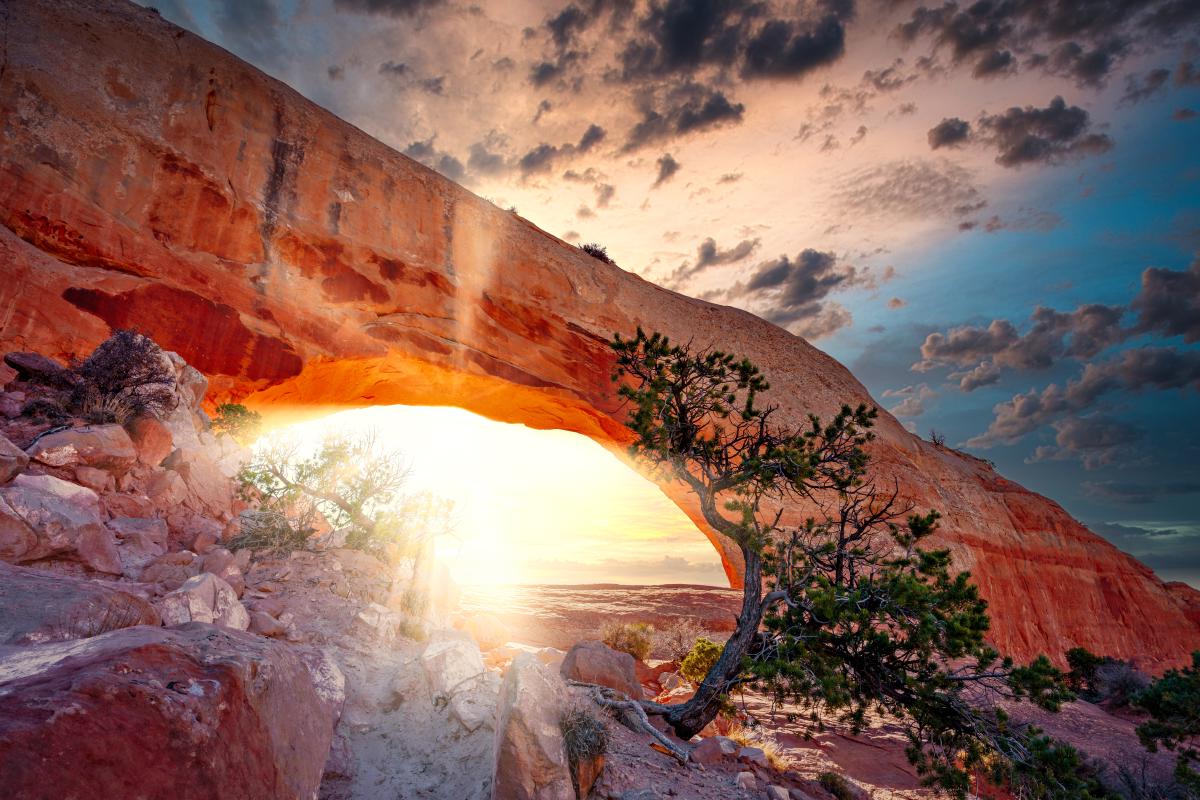
In the American Southwest, the overlanding and the photography occupy the same square meter. Utah’s folds of sandstone — Valley of the Gods, the Moki Dugway, the slot canyons of the Escalante — sit on public land where dispersed camping is legal, so a photographer can park beside the composition and wait for the sky to cooperate. In winter the air clears, the crowds vanish, and the Milky Way wheels above the arches in one of the darkest inhabited corners of the country.
Bolivia’s Altiplano is the most otherworldly terrain a vehicle can reach. The Salar de Uyuni, the largest salt flat on earth, becomes a mirror after rain, erasing the horizon and reducing the landscape to pure abstraction; farther south, the Eduardo Avaroa Reserve stacks red lagoons full of flamingos, the green lake beneath the Licancabur volcano, and the steam and geysers of Sol de Mañana. At four thousand meters the air is thin, the cold is real, and the light is fierce — and minimalism, with nothing in the frame but horizon, subject, and sky, becomes the dominant language.
At the far end of the road, the light becomes the entire subject. The Dempster Highway crosses from the Yukon into the Northwest Territories, through the granite spires of Tombstone Territorial Park and out onto the tundra, where in June the sun circles without setting and by autumn the aurora has begun. Norway’s Lofoten Islands make the same offer more gently: red fishing huts, dark peaks rising straight out of the sea, and green curtains of northern light overhead. In the Arctic, the photographer’s day has no fixed edges, which is the point.
Mongolia returns the human element to the frame. The steppe unrolls for hundreds of kilometers between settlements, so a journey is measured in days and landmarks rather than hours; the dunes of Khongoryn Els and the Flaming Cliffs at Bayanzag are the classic subjects, but the more enduring images are often of the people who host the traveler — herders, families, and the annual Naadam festival, where horses, wrestling, and archery supply movement no landscape can. Here the road is faint or absent altogether, and local knowledge is the only map worth carrying.
Finally, the Himalaya offers altitude as both barrier and frame. Ladakh’s high passes — Khardung La, and the long climb to Pangong Tso — put a photographer above much of the weather, in thin, brilliantly clear air that has made the region a destination for astrophotography; the dunes of Nubra and the whitewashed monasteries at Lamayuru and Thiksey supply structure and human meaning. The driving is slow, the oxygen thin, and the results, on the good days, are unlike anything at lower elevation.
What these places share is not a checklist of sights but a set of conditions: long, unobstructed light; skies dark enough to matter; roads that demand self-reliance to travel; and, above all, the absence of crowds. Each rewards the traveler who arrives with the patience to wait and the means to stay — the two things that overlanding and photography, practiced together, are built to provide.
The Challenges of the Road#
For all its appeal, overlanding photography is not a comfortable discipline, and the discomfort is structural rather than incidental. It does not come from a single bad day but from the permanent conditions of traveling and shooting at the same time: a road that refuses to keep a schedule, a vehicle that insists on being lived in, and an environment that treats delicate equipment as an invitation to ruin it. Understanding those conditions in advance is what separates the photographer who comes home with a coherent body of work from the one who comes home with a broken lens and a folder of almosts.
The first difficulty is the unpredictability of the road itself. Weather moves in, roads close, borders take longer than expected, and mechanical failures interrupt even the most meticulously planned itinerary. A river that was fordable yesterday may be impassable today; a pass open in the morning may be snowed shut by evening. For a photographer this means that the carefully imagined shot may simply never materialize, and adaptability becomes the primary skill rather than a virtue one aspires to. The itinerary, treated honestly, is a fiction — a hypothesis about the future that the journey is under no obligation to honor. The compensation is that the unplanned moment often yields the better image: the light that breaks through after a storm, the encounter in a village where a breakdown forced a stop, the scene that no amount of research could have anticipated. The photographer’s real task is not to execute a plan but to be ready when the plan is abandoned.
There is a further tension that few photographers anticipate, which is that driving and photographing are competing jobs. The person responsible for the vehicle must watch the track, the fuel, and the weather, and that responsibility cannot be set aside for the sake of a composition. Golden hour is frequently the hour when the camp must be found, the light is worst exactly when the road demands the most attention, and the best night skies require being awake when the day’s driving has already drained everyone. Managing this conflict is part of the craft: knowing when to stop and when to press on, when a photograph is worth the delay and when it is merely an indulgence that will cost the group an hour of sleep.
The second constraint is space. Overlanders travel with limited resources, and room inside a vehicle is precious in a way that a photographer accustomed to a studio or a car trunk may not immediately grasp. Camera bodies, lenses, tripods, batteries, chargers, and storage all add weight and occupy volume that might otherwise hold water, food, tools, or spare parts, and the arithmetic is unforgiving: every extra kilogram of optics is a kilogram unavailable for fuel or provisions, every cubic centimeter spent on foam cases is one unavailable for the pantry. The difficulty is finding the balance between carrying the equipment that makes good photographs possible and preserving the practicality of the vehicle — because a rig so loaded with gear that it becomes difficult to live in has traded one kind of freedom for another, and the trip will suffer for it even if the photographs do not. Living with this constraint tends to produce better photographers by force: when the bag has room for only two lenses, one learns to know those two intimately, and improvisation becomes second nature, whether that means bracing a camera on a rock, using a jacket to wipe a filter, or accepting that the shot simply requires a different, lighter approach.
The third challenge is the environment itself. Extended journeys expose equipment to dust that works its way into every seal, mud that cakes and dries and works free again as grit, temperature extremes that swing from desert heat to alpine frost within a day, and the relentless vibration of washboard and rock that loosens screws and fatigues mounts. The failures are specific and cumulative: tripod legs seize, sensors gather fine grit, batteries surrender their capacity in the cold and recover it only when warmed, and lenses carried from a cold dawn into a warm vehicle collect condensation that can fog internal elements and, in humid climates, seed fungus that permanently etches the glass. Coastal routes add salt spray that corrodes everything it touches. Meeting this demands durable, weather-sealed gear and a maintenance habit that many photographers never had to develop at home, where the worst threat to a camera was a rainy afternoon. It also demands redundancy and ritual: a second body or at least a second card, batteries kept warm inside a jacket rather than in a cold bag, and a short cleaning discipline each evening that costs ten minutes and saves a lens.
The Rewards#
What balances these difficulties is the simple fact that the images produced on an overlanding journey are unlike any made elsewhere, and the reasons have less to do with skill than with circumstance. Because the locations are off the beaten path, untouched by mainstream tourism and largely unknown to the photographic market, the pictures carry an authenticity and rawness that is difficult to manufacture and almost impossible to fake. Nothing in the scene was staged for a visitor, no crowd had to be waited out or cropped away, and the light fell on a place that would have looked much the same had no camera existed. What the photographer records, then, is a genuine encounter rather than a performance of one — a record of connection with a place and its people that reads as true because it is true.
There is also the personal growth that comes from documenting a journey rather than merely passing through it. Photography imposes a different pace. It encourages the traveler to observe details that speed would erase, to find beauty in simplicity rather than in spectacle, and to slow down enough to notice the ordinary things — the way dust hangs in late light, the pattern of a worn track, the particular silence of a place with no engine running. Framing a shot becomes a mindful exercise, a deliberate act of attention that reshapes what the traveler looks at and, gradually, how they see. Over the course of a long journey this practice does not merely improve photographs; it changes the photographer’s relationship to the landscape and even to the journey itself, turning the trip from something endured between destinations into something actively examined.
The competence that accumulates along the way belongs to this same reward. Loading and unloading the vehicle, judging a track, reading weather, managing a limited power supply, and keeping fragile equipment alive in a hostile environment all build a particular kind of resourcefulness, and photography is woven through it. The traveler learns what is worth carrying and what is worth leaving, when to stop and when to move on, and how to make a photograph from whatever the day has offered rather than from the day that was hoped for. This is the less visible half of the reward, rarely present in the final images, but it is the part that tends to outlast the trip and inform the ones that follow.
And finally there are the memories. Photographs serve as a visual diary, preserving the essence of a journey long after it ends and allowing the traveler to revisit it in a way that memory alone cannot. Reliving those moments through images enhances their significance, because a photograph fixes details the mind would have let drift — a face, a meal, a particular sky — and returning to them can restore the feeling of a day that has otherwise blurred into the sequence of the road. Sharing them completes the circuit: a print on a wall, a post on a blog, a story told over a table all turn a private experience into something that can travel beyond the traveler.
That act of sharing is where the reward becomes reciprocal. A photograph that might otherwise have remained in a folder becomes, in the right context, an invitation — evidence that such places exist and that they can be reached, offered to someone who had not considered going. Storytelling enriches both the telling and the living; the journey is understood more fully when it is narrated, and the narration gives the next traveler a reason to set out. In this sense the rewards of overlanding photography are not confined to the photographs at all. They reside in the attention the practice demands, the resourcefulness it builds, the memories it preserves, and the small, durable possibility that someone else, seeing what was found out there, will decide to go and look for themselves.
Conclusion#
The relationship between overlanding and photography is less a pairing of hobbies than a single discipline, practiced with different tools at different moments. At its heart is the shared spirit of exploration and adventure that drives both overlanders and photographers to seek the unknown and to preserve what they find, and it is this common impulse, rather than any superficial overlap of interests, that explains why the two pursuits fit together so naturally. The traveler who goes out with a camera is not dividing their attention between two hobbies; they are practicing one habit of attention in two registers at once.
The gifts run in both directions, and each pursuit supplies precisely what the other lacks. Overlanding, with its emphasis on remote and rugged travel, grants photographers access and subject matter they could not otherwise obtain — the rare view, the chance encounter, the place that no tour will ever reach. Photography, in turn, gives the journey a record and a voice, transforming raw experience into narrative and granting the road a memory it would not otherwise keep. Without the camera the journey dissolves into anecdote, a story told and retold until its edges soften; without the journey the photograph has nothing to point at but itself. Held together, they correct each other’s weakness.
The challenges along the way are real, and it would be dishonest to pretend otherwise. The road will not be scheduled, the vehicle will carry only so much before it ceases to be livable, and the conditions — the dust, the temperature swings, the vibration — exact a steady tax on both traveler and equipment. Yet these are not obstacles standing between the photographer and the work; they are the substance of the work. They are the price of images that feel earned, and they are more than repaid by what the practice produces: authenticity that cannot be simulated, growth that comes from being forced to adapt, and memories that hold their shape because they were hard-won. The difficulties, in the end, are part of what makes the results worth keeping.
Together, the two pursuits become something more than their parts. The traveler returns changed, having traded certainty for capability and comfort for perspective. The landscape becomes a known place rather than a picture of one, carried in memory with the specific weight of weather, effort, and time. And the photograph becomes a durable object that outlasts both — a small, precise account of a moment that would otherwise have passed unrecorded and unremarked. Something of each is altered by the encounter, and none of it can be undone.
What remains, finally, is a way of engaging with the world that is at once an adventure and an act of attention. Whether in the solitude of a remote wilderness or the camaraderie of a shared camp, the combination of overlanding and photography asks the traveler to go further, look harder, and return with something to show for it. What matters is not the equipment or the destinations but the disposition the practice encourages: to move deliberately through the world, to notice what is there, and to leave behind, in images and in memory, a durable account of what it was to be there.