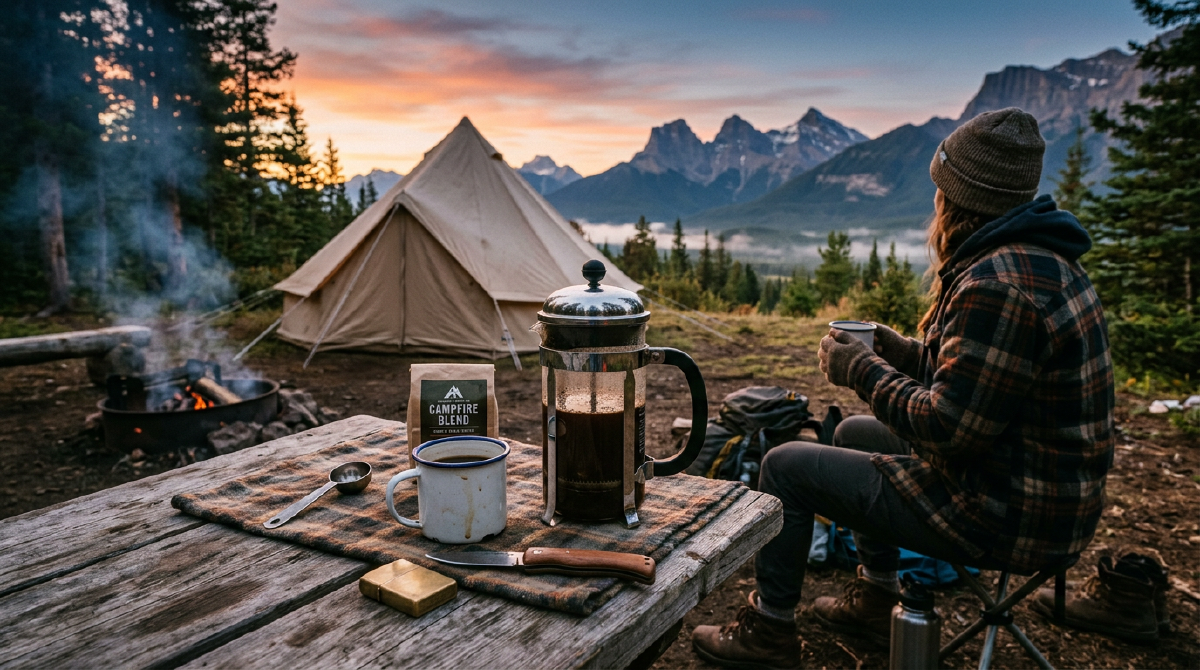
There is a particular kind of satisfaction in pouring a well-made cup of coffee at a campsite, with nothing but open sky and the smell of pine or woodsmoke for company. Over the years, campers have developed a range of methods for brewing coffee outdoors, from the beautifully simple to the surprisingly sophisticated. The three major approaches — French press, cowboy coffee, and portable espresso — each occupy a distinct place on the spectrum of effort, quality, and gear. Choosing among them depends on what you value: simplicity, flavor, ritual, or the ability to pull a genuine shot of espresso beside a tent.
French Press: The Campsite Classic#
The French press is arguably the most popular dedicated coffee maker among campers, and for good reason. Its design is elegant in its simplicity: a carafe, a plunger fitted with a fine mesh screen, coarsely ground coffee, and hot water. There are no paper filters to pack or dispose of, no electricity required, and very little that can break. It is a device that has remained essentially unchanged since its modern form was patented in Italy in the 1930s, and the reason it has endured is that the underlying principle — steeping coffee grounds directly in water, then separating them with a screen — produces a cup that is genuinely difficult to replicate with other methods.
How It Works and Why the Mesh Matters#
To understand what makes French press coffee distinctive, it helps to understand what the mesh filter does differently than a paper filter. Paper, which is used in pour-over and drip methods, is dense enough to trap the oils that naturally exist in roasted coffee. These oils carry much of the flavor and aroma that distinguish one bean from another. When paper absorbs them, the resulting cup is cleaner, brighter, and thinner in body. The mesh screen of a French press, by contrast, allows those oils to pass freely into the cup. The result is a brew with noticeably more body, a heavier mouthfeel, and a richness that paper-filtered methods cannot achieve. This is not a matter of preference dressed up as fact — it is a measurable difference in what ends up in your mug. The French press gives you more of the coffee, in a literal, chemical sense.
The mesh screen also allows very fine particles — what coffee professionals call “fines” — to slip through into the finished brew. This is the source of the French press’s most discussed characteristic: sediment. But the mesh is selective. It holds back the bulk of the grounds while letting the liquid and the smallest particles pass. The balance between these two functions — allowing oils through while retaining most of the solid material — is what makes the French press work as well as it does.
The Brew Method in Practice#
The process of making French press coffee at camp is straightforward, but the details matter more than beginners often expect. The standard ratio is roughly 55 to 60 grams of coarsely ground coffee per liter of water, though many experienced users adjust this to taste. The grind should be coarse and even — somewhere between the texture of coarse salt and raw sugar. A grind that is too fine will over-extract during the steep, producing bitterness, and will clog the mesh screen during the plunge, making it difficult or impossible to press down without breaking something.
Water temperature is another variable that is easy to overlook. The ideal range is between 195°F and 205°F — just below a full boil. At camp, bringing water to a boil and then letting it sit for thirty seconds to a minute is a reliable way to hit this window. Boiling water, contrary to popular belief, is slightly too hot for coffee extraction. It can scorch the grounds, particularly at altitude where the boiling point drops and the margin for error narrows. At 8,000 feet, for example, water boils at roughly 196°F, which is right at the lower edge of the ideal range. Campers at high altitude may want to pull the water off the heat almost immediately after it begins to boil, or simply accept that the cooler water at elevation will produce a slightly different cup.
Once the water meets the grounds, the standard steep time is four minutes. This is not an arbitrary number — it reflects the point at which most of the desirable compounds have been extracted from the grounds without pulling out excessive bitterness. Leaving the press for five or six minutes will produce a stronger cup, but not necessarily a better one, as the tannins and other bitter compounds become more prominent with extended steeping. Some campers prefer this bolder profile, and there is nothing wrong with that, but it is worth understanding the trade-off.
The plunge itself is a moment that rewards patience. Pressing the plunger down quickly forces water and fines through the mesh at high velocity, agitating the grounds and increasing sediment in the cup. A slow, steady, even plunge — taking fifteen to twenty seconds from top to bottom — produces a cleaner result. It also puts less stress on the mesh screen, which is the single most likely part of the French press to fail over time.
The Question of Grit#
No discussion of the French press can avoid the topic of sediment, and it is worth exploring honestly rather than dismissing it as a minor inconvenience. Even with a careful plunge and a quality press, some fine particles will make it into the cup. This is an inherent characteristic of the method, not a flaw to be engineered away. The mesh screen, no matter how finely woven, cannot catch every microscopic particle, and the agitation of the plunge inevitably forces some through.
For many people, this sediment is part of what makes French press coffee feel substantial. It adds a subtle texture — a faint graininess on the tongue — that contributes to the perception of a fuller, more complete cup. There is a reason that French press coffee is often described as “rich” in ways that drip coffee is not, and the presence of these fine particles is a significant part of that richness.
For others, however, that last half-inch of sludgy grounds at the bottom of the mug is genuinely unpleasant. The practical solution is twofold: use a coarser grind, which produces fewer fines, and let the press sit for an extra minute or two after plunging before pouring. Gravity will settle the heaviest particles to the bottom, and pouring gently — without tipping the carafe steeply — leaves most of the sediment behind. It is an imperfect solution, but it reduces the problem substantially.
Choosing the Right Press for Camp#
The two main categories of French press for outdoor use are glass and insulated stainless steel, and the choice between them matters more in the field than it would in a kitchen. Glass presses produce an excellent cup, but they are fragile in ways that make them a risky choice for camping. A single drop onto a rocky campsite floor can end the morning’s coffee plans before they begin. For car camping on flat, stable ground, where the press will sit on a table and be handled carefully, glass is a perfectly reasonable choice. For anything rougher, stainless steel is the way to go.
Insulated stainless-steel models — from makers like Stanley, Bodum, Espro, and GSI Outdoors — solve two problems at once. They eliminate the breakage risk entirely, and they keep the coffee hot for hours after plunging. On a cold autumn morning, when the temperature has dropped overnight and the fire is still building, the difference between a press that stays hot for an hour and one that goes lukewarm in fifteen minutes is not trivial. It means you can brew coffee once, pour a cup, and return for a second cup twenty minutes later without reheating anything.
The Espro press deserves particular mention for its approach to the sediment problem. Espro’s design uses a double micro-filter that captures far more fines than a standard single screen, producing a noticeably cleaner cup — closer to what you would get from a pour-over, but with more body than paper filtering alone provides. The trade-off is a slightly more involved cleanup, as the double filter traps grounds in a compact puck that needs to be knocked out rather than simply dumped. For campers who are serious about reducing grit without switching to a different brew method, the Espro is a compelling option.
Cleanup and Group Brewing#
Cleanup is one of the French press’s genuine advantages in a camp setting. Once you have finished pouring, the spent grounds can be dumped directly into a compost bin, a designated waste bag, or in some cases onto the ground away from water sources where they will decompose naturally. There is no paper filter to pack out, no grounds stuck to a permanent filter that need to be rinsed clean. A quick swirl of water in the carafe, a dump, and the press is ready for the next round. In practice, this takes less than a minute, and that efficiency matters when you are packing up a campsite and have a dozen other tasks competing for attention.
For groups, the French press has a clear advantage over single-serving methods. A one-liter press serves two to three people in a single brew, and a 1.5-liter model can serve four. This means one round of boiling water, one four-minute steep, and one plunge produces enough coffee for the whole campsite. Compare that to methods like pour-over or AeroPress, where each cup requires its own separate preparation, and the time savings over a multi-person trip become significant. The French press is, in this sense, a social brewing method — it scales naturally with the size of the group, and the ritual of gathering around the press while the coffee steeps is part of what makes a campsite feel like a shared space.
Cowboy Coffee: Nothing But the Basics#

Cowboy coffee is the oldest and most minimal method of brewing outdoors. The technique predates every gadget on this list by well over a century, and its roots reach back further still — to the coffeehouses of the Ottoman Empire and the rough camps of the American frontier, where coffee was boiled in whatever vessel was at hand and drunk from whatever cup you could find. The principle is as plain as it gets: cold water, ground coffee, a pot, and a fire. There is no filter, no plunger, no paper, no mechanism of any kind. The coffee and the water meet, they are heated, and gravity does the rest.
A Method Shaped by Necessity#
The name “cowboy coffee” evokes a particular image — a cattle drive across open range, a cookfire at the edge of camp, a tin pot blackened by smoke. But the method is not uniquely American, and it is not limited to cowboys. Virtually every culture that brewed coffee before the invention of the paper filter in the early twentieth century used some version of this technique. Ethiopian coffee ceremony, Turkish ibrik coffee, the boiled coffee of Scandinavian “kokekaffe” — all are variations on the same fundamental idea: combine coffee and water, apply heat, let the grounds settle, pour. What makes cowboy coffee distinctively “cowboy” is not the technique itself but the context in which it survives: outdoor camps, minimal gear, and the willingness to accept a cup that is rough-edged but real.
Understanding this history matters because it reframes the method. Cowboy coffee is not a primitive fallback for people who do not own better equipment. It is a practice with centuries of accumulated wisdom behind it, refined by countless hands over countless mornings. The fact that it still works — and works well — is not an accident. It is the result of a method that has been stripped to its essentials and found to be sufficient.
The Cold Water Start and Why It Matters#
The standard instruction for cowboy coffee begins with a detail that many beginners overlook: combine the grounds and cold water before applying heat. This is not arbitrary. Starting with cold water allows the grounds to become fully saturated before extraction begins in earnest. When dry grounds hit boiling water, the outer layer of each particle extracts rapidly while the interior remains dry — a phenomenon called “case hardening” in coffee science. This produces an uneven extraction: bitter on the outside, underdeveloped on the inside. Cold water, by contrast, lets the grounds swell gradually and evenly as the temperature climbs, producing a more balanced extraction across the full particle.
The ratio of coffee to water is another variable that rewards attention. The traditional guideline — roughly two tablespoons of ground coffee per six ounces of water — translates to approximately ten grams of coffee per 180 milliliters. This is a moderately strong ratio, stronger than most drip methods but weaker than espresso. For a standard 1.5-liter pot, this means roughly 80 grams of coffee, or about eight level tablespoons. The exact amount is a matter of taste, and experienced campers adjust it to their preference. A stronger ratio produces a heavier, more assertive cup; a weaker ratio yields something closer to a standard morning coffee. There is no single correct answer, only the answer that suits the person drinking it.
Grind size, as with every other brewing method, affects the outcome. Cowboy coffee works best with a medium to medium-coarse grind — coarser than what you would use for pour-over, but finer than the very coarse grind recommended for French press. Too fine, and the grounds will not settle properly; they will remain suspended in the liquid, producing a muddy, overly bitter cup that is difficult to pour without scooping up sediment. Too coarse, and the extraction will be weak and watery, with the flavor of the coffee barely present. The sweet spot is a grind that feels like coarse sand between your fingers — substantial enough to sink under its own weight, but fine enough to release its flavor during the relatively brief contact time of the boil.
The Boil: Where the Method Lives or Dies#
The moment the water begins to boil is the most critical point in the entire process, and it is where most bad cowboy coffee is made. The temptation is to let the pot roll at a full boil for a minute or two, reasoning that more heat means more extraction. The opposite is true. A rolling boil agitates the grounds violently, breaking open cell structures that release harsh, bitter compounds — particularly chlorogenic acid lactones and phenylindanes, which form during roasting and are over-extracted at high temperatures. These are the compounds that make coffee taste scorched, ashy, and unpleasant. A brief, controlled boil followed by immediate removal from heat produces a dramatically different cup.
The ideal approach is to bring the water to a boil with the grounds already in the pot, watch for the first bubbles breaking the surface — not a full rolling boil, but the point where the water is clearly hot enough to extract — and then pull the pot off the fire or turn off the burner. At sea level, this occurs at 212°F. At higher elevations, it occurs sooner, as atmospheric pressure lowers the boiling point. At 5,000 feet, water boils at approximately 203°F; at 10,000 feet, it boils at roughly 194°F. This means that at high altitude, the water is already cooler when it boils, which reduces the risk of over-extraction but also reduces the total extraction potential. Campers at elevation may want to use a slightly finer grind or a slightly longer steep to compensate, though the difference is subtle enough that most people will not notice it without a side-by-side comparison.
Once the pot is removed from the heat, the next phase begins: settling. This is the step that separates passable cowboy coffee from genuinely good cowboy coffee, and it requires patience. The grounds, which have been violently agitated by the boil, need time to sink to the bottom of the pot. Three to four minutes of undisturbed rest is the minimum; five minutes is better. During this time, gravity pulls the heavier particles downward while the lighter ones remain briefly suspended before settling in turn. The resulting cup, poured carefully from the top, is remarkably clean for a method that uses no filter at all.
The Cold Water Trick and Other Old Wisdom#
One of the oldest tricks in cowboy coffee lore is the addition of a small amount of cold water to the pot after the steep. The practice is widespread and has been documented in camp cookbooks, ranch guides, and family traditions for generations. The explanation most commonly offered is that the cold water “shocks” the grounds, causing them to contract and sink more quickly. The reality is slightly more complex. Cold water added to a hot pot does two things: it lowers the temperature of the liquid, which reduces the thermal energy keeping fine particles suspended, and it increases the total volume of the liquid, which reduces the density of the suspension and allows gravity to act more effectively on the remaining particles. The net effect is a cleaner pour, with less sediment reaching the cup.
This trick is not universally practiced, and some experienced campers consider it unnecessary if the settling time has been adequate. Others swear by it, particularly when brewing with a coarser grind that tends to produce more floating particles. As with much of cowboy coffee, the value of the technique depends on the specific conditions — the grind, the pot, the water, the heat — and the only way to know whether it helps in your setup is to try it both ways.
The Flavor Profile: What Cowboy Coffee Actually Tastes Like#
Cowboy coffee, when made well, has a flavor profile that is distinctly its own. It is not a substitute for pour-over, and it is not trying to be. The cup is heavy-bodied, with a rounded sweetness that comes from the full immersion of the grounds and the absence of any filtering material that might strip away oils. The bitterness, when the method is executed correctly, is present but balanced — a warm, roasted quality rather than the sharp, acidity-driven bitterness of over-extracted coffee.
What cowboy coffee lacks is the clarity and nuance of filtered methods. The fine particles that remain suspended after settling give the cup a slight murkiness, and the extraction — driven by the uncontrolled heat of a fire rather than the precise temperature of a kettle — tends to flatten the more delicate flavor notes. You will not taste the bright citrus of a Kenyan single-origin or the floral jasmine of an Ethiopian Yirgacheffe in a cowboy brew. What you will taste is coffee in its most elemental, comforting form — a deep, warm, unmistakably coffee flavor that pairs with the smell of woodsmoke and the sound of a campfire in a way that no other method quite replicates.
This is not a limitation so much as a definition. Cowboy coffee does not aim for complexity; it aims for presence. It is coffee that tastes like the place you are drinking it, and that is precisely the point.
The Gear-Free Advantage#
The appeal of cowboy coffee lies partly in its complete absence of specialized equipment. There is no device to wash, no filter to replace, no moving parts to fail. A metal pot and a heat source are all you need, and both are likely already part of any camp kitchen. In a world where outdoor recreation has become increasingly gear-dependent — where even a weekend car camping trip can involve a dozen specialized gadgets — there is something deeply satisfying about a method that requires nothing more than the most basic elements.
This simplicity extends to cleanup. Once the coffee has been poured, the spent grounds can be dumped directly into a fire pit, a compost area, or a waste bag. There is no mesh screen to rinse, no paper filter to wring out, no carafe to scrub. A quick rinse of the pot with clean water, and it is ready for the next use — or for boiling water for a meal, which is often the pot’s primary purpose anyway. In this sense, cowboy coffee is also the most versatile method, because it does not require a dedicated vessel. The same pot that makes your morning coffee will cook your oatmeal, heat your soup, and boil your drinking water.
For groups, this gear-free simplicity becomes a genuine practical advantage. Cowboy coffee scales effortlessly — brew as much as the pot will hold, and pour for as many people as are gathered around the fire. There is no need to make multiple rounds of pour-over, no need to weigh out single-serving doses, no need to manage a queue of mugs waiting for their turn under the dripper. One pot, one boil, one pour, and everyone has coffee. For camp cooks who are already managing meals for a group, this efficiency matters.
Consistency: The Method’s Greatest Challenge#
The downside of cowboy coffee is consistency. Without a thermometer, a timer, or any mechanism for controlling the extraction, the difference between a good pot and a bitter one comes down entirely to experience and attention. Two campers using the same pot, the same coffee, and the same water can produce noticeably different results based on how they manage the boil, how long they let the coffee settle, and how carefully they pour.
Over-boiling is the most common mistake, and it is the one that gives cowboy coffee its bad reputation among people who have only tasted it done poorly. When the pot boils hard for too long, the water temperature exceeds the range at which desirable compounds are extracted and begins pulling out the harsh, bitter compounds that make coffee taste burnt. The fix is straightforward — watch the pot, remove it from the heat at the first sign of a rolling boil, and resist the temptation to let it go longer — but it requires a level of attentiveness that not every camper brings to their morning routine.
Pouring technique matters as much as brewing technique. Tilting the pot steeply to pour the last of the coffee will disturb the settled grounds at the bottom and send a cloud of sediment into the cup. A slow, gentle pour that keeps the pot nearly level allows the grounds to remain undisturbed and the clean coffee to flow over the lip. Leaving the last inch or so of liquid in the pot — grounds and all — is the surest way to avoid grit in the cup, and it is a small price to pay for a cleaner result.
When Cowboy Coffee Truly Shines#
There are situations where cowboy coffee is not merely adequate but genuinely the best choice. On a multi-day backpacking trip where every gram of pack weight is accounted for, the absence of any dedicated brewing device is a meaningful advantage. A metal pot is already in the pack for cooking and water purification; adding cowboy coffee to its duties requires no additional weight or space.
In group settings where the camp cook is already managing a fire and multiple meals, the simplicity of cowboy coffee reduces one more task from the morning routine. Boil water, add grounds, wait, pour — the entire process integrates seamlessly into the rhythm of camp life in a way that more finicky methods do not.
And there is a dimension of cowboy coffee that is harder to quantify but impossible to ignore: the ritual. The act of watching a pot come to a boil over an open fire, of letting it settle while the morning warms around you, of pouring a cup and holding it in both hands — this is not just a method of making coffee. It is a practice that connects you to the place and the moment. The French press is a device. The espresso maker is a machine. Cowboy coffee is an act, and it asks you to be present for it. That is worth something, even — or especially — when a better cup is theoretically available from a more sophisticated method.
Portable Espresso: The Modern Frontier#
For many years, the idea of making genuine espresso while camping would have been absurd. Espresso is not simply strong coffee brewed in a small cup — it is a specific extraction method defined by physics. Hot water, typically between 195°F and 205°F, is forced through a finely ground, tightly packed bed of coffee at a pressure of roughly nine bars — about nine times atmospheric pressure, or the equivalent of a column of water 300 feet high. This pressure is what produces crema, the golden, hazelnut-colored foam that sits atop a well-pulled shot, and it is what gives espresso its concentrated intensity, its viscous body, and its ability to dissolve flavors from the grounds in a way that immersion or gravity alone cannot achieve. For most of the twentieth century, generating that kind of pressure required a heavy, countertop machine connected to a wall outlet and a water line. The idea of carrying such a machine into the woods was not merely impractical — it was nonsensical.
The first serious attempts at portable espresso emerged in the early 2000s, when manufacturers began experimenting with hand-pump mechanisms small enough to fit in a backpack. The earliest models were crude: low pressure, small baskets, inconsistent extraction, and a cup that was closer to strong Moka pot coffee than to anything a barista would recognize as espresso. But they proved the concept, and by the mid-2010s, a second generation of devices had arrived that could genuinely hit nine bars of pressure and produce shots with real crema. The breakthrough was not any single invention but a convergence of materials science, miniature engineering, and a growing market of travelers and outdoor enthusiasts who refused to accept that good coffee required a kitchen.
Today’s portable espresso market is substantial and growing. The range of devices spans from simple, sub-$50 hand-pump units that produce espresso-style concentrate to sophisticated battery-powered machines that heat their own water from cold and extract at up to 20 bar. The quality ceiling has risen dramatically: the best portable espresso makers in 2026 produce shots that genuinely rival what you would get from a well-calibrated home machine, with crema, sweetness, and complexity that would have been unthinkable a decade ago. The gap between portable and countertop has narrowed to the point where the difference is more about workflow and consistency than about fundamental capability.
Two Philosophies, One Goal#
The current landscape of portable espresso can be divided broadly into two camps, and the divide between them is as much philosophical as it is technical. On one side are manual hand-pump devices — compact, mechanical machines that require the user to supply hot water and generate pressure by hand. On the other side are battery-powered self-heating machines that heat cold water internally and extract with the push of a button. Both can produce real espresso with crema, but they represent fundamentally different ideas about what camping coffee should be.
The manual approach treats espresso as a craft. It asks the user to participate in every step of the process — heating water on a stove, grinding the beans to a precise consistency, tamping the grounds with care, and pumping with a rhythm and force that affect the quality of the shot. There is a learning curve, and the results depend on technique. But the rewards are proportional: a well-pulled shot from a manual device, made with fresh beans and careful attention, can be extraordinary. The manual philosophy values control, skill, and the satisfaction of having made something demanding with your own hands. It is espresso as practice, not just product.
The self-heating approach treats espresso as a result. It removes as many variables as possible — grinding is optional if you use capsules, water temperature is pre-set, pressure is applied automatically — and delivers a consistent shot with minimal effort. The trade-off is weight, cost, and battery dependence. But for campers who want espresso without turning their morning into a project, the self-heating machine offers something that manual devices cannot: the ability to press a button in a cold tent and have a hot espresso two minutes later without having done anything else first. It is espresso as convenience, and for many people, that is exactly the right priority.
Understanding this divide is essential to choosing the right portable espresso maker, because the two approaches serve different needs, different camping styles, and different relationships with coffee itself. The sections that follow explore each philosophy in detail, through the specific machines that define them.
Manual Espresso: The Wacaco Picopresso#
The Wacaco Picopresso has earned a strong reputation as the gold standard for manual portable espresso. It is a compact, fully manual hand-pump device that weighs roughly 350 grams and produces up to 18 bars of pressure. What sets it apart from other manual options is its 52-millimeter unpressurized naked portafilter — the same kind of bottomless basket that espresso purists use at home. This design allows the user to watch the extraction happen in real time, diagnosing channeling and adjusting technique shot by shot.
The Picopresso uses an 18-gram dose, which is close to the commercial standard. This larger basket, combined with the unpressurized design, means it can produce espresso that genuinely rivals what you would get from a proper home machine — provided you bring a capable burr grinder and know what you are doing. The learning curve is real. Grind size, tamp pressure, water temperature, and pumping rhythm all affect the shot, and the Picopresso demands attention to each of them.
For the camper who already carries a stove to heat water and values the craft of espresso-making as part of the outdoor experience, the Picopresso is hard to beat. It is light, it has no battery to charge, and it will keep pulling shots as long as you have hot water and coffee. Its weakness is self-containment: it depends entirely on an external heat source, and it requires a separate grinder, scale, and kettle for best results. For ultralight backpackers, the total kit weight can add up quickly.
Self-Heating Espresso: The Outin Machines#
Outin entered the portable espresso market with the Nano, a battery-powered machine that heated room-temperature water to roughly 198°F in about 200 seconds, then extracted espresso at up to 20 bar of pressure. The concept was simple and compelling: no kettle, no stove, no hot water pre-heated and carried in a thermos. Press a button, wait a few minutes, and get espresso from cold water.
The follow-up model, the Outin Mino, refined the formula with several meaningful improvements. The Mino features a larger 12-gram basket (up from the Nano’s 10 grams), a noticeably faster heating cycle, an IP67-rated body for dust and water resistance, and a brew cup that doubles as a stand. Both machines work with ground coffee and Nespresso-compatible capsules, adding versatility for campers who do not want to carry a hand grinder.
The Outin machines represent the convenience-first end of the portable espresso spectrum. For car campers, overlanders, or anyone who has USB-C power available and does not want to deal with boiling water separately, they remove the single biggest friction point in outdoor espresso. The trade-offs are weight (the machines are heavier than any manual option), battery dependence (cold weather and repeated shots drain the battery faster), and a smaller dose capacity that limits how much coffee goes into each shot.
Self-Heating Meets Wacaco: The Pixapresso#
Wacaco responded to the self-heating trend with the Pixapresso, which combines an electric pump and a built-in water heater in a single compact unit. At roughly 755 grams, it is heavier than the Picopresso but lighter than some of the Outin models, and it offers a water capacity of up to 120 milliliters with a pressurized basket that accepts doses from 8 to 16 grams.
The Pixapresso’s pressurized basket is a deliberate design choice. Pressurized baskets are more forgiving of inconsistent grinds, which matters when you are using pre-ground coffee or a less-capable hand grinder in the field. They produce a thick, stable crema even when the puck preparation is not perfect. For campers who want decent espresso without obsessing over grind calibration, this is a genuine advantage.
What the Pixapresso sacrifices is the ceiling. The unpressurized naked portafilter of the Picopresso allows a skilled user to extract a shot with the clarity, sweetness, and complexity that defines great espresso. The Pixapresso’s pressurized basket, while consistent, cannot match that level of flavor expression. It is a trade-off between accessibility and artistry.
For camping specifically, the Pixapresso occupies an interesting middle ground. It heats its own water, which is a major advantage when you do not want to fire up a stove just for coffee. But it also needs a charge, and in cold conditions the battery’s performance drops. Extended off-grid trips without access to USB-C power can leave the machine stranded. It is best suited to car camping, powered campsites, or short trips where charging is available.
Comparing the Espresso Options#
The differences among these machines matter most when you consider them in the context of a specific camping style. The table below summarizes the key specifications:
| Feature | Wacaco Picopresso | Outin Nano | Outin Mino | Wacaco Pixapresso |
|---|---|---|---|---|
| Type | Manual hand pump | Battery self-heating | Battery self-heating | Battery self-heating |
| Max pressure | 18 bar | 20 bar | 20 bar | 18 bar |
| Coffee dose | ~18 g | ~10 g + pods | ~12 g + pods | 8–16 g |
| Water capacity | ~80 ml | N/A | N/A | ~120 ml |
| Self-heating | No | Yes (~200 s) | Yes (faster) | Yes |
| Weight | ~350 g | Heavier | Heavier | ~755 g |
| Basket style | Unpressurized (naked) | Pressurized | Pressurized | Pressurized |
| Capsule compatible | No | Yes (NS) | Yes (NS) | Yes (NS) |
| Battery required | No | Yes | Yes | Yes |
| Approx. price | $130 | $130 | Higher | Higher |
The Picopresso wins on weight, dose size, extraction quality, and independence from charging. The Outin machines and the Pixapresso win on convenience, self-containment, and ease of use for people who do not want to master manual technique. Which matters more depends on the trip.
Choosing the Right Method#
The best campsite coffee method is not a fixed answer — it shifts with context. For a weekend car camping trip with a full kitchen setup and access to power, a French press is effortless and reliable. For a multi-day backpacking trip where every gram counts and a stove is already being carried, cowboy coffee eliminates the need for any dedicated brewing device. For the camper who considers espresso non-negotiable, the choice between a manual Picopresso and a self-heating Outin or Pixapresso comes down to whether you value weight and control or convenience and independence from a heat source.
There is no wrong answer, only the right one for the morning in front of you.