
The Wok Mon is one of the better pieces of kitchen logic to come along in years. It is a domed steel ring that sits over a home gas burner and does one thing: it takes the ring-shaped flame a domestic stove produces and squeezes it into a single column aimed at the center of a wok. On a typical 9,000 BTU home burner, that is close to magic. The wok bottom goes from a sulky 650°F to somewhere north of 700, and on a good day almost 800. Meat sears instead of steaming. The wok finally behaves like the pan in the videos.
Then comes the obvious idea, usually from someone with a portable burner in the garage. If the Wok Mon makes a weak stove burner strong, what does it do on a standalone burner — in this case a Chef Master 90019, the 15,000 BTU butane catering stove that gets dragged out for camping, tailgating, and the occasional driveway stir-fry?
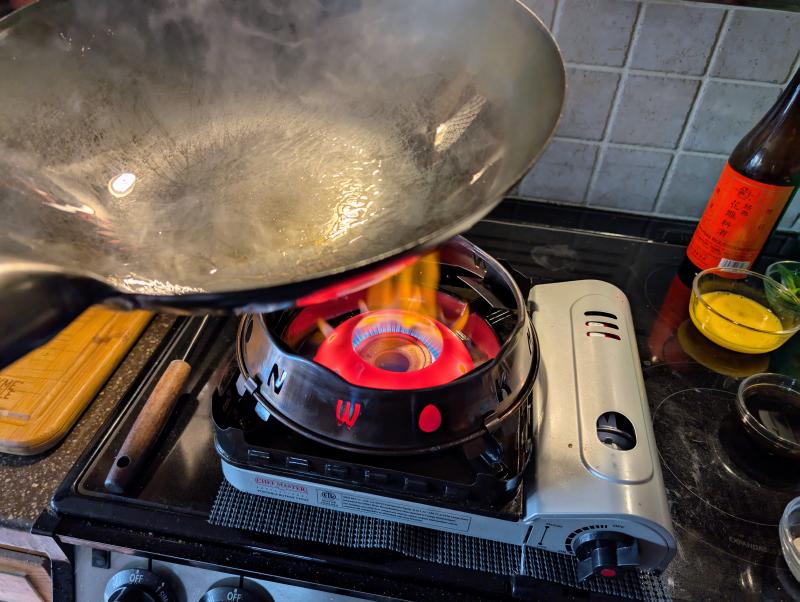
The answer is that it can still melt it. Not the whole thing, and not dramatically, but the parts that matter. On this stove the head itself is in the running, and the 15,000 BTU rating is exactly what makes it easy to underestimate.
The ring is a heat trap, and that is the point#
A wok ring works by refusing to let heat escape. The curved bottom of the wok sits in the ring, the flame concentrates underneath, and the hot gas that would normally spill sideways across a flat pan gets held in place against the metal instead. That is exactly why it works on a stove, and exactly why range manufacturers warn against it. GE’s manuals are blunt: a wok ring “acts as a heat trap, which may damage the burner grate and burner head,” and can push carbon monoxide past allowable limits because the burner no longer gets the air it needs.
A standalone burner is the same physics with a different set of parts around it. A 15,000 BTU butane stove is barely more than the best burner on a domestic stove (usually about twelve thousand BTU), which is why people treat it as harmless. But BTU measures heat delivered per hour, not how hot the flame is. A 15,000 BTU burner still makes a flame in the same temperature range as a burner several times its size — a theoretical flame temperature near 3,600°F — but it simply delivers less of that heat over a smaller area. The Wok Mon concentrates what heat there is into a single column, and the wok holds it there. Trap enough of it against a brass burner head — or, on a larger burner, a zinc bracket or an aluminum leg — and 15,000 BTU is plenty.
What actually melts#
Here the intuition misleads people, and on the 90019 it misleads them twice. The burner is easy to mistake for cast iron, especially once soot and heat have darkened it; the product specifications list the burner material as brass. Brass is not iron. Yellow brass melts around 1,660–1,710°F; the exact range depends on the alloy, but not by much. It also anneals — loses its hardness — from roughly 800°F, long before it melts. A 15,000 BTU flame still has a theoretical flame temperature near 3,600°F. It does not have to heat the whole head to melting. It only has to hold one section of brass in the flame long enough for the metal to go soft and move.
That is the difference between this stove and the cast-iron camp burners people compare it to. A cast iron head melts around 2,100–2,200°F and stays brittle until it does; it cracks before it bends. A brass head has a long, soft range before failure, and a soft range is exactly what produces a flow pattern instead of a crack.
The rest of the stove is a mix of materials with very different limits, and the melting points are not close:
- Brass burner and brass fittings — roughly 1,630–1,710°F to melt depending on alloy, but soft and annealed from about 800°F. This is the part sitting in the flame.
- Zinc die-cast alloys — the family usually called Zamak, used for small die-cast parts such as knobs and brackets — melt at roughly 718–728°F.
- Aluminum castings — burner heads on lighter portable stoves, venturi tubes, legs, wind screens — melt around 1,050–1,220°F depending on alloy, and lose most of their strength well before they melt. They sag first.
- Rubber seals and plastic parts — the canister gasket and any plastic parts on this stove; on a propane tank burner, the hose and regulator, where a typical LP hose assembly is rated for roughly −40°F to 130°F. They do not need to melt. They only need to get warm enough to soften, crack, or leak.
- Paint and powder coat — can soften, blister, or burn at a few hundred degrees, which is why a stove that has been abused smells like a barbecue that has given up.
The heat transfer plate and wind guard sit in the hot zone, whatever they are made of, and they take the heat first.
So the honest answer to “can it get hot enough to melt the burner” is yes, and on this stove the head is not the innocent bystander. It is brass, it is in the flame, and it is the part that flows. The cast-iron-looking parts around it — the pan supports, the wind guard, the heat transfer plate — are a separate question.
What the flow pattern means#
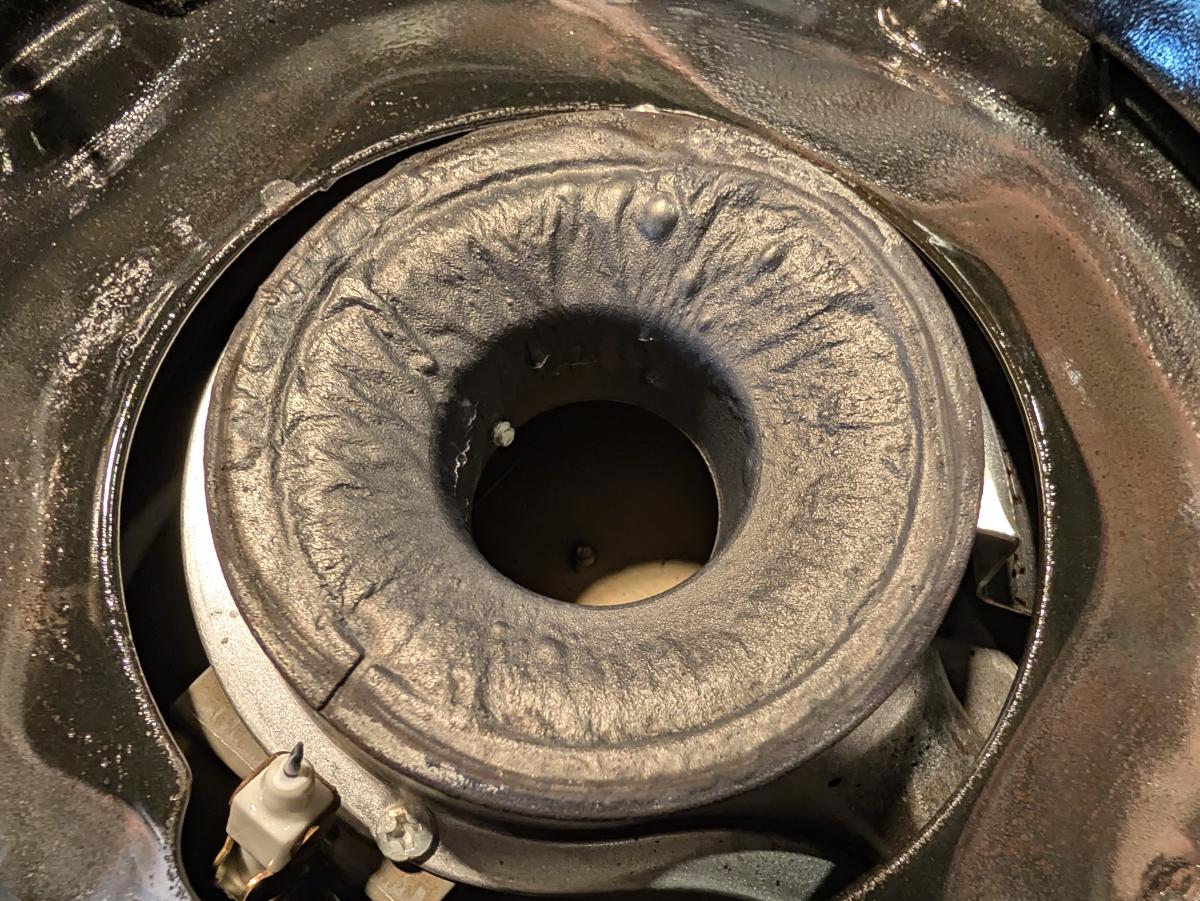
The flow pattern is the part that looks impossible, and it is the part that makes the diagnosis. Cast iron does not flow. It stays rigid until it cracks or spalls, because it has no useful soft range. Brass does the opposite: it anneals and softens long before it melts, and the hottest section can melt outright. Either way, the result is rounded edges, drooping ports, and a surface that looks as if it was pulled while wet. A pattern that runs across the head was not iron.
That matters because the 90019’s burner is brass, and the stove puts it directly under a wok ring that refuses to let heat escape. The ring does not have to touch the head to heat it. It only has to hold the combustion gas in place long enough for the brass to reach the range where it stops behaving like a structural material. From there, the weight of the wok and the force of the flame do the rest.
Color is not a material test — soot, paint, and heat tint make brass and iron look alike. A magnet settles which part is which: cast iron grabs it, brass and aluminum do not.
The one thing that can fake a flow pattern is the finish. Paint and powder coat can soften, blister, or reflow at a few hundred degrees, so a black head can show a glossy, wrinkled, run-together skin with the metal underneath perfectly sound. Geometry is how you tell them apart: if the ports have closed, the edge has drooped, or the head no longer sits flat, the metal moved. If the shape is intact and only the surface has run, it was the coating.
If the part that deformed is the pan support or the outer ring rather than the burner, the material question changes again. Cast iron would crack, not bend. Thin steel would bow and scale. The Wok Mon itself is steel and can warp if the flame is allowed to play on it directly. A ring that has lost its shape is a sign that the assembly around the burner is taking more heat than it was designed for, even if the head is intact.
Whichever part moved, the response does not change. A deformed burner is not a burner to bend back into shape. The ports have changed size, the air mixture has changed with them, and the metal is weakest exactly where the flame sits. Replace it. A burner that has been hot enough to lose its shape is also a carbon monoxide risk, because the flame is no longer sitting where the designer put it.
The 90019’s real weak point#
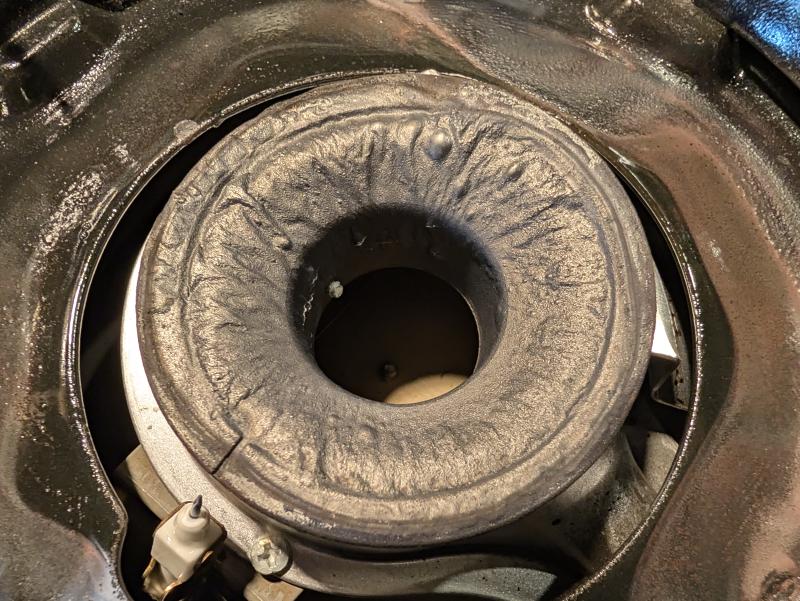
The burner head is the visible damage. The fuel canister is the one that can hurt you.
The 90019 is a butane stove, not a propane burner with a tank and hose. Its fuel is an 8 oz BF-1010 canister that sits inside the stove body, under a cover, a few inches from the burner. The manual is unusually direct about the limit this imposes: do not use a pan larger than 9 inches, because a larger pan “will cover the fuel compartment and cause the canister to overheat.” It also warns against any heat source that could push the canister above 120°F.
A wok is 12 to 14 inches across. The Wok Mon adds a ring that sits above the burner and extends the hot zone even farther out. Together they are a lid over the fuel compartment, which is exactly the condition the manual tells you to avoid. The stove’s in-line regulator has a pressure-sensing shut-off, and it will cut the gas when the canister gets hot. That is a safety feature, not a nuisance: a 90019 that keeps shutting off mid-cook is telling you the canister is overheating.
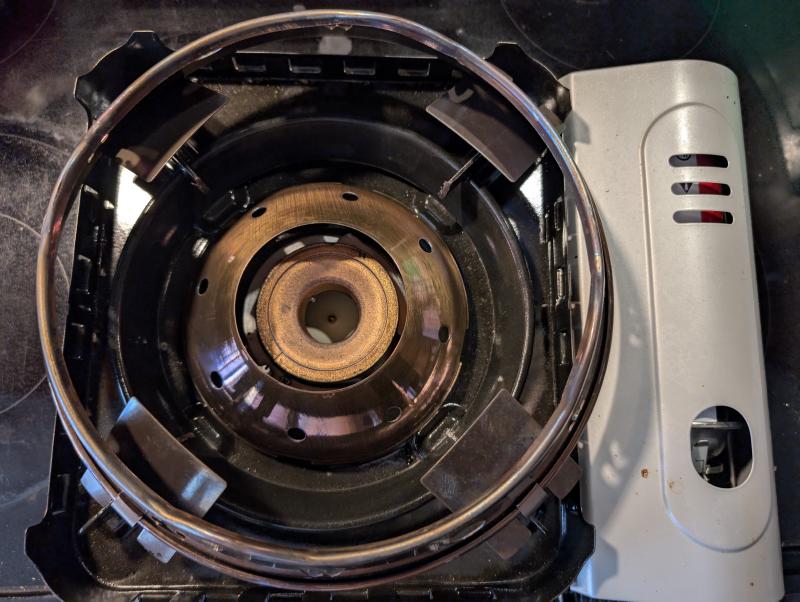
There is a second mismatch, which is mechanical. The Wok Mon is designed to drop into a stove grate and seat around a burner cap of a specific diameter. The 90019 does not have that geometry. It has a heat transfer plate, a double wind guard, and pan supports sized for a 9-inch pan. The ring can sit high, loose, or cocked, which aims the flame at the metal instead of the wok and puts the trapped heat exactly where the stove is least able to shed it. On a stove this small, the ring is less a concentrator than a lid.
So the probable failure sequence on a 90019 is not “cast iron melts.” It is: the wok and ring trap heat, the brass burner can soften and flow, the thin metal body and the canister cover soak up the rest, the canister pressure rises, and the safety either trips or the canister overheats and vents. The melted head is the evidence; the fuel compartment is the hazard.
The order things go wrong#
The metal rarely has to melt. It only has to stop being the shape it was. In practice the sequence is predictable, and every step before the last one is a chance to stop.
The paint cooks off first, which smells like burning enamel and is easy to dismiss. Then the brass burner can anneal and slump, usually visible as a head that suddenly sits crooked or a flame that has gone yellow and lazy because a port has closed. Then the canister cover and the seals get hot, and the pressure-sensing shut-off starts to trip. That is the point where the machine has stopped being safe and started being a fire waiting for a reason. By the time anything is actually liquid, the burner has been telling you for ten minutes.
There is a second failure that is easier to miss: the flame can flash back into the venturi when the burner overheats or the mixture goes rich, so the fire is burning inside the tube instead of at the ports. That is the sound of a burner cooking itself from the inside, and it is the reason a yellow, roaring, popping flame means shut it off, not turn it up.
Running one without ruining it#
The short version is that the Wok Mon does not belong on a 90019. It was designed to drop into a stove’s grate, around a burner cap of a specific diameter. The 90019 is a different animal: a heat transfer plate, a wind guard, and pan supports sized for a 9-inch pan. The ring may not seat, and what you get is less a concentrator than a loose heat shield that holds heat over the fuel compartment. Use the supports that came with the stove, keep the pan inside the 9-inch limit, and keep the flame off the metal.
That last point is the one the manual cares about most. The 90019’s canister sits inside the stove, and a pan that covers the fuel compartment turns the chassis into an oven. A wok is already over the limit before the Wok Mon makes it worse. If you want to stir-fry on butane, use a stove designed for a wok and follow its pan-size limit; do not try to turn a 9-inch catering stove into a wok range.
If you are going to run a wok on a standalone propane burner anyway — the tank-and-hose kind — a few rules carry most of the weight. Start low and bring the burner up rather than lighting it at full roar, and never leave a dry wok sitting in a full flame while you chop the next thing. Keep the tank at least two feet from the burner, per the CPSC’s turkey-fryer guidance, and keep the hose out from under the frame and away from the drip line. Cook outside, on concrete or dirt, never in a garage or under a porch roof. Watch the flame rather than the knob: blue with a hint of yellow is healthy, a yellow sooty tongue means the burner is starved for air. And let the thing cool before you move it, because a hot burner is soft in ways you cannot see.
What I use instead#
The 90019 is the cautionary tale, not the setup. The two burners that actually do the work in my kitchen are a different answer to the same problem: give the wok a wide, hot, stable seat and stop asking a small stove to behave like a wok range. Neither one needs a Wok Mon. Both already have a ring or a grate designed to hold a wok at the right height.
Outside: Concord Professional Single Banjo Wok Burner with Stand#
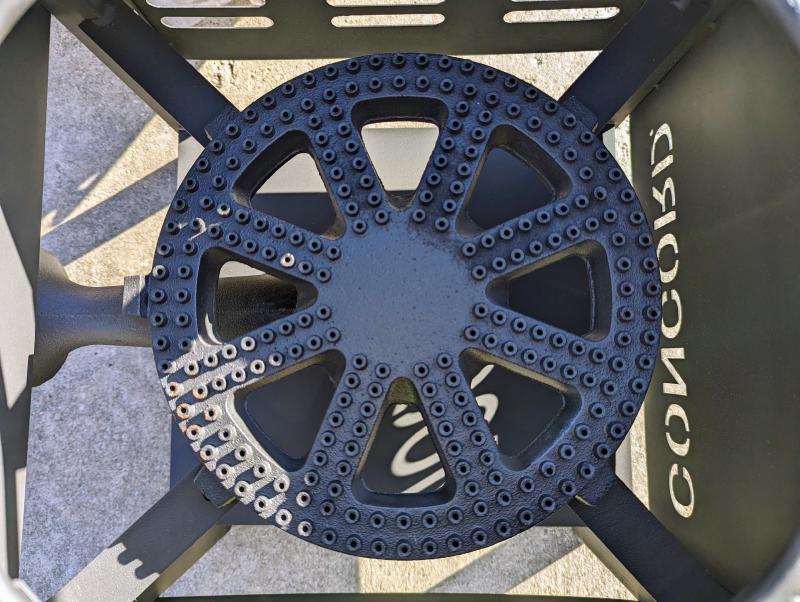
The outdoor burner is the 16-inch Concord Professional Single Banjo Wok Burner with Stand, the Stronghold. It is a propane burner rated at up to 270,000 BTU, with a cast iron banjo head, a powder-coated steel frame, a removable heavy-duty wok ring, and a built-in windscreen. It measures 16 inches on each side, weighs about 29 pounds, and is built to sit on the ground or on a sturdy stand. The standard ring fits woks of 9 inches and up; the Drop In Wok edition opens the center for 11-inch-and-up woks.
This is not a camping stove. It is a piece of outdoor kitchen equipment that happens to be portable, and it should be treated that way.
How I run it:
- Set it on concrete, gravel, or bare dirt. Never on a wood deck, never indoors, never under a porch roof or in a garage.
- Use the regulator and hose specified for the burner, and check the connection with soapy water before the first light of the season. A high-pressure propane leak is not a smell to troubleshoot with a match.
- Keep the tank at least two feet from the burner and out from under the frame. The CPSC’s turkey-fryer guidance is the right rule of thumb even though this is not a turkey fryer.
- Open the tank valve slowly, crack the burner valve, and light with a long lighter. Do not open the burner valve wide and then hunt for a flame; a wide-open banjo head can pool gas before it lights.
- Preheat the wok for a minute or two, then cook in small batches. 270,000 BTU will overwhelm a crowded wok; the food will steam in its own water before it sears.
- Keep the wok moving. The ring is there to hold it at the right height, not to let it sit in one spot and burn.
- Turn the tank off first and let the burner burn down the gas in the line, then let the whole thing cool before you move it. The frame stays hot longer than the flame does.
- Wear heat-resistant gloves. The flame is invisible in daylight and the frame stays hot after the burner is off.
The Concord is the right tool when the job is a 14-inch wok, a crowd, and a driveway. It is absurd overkill for a two-person dinner, and that is part of why it works: you can turn it down and still have a wide, stable flame under the pan.
Indoors and camping: Oxenforge Ultra Powerful Portable Wok Stove#
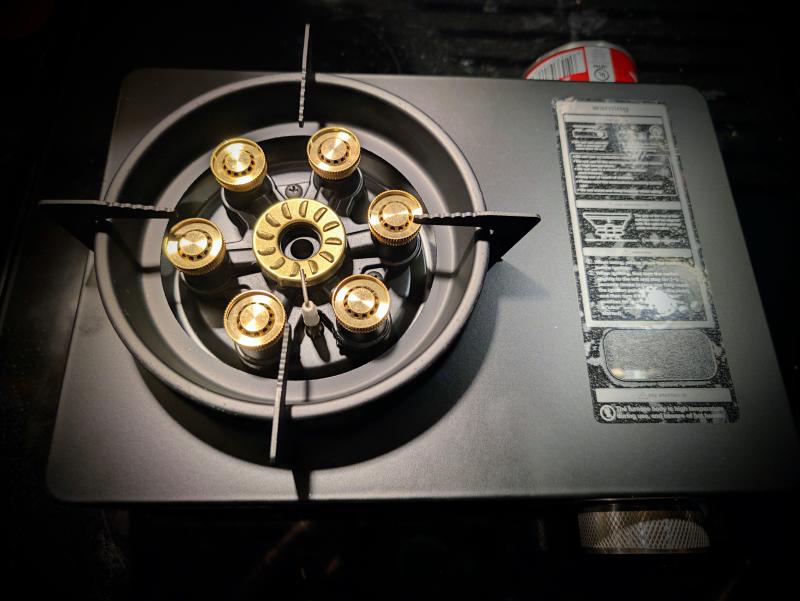
The replacement for the 90019 is the Oxenforge Ultra Powerful Portable Wok Stove. It is a 22,000 BTU/hr butane stove that weighs 2 kg / 4.4 pounds with its carrying case and measures 29 × 20 × 12 cm. It has a piezoelectric ignition, a cast copper burner, a magnetic canister lock, and grates that accept both round-bottom and flat-bottom woks. It runs on standard butane canisters; with the optional external fuel pipe, it can also run on propane, butane, and high-altitude canisters. Oxenforge rates it at about 30 minutes at full power on a standard canister.
It is not a miniature Concord. It is a concentrated 22,000 BTU flame in a package you can put in a tote bag, and that is exactly the point. It is only 7,000 BTU more than the 90019, but it is designed to put that heat into a wok instead of into a 9-inch pan. The 90019’s problem was never that 15,000 BTU was too little; it was that the heat was trapped over a fuel compartment that could not take it. The Oxenforge is the stove I use indoors and the one that goes in the truck for camping.
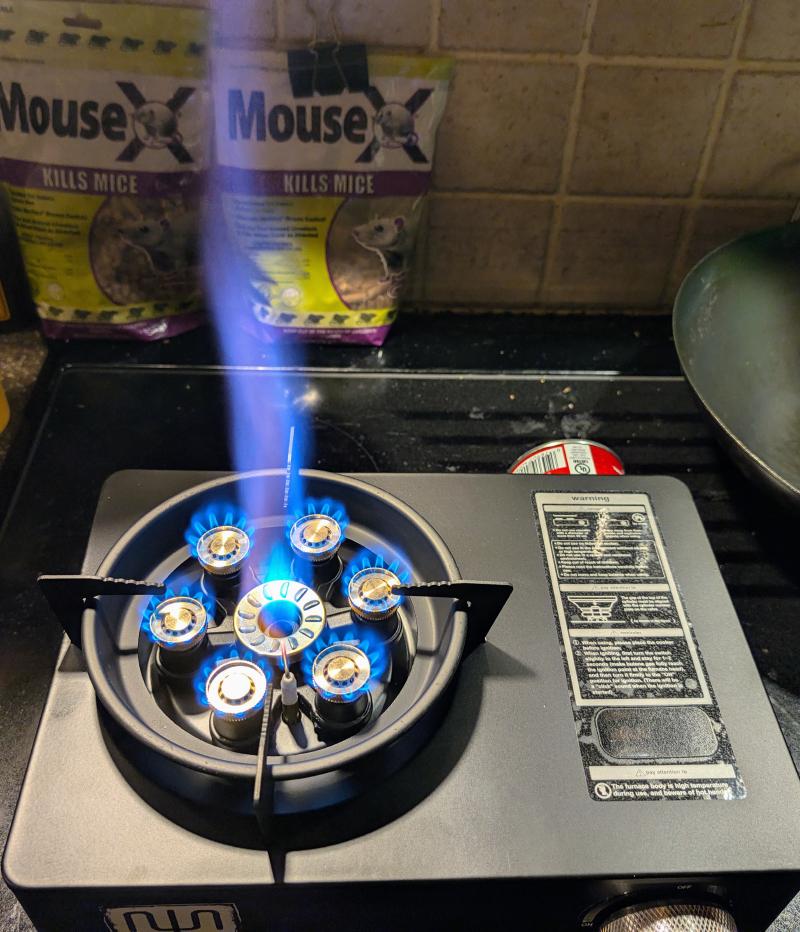
How I run it:
- Set it on a stable, heat-resistant surface and center the wok. The stove is light; a loaded wok is not. A wok that overhangs the grate is a lever waiting to tip the whole thing.
- Seat and lock the canister according to the instructions. The magnetic lock is there to keep the canister from walking out; it is not a substitute for checking that the lever is fully engaged.
- Health Canada is blunt: portable butane stoves should never be used indoors or in confined spaces, because the canister can produce carbon monoxide. I use this one indoors with a running hood, an open window, and a CO alarm, and never in a sealed room, a tent, or a vehicle. Treat that as a calculated risk, not a recommendation.
- Light it with the piezo, let the flame settle, and start low. A blue flame with a little yellow at the tip is healthy; a yellow, lazy flame means the canister is cold, the mixture is off, or the canister is nearly empty.
- Use a 12–14 inch wok. That is the size this class of stove is built around; a larger wok spreads the heat thin and turns the center into a hot spot.
- Cook in small batches and keep the food moving through the center of the flame. This stove sears best when the wok is not crowded.
- If the flame falls off, check the canister. Cold butane loses pressure, and a canister that is nearly empty will do the same thing. Do not warm it with hot water, a torch, or a heater; swap it.
- Let the burner and the canister housing cool before you pack it. The case is not a heat shield.
- If you add the external fuel pipe for cold weather or altitude, check the connection every time and keep the hose away from the burner and the drip line. The pipe moves the fuel connection outside the chassis, so the hose has to be routed with the same care as any propane line.
Neither of these burners is a reason to put a Wok Mon on a 90019. The Concord has a wok ring sized for a wok. The Oxenforge has a grate sized for a wok. The Wok Mon is a fix for a flat domestic grate with a weak flame, and it is a good one. It is not a universal adapter, and on a stove with the fuel sitting inches from the burner, it is the wrong kind of clever.
The Wok Mon is a good answer to a bad stove burner. A 15,000 BTU butane catering stove is a different problem, and the ring is the wrong answer to it. The usual result is a demonstration of how much heat is really in that flame, and the demonstration is usually expensive.
Sources#
- Serious Eats, The Wok Mon Converts Your Home Burner Into a Wok Range. For Real. — how the ring works, the 650°F baseline, and the 700–800°F wok readings.
- Serious Eats, The Best Outdoor Wok Burners, Tested & Reviewed — home burners at 3k–9k BTU, outdoor burners at 65k–210k, for scale against a 15k portable.
- WokMon, WokMon Set — burner-diameter sizing (2–5⅞ inches) and the 12–14 inch wok recommendation.
- Concord Cookware, Concord Professional Single Banjo Wok Burner with Stand (Stronghold, 16") — 270,000 BTU max, cast iron banjo head, powder-coated steel frame, 16-inch frame, 29 lb, 9-inch minimum wok, removable wok ring, windscreen.
- Concord Cookware, Concord Professional Single Banjo Wok Burner with Stand — Drop In Wok Edition (16") — 11-inch minimum wok.
- Oxenforge, Ultra Powerful Portable Wok Stove — 22,000 BTU/hr, 29 × 20 × 12 cm, 2 kg / 4.4 lb with case, piezo ignition, cast copper burner, magnetic canister lock, round- and flat-bottom wok grates, standard butane canisters, about 30 minutes at max.
- Oxenforge, External Fuel Pipe for Oxenforge Stove — propane, butane, and high-altitude canister compatibility.
- Chef Master, 90019 Portable Butane Stove instruction manual — the 9-inch pan limit, the 120°F butane warning, and the canister-overheat caution.
- WebstaurantStore, Chef Master 90019 product page — 15,000 BTU rating, brass burner, double wind guard, and piezo ignition.
- Chef Master, 2020 Product Catalog — 90019 listed with an in-line regulator with pressure-sensing shut-off and a heat transfer plate.
- GE, Use and Care & Installation Guide — the wok ring heat trap and carbon monoxide warning.
- Gas One, Cast Iron vs. Cast Aluminum Burner Heads — 2,100–2,200°F for cast iron and 1,050–1,220°F for aluminum; why aluminum sags before it fails.
- AZoM, Yellow Brass UNS C27000 — 1,660–1,710°F melting range; the 90019’s burner is brass, not iron.
- Copper Development Association, C27451 Yellow Brass — 800–1,100°F annealing range, the softening range cited.
- AZoM, Grade Zamak 3 — 718–728°F melting range for the zinc die-cast family.
- Engineering ToolBox, Adiabatic Flame Temperatures — propane and butane adiabatic flame temperatures near 3,600°F in air, roughly independent of burner size.
- MB Sturgis, LP Regulator & Hose — −40°F to 130°F operating range for a low-pressure RV propane hose and regulator.
- CPSC, Safety Tips for Turkey Fryers — two feet between the propane tank and burner on a turkey fryer.
- Health Canada, Barbecue and portable butane stove safety — portable butane stoves should never be used indoors or in confined spaces; carbon monoxide risk, canister overheat, venting, and flash-fire risk; use pans that fit the grate and do not cover the canister; never place near other heat sources.