
The Map This Essay Draws#
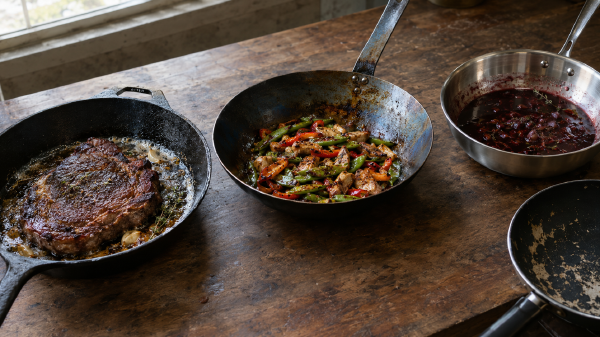
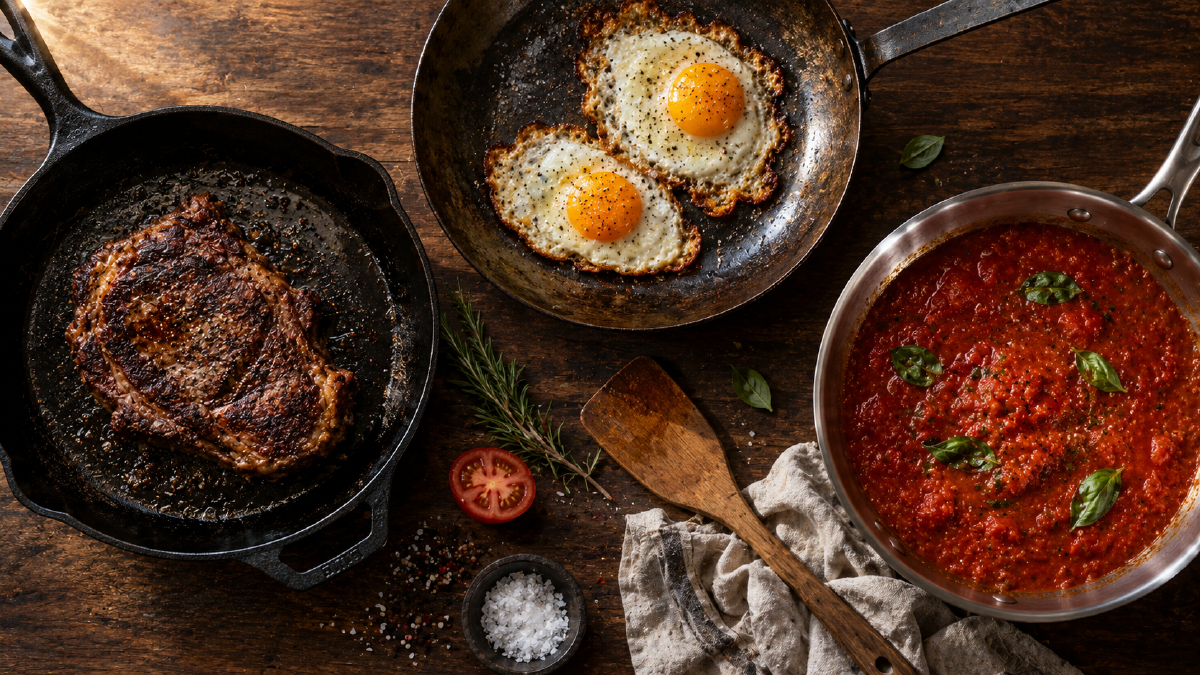
Every kitchen eventually develops the same quiet argument: three pans, three loyalties, and a cook standing at the stove trying to remember which one did the potatoes justice and which one ruined the tomato sauce. The question of which skillet to use for which food is usually answered by habit, by whatever pan is nearest, or by folklore — cast iron for everything, carbon steel for the serious, stainless for people who like scrubbing. All three answers are wrong in interesting ways. The truth is that each of these materials has a physical character that makes it a natural partner for some foods and an obstacle to others, and that understanding the character converts cooking from superstition into informed choice.
This essay is that map. It moves from the material itself — what heat does inside a slab of cast iron versus a sheet of carbon steel versus a clad disc of stainless — to the foods those properties serve, food category by food category, with the reasoning laid out rather than asserted. Steaks, eggs, fish, onions, tomatoes, cornbread, candy, breaded cutlets, caramelized sugar, and everything between will be assigned their rightful pan and explained. Two closing sections handle the practical edges of ownership: how to clean and maintain each material without fear or mythology, and why the wok — best made of carbon steel — is not merely another skillet option but a structurally different tool that certain foods require rather than merely prefer.
The premise throughout is that cookware is a technology with trade-offs, not a hierarchy. There is no best pan; there is only the pan whose weaknesses happen to be irrelevant to the food in front of you. A material that retains heat magnificently becomes a liability when the food demands quick recovery. A surface that never reacts with acid becomes pointless when the dish has no acid in it and the cook wants the crust that only raw, oily steel will give. Matching pan to food is the difference between fighting the vessel and being carried by it, and the match is learnable in an afternoon of attention. What follows is the reasoning that makes it stick.
The Physics That Decides the Question#
Heat Capacity: Why Mass Matters at the Moment of Truth#
Before any food enters the pan, three physical properties are already deciding how the cooking will go, and the first is heat capacity — the amount of thermal energy a pan can store and surrender. Heat capacity in practice is mass times the specific heat of the material, and in a kitchen it shows up as one experience everyone knows: the temperature crash. Lay a cold steak in a weakly preheated pan and the surface temperature collapses, moisture releases, and the meat steams in its own juices; lay the same steak in a heavy cast iron skillet that has been preheating for five minutes and the surface barely notices — the pan’s stored energy pours into the meat and the sear continues uninterrupted.
Cast iron’s virtue is almost entirely this stored mass. A standard 12-inch cast iron skillet weighs three to four kilograms of metal that has been heated to 230°C/446°F and holds enough energy to cook through a large batch of food, brown a roast, or maintain deep-frying temperature with a basket of cold potatoes lowered into it. Carbon steel, by contrast, is thin — a carbon steel skillet or a crêpe pan might be a millimeter or less of steel — and stores far less heat. What it gains in exchange is response: turn the burner down and a carbon steel pan’s surface temperature follows within seconds, because there is so little mass to argue with. This makes carbon steel the material of precision sautéing and delicate eggs, where a pan that keeps cooking after you reduce the flame is actively hostile to the food.
Stainless steel cookware sits between these poles only because of how it is built. Bare stainless is a poor conductor of heat — its thermal conductivity is a fraction of aluminum’s or copper’s — which is why cheap single-ply stainless pans develop hot spots that scorch sauce in rings. Quality stainless cookware is therefore clad: layers of aluminum or copper sandwiched between stainless sheets, giving the pan the conductivity of the soft metal and the inertness of the steel. The food sees stainless; the heat sees aluminum; the mass falls between cast iron and carbon steel. The practical result is a pan that spreads heat evenly across its floor, recovers moderately fast, and heats more slowly than either of its rivals — a slow, even, stable surface rather than a fierce one.
Conduction and Evenness: Hot Spots, Rings, and the Clad Difference#
Conductivity governs how quickly heat spreads sideways through the metal itself, and it explains the second thing every cook notices: whether the pan browns uniformly or in rings. Iron conducts heat respectably but not brilliantly; what makes cast iron behave evenly is its thickness, which lets heat migrate laterally before the food notices an imbalance — the pan equalizes itself through sheer volume, given enough preheating time, and punishes impatience with persistent hot spots when preheated fast. Carbon steel, being thin, has neither the mass nor the lateral spread to self-equalize, which is precisely why its most successful applications either use moderate heat with movement — pancakes, eggs, crêpes — or concentrate the burner’s fire deliberately, as in wok cooking, where hot spots are not a defect but the entire design.
Stainless clad pans solve the problem chemically rather than by mass: the aluminum or copper core conducts heat laterally faster than iron ever could, so a clad skillet heated over a single gas flame browns its outer floor almost as evenly as its center. This evenness is not a vanity — it is the property that makes stainless the safest pan for foods that scorch rather than sear, from butter-based sauces to sugar going through caramel stages. A hot spot in a pan of caramel is a burnt patch in an otherwise perfect batch, and the clad construction exists specifically to eliminate it.
Surface Chemistry: Seasoning, Passivation, and Why Food Sticks#
The second great property is chemical rather than thermal, and it governs everything about sticking, fond, and flavor: what the food actually touches. Three surfaces exist in this conversation, and they behave nothing alike.
Cast iron and carbon steel share a surface technology called seasoning — a layer of cooking oil that has been heated past its smoke point until the fat molecules cross-link into a hard, plastic-like polymer chemically bonded to the metal. Seasoning is not paint and not a coating sitting on top; it is oil become plastic become part of the pan. Its nonstick quality is real but partial: a well-seasoned pan releases food that has been given enough fat and the right temperature, and the layer repairs itself with use because every cooking session deposits a little more polymerized fat into the matrix. The same layer also answers the acidity question for these two materials: seasoning is a barrier between food and reactive iron, and it works until acid, abrasion, or neglect wears through it. The moment bare iron is exposed, two things happen — food sticks to the rough, chemically hungry metal, and the iron reacts with acids and sulfur compounds, producing metallic off-flavors and the gray-green discoloration that famously appears when eggs meet an under-seasoned cast iron pan.
Stainless steel has no seasoning and needs none, because its surface performs a different trick. Chromium in the alloy combines with oxygen to form a passive layer of chromium oxide a few molecules thick — the same self-repairing armor that defines stainless everywhere — and this layer is inert to virtually everything a kitchen contains. Tomato sauce, wine, lemon, vinegar, and tamarind sit against stainless without reacting, without stripping, and without picking up metallic taste. The price of this inertness is sticking, because nothing about the smooth oxide layer prevents proteins from bonding to it when they are heated dry and fast. Where stainless earns its keep is in fond: the brown residues that proteins and sugars leave welded to the pan floor during searing are concentrated flavor, and they release from stainless on contact with liquid — deglazing — while they would bond permanently to an unseasoned rough surface and burn onto seasoning. A cook who understands this stops seeing sticking as a failure and starts seeing it as the pan holding onto flavor until the moment liquid claims it.
The Preheat Truth: Leidenfrost, Water Beads, and the Time Constant#
The third property is behavioral, and it is the one that causes the most cross-replacement frustration in kitchens where cooks swap pans without adjusting habits: each material wants a different preheating ritual, and using one pan’s ritual on another is how food gets blamed for the pan’s mistake.
Cast iron must be preheated slowly — five to ten minutes on medium — because its mass takes time to equalize, and rushing produces exactly the unevenness its reputation denies. Carbon steel wants medium heat and patience measured in two or three minutes; it reaches readiness quickly and then demands attention, because it overshoots almost as fast as it climbs. Stainless clad needs the most deliberate ritual of the three: the preheat test for stainless is water droplets that bead up and skitter across the surface like mercury — the Leidenfrost effect, in which a droplet is supported by its own vapor — which signals the pan has reached roughly 190°C/374°F and is ready for fat and food. Drop food onto stainless before that moment and it welds to the metal; wait for the dance and the same protein releases with a nudge. Cast iron and seasoned carbon steel, being rougher and oilier, never stage so theatrical a test — they are ready when the fat shimmers and moves freely, and their forgiveness in this department is one reason beginners love them.
What the Foods Actually Need#
From these properties flows every recommendation in this essay. Foods that need fierce, sustained heat and forgives little — thick steaks, deep-frying, cornbread baking — want stored mass, which means cast iron. Foods that need responsive, moderate, controllable heat with a nonstick surface that improves with use — eggs, crêpes, sautéed vegetables, skin-on fish — want thin, seasoned responsiveness, which means carbon steel. Foods that attack the pan with acid, sugar, or delicate proteins that demand even, stable, non-reactive heat — tomato sauce, wine reductions, pan sauces, candy — want inertness and evenness, which means stainless clad. And foods that need extreme heat applied in seconds with constant motion — stir-fry above all — need not just a material but a shape, which is the wok’s domain and the subject of its own section.
With the physics established, the essay can turn to the materials themselves in earnest: what each one is, what cooking personality it brings to the stove, and which foods it naturally befriends.
Carbon Steel: The Responsive One#
What It Is and How It Behaves#
Carbon steel is iron with roughly one percent carbon and no significant chromium, rolled into a sheet and formed into a pan — the material of restaurant ranges, French crêpe pans, and the Chinese wok alike. Its defining trait is thinness paired with toughness: a carbon steel skillet typically carries one to two millimeters of metal, a fraction of a cast iron pan’s wall, and this single fact governs everything else. Light pans heat fast, cool fast, and follow the burner’s commands with a fidelity heavier materials cannot match. When the recipe says reduce to medium-low, a carbon steel pan is at medium-low within seconds; when the onions are done and the pan must stop cooking them, removing it from the flame ends the cooking rather than merely suggesting it end.
The trade-off for this responsiveness is modest heat storage and a vulnerability to hot spots. A carbon steel pan sitting over a high flame will brown the center of its floor harder than its walls, and adding a large mass of cold food — a full pound of ground meat, a heap of wet vegetables — drops the surface temperature more dramatically than cast iron would. Seasoned cooks compensate the way professionals do: hotter preheat, smaller batches, and movement, tossing or stirring so no patch of floor sits empty long enough to overheat while another cools. Where those conditions are met, carbon steel produces what many cooks consider the finest browning of any Western pan: aggressive searing crusts, lace-edged potatoes, and the dry, even heat that caramelizes without stewing.
Seasoning is the material’s second half. Out of the box, carbon steel is often dull, stiff with a protective shipping coating, and prone to sticking; after a few cycles of oil and heat, it polymerizes into the familiar dark, semi-glossy surface that releases an egg with a shake. The seasoning on carbon steel tends to be thinner and smoother than cast iron’s simply because the pan itself is smoother, which gives the nonstick quality a crisper edge — this is why a well-kept carbon steel pan often out-releases a well-kept cast iron one for delicate work, while remaining equally willing to be scrubbed back and reseasoned when something goes wrong.
The Foods Carbon Steel Is Built For#
Eggs in all their quick forms. Scrambled eggs, fried eggs, omelets, and frittatas are the classic test of a nonstick surface, and carbon steel passes with a technique any intermediate cook can learn: medium heat, a real film of butter or oil, and a moment’s patience while the proteins set before the first nudge. The responsiveness matters because eggs tolerate no carryover — a pan that keeps delivering heat after the flame is lowered turns tender curds into rubber within a minute, and carbon steel’s near-instant response gives the cook direct authority over that transition. The one asterisk is sulfur: eggs cooked against bare or thin-seasoned steel can pick up gray-green iron sulfide discoloration, which is cosmetic, tasteless, and solved entirely by sufficient seasoning — the polymer layer keeps egg sulfur from ever meeting the iron.
Crêpes, pancakes, and waffles’ stovetop cousins. Thin batters demand thin pans. A crêpe needs its floor at a stable, moderate temperature that responds the instant the pan is lifted off the flame between pours, and the ritual of wiping a barely-oiled pan between crêpes suits carbon steel’s easy-to-renew surface. American pancakes, which want slightly lower heat and longer contact for an even interior before the exterior browns, also sit naturally in carbon steel: the pan’s rapid response lets the cook drop to low the moment the first bubbles hold their shape, and the flip-side brown comes out mottled gold rather than scorched, the way it does on heavier iron that never stopped radiating at full force.
Skin-on fish and delicate fillets. Crispy salmon skin is a problem of moisture management and release chemistry: the skin must sear against hot metal with enough fat present to prevent bonding, and it must not be disturbed before it releases itself. Carbon steel’s smooth, seasoned surface and fast, even surface heat make it the reliabler for this than cast iron, whose rougher, pebbled floor gives the delicate skin microscopic handholds, and safer than stainless for less experienced hands — though stainless with proper preheat and fat performs admirably. The thin pan also recovers instantly when a cold fillet is added, and its quick cooling lets the cook halt the process the instant the flesh turns opaque at the edges.
Sautéed vegetables, from greens to mushrooms. The essence of sautéing is high heat, small quantity, and constant motion — and it is precisely the domain where cast iron’s mass is unnecessary and stainless’s stickiness is a nuisance. Spinach collapses in its own liquid if the pan cannot drive that moisture off quickly; mushrooms turn to boiled sponges if the floor loses temperature when they hit it; onions sautéing for a garnish need a pan whose heat falls the moment the burner does. Carbon steel’s thin walls flash off surface moisture fast, its seasoning releases caramelizing sugars without fuss, and its responsiveness lets the cook oscillate between aggressive searing and gentle sweating as each vegetable demands.
Hash browns, home fries, and potato crusts. Potatoes are a contest between crust and adhesion, and carbon steel resolves both: the pan gets screaming hot with oil shimmering and faintly smoking, the shredded or diced potatoes go in in a single layer, and the seasoning plus fat produces a lacy, deeply browned underside that releases intact when it is ready rather than when the cook forces it. The responsive heat matters for the finish — dropping to low to cook the interior through without re-browning the crust — a modulation cast iron resists through sheer stored energy.
Grilled cheese, quesadillas, and flatbreads. Foods built from bread and fat want a pan that browns evenly at moderate heat without the fierce stored radiation of cast iron, which can push from golden to charred while the cook is still arranging the second sandwich. Carbon steel’s even, controllable floor toasts bread to a uniform amber, and its low mass means the second batch, begun after the burner was briefly uncovered, behaves exactly like the first.
Seared steaks and chops — with the lighter touch. Carbon steel sears steak beautifully when preheated hard, offering a compromise between cast iron’s raw thermal mass and stainless’s demanding release chemistry: it takes a crust readily, releases browned meat without heroics thanks to seasoning, and gives faster control for cooks who prefer to sear and then finish gently rather than blast continuously. Its weakness — temperature drop on a large cut — is handled by preheating thoroughly, drying the meat, and not crowding the pan with more than one thick steak at a time.
Skillet sauces without acid, and quick pan gravies. A pan sauce built on fond from seared meat, with stock and a splash of wine kept brief, works fine in carbon steel as long as the acid’s contact time stays short — minutes, not a simmering hour. The seasoning tolerates what an hour of tomato ragù would not, and the same pan that seared the protein can build the sauce around it without transferring the food to another vessel, which is its own flavor argument.
The one great caution: long acidic cooks. Carbon steel’s clear failure domain is anything where acid leads for an extended period — tomato sauce simmering for forty minutes, a lemon-butter reduction held warm, a stew built on wine and left alone. The acid attacks exposed seasoning, the iron beneath responds with metallic taste and darkened color, and the pan loses its seasoning in the very region where the sauce clings. Brief contact is inconsequential; prolonged contact is a stripping operation. The rule that follows throughout this essay: carbon steel is the pan for the dish where liquid is a supporting actor, not where it is the stage on which the entire dish simmers.
Cast Iron: The Thermal Battery#
What It Is and How It Behaves#
Cast iron is iron poured into a mold with two to three percent carbon and a wall thickness measured in half-centimeters rather than millimeters — a pan that is deliberately, almost absurdly heavy. That weight is not a manufacturing shortcut but the entire engineering proposition: cast iron is a thermal battery. Charged on the burner for five to ten minutes, it stores an enormous reserve of heat energy, and that reserve keeps cooking when everything else in the kitchen wants to stop. Cold meat hits the floor and the temperature barely dips. A pot of oil receives a basket of frozen fries and the fat recovers instead of collapsing into greasy absorption. A batch of cornbread batter goes into a preheated pan slicked with fat and the edges begin frying on contact — the famous crackling cornbread crust is a direct consequence of stored mass meeting batter.
The battery has consequences on both sides. Its heat lingers after the burner is cut, which means carryover cooking continues during resting, serving, and even after the pan leaves the stove — wonderful for a steak that benefits from gentle continued energy, ruinous for eggs or delicate sauces that need the heat to stop now. Its mass also makes it slow and unforgiving to preheat: heat needs minutes to travel from the flame through three kilograms of iron and equalize across the floor, and impatience here produces the uneven hot spots that cast iron’s defenders insist cannot exist. Heat the same pan gently and patiently and its floor browns with an evenness almost no single-ply pan can match — not through conductivity but through volume, given time.
The surface is seasoned, exactly as carbon steel’s is, and generally thicker and more forgiving because the sand-cast texture of the metal grips polymerized oil tenaciously. That texture is itself a double-edged property: it builds a durable nonstick layer and it holds heat at the contact level beautifully, but its microscopic roughness gives delicate proteins — fish skin, thin egg sheets — places to mechanically bond, which is why cast iron’s nonstick reputation is excellent for sturdy foods and merely adequate for fragile ones. Bare cast iron is also chemically reactive with anything acidic, and because seasoning wears, the pan must be treated as a surface with a maintenance schedule rather than an inert tool.
Enameled cast iron is the material’s other face: glass fused to the metal at high temperature, giving up the seasoning requirement and the acid reactivity in exchange for a smoother, lighter-colored, non-stick-optional surface that will happily hold a tomato braise all afternoon. Enamel sacrifices some of the bare pan’s direct contact qualities — its release is poorer for seared proteins, and it cannot be scoured or overheated carelessly — but for the foods where bare cast iron’s only flaw was acid sensitivity, enamel converts the objection into a footnote. Where this essay says “cast iron” for a food, the bare-versus-enamel choice can be read as a preference: bare when the surface itself contributes to the result, enamel when the dish is wet, acidic, and indifferent to what is underneath it.
The Foods Cast Iron Is Built For#
Thick steaks, roasts, and hard-seared proteins. This is cast iron’s throne room. A thick ribeye wants a surface that will not flinch when a cold, wet, two-inch slab is laid on it, and no common pan holds its temperature through a sear like charged cast iron. The Maillard reaction that creates crust needs sustained surface heat above 140°C/284°F, and cast iron delivers it continuously, producing the dark, even, restaurant-quality crust on steaks, pork chops, lamb racks, and chicken thighs that thinner pans struggle to sustain. The same property finishes the job off-heat: the pan’s residual energy keeps contributing gentle energy during rest, and many cooks sear on the stovetop and complete thicker cuts in the same pan in a 200°C/392°F oven — a transition only a pan with no plastic, no bonded handle failures, and full thermal mass handles natively.
Deep and shallow frying. Frying is temperature control at scale, and temperature stability is mass. A cast iron skillet holds oil at 170°C/338°F through a load of cold food far better than a thin pan, recovering faster and overheating less — which is the difference between a crisp, evenly browned fried chicken and one that alternates between pale and scorched. Cast iron’s sloped-wall skillets serve for shallow frying and pan-frying cutlets, while its deeper Dutch-oven form handles true submersion frying; either way the principle is identical, and it is the single clearest case where a lighter pan’s fast response becomes a liability rather than a virtue.
Cornbread, skillet biscuits, and pan-baked breads. Baking in cast iron works on the same stored-heat logic as frying: a preheated pan meeting batter sizzles, setting the exterior before the crumb fully sets, which yields the crisp, fried bottom crust that defines Southern cornbread. The pan then conducts steady, even heat through the loaf in the oven, browning uniformly without the hot spots that plague thin bakeware. Cast iron’s oven ceiling — essentially unlimited for bare iron — matters here too, since many breads bake at 220–240°C/428–464°F.
Skillet pizza and flatbreads. Pizza in a screaming-hot cast iron pan gives a fried, crisp underside and a chewy rim, with the mass keeping the floor hot after the dough lands — the enemy of pizza is a floor that cools on contact, and dough is a large, cold, wet load. The same pan slides under a broiler for the top melt, completing the pie with the leopard-spotted char of a deck oven.
Dutch babies, popovers, and oven puffs. These batters rely on a violent burst of steam against a hot, fat-coated surface to climb, and a preheated cast iron skillet is the classic vessel. The pan’s heat reserve means the batter begins rising the instant it lands, while the oven’s ambient heat finishes the structure — and the dramatic, uneven puffing looks right in a heavy, dark pan that radiates heat strongly.
Caramelized onions and long, slow, dry-ish cooking. Onions caramelized properly take forty minutes of low, steady heat and frequent stirring, and cast iron’s forgiving, even warmth is ideal — the pan cannot be shocked into hot spots by stirring because it holds its floor temperature through every disruption. The same argument serves slow-sautéed mushrooms after their water has cooked away, long-rendered bacon, and confit-style cooking where gentle sustained heat does the work. The caveat is movement and patience: cast iron’s retained heat means onions left alone will darken unevenly, so the stirring cadence stays regular.
Corns, tortillas, and dry toasting. Dry-toasting spices, charring corn tortillas for tacos, and blistering corn kernels or padrón peppers all benefit from mass: food added to a cast iron floor loses little heat, so blistering happens instead of steaming, and the char comes quickly. This is also why cast iron excels at the reverse — keeping finished tortillas warm in the oven while the rest of the meal finishes, holding their heat for the table.
Stews, chili, and braises — bare or enameled. For thick, long-cooked dishes with moderate liquid, cast iron transitions from stovetop to oven and holds a bare simmer with minimal flame attention. In the bare pan, a chili or stew with only light acidity is superb and arguably better seasoned with use; in enamel, the same dish with aggressive tomatoes, wine, or vinegar is equally at home with zero maintenance risk. The choice reads: mild braise in bare iron, proudly acidic braise in enamel.
Burgers and smash burgers. The crust on a smash burger is created by pressing cold, coarse-ground beef against a very hot surface, and cast iron’s mass delivers the temperature recovery needed for several batches in succession. Its texture also helps the crust grip and release at the right moment, and the fond left behind — beef fat polymerized into the seasoning — makes the pan better with every batch.
The one great caution: acid and delicate release. Where cast iron fails is precisely where carbon steel fails, only sooner: prolonged acidic cooking in a bare pan strips seasoning and imparts metallic flavor, and this is why tomato-heavy ragùs, wine braises with hours of reduction, and lemon-forward sauces belong elsewhere or in enamel. Its second failure is delicate release — fish fillets, thin crepes, and omelets bond to the textured floor more readily than to smooth steel — and its third is thermal inertia when heat must fall immediately: foods that finish in residual cast iron heat keep cooking, and the cook must plan the pan off the burner early rather than at the recipe’s stated endpoint.
Stainless Steel: The Neutral Stage#
What It Is and How It Behaves#
Stainless steel cookware is a composite product pretending to be a single material: sheets of 18/10 or 18/8 stainless — iron with roughly eighteen percent chromium and up to ten percent nickel — bonded over a core of aluminum or copper that does the actual heat work. The stainless is chosen entirely for its surface: chromium’s passive oxide layer makes it inert to acid, salt, and virtually every other compound a kitchen produces, it never seasons, never flakes, never reacts, and can be scoured, soaked, and dishwashered without strategic anxiety. The core is chosen for everything else — lateral heat spread, response, and the elimination of the hot spots that a poor conductor like bare stainless would create.
This split personality defines the material’s behavior. The pan’s food-facing surface is the least sticky and most chemically indifferent of the three; its thermal character is middle-of-the-road, with even floor heat from the clad core, moderate mass, and slower preheating than either iron pan. It will not deliver cast iron’s furious, sustained sear or carbon steel’s instant response — but it does something neither can: it holds a uniform, controllable, chemically neutral floor across its entire area, indefinitely, without requiring seasoning care, and it releases browned-on flavor into liquid on demand.
Sticking is the famous cost, and it deserves honest explanation rather than apology. Proteins bond to hot, dry metal whenever they are placed on a surface too hot and too bare to let their own structure set before contact — stainless’s smooth oxide gives them nowhere to grab microscopically, but chemistry does the welding. The fix is a ritual rather than a coating: fully preheated pan to the water-bead test, adequate fat, dry food, and above all patience — food placed on proper stainless releases itself when the Maillard crust beneath it has finished, usually after the cook has stopped watching anxiously. The cook who presses, nudges, or checks early tears the protein and blames the metal; the cook who waits discovers the pan letting go with a nudge. This is why stainless technique is considered the marker of an advanced stove hand: it demands understanding of the release event rather than dependence on a permanent surface treatment.
The foods that love stainless are, with rare exceptions, foods where one of its three unique strengths decides the outcome: acid neutrality, fond management, or scorch-resistant evenness. It is also the only one of the three that is oven-safe in the modern sense for broiling with lids off, dishwasher-safe without endangering a seasoning layer, and visually honest — because the pan is light-colored inside, the cook can watch butter foam progressing toward brown, onions crossing from sweated to golden, and caramel deepening through its stages with a precision that black iron floors make guesswork.
The Foods Stainless Steel Is Built For#
Tomato sauce, and every acid-forward braise. This is stainless steel’s clearest win. A marinara simmering for an hour, a shakshuka base, a butter chicken gravy, a wine-braised short rib liquid, a pan of tomato paste cooked to brick red — all of these attack seasoning on iron and all of them sit on stainless with no consequence whatsoever, no metallic taste, no darkened color stripped from the seasoning, no maintenance debt. The inertness extends to the whole flavor family: lemon, vinegar, tamarind, wine, verjuice, and yogurt-based sauces can reduce in stainless until they are thick and aggressive, tasting only of themselves. Enamel-coated cast iron covers this same territory, but bare stainless does it more cheaply, more evenly for reduction work, and with better fond integration for dishes that sear first.
Deglazed pan sauces — the fond economy. The sequence of searing meat, removing it, adding aromatics to the fond, and drowning everything in liquid is the beating heart of classical sauce-making, and stainless is its native vessel. The brown residues weld to the floor during the sear rather than being absorbed into seasoning, they cannot burn irretrievably the way they would on a textured surface because they remain accessible to liquid, and deglazing lifts them completely — the wine turns brown in seconds, and the entire flavor of the sear transfers into the sauce. In a seasoned pan the same residues either season the pan (flavor lost to the sauce) or char into the seasoning (flavor destroyed). For steak au poivre, pan sauces with mustard and cream, mushroom ragouts built on seared fond, and every “don’t skip this step” instruction in a French technique book, stainless is the correct and intended stage.
Wine reductions, vinegar glazes, and gastriques. Reductions concentrate acid along with flavor, and reduction means prolonged heat on an increasingly aggressive liquid — exactly the process that would strip iron seasoning in minutes. Stainless holds a wine-and-shallot reduction to a syrup without reacting, and the light interior lets the cook see the reduction’s bubbles change from loose and fast to tight and slow, which is how doneness is judged. Sugar-and-acid glazes — balsamic glazes, cranberry reductions, fruit compotes — fall in the same category: the dish is defined by controlled scorching of sugar in the presence of acid, and only an unseasoned, non-reactive floor can be trusted with it.
Candy, caramel, and sugar work. Sugar cooking is a precision art of controlled burning: soft ball at 112°C/234°F, hard crack at 149°C/300°F, caramel darkening by the second. It requires an even floor without hot spots (a hot spot burns one patch of sugar while the rest lags), a non-reactive surface (acidic fruit syrups and cream-based caramels attack bare metal), and visual monitoring against a light background — stainless clad delivers all three, and its moderate mass makes temperature overshoot at the end of cooking manageable. Seasoned iron is disqualified twice over: sugar bonds to seasoning and tears it away as it hardens, and the dark floor hides the color changes that signal caramel perfection.
Eggs and delicate proteins — with technique. Butter-basted fried eggs, soft scrambled eggs, and omelets do beautifully in stainless when the preheat and fat rules are followed, and many professional kitchens prefer them there precisely because stainless can be scrubbed sterile between batches — no seasoning carries one batch’s flavor into the next. Delicate fish fillets — sole, flounder, tilapia — release from properly heated, well-fatted stainless more reliably than from the textured floor of cast iron, and the light surface shows exactly when the flesh’s proteins have set enough to move. The threshold for failure is higher than iron’s, but the reward is a cleaner release event and an easier cleanup for the next dish.
Butter-based and cream sauces. Béurre blanc, hollandaise in a pan, cream reductions, and any sauce where butter’s milk solids are being browned or merely warmed need even, moderate, responsive heat and no metallic interference — brown butter is a delicate Maillard reaction of milk solids that scorches in a heartbeat on an uneven floor. Clad stainless spreads the heat so uniformly that butter foams across the whole pan at once, and its neutrality means nothing in the sauce’s emulsion reacts with the vessel. Cast iron’s radiating mass overshoots the narrow temperature window; carbon steel can do it, but stainless’s evenness and light interior for reading the butter’s color make it the natural choice.
Scallops, shrimp, and quick-seared shellfish. Shellfish sear in seconds and turn rubber in half a minute of overcooking, so the pan must deliver immediate, even heat and release quickly — and stainless, preheated to the droplet test with adequate fat, releases scallops with the clean sear that sticking’s opposite face provides: the same chemistry that welds protein to dry metal guarantees that a properly crusted side will release when crust is complete. The light floor also helps the cook see shrimp turning from gray to coral without lifting.
Poaching, shallow braising, and one-pan liquids. Poached fish, eggs poached in simmering water, and shallow-braised greens need stable, non-reactive liquid holding — stainless holds simmering water and stock without imparting anything, and its oven-to-table behavior with a lid makes it the default for dishes that finish covered. None of this requires thermal drama; the pan simply must be inert and patient.
Boiling, blanching, and reheating in the pan. Beyond searing, stainless’s neutrality makes it the correct vessel whenever liquid is the medium rather than the accompaniment: blanching vegetables before shocking, warming beans in their own liquor, reheating leftover stew without altering it, and rendering where water accompanies fat. Iron pans can perform these tasks, but they spend their seasoning doing it, and cast iron’s mass makes bringing liquid to a boil an exercise in wasted time.
The one great caution: patience is mandatory. Stainless’s failures are all failures of protocol rather than material: insufficient preheat welds food, insufficient fat glues it, impatient release tears it, and an aggressive high-flame reduction on a thin single-ply pan scorches rings into the floor. The pan asks for the Leidenfrost test, real fat, dry food, and waiting — and gives, in exchange, the only fundamentally flavor-neutral, acid-proof, maintenance-free cooking surface of the three. Where iron is a living surface that must be tended and stainless is a neutral stage, the cook who understands both stops choosing between them by loyalty and starts choosing by the dish.
The Food-by-Food Guide: Proteins#
The three material sections established why each pan behaves as it does; this guide applies that reasoning dish by dish, beginning with the proteins that most often decide a cook’s loyalties. The recommendations are preferences grounded in the physics above, not laws — every food here can be cooked acceptably in two of the three materials with suitable technique — but in each case one pan gives the result the dish is asking for with the least fighting.
Thick Steaks and Roasts: Cast Iron, Fiercely Preheated#
A ribeye, strip, or porterhouse two-and-a-half centimeters thick is a duel with moisture, and the winning weapon is sustained heat that the pan will not surrender. Cast iron, preheated slowly until the entire floor is uniformly radiating, sears the exterior to a dark Maillard crust while the interior climbs to medium-rare, with the temperature dip from the cold meat absorbed entirely by the pan’s reserve. The ideal method — a hard sear in the dry or barely-oiled cast iron, then a gentle finish either in a 200°C/392°F oven inside the same pan or over low flame while the cook bastes with butter, garlic, and thyme — depends on the pan’s dual nature as stovetop battering ram and oven-proof mass. Carbon steel is a legitimate second choice for a single steak when speed and post-sear control matter more than absolute crust, and its seasoning releases the meat without the stick-scrape-stress of stainless; stainless earns its place when the cook wants the fond intact for a sauce immediately afterward and accepts that the sear will demand more attention. Thin, wide, one-inch steaks or minute steaks flip the calculus toward carbon steel or stainless, because their total cook time is short enough that mass matters less than responsiveness.
Burgers and Smash Burgers: Cast Iron or Carbon Steel#
A burger’s crust is created by ground meat pressed against intense heat, and both iron pans serve it — cast iron when the cook wants deep, sustained browning and temperature recovery across batches, carbon steel when the cook wants to regulate heat precisely for medium interiors without carryover overcooking thin patties. Smash burgers favor cast iron’s fierce floor: the press happens in the first ten seconds, the crust forms almost instantly, and the pan’s mass means the second batch meets the same fury as the first. The fond question decides between them when a pan sauce or gravy follows: choose stainless for a fond-based gravy, iron for eating the burgers straight with the crisp edges alone. Where burgers lose: stainless’s release is workable but demands precise timing, and its floor recovers more slowly under repeated cold patty loads.
Chicken: Thighs in Cast Iron, Breasts in Carbon Steel or Stainless#
Chicken thighs are collagen-rich, forgiving, and best when their skin is rendered glass-crisp and their meat finishes tender — a job for cast iron’s patient, sustained heat, ideally skin-down in a cold pan brought up together to render the fat slowly, or in a hot pan for a faster crust, then finished in the oven in the same vessel. The thighs’ robustness suits iron’s texture, and their fat content protects the seasoning. Chicken breasts, by contrast, are lean, unforgiving, and turn from perfect to dry in ninety seconds: they want responsive heat that stops on command — carbon steel’s strength — or the even, moderate floor of stainless where they can be butter-poached in the pan’s own shallow liquid. For breasts in slices destined for stir-fry, the wok claims them entirely, at speeds no flat pan matches. Breaded chicken cutlets — schnitzel, Milanese, katsu — fall to whichever frying pan is at hand, with cast iron giving the steadiest oil temperature for deep frying and stainless or carbon steel managing shallow frying admirably for single batches.
Pork Chops and Roasts: Cast Iron for the Sear, Stainless for the Sauce#
Pork chops behave like small steaks and answer to the same logic: cast iron for the crust, especially thick bone-in chops that sear and then finish in the oven, with the pan’s carryover heat helping the resting phase. Lean, fast-cooking loin chops suit carbon steel’s quicker tempo. Pork roasts and tenderloins that will be followed by a pan sauce made on the fond hand the skillet decision to stainless: sear the meat in the neutral pan, build the sauce in the same fond, and let the reduction’s acidity — apple cider, wine, mustard — live without stripping anything.
Lamb: Cast Iron’s Fierce Floor, Stainless’s Fond#
Lamb’s fat is its signature, and fat rendering is a mass game: lamb chops, racks, and leg steaks want cast iron’s unyielding heat to crisp the exterior fat and brown the meat without the pan cooling into grease pooling. Ground lamb and kofta sear happily in either iron pan. But lamb is also the meat of pan sauces — rosemary, red wine, currant jelly reductions — and where the sauce is the point, stainless hosts the entire sequence so the fond remains available to the liquid.
Skin-On Fish: Carbon Steel First, Stainless with Skill#
Crispy-skin salmon, arctic char, or branzini is a release problem, and carbon steel’s smooth, seasoned floor gives skin the best chance of searing to a crisp sheet that lets go intact — provided the skin is dry, the pan is properly hot, the fat is generous, and the cook does not touch the fillet until it releases itself. Stainless performs equally well for an experienced hand and has the advantage of showing exactly when the fond and flesh progress, but it punishes early attempts more harshly. Cast iron is the last choice for delicate skin because its pebbled surface mechanically grips the skin’s proteins; it excels instead with sturdy, skinless, meaty fish — monkfish, swordfish steaks, halibut — that can withstand iron’s texture and reward its fierce heat. Poached and en papillote fish belong to stainless or enamel, where liquid rules.
Shrimp, Scallops, and Mussels: Stainless for Precision, Wok for Speed#
Shellfish cook in one to three minutes, so the pan’s job is immediate even heat, rapid visual feedback, and quick release — stainless’s territory when seared scallops and shrimp are the goal, with the light floor displaying doneness at a glance. Mussels and clams steamed in wine and aromatics want a covered pan that will not react with the acid — stainless or enamel — and the same is true of fra diavolo and any shellfish stew with tomatoes. For large quantities of shrimp or mixed seafood stir-fried with aromatics at high heat, no flat skillet of any material competes with the wok’s toss-and-flare tempo.
Organ Meats and Wild Game: Carbon Steel or Cast Iron by Cut#
Liver sears in ninety seconds a side and dries in half that — carbon steel’s responsive heat and nonstick surface make it the natural pan for calves’ liver with onions, where seconds decide texture. Heart, kidneys, and sweetbreads reward cast iron’s searing fury. Wild game — venison, elk, duck breast — is lean and dense: venison steaks follow the cast-iron steak method with even more urgency about not overcooking (carbon steel’s fast cool-down helps), while duck breast’s thick fat cap renders best in a cold cast iron pan brought up slowly, letting the fat pool out before the skin crisps.
The Food-by-Food Guide: Breakfast, Vegetables, and Starches#
Eggs: Carbon Steel’s Crown, Stainless’s Diploma, Cast Iron’s Caveat#
No food is more contested in the pan material debate, because no food exposes a surface’s true character faster than an egg. Fried eggs want a floor that is hot enough to set the white on contact yet mild enough to keep the yolk liquid — carbon steel, with its thin response and self-renewing seasoning, delivers this with the least ceremony: medium heat, butter, a brief pause, and the egg slides. Omelets make the same demand more severely, since the tender custard must roll against the pan wall without tearing, and the classic French crêpe-pan tradition of carbon steel for omelets is no accident. Scrambled eggs, cooked low and slow in the French style or fast in the diner style, again favor carbon steel for the immediate response that ends carryover cooking the instant the pan is lifted.
Stainless graduates eggs when the technique is clean — full preheat to the water-bead test, generous butter, eggs slid in without crowding, and the patience to let the bottom set completely before any movement. The reward is an egg that releases whole and a pan that can be scrubbed between courses with no thought of seasoning politics. Cast iron can fry an egg beautifully in a well-seasoned pan, but its textured floor makes the release less reliable and its residual heat keeps cooking the yolk after the flame is out — which is why the standard advice is to pull cast iron eggs early and plate immediately. The sulfur discoloration problem — gray-green tint from iron sulfide — belongs specifically to bare or thin-seasoned cast iron meeting egg sulfur, and it is harmless but unattractive; a mature seasoning layer prevents it entirely.
Pancakes, Waffles, and French Toast: Carbon Steel, Cast Iron by Style#
Pancakes are a heat-regulation exercise: brown exterior, risen interior, no raw middle, and no carryover that turns the stack gray on the plate. Carbon steel’s floor drops to low the moment the cook says so, and the even-but-responsive browning produces the mottled gold pancake enthusiasts seek. Cast iron suits thick, buttermilk-style pancakes and Dutch-baby-style batters where stored heat and oven transfer matter more than stopping power, and its mass keeps a big batch at steady temperature after the first pour — provided the cook lowers the heat to compensate for the charging pan. French toast, which needs a moderate, even floor for four minutes a side without scorching the custard’s milk solids, is comfortable in either iron pan; stainless does it too, with sticking managed by the usual preheat-fat-patience trinity.
Hash Browns, Home Fries, and Breakfast Potatoes: Cast Iron or Carbon Steel#
Shredded hash browns are the crust-and-release test again: cast iron gives the deepest, most even browning across a wide patty because its floor temperature barely dips under the cold potatoes, and its seasoned surface releases the browned lattice when the cook judges it ready. Diced home fries, stirred frequently through a long browning phase, take equally to cast iron’s steady warmth or carbon steel’s faster cycle — carbon steel for cooks who like to drive moisture off hard at the start and then gentle the interiors; cast iron for the oven-finished method where the skillet transfers to heat the potatoes through after stovetop browning.
Sautéed Vegetables: Carbon Steel Almost Always#
The vegetable kingdom belongs overwhelmingly to carbon steel, and the reasoning from the material section applies category by category. Greens — spinach, kale, chard — wilt in under two minutes and must shed their water fast; a thin pan at high heat does this while a heavy pan’s retained energy overcooks them toward olive-drab. Mushrooms require dry, high heat to brown rather than steam, and carbon steel’s quick response lets the cook drive off their released water and then brown in the rendered fat without scorching. Asparagus, green beans, and broccolini want blistering char with crisp-tender interiors, which thin steel at full flame delivers. Zucchini, summer squash, and peppers brown and soften in the same tempo. Onions for fajitas or a quick garnish want fierce heat and constant motion; the same pan handles them in minutes.
Two vegetables complicate the default. Caramelized onions, cooked truly — forty to fifty minutes of low, steady stirring — suit cast iron’s patient floor as much as carbon steel’s control, and the choice comes down to whether the cook prefers steady ambient warmth or active modulation; both deliver, stainless tolerates them, and the only wrong pan is one walked away from. Roasted root vegetables and sheet-pan-style stove-then-oven work belongs to cast iron, where the skillet can brown on the burner and finish in a hot oven without a vessel change.
Starches and Grains: Potatoes, Rice, Pasta, Bread#
Potatoes in every guise follow their texture: crispy preparations to cast iron or carbon steel per the hash brown logic, creamy preparations — mashed potatoes, potato gratin, purees — to stainless where dairy and acidity are involved and scorch-free evenness matters. Rice, unless steamed or boiled in a pot, meets the skillet only as fried rice, and fried rice is wok territory; a wide carbon steel skillet can approximate it with day-old rice over maximum heat, but the toss-and-sear geometry of the wok is the point of the dish.
Pasta meets the skillet as sauce, not as boil — the boiling belongs to a stockpot — and sauce decides everything: tomato, vodka, wine, and cream-tomato hybrids to stainless or enamel; garlic-and-oil aglio e olio, where the pan merely carries flavored fat, to carbon steel with the pasta finished in the same pan; cacio e pepe and butter-emulsion sauces, which scorch at the slightest unevenness, to clad stainless for its even floor and light interior. Pasta bake and pasta alla Norma finish in the oven: cast iron for the crisp-edged cheesy top, enamel or stainless for the acidic base beneath.
Cornbread, skillet biscuits, focaccia, and pan pizza return to cast iron and its preheated-batter sizzle, while lean yeasted flatbreads and crêpes stay with carbon steel. Tortillas — flour or corn — want the dry, fierce heat of cast iron or a well-seasoned carbon steel griddle, the traditional comal being exactly that: a thin steel or iron plate whose mass holds toasting heat while its surface stays bare and dry.
Corn, Avocado Toast, and the Small Plates#
Charred corn kernels and blistered shishitos are mass-and-ignition foods: cast iron holds the heat while the kernels char rather than steam. Avocado toast’s bread wants the moderate, even toasting of carbon steel or stainless — there is no heroism here, only bread meeting controlled heat — while the egg on top follows the egg rules above, which usually means the cook owns both pans at the stove in the first place.
The Food-by-Food Guide: Sauces, Sweets, and the Acidic Frontier#
Tomato Everything: Stainless or Enamel, Without Exception#
Tomato is the great separator of pans, because it is simultaneously the most common sauce base in the world and the most aggressive common ingredient against iron. The acid in tomatoes attacks exposed iron directly and the seasoning layer chemically, and the results of cooking a slow tomato sauce in bare cast iron or carbon steel are consistent and unmistakable: a metallic, slightly tinny taste, a darkening of the sauce, and a pan whose seasoning has been stripped in a broad swath where the acid pooled. The longer the cook and the more concentrated the tomato — paste worse than passata, hours worse than minutes — the more pronounced the damage. Therefore the entire tomato family, without exception, belongs to stainless or enameled cast iron: marinara and ragù; shakshuka (the traditional cast iron egg dish is, in fact, properly cooked in a bare cast iron pan only briefly and with the eggs never meeting long-simmered tomato, or moved to enamel for the full simmer); pomodoro pasta sauces; tomato-based curries and butter chicken gravy; chili with a full can of tomatoes; salsa roja cooked down; and pizza sauce reduced on the stovetop. The stainless pan takes a two-hour ragù without noticing; the light interior lets the cook watch the sauce darken from raw red to deep brick; and nothing in the pan imparts anything to the food.
The wok is the one iron vessel that does deal with tomato, briefly: a blistered tomato stir-fry, in which halved tomatoes hit a smoking wok for ninety seconds and leave with their skins blistered and their acid barely in contact with the metal, sits in a different category because the contact time is trivial and the seasoning is renewed immediately afterward. This is the general rule for carbon steel and cast iron if a dish insists on its acid: shorten the exposure, and reseason after.
Cheese Sauces, Cream, and Dairy: Stainless for Evenness, Carbon Steel for Fond-Based#
Dairy provides two very different cooking problems. Melted cheese sauces and cream reductions scorch the instant a floor’s temperature varies by a few degrees, and only a pan with uniform lateral heat spread can hold a cheese sauce at a simmering-not-burning temperature — clad stainless, or enamel. Carbon steel and cast iron can handle cream briefly (a pan sauce finished with a splash), but they are the wrong vessels for a long-held béchamel or a cheese sauce that must sit at serving temperature. The other dairy problem is starch-and-water-based — macaroni and cheese, gratins — which, if assembled and baked, belongs to cast iron for the crisp-edge top and to stainless or glass for the custardy middle. Cream-based pasta sauces, alfredo above all, prefer stainless’s even, responsive floor and its ability to be scraped clean without disturbing seasoning.
Caramel, Candy, and Sugar: Stainless Only#
Sugar transforms by temperature and color, and both are read off the pan; the requirement is an unreactive, evenly heated, light-colored surface. Stainless clad delivers: the floor reaches a uniform temperature so that crystallization and burning occur uniformly rather than at hot spots, the inert surface tolerates the acidic components of fruit caramels and the cream of toffee, and the pale interior lets the cook watch sugar pass from amber to mahogany before it laces toward bitter. Cast iron and carbon steel are doubly disqualified — sugar welds to seasoning and tears it away when it sets hard, and both floors are dark enough to disguise the moment where caramel should leave the heat. Enamel-coated pans can handle sugar sauces and fruit compotes, but for hard candy temps and precise dry caramel, nothing beats a familiar clad saucepan or skillet.
Jams, Fruit Preserves, and Marmalade: Stainless or Enamel#
Fruit preserves are sugar, acid, and water cooking for a long time in a state of active attack on any reactive surface. Prolonged boiling with fruit acids strips bare iron seasoning in a single batch and leaves a metallic tang in set jams; pectin reactions are sensitive to metal ions; and the coloring of light fruits suffers from iron contamination. Stainless and enamel are the answer without compromise. The same goes for lemon curd, lime curd, and any citrus preparation, where the double assault of acid and sugar demands complete inertness.
Reductions, Gastriques, and Acid Glazes: Stainless#
Wine, vinegar, verjuice, and citrus reduced to a glaze occupy the same territory as preserve-making with less sugar and more heat: the reduced liquid becomes progressively more concentrated acid held over a hot floor for minutes to tens of minutes, which is precisely the set of conditions that destroys iron seasoning. Stainless does the work without judgment, and its light floor shows the bubble-size progression that signals syrup stage.
Frying and Confit: Cast Iron for Volume, Carbon Steel for Precision#
Deep and shallow frying both trace back to the heat-capacity principle. A pot of oil for fried chicken, doughnuts, or fries at scale wants cast iron or its Dutch-oven form: the mass holds the frying temperature through cold loads, recovering quickly enough that crusts brown evenly rather than absorb oil during the pan’s recovery dip. Small-batch shallow frying — a few cutlets, one round of tempura, a couple of eggs — suits the faster responding carbon steel, where the cook can move between high for the initial sizzle and lower for even browning. Confit, which requires a long, gentle, stable fat bath (often 90–130°C/194–266°F), is safest in cast iron’s or enamel’s steady mass, where temperature drift is minimal and no scald risk of a hot spot exists.
Chocolate Work and Scorched-Delicate Dairy: Stainless, Lowered and Attentive#
Melting chocolate, making ganache, and heating milk for custard all fail at exactly the same failure mode: a hot spot scorches the solids and ruins the batch. Clad stainless gives the most uniform floor available, and its light interior lets the cook see the scarf of scorch beginning in time to react. Iron pans, with their dark floors and either retained heat or thermal lag, give the cook no visual or thermal warning until the damage is done.
The Blade’s Edge of All Three: Starchy, Saucy, and Slow#
Finally, a category of everyday cooking where the pan choice is less about zeal and more about consequences across hours: stews, soups, and slow braises in a skillet or braising pan. If the braise is acidic — wine-based, tomato-based, vinegar-splashed — stainless or enamel. If it is a milk-and-salt braise (pork in milk, certain Tuscan dishes central to Italian cooking) — stainless or enamel again, since milk solids and long heat leave iron pans both scorched and stripped. If it is a neutral, fat-forward, mostly-meat braise — carnitas simmering in lard, a pot roast in stock — bare cast iron works beautifully and only becomes more seasoned throughout.
The Wok: Shape as Technology#
Why a Wok Is Not Just a Deep Skillet#
Western cooks often assume the wok is simply a large, bowl-shaped frying pan, and that a sufficiently wide skillet can substitute for it. It can, marginally, for a handful of dishes — but the wok is not a pan variant; it is a different thermal instrument, and understanding why some foods essentially require one begins with the structure no flat pan possesses.
The first structural feature is the sloping wall. A wok’s sides rise at a shallow angle from a small, curved floor, and this geometry creates deliberate temperature zones: the small hot center where food is seared, the cooler mid-walls where food is pushed to rest, and the still-cooler upper walls where nothing cooks at all and aromatics wait. A cook working a proper wok is continuously moving food among these zones, treating the vessel as a temperature gradient rather than a single uniform surface. That gradient is not a compromise but the design’s central purpose: in one motion, the cook sears a protein at the floor, banks it up the wall to stop its cooking, and drops the next ingredient into the freed hot zone. No flat pan of any material can reproduce that zoning; the very uniformity that makes a skillet good at searing and sauces is what makes it wrong for the rapid choreography of stir-frying.
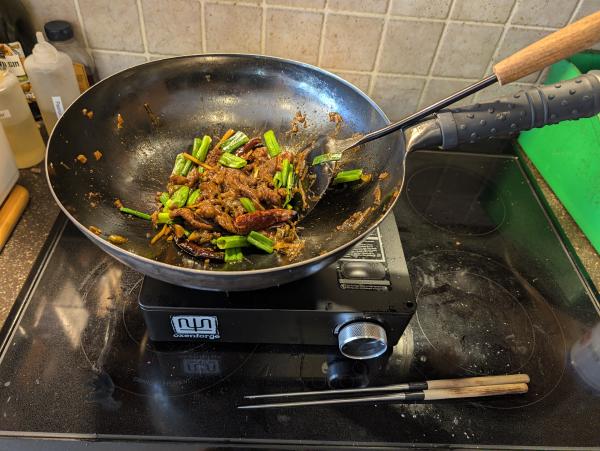
The second feature is the curved floor’s relationship to the heat source. Sitting in the ring of a high-output burner, the wok’s floor receives a concentrated column of flame and reaches temperatures that flat skillets never see — often 300°C/572°F and beyond, with the dish’s own oil at the smoke point and the metal beyond it. The wall’s slope means the concentrated floor area is small, so heat is intense exactly where the cook wants it, and the wide mouth means enormous surface area for evaporation: that mouth is a chimney. Every toss sends steam and volatile aromatics out of the pan rather than letting them pool, which is why wok cooking smells like the street rather than like a simmering pot. The skillet, with its low walls, actually outperforms the wok at draining off vapor — until food must be moved, tossed, and seared in an environment where wide-diameter contact would burn it. The wok trades even contact for speed and control, and stir-fry dishes are built around that trade.
Carbon Steel: The One Right Answer#
Woks are made from carbon steel, cast iron, aluminum, stainless steel, and nonstick-coated metals. Only the first is correct for serious use, and the reasons parallel everything this essay has said about the material — carbon steel’s thinness, toughness, and willingness to be seasoned — while adding a few specific to the wok’s demands.
Carbon steel woks are one to two millimeters thick, and this is the wok’s entire thermal identity: thin enough to heat and cool almost instantly when the cook moves the pan on and off the flame, and to respond to the adjustable roar of a high-output burner within a second; tough enough to take the physical abuse of constant tossing and scraping with a metal spatula; light enough to be tossed by hand all evening. Restaurants in the Cantonese tradition care for their woks almost as living objects — the first-use ritual of burning off the factory coating, seasoning with oil and aromatics, and the subsequent nightly practice of heating the wok dry, wiping it with oil, and never allowing it to sit wet. A carbon steel wok that has been used for years develops a patina-like seasoning that is smoother and darker than any skillet’s, and it becomes effectively nonstick for the brief, high-heat moment that is all stir-frying requires.
Cast iron woks are the ambition that always disappoints. They are heavy enough that the tossing motion, which is essential rather than decorative, becomes impossible; they heat slowly and cool slowly, erasing the responsiveness that the cuisine is built on; and they are brittle under the thermal shock of a hot wok meeting a cold splash. Recipes cooked in cast iron woks taste like flat-pan food and are, in effect, just a large curved skillet.
Stainless woks combine the wrong surface with the wrong thermal character. They are heavy, slow to respond, and their core-clad floor distributes heat evenly — the exact opposite of the deliberate hot-floor choreography — and their smooth, non-stickiness means food releases only through fat film at the exact right temperature, which is fine for Western sauté but defeats the wok’s rapid toss-and-sear. Nonstick-coated woks are the most tempting and most misleading variant: they are light and easily cleaned, they seem convenient, but their coating degrades above 260°C/500°F and stir-frying happens beginning at 260°C/500°F. A nonstick wok used correctly destroys its own coating within weeks, and used below the necessary temperature it steams rather than sears. Aluminum woks lack toughness, reactivity-wise, and geometry-wise they deform at stir-fry temperatures and cannot be seasoned. For the serious cook, then, there is one wok: a carbon steel one, preferably with a flat bottom for Western stoves or a round bottom for a dedicated burner, and if round, with a wok ring to stabilize it.
The Foods a Wok Does Better Than Any Skillet#
Fried rice. The archetype, and the clearest proof that a wok is a distinct technology. Day-old, dry, chilled rice is a mass of grains that must be shattered apart by tossing, coated thinly in flavored fat, and dried on hot metal in under three minutes. A wok’s slope lets the cook press and break rice against the walls by movement alone, and the steep flare throws off the steam that would otherwise congeal the grains — the same rice in a flat skillet becomes a sticky, steaming clump. The wok-hei developed in the process — the slightly smoky, caramelized flavor of rice that has met metal hot enough to toast it — cannot be faked in a pan with an even, moderate floor.
Stir-fried greens and vegetables in the Asian manner. Water spinach, Chinese broccoli (gai lan), bok choy, snow peas, and bean sprouts share the properties of rapid water release and desire for blistering char, and the wok’s combination of a hot floor for the char and a wide mouth to exhaust the released steam makes it the only pan that cooks them without softening them. A flat pan can produce acceptable results for a small portion at extreme heat; the wok does it reliably for the quantities the dish demands and for the two-minute timing that keeps the vegetables crisp.
Wok-tossed noodles. Lo mein, chow fun, and pad see ew begin as a mass of cold, sticky, overlapping noodles that must be separated and seared without breaking. The wok lets the cook toss them into the flare, spread them momentarily against a hot wall, then bring them back down; the metal spatula’s blade rides easily on the wok’s curved wall, lifting and turning the noodles whole. In a flat skillet, the noodles either tear from being dragged across a blunt edge or steam into a mass. This is one of the clearest cases where geometry, not heat, decides the outcome.
Stir-fried proteins at speed. Velveted chicken, beef slices, and shrimp destined for stir-fry are cooked in thirty to sixty seconds at a temperature that puts the Maillard reaction into overdrive and stops before moisture loss. A home burner and a flat pan can manage the temperature but not the speed or the movement; the wok lets the cook sear one portion at the hot floor while banking the previous one up the wall, finishing a restaurant-style dish in a domestic kitchen.
Whole-fish and crab dishes. Cantonese steamed fish is often finished in a wok — the whole fish sits on a rack inside a covered wok with a shallow pool of broth, then hot oil is poured over it — and the wok’s depth and lid make it a hybrid steamer/braiser that no skillet replicates. Crab in black bean sauce and similar seasoned-seafood dishes use the same profile: hot floor for the aromatics, deep side for the sauce and the crab to be tossed through it. A skillet’s low walls spill; the wok contains.
Poaching, steaming, and double-boiling. With a rack and lid, a wok becomes an excellent steamer for dumplings, bao, and whole fish; with a bowl nested inside, it becomes a double boiler for delicate custards and melted chocolate with gentler temperature than a water bath on a burner. The depth and the wide rim mean the wok’s massive surface area supports heat gently and evenly, and its shape makes the setup stable in ways an improvised skillet-and-bowl never is.
Popcorn, and the “popcorn trick” as a diagnostic. Popcorn in a carbon steel wok is a theatrical favorite: the wide mouth and capacity mean almost no kernels are left behind, and the thin metal responds to the cook adjusting the flame as the popping slows. The trick also serves as a diagnostic — kernels that need vigorous shaking and careful heat management will burn in a skillet of the same metal at the same setting because the skillet cannot exhaust the steam the way the wok can.
Frying small batches and everything that needs a toss rather than a stir. Beyond Asia, the wok’s geometry has one more general virtue: any dish where the cook wants to shake the vessel — halved Brussels sprouts browning cut-side down, skinned almonds browning, spices blooming in fat — benefits from the wok’s sloped walls, which keep the food gathered at the floor where the heat is, so the entire batch remains in the hot zone during the shake. A flat pan with tall walls scatters the food; a wok returns everything to the heat with a single motion.
What Not to Cook in a Wok#
The wok’s strengths are also its exclusions. Long-simmered acidic sauces strip the seasoning as badly as they strip a skillet’s, so the wok cooks tomato-based dishes only in brief, high-heat contact and never as a simmering vessel. Egg dishes — omelets and scrambled eggs — are done in the Cantonese kitchen with a wok at lower temperatures and heavy fat, but the geometry fights the cook (eggs pool at the curved floor and run up the walls), and a flat pan is the better tool. Breads, pancakes, roasts, and anything relying on a flat, wide, even contact area belong to flat-bottomed vessels. And confit, deep slow-frying, and any multi-hour cooking are counter to the wok’s thermal profile, which is built for speed rather than endurance. The wok is the cook’s fastest tool and, like any specialist, mediocre outside its discipline.
There is also the practical matter of the stove. The home wok’s great weakness is heat output: a domestic burner delivers a fraction of the energy a professional wok range’s central jet does, which is why home stir-frying so often produces a wetter, duller result than restaurant cooking. The answers are practical rather than philosophical. Preheat the wok dry until it smokes before adding oil; cook in smaller batches than the recipe implies; use a flat-bottomed wok designed for the domestic burner so the flame actually contacts the floor rather than licking past a round bottom suspended in a ring; and acquire a portable high-output burner if the cuisine becomes a serious matter — a fifty-dollar adaptation that transforms a home carbon steel wok from an approximation into the real thing.
Cleaning and Maintenance Without Mythology#
Cookware advice in circulation is often less about cleaning than about identity — iron owners defending their seasoning, stainless owners defending their scrubbing — and the result is a fog of contradictory rules. The truth is that each material’s care follows directly from what it is, and once the reasoning is clear, the rules stop seeming arbitrary. What follows is the care each material actually needs, plus the specific habit that most reliably destroys it.
Carbon Steel: Season, Deglaze, Dry, Oil#
Carbon steel is the easiest of the reactive metals to keep, because its smooth surface and thin mass make both reseasoning and recovery fast. The daily ritual: after cooking, while the pan is still warm, wipe it out with a paper towel or cloth, deglaze with a splash of hot water while the pan is on the burner, and scrape loose anything stuck with a spatula or a chain-mail scrubber. Pour off the water, wipe again, put the pan back on the heat for thirty seconds until it is fully dry, then wipe on a few drops of oil — a film, not a puddle — with a paper towel, and let it cool. That sequence takes under a minute, and it maintains the seasoning indefinitely.
When food does stick badly, or the seasoning is uneven, the pan can be washed with hot water and a dash of soap — the old prohibition against soap belongs to an era when dish soap contained lye and would saponify the seasoning; modern detergent does not destroy a polymerized layer in a single wash. Even a light scrub with a stiff brush or mild abrasive is acceptable and will be repaired by the next few cooking sessions. Steel wool on stubborn rust or carbonized patches is legitimate: strip the region, dry it, and reseason that area on the stovetop with a thin layer of oil at high heat. The habits to avoid are exactly two, and they are the ones that do the damage: leaving the pan wet (a carbon steel skillet will flash-rust within hours in humid conditions and overnight in a dry kitchen), and boiling or simmering acidic liquid in it for extended periods. A pan left soaking “for a few minutes” that turns into overnight is the most common way a good skillet loses months of seasoning.
Cast Iron: Dry It, Don’t Fear It#
Cast iron tolerates a surprising amount of abuse and is destroyed by exactly one thing: moisture left on the metal. Its care differs from carbon steel only in degree and in the ritual’s history. Daily: while still warm, wipe and rinse with hot water, use a brush or scrubber for residue, and place the pan back on a burner over low heat until completely dry — the step that matters most, because cast iron’s porous surface holds water deep in its texture and a towel will not reach it. A light wipe of oil after drying maintains the seasoning and the pan’s gloss. For heavily soiled pans, kosher salt and oil used as a scrubbing paste is the classic technique: the salt abrades without scratching and absorbs residue, and it works with cold and warm pans alike.
The chain-mail scrubber has become the modern standard for cast iron for a good reason: it removes carbonized food and can strip a layer of seasoning when used aggressively, but the metal may be reseasoned in minutes on the stovetop with a thin oil film at high heat, so the trade is favorable compared to the alternative of a gunked floor. Soap is a non-issue for the same reason it is for carbon steel. The pan should not be scrubbed down to bare gray metal routinely, but neither should a cook be afraid of the occasional strong scrub — the seasoning’s whole virtue is that it is renewable. The permanent cautions are physical rather than chemical: never put a hot cast iron pan into cold water (thermal shock can crack it, especially with structurally stressed vintage pans), never wash it in a dishwasher (the detergent and the drying cycle are both hostile and the rust that follows is severe), and never leave it to air-dry — that single omission accounts for most ruined cast iron in the world.
Enameled cast iron inverts the rules: gentle detergent and warm water, a nylon or sponge scrub, no metal utensils, no thermal shock, no high heat above the manufacturer’s limit (usually medium on the stovetop), and immediate attention to burnt residue, which can permanently stain the enamel. It will never need seasoning and it will never tolerate the cast iron methods described above; a cook owning both should internalize the difference immediately, because the natural instinct when a pan browns is to reach for the metal scrubber, which is exactly the wrong move on enamel.
Stainless Steel: The Dishwasher Is Fine, Patience Is Not Optional#
Stainless is the maintenance-free member of the trio, with a few care points that are about appearance rather than survival. Warm soapy water, a sponge or scrubby pad, and then either towel-drying or air-drying suffices; the dishwasher is safe for most clad pans unless the manufacturer says otherwise, with the caveats that high heat can discolor the aluminum core’s exposed rim, and that a pan with a bonded nonstick or wooden handle may not be dishwasher-safe regardless of the body’s material. For stuck-on protein, the technique is the opposite of iron’s: let the pan come to room temperature, add water, and put it on gentle heat for a few minutes to deglaze and soften the residue rather than attacking it cold with force. Barkeepers Friend or a similar mildly acidic cleanser lifts heat tint, rainbow staining, and tough brown polymerized grease from stainless without scratching, and it is the single product most worth keeping under a stainless owner’s sink.
What ruins stainless cookware is cumulative rather than sudden: salts and acids left in the pan overnight can pit the metal, especially if the pan is covered, because chlorides concentrated at the surface attack the passive layer; high heat with nothing in the pan can warp a thin pan or burn on polymerized films that bake into amber lacquer; and improper thermal shock — dumping cold water into a hot pan — can bow a clad floor permanently, and a warped floor’s contact with the burner becomes uneven forever. The care list is short: don’t leave it dirty overnight, don’t warp it, and treat its browning polymer as a matter for acidic cleaner and patience rather than force.
The Wok: The Nightly Ritual#
Wok maintenance is a compressed, high-frequency version of carbon steel care, because the wok is heated harder than any other pan and its seasoning is therefore under constant attack from the top. The classic professional routine: never let the wok sit with food in it, wipe or rinse it as soon as the dish leaves, scrub with hot water and a bamboo or stiff brush while the wok is hot, dry it over the flame, and wipe the interior with a film of oil before hanging it. Some cooks season the wok again briefly each time it is dried by heating a teaspoon of oil in it until it just begins to smoke and wiping it out; the thin metal makes this a fifteen-second operation, and it repairs whatever the last dish removed.
Three wok-specific cautions complete the picture. First, the initial seasoning must be done properly: a new carbon steel wok arrives coated with machine oil or lacquer that must be scrubbed off with hot soapy water and a scrubber, dried, then blued over high heat and seasoned with an oiled cloth for ten to fifteen minutes, with the process perhaps repeated once or twice before the wok’s first real use. Second, acidic stir-fries and sauces shorten the wok’s seasoning life and should be followed by prompt cleaning and a fresh oil film. Third, water and the wok must never be long acquainted: a wok left soaking or hanging damp develops rust along the flare almost immediately, and the rust there is thin, awkward to scrub, and easy to miss. The wok asks more maintenance per hour than any other pan this essay discusses — and returns more performance per hour than any other pan as well.
The Universal Principles#
Beneath the material-specific rules, five principles hold across all four vessels and explain most of the panic that new owners experience. Dry the pan before storing it; moisture is the common enemy of every material here, whether it causes flash rust on carbon steel or pitting, and drying is the one habit no material forgives the absence of. Clean while warm when the material permits it, because warm pans release residues that cold pans hold. Match the cleaner’s aggressiveness to the surface: chain mail and steel wool for the irons, soft sponges and acidic cleaners for stainless and enamel. Address the moment a pan fails — a spot of rust, a patch of stripped seasoning, a burnt ring — before it spreads, since every correction in this essay is cheaper at the first sign. And reseason after any correction that exposes bare metal, because the exposed surface will attack food and be attacked by it in equal measure.
The Decision Rules, Condensed#
None of the preceding material is useful if a cook cannot recall it at the stove with a hot pan in hand and a dish waiting. What follows is the compressed decision framework — first as a single table that gathers the whole essay into one glance, then as the rules of thumb that encode the physics, the surface chemistry, and the food guide into something short enough to remember. The table is not a replacement for the reasoning above it; it is the reasoning, folded small enough to post inside a cabinet door. Read down the first two columns for the practical assignments, and use the notes columns for the reasons a cook will otherwise rediscover the hard way.
| Material | What It Is | Thermal Character | Surface Behaviour | Foods It Wins | Foods to Keep Away |
|---|---|---|---|---|---|
| Carbon steel | 1–2 mm sheet steel, ~1% carbon, no chromium | Thin, fast to heat, instant to respond, modest heat storage, prone to hot spots if crowded | Seasoned; smooth polymer layer, excellent release for delicate work, self-renewing with use | Eggs, crêpes, pancakes, delicate fish and skin-on fillets, sautéed vegetables, hash browns, grilled sandwiches, quick sears, garlic-and-oil pasta | Long acidic simmers (tomato, wine, vinegar); left wet; crowded batches |
| Cast iron | Sand-cast iron, 2–3% carbon, 3–4 kg for a 12-inch pan | High stored heat, slow to preheat, slow to cool, carries over cooking after the flame is off | Seasoned; thick, durable, slightly pebbled release — superb for sturdy foods, less certain for delicate ones | Thick steaks and roasts, deep and shallow frying, burgers and smash burgers, cornbread, skillet pizza, oven puffs, caramelized onions, tortillas, fat-forward braises, neutral stews | Long acidic cooks in bare pans; slow-simmered tomato, wine, or vinegar; delicate fish skin; anything needing the heat to stop instantly |
| Stainless steel (clad) | 18/10 stainless bonded over an aluminium or copper core | Even floor heat from the core, moderate mass, slowest to come up to temperature, stable once there | Unseasoned, inert; sticks without protocol, releases on the preheat-fat-patience ritual, holds fond for deglazing | Tomato sauces and ragùs, wine and vinegar reductions, pan sauces on fond, caramel and candy, cream and butter sauces, delicate dairy, poaching, beans and reheating, scallops and shrimp | Hard searing without technique; dishes that rely on a living seasoned surface; sugars or dairy abandoned on high heat |
| Enameled cast iron | Glass fused to cast iron | Cast iron’s mass with a somewhat gentler stovetop ceiling | Glass-smooth, inert, non-seasoning; moderate release, but chips and stains under metal and shock | Acidic braises, tomato-based long cooks, pork in milk, fruit compotes, chilli, stews, shakshuka, oven gratins | Metal utensils, thermal shock, stovetop heat above the maker’s limit, and any abrasion the bare pan would shrug off |
| Carbon steel wok | 1–2 mm sheet steel, rounded or flat-bottomed, wide-flared | Deliberate gradient: scorching floor, cooler walls for banking food; near-instant response to flame changes | Seasoned; smooth and dark with use, quick-release at high heat, renewed with a nightly oil film | Stir-fry, fried rice, wok-tossed noodles, Asian greens, velveted proteins, whole fish and crab in sauce, steaming and double-boiling, popcorn | Simmered acidic sauces; omelets, pancakes, breads, or any wide flat-contact work; slow braises and confit |
| Nonstick-coated | PTFE or ceramic coating over aluminium or steel | Depends on the body beneath — usually light and responsive | Genuinely nonstick at low-to-moderate heat; degrades above roughly 260°C/500°F | Eggs, delicate fish fillets, and low-temperature convenience work | Hard sears, stir-fry, deep frying, and anything above its coating’s ceiling — the very tasks the coated pan is often promoted for |
The table’s logic runs left to right in every row: the material’s construction sets its thermal character, the thermal character sets its surface behaviour, and both together assign the foods. Nothing in it is a preference; each “wins” cell and each “keep away” cell traces back to a property established in the opening sections, from the polymer chemistry of seasoning to the passive oxide layer on chromium steel to the shock tolerance of glass over iron. Two of the entries — enameled cast iron and the coated pan — are included because they so often stand in for the three principal materials at the stove, and both fail in ways that are predictable from the same reasoning: enamel surrenders the bare pan’s contact qualities and gains acid immunity, while a coating surrenders heat ceiling and gains release.
The first rule governs heat: use mass when the food must not stop cooking, and use thinness when the food must stop now. Foods that benefit from unbroken, furious heat — thick steaks, frying, cornbread, smash burgers, blistered tortillas, charred corn — want stored heat, which means cast iron. Foods that benefit from the heat ending on command — eggs, pancakes, delicate fish, quick sauces, vegetables, most seafood — want responsiveness, which means carbon steel. Foods that need heat to arrive evenly and stay even while something delicate transforms inside them — caramel, cheese sauce, custard, reductions — want lateral conductivity and stability, which means clad stainless.
The second rule governs chemistry: ask what the food will do to the pan, not only what the pan will do to the food. Acid and prolonged liquid strip the iron pans, so tomatoes, wine, vinegar, lemon, and sugar-acid combinations belong to stainless or enamel. Bare metal in contact with delicate protein sticks without enough fat and heat, so eggs and fish ask for seasoning — carbon steel above all — or stainless with correct ritual. Sugar and dairy scorch at hot spots, so they ask for the evenest floor available, which is clad stainless. Nothing in this category is about quality of cooking in the abstract; it is about which material is chemically indifferent to the dish and which is going to participate in it whether invited or not.
The third rule governs technique: every pan has a protocol, and violating the protocol is the most common reason a good pan “doesn’t work.” Stainless must be preheated until a water droplet beads and skitters, receive real fat, receive dry food, and then be left alone until the food releases itself. Cast iron must be preheated slowly and for far longer than instinct suggests, and the burner must be lowered a step earlier than the recipe’s stated end point because the pan keeps delivering heat. Carbon steel must be preheated fast, kept moving, and never crowded; its failure is a pan that cools under a crowd and stews what it should have seared. The wok must be heated dry until it smokes, given more fat than seems reasonable, loaded in small batches, and kept in constant motion, with a high-output burner at its back whenever possible. A cook who cannot get browning from a given pan is usually guilty of one of these protocol breaches, not of owning the wrong pan.
The fourth rule governs sequence: the right pan is often decided less by the dish’s identity than by what must happen in the same vessel afterward. Searing followed by a pan sauce built on the fond belongs in stainless, regardless of the protein. Searing followed by oven finishing belongs in cast iron. Searing followed by a quick toss with aromatics and a splash — no prolonged acid — belongs in carbon steel. Braising in the same pan for an hour belongs in enamel or stainless if the braise is acidic, and in bare cast iron if it is fat-forward and mild. A cook who plans the whole arc of a dish’s cooking chooses better pans than one who plans only the first thirty seconds.
The fifth rule acknowledges that loyalty has practical value: if only one pan is on hand, the best pan is the one whose limitations are least likely to ruin the dish in question — carbon steel is the most versatile single pan, tolerating everything except long acid cooks; enameled cast iron is the most forgiving, tolerating everything except high-heat searing and physical abuse; stainless is the most specialized toward sauces, reductions, and sweets. The three-material kitchen this essay has assumed throughout — one seasoned iron skillet or wok, one carbon steel skillet, one clad stainless skillet or sauté pan — covers every food discussed here without compromise except the explicitly wok-shaped dishes. A fourth pan, the carbon steel wok, converts the kitchen from complete to traditional.
A Practical Appendix: The Two-Pan and One-Pan Kitchens#
Not every cook will own four pans, and the decision rules are worth re-reading in light of smaller inventories, because the same reasoning that assigns foods to materials also assigns priorities to purchases.
A cook with one pan should own a seasoned carbon steel skillet of ten or twelve inches: it sears well, releases eggs, tolerates vegetables and grains, browns potatoes, and only fails at long acidic simmers — a limitation that can be routed around with a stockpot or an enameled Dutch oven later. A cook with two pans should add a clad stainless skillet, which covers every acid, sugar, and dairy task the carbon steel cannot, and gives the kitchen its fond-based sauce capability. A cook with three should add cast iron, which is where thick steaks, frying, cornbread, and oven baking become genuinely easy rather than merely possible. The wok is the fourth addition and the one with the most sharply defined benefit: it is not a better skillet for anything already covered, but the only tool for a class of cooking — stir-fry, fried rice, tossed noodles, steamed whole fish — that no flat pan of any material performs properly. Cooks who make those dishes weekly will notice the wok’s absence with every meal; cooks who make them rarely can defer it without regret, because there is nothing else in the kitchen that the wok would replace.
There is also a question of sizes and shapes which the material discussion has left implicit and which matters more than most buyers assume. A skillet’s diameter interacts with its material’s thermal character: a twelve-inch carbon steel pan is thin enough that its rim runs cooler than its floor on a domestic burner, which is fine for sautéing with movement and frustrating for anything held still in the outer ring; a twelve-inch cast iron pan of the same diameter equalizes over its whole floor given enough preheat, which is why larger cast iron implements — griddles, pizza pans, wide skillets — work when large thin pans do not. Stainless should be bought as heavy as budget allows, because the core’s thickness is what delivers the evenness the material is chosen for; a thin stainless skillet is the worst of all worlds, sticking without the compensation of thermal stability. And for the wok, the domestic cook benefits from a flat bottom even when tradition favors round, because a flat floor actually touches the burner’s flame and receives the energy the cuisine requires; a round wok on a domestic stove, suspended in a ring with the flame licking past its floor, is the single most common reason home stir-fries disappoint.
Seasoning a new pan deserves a short word, since the first hours determine years of performance and the ritual confuses first-time owners of both iron materials. Carbon steel is the easier initiation: scrub off the factory coating with hot soapy water, dry it, heat it to blue the surface if it is a wok, then apply a very thin film of oil and heat it until it smokes, wiping off the excess and repeating three or four times; within a week of cooking, the pan turns dark and slippery and stays that way with the daily dry-and-oil ritual. Cast iron purchased new is usually pre-seasoned and needs only the same treatment to improve its surface; bare or vintage cast iron, stripped of seasoning by neglect or by an aggressive scrub, can be built back the same way, and a pan that has been left to rust can be rescued by scrubbing the rust away, drying it thoroughly, and starting the thin-oil-heat cycle again — cast iron, unlike most kitchen tools, is nearly always worth rescuing.
What the Manufacturers Get Wrong, and What to Ignore#
Having established the reasoning, it is worth clearing away a set of claims that circulate widely in cookware marketing and home-kitchen folklore, because each one causes real cooking decisions to go wrong. These are not strawmen; they are the assertions most often repeated in cookware aisles and forums, and each fails for a specific, explainable reason.
“Cast iron is naturally nonstick.” Cast iron is not nonstick; it is conditionally nonstick, and the condition is a properly maintained polymer layer plus adequate fat plus the right temperature. The misleading phrase is “naturally,” which implies that the property comes with the material itself. A brand-new, bare cast iron pan — or a well-seasoned pan used too cold, without fat, or with wet food — sticks as enthusiastically as anything in a low-priced cookware set. The chemistry here is the same as everywhere else in this essay: release depends on the surface that exists at the moment of cooking, not on the metal’s reputation. This is worth knowing because it correctly predicts the two pan behaviors that most surprise new owners: a tomato-based dish welded to a “nonstick” pan, and an egg sticking to a pan that seared beautifully. Acid and water both wet through the seasoning to the iron beneath, and bare iron grabs whatever lands on it.
“Cast iron leaches iron into food, so it’s healthier.” This is a real but small effect, and its direction of error matters. Bare iron pans do release measurable iron into food, most so with acidic foods cooked for a while — which is exactly the case where the metallic taste appears, so the health benefit and the flavor penalty travel together. For most people the extra iron is trivial; for people with iron-loading conditions, such as hemochromatosis, it is a genuine reason to prefer stainless. Neither the alarmist version (“your pan poisons the sauce”) nor the promotional version (“cook everything in cast iron for your health”) survives the evidence, and the practical conclusion is the one this essay has used all along: the iron pans belong to dishes whose chemistry does not strip them.
“Stainless is nonstick if you preheat it enough.” What is actually happening in a properly preheated stainless pan is that the protein crust forms fast enough to release itself before it welds to the floor — a question of the food’s own chemistry rather than the pan’s surface. This is why the technique works beautifully for proteins and fails for starches and batters: a pancake or a piece of fish dredged in flour has nothing that sets and self-releases; it simply bonds. Cooks who “learn stainless” on scrambled eggs and pancakes conclude the material is defective, when the honest conclusion is that those foods belong to a seasoned pan or to steel, and stainless was never the right vessel for them.
“A nonstick-coated pan solves all of this.” Nonstick coatings — PTFE and ceramic variants alike — are excellent at exactly one thing, and that thing is eggs or a fish fillet cooked at low-to-moderate temperature. Above roughly 260°C/500°F they degrade, which is why the foods this essay assigns to cast iron and carbon steel — hard sears, stir-fry, frying at temperature — are precisely the foods that destroy them. They also cannot be seasoned, cannot develop fond worth having, and lose their nonstick character with use in a way that iron pans do not. The nonstick skillet in a well-equipped kitchen is an egg pan and a convenience appliance, not the pan for which this essay was written, and confusing it with cast iron’s or carbon steel’s “nonstick” is the source of most cookware disappointment.
“The heavier the pan the better.” Mass is good when heat storage is the requirement and bad when response is, and a pan’s usefulness depends on the requirement. It is why this essay recommends thin carbon steel for eggs and heavy cast iron for steaks — the same cook making both decisions correctly. The marketplace’s “heavy is premium” message sells overweight stainless that preheats slowly for tasks needing speed and light carbon steel that warps under sustained thermal abuse. The right question is never “how heavy,” but “how heavy relative to how responsive, for what dish.”
“Seasoning means the pan never needs washing.” Fat polymerizes, but frying oil residue and old food do not disappear; they turn rancid and produce the black, tacky-coated pan smell that tastes faintly of antique furniture. A skillet wiped clean with a towel but never actually washed accumulates a layer of old oil that mimics seasoning’s appearance while providing neither release nor protection, because rancid oil has no protective chemistry. The iron pans want washing — with water, dish soap if desired, and a scrubber when needed — followed by drying on heat and a thin fresh oil film. The old folklore prohibition against soap conflates two different substances: the lye-based soaps of the pre-detergent era, which could attack polymerized seasoning, and modern dish detergent, which does not. Continuing to honor the prohibition is harmless in itself but leads some owners to omit rinsing, which is where residue and eventually rust accumulate.
“Stainless and aluminum and enamel behave the same because they’re all ’not cast iron.’” Nothing could be further from the practical truth. Aluminum conducts heat better than any clad composite and distributes it evenly, but it deforms at high temperature, reacts with acid and salt, and cannot be seasoned — its place is within layered pans rather than as a cooking surface. Enamel is glass bonded to iron: chemically inert, but physically brittle, prone to chipping, and intolerant of the thermal shock the bare pan shrugs off. Stainless is inert and even but demands preheating protocols. Grouping them obscures exactly the distinctions this essay spent its first sections building, and those distinctions are what the cook needs at the stove.
“Any pan can be preheated at any rate.” The rate of heating matters more than most cooks believe, and it determines whether a pan survives for decades or warps in a year. Cast iron heats slowly and evenly, and rushing it on a burner’s maximum may cause uneven expansion and, eventually, cracks or warps; a pan placed over a high flame cold can crack, particularly a thin-walled or vintage casting. Clad stainless reaches its working temperature only with adequate preheating and tolerates fast heat better, but dumping a hot pan into cold water can bow the floor permanently. Carbon steel warps when heated hard while empty and cold — the classic abuse of wok beginners, who heat the pan dry at maximum from the start. The rule across all materials is that heat should be introduced gradually and the pan should never be moved from hot to cold abruptly; the materials differ in tolerance, but not in the principle.
The Seasoning of the Mind#
There is one final kind of care this essay has not yet addressed, and it belongs to the cook rather than the pan: attention. Every recommendation above assumes a cook tasting, smelling, and watching — and the reason cookware lore is so muddled is that most of it was written by people paying attention only to the pan. A gas flame’s actual output, a pan’s real temperature, an oil’s true smoke point, a kitchen’s humidity and altitude — none of these appear in the recipes that assign pans by name, and all of them change what the pan does by margins large enough to determine whether the dish works.
Cooking is, in the end, an attentive craft rather than a form of obedience, and the cook who understands why a cast iron pan sears a steak better than a stainless one will also understand, without being told, what to do when a recipe’s pan assignment is wrong for the kitchen in front of it. That is the real object of the essay. Pans are tools, tools have specific uses, and the specifics reward reasoning rather than loyalty. Passing the reasoning forward — from the atom of carbon that makes steel seasonable, through the chromium that makes stainless inert, to the mass that makes cast iron steady and the slope that makes a wok a wok — gives cooks something more durable than a rule for each dish: a way of thinking that produces the right rule whenever a new dish appears. Which skillet for which food, then, has a single underlying answer with a dozen expressions. Use the material whose properties the dish needs. The rest is dinner.
Closing: The Pan Is a Conversation#
The question with which this essay began — which skillet to use for which food — is usually asked as though there were a single correct answer waiting to be memorized. There is not, and that is the good news. The three materials and their wok-shaped cousin each excel at what the others cannot do, and their virtues are reciprocal by construction: cast iron’s stubborn mass is possible only because it sacrifices response; carbon steel’s responsiveness is possible only because it sacrifices mass; stainless’s perfect neutrality is possible only because it sacrifices the living, self-improving surface of the irons. A kitchen holding all four owns the entire argument, because each pan covers the others’ blind spots, and a cook who understands the reasoning above can predict, before opening any cookbook, which pan the recipe’s physics demand.
That understanding is the real dividend. A cook who has internalized why tomato sauce cannot simmer in iron, why pancakes want a thin pan, why caramel needs a pale, level floor, and why fried rice can only be itself in a wok can walk into any kitchen, with any set of pans that has ever been manufactured, and choose correctly on the spot. The steaks will crust, the eggs will slide, the sauces will reduce without tasting of metal, and the stir-fry will taste of fire. None of it requires the best equipment; all of it requires attention to what each material actually is — a mass, a response, or a neutrality — and to what the food in front of it actually needs. The pan, properly chosen, stops being an obstacle between the cook and dinner and becomes what it should have been from the beginning: a quiet, accurate extension of the hand, answering every command without argument, and doing exactly what the food demanded of it.
Postscript: Five Menus, Pan by Pan#
Abstractions are easier to trust when they produce dinners, so this final section traces five complete meals from stove to table, naming the pan for each step and, briefly, why. The point is not to dictate menus but to show the reasoning operating continuously across a real sequence of dishes, where the same cook moves between four pans within the hour and the transitions make the logic visible.
The first menu is a steak dinner. The steaks go into a slowly preheated cast iron skillet, seared hard on both sides to develop the crust, then moved with the pan into a 200°C/392°F oven to finish, after which they rest on a board while the cook builds a red-wine pan sauce in a stainless skillet — the fond, the shallots, the wine reduction, and a knob of butter, none of which touches iron. While the steaks rest, sliced potatoes that were par-cooked earlier meet the cast iron pan again for a hard, crisp finish in the rendered beef fat, and a handful of spinach goes into a carbon steel skillet for ninety seconds with garlic and a slick of oil. Three pans, one meal, and each assignment follows from a property: mass for the sear, inertness for the reduction, responsiveness for the greens.
The second menu is a stir-fry night. The rice is cooked and chilled a day ahead, the vegetables cut to uniform size, and the protein velveted in cornstarch and soy. The carbon steel wok is heated dry until it smokes, oiled, and the protein sears in one layer for ninety seconds before being banked up the wall; the aromatics drop into the hot floor; the vegetables go in next and are tossed against the flare until bright; the rice comes last, pressed and broken against the walls, seasoned with soy along the rim of the wok where it sizzles on contact and caramelizes, then turned through with the egg that was scrambled in the floor’s center. No other pan of any material produces that meal, because the dish is defined by the gradient, the toss, and the heat, not merely by high temperature.
The third menu is a Sunday breakfast. Bacon renders slowly in a cold cast iron skillet brought up to temperature, its fat saved; shredded potatoes go into the same pan’s hot fat and are left undisturbed to knit into a crust; eggs are cooked soft in a carbon steel skillet with butter and plated before carryover can finish them; pancakes go onto a second carbon steel pan or a griddle at medium-low so that the batter’s second side browns before the interior tightens. The bacon and potatoes in cast iron, the eggs and pancakes in steel: a division determined by mass and response, respectively.
The fourth menu is a pasta night with tomato sauce. The sauce simmers for forty minutes in a stainless sauté pan with onion, garlic, and basil, tasting only of itself; the pasta is finished in the sauce with a ladle of starchy water in the same pan; the protein component, if there is one — meatballs, say — is seared in carbon steel and then tucked into the stainless pan for the last ten minutes so it takes on the sauce without ever touching iron. The one pan that could be substituted, an enameled cast iron braiser, would do the whole dish correctly as well; the one pan that could not be used is the cast iron skillet, whose seasoning would be stripped by the acid before the pasta was done.
The fifth menu is a fish dinner eaten at home. A whole branzino, scaled and dried, is seared skin-down in a carbon steel skillet that has been preheated dry to the smoking point and slicked with oil; the fish is left alone for four minutes until it releases and the skin is a crisp, golden sheet. A lemon-butter sauce is built in a stainless pan at the last moment, kept off the heat as it is whisked so the emulsion holds. A quick sauté of fennel and orange segments — acid, again — goes into the stainless pan after a wipe, two minutes at most, and everything is plated together. The carbon steel provided the release and the crisp skin; the stainless absorbed the citrus with no consequence whatsoever.
Five menus, four pans, and not a single assignment that required consulting a rulebook. That is the test this essay has been building toward: that the answer to “which pan” becomes self-evident when the cook knows what each material is doing while the food cooks, and that a kitchen arranged around that knowledge stops producing the small daily failures — a stripped seasoning here, a scorched sauce there, fried rice gone to mush — that wear down a cook’s confidence in the tool. The pans are patient teachers. Used thoughtfully for a month, they explain themselves.
References#
The factual claims in this essay rest on engineering data, manufacturer specifications, food-science literature, and the standard references behind the material and food chemistry described above: measured thermal properties, alloy compositions, published studies of iron transfer during cooking, and the temperature scales of sugar cookery. Numbers derived in the text, and judgments that are mine, carry no citation.
- The Engineering ToolBox. “Specific Heat of Metals.” Tabulated specific heat capacities, including 0.49 kJ/kg·°C for carbon steel, the constant behind the essay’s heat-capacity comparisons. https://www.engineeringtoolbox.com/specific-heat-metals-d_152.html
- Lodge Cast Iron. “12 Inch Cast Iron Skillet,” product specification for the Classic skillet. Listed weight 3,488 g (about 7.7 lb), the basis for “three to four kilograms.” https://www.lodgecastiron.com/products/round-cast-iron-classic-skillet
- The Engineering ToolBox. “Thermal Conductivity of Metals and Alloys.” Thermal conductivity of aluminum alloys near 215 W/m·K against roughly 17 W/m·K for stainless steel — the ratio that motivates clad construction and explains single-ply hot spots. https://www.engineeringtoolbox.com/thermal-conductivity-d_429.html
- Wikipedia. “Seasoning (cookware).” The polymerized-fat layer, its formation when oil is heated past its smoke point, its partial nonstick behavior, and its vulnerability to acid. https://en.wikipedia.org/wiki/Seasoning_(cookware)
- Serious Eats (J. Kenji López-Alt). “The Truth About Cast Iron Pans: 7 Myths That Need to Go Away.” Polymerized seasoning, the soap myth, the acidic-food caution, and the uneven heating and long preheat described in the text. https://www.seriouseats.com/the-truth-about-cast-iron
- British Stainless Steel Association. “Passivation of Stainless Steels.” The chromium-rich passive oxide film that forms spontaneously on stainless steel and re-forms when the surface is disturbed. https://bssa.org.uk/bssa_articles/passivation-of-stainless-steels/
- Wikipedia. “Leidenfrost effect.” The Leidenfrost point for water at approximately 193°C and the skittering droplet that serves as a preheat test — the phenomenon the essay rounds to “roughly 190°C.” https://en.wikipedia.org/wiki/Leidenfrost_effect
- Wikipedia. “Carbon steel.” Carbon content from about 0.05 to 2.1 percent by weight, with no chromium required — the definition behind “roughly one percent carbon and no significant chromium.” https://en.wikipedia.org/wiki/Carbon_steel
- Wikipedia. “Cast iron.” Carbon content above 2 percent, commonly 1.8–4 percent by weight, with 1–3 percent silicon; the basis for “two to three percent carbon” and for the material’s brittleness under thermal shock. https://en.wikipedia.org/wiki/Cast_iron
- Wikipedia. “Vitreous enamel.” Glass powder fused to a metal substrate by firing, typically at 750–850°C, producing the coating described as enameled cast iron. https://en.wikipedia.org/wiki/Vitreous_enamel
- Wikipedia. “Maillard reaction.” The browning reaction between amino acids and reducing sugars and the temperatures at which it proceeds rapidly, supporting the 140°C threshold used in the searing sections. https://en.wikipedia.org/wiki/Maillard_reaction
- Wikipedia. “Stainless steel.” The 18/8 (AISI 304) composition of roughly 18 percent chromium and 8–10 percent nickel; the self-repairing chromium oxide film; and localized pitting corrosion, which is most common in the presence of chloride ions. https://en.wikipedia.org/wiki/Stainless_steel
- Wikipedia. “Candy making.” Sugar-stage temperatures, including soft ball at 112–116°C and hard crack at 146–154°C. https://en.wikipedia.org/wiki/Candy_making
- Wikipedia. “Wok.” The carbon steel wok, the Cantonese wok hei (“breath of the wok”), and the output range of domestic high-BTU wok burners against the far larger portable propane burners used outdoors. https://en.wikipedia.org/wiki/Wok
- Wikipedia. “Polytetrafluoroethylene.” Thermal decomposition beginning around 260°C, with pyrolysis above 400°C — the coating ceiling cited for nonstick pans. https://en.wikipedia.org/wiki/Polytetrafluoroethylene
- Wikipedia. “Bar Keepers Friend.” The original powdered cleanser’s primary active ingredient, oxalic acid (listed at 5–10 percent in its safety data sheet), and its use in removing rust from and passivating stainless steel. https://en.wikipedia.org/wiki/Bar_Keepers_Friend
- Brittin, H.C., and Nossaman, C.E. “Iron content of food cooked in iron utensils.” Journal of the American Dietetic Association, 1986. PMID 3722654. Ninety percent of foods gained iron when cooked in iron utensils, with acidity, moisture, and cooking time significantly affecting the amount — the evidence behind the acid-and-iron discussion. https://pubmed.ncbi.nlm.nih.gov/3722654/
- National Institute of Diabetes and Digestive and Kidney Diseases (NIDDK). “Eating, Diet, & Nutrition for Hemochromatosis.” Confirms hemochromatosis as a disorder of iron overload and notes that most people with it do not need to change their diet to eat less iron, since diet has a relatively small effect compared with phlebotomy — the basis for treating the cookware effect as real but small. https://www.niddk.nih.gov/health-information/liver-disease/hemochromatosis/eating-diet-nutrition