A single-bevel Japanese knife is a strange thing to bring into a Western home kitchen. It is directional where a chef’s knife is neutral, fragile where a chef’s knife is forgiving, and demanding in ways that no amount of watching videos will prepare you for. Most of what is written about these knives stops at two points: how to buy one and how to sharpen one. The gap between those two moments — the months of everyday use that turn a beautiful tool into a skill — is almost never addressed. This essay is about that gap. It proposes a set of deliberate, inexpensive exercises that a home cook can practice on a cutting board, with vegetables that cost pennies, to build the hands and eyes that a single-bevel knife actually asks for. None of the drills require raw fish, a professional kitchen, or a decade of training. They only require patience, a cheap ingredient, and the willingness to do the same simple motion better than you did it yesterday.
Why a Single-Bevel Knife Demands a Different Curriculum#
Before the exercises make sense, the reason they exist needs to be clear. A single-bevel (kataba, 片刃) knife is ground, as the name says, on one side only: the entire cutting wedge lives on a single angled face, meeting an almost perfectly flat opposite side. The flat side is not truly flat — it is hollowed very slightly toward the edge, a concavity called the ura (裏), with only a thin strip of steel at the very edge (the ura-suki, 裏透かし) that ever touches anything. The beveled face carries the visible architecture of the blade, its ridge line (shinogi, 鎬) marking where the grind meets the body of the knife. The result is an edge far more acute than anything a Western knife can carry — typically ten to fifteen degrees rather than the twenty to thirty of a symmetric blade — which is why these knives slice with such uncanny cleanness, and why they are so particular about who uses them. The full mechanics of this geometry, and the sharpening ritual that maintains it, are covered in depth in the companion essays [[Single Bevel vs. Double Bevel]] and [[Sharpening Japanese Single-Bevel Kiritsuke]]; what matters here is what the geometry means for the hands.
It means, first, that the knife steers. Because the cutting force concentrates on the beveled side, the blade naturally wants to travel toward its flat side as it cuts. A double-bevel knife, sharpened symmetrically, goes where you point it; a single-bevel knife has an opinion about the direction of travel, and until your hands learn to compensate, that opinion wins. It means, second, that the blade cuts only in pushes and draws, never in the rocking motion that Western cooks learn on a chef’s knife. There is no belly to rock across; the edge is a straight razor-like line that must travel cleanly through food from heel to tip in single strokes. And it means, third, that the flat side is a working surface, not a blank: food releases from it as it slides along the blade, which is the entire reason a single-bevel knife produces slices that look almost polished. Every one of these traits is a skill to be learned, and skills are learned by exercise, not by explanation. That is the whole curriculum in miniature: learn to hold the line, learn to draw the edge, learn to use the flat side as the guide it is.
The Exercises#
The five drills that follow are sequenced by difficulty and by the capabilities they build. Each one stands alone, but together they form a ladder: the steering drill creates the hand that can hold a line, the draw cut gives that hand a full-edge stroke, the katsuramuki groundwork turns that stroke into continuous, angle-sensitive work, the slicing drill applies it to the blade’s highest calling, and the deba work teaches the knife’s relationship with force. Practice them with a workhorse single-bevel knife — not your finest yanagiba — and with the cheapest ingredients you can find, because the point is the repetition, not the material.
| Exercise | What it builds | Practice ingredient | Beginner target |
|---|---|---|---|
| Steering drill | Flat-side discipline, grip pressure | Cucumber or firm tofu | Ten even rounds, no veering |
| Whole-edge draw | Push and draw slicing | Daikon rounds | 3 mm slices, one stroke each |
| Katsuramuki groundwork | Continuous angle control | Daikon cylinder | One unbroken sheet, nail-thick |
| One-stroke slicing | The sashimi motion | Pressed fish or firm block | Clean slices, no sawing |
| Deba weight-work | Reading bone and resistance | Small fish or chicken leg | Clean joint cuts, no force |
Exercise One: The Steering Drill#
The first exercise has nothing to do with thin slicing, because thin slicing is not what fails first with a single-bevel knife. What fails first is the line. A home cook picks up a kataba blade, pushes it through a piece of food, and watches it wander — the cut drifts sideways, the slices come out wedge-shaped, and the cook, not understanding why, presses harder and makes it worse. The steering drill exists to put that failure firmly in view and then to correct it.
It is worth understanding the physics of the wander before reaching for a fix, because a correction made without understanding is merely another guess. A double-bevel blade is symmetric, so the forces of cutting cancel across the edge: whatever resistance the steel feels on one side, it feels equally on the other, and the knife goes where it is aimed. A single-bevel blade enjoys no such balance. The entire wedge of the cutting edge lives on one face, so the resistance of the food acts on that one side alone and shoves the edge sideways with every stroke — always in the same direction, toward the flat side. The knife does not wobble randomly; it crabs. The tendency is constant, directional, and entirely predictable, and the harder the ingredient or the less keen the edge, the more force the cut demands and the stronger the lateral push becomes. This is why the wander is worst in dense foods and at the end of the edge’s life, and why pressing harder to straighten the cut is precisely backwards: every additional ounce of downward force feeds the very sideways push that caused the problem.
The setup is almost embarrassingly simple: an English cucumber, or a block of firm tofu, and a board. The cucumber is cut into rounds, not by speed but by intention — a push cut or a short draw cut — with the goal of producing a line of rounds that are flat on both faces and consistent in width. The choice between the two motions matters less than the observation, but if you want the blade’s misbehavior to declare itself quickly, begin with the push cut: its straight, downward-forward stroke amplifies the lateral tendency and makes it the better diagnostic, whereas the draw cut’s slicing action lets the edge ride through the food and hides a wandering line in subtlety. Watch the blade as it descends and ask where it wants to go. A right-handed knife ground the conventional way will pull toward its flat side; the rounds will develop a subtle bevel on one edge, or the whole row will lean, if the blade has been allowed to wander through the cut.
Two kinds of evidence report the wander, and a patient session reads them both. The first lives in the guiding hand and cannot be faked: when the fingers of the claw are curled and the flat of the blade rides the knuckles, every lateral shove of the steering blade presses against that wall of knuckles, and you feel the drift a fraction of a second before it shows in the food. The knuckles are not merely protection; they are a sensor, a reference plane against which the blade’s inclination registers as a constant, nagging pressure. The second kind of evidence waits in the stack. Ten rounds set atop one another: a column that stands square tells you the blade held its plane; a column that leans, or a stack whose rounds cup and rock, tells you precisely where the wander accumulated. The stack is the honest report card, and it never forgives a persistent drift the way a single round might.
The correction is not more pressure on the handle but a redistribution of it: slightly more weight onto the flat side of the blade through the thumb and index finger of the pinch grip — the hold on the blade itself, thumb on one side and forefinger on the other, just above the heel — which presses the flat face against the food and holds the line the way a keel holds a boat. Notice where that pressure must not go. The handle is the far end of the lever; force applied there arrives at the edge late, diffused, and incapable of fine adjustment, which is exactly why gripping the handle harder — the natural instinct of every frustrated beginner — feels vigorous and changes nothing. The controlling fingers must sit next to the cut, and it is from there that the counter-pressure issues: a gentle, constant lean of the whole blade against the ingredient, almost like resting the flat side on the food rather than pushing it. When the balance comes right, the blade stops asking to wander; it settles into the cut the way a hull settles onto an even keel, and the sensation is unmistakable. The knife steers; the guide hand answers; and what began as a fight becomes a negotiation.
The progress check is brutally objective. When ten rounds come off the board without a single wedge, and the stack stands square on the counter, the steering drill has done its work. Then it is time to make it harder: smaller rounds, then thinner rounds, then rounds cut from a length of cucumber that has been halved and flattened so the blade crosses two densities in a single stroke — the firm wall of the peel side and the watery flesh, each offering a different resistance and therefore a different lateral push, the blade’s steering impulse changing mid-cut and demanding an answer in the same instant it is felt. This is the finest stage of the drill, because it moves the skill from static to dynamic: no longer holding a constant correction against a constant tendency, but reading a changing resistance with the fingertips and responding in real time. Each variation teaches the same lesson — the blade has an inclination, and you are the one who holds it true.
There is a larger reward at the end of the drill, and it deserves naming because it is the point of everything that follows. The steering drill is where a home cook first discovers that a single-bevel knife is not a neutral instrument but a creature with a disposition of its own — and that mastery is neither fighting it nor ignoring it, but learning its inclination so thoroughly that holding the line takes no thought at all. The cook who has spent a few sessions reading the wander and correcting it from the pinch rather than the handle reaps that awareness in every later exercise, because each of them depends on holding a line through a stroke. The whole curriculum, in this sense, begins here, with a cucumber, a board, and the quiet discovery that the steel has a will — and that yours, properly trained, is the steadier one.
Exercise Two: The Whole-Edge Draw#
The steering drill trains the line; the second exercise trains the stroke. A single-bevel knife is a draw-cut instrument. Western cooks are taught to chop — to bring the blade down onto the food — but a kataba blade is at its best when the edge is drawn across the food, heel first, so that the cut travels along the full length of the edge and finishes at the tip. This is the motion that produces the glassy surface of a well-cut slice, and it is the motion that most home cooks have never once performed deliberately.
Why the single-bevel edge insists on the draw is written in its geometry, which the first exercise has already made familiar. A chopping motion brings the edge down onto the food in a blow: the force concentrates at the point of first contact, the blade wedges into the material rather than shearing it, and the full impact of the stroke is absorbed by a short length of the edge. That is miserable physics for an edge ground to ten or fifteen degrees. A symmetric chef’s knife shrugs at the impact because its edge is thicker and its steel more forgiving; a kataba edge is thin, hard, and brittle by design, and it answers a chop the way thin steel always answers a blow — with chips, micro-fractures, and a dullness that no sharpening session fully erases. The draw inverts all of it. Instead of the edge falling onto the food, the food gives way to the edge as it travels: the blade shears a continuous plane of material across its whole length, so the force of the stroke is spread over the entire edge rather than spent on a single contact point, and the work of the cut is distributed the way a fine edge was always meant to take it. The same geometry that makes the knife a poor chopper makes it a magnificent drawer, and to watch a cook using it as the other is to watch a tool being argued with.
There is a second reason the draw is not merely tolerated but preferred, and it follows directly from the steering lesson of the first exercise. When the blade is drawn heel to tip with the flat side riding the food, the knife’s own inclination — the wander that fought you in the steering drill — becomes an ally. The flat side glides along the cut face of the ingredient like a runner on a rail, holding the blade in a constant plane; the bevel side does the cutting; and the steering impulse, instead of shoving the blade sideways, is absorbed by the surface the flat side is riding. The draw is the first exercise in which the cook stops fighting the blade’s character and begins using it.
The ingredient is daikon — the great practice vegetable of Japanese cooking, long, firm, cheap, and unforgiving of sloppiness. It rewards deliberate work with consistent feedback: the root is dense and uniform, so every round offers the same resistance whether it comes from the top of the piece or the bottom, and its flesh is white, which means every flaw — a drag mark, a tear, a wedged edge — shows itself honestly on the cut face. No darkened vegetable hides a mistake the way daikon refuses to.
The drill is simple: slice the daikon into rounds, and give each round exactly one stroke. The stroke has three phases, and a good practice session learns to feel each of them. The first is the engage, in which the heel of the blade meets the daikon at the near edge — not with pressure but with presence, the edge finding the exact line of the cut. The second is the draw itself: the blade travels back and slightly down toward the cutting hand, the edge passing through the vegetable in a single continuous motion, the flat side riding the face of the slice that stays on the board, where it holds the blade in a constant plane the way the knuckles did in the steering drill, so that the thickness of each round follows the advance of the blade rather than the mood of the wrist. The third is the exit, as the cut completes and the edge comes cleanly out at the tip — the blade finishing its work with nothing left hanging, no final press, no follow-through squeeze. No chopping, no sawing, no rocking. One continuous event per slice, the way a sentence is one continuous event even when it is long.
If the first stroke does not finish the cut, that is information, not failure — but the information is only useful if it can be read. The diagnosis begins at the beginning. A blade that bounds off the surface rather than biting into it is dull, and dullness is not a technique problem; it is an invitation to the stones, a reminder that the exercise hour and the sharpening hour are halves of the same practice. An edge that stalls mid-draw, biting and stopping as though stuck, is being presented at too steep an angle: the blade is wedging instead of shearing, and the fix is to flatten the angle until the edge leads and the bevel follows. A cut that completes everywhere except the far edge, dying just short of the exit, is a draw that was too short — the stroke ended before the blade did, and the tip, not the cook, paid for it. And a cut that resists from the very first touch, with the blade buried deeper than it can pass through in a single motion, is a bite taken too large: advance less, and let the steel take what it can take in one passage. Four diagnoses, four fixes — and each failed stroke that is read this way is worth a dozen that succeed by luck.
The beginner target is a round of roughly three millimeters, cut with a single stroke end to end. The advanced target is the same round at two millimeters, then at paper-thin, until the slice holds the light and the cut produces a clean whisper instead of a tear. Listen to the sound as you work: a healthy single-bevel draw through daikon is quiet, a soft and almost dry hiss, the sound of an edge planing through firm cellulose — and a clean draw feels the way it sounds, almost nothing at all, a resistance so even and slight that the blade seems to pass through agreement rather than effort. A tearing, crunching sound, or a resistance that gathers at the tip as the stroke finishes, means the angle is wrong or the edge is being pushed rather than drawn. The ear is the cheapest feedback instrument in the kitchen: it never lies about a bad cut, and it allows the eyes to stay on the work.
There is a quieter lesson in the whole-edge draw, and it is the reason the exercise earns its place before the more glamorous drills that follow. Chopping wears a knife unevenly, spending the same few centimeters of steel again and again while the rest of the edge idles; the draw spreads the work along the entire length of the blade, so the edge wears evenly and the knife holds its character longer between visits to the stone. And the motion itself teaches the taste of a complete act: one stroke, one slice, one exhale, the blade passing through the food the way attention passes through a task — without pause, without repetition, without the panic of a second attempt. The cook who has learned to finish a draw will recognize, in the fourth exercise’s one-stroke slicing, an old friend wearing better clothes. The whole edge is where a cut stops being a blow and becomes a passage, and that is a change the hands remember long after the daikon is gone.
Exercise Three: Katsuramuki Groundwork#
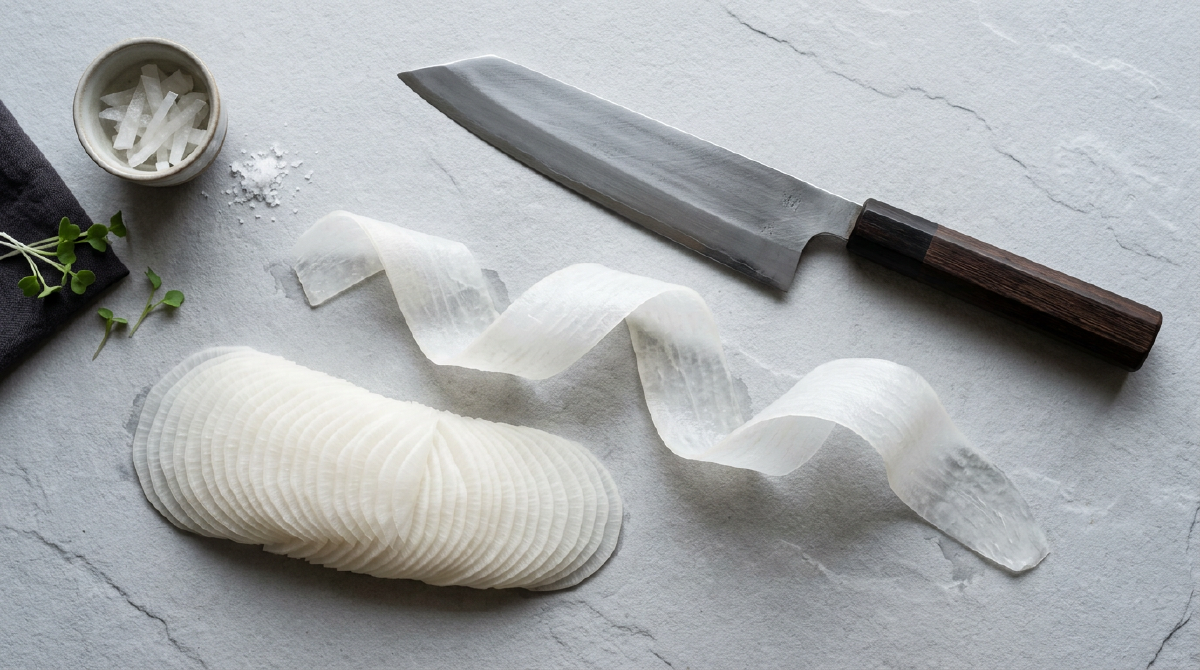
Every tradition has its rite of passage, and for single-bevel vegetable work, that rite is katsuramuki — the art of peeling a single unbroken sheet from the circumference of a daikon by rotating the vegetable against a stationary, angled blade. In professional kitchens it is performed at paper thickness and applauded as a display of pure control, and in the great apprentice kitchens of Japan it has long held the role that the tourne holds in the French tradition, the test that separates those who have memorized the motions of knife work from those who have actually mastered them — a distinction explored at length in the [[Knife Skills]] essay. The home cook’s version should begin at the opposite extreme, and that is the point of the exercise: the motion, not the thinness, is what needs to be learned first.
The setup is a cylinder of daikon, eight to ten centimeters long, peeled of its skin, and a blade held at a low, fixed angle — traditionally an usuba, but a yanagiba or even a kiritsuke will teach the same lesson. The blade does not move; the daikon does. With the flat side of the blade riding the surface of the vegetable, the right hand rotates the daikon against the edge while the left guides the angle, peeling a continuous spiral of flesh from the outside in. It is worth pausing on what that flat side is actually doing, because this is the exercise where the single-bevel design’s most famous property — food release — finally shows its face. As the sheet is cut free, it slides over the flat side of the blade, and it does so with almost no friction because the surface it touches is not the whole flat face but the narrow strip of the ura-suki, the hollow behind it keeping the steel from dragging on the sheet the way a wet paper towel drags on glass. If the knife has been sharpened carelessly, if the hollow has been flattened and the ura-suki widened, the sheet will stick to the blade, bunch, and tear at exactly this point — and the cook will learn, in a single ruined sheet, why the sharpening essay insists that the back of the blade be protected like a porcelain heirloom. Katsuramuki is the exercise in which the geometry that the rest of this essay has been discussing is not explained but felt.
Begin thick — a sheet the thickness of a pencil lead, which forgives every wobble of the wrist. The goal at this stage is not thinness but continuity: one sheet, unbroken, all the way around. The reason to begin thick is not indulgence but sequencing. A thick sheet tolerates a hand that wanders, so the beginner can learn the continuous rotation-and-feed rhythm without the constant, demoralizing punctuation of tears; a thin sheet punishes every error instantly and teaches nothing but frustration. Only when the sheet runs without tearing should the thickness come down, a millimeter at a time, until the sheet goes translucent and the light passes through it like water. The ladder matters more than the destination: every thickness is a complete exercise in its own right, and a cook who can run a pencil-lead sheet end to end has already learned most of what the technique has to give.
What katsuramuki actually trains is continuous angle control. A push cut is a discrete event; each cut can be individually corrected. Rotary peeling is a single extended event with no reset point, a long sentence with no period, in which the angle of the blade must stay constant while the surface beneath it changes curvature at every instant. But the phrase “angle control” hides the real difficulty, which is that the angle is not the only thing changing. As the spiral works from the outside of the cylinder inward, the radius of the vegetable shrinks, and a hand that rotates the daikon the same way at the end of the sheet as at the beginning will find the blade suddenly feeding too fast or too slow, the sheet thickening and thinning in tides. The cook must not merely hold the blade steady; the cook must read the shrinking cylinder through the fingertips and feed it at a pace that keeps the sheet constant — the same dynamic reading, in slow motion, that the halved cucumber demanded of the steering drill in fast forward. This is why the exercise is called groundwork: it builds the foundation that the drawing skills of Exercise Two and the one-stroke slice of Exercise Four will both stand upon.
And because the sheet cannot be inspected until it is finished — you cannot pause a rotary peel to check the thickness, since pausing introduces exactly the seam that breaks the sheet — the work is done almost entirely by feel and by sound. The fingers feel the sheet leaving the blade, its tension, its give; the ear hears the same quiet hiss as the whole-edge draw, the blade planing continuously rather than cutting discretely. The cook who practices katsuramuki is training attention itself: the ability to hold a single intention for the entire length of a long action, without checking, without correcting in retrospect, without the comfort of a reset — the ability, in short, to finish what was begun. It is the most demanding sustained-motion exercise a home cook can practice with a single-bevel knife, and it quietly builds the patience that every other drill has only hinted at — the patience to let a long sentence run to its period.
One unbroken sheet, nail-thick, is a real accomplishment. It is worth celebrating, briefly, with the sheet draped over a bowl like a ribbon. But the deeper prize is the one that will not appear in any photograph: the cook who has heard the sheet whisper its way around a full rotation has learned something no explanation could convey — that a sharp single-bevel edge, held steady by a steady hand, can sustain a cut far longer than any discrete chop, and that the blade’s willingness to do so depends on the care its flat side has been given. And the cook who has mastered the sheet will find, in the one-stroke slicing that follows, that the draw of Exercise Two has been hiding a family resemblance all along: the sashimi slice is nothing more than a katsuramuki straightened out, the rotation removed and the full length of the blade extended into a single, unhurried passage. Katsuramuki, in the end, is where the hand learns that the blade can be trusted with a long commitment.
Exercise Four: One-Stroke Slicing#
The steering drill holds the line, the draw cut masters the stroke, katsuramuki builds the sustained angle — and now all three come together in the blade’s reason for being: the long, one-stroke slice. In Japanese terminology the motion is hira-zukuri, and it is the technique behind sashimi’s thin, translucent slabs: the blade held at a shallow angle, the flat side laid against the fish, a single draw from heel to tip that travels the whole length of the edge without stopping, without rocking, without sawing. It is worth being clear about what is at stake in this one motion, because it explains why every Japanese knife tradition circles around it. The sashimi slice is eaten raw, which means the cut itself is a form of cooking: a crushed cut tears the fish’s cells, clouds the surface, and lets the fillet weep its flavor onto the board, while a clean single-bevel cut severs whole cells cleanly, leaving the face glossy and the flesh bright — the difference between a fillet that tastes of itself and one that tastes of being handled. The entire design of the blade, from its thin ten-to-fifteen-degree edge to its hollow-backed flat side, exists to make this single stroke possible. Everything in the first three exercises has been rehearsal for it.
The motion bears a closer look before the practice begins, because it contains all three prior lessons at once. The blade settles at a shallow angle, nearly parallel to the surface of the food, with the flat side laid against the fish — the line held by exactly the counter-pressure learned in the steering drill, and the reference plane established where the flat side meets the uncut block, precisely as it rode the board-side face in the whole-edge draw. Then the blade draws through: the full-length stroke of Exercise Two, now executed as one continuous, unhurried passage with the sustained angle of a katsuramuki sheet — no rotation, no reset, a long sentence run straight to its period. The draw is what separates the one-stroke slice from every lesser cut. The edge planes through the fish the way it planed through daikon, and the slice that comes off carries the signature glassy face, held flat by the flat side as it emerges.
Home cooks rarely get to practice it on the real thing, because the real thing is expensive, and practicing badly on an expensive fillet is how good fish becomes bad scraps. The exercise solves this with a proxy — but the proxy is not merely a way to save money; it is a way to save the hand. An expensive fillet carries a weight of expectation that tightens the grip, and a tightened grip is the one thing guaranteed to produce the very hesitation the technique punishes: the stroke that stops, the push that replaces the draw, the angle that shifts mid-cut. A cheap block of something fish-like carries no such weight. The hand can stay soft while it learns, and the repetition can be unapologetic, because the cost of a hundred imperfect slices is measured in cents.
The proxy needs to behave somewhat like fish: firm, sliceable, and forgiving enough to survive imperfect practice. A block of smoked tofu, a slab of pressed or cured fish from the freezer section, or a firm, chilled block of cooked fish all work; some cooks practice on the dense stalk of a leek, which takes a clean single-bevel cut beautifully. The requirements are the same ones that made daikon a good teacher: a material dense enough to offer true resistance, uniform enough to give consistent feedback, and honest enough to display every flaw on its face. What the proxy must not be is too soft — a material that yields before the blade does teaches the hand nothing, because the stroke that crushed it could never have cut fish.
The drill is the motion itself, repeated until it becomes automatic: the slab is steadied with the flat fingers of the guiding hand, well away from the edge; the knife settles at a low angle with the flat side against the food; and then the blade draws through in one long, unhurried stroke, finishing as the tip leaves the far edge. The guiding hand deserves its own attention, because its role here is not the claw’s feeding duty of the earlier exercises — there is nothing to advance between one-stroke slices; the slab is stationary and each slice is a separate plane. The guiding hand is a wall, not a mover: it steadies the slab against the blade’s draw, providing the counter-pressure that lets the edge travel cleanly, and it must hold perfectly still, because any give in the food is a drag mark in the slice. Steady food, moving blade, and nothing else — the whole discipline of the two hands in a single sentence.
The first slices will show every hesitation — drag marks where the stroke stopped, surface tearing where the blade was pushed instead of drawn, uneven thickness where the angle shifted mid-cut. That is the point. Nothing teaches the single-bevel stroke like the evidence of a bad one, and each flaw can be read the way the earlier exercises taught you to read their equivalents. A drag mark is a stopped draw — the stroke faltered and re-engaged, and the re-engagement shows like a sentence with a word repeated; the remedy is to slow down and let the draw run its full length in one breath. A torn surface is a push wearing a draw’s clothes — the edge was forced through the food instead of planing it, and the fix is to trust the edge the way Exercise Two demanded. An uneven thickness is a wandering angle — the blade rose or dipped mid-stroke, and the cure is the katsuramuki discipline of holding the angle as a constant through a changing surface. And there is a fourth tell, the one beginners notice last: a slice that sticks to the blade as it finishes is a food-release failure, a moment when the flat side dragged instead of letting the ura-suki do its work — sometimes a wet blade, sometimes a quiet warning that the ura-suki is overdue for its feather-light pass on the stone. Four flaws, four teachers.
The progress check is the slice itself. A proper one-stroke single-bevel slice lies flat, holds its shape, and shows a face so even it reflects light — the signature of an edge that planed through rather than crushed. Curl is the visible confession of crushing; the reflection is the report of a blade that never wobbled. When the proxy slices come out clean and consistent, the drill has earned its fee. The last stage of the exercise is a graduation: one small, honest fillet of fish, cut at low angle with the same single stroke, and the quiet discovery that the expensive ingredient behaves exactly like the cheap one, because the skill was never in the fish. It was in the hand — the same hand that held the line against a cucumber, drew the daikon’s full edge, and ran a sheet of white flesh around a shrinking cylinder. The one-stroke slice is where the whole curriculum finally introduces itself: the straightened katsuramuki of Exercise Three, the old friend of Exercise Two wearing better clothes, rehearsed on anything that would hold still long enough, and ready at last for the plate.
Exercise Five: Deba Weight-Work#
The exercises so far have all concerned the blissful end of the knife’s life: clean cuts through clean materials. But a single-bevel knife has a heavier, rougher sibling in the deba, and a home cook who keeps one will eventually face its question: how do you cut through bone-adjacent work without behaving like a cleaver? The fifth exercise answers it, and it is included because it is the lesson in force that the other four cannot give. Everything before it taught the hand to be light; the deba teaches the hand to be light where the work is heavy, which is the far harder thing, because the temptation to press is nowhere stronger than in the presence of resistance.
It is worth saying plainly what the deba is, because its reputation misleads more beginners than any other single-bevel knife. The deba is thick and heavy, with a spine that feels like it could take a beating — and yet it is a single-bevel blade through and through, still hollow-backed, still ground to an acute edge, still governed by every rule the earlier exercises established. That is the counterintuitive heart of the matter: the deba’s thickness is not an invitation to force but the reason force becomes unnecessary. It cuts with weight and follow-through, not with impact, and its skill lies in reading the resistance of the work. A cleaver is built to be swung; its edge is blunt and its steel forgiving, so it survives being used as a blunt instrument. The deba is built to be let down onto the work. The mass is there precisely so the hand does not have to be violent — the knife falls into the cut, and the cook’s only duty is to aim its fall.
The temptation the deba exposes is the oldest instinct in the kitchen: when the work resists, press harder. Every previous exercise trained against that instinct in soft materials, where escalation merely makes ugly cuts; the deba reveals what escalation costs at the edge’s worst hour, where a hard, acute, brittle edge answers pressure not with a better cut but with a chip. The restraint so carefully learned on cucumber and daikon is not abandoned here — it is finally put to the test. The echo of the martial arts is exact: the swordsman who forces the cut meets resistance, while the one who lets the blade fall meets air. Every ounce of applied force is an argument with the knife, and the knife always wins that argument by breaking something.
The exercise is a small whole fish or a chicken leg, practiced slowly, with attention to what the knife encounters with each stroke. Cutting through a joint means finding the seam — the thin gap where bone meets bone — and letting the blade settle into it, the weight of the knife doing the work that force would do wastefully. The seam is found, not forced: it is the place where the resistance of the work drops away, and a blade that seeks it feels that drop through the handle the way the guiding hand felt the wander in the steering drill. Working a fish along its spine means following the skeleton, the blade riding the bone’s curve rather than fighting it — the skeleton becomes a map, and the blade travels it the way a fingertip travels a marked route, every change in the bone’s direction announced in advance by the flesh above it. And when the work is read correctly, it confirms itself aloud: the joint opens with a quiet pop rather than a crack, the skin parts with a whisper rather than a tear, and the session carries the familiar acoustics of a clean draw — the knife’s honest language, for the cook who cares to listen.
Twisting and prying are the two cardinal errors, and they deserve their reputation because they attack the blade in the one direction it cannot defend. An edge is a wedge: it is shaped to take force along its own plane, and it is nearly helpless against force applied sideways. A twist wrenches the thin acute edge across the grain of the steel; a pry bends the blade against its spine; and both finish what no amount of hard cutting could — the chip, the rolled edge, the lateral bend that no sharpening will ever fully straighten, only grind around. These are also the two things that a home cook rebuilding a knife’s edge will regret most, because they undo at once what the stones take an hour of coarse work to repair. The remedy is the same restraint the other exercises taught, voiced one octave lower: if the blade will not pass, it is not asking for more force. It is asking to be withdrawn, reconsidered, and presented to a different seam.
The drill is not speed; it is the deliberate, almost tender negotiation with resistance that keeps a hard, acute edge intact. Practice it as slowly as the first steering session, one stroke at a time, the whole attention on what the blade reports through its handle — the firm glide of flesh, the sudden give of a joint’s capsule, the firm refusal of bone that says turn aside rather than push through. The cook who treats those reports as information rather than obstacles will find the deba becoming as articulate as any other single-bevel knife: the same quiet hiss against flesh, the same effortless parting, the same sense of a blade being guided rather than driven — the weight of the other exercises’ knife, speaking in a lower voice.
The progress check for the deba exercise is different from the others — not a measurement but a feeling of effortlessness. When the joint separates with a quiet pop and the blade never once sounded like it was being hammered, when the fish fillets off the bones in two clean sheets with the flat side riding the flesh, the home cook has learned what the deba is for — not because the fish is filleted, but because the knife reaches the end of the session as the knife it was at the beginning. It is the smallest lesson in the curriculum and, in some ways, the deepest: the knife does not want your force. It wants your understanding of where and when to apply it, which is a different thing entirely. And that is where the whole course has been tending — from the first cucumber round, through the daikon’s full edge, the unbroken sheet, and the translucent slice, to this truest test: a hand light enough to trust a heavy blade with the hardest work it will ever be asked to do. Force is the answer for materials that will not listen; understanding is the answer for knives that will. The deba, for all its size, asks only the question the cucumber asked on the first day: will you listen, or will you press?
The Shape of a Practice Week#
None of this needs to be a daily ritual, nor should it be. The exercises are designed for three short sessions a week, ten to fifteen minutes each, with one exercise per session and the ladder followed in order. That rhythm is not a rigid schedule or a moral demand. It is a way of arranging repetition so that each return to the knife has enough attention to become useful.
A skill is not built only during the minutes in which the hands are moving. It is also built in the interval between those minutes, when the body has time to register a correction and the cook has time to remember what the correction felt like. Spacing the sessions gives that memory room to settle. It also prevents practice from becoming a contest of endurance, in which tired hands repeat the same mistake because stopping has become more difficult than continuing. Three attentive sessions are more valuable than a week of hurried gestures. The aim is not to accumulate minutes; it is to give the hand a reason to remember each one.
The ladder should be followed in sequence because each exercise gives the next one a physical foundation. The steering drill teaches the hand to answer the knife’s directional pull. The whole-edge draw teaches that hand to carry a clean stroke from heel to tip. Katsuramuki asks the cook to sustain that stroke while the radius, resistance, and angle are constantly changing. One-stroke slicing brings the preceding lessons together, and the deba work tests whether the cook can remain restrained when the material offers resistance. Returning to the earlier exercise after reaching the later ones is not a retreat. It is a way of checking whether the new skill has been absorbed. A cook who can suddenly make a cleaner slice but has lost the square stack from the steering drill has not simply advanced; the foundation has become uneven.
Because the ladder contains more exercises than a seven-day week can comfortably contain, the full cycle may take a little more than two weeks. That is perfectly reasonable. A missed session does not require starting over or making up lost time with a punishing session. If a week becomes crowded, the cook can return to the last rung that received real attention and resume from there. The important thing is not completing a perfect calendar but preserving the order of the learning. A short session that begins with an honest question is more useful than a longer one that merely counts cuts.
Each session benefits from having one clear purpose. The cook might be asking whether the knife can hold a square line through ten cucumber rounds, whether a daikon slice can be completed in one uninterrupted draw, or whether a katsuramuki sheet can remain unbroken around the vegetable. That question gives the session a direction without turning it into a test of character. A small amount of preparation before the clock begins matters: a stable board, a clean and dry blade, an ingredient cut to a workable size, and enough light to see the cut face. The setup should not become a ritual of perfection, but it should remove distractions that have nothing to do with the skill being practiced.
Ten minutes of full attention will teach more than half an hour of vague repetition. The session can begin with a few easy repetitions that allow the hand to remember the basic shape of the movement, then spend its middle portion on deliberate attention to one detail, such as the pressure of the flat side or the sound of the edge entering the food. The final repetitions should be successful enough to leave the cook with a clear image of the intended motion. Stopping before fatigue turns correction into confusion is not a lack of discipline. It is part of good teaching. The goal of a practice session is to leave the hands with something they can repeat correctly, not to prove that the cook can endure a long session after attention has gone elsewhere.
The inexpensive ingredients are chosen to remove friction from this process. A daikon, cucumber, firm block of tofu, or inexpensive fish substitute allows the cook to repeat a motion without protecting a costly object or worrying about ruining an expensive meal. The low cost makes repetition emotionally easier. There is no special occasion required for practice, and no ingredient that must be treated as a performance. The material can be ordinary because the purpose is ordinary and serious: to give the hand enough repetitions to discover what the knife is asking it to do.
Cheap does not mean careless. The board should still be stable, the hands dry, and the blade used with the same respect one would bring to an important kitchen tool. A good practice ingredient is chosen because it gives honest feedback. Daikon is firm and relatively uniform, so the cook can see changes in thickness and resistance. Cucumber reveals changes in density. A firm block used for one-stroke slicing provides a surface on which drag, crushing, and an uneven angle are visible. The ingredient is not merely something the knife passes through. It is the measuring instrument. The more clearly it records what the blade has done, the more useful the repetition becomes.
A notebook line, or a page in the vault, gives that feedback a memory beyond the immediate session. A useful record does not need to become an elaborate journal. It can note the exercise, the target for that day, the thickness actually achieved, the number of rounds or slices attempted, and a brief description of what the hand and edge did. Perhaps the cut was square but the stroke ended early. Perhaps the sheet tore at the same point for the third time. Perhaps the first two slices felt forced while the last two passed cleanly after the angle was lowered. These details are more valuable than a single number, because they reveal the relationship between the correction and the result.
The log is also a defense against the generous mythology of memory. It is easy to remember a good session and quietly forget a bad one. It is easy to believe that a thin slice represented control when it came from a sudden burst of speed, or that an unbroken sheet happened because the hand had become naturally relaxed. Written notes preserve the difference between a result and the conditions that produced it. Before the next session, the cook can read the last entry and choose one meaningful adjustment rather than changing several things at once. The record turns practice into a conversation across time.
Practice, in this sense, is repetition with attention. It means noticing the instant the knife begins to pull, the instant the edge fails to enter cleanly, the moment the flat side begins to drag, and the point at which extra pressure appears because the hand has stopped reading the food. Attention does not mean tension. It is the opposite of forcing. The cook observes, makes a small correction, and allows the next repetition to test whether the correction was right. A session in which the hands move continuously but the same error is repeated is not necessarily practice. The log is one way of making the invisible work of attention visible.
The practical rule that protects the entire project is to use a workhorse single-bevel blade while the technique is still being learned. A workhorse is not a damaged or neglected knife. It is a maintained blade that can be entrusted to repetition, preferably one whose loss would be painful but whose edge does not carry the emotional weight of a treasured yanagiba or kiritsuke. The valuable knife can wait. Learning involves mistakes, and mistakes should not be asked to become permanent marks on an irreplaceable piece of steel.
This is especially important because the ura and ura-suki are not incidental surfaces. The ura is the gently hollowed back of a single-bevel knife, and the ura-suki is the narrow strip near the edge that does the work of contacting the food and guiding the cut. That geometry is what allows food to release from the blade and what makes a clean katsuramuki sheet possible. The flat side may touch the food or the cut face in a controlled way, but it should never slam, scrape, or act as an unmoving block against the board. The blade should be kept away from abuse that might bend the ura, widen the ura-suki, or damage the geometry the cook is trying to learn to feel.
The edge deserves the same restraint. If the knife begins to skip, tear, or demand increasing pressure for a cut that previously flowed, the correct response is not to press harder. First, the cook should distinguish between a dull edge and a poor presentation. A blade presented too steeply may wedge into the food; a blade that has simply lost its keenness may continue to move but no longer shear cleanly. A pause, a careful inspection, and a clean stroke through the same material can often tell the difference. If the edge is dull, the answer is the sharpening bench, not a contest of endurance.
Sharpening is therefore not an admission that the practice has failed. It is part of the practice. The hand learns to work with an edge that is responsive, and the edge remains responsive because the hand is learning not to abuse it. The exercises and the stones are partners in the same project. The drills build the hand’s sense of line, angle, release, and resistance; the stones restore the geometry that makes those sensations possible. A carefully maintained edge gives clearer feedback, while careful technique gives the edge a better chance to remain sharp. The companion essay on Sharpening Japanese Single-Bevel Kiritsuke belongs to this same cycle, not to a separate world of maintenance that begins only after something has gone wrong.
The fifth exercise is the only one that brings the work near bone, but that exception is not permission to treat the knife as a cleaver. The deba’s weight can be useful when it follows a joint or a natural seam, yet the work still depends on restraint. The blade should be allowed to settle into resistance, then withdrawn and reconsidered when it meets a direction it cannot safely follow. Twisting, prying, swinging, and striking through bone are not tests of strength. They are ways of damaging an acute edge and teaching the hand an impulse the knife was never designed to reward. The exception means working around bone with understanding; it does not mean forcing an edge through it.
On a second pass through the practice week, the challenge can become more precise without becoming more dramatic. The cook might ask for smaller cucumber rounds, a thinner daikon draw, a more continuous katsuramuki sheet, or a one-stroke slice that lies flatter and reflects more light. The deba work may become quieter and more economical, with less visible effort in the hand. Only one variable needs to change at a time. Raising difficulty gradually keeps the feedback clear and prevents frustration from being mistaken for a lack of talent.
The pauses between sessions are part of this progression. They allow the cook to clean the knife, inspect the edge, note where the board was causing trouble, and decide whether the next session should sharpen, simplify, or challenge the hand. They also make the practice sustainable. A routine that can survive an ordinary week will outlast a demanding one, and the cook who returns after a missed week is more likely to continue than the cook who has made the routine so severe that every interruption feels like failure.
The shape of a practice week is therefore not a rigid program. It is an agreement with the knife: return often enough to learn, keep the sessions short enough to remain attentive, use materials that make repetition easy, and record enough to know whether the attention is taking hold. The goal is not to protect the blade by never learning anything difficult. It is to learn the difficulty in a way that leaves both the hand and the edge ready for the next repetition.
Reading Your Progress#
The gratifying thing about these exercises is how readable they are. Knife skills can often remain hidden inside vague impressions: the cook feels that the motion was “better,” but cannot say what changed or prove that the change will remain. These drills are more direct. The cucumber stack either stands square or it does not. The daikon either leaves the blade in one clean passage or it tears and drags. The katsuramuki sheet either survives the turn or breaks. The slice either lies flat with an even sheen or records the hesitation that made it curl. The material does not flatter the cook or reinterpret an intention. It simply shows what happened.
That visibility is one of the great advantages of practicing with a single-bevel knife. A symmetrical blade can absorb a great deal of careless technique, allowing an imperfect stroke to produce an acceptable piece of food. The single bevel exposes more of the relationship between the hand, the edge, and the food. Its asymmetry means that a small change in angle has a visible consequence. Its narrow cutting wedge means that a hesitant stroke leaves a different mark from a continuous one. The knife becomes a sensitive indicator of attention. Even when the result is imperfect, it tells the cook what kind of imperfection deserves attention.
The steering drill is read first through the stack. Ten cucumber rounds placed one on top of another provide a simple and unusually honest report. If the cut faces are parallel, the rounds can be aligned cleanly, and the stack settles without rocking, the blade has held a reasonably consistent plane. If the stack leans, cups, or shifts from side to side, the wander has accumulated. A single round might look acceptable by itself, but a stack makes small deviations cumulative. The cook can see the cut as a path rather than as an isolated event.
The important point is not that every round must be perfect. A thick, square set of rounds is already a meaningful result, especially for a cook whose early attempts were wedge-shaped or irregular. The stack can distinguish between different kinds of difficulty. If the rounds are thick but square, the hand is learning to preserve a plane. If they are thin but uneven, the cook has gained speed or ambition without yet gaining control. If the stack leans consistently in one direction, the steering problem is probably still present even if individual cuts appear plausible. The result becomes a conversation between the eye and the hand, rather than a simple declaration of success or failure.
The whole-edge draw offers another kind of report, one that is heard as much as seen. A clean cut through daikon should produce a low, even whisper rather than a tearing or crunching sound. The sound matters because it reflects the relationship between the edge and the resistance of the vegetable. A stroke that hesitates will often gather resistance as it approaches the tip. A stroke that is presented too steeply may bite at the beginning and then stall. A stroke that is too short may leave a torn crescent at the far edge. The ear cannot diagnose every fault, but it notices when the work has stopped being a continuous shear.
The first evidence of progress in the draw is therefore not necessarily a paper-thin slice. It is a slice that completes in one stroke without sawing, without a second attempt, and without the cook pressing the handle harder as the tip approaches. Thickness can come later. Continuity has to come first. A cook who can produce a clean three-millimeter round has learned something that will remain useful when the target becomes two millimeters or less. A cook who can produce an extremely thin slice by forcing the knife through a wavering path has not yet learned the motion that makes thinness reliable.
The daikon also makes thickness legible because its white flesh offers little visual distraction. A drag mark, a torn surface, or an uneven plane can be seen without being hidden beneath the skin or color of another ingredient. This is one reason the exercise is so useful for a home cook. The feedback is not dependent on an instructor’s opinion, nor on a vocabulary of technical terms. The cut face shows whether the edge planed through the vegetable or crushed it. The sound shows whether the stroke remained continuous. The piece in the hand shows whether the result is becoming more consistent.
Katsuramuki provides a different kind of evidence because its success cannot be evaluated only at the end. The sheet is the result, but the location and character of a tear tell the story of what happened earlier. A sheet that breaks near the beginning may indicate that the angle or rotation was unstable from the start. A sheet that survives halfway and then gives way may show that the cook failed to adjust as the daikon became smaller. A sheet that tears because it sticks to the blade may point toward the condition of the flat side and the ura-suki. In this exercise, continuity is the first accomplishment. An unbroken sheet the thickness of a pencil lead contains more skill than a translucent sheet produced through frantic correction.
The thickness of a successful katsuramuki sheet should not be confused with its value. A thick sheet that comes off in one continuous ribbon proves that the hand can sustain the motion. A thinner sheet proves that the hand is beginning to refine its control. The two achievements are related, but they are not identical. This distinction matters in every exercise. It is possible to chase a dramatic result before learning the basic continuity that makes the dramatic result dependable.
The one-stroke slice makes the same point through its surface. A slice that lies flat, holds its shape, and reflects light evenly has been cut by an edge that continued through the material rather than one that entered and stopped. A slice with a visible drag mark records a moment of hesitation. A curled or crushed surface suggests that the blade was forced into the food rather than drawn across it. An uneven thickness shows that the angle changed during the passage. These are not merely aesthetic complaints. They are evidence of what the hand did while attention was directed elsewhere.
The reflection on the slice is useful precisely because it is not a trick of presentation. A single-bevel cut can leave a glossy face when the edge is keen, the angle is stable, and the flat side has allowed the food to release cleanly. The sheen is therefore a physical signature of the cut. It does not mean that every slice must look like glass, nor that appearance is more important than flavor. It is simply a visible confirmation that the edge passed through the food with less destruction. On a cheap practice block, that same confirmation gives the cook confidence before moving to an expensive fillet.
The deba exercise is measured in a quieter register. A joint that opens with a pop, a fish that separates from its bones in a clean sheet, and a blade that arrives at the end of the session without chips, bends, or new damage are all signs of progress. The measure is not how much force the cook can produce. It is how little force is necessary once the hand has learned to read resistance. The knife should be allowed to arrive at the work through controlled movement, not swung at it. The successful result feels quieter and more deliberate than the effort that produced it.
That distinction is important because the deba can make incorrect technique look impressive. A hard downward blow may appear decisive, but it can conceal a hand that has stopped listening. A seam cut may look modest, yet it demonstrates greater understanding because the blade has been placed where it can do its work without being forced against the direction of resistance. The fifth exercise does not reverse the lessons of the first four. It reveals what those lessons look like when the material is heavier and the consequences of inattention are more serious.
Across all five exercises, progress generally appears as a reduction in the number of interventions the cook must make. At first, the hand constantly corrects: the blade drifts, the wrist changes angle, the grip tightens, the draw stops, the vegetable is repositioned. Later, the corrections become smaller. The cook feels the blade begin to pull and adjusts before the error is visible. Still later, the hand anticipates the change in resistance and the stroke remains uninterrupted. This progression is more meaningful than a dramatic improvement in thickness, because it shows that attention is beginning to operate ahead of failure.
The log makes this gradual change visible. Without a record, every session can seem like a fresh encounter with the knife. With a record, the cook can see that the same thickness once required several corrections but now requires none, or that a katsuramuki sheet once broke in three places and now survives nearly all the way around the daikon. The log also prevents a bad session from being mistaken for a collapse of skill. If the edge was dull, the board was unstable, or the cook was tired, the result may say more about the conditions than about the hand. Recording those conditions makes the next adjustment more intelligent.
Measurement should support attention, not replace it. A ruler can be useful for recording the approximate thickness of a round or a sheet, but a number cannot tell the whole story. The cook also needs to notice whether the edge entered cleanly, whether the wrist was braced, whether the breath became shallow, whether the last stroke felt more settled than the first, and whether the result was achieved through control or through force. The most valuable record is often the sentence that captures the quality of the session: “The first three cuts wandered, the next five held,” or “The sheet tore when the daikon became too small.” The log is not a report card designed to produce anxiety. It is a mirror that allows progress to remain visible.
The physical signs of progress are often subtle. The shoulders loosen. The grip no longer turns white around the handle. The guiding hand becomes still without becoming rigid. The cook stops bracing for the knife to pull and begins moving with its direction. The stroke may even slow down, because it no longer needs to be hurried to compensate for uncertainty. These changes are not merely psychological. They are evidence that the hand has stopped spending energy on unnecessary resistance. A relaxed hand is not a careless hand; it is a hand that has found enough support to respond accurately.
The final sensation described in the exercises—the knife feeling less like a tool being operated and more like a direction through which attention is flowing—should not be mistaken for a mystical disappearance of effort. The cook is still holding the knife, still choosing the angle, and still reading the food. The difference is that these actions no longer feel like separate arguments. The hand does not first command the blade, the wrist does not second-guess it, and the food does not register as an obstacle to be overcome. The stroke becomes one event. The breath, the movement, the edge, and the ingredient belong to the same action.
That quality is what the older vocabularies of ki, wa, and pneuma can help the cook notice. These terms are not interchangeable, and they should not be used as decorative labels for a successful cut. In this context, ki can suggest the directing force of attention, the way intention gathers the body around a task. Wa can describe the relational harmony among hand, blade, ingredient, board, and moment, in which no one part overwhelms the others. Pneuma can evoke breath, continuity, and the capacity to sustain a movement without breaking it into anxious fragments. The vocabulary does not explain the skill for the cook. It gives language to an experience the hands may already be beginning to recognize.
A single-bevel knife is a demanding teacher because it makes inattention visible. It does not literally punish the inattentive cook, nor does it reward patience in a magical or automatic way. It simply refuses to conceal the consequences of a hurried grip, an unstable angle, or a dull edge. The patient cook benefits because patience allows small corrections to accumulate. The rushed cook may complete many strokes, but the knife records the same error in each one. Its demands are severe, but its teaching is exact: the blade reveals the relationship between what the hand intends and what it actually does.
The drills are the tuition for that lesson. They do not guarantee effortless knife work, and they do not replace judgment, maintenance, or a properly sharpened edge. When an edge loses its responsiveness, the answer is not to interpret the failure as a moral verdict or to press through it; it is to care for the knife and resume the practice with renewed attention. The companion discussion of [[Sharpening Japanese Single-Bevel Kiritsuke]] belongs to this same process, because an edge that has been restored gives the hand a clearer teacher.
In the end, reading progress means reading more than the size of a slice. It means noticing fewer corrections, cleaner sound, more continuous movement, and a growing absence of unnecessary force. The square stack, the intact sheet, the flat slice, and the quietly opened joint are all small physical facts, but together they describe a changing relationship among the cook and the knife. The final goal is not merely to make thinner daikon or to display a perfect cut. It is to bring full attention to one stroke at a time, until the hands, blade, and ingredient begin to move as a coordinated whole. The drills are the tuition; the visible result is the evidence that attention is beginning to pass through the work.
The Knife Gives Back What You Give It#
It is easy to see a single-bevel knife as a purchase: an object to acquire, display, and perhaps keep at a respectful distance. The provenance, the steel, the finish, the price, and the reputation of the maker can all become more interesting than the knife’s actual work in the kitchen. A beautiful yanagiba or kiritsuke may spend years in a cabinet, admired but unused, while the cook who understands how to move a single bevel is working with a modest blade every day. The object is impressive, but the relationship is what makes it useful.
The exercises in this essay propose a different way of understanding that relationship. A single-bevel knife is not merely waiting to be owned. It is a skill waiting to be learned by a particular hand. The blade has a direction, an angle, a way of releasing food, and a particular relationship with resistance. Those qualities are already present in the steel, but they do not become skill simply because they have been purchased. A hand must learn to feel when the edge is leading properly, when the flat side is guiding the cut, when the wrist is adding unnecessary force, and when the knife is being asked to do something it was not designed to do.
That is why a workhorse blade can sometimes be more valuable during the learning process than a precious one. The valuable knife may be saved for the moment when the cook believes they are ready, but readiness cannot arrive through postponement. The hand has to meet the edge, and it has to meet it often enough to learn from the meeting. A maintained, comfortable, less emotionally precious single-bevel knife gives the learner room to make mistakes without turning every mistake into a crisis. The workhorse is not disposable. It is simply a blade whose purpose during this stage is teaching.
The accessibility of the exercises matters for the same reason. A cook does not need a professional kitchen, rare fish, or an elaborate collection of equipment to begin. A cucumber can reveal a wandering line. A daikon can reveal a draw cut that stalls, tears, or demands too much pressure. Fifteen minutes of focused practice can turn an abstract principle about angle or steering into a sensation the hand can remember. The ingredients may be inexpensive enough to discard, but the knowledge they produce is not disposable. It remains in the fingers, in the way the eyes read a cut face, and in the way the body learns to pause before applying force.
The low cost of practice changes the emotional quality of learning. When an expensive ingredient is involved, hesitation can become part of the cut itself. The cook tightens the grip, worries about wasting the fish, and begins trying to protect the ingredient rather than observe the blade. With an ordinary vegetable, there is room for an imperfect stroke to be examined without becoming a loss. The cook can repeat the cut, alter one detail, and try again. Repetition becomes generous rather than guarded. The daikon does not need to be perfect, and neither does the first attempt.
That generosity is part of what the knife gives back. It does not return confidence in the form of instant mastery. It returns evidence. A stack begins to stand square. A slice begins to lie flatter. A sheet survives a longer turn around the vegetable. The sound of the cut becomes quieter, and the hand stops waiting for the blade to misbehave. These are modest results, but they accumulate into a different relationship with the work. The cook begins to trust the cut because the cut has repeatedly given trustworthy evidence.
That return is durable in a way that equipment alone cannot be. A new blade may improve the starting point, but it cannot provide the hand with the memory of ten thousand small corrections. A hand trained to hold a line can use that skill on different vegetables, different recipes, and eventually different knives. An eye trained to notice changing resistance becomes more perceptive around every curve of an ingredient. A wrist trained to draw from heel to tip carries a motion that remains useful long after the original daikon has been eaten. The practice does not remain trapped inside the practice session. It travels into ordinary cooking and changes what ordinary cooking feels like.
The value of that change is not limited to a more elegant slice. A cleaner cut wastes less food, requires less force, and asks less of the cook’s patience. It can make preparation less frantic because the knife is no longer fighting the hand that holds it. The cook who has rehearsed the difficult motion before guests arrive is not merely trying to produce a perfect dish. The cook is arriving at the kitchen with a body that already knows what to do with the tool. The work can become less reactive and more attentive. There is room to notice the ingredients, the people at the table, and the changing demands of the meal instead of being absorbed entirely by anxiety about the blade.
This is one of the deeper forms of the knife’s generosity: it gives back composure. The same knife that once made the cook self-conscious can, through familiarity, become a source of steadiness. Its demands are real, but they become intelligible. The cook learns that the blade is not an enemy requiring force, nor a treasure requiring worship. It is a working relationship governed by geometry, maintenance, and attention. Once those conditions are understood, the fear surrounding the object can give way to a more accurate respect.
The phrase “the knife gives back what you give it” should not be mistaken for a claim that the knife rewards care with automatic perfection. It is a conditional truth. A hand that pays attention receives clearer feedback. A hand that protects the ura and ura-suki preserves the geometry that makes release and clean cutting possible. A hand that respects a dull edge by sharpening it rather than forcing it receives an edge capable of responding. A hand that practices one stroke after another, recording what happens and adjusting deliberately, receives a skill that can grow without being destroyed by impatience. The return is made from the materials the cook provides: time, care, judgment, and the willingness to begin again.
The opposite is equally true. A knife used as though it were a double-bevel tool, twisted to gain leverage, dropped onto a hard board, or forced through resistance will return chips, rolling, uneven cuts, and uncertainty. The damage may remain hidden until the next session, when the cook wonders why a motion that worked yesterday now feels suddenly difficult. This is one reason maintenance belongs within the idea of giving. The companion essay on [[Sharpening Japanese Single-Bevel Kiritsuke]] is not a separate technical appendix; it is part of the relationship. Sharpening is how the cook continues to answer the needs of the blade after the cutting lesson is over.
The care required by a single-bevel knife should not make it permanently fragile in the cook’s hands. Knowledge reduces needless fear. Once the cook understands the ura, the ura-suki, the draw, and the directional pull of the edge, the knife can be used with greater confidence rather than greater hesitation. Respect does not mean keeping the blade away from the work. It means approaching the work with fewer assumptions and more accurate attention. The knife is not diminished by being used. It is diminished by being misunderstood.
There is also a quieter kind of return that does not appear in photographs. Over time, the blade acquires a history in the hand. The cook knows where it likes to begin a cut, how it responds to a dense section of daikon, when the edge is no longer giving the clean sound it gave yesterday. The knife becomes familiar without becoming ordinary. Its delicacy remains, but it is no longer mysterious. The cook can move from one exercise to the next with less internal negotiation because the body has begun to recognize the tool as part of its own vocabulary.
This is perhaps the strongest argument for beginning with inexpensive ingredients and short sessions. The point is not to make the knife seem disposable. It is to make practice possible. Repetition is the form of attention given to a tool over time. A knife that is handled carefully in ordinary conditions becomes more familiar, but a knife that is merely displayed remains largely unknown. The return belongs to use, not possession. The more deliberately the cook practices, the more completely the object becomes a partner in the work rather than a status symbol beside it.
Even the mistakes contribute to this exchange, provided they are met with attention. A torn sheet records a loss of continuity. A leaning stack records a wandering line. A slice with a drag mark records a hesitation. A joint that cracks under pressure records a failure to listen. These results are not flattering, but they are informative. The knife gives the cook a truthful mirror, and the mirror becomes valuable only when the cook is willing to see what it shows. Attention turns an awkward cut into a lesson rather than a verdict.
The final return is not a trophy or a perfect piece of fish. It is the capacity to remain present during an ordinary stroke. The cook has rehearsed enough that the hand does not need to negotiate every movement from the beginning. The line is held without drama, the blade travels without being forced, the angle changes without panic, and the result arrives with less waste than before. The knife has not removed the need for effort. It has made effort more intelligent.
This is why the knife gives back only what it is given. A blade cannot supply patience, but it can make patience visible in the steadiness of a cut. It cannot create attention, but it can punish inattention by refusing to hide the result. It cannot sharpen the hand by itself, but repeated contact with a maintained edge can teach the hand how little force a precise cut requires. It cannot make a cook skilled through possession, but it can offer a clear, demanding, and unusually generous way to become skilled.
The choice is therefore not between cherishing a single-bevel knife from a distance and risking it through careless use. It is between leaving it as an object and entering into a working relationship with it. A cucumber, a daikon, and fifteen minutes are enough to begin that relationship. The return will not be immediate, and it will not be spectacular. It will appear in a square stack, a clean whisper, an unbroken sheet, a flat slice, a knife that survives the session without a chip, and eventually in the calm of a cook who no longer feels the need to overpower the tool.
A knife left in a drawer remains a purchase. A knife used with attention becomes a capability. The exercises are how a home cook gives that capability a place in the hand, and the hand is how the knife begins to give something back.