
Why This Dish, This Wok, This Burner#
I have made Mongolian beef perhaps a dozen times over the years, and most of those attempts were exercises in compromise. For a long time the wok was a KitchenAid stainless flat-bottom model on my electric range: a pan that heated unevenly, stuck unless the oil was generous, and never got hot enough to do anything but steam the beef. Later I moved to a Yosukata carbon steel flat-bottom wok on a Chef Master 90019 butane stove, with a WokMon focus ring sitting over the burner. That was a genuine step up — the WokMon turned the ring of fire into a concentrated column, the carbon steel seasoned up nicely, and for the first time I got something close to a sear at home. But 15,000 BTUs through a flat bottom is still a compromise, and Bill Leung’s Mongolian Beef at The Woks of Life deserves better than a compromise. His version has been sitting near the top of that site since 2015 for a reason — it is the one that finally cut the sugar and the oil to sane levels — but a recipe can only do so much when the pan is only just hot enough.
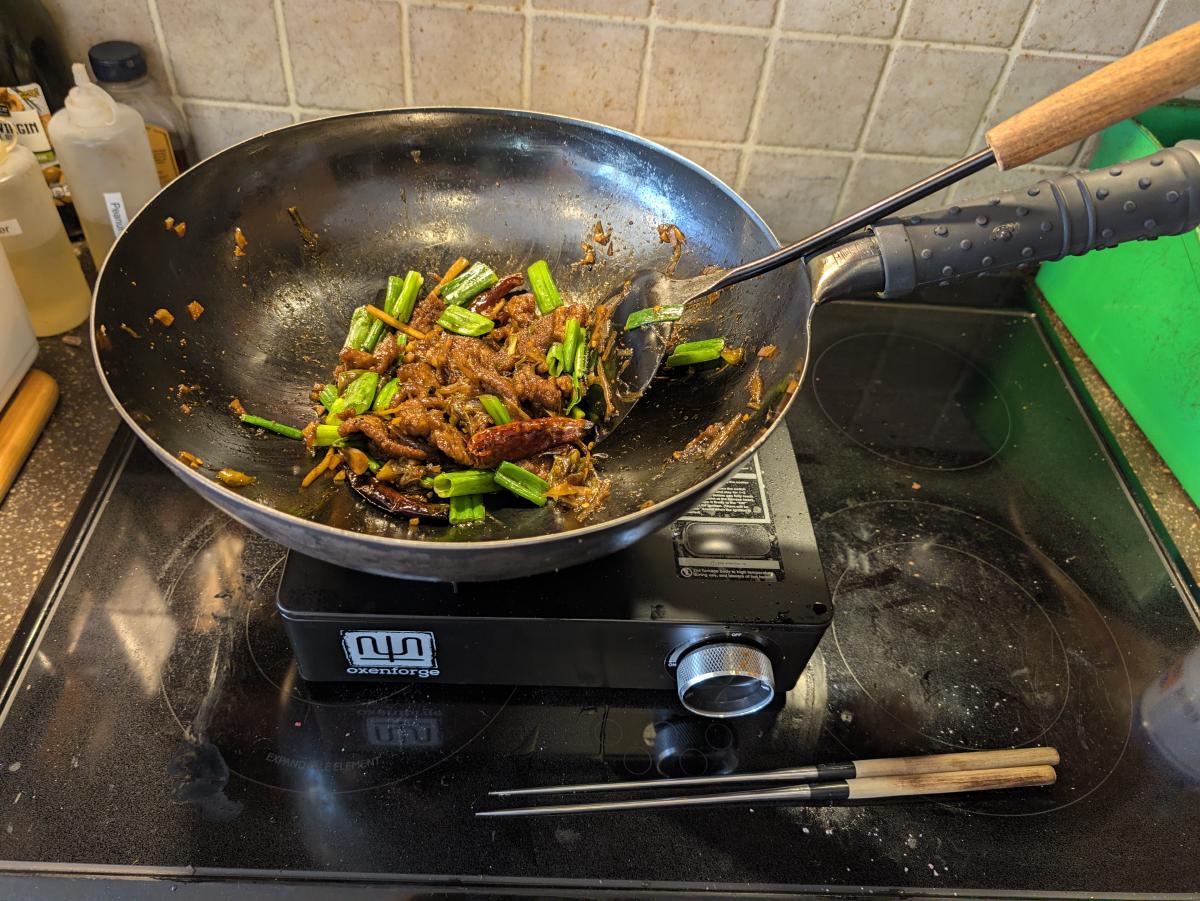
This time I had two pieces of equipment that change the arithmetic: a 32cm Oxenforge hand-hammered round-bottom wok, and the Oxenforge Ultra Powerful Portable Wok Stove. Together they cost about as much as a decent set of stainless pans, and they turn a home stir-fry from a simulation into the real thing.
| Element | What I Used | Why It Mattered |
|---|---|---|
| Wok | Oxenforge 32cm round-bottom, hand-hammered Zhang Qiu carbon steel, ~2mm | Thick steel holds heat and recovers fast; the round bottom lets the oil pool and the beef sear in batches |
| Burner | Oxenforge Ultra Powerful Wok Stove, 22,000 BTU/hr | Enough concentrated flame to get a real sear instead of a steam |
| Beef | 1 lb flank steak, sliced ¼ inch against the grain | Cheap, beefy, and built for a fast hard sear |
| Method | Velvet 1 hour, cornstarch dredge, shallow-fry, glaze | Tender interior, crisp shell, sauce that clings |
| Serving | Jasmine rice, steamed and rested | Soaks up the glaze without turning to paste |
Bill’s Recipe, With My Hands on It#
The Woks of Life version is a velveting recipe first and a stir-fry second, and that order matters. I sliced a pound of flank steak across the grain into quarter-inch strips, then tumbled it with two teaspoons of neutral oil, two teaspoons of Shaoxing wine, a teaspoon of light soy, a tablespoon of cornstarch, a tablespoon of water, and a quarter teaspoon of baking soda. The baking soda is the quiet hero — it raises the pH of the surface and keeps the meat from tightening into shoe leather during the fry — and the cornstarch and water form a thin slurry that clings to every slice. I left it for an hour in the fridge, and it came out glossy and slightly tacky, exactly as the recipe promises.
The sauce is almost embarrassingly simple, which is why it works: a quarter cup of light brown sugar dissolved in three-quarters of a cup of hot water, then a quarter cup of soy sauce and a teaspoon of dark soy for color. No hoisin, no ketchup, no corn syrup. The restraint is the point. Bill’s whole argument is that the restaurant version is too sweet, and after making this one I believe him.
Before frying, I dredged the marinated beef in half a cup of cornstarch. This is the step people skip and then wonder why their Mongolian beef tastes like stew. The cornstarch is what turns the surface into a shell — not a heavy batter, just a dusting that grabs oil and goes crisp in under a minute.
The Stove Changes the Math#
Domestic burners top out somewhere in the low teens of thousands of BTUs, and much of that heat licks up the sides of the wok instead of pooling in the bottom. The Oxenforge stove is rated at 22,000 BTU/hr, which does not sound like a restaurant burner, and it isn’t one. But it is a compact, concentrated flame sitting directly under a round-bottom wok, and that geometry is worth more than the number. The flame hits the curve of the steel where the oil and the food actually are. A butane canister gives roughly half an hour at full roar, which is several dinners’ worth of a dish that cooks in ten minutes.
I set the 32cm wok on the grate, poured in two-thirds of a cup of neutral oil, and let it come up. The wok is about 2mm thick — heavier than the spun carbon steel most people buy — and that thickness is why it behaves. It takes a little longer to heat, then it holds. When I dropped in the first batch of beef, the oil roared instead of sighing, and the slices immediately bubbled at the edges.
I seared them about a minute a side, in two batches, resisting the urge to stir. That is the other thing a hot wok buys you: the confidence to leave the meat alone. The slices came out with a deep amber crust and an interior that was still pink and tender. I turned off the burner, lifted them out to a plate, and the crust stayed crisp while I finished the sauce — no soggy collapse, which is the usual fate of home-fried beef.
The Sauce, the Slurry, and Thirty Seconds#
I poured off the oil, leaving about a tablespoon, and brought the wok back to medium-high. Ginger and eight dried chiles went in first, then the garlic and the white parts of four scallions, each stage lasting only about fifteen seconds. The aromatics toasted without scorching because the steel was already hot and the oil was already where it needed to be.
Then the sauce went in, and it came to a simmer almost instantly. Two minutes of reduction, then a slurry of a tablespoon and a half of cornstarch in two tablespoons of water, stirred in slowly. The liquid went from watery brown to a glossy mahogany that coated the back of a spoon. I put the beef back in with the green scallion tops and tossed for thirty seconds. That is all it takes. The sauce grabbed the crust, the scallions wilted but stayed bright, and there was no puddle left in the bottom of the wok.
Over Jasmine Rice#
I served it over jasmine rice — rinsed until the water ran clear, cooked by absorption, rested off the heat for ten minutes, then fluffed with a fork. The rice is not an afterthought here. Mongolian beef is intense: salty, sweet, a little hot, and very rich. Plain jasmine rice is the neutral ground that lets you eat more than three bites. The glaze soaked into the top layer of grains and left the bottom of the bowl clean.
How Good It Actually Was#
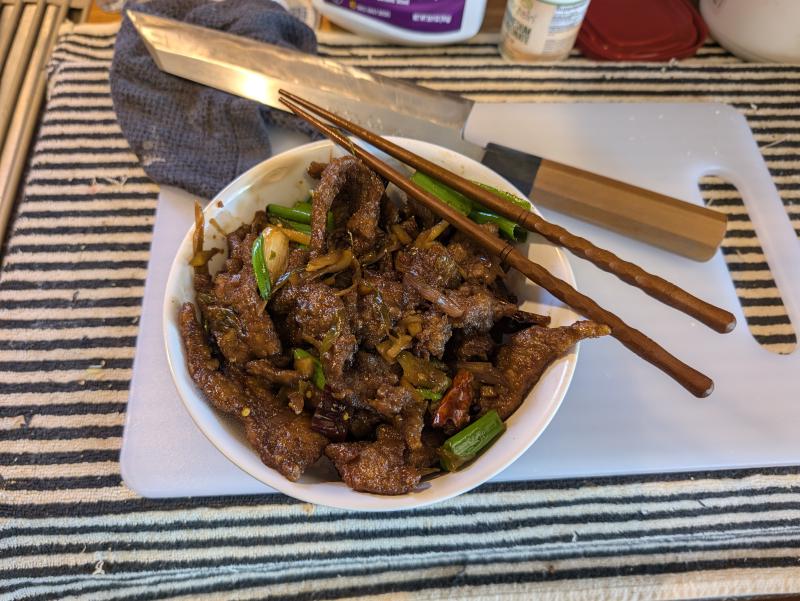
It was the best Mongolian beef I have made at home, and it was not particularly close. The crust was the difference. Each piece had a thin, crisp shell that gave way to tender beef, and the sauce clung to that shell instead of sliding off. The sweetness was present but restrained — brown sugar, not candy — and the dried chiles gave a warm background heat rather than a punch. The scallions were still green and slightly crunchy, which made the whole dish taste fresher than the takeout version it was imitating.
The wok contributed in a way I could taste. There was a faint smoky edge to the beef, the thing people call wok hei, that I have never gotten from a Western-style skillet. It was not the roaring, almost acrid char of a restaurant burner, but it was there, especially on the darker edges of the first batch. The 32cm size was also right for a pound of beef: wide enough that the slices sat in a single layer, deep enough that the oil did not climb the walls.
The stove contributed in a way I could feel. The flame was responsive in a way my kitchen range is not — a quarter turn of the knob changed the sound of the oil. It also ran hot enough that I had to work quickly, which is exactly the point. The whole cook, from first slice hitting the oil to the final toss, took under ten minutes.
What I Would Do Differently — and One Caveat#
Almost nothing, which is rare. Next time I would break two of the chiles in half for a little more heat, and I would cook the beef in three smaller batches rather than two, because the second batch cooled the oil slightly and browned a touch less evenly than the first. I would also season the wok with another round of ginger and scallion before the next cook, not because it needed it, but because the steel is still young and the seasoning is still building.
The one honest caveat is that this stove is not a restaurant burner, and the wok is not a magic wand. If you crowd the pan or skip the cornstarch, you will still get steamed beef in a sweet sauce. The equipment rewards good technique; it does not replace it. But when the technique is right, the combination of thick hand-hammered steel and a concentrated 22,000 BTU flame does something a domestic kitchen usually cannot: it makes the beef crisp, the sauce cling, and the whole thing taste like it came out of a much louder kitchen than mine.
I ate it standing at the counter, straight out of the wok, before I even sat down with the rice. That is the highest review I can give.
Recipe adapted from Bill Leung’s Mongolian Beef at The Woks of Life. Wok and stove details from Oxenforge.