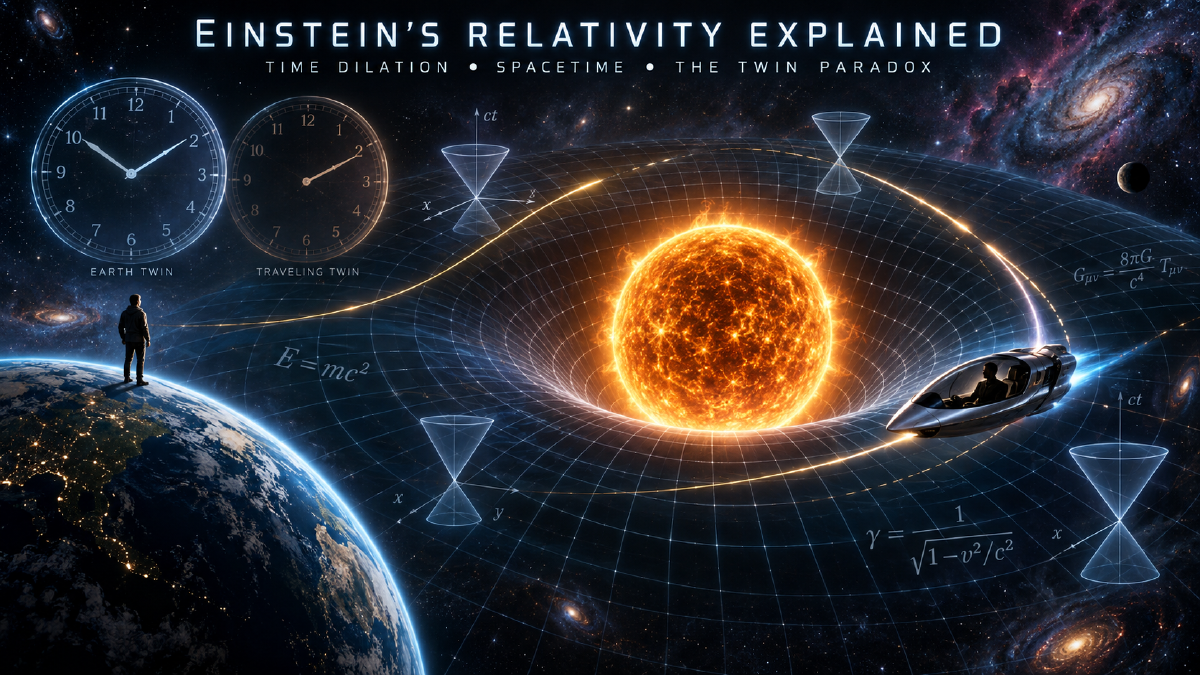

The Fabric of Spacetime: A Journey Through Special and General Relativity#
“Time and space are modes by which we think and not conditions in which we live.”
— Albert Einstein, Relativity: The Special and General Theory (Henry Holt and Company, 1916)
Prologue: A Revolution in Perspective#
Imagine you are on a train moving at constant speed down a perfectly straight track. You drop a ball. From your perspective inside the train car, the ball falls straight down, just as it would if the train were parked in a station. Now imagine someone standing on the platform watching you. From their perspective, as the ball leaves your hand, it already has the horizontal velocity of the train. They see it trace a graceful arc combining forward motion with falling before hitting the floor of the moving car. Both descriptions are correct. The path looks different, but the laws of physics governing the ball’s motion are the same in both frames of reference. This is the essence of relativity: motion is relative, and the laws of physics don’t play favorites for “stationary” observers.
For centuries, this common-sense idea that Galileo articulated served physics beautifully. But at the dawn of the twentieth century, it ran headlong into something deeply counterintuitive: light. Light seemed to refuse to play by the same rules. No matter how fast you chased a beam of light, or how fast the source was moving toward you, you always measured its speed to be the same: about $299,792,458$ meters per second, denoted $c$. This single, stubborn fact would upend our notions of space and time themselves.
In 1905, a twenty-six-year-old patent clerk named Albert Einstein published a paper titled “On the Electrodynamics of Moving Bodies” that would change everything. With it came Special Relativity. A decade later, he would generalize it to include gravity, giving us General Relativity. Together, these theories revealed a unified fabric we call spacetime and showed us that time can stretch, lengths can shrink, and gravity is not a force pulling across empty space, but the very curvature of that fabric.
This essay is a journey into that strange and beautiful reality. We will proceed without demanding advanced mathematics, but we will not shy away from the equations that give these ideas their precision. Along the way, we will focus on two of relativity’s most astonishing predictions: time dilation and length variation, first in the special case, then in the general case, all culminating in the famous twin “paradox” examined from both perspectives with the resolution that only comes from understanding the full picture of spacetime. What follows is an exhaustive exploration of these ideas.
Part I: The World Before Relativity#
Newton’s Absolute Universe#
For over two hundred years, Isaac Newton’s vision reigned supreme. In his Principia Mathematica, he laid out a cosmos governed by universal laws. In Newton’s universe, space was an absolute, unchanging stage on which events unfolded - it existed independently of anything happening within it, like an infinite empty container. Time flowed uniformly and identically for everyone, everywhere - a cosmic clock ticking at the same rate from the beginning to the end of time, indifferent to motion, gravity, or anything else. Velocities could be simply added and subtracted using Galilean transformation. If you threw a ball at 10 meters per second on a train moving at 50 meters per second in the same direction, someone on the ground saw it move at 60 meters per second. This Galilean addition of velocities matched everyday experience perfectly and seemed self-evident.
This framework was staggeringly successful. It explained the motions of planets, the trajectories of projectiles, the mechanics of levers and pulleys, the tides, and countless other phenomena. Newton’s laws could predict with incredible precision. The idea of relative motion was understood - there was no way to tell if you were moving at constant velocity in a closed room. But Newton posited that there must exist some absolute rest frame, some universal zero velocity, even if we might not be able to detect it. The laws of motion were the same in all inertial frames (the principle of Galilean relativity), but space and time themselves were absolute and the same for all observers regardless of their motion.
The Rise of Electromagnetism and the Aether Crisis#
By the nineteenth century, the stage seemed complete - until electricity and magnetism came along to challenge it. Through the work of Coulomb, Ampère, Faraday, and finally James Clerk Maxwell, these seemingly separate forces were unified into a single theory of electromagnetism. Maxwell condensed everything into four elegant equations that described electric and magnetic fields and how they interact.
Maxwell’s equations did something remarkable: they predicted that changing electric fields create magnetic fields and vice versa, allowing self-propagating electromagnetic waves. When Maxwell calculated the speed of these waves from the electric and magnetic constants, he got a value of about $3 \times 10^8$ meters per second - which was already known to be the speed of light. This was no coincidence. Light itself is an electromagnetic wave.
But waves have always required a medium. Sound waves travel through air, water waves through water, seismic waves through rock. If light is a wave, it must travel through some medium too. Physicists called this hypothetical medium the luminiferous aether - an invisible, weightless, perfectly transparent substance that permeated all of space, even the vacuum between stars. In this aether, Maxwell’s equations held in their simplest form, and the speed of light was $c$ relative to the aether.
If the aether existed as a fixed, absolute medium filling all space (analogous to Newton’s absolute space), then the Earth, as it orbits the Sun at about 30 km/s, must be moving through this aether and creating an “aether wind”. Just as you feel wind when driving a car, Earth should experience a wind blowing through the aether. This wind should affect the speed of light depending on whether light traveled with the wind, against it, or across it. By measuring these differences, we should be able to detect Earth’s motion relative to the absolute aether and thus to absolute space itself.
This was a perfect test of Newtonian absolute space. In 1887, Albert Michelson and Edward Morley conducted their famous interferometer experiment at Case Western Reserve University with unprecedented precision. They designed an instrument so sensitive it could detect differences far smaller than those expected. They rotated the apparatus in all directions, at different times of day and year (to account for Earth’s changing motion). They found… nothing. No aether wind. No difference in the speed of light in any direction. The result was null.
This was one of the most important null results in the history of physics. Many tried to save the aether. George FitzGerald and Hendrik Lorentz independently proposed that objects moving through the aether are physically contracted along the direction of motion by exactly the amount needed to cancel the effect. This length contraction was ad hoc - there was no physical mechanism, it just happened to make the numbers work. Others proposed the aether was “dragged” along with the Earth. All explanations grew increasingly complicated and strained.
The aether had become a theoretical crutch that was no longer necessary. Physics was in genuine crisis. Into this crisis stepped a young patent clerk in Bern, Switzerland, who would take the boldest step imaginable: he would simply abolish the aether altogether.
Part II: Special Relativity - The Relativity of Space and Time#
Einstein’s Two Postulates#
In June 1905, Albert Einstein published his paper “Zur Elektrodynamik bewegter Körper” (“On the Electrodynamics of Moving Bodies”) in the journal Annalen der Physik. At just twenty-six years old and working as a patent clerk in Bern, Switzerland, Einstein took a step so bold that it would render decades of theoretical contortions obsolete. Rather than attempting to preserve the luminiferous aether or patch the growing inconsistencies between Newtonian mechanics and Maxwell’s electrodynamics, he abandoned the aether entirely and built a new theory from first principles using just two postulates.
Postulate I (Principle of Relativity). For every inertial frame of reference $S$, and for every inertial frame of reference $S’$, all laws of physics hold in exactly the same form in $S$ and in $S’$. No physical experiment performed entirely within an inertial frame can distinguish that frame from any other inertial frame.
Postulate II (Invariance of the Speed of Light). In vacuum, the speed of light $c$ has the same value in all inertial frames of reference, independent of the motion of the light source and independent of the motion of the observer. That is, for any inertial observer, $c \approx 299,792,458,\text{m/s}$ regardless of relative velocity.
The first postulate is a sweeping generalization of Galileo’s principle, extending relativity from mechanics to all physical laws, including electromagnetism and optics. An inertial frame is any frame of reference moving at constant velocity, including one at rest. If you find yourself in a sealed laboratory with no windows, you cannot perform any experiment whatsoever to determine whether that laboratory is stationary or moving uniformly through space. The results of every physical experiment will be identical in both cases. This utterly demolishes the notion of absolute velocity and eliminates any need for a preferred, universal frame of reference.
The second postulate is the one that defies all common intuition. In the Newtonian world, velocities add linearly. Light refuses to do this. If you were in a spaceship traveling at half the speed of light and turned on your headlights, you would measure the light leaving your ship at $c$. An observer on a distant planet watching your ship fly by would also measure that same beam of light passing them at exactly $c$, not $c$ plus half the speed of light. The motion of the source and the motion of the observer are irrelevant; $c$ is absolute for all inertial observers.
These two postulates appear simple on the surface, yet they are in direct conflict with Newton’s concepts of absolute time and absolute space. If the speed of light must be the same for everyone regardless of their motion, then something else must give way. Time cannot flow at the same rate for all observers. Distances cannot be absolute. Simultaneity cannot be universal. Postulate I tells us there are no preferred frames, Postulate II tells us light is impartial to motion, and together they force a complete reconstruction of our notions of reality. There is no aether to serve as a cosmic reference point because the very concept is meaningless when all inertial frames are equivalent and $c$ is invariant. What Einstein revealed was not that motion is relative in the Galilean sense, but that space and time themselves are relative, woven together into the single fabric of spacetime.
The Relativity of Simultaneity#
The most fundamental consequence is that simultaneity is relative. In Newtonian physics, if two events are simultaneous for one observer, they are simultaneous for all observers. With Einstein’s postulates, this is false.
Let us examine the classic train and platform thought experiment in detail.
Consider a train of length $L$ (measured in the platform frame) moving at constant velocity $v$ to the right relative to the platform. Observer M (for middle) is standing at the exact center of the platform. Observer T (for traveler) is standing at the exact center of a train car. At the precise moment that T passes M, two lightning bolts strike the train - one at the front end of the train car and one at the rear end of the train car. In observer M’s frame (platform frame), the train is moving but M is at rest at the center. M sees the lightning strikes occur at the front and rear ends of the moving train at the same time. Since M is equidistant from both ends of the train (in the platform frame’s measurement of the train’s length at that instant) and light travels at $c$ in all directions relative to M, the light from both strikes reaches M simultaneously. M correctly concludes the strikes were simultaneous.
Now consider observer T on the moving train. At the moment of the lightning strikes, T is at the same position as M. But the train is moving to the right. By the time the light from the strikes begins to travel, T is moving. The rear end of the train was at some position when it was struck, but more importantly, T is moving toward the front of the train and away from the rear of the train. However, light from both strikes still travels at speed $c$ relative to T (postulate 2). The light from the rear strike has to travel from the rear end to reach T, but T is moving away from that rear end, so the light must cover more distance in T’s frame? Or alternatively, think in terms of who gets hit first: the light from the front strike is emitted from a point on the train that T is moving toward, so T encounters that light beam sooner. The light from the rear strike comes from behind and T is moving away from it. Since both beams travel at $c$ relative to T and T is closer in effect to the front strike’s light path at the relevant times, the front strike’s light reaches T first.
T sees the front lightning bolt strike first, then the rear lightning bolt strike. Since T is in the middle of the train car and is a careful observer who knows light travels at $c$, T concludes that the front strike occurred before the rear strike, even though M saw them as simultaneous.
Both are correct. There is no universal truth about simultaneity. The time order of events that are spacelike separated (and these lightning strikes, if simultaneous in platform frame, are spacelike separated in general? Or timelike? No - if they occur at different positions but same time in M’s frame, $\Delta x \neq 0, \Delta t=0$, so $\Delta s^2 = +\Delta x^2 > 0$ means spacelike separated). Spacelike separated events have no causal connection possible and different observers can disagree about their time order. That is exactly the case here.
This relativity of simultaneity is not a perceptual effect or a delay due to light travel time to reach our eyes - it is about the simultaneity of the events themselves as defined in each frame.
Time Dilation in Depth#
From the relativity of simultaneity and $c=constant$, time dilation follows inevitably. We already examined the light clock; let us be more thorough.
Consider a “proper clock” - any clock whose mechanism is based on some physical process. By the first postulate, the laws governing that clock are the same in its rest frame. Let the time between two ticks of that clock, when measured in its rest frame $S’$, be $\Delta t_0$. This is the proper time interval because it is measured at the same position in the rest frame (the clock doesn’t move).
Now observe this clock from frame $S$ where the clock is moving with constant velocity $v$ along the $x$-axis. In frame $S$, to measure the time between the same two ticks of the moving clock, we must record the time shown by the moving clock at tick 1 and at tick 2. But in frame $S$, the clock is at different positions at tick 1 and tick 2. Also, we need to synchronize our own clocks in frame $S$.
Using the Lorentz transformations:
$$ t = \gamma\left(t' + \frac{v x'}{c^2}\right), \qquad x = \gamma(x' + v t') $$For the moving clock at rest in $S’$, let its position be constant $x’_0$. The two ticks occur at $(t’_1, x’_0)$ and $(t’_2, x’_0)$ in frame $S’$, with $\Delta t’ = t’_2 - t’_1 = \Delta t_0$. In frame $S$, these same events occur at:
$$ t_1 = \gamma\left(t'_1 + \frac{v x'_0}{c^2}\right), \qquad t_2 = \gamma\left(t'_2 + \frac{v x'_0}{c^2}\right) $$Thus $\Delta t = t_2 - t_1 = \gamma (t’_2 - t’_1) = \gamma \Delta t_0$.
So the time interval between ticks as measured in frame $S$ (where the clock is moving) is $\gamma$ times larger than in the rest frame. Since $\gamma > 1$, $\Delta t > \Delta t_0$. The moving clock runs slow.
This is a general result for any time interval measured between events that occur at the same position in one frame (a proper time interval) - when measured in any other inertial frame relative to which those events are moving, the interval is dilated by factor $\gamma$.
Time dilation is reciprocal in a sense? Suppose in frame $S’$ we have a clock at rest and in frame $S$ we observe it running slow. From frame $S’$’s perspective, clocks in frame $S$ are moving and should run slow. This seems contradictory, but it is not, because to compare two clocks you must bring them together or make careful comparisons, and the symmetry is broken when you do a full round trip comparison (as in the twin paradox).
Length Contraction in Depth#
Now length. As before, proper length $L_0$ is the length of an object measured in its rest frame - distance between two ends at the same time in that rest frame.
Let a rod lie along the x-axis at rest in frame $S’$, with its left end at $x’_1$ and right end at $x’_2$ for all times $t’$ in that frame. The proper length is $L_0 = x’_2 - x’_1$.
Now measure this rod from frame $S$, in which frame $S’$ (and thus the rod) is moving in the +x direction with velocity $v$. To measure the length of the moving rod in frame $S$, we must measure the position of the left end and the right end simultaneously in frame $S$ - at the same time $t$ in frame $S$, but possibly different $t’$ in frame $S’$.
Let us denote the positions in frame $S$ at time $t$ as $x_1(t)$ for the left end and $x_2(t)$ for the right end. The length in frame $S$ is $L = x_2 - x_1$ at the same $t$.
Using the inverse Lorentz transformation: $x’ = \gamma(x - v t)$, so $x = \frac{x’}{\gamma} + v t$. But we have $x’_1, x’_2$ fixed (positions of ends in $S’$). At the same time $t$ in frame $S$, the positions are $x_1 = x’_1/\gamma + v t$, $x_2 = x’_2/\gamma + v t$, hence $L = x_2 - x_1 = (x’_2 - x’_1)/\gamma = L_0/\gamma$.
So $L = L_0 / \gamma = L_0 \sqrt{1 - v^2/c^2} \le L_0$.
The moving rod is shorter along its direction of motion. Again, this comes directly from the relativity of simultaneity - in the moving frame, we measure the ends simultaneously but those correspond to events that are not simultaneous in the rod’s rest frame.
An important consequence: a very long object moving very fast can appear short enough that it might fit in a shorter container in the lab frame, while from the object’s frame the container is even shorter. This is related to the “relativistic pole in barn” paradox, which is resolved by the relativity of simultaneity (the events of “entering” and “leaving” are not simultaneous in both frames).
The Lorentz Transformations#
The Lorentz transformations are the mathematical core of Special Relativity, replacing Galilean transformations. For two inertial frames $S$ and $S’$ where $S’$ moves relative to $S$ along the x-axis with constant velocity $v$, and their origins coincide at $t=t’=0$:
$$ t' = \gamma\left(t - \frac{v x}{c^2}\right), \qquad x' = \gamma(x - v t), \qquad y' = y, \qquad z' = z $$The inverse transformations are obtained by replacing $v$ with $-v$ and swapping primed/unprimed:
$$ t = \gamma\left(t' + \frac{v x'}{c^2}\right), \qquad x = \gamma(x' + v t'), \qquad y = y', \qquad z = z' $$Notice the term $v x / c^2$ in the time transformation - time depends on position. This is the mathematical expression of the relativity of simultaneity. Events with the same $t$ but different $x$ in frame $S$ have different $t’$ in frame $S’$.
Also notice that for $v \ll c$, $\gamma \approx 1$ and $v x / c^2 \ll t$, so we recover Galilean transformations $t’=t, x’=x-vt$.
These transformations preserve the spacetime interval $\Delta s^2 = - (c\Delta t)^2 + \Delta x^2 + \Delta y^2 + \Delta z^2$.
Spacetime Diagrams (Conceptual)#
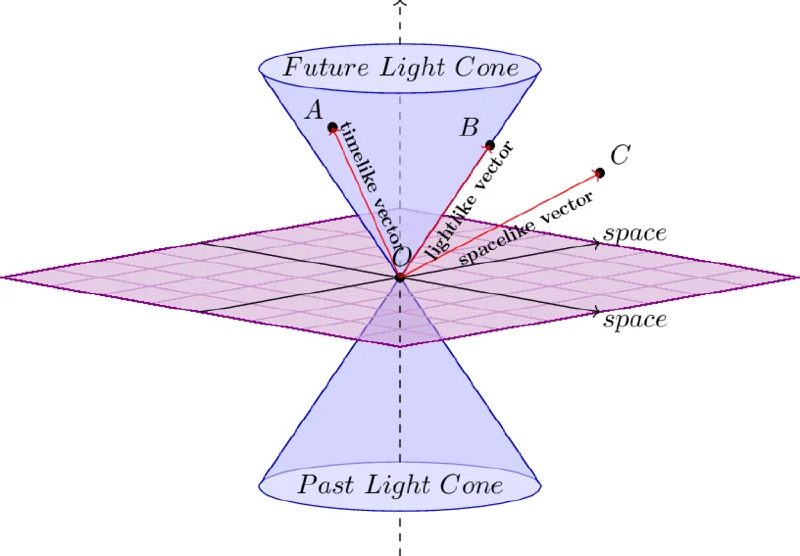
In a Minkowski spacetime diagram, we plot $ct$ on the vertical axis and $x$ on the horizontal axis (using $ct$ so that both axes have dimensions of length). The worldline of a light ray is a line at 45 degrees ($x = \pm c t$). The light cones divide spacetime into past, future, and elsewhere. Different inertial observers have different axes (their time axis and space axis are rotated relative to each other), which visually shows why simultaneity is relative - what is a horizontal line of constant $t$ for one observer is a tilted line for another.
Part III: The Twin “Paradox” - Exhaustive Special Relativistic Treatment#
The Setup in Detail#
Let us construct the twin paradox carefully with precise numbers.
Two identical twins, Alice and Bob, are born at the same event on Earth at time $t=0$ in Earth’s inertial frame $S$. Alice chooses to remain on Earth for her entire life (or at least for the duration of this experiment). Bob decides to make a journey to a star and back.
Let the star be at rest in frame $S$ at position $x = D = 4$ light-years away from Earth. Bob’s spaceship can travel at constant speed $v = 0.8c$ for most of the journey. He departs Earth at event $E_1$: $(t,x) = (0,0)$ in frame $S$, same event where both twins start. He travels to the star along the positive x-axis. The journey to the star takes time $t_{out} = D/v = 4/0.8 = 5$ years in Earth’s frame. He arrives at the star at event $E_2$: $(t,x) = (5,\text{years}, 4,\text{ly})$.
At event $E_2$, Bob instantaneously (in our idealized version) turns around and accelerates to speed $v = 0.8c$ in the negative x direction, beginning his return journey. He travels back and arrives at Earth at event $E_3$: $(t,x) = (10,\text{years}, 0)$ in Earth’s frame, where Alice is waiting for him.
We want to know: how old is each twin at event $E_3$?
Alice’s Perspective#
Alice never accelerates. She remains at rest at $x=0$ in frame $S$ for all time. Her worldline is the line $x=0$. The time elapsed on her clock between $E_1$ and $E_3$ is just the coordinate time difference in her rest frame: $\Delta t_A = 10 - 0 = 10$ years. Since she experiences no acceleration and stays at constant position, this is both coordinate time and proper time. Alice is 10 years older.
Bob’s Perspective - Outbound Leg#
Now consider Bob’s journey in segments. From $E_1$ to $E_2$, Bob travels at constant velocity $+0.8c$ in frame $S$. We can consider an inertial frame $S’$ that moves at $+0.8c$ relative to $S$ and in which Bob is at rest during the outbound journey. In frame $S’$, Bob’s position is constant.
We want to compute the proper time elapsed on Bob’s clock during the outbound leg. The events $E_1$ and $E_2$ both occur on Bob’s worldline. The time interval between $E_1$ and $E_2$ measured in Bob’s rest frame (frame $S’$ during outbound leg) is the proper time for that segment because both events happen at Bob’s position.
Alternatively, use time dilation. In Earth’s frame $S$, the time for outbound journey is 5 years but these events happen at different positions (0 and 4 ly). The proper time is $\Delta t_0 = \Delta t / \gamma = 5 / \gamma$. We have $\gamma = 1/\sqrt{1 - 0.64} = 1/0.6 = 5/3 \approx 1.6667$, so $\Delta t_0 = 5 / 1.6667 = 3$ years.
Yes. So during outbound journey, Bob’s clock advances by 3 years.
Bob’s Perspective - Turn-Around#
At event $E_2$ (arrival at star), Bob must turn around. To change from velocity $+0.8c$ to velocity $-0.8c$, he must accelerate. In our idealized instantaneous turn-around, this is an infinite acceleration in zero time, which is unphysical but gives the same result as any finite acceleration. In reality, finite acceleration over some distance would add small effects, but the total age difference would be the same (it comes from the non-inertial nature). Instantaneous is easier for calculation.
During instantaneous turn-around, Bob’s position doesn’t change, but his velocity (and thus his rest frame) changes discontinuously from frame $S’$ (moving at +0.8c relative to $S$) to frame $S’’$ (moving at -0.8c relative to $S$).
Bob’s Perspective - Inbound Leg#
Now in frame $S’’$, Bob travels back to Earth at $-0.8c$. By symmetry of the situation (same speed, same distance in Earth’s frame), the proper time for the return journey is again 3 years. Bob arrives back at Earth at event $E_3$.
Total proper time on Bob’s clock is 3 years (outbound) + 0 (instantaneous turn-around, idealized) + 3 years (inbound) = 6 years. So Bob is 6 years old at reunion, Alice is 10 years old. Bob is younger.
The Apparent Paradox and Why It’s Not One#
Now the apparent paradox from Bob’s perspective: during outbound leg, Bob is at rest in frame $S’$ and sees Earth moving away at 0.8c. He sees Alice’s clock running slow by factor $\gamma$, so in the 3 years that pass on his clock during outbound journey, he expects only $3 / \gamma = 1.8$ years to pass on Earth’s clocks. That would mean at turn-around, according to Bob’s outbound frame calculation, only 1.8 years have passed on Earth. But in reality, in Earth’s frame 5 years passed by turn-around. That is a big difference - and it comes from the relativity of simultaneity.
Let us compute this carefully. Event $E_1$ is the departure: in all frames, same event, we can set coordinates so $t=t’=t’’=0, x=x’=x’’=0$.
Coordinates in Earth’s frame $S$#
$E_1: (t,x) = (0, 0)$ $E_2$ (turn-around at star): $(t,x) = (5,\text{years}, 4,\text{ly})$ $E_3$ (reunion): $(t,x) = (10,\text{years}, 0)$
Coordinates in Bob’s outbound frame $S’$ (moving at +0.8c relative to $S$)#
Use Lorentz transformations: $t’ = \gamma(t - v x / c^2)$, $x’ = \gamma(x - v t)$. Set $c=1$ for simplicity in light-years and years (since $c=1,\text{ly/year}$). With $c=1, v=0.8, \gamma=5/3$:
$E_1: t’=\frac{5}{3}(0 - 0)=0, x’=\frac{5}{3}(0)=0$ $E_2: t’=\frac{5}{3}(5 - 0.84)=\frac{5}{3}(5 - 3.2)=\frac{5}{3}(1.8)=3,\text{years}, x’=\frac{5}{3}(4 - 0.85)=\frac{5}{3}(4 - 4)=0$. Correct - at rest in $S’$. $E_3$: transform from $S$ to $S’$: $t’=\frac{5}{3}(10 - 0)=\frac{50}{3}\approx16.666,\text{years}, x’=\frac{5}{3}(0 - 0.8*10)=\frac{5}{3}(-8)= -\frac{40}{3}\approx-13.333,\text{ly}$. Event $E_3$ is in Bob’s outbound frame’s past? No wait - but Bob is only in frame $S’$ until $E_2$. After $E_2$ he switches to $S’’$. The coordinates of $E_3$ in frame $S’$ are just a mathematical coordinate transformation of that event; the frame $S’$ is not Bob’s frame at $E_3$.
But the key is the relativity of simultaneity at turn-around. Consider event $E_A1$: “a particular clock on Earth reads some time” simultaneous with $E_2$ in different frames. In Earth’s frame $S$, we can consider events on Earth ($x=0$) at different times. Event $E_2$ is at $t=5$ years. An event simultaneous with $E_2$ in frame $S$ on Earth is any event with $t=5, x=0$ - but Alice is at $x=0$ all the time, so the event “Alice reads clock showing 5 years” is simultaneous with $E_2$ in frame $S$.
Now in Bob’s outbound frame $S’$, what events on Earth are simultaneous with $E_2$? Find which $(t,x)$ with $x=0$ (on Earth) has the same $t’$ as $E_2$. $E_2$ has $t’_2 = 3$ years in frame $S’$. We want $t’ = \gamma(t - 0) = 3$ when $x=0$, so $t = 3/\gamma = 3/1.6667 = 1.8$ years. Thus in frame $S’$, event $E_2$ (turn-around) is simultaneous with the event “Alice on Earth reads 1.8 years” on Earth, not with “Alice reads 5 years”. Alice has only aged 1.8 years in Bob’s outbound frame’s notion of simultaneity at turn-around!
That is the crucial point. In Bob’s outbound frame, when he arrives at the star, he thinks only 1.8 years have passed on Earth. But in Earth’s frame, 5 years passed. Both are correct for their frames - simultaneity is relative.
Now Bob turns around and switches to his inbound frame $S’’$, which moves at $-0.8c$ relative to frame $S$. Let us compute coordinates in frame $S’’$.
Frame $S’’$ moves at velocity $v’’ = -0.8c$ relative to $S$. Use Lorentz transformations with $v = -0.8$: $t’’ = \gamma(t - v x / c^2) = \frac{5}{3}(t - (-0.8)x) = \frac{5}{3}(t + 0.8x)$ $x’’ = \gamma(x - v t) = \frac{5}{3}(x - (-0.8)t) = \frac{5}{3}(x + 0.8t)$
$E_1: t’’=0, x’’=0$ $E_2: t’’=\frac{5}{3}(5 + 0.8*4)=\frac{5}{3}(5 + 3.2)=\frac{5}{3}(8.2)\approx13.666?$ Wait wait - wait, $t’’ = \frac{5}{3}(t + 0.8x)$. At $E_2$, $t=5, x=4$, so $t’’=\frac{5}{3}(5 + 3.2)=\frac{5}{3}(8.2)\approx13.667$ years, $x’’=\frac{5}{3}(4 + 4)=\frac{5}{3}(8)\approx13.333$ ly. That can’t be - frame $S’’$ is moving relative to $S$; Bob’s position at $E_2$ in frame $S’’$ should be some position, but better to think about simultaneity.
But easier: find which event on Earth is simultaneous with $E_2$ in frame $S’’$. In frame $S’’$, we want $t’’ = constant$ for events simultaneous with $E_2$. $E_2$ has coordinates in $S$: (5,4). Find its $t’’$: $t’’(E_2)=\gamma(t_2 - v’’ x_2 / c^2)=\frac{5}{3}(5 - (-0.8)*4)=\frac{5}{3}(5 + 3.2)=\frac{5}{3}(8.2)$, but better use the form relative to $S$: for frame moving at $v’’ = -0.8$ relative to $S$, $t’’ = \gamma(t - v’’ x / c^2) = \gamma(t - (-0.8)x) = \gamma(t + 0.8x)$. We want events on Earth with $x=0$ simultaneous with $E_2$ in frame $S’’$, so $t’’ = \gamma(t_{E2} + v’’)$ Or better set $t’’(E_2) = \gamma(t_2 - v’’ x_2)=\frac{5}{3}(5 - (-0.8)*4)=\frac{5}{3}(8.2)$ is not right dimensionally; better keep factors clear.
Better use the result: for a frame moving at velocity $v$ relative to $S$, the time of an event on Earth ($x=0$) simultaneous with some event $(t_e, x_e)$ in frame $S’$ is $t = t_e - \frac{v}{c^2}x_e$ (up to factors of $\gamma$ - more precisely, $t_{simultaneous\ on\ Earth} = t_e - \frac{v x_e}{c^2}$ in the limit). With $c=1$, for frame $S’$ moving at $+0.8$ relative to $S$, $t = t_2 - v x_2 = 5 - 0.8*4 = 5 - 3.2 = 1.8$ years. Yes, matches.
For frame $S’’$ moving at $v’’ = -0.8$ relative to $S$, the formula becomes $t = t_2 - \frac{v’’}{c^2}x_2 = t_2 - \frac{(-0.8)}{1}*4 = 5 + 3.2 = 8.2$ years. So in Bob’s inbound frame $S’’$, event $E_2$ is simultaneous with the event on Earth where Alice reads 8.2 years on her clock.
Now put it together from Bob’s perspective:
- During outbound leg (3 years on his clock), he is in frame $S’$ where turn-around is simultaneous with Alice being 1.8 years old. So at the moment of turn-around (end of outbound leg), Bob thinks only 1.8 years have passed on Earth.
- Now he switches frames to $S’’$. At the very instant of switching (same position and same time in his journey), his notion of simultaneity jumps. In the new frame, turn-around is simultaneous with Alice being 8.2 years old. So during the instantaneous turn-around, Bob sees Alice jump from age 1.8 years to age 8.2 years! That is a jump of 6.4 years forward in Alice’s age, all happening during his instantaneous acceleration.
- Now during the inbound leg (3 more years on his clock), he is in frame $S’’$ and again sees Alice’s clock running slow. But Alice is now “at” age 8.2 years at the start of this leg (by his simultaneity). Time dilation means in 3 years of his time, only $3 / \gamma = 1.8$ more years pass on Earth, so he expects Alice to become 8.2 + 1.8 = 10 years old by the time he arrives. Which matches exactly - Alice is 10 years old at reunion.
The paradox is resolved. Bob is not “seeing” Alice age slowly the whole time in a continuous way; the frame change at turn-around causes a massive jump in what he considers simultaneous. The asymmetry is that only Bob changes inertial frames (accelerates). Alice never does.
This is purely a Special Relativity resolution using only inertial frames and the relativity of simultaneity. No gravity needed for the idealized case.
Part IV: General Relativity - Gravity as Curved Spacetime#
Beyond Special Relativity#
Special Relativity is beautiful but limited - it only works for inertial frames (constant velocity, no acceleration). It says nothing about gravity. Einstein knew this was incomplete. He spent ten years trying to extend relativity to include acceleration and gravity, finally publishing General Relativity in November 1915.
The path to General Relativity began with a thought experiment that would prove more profound than Einstein could have imagined.
The Equivalence Principle#
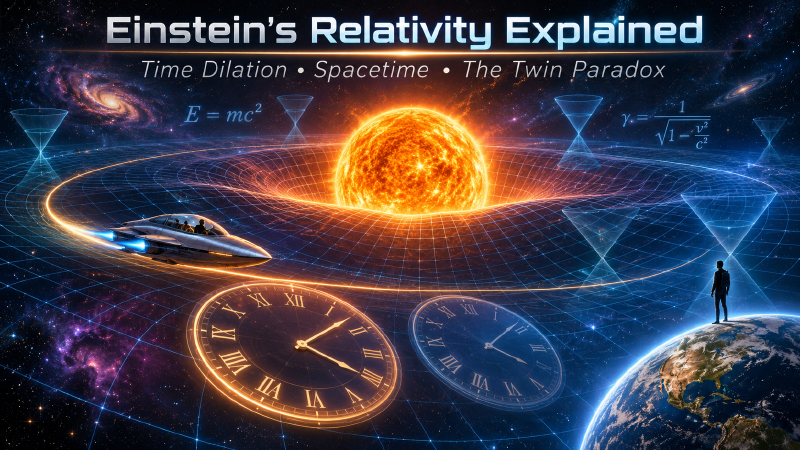
Imagine you are in a windowless elevator with no way to see outside. You have no way of knowing if you are standing firmly on the surface of the Earth, or if you are adrift in the void of deep space aboard a rocket accelerating upward at a constant rate. This seemingly simple thought experiment would prove to be one of the most profound insights in the history of physics, forming the very foundation of General Relativity.
If you were on Earth, gravity would pull you downward with force $mg$. The floor of the elevator would push upward on your feet, creating the sensation of weight. If you were to drop a ball from your hand, you would watch it accelerate toward the floor at $g \approx 9.8,m/s^2$. If you stood on a scale, it would register your weight with precision.
Now imagine the alternative: far from any stars, planets, or sources of gravity, your elevator is being propelled upward by a rocket at a constant acceleration of $a = g$. There is no gravitational pull acting on you whatsoever. However, the floor is accelerating up towards you, and in turn, you are being pushed into the floor. The sensation of weight is identical to that experienced on Earth. If you drop a ball, the floor will accelerate up to meet it, causing the ball to appear to plummet towards the floor at the exact same acceleration of $g$. A scale would read the same value as it would on Earth. In both scenarios, every mechanical measurement you could take would yield indistinguishable results.
It is this identity that led Einstein to his revolutionary conclusion.
The Weak Equivalence Principle (WEP). All objects, regardless of their mass, composition, or structure, fall at the same rate in a gravitational field in the absence of non-gravitational forces. Equivalently, the inertial mass and gravitational mass of an object are identical, and locally, the effects of a uniform gravitational field are indistinguishable from the effects of uniform acceleration.
From this, Einstein extrapolated even further to what is now known as the strong form.
The Strong Equivalence Principle (SEP). In any sufficiently small region of spacetime, the laws of physics are indistinguishable from those of Special Relativity. Gravitational effects vanish entirely for a local observer in free fall, rendering them equivalent to an inertial observer in empty, Minkowski spacetime.
This distinction is crucial. The weak form applies specifically to the motion of freely falling bodies, whereas the strong form extends this universality to all laws of physics, from electromagnetism to nuclear interactions.
Crucially, the word locally cannot be overstated. If your elevator were large enough, or if the gravitational field were non-uniform (as is the case near a planet), you would be able to tell the difference. Tidal forces would reveal the truth; objects on opposite sides of the elevator would be pulled slightly towards the center of mass of the gravitating body, something that uniform acceleration could never reproduce. However, if the region of spacetime you are examining is small enough that these tidal effects are negligible, gravity and acceleration are one and the same.
This equivalence is the key that unlocked General Relativity. If acceleration can so perfectly mimic gravity, then gravity is not a force acting at a distance as Newton had described. Instead, gravity is a consequence of the geometry of spacetime itself. A freely falling observer is simply following the straightest possible path through a curved spacetime, and what we perceive as the “pull” of gravity is no different than the sensation of acceleration in our elevator. It is in this leap, from equivalence to curvature, that Einstein reimagined the cosmos forever.
From Flat to Curved Spacetime#
In Special Relativity, spacetime is flat (Minkowski spacetime). It has no curvature - the geometry is like Euclidean space extended to four dimensions. Parallel lines stay parallel, the angles in a triangle sum to $\pi$ radians (180 degrees), shortest paths are straight lines.
In General Relativity, the presence of mass and energy curves spacetime. The curvature varies from place to place depending on the distribution of matter and energy.
To visualize this, consider a stretched rubber sheet. Place a heavy bowling ball in the middle - it creates a depression, curving the sheet. Now roll a marble across the sheet. The marble follows the curves of the sheet, spiraling in toward the bowling ball or going into orbit depending on its speed. From the marble’s perspective on the two-dimensional sheet, it seems to be attracted to the bowling ball. But from above, we see it is simply following the shortest (straightest possible) path in the curved two-dimensional geometry.
This is exactly analogous to gravity in General Relativity. The Sun curves spacetime around it. The Earth follows a geodesic - the straightest possible path in that curved four-dimensional spacetime - and we perceive this as an orbit. When you drop a ball, it follows a geodesic toward Earth. There is no mysterious force pulling at a distance; the ball is simply going “straight” through curved spacetime.
Of course, the rubber sheet analogy is imperfect (it uses gravity to create the curvature), but it captures the essential idea: mass curves spacetime, and curvature determines motion.
Geodesics and the Metric#
In curved spacetime, the “straight line” is replaced by a geodesic. A geodesic is the path of extremal (usually minimal) proper time or distance between two points in curved spacetime. For a freely falling object with no forces acting on it (other than gravity, which is not a force in GR), it follows a geodesic.
The geometry of spacetime is described by the metric tensor $g_{\mu\nu}$, which tells us how to compute distances and intervals. For flat Minkowski spacetime, in Cartesian coordinates we have:
$$ ds^2 = -c^2 dt^2 + dx^2 + dy^2 + dz^2 $$In curved spacetime, the metric coefficients become functions of position: $ds^2 = g_{\mu\nu}(x) dx^\mu dx^\nu$. This encodes all the information about the curvature.
Einstein’s Field Equations#
The relationship between matter/energy and curvature is given by Einstein’s field equations:
$$ G_{\mu\nu} + \Lambda g_{\mu\nu} = \frac{8\pi G}{c^4} T_{\mu\nu} $$Where $G_{\mu\nu}$ is the Einstein tensor (constructed from the metric and its first and second derivatives, encoding curvature), $\Lambda$ is the cosmological constant, $g_{\mu\nu}$ is the metric tensor, $G$ is Newton’s gravitational constant, $c$ is the speed of light, and $T_{\mu\nu}$ is the stress-energy tensor (encoding the density and flux of energy and momentum).
The physical meaning is beautifully concise: matter tells spacetime how to curve; curved spacetime tells matter how to move.
Solving these equations is extremely difficult in general, but there are important exact solutions. The Schwarzschild solution describes the spacetime around a spherically symmetric, non-rotating mass. The Kerr solution describes rotating black holes. The Friedman-Lemaître-Robertson-Walker metric describes an expanding universe.
For most of our purposes regarding time dilation and the twin paradox, we need the consequences of these solutions, not the equations themselves.
Part V: Time Dilation and Length Effects in General Relativity#
Gravitational Time Dilation - Derivation from Equivalence Principle#
We can understand gravitational time dilation using the equivalence principle alone, without solving Einstein’s full equations.
Consider a rocket in deep space accelerating upward with constant acceleration $g$. At the bottom of the rocket there is a clock $C_B$ and at the top there is a clock $C_T$, separated by height $h$ (in the rocket’s frame).
At some time, the bottom clock $C_B$ emits a light pulse upward toward the top clock $C_T$. By the time this light pulse reaches the top, the rocket has accelerated. The top of the rocket is moving faster than the bottom was when the pulse was emitted (because the rocket is accelerating). Also, we need to account for the fact that in the accelerating frame, there are relativistic effects. But more directly, think about the Doppler shift.
Alternatively, use the equivalence principle: an accelerating rocket in space is equivalent to a stationary rocket in a gravitational field of strength $g$. Therefore, light traveling upward in an accelerating rocket (equivalent to upward in gravity) should experience the same effect as in gravity - gravitational redshift, which means time dilation.
More carefully: in the accelerating frame, the clock at the top is moving relative to the clock at the bottom at the moment the light is received (if we consider the sequence), but easier to use the equivalence directly on the rate of clocks.
By equivalence principle, a clock at higher gravitational potential (farther from a mass, weaker gravity) runs faster than a clock at lower gravitational potential (closer to mass, stronger gravity). A clock at the top of the rocket in our equivalent gravitational field is at higher gravitational potential than a clock at the bottom, so the top clock runs faster than the bottom clock.
The relationship for weak gravitational fields ($gh \ll c^2$) gives a time difference. More precisely, using the Schwarzschild metric, we get:
$$ \Delta \tau = \Delta t_\infty \sqrt{1 - \frac{2GM}{r c^2}} $$where $\Delta \tau$ is the proper time for a clock at radius $r$, and $\Delta t_\infty$ is the time for a clock at infinity. The factor $\sqrt{1 - 2GM/(r c^2)}$ is less than 1 for finite $r$, so $\Delta \tau < \Delta t_\infty$ - clocks closer to the mass run slower.
For two clocks at different radii $r_1$ and $r_2$ with $r_2 > r_1$ (clock 2 higher up, farther from mass), we have:
$$ \frac{\Delta \tau_2}{\Delta \tau_1} = \frac{\sqrt{1 - 2GM/(r_2 c^2)}}{\sqrt{1 - 2GM/(r_1 c^2)}} $$If the gravitational field is weak ($2GM/(r c^2) \ll 1$), we can approximate $\sqrt{1-x} \approx 1 - x/2$ for small $x$, so:
$$ \frac{\Delta \tau_2 - \Delta \tau_1}{\Delta \tau_1} \approx \frac{GM}{c^2}\left(\frac{1}{r_1} - \frac{1}{r_2}\right) $$If $r_2 = r_1 + h$ with $h \ll r_1$, this becomes approximately $\frac{g h}{c^2}$ where $g = GM/r_1^2$.
Gravitational Redshift#
As light travels upward from lower to higher gravitational potential, it is redshifted. The frequency ratio is:
$$ \frac{f_{high}}{f_{low}} = \frac{\Delta \tau_{high}}{\Delta \tau_{low}} = \sqrt{\frac{1 - 2GM/(r_{low} c^2)}{1 - 2GM/(r_{high} c^2)}} $$Since $r_{high} > r_{low}$, the denominator inside sqrt is smaller? Wait: $1 - 2GM/(r c^2)$ becomes larger as $r$ increases (closer to 1). So if light goes from $r_{low}$ to $r_{high} > r_{low}$, then $\sqrt{1 - 2GM/(r_{low}c^2)} / \sqrt{1 - 2GM/(r_{high}c^2)} < 1$? Wait, let us compute: numerator inside has $r_{low}$ (smaller r means smaller value), denominator has $r_{high}$ (larger r means value closer to 1, larger). So overall ratio = sqrt(smaller / larger) < sqrt(larger/larger) but more directly sqrt(some value < 1 / value closer to 1) = sqrt(smaller/something bigger) < 1. Thus $f_{high} < f_{low}$ - frequency decreases, wavelength increases, light is redshifted.
Yes. This was confirmed by Pound-Rebka in 1959 to extremely high precision, confirming General Relativity’s prediction.
Gravitational Time Dilation in the Twin Paradox#
Now let us return to the twin paradox and see how General Relativity illuminates it, especially the turn-around.
In the idealized instantaneous turn-around, there is infinite acceleration - not physically realizable, but mathematically we can think about the limit. In a real turn-around, Bob fires his rockets to decelerate, turn around, and accelerate back up to speed. During all these acceleration phases, Bob is in a non-inertial frame.
Consider Bob in his rocket during a long, gradual turn-around. At some point he is accelerating “forward” in the direction he was going (to slow down) and then “backward” relative to his original velocity to speed up in the opposite direction. During this acceleration, by the equivalence principle, he experiences a gravitational field. The direction of effective gravity in his accelerating frame is opposite to the direction of acceleration.
More precisely, in an accelerating frame with acceleration $\vec{a}$ relative to an inertial frame, there is an effective gravitational field $\vec{g}_{eff} = -\vec{a}$.
Let us think about Bob’s turn-around. As he approaches the star moving at +0.8c, he fires his engines to decelerate. The acceleration in the Earth’s frame (and roughly in his frame) is in the -x direction (opposing his motion). Therefore, in Bob’s accelerating frame during deceleration, the effective gravitational field is in the +x direction (opposite to acceleration). So Bob feels pressed against the rear of his spaceship (the end facing away from the direction of motion/deceleration) as if in a gravitational field pointing “backward” relative to his motion? Or more carefully, effective gravity points opposite to the acceleration of the frame.
This means in Bob’s turn-around frame, there is a gravitational field. Where is “up” in this field? “Up” would be in the direction opposite to effective gravity. The Earth is behind Bob relative to the direction he was traveling (behind him along the journey he just completed, further back along x from the star). The star is in front of him. Depending on the details, the gravitational potential difference means that Earth ends up in a different effective potential.
A careful analysis shows that during the entire acceleration phase, Alice on Earth is at a higher effective gravitational potential in Bob’s accelerating frame than Bob is in his spaceship (or vice versa), and gravitational time dilation applies: clocks at higher gravitational potential run faster. Alice’s clocks run fast relative to Bob’s clocks during the acceleration phase. When you integrate this effect over the acceleration phase, you get exactly the same result as Special Relativity - the jump of 6.4 years in our example. For instantaneous turn-around it’s infinite acceleration but the integrated effect is finite and correct; for gradual turn-around the acceleration is gentler but lasts longer and the total is the same.
This is a beautiful unification: the twin paradox is resolved by Special Relativity via frame changes and relativity of simultaneity, and equivalently by General Relativity via acceleration creating effective gravity and gravitational time dilation. Both are correct. General Relativity gives a more physical picture of why acceleration matters.
Also, we can think of it as: Bob’s worldline is not a geodesic (geodesics are paths of inertial motion). Alice’s worldline is very close to a geodesic (she’s in Earth’s gravity but in free fall around the Sun approximately, and we neglect that). The proper time is maximized along geodesics, so Alice has more proper time elapse. Bob follows a curved (accelerated) path and has less proper time.
Part VI: More on Length Variation and Time Dilation - Deeper Examples#
The Relativistic Train in Tunnel (Barn and Pole Paradox)#
A classic example that illustrates length contraction and relativity of simultaneity is the “pole in barn” paradox. Imagine a barn of proper length $L_B = 10$ meters with doors at both ends that can be opened and closed. A pole has proper length $L_P = 12$ meters (longer than the barn). A runner carries the pole at very high speed toward the barn. At some speed, due to length contraction, the pole will appear shorter in the barn’s frame.
Find speed such that $\gamma$ gives $L_P / \gamma = 10$ meters: $12 / \gamma = 10$, so $\gamma = 1.2$, $1 - v^2/c^2 = 1/1.44$, $v^2/c^2 = 1 - 1/1.44 = 0.3055…$, $v \approx 0.5528c$.
In the barn frame, when the pole is moving at this speed, it is length-contracted to 10 meters - same length as the barn. The runner can enter the barn, and if both doors are closed at the same instant in the barn frame while the pole is entirely inside, the pole fits in the barn. Then the doors can be opened.
Now look from the runner’s frame. In the runner’s frame, the pole is at rest with length 12 meters. The barn is moving toward the runner at 0.5528c and is length-contracted: $L_B / \gamma = 10 / 1.2 \approx 8.33$ meters. The barn is only 8.33 meters long while the pole is 12 meters long - the pole cannot possibly fit in the barn in the runner’s frame!
This is a paradox only if we assume simultaneity is absolute. It is resolved by the relativity of simultaneity. In the barn frame, the events “front door closes” and “back door opens” (or closes, depending on setup) happen simultaneously while the pole is inside. In the runner’s frame, these same two events do not happen simultaneously - because of the relativity of simultaneity, one happens before the other. In fact, the back door closes after the front of the pole has already passed the back door? Or the sequence is different. When calculated properly, in the runner’s frame the pole never entirely fits inside the barn at the same time, but the events are ordered differently so that no physical contradiction occurs. Both frames are correct.
Time Dilation and Relativistic Doppler Effect#
Time dilation affects not just clocks but also the observed frequency of light (relativistic Doppler effect). There are two components: the transverse Doppler effect (pure time dilation, when source is moving perpendicular to line of sight) and the longitudinal Doppler effect (time dilation plus the classical Doppler effect when moving toward or away along the line of sight).
Classical Doppler: if a source moves toward you, waves get compressed, frequency higher (blueshift). If moving away, stretched, lower frequency (redshift). But even if moving exactly perpendicular, classical physics predicts no Doppler shift - but Special Relativity predicts a redshift due purely to time dilation, because the moving source’s clock runs slow so it emits fewer wave crests per unit time in your frame.
The relativistic longitudinal Doppler effect (source moving directly toward observer with speed $v$): the observed frequency is
$$ f' = f \sqrt{\frac{1 + v/c}{1 - v/c}} $$This is blueshifted (factor > 1). Notice it has $\sqrt{(1+\beta)/(1-\beta)}$ which is different from classical. For transverse motion ($v$ perpendicular), $f’ = f / \gamma = f \sqrt{1 - v^2/c^2}$ - pure redshift due to time dilation.
Length Contraction and Visual Appearance#
A common misconception is that length contraction means objects look flattened when moving fast. That is not quite true. What we see (the image formed on our retina from light rays that arrive simultaneously) is different from what we measure (positions at the same time in our frame). Terrell rotation shows that fast moving objects actually appear rotated rather than simply contracted, because light from different parts of the object takes different times to reach our eyes. The combination of length contraction and light travel time effects gives a rotation. This is a subtle but important point - visual appearance is more complicated than just $L = L_0/\gamma$.
Part VII: The Twin “Paradox” - General Relativistic Deep Dive and Variations#
Why Acceleration is Essential#
In our analysis, the only way for the twins to reunite is if Bob accelerates. If both stayed in inertial frames, they could never meet again. The asymmetry is exactly the acceleration (and thus the non-inertial motion). Even in General Relativity, acceleration is absolute in the sense that an accelerated observer can feel g-forces while an inertial observer cannot. You cannot transform away acceleration with a coordinate transformation; you can only transform between inertial frames.
The Equivalence Principle Resolution in Detail#
Let us model the turn-around more realistically with finite acceleration to see the gravitational time dilation clearly.
Assume Bob decelerates at constant proper acceleration $a$ for some time, turns around, accelerates back up to $v=0.8c$ at same acceleration, coasts at constant velocity to star and back, and does similar deceleration/acceleration at Earth. For large $a$ or for understanding, but easier to think of a very rapid turn-around approximating instantaneous - or better, consider a scenario where Bob spends significant time in acceleration equivalent to gravity.
Or alternatively, consider the “uniformly accelerating twin” scenario - sometimes called the “relativistic rocket” or using Rindler coordinates. In Rindler coordinates (the coordinates of a uniformly accelerating observer), there is a horizon (analogous to a black hole horizon) and the metric gives gravitational time dilation. A clock at the back of an accelerating rocket (where you feel pushed) runs slower than a clock at the front, just like clocks deeper in a gravitational well run slower.
In our turn-around, the “back” and “front” of the spaceship relative to the direction of acceleration create different effective gravitational potentials, and the Earth ends up in a position corresponding to a certain potential relative to Bob. The integrated time dilation gives the age difference.
Different Versions of the Twin Paradox#
There are many variations that all give same result. One version has Bob travel in a large circle (changing direction constantly) - he still ages less. Another has him travel out and back along a straight line. Another version uses the gravitational time dilation in a different way - for example, one twin stays at sea level and other lives on a mountain (or in orbit). The mountain-top twin is slightly higher up, in weaker gravity, so their clock runs faster - they age a tiny bit more. But this is a small effect; the traveling twin effect is much larger at high speeds.
Also, there is the “triplet paradox” and other variants, all resolved by the same principles.
The Longest Proper Time Path#
In both Special and General Relativity, there is a fundamental result: between two events, the worldline of an inertial (geodesic) observer has the maximum proper time of any possible worldline connecting those events. Accelerated worldlines have shorter proper time.
This is analogous to how in Euclidean geometry the straight line has the shortest distance between two points, but in spacetime with this metric signature, it is the opposite for timelike paths - the “straight” (inertial) path gives maximum proper time. That seems backwards but comes from the minus sign in $\Delta s^2 = -c^2 \Delta t^2 + \Delta x^2 + …$
For timelike paths, $\sqrt{-ds^2}$ gives $d\tau = dt \sqrt{1 - v^2/c^2} = dt / \gamma \le dt$, so proper time is less than coordinate time. To have large proper time, you want small velocity ($\gamma \approx 1$). Alice stays put ($v=0$) and gets proper time equal to coordinate time (10 years). Bob moves fast and gets less proper time. Yes, maximum at zero velocity (inertial).
Part VIII: Experimental Confirmations - An Extended Look#
Ives-Stilwell Experiment (Time Dilation of Moving Clocks)#
The Ives-Stilwell experiment (1938, with improvements) directly tested time dilation via the Doppler effect of moving atoms. Hydrogen atoms were accelerated to high speeds and emitted light. The relativistic Doppler effect gives both the longitudinal shift and the transverse time dilation effect. The experiment confirmed the $\sqrt{1 - v^2/c^2}$ factor predicted by time dilation to high precision.
Rossi-Hall Experiment (Muon Time Dilation)#
We already discussed cosmic ray muons, but the Rossi-Hall experiment (1941) made a quantitative measurement. They measured muon flux at the top of Mount Washington (elevation ~1910 m) and at sea level. Knowing the muon flux at top, classical prediction said few should survive to bottom. The observed flux at bottom was much higher than classical prediction but matched the relativistic prediction including time dilation. This was a clear confirmation.
Hafele-Keating (1971) - Macroscopic Clocks#
As described, flying atomic clocks around the world showed time differences matching relativistic predictions. Eastward flight gave one result, westward another (due to Earth’s rotation), and both matched theory.
GPS System#
Arguably the most important practical confirmation - GPS would fail without relativistic corrections. Every day, billions of devices rely on relativity being correct.
Gravitational Redshift Measurements#
Pound-Rebka (1959) was the first lab measurement. Later measurements with spacecraft and astronomical observations (like signals from satellites, or light from white dwarfs) have confirmed gravitational redshift to exquisite precision. The 1976 Gravity Probe A experiment launched a hydrogen maser rocket to altitude and measured gravitational redshift with accuracy better than 70 parts per million, confirming Einstein’s prediction.
Gravitational Time Dilation with Clocks#
Modern optical atomic clocks are so precise they can detect gravitational time dilation over height differences of just centimeters. Clocks at different heights in a lab run at different rates, and the difference matches $g h / c^2$. This is relativity demonstrated in tabletop experiments.
Shapiro Delay (Gravitational Time Delay)#
Light passing near a massive object takes longer to travel than it would in flat space, due to both the longer path in curved space and the gravitational time dilation (light slows down in a gravitational potential in some coordinate pictures). This was measured using radar signals bounced off planets and matches General Relativity.
Gravitational Waves#
LIGO’s first detection in 2015 opened a new era. The observed waveforms match General Relativity’s predictions for merging black holes with extraordinary precision, confirming the theory in dynamical strong-field regime.
Frame Dragging (Gravity Probe B)#
Gravity Probe B (launched 2004) measured frame dragging - the effect where a rotating mass drags spacetime around with it. The results matched General Relativity’s predictions, though with some experimental challenges.
Part IX: Common Misconceptions and Deeper Clarifications#
“Time dilation means time travel to the future”#
In a sense, yes - but not in the science fiction way of jumping arbitrarily far. By traveling at high speed and returning, or by being in strong gravity and returning to weaker gravity, you can age less than others. That is a form of forward time travel relative to others. But you cannot go backward in time, and you cannot travel to arbitrary times except by these effects. Also, you can’t “visit” the past.
“The twin paradox means relativity is contradictory”#
No, it means our Newtonian intuition is wrong. Once you include the relativity of simultaneity and the fact that acceleration breaks symmetry, it is perfectly consistent.
“Length contraction is an optical illusion”#
No, it is a real physical effect of measurement in spacetime. The relativistic pole really does fit in the relativistic barn in the barn frame (the doors can be closed simultaneously while it is inside). The reality depends on the frame, but all frames give consistent results with no physical contradictions.
“You can’t actually reach c”#
Correct for massive objects. As $v \to c$, $\gamma \to \infty$, so time dilation becomes infinite and length contraction becomes zero. It would take infinite energy to accelerate a massive object to $c$. Massless particles like photons always travel at $c$.
“Special relativity doesn’t apply to gravity”#
Correct - Special Relativity is for inertial frames with no gravity. General Relativity extends it to gravity and acceleration.
“Everything is relative”#
Not everything. The speed of light is invariant. The spacetime interval is invariant. Causality (light cone structure) is invariant. The laws of physics are invariant. What is relative is space, time, simultaneity, lengths, durations as measured separately.
Part X: Relativity and Quantum Entanglement - A Delicate Dance#
While Special and General Relativity govern the large scale structure of spacetime, causality, and gravity, Quantum Mechanics governs the probabilistic nature of reality at the smallest scales. Perhaps no other pairing has caused more philosophical tension than these two theories. Nowhere is this tension more apparent than in the phenomenon of quantum entanglement, which is explored in greater depth in Quantum Entanglement Explained
The EPR Paradox and Spooky Action#
In 1935, Albert Einstein, Boris Podolsky, and Nathan Rosen published their famous EPR paper, arguing that Quantum Mechanics was incomplete. They imagined two particles that had interacted and then been separated by vast distances. Due to conservation laws, their properties would be correlated. Quantum Mechanics predicted that measuring one particle would instantaneously determine the state of the other, regardless of distance. Einstein derisively referred to this as “spukhafte Fernwirkung” or “spooky action at a distance”.
Einstein’s issue was not the correlation itself, but the apparent violation of locality. In his view, no information or influence could travel faster than the speed of light, as this would violate causality and the structure of Special Relativity’s light cones. He believed that the particles must have carried predetermined, hidden variables with them, and that Quantum Mechanics was simply ignorant of them.
Bell’s Theorem and Experimental Reality#
For nearly thirty years, the debate remained philosophical until physicist John Stewart Bell formulated Bell’s Theorem in 1964. Bell showed that no local hidden variable theory could reproduce all of the predictions of Quantum Mechanics. Subsequent experiments, most notably by Alain Aspect and his collaborators in the 1980s, decisively violated Bell’s inequalities. Nature, it seems, really does exhibit correlations that cannot be explained by any local, realistic theory.
No-Signaling and Compatibility With Relativity#
This is where the beautiful compromise lies. While entangled particles appear to be correlated instantaneously across any distance, there is no way to use this correlation to transmit usable information faster than light. If Alice measures her entangled particle, she gets a random result. Bob, measuring his far away particle, also gets a random result. Only when they later compare their results can they see the correlations. This is known as the no-communication theorem.
Because no information is transmitted, no causality is violated. An observer in one frame cannot use entanglement to send a message to the past or future of another observer in a way that would create paradoxes. The correlations are not causal signals, they are correlations of a global, quantum state that exists outside of our classical notion of local cause and effect. Special Relativity is therefore not violated, as its prohibition is on faster-than-light communication, not on nonlocal correlations.
The Quest For Quantum Gravity#
While compatible at the level of no-signaling, the two theories remain fundamentally at odds on a deeper level. General Relativity treats spacetime as a smooth, dynamical manifold, curving in response to matter and energy. Quantum Mechanics, on the other hand, is inherently probabilistic and suggests that at the Planck scale ($l_p \approx 1.616 \times 10^{-35},m$), spacetime itself may become foamy, fluctuating, and inherently quantized.
Phenomena such as black holes have only exacerbated this tension. The black hole information paradox pits unitarity from Quantum Mechanics against the no-hair theorem and causal structure of General Relativity. Theories such as String Theory, Loop Quantum Gravity, and more recently, holography (the AdS/CFT correspondence) are all attempts to reconcile these frameworks. Notably, the ER=EPR conjecture proposed by Maldacena and Susskind suggests a deep connection between entanglement ($EPR$) and wormholes ($ER$), hinting that spacetime geometry itself may be emergent from quantum entanglement.
In essence, while relativity tells us how spacetime is structured and forbids superluminal signaling, quantum entanglement reveals that the fabric of reality is far more interconnected than our local intuition allows. Far from being enemies, these two theories may be two pieces of a deeper, yet undiscovered, unified theory of quantum gravity.
Epilogue: The Ongoing Wonder#
Relativity teaches us humility about our intuitions. Space is not a box, time is not a metronome. There is no universal “now”, no absolute rest. The past, present, and future are not as sharply separated as they feel. What we call “gravity” is the geometry of spacetime itself, curved by mass and energy.
Yet for all its strangeness, relativity is also deeply beautiful. It reveals a universe of unity: space and time woven together, matter and energy intertwined ($E=mc^2$), and the local indistinguishability of acceleration and gravity pointing to the geometric nature of the cosmos.
The twin paradox, which seems paradoxical only because we cling to Newtonian intuition, perfectly encapsulates the lesson: different paths through spacetime yield different elapsed proper times. The traveling twin takes a shorter path in terms of aging, a longer path in terms of distance traveled - and in spacetime, the “straight” path (geodesic, inertial) is the one of maximum proper time, not minimum.
From GPS satellites keeping us on course, to particle accelerators unlocking the secrets of matter, to gravitational wave observatories hearing the collisions of black holes billions of light-years away, relativity is woven into the fabric of modern physics and technology. More than that, it invites us to see the universe from a larger perspective - one where our everyday “common sense” is just a local approximation, and the true nature of reality is far richer than we ever imagined.
As we gaze at the stars, we are looking into the past. Time itself bends. And somewhere, in the dance of curved spacetime, the universe is keeping time in ways our ancestors could never have dreamed. We live in Einstein’s universe - strange, counterintuitive, and utterly magnificent.
References#
Aspect, A., Grangier, P., & Roger, G. (1982). Experimental Realization of Einstein–Podolsky–Rosen–Bohm Gedankenexperiment: A New Violation of Bell’s Inequalities. Physical Review Letters, 49(2), 91–94. https://doi.org/10.1103/PhysRevLett.49.91
Bell, J. S. (1964). On the Einstein Podolsky Rosen Paradox. Physics Physique Физика, 1(3), 195–200. https://doi.org/10.1103/PhysicsPhysiqueFizika.1.195
Einstein, A. (1905). Zur Elektrodynamik bewegter Körper. Annalen der Physik, 322(10), 891–921. https://doi.org/10.1002/andp.19053221004
Einstein, A. (1916). Die Grundlage der allgemeinen Relativitätstheorie. Annalen der Physik, 354(7), 769–822. https://doi.org/10.1002/andp.19163540702
Einstein, A. (1920). Relativity: The Special and General Theory. Henry Holt and Company. (Translated by Robert W. Lawson)
Einstein, A., Podolsky, B., & Rosen, N. (1935). Can Quantum-Mechanical Description of Physical Reality Be Considered Complete? Physical Review, 47(10), 777–780. https://doi.org/10.1103/PhysRev.47.777
Hafele, J. C., & Keating, R. E. (1972). Around-the-World Atomic Clocks: Observed Relativistic Time Gains. Science, 177(4044), 168–170. https://doi.org/10.1126/science.177.4044.168
Hafele, J. C., & Keating, R. E. (1972). Around-the-World Atomic Clocks: Predicted Relativistic Time Gains. Science, 177(4044), 166–168. https://doi.org/10.1126/science.177.4044.166
Maldacena, J., & Susskind, L. (2013). Cool horizons for entangled black holes. Fortschritte der Physik, 61(9), 781–811. https://doi.org/10.1002/prop.201300020
Michelson, A. A., & Morley, E. W. (1887). On the Relative Motion of the Earth and the Luminiferous Ether. American Journal of Science, s3-34(203), 333–345. https://doi.org/10.2475/ajs.s3-34.203.333
Pound, R. V., & Rebka, G. A. (1959). Gravitational Red-Shift in Nuclear Resonance. Physical Review Letters, 3(9), 439–441. https://doi.org/10.1103/PhysRevLett.3.439
Rossi, B., & Hall, D. B. (1941). Variation of the Rate of Decay of Mesotrons with Momentum. Physical Review, 59(3), 223–229. https://doi.org/10.1103/PhysRev.59.223
Further Reading#
Taylor, E. F. & Wheeler, J. A. (1992). Spacetime Physics: Introduction to Special Relativity (2nd ed.). W. H. Freeman and Company.
Thorne, K. S. (1994). Black Holes and Time Warps: Einstein’s Outrageous Legacy. W. W. Norton & Company.
Hartle, J. B. (2003). Gravity: An Introduction to Einstein’s General Relativity. Addison-Wesley.
Rindler, W. (2006). Relativity: Special, General, and Cosmological (2nd ed.). Oxford University Press. https://doi.org/10.1093/oso/9780198567318.001.0001
Schutz, B. F. (2009). A First Course in General Relativity (2nd ed.). Cambridge University Press. https://doi.org/10.1017/CBO9780511984181
Will, C. M. (2018). Theory and Experiment in Gravitational Physics (Revised ed.). Cambridge University Press. https://doi.org/10.1017/9781316338612
Appendix: A Comprehensive Guide to the Equations#
| Equation | Meaning |
|---|---|
| $c = 299,792,458,\text{m/s}$ | Speed of light in vacuum |
| $\gamma = \frac{1}{\sqrt{1 - v^2/c^2}} = \frac{1}{\sqrt{1 - \beta^2}}$ where $\beta = v/c$ | Lorentz factor (>= 1), increases to infinity as $v \to c$ |
| $\Delta t = \gamma \Delta t_0$ | Time dilation: moving clock runs slow; $\Delta t_0$ is proper time (events at same position in rest frame) |
| $L = \frac{L_0}{\gamma} = L_0 \sqrt{1 - v^2/c^2}$ | Length contraction along direction of motion; $L_0$ is proper length (measured in object’s rest frame) |
| $t’ = \gamma\left(t - \frac{v x}{c^2}\right),\ x’ = \gamma(x - v t),\ y’=y,\ z’=z$ | Lorentz transformations for $S’$ moving at +x relative to $S$ |
| $t = \gamma\left(t’ + \frac{v x’}{c^2}\right),\ x = \gamma(x’ + v t’),\ y=y’,\ z=z'$ | Inverse Lorentz transformations |
| $\Delta s^2 = - (c\Delta t)^2 + (\Delta x)^2 + (\Delta y)^2 + (\Delta z)^2 = -c^2 d\tau^2$ | Spacetime interval (invariant). For timelike, $d\tau = dt\sqrt{1-v^2/c^2}$ is proper time |
| $\Delta s^2 < 0$ (timelike), $=0$ (lightlike), $>0$ (spacelike) | Causal classification of events |
| $r_s = \frac{2GM}{c^2}$ | Schwarzschild radius (event horizon of non-rotating black hole) |
| $\Delta \tau = \Delta t \sqrt{1 - \frac{2GM}{r c^2}}$ | Gravitational time dilation; $\Delta \tau$ proper time at radius $r$, $\Delta t$ at infinity |
| $\frac{f_{receiver}}{f_{emitter}} = \sqrt{\frac{1 - 2GM/(r_e c^2)}{1 - 2GM/(r_r c^2)}}$ | Gravitational redshift ($f_r < f_e$ if receiver higher up) |
| $f’ = f \sqrt{\frac{1 + \beta}{1 - \beta}}$ ($\beta = v/c$, approaching) | Relativistic longitudinal Doppler (blueshift when approaching) |
| $f’ = f/\gamma = f\sqrt{1-\beta^2}$ (transverse) | Transverse Doppler (pure time dilation redshift) |
| $G_{\mu\nu} + \Lambda g_{\mu\nu} = \frac{8\pi G}{c^4} T_{\mu\nu}$ | Einstein field equations |
| $d\tau^2 = -\frac{1}{c^2}ds^2 = dt^2\left(1 - \frac{v^2}{c^2}\right)$ (flat) | Proper time element along worldline |
| $ | S |
| $ER = EPR$ | Maldacena–Susskind conjecture: Einstein–Rosen bridges (wormholes) are equivalent to Einstein–Podolsky–Rosen entanglement. |
Key definitions: Proper time ($\Delta \tau$) is time measured by a clock along its worldline. Proper length ($L_0$) is length measured in object’s rest frame. An inertial frame has constant velocity. A geodesic is the straightest path in curved spacetime (maximizes proper time for timelike paths). The equivalence principle equates local acceleration with local gravity. Invariants are quantities same for all inertial observers.