A sharp knife and a few practiced techniques can transform a home kitchen from a place of frustration into one of confidence and efficiency. Professional chefs spend years perfecting their knife work, but the truth is that home cooks can handle the vast majority of everyday tasks by mastering just five core skills. These techniques form the foundation of safe, fast, and consistent food preparation.
The Grip: Where Everything Begins#
Before a cook ever learns to dice an onion or chiffonade basil, there is a more fundamental question to answer: how do you actually hold a knife? It sounds almost insultingly basic, yet the way a hand wraps around a handle is the single greatest determinant of whether the cuts that follow will be controlled and precise or wobbly and dangerous. The grip is not a detail to be glossed over on the way to the “real” skills — it is the real skill, the invisible architecture upon which everything else is built.
The Dominant Hand: The Pinch Grip#
The most widely taught technique among professional chefs is the pinch grip. To perform it, the thumb and index finger reach forward and clamp onto the blade itself, just above the heel where the metal meets the handle. The remaining three fingers then curl naturally around the handle, securing the knife in place. This is a strikingly different posture from the way most home cooks instinctively pick up a knife, which is with a full-palm grip around the handle — the way one might hold a hammer or a tennis racket.
The hammer grip feels intuitive because it maximizes contact between hand and handle, creating a sense of firmness and security. But that sense is misleading. When the entire hand wraps around the handle behind the blade, the point of control sits several inches away from the cutting edge. This distance creates a lever effect: even tiny wrist movements translate into large, uncontrolled swings of the blade tip. The knife wobbles. Cuts come out uneven. And the cook, sensing the instability, compensates by pressing down harder, which only compounds the problem.
The pinch grip solves this by moving the fulcrum of control directly onto the blade, just a centimeter or two above the cutting edge. With the thumb and index finger pinching the steel, the wrist, hand, and blade become a single, integrated unit. Movements that originate in the shoulder and elbow flow smoothly through the arm and into the edge without the wobble that plagues the hammer grip. The knife ceases to feel like a separate object being wielded and begins to feel like an extension of the hand itself — a longer, sharper finger that does exactly what the brain commands.
There is also a physiological advantage. The hammer grip engages the smaller muscles of the fingers and wrist, which fatigue quickly during extended prep work. A cook preparing ingredients for a holiday meal might spend an hour or more chopping, and by the end, a cramped, aching hand leads to sloppy cuts and increased risk of injury. The pinch grip redistributes the effort to the larger muscles of the forearm and upper arm, which endure far better over time. The result is less fatigue, more consistency, and a safer working experience overall.
The Non-Dominant Hand: The Claw#
If the pinch grip is about controlling the knife, the claw is about controlling the food. The non-dominant hand — the one holding the ingredient on the cutting board — performs a role that is equal in importance and far more frequently misunderstood.
The technique is called the claw because of the shape the hand assumes: fingers curl inward toward the palm, with the fingertips tucked well away from the blade. The knuckles push forward and form a kind of wall or shelf against which the flat side of the knife blade rests as it moves up and down. The thumb, hidden behind the fingers, acts as a backstop, gently pushing the food forward toward the blade after each cut. At no point do the fingertips ever extend past the knuckles or come into the path of the edge.
This posture serves a dual purpose. First and most critically, it protects the fingertips. A surprising number of kitchen injuries come not from dramatic slips but from the slow, gradual migration of fingertips toward the blade during repetitive chopping. The claw eliminates this risk by placing the vulnerable soft tissue of the fingertips behind the hard barrier of the knuckles. If the blade wanders — and during the learning process, it will — it contacts bone and cartilage rather than flesh. Second, the knuckles serve as a physical guide for the blade. By pressing the flat of the knife against the knuckles and sliding the food forward with the thumb, the cook creates a consistent, repeatable system for controlling the thickness of each cut. The distance the food advances between cuts determines the slice width, and the knuckles ensure the blade comes down in the same plane every time.
Bringing the Two Hands Together#
What makes knife work truly click is the coordination between these two hands. The dominant hand drives the knife in its cutting motion — whether that is the rocking arc of a mince or the straight descent of a dice — while the non-dominant hand feeds the ingredient forward at a steady pace. The rhythm between the two is what produces uniform pieces at speed. It is very much like the relationship between a drummer’s two hands: each performs a distinct function, but the magic lies in the synchronization.
Many home cooks focus exclusively on the knife hand and neglect the feeding hand, which results in cuts that are thick in some places and paper-thin in others. Others focus on the claw but hold the food so tightly that it squashes under pressure rather than slicing cleanly. The balance between firmness and give, between guiding the blade and allowing it to do its work, is a subtle thing that develops only through practice.
Common Mistakes and How to Correct Them#
The most frequent error among beginners is reverting to the hammer grip under stress. When a recipe calls for a large volume of chopping and the cook feels pressure to move quickly, the natural instinct is to grab the handle more tightly with the full palm. This is the moment when most slips and uneven cuts occur. The remedy is deliberate, slow practice — the kind that feels almost meditative. Cutting a single onion into dice at a glacial pace, focusing entirely on maintaining the pinch grip and the claw, teaches the muscles a pattern that eventually becomes automatic.
Another common mistake is positioning the claw hand too far from the blade. When the guiding hand sits several inches away from the knife, the cook loses the tactile feedback that the knuckle-against-blade contact provides. The food shifts and slides, and the cuts become unpredictable. The claw should be close enough that the flat of the blade gently touches the front knuckles throughout the cutting motion, creating a constant point of reference.
Finally, many cooks hold their breath or tense their shoulders while chopping, which accelerates fatigue and reduces fluidity. Good knife work is almost athletic in nature — it benefits from relaxed shoulders, steady breathing, and a posture that allows the arms to move freely. Standing up straight with feet shoulder-width apart and the cutting board at a comfortable height (roughly hip level for most adults) creates the stable base from which controlled cutting can occur.
Why the Grip Matters More Than the Cut#
It may seem paradoxical, but mastering the grip and the claw will do more for a home cook’s knife skills than memorizing the names and shapes of every classical French cut. A cook with a perfect pinch grip and a reliable claw can produce beautiful, consistent work with any technique, because the foundation is sound. Conversely, a cook who has watched dozens of tutorial videos on julienne and brunoise but never corrected their hammer grip will continue to struggle with uneven pieces, slow progress, and the low-grade anxiety that comes from feeling unsafe with a sharp blade.
The grip is where everything begins because it determines the relationship between the cook, the knife, and the food. When that relationship is built on proper technique, the result is not only better cooking but a genuine sense of ease and enjoyment in the preparation itself — the kind of quiet satisfaction that comes from hands doing exactly what they were trained to do.
The Rock Chop: The Everyday Workhorse#
Of all the cutting techniques available to a home cook, the rock chop is the one that will see the most use by a wide margin. It is the motion that reduces a bundle of parsley to a fine mince, that transforms a few cloves of garlic into a fragrant paste, that works through an onion with the kind of efficiency that makes the whole process feel almost effortless. If the grip is the foundation, the rock chop is the first house built upon it — and for many cooks, it is the only house they will ever truly need.
The Anatomy of the Motion#
The rock chop derives its name from the way the knife moves: the tip of the blade stays in contact with the cutting board at all times, acting as a fixed pivot point, while the heel of the knife rises and falls in a smooth, cyclical arc. The motion is continuous rather than discrete. There is no pause between cuts, no lifting and repositioning of the blade. The knife simply rocks forward and back, forward and back, like a pendulum swinging on an axis.
This continuous motion is what makes the technique so efficient. Because the tip never leaves the board, there is no wasted energy in lifting and replacing the knife for each cut. The blade travels a short, predictable path every time, which means the cook can develop a rhythm — a steady, almost metronomic cadence that allows the chopping to continue without conscious thought. Professional chefs often describe the rock chop as the technique that allows the mind to wander, because once the muscle memory is established, the hands simply do the work while the cook surveys the rest of the meal preparation.
The pivot point at the tip also serves as a natural guide for consistency. Because the blade moves along a fixed arc, each cut travels through roughly the same plane. If the food is advanced steadily beneath the blade — fed forward by the claw hand at a consistent pace — the resulting pieces will be remarkably uniform in size. This uniformity is not merely aesthetic. Pieces that are the same size cook at the same rate, which means a pan of rock-chopped onions will soften and caramelize evenly, without the frustrating scenario of some pieces turning translucent while others remain raw and crunchy.
The Design Connection: Why the Chef’s Knife Curves#
The rock chop is intimately tied to the design of the Western chef’s knife, and understanding why requires a brief look at blade geometry. A French-style or German-style chef’s knife has a belly — the curved portion of the cutting edge that runs from the heel to the tip. This curve is not decorative. It is the mechanical feature that makes the rocking motion possible. As the heel rises, the point of contact between blade and board shifts forward along the curve, and as the heel descends, the contact point moves back. The result is a slicing action that occurs across the entire length of the blade with each rock, rather than a simple chopping impact concentrated at one point.
This slicing component is crucial. A straight, flat blade — like a Chinese cleaver or a Japanese nakiri — does not rock in the same way because it lacks the curved belly. These knives are designed for a different motion: a straight push or pull cut where the blade contacts the board along its full length simultaneously. Neither approach is inherently superior, but the rock chop is specifically a product of the curved Western blade, and attempting it with a flat-edged knife produces awkward, inefficient results. This is one reason why the choice of primary kitchen knife matters more than many cooks appreciate. A chef’s knife with a pronounced belly will rock smoothly, while one with a flatter profile will resist the motion and force the cook to compensate.
The weight of the knife also plays a role. German-made chef’s knives tend to be heavier than their Japanese counterparts, and that extra mass contributes to the rock chop’s efficiency. The blade carries momentum through the arc, reducing the effort the cook needs to apply. A lighter knife requires more active force to maintain the rocking motion over time, which can lead to fatigue during large-volume prep. Neither style is wrong, but the rock chop rewards a knife with some heft behind it.
Applications: Where the Rock Chop Shines#
The rock chop excels in tasks that require reducing food into small, relatively uniform pieces — what culinary terminology refers to as chopping, mincing, and fine mincing. Herbs are perhaps the most iconic application. A bunch of flat-leaf parsley, roughly chopped with a few passes of the rock chop, transforms into a vibrant green mince in seconds. Basil, cilantro, chives, and thyme all respond beautifully to the same motion, provided the cook resists the temptation to press too hard and bruise the delicate leaves.
Garlic is another natural fit. A clove crushed under the flat of the blade, then subjected to a few seconds of rock chopping, breaks down into a fine mince that distributes evenly through a sauce or dressing. The same is true for shallots, ginger, and the countless aromatics that form the base of cuisines around the world.
Perhaps the most common use of the rock chop in home kitchens is dicing an onion. While the initial halving and slicing of the onion may employ other techniques, the final cross-chopping — where the sliced onion is gathered into a pile and worked through with the rocking motion — is pure rock chop. This is the step that determines whether the onion pieces will be a consistent dice or a chaotic mix of chunks and slivers. A cook who has mastered the rock chop can work through an onion in under a minute, producing pieces uniform enough for a professional-looking sofrito or mirepoix.
The Importance of Rhythm Over Force#
One of the most common mistakes home cooks make with the rock chop is pressing down too hard. There is a natural impulse, especially for beginners, to apply downward pressure in the belief that force equals efficiency. But a sharp knife does not need force — it needs a clean edge moving through food at the right angle. When a cook presses down aggressively, several things go wrong simultaneously.
The blade can crush rather than cut, particularly with soft or delicate ingredients. A tomato subjected to heavy-handed rock chopping does not produce neat slices — it produces a pulpy mess, because the downward force ruptures the cell walls before the edge can sever them cleanly. The same happens with herbs, where excessive pressure bruises the leaves, causing them to darken and lose their aromatic oils prematurely.
Excessive force also destabilizes the cut. When the blade is driven hard into the board, it tends to bounce slightly on impact, which disrupts the smooth arc of the rocking motion. The cook feels this instability and instinctively compensates by gripping harder, which creates tension in the arm and shoulder, which further disrupts the rhythm. It is a feedback loop that leads to fatigue, frustration, and uneven results.
The remedy is to trust the edge. A well-maintained chef’s knife, held with a proper pinch grip and guided by a steady claw, will cut through most ingredients with remarkably little effort. The rocking motion itself generates a slicing action along the curved belly of the blade, and that slicing is what severs the food’s fibers — not brute force. The cook’s job is to maintain the rhythm and let the knife do the work. The sound of a well-executed rock chop is telling: a soft, rhythmic tapping as the blade kisses the board, not a heavy thudding that rattles the countertop.
Developing the Rhythm#
Like any motor skill, the rock chop’s rhythm develops through repetition, and the best way to develop it is through low-stakes practice. An onion is an ideal training partner because it is inexpensive, readily available, and forgiving of imperfect technique. A cook who dedicates a few sessions to simply rocking through onions — focusing not on speed but on the smoothness of the motion, the consistency of the grip, and the steadiness of the claw’s feeding pace — will find that the technique becomes automatic surprisingly quickly.
Some cooks find it helpful to count silently, establishing a metronome-like tempo that keeps the motion even. Others prefer to focus on the sound of the blade against the board, listening for the steady tap-tap-tap that indicates a smooth, controlled arc. Still others simply let the motion flow, paying attention to the feel of the blade rocking through the food and adjusting pressure in response to resistance. Whatever the method, the goal is the same: a motion so consistent and relaxed that it feels like the knife is moving on its own.
The Rock Chop as a Gateway#
Mastering the rock chop does more than enable efficient mincing and chopping. It builds the foundational coordination between the two hands — the knife hand driving the blade and the feeding hand advancing the food — that underpins every other cutting technique. The sense of rhythm developed through the rock chop carries directly into the push cut, the draw cut, and other techniques that demand synchronized hand movement. It teaches the cook to feel the blade’s interaction with food, to sense when the edge is sharp enough and when it needs attention, to recognize the difference between cutting and crushing.
In this sense, the rock chop is not merely a technique but a teacher. Every minute spent rocking through herbs or onions is an investment in the broader skill set that defines a competent, confident home cook. It is the everyday workhorse not only because it handles the most common tasks, but because it develops the awareness and control that elevate every other task that follows.
The Straight Push Cut: Precision in Straight Lines#
Where the rock chop is all about rhythm and flow, the straight push cut is about discipline and geometry. It is the technique a cook reaches for when the goal is not just to reduce food to smaller pieces, but to produce pieces that are precisely uniform in size and shape — the kind of cut that separates a carefully composed stew from a haphazard pot of roughly-hewn ingredients. The push cut is the workhorse of the classic culinary principle known as mise en place, and its mastery is what allows a home cook to prepare components that cook evenly, look elegant, and come together as a coherent dish.
What the Push Cut Actually Is#
At its most basic level, the push cut is exactly what its name suggests. The knife lifts completely off the cutting board — entirely clear of the food — and then travels forward and downward in a single, controlled motion, slicing through the ingredient and coming to rest on the board. The blade then lifts again, moves back to its starting position, and the motion repeats. Each cut is a discrete, separate event, in contrast to the continuous, connected arcs of the rock chop.
The distinguishing feature of the push cut is the forward vector of the blade’s travel. As the knife descends through the food, it also moves horizontally across the board, so that the edge slices through the ingredient along its length rather than simply pressing straight down. This slicing action is what produces the clean, smooth face of a well-cut piece. A straight downward chop presses the food apart; a push cut severs it. The difference is visible in the texture of the cut surface — clean and glossy versus rough and torn — and it is audible as well, in the crisp, dry whisper of a blade passing cleanly through a carrot versus the dull crush of a blunt-force chop.
The path of the blade slides along the curve of the knife’s belly, much like the rock chop, but rather than oscillating around a fixed pivot point at the tip, the push cut carries the entire blade forward, ending each motion with the edge flat against the board. This full-length contact with the board at the end of each stroke is significant: it engages the entire edge of the knife, distributing wear evenly and giving the cook a crisp, tactile confirmation that the cut is complete.
Where the Push Cut Excels#
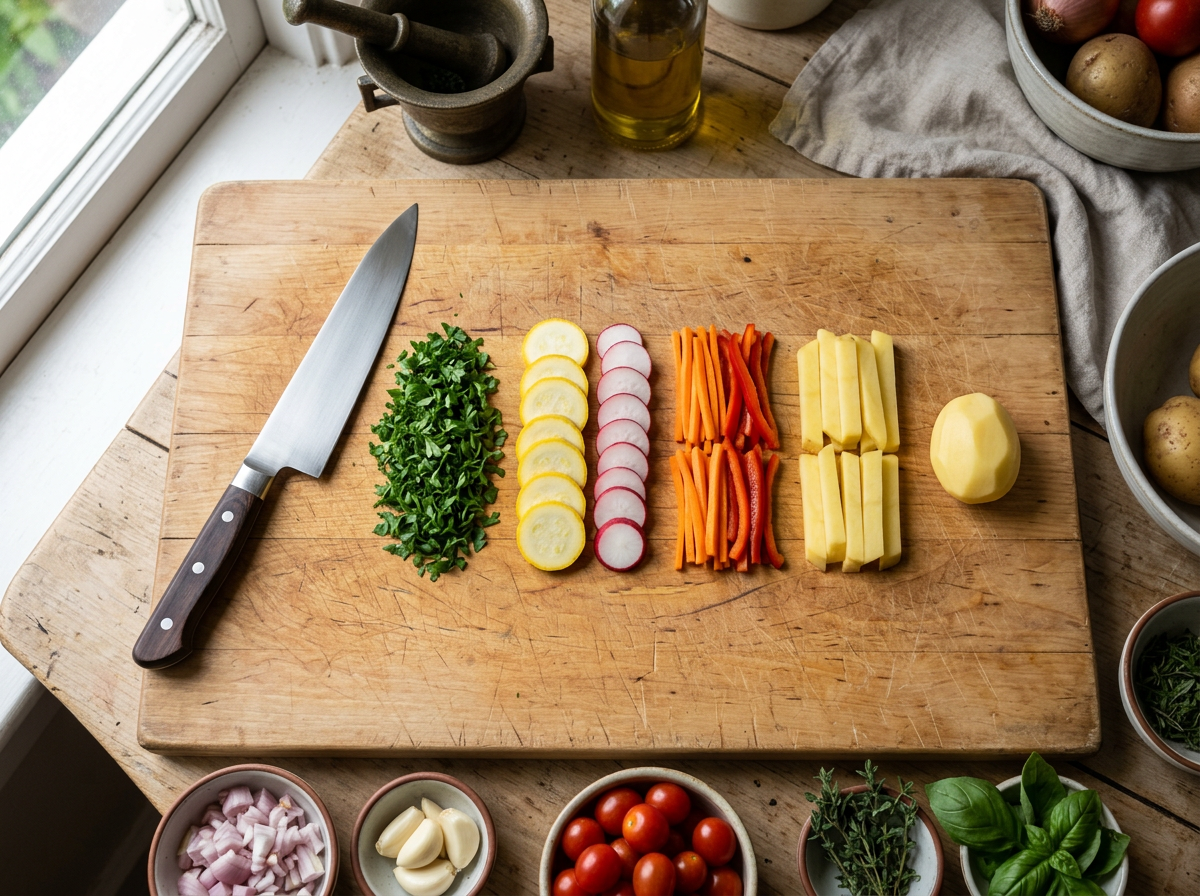
The push cut is the technique of choice for dicing — the process of cutting food into uniform cubes — as well as for the julienne and batonnet cuts that precede a proper dice. It is the tool for carrots, celery, potatoes, and the many firm vegetables that must be reduced to consistent pieces without crushing or tearing. It also handles slicing tasks beautifully, from cucumbers destined for a salad to the even rounds of carrot that lift a braised dish from rustic to refined.
The reasons for this are mechanical. The discrete, deliberate motion of each cut allows the cook to advance the food by precisely measured amounts between strokes. Because the claw hand moves the ingredient forward against the guiding knuckles, and because the blade travels a consistent, repeatable path with every stroke, the spacing between cuts becomes uniform almost automatically. Each piece ends up the same width, which means the same volume, which means the same cooking time. This is the technical foundation of even cooking: identical pieces, identical rate of heat transfer, identical doneness at the end.
This matters far more than most home cooks realize. Consider a vegetable soup. If the carrots are cut into uneven shapes — some thin slices that will soften in minutes, some thick chunks that need twenty — the cook faces an impossible choice: pull the soup off the heat when the thin pieces are tender and risk crunchy chunks, or wait until the chunks are done and accept overcooked slivers that disintegrate at the touch of a spoon. The same principle applies to every stir-fry, every roasted vegetable medley, every pan of caramelized onions (where uneven cuts mean some onions reach the rich brown stage while others remain pale and raw), every stew, and every curry. Uniform cutting is not aesthetics; it is the difference between a dish whose textures come together and one that falls apart.
The Squaring-Off: A Necessary Prelude#
An honest discussion of the push cut must acknowledge that it rarely operates in isolation. To dice a carrot or a potato into neat cubes, the cook must first produce a stable, rectangular foundation to cut from. This is the practice of squaring off: trimming the rounded sides of a root vegetable to create flat surfaces, cutting it into planks, and then cutting those planks into batons before finally dicing.
Each stage of this sequence employs the push cut. The initial squaring runs the blade straight down through a firm vegetable to remove a rounded edge. The planks are produced by laying the squared block flat and slicing it into even sheets, again with straight push cuts. The batons come from stacking the planks and cutting them crosswise into strips. The dice is the final series of push cuts applied across the batons. The whole operation is a chain of straight, deliberate motions, each dependent on the quality of the one before it — a cubist sculpture in reverse, built from a sequence of parallel cuts rather than mass.
This preparatory work can feel fussy and time-consuming to a home cook accustomed to simply hacking vegetables into rough chunks. But it is precisely where the discipline of the push cut pays its largest dividends. The flat surfaces created by squaring off give the vegetable a stable base — it will not roll or shift beneath the blade, which is both safer and more consistent. The uniform planks and batons guarantee that the final dice is uniform. And because each cut in the sequence is a simple, straight motion rather than a complex one, the technique remains approachable even as the geometry of the final result becomes more ambitious.
The Onion as the Ultimate Teacher#
When culinary instructors want to build a student’s push-cut fundamentals, they reach, almost universally, for an onion. This is not an accident. The onion combines everything the push cut demands: a firm texture that responds well to clean slicing, a rounded shape that forces the cook to stabilize the food before cutting (you cannot push-cut a whole onion safely), and a structure of concentric layers that is merciless in revealing uneven cuts — an onion sliced at inconsistent intervals shows every gap and overlap in its translucent rings.
The classic onion dice is a miniature masterclass in the push cut. The onion is halved through the root end, and each half is laid flat on the board. Horizontal push cuts are made parallel to the board, leaving the root intact so the half holds together. Then vertical push cuts run across the onion from tip to root, creating the lattice. Finally, the onion is turned and diced with a crosswise series of push cuts, the root end steadying the structure while the blade works through the layers. Every one of these motions is a straight push cut, and the quality of the final dice — uniform, neat, and intact — is a direct report card on the cook’s control.
There is a deeper reason why the onion is such a worthy practice subject: it appears in nearly every cuisine on earth. The onion is the aromatic foundation of French mirepoix, Italian soffritto, Spanish sofrito, the trinity of American Creole cooking, Indian tempering, and countless other flavor bases across the world’s kitchens. A cook who can dice an onion quickly and evenly has mastered the single most frequently repeated task in home cooking. Every hour spent practicing the push cut on onions is an hour invested in hundreds of future dishes.
Common Pitfalls and Their Remedies#
The most common mistake in the push cut is rushing the lifting phase. Because the blade must lift fully off the board before each stroke, there is a temptation to begin the next cut before the previous one is complete — to initiate the descent while the blade is still moving backward. This turns the push cut into a kind of chopping motion that compromises the clean slicing action and produces ragged edges. The remedy is to slow down deliberately and feel each phase of the movement: lift, position, push forward and down, rest on the board, and begin again. Speed arrives naturally once the phases become one smooth, habitual motion.
A second common error is holding the knife at too steep an angle during the descent. A push cut that descends nearly vertically loses its slicing component and becomes a straight chop, which crushes the food and requires far more force. The proper angle is relatively shallow — the blade should meet the food close to horizontally, sliding through it with a forward-leaning path that keeps the edge moving into the ingredient. This is what produces the clean, gliding sensation that tells the cook the cut went well.
Finally, home cooks often neglect the claw side of the equation during push cutting, assuming that the slow, deliberate nature of the technique makes the feeding hand less important. The opposite is true. The evenness of the dice depends entirely on how consistently the ingredient advances between strokes, and that consistency comes from the claw hand’s gentle, measured feeding pace. The two hands form a partnership: the knife hand provides the cutting motion, the feeding hand provides the spacing. If either works carelessly, the result is uneven regardless of how perfectly the blade moves.
Why It Matters#
The push cut may lack the dramatic elegance of a fast rock chop or the virtuosity of a tourne, but it is the technique that quietly determines the quality of an enormous share of home cooking. It is what turns a pile of vegetables into a properly executed stew, what produces the even dice that makes a stir-fry cook at the same pace, what allows a cook to slice a firm aubergine into uniform rounds that roast to the same blinding tenderness. It is precision in straight lines, and precision — rather than speed or flair — is the true currency of good knife work.
The Julienne and Batonnet: Shaping with Intention#
There comes a point in every cook’s development when mere size reduction is no longer enough. The food must not simply be made smaller — it must be made into something: a specific, deliberate shape that serves the dish. This is the moment when cutting stops being a chore and becomes a form of control over the final result. The julienne and its larger cousin, the batonnet, are the gateway to that way of thinking. They are the first cuts in which the cook shapes food with intention, and in learning them, a home cook begins to cross the invisible line between following a recipe and actually understanding what the recipe is trying to achieve.
Defining the Cuts#
The julienne is a thin strip of food, most often described in classic culinary terms as roughly the size of a matchstick. Its dimensions are typically stated as about one-eighth of an inch on each side, though in practice home cooks produce a wide range of juliennes from hair-thin to pencil-thin, depending on the application. The batonnet is the same shape at a larger scale — strips in the range of one-quarter to one-half inch on a side, comparable to the diameter of a small pencil, and typically between two and three inches in length. Both are prismatic strips with square or rectangular cross-sections: every strip is the same width, the same height, and (ideally) the same length as every other strip in the batch.
These dimensions are not arbitrary. They are tuned to how food behaves during cooking. A julienned carrot, at matchstick size, has a high surface-area-to-volume ratio, which means it cooks rapidly and absorbs dressings and sauces readily. A batonnet of potato, at pencil thickness, is large enough to maintain its structural integrity through a roast or a fry while still being small enough to cook through in a reasonable time. The size of the cut is a cooking decision as much as a visual one.
The Sequence: Square, Plank, Strip#
The path to a proper julienne or batonnet is rarely direct. Most ingredients — carrots, potatoes, zucchini, cucumbers, celery — arrive in rounded, tapered, organic shapes that resist clean parallel cutting. Attempting to julienne a whole carrot as it sits produces irregular, uneven strips that vary wildly in size and, consequently, in cooking behavior. This is why both techniques begin with a step that has nothing to do with strips at all: squaring off.
Squaring off means trimming the ingredient into a stable rectangular block. A carrot, for instance, is first cut across the ends to remove the tip and the rough top, then sliced lengthwise to remove the rounded sides, leaving a piece that resembles a broomstick with four flat faces. Every loss of material — and there is some — is a deliberate trade: the scraps are sacrificed so that the subsequent cuts can be perfectly parallel and uniform. The flat faces give the vegetable a stable base so it cannot roll under the blade, and they give the cook constant reference planes that guarantee each subsequent slice is the same thickness as the last.
Once the block is squared, the cook makes the first series of straight push cuts through the block to produce planks — flat, even sheets of the desired thickness. If the target is a julienne, the planks are thin; if a batonnet, they are thicker. The planks are then stacked atop one another (the flat surfaces making the stack stable) and cut crosswise into strips with a second series of push cuts. Because the planks are uniform, the strips are uniform; because the strips are uniform, the final cut is uniformly shaped. The entire operation is a chain of dependencies, each stage relying on the discipline of the one before it — and that is precisely the point.
This sequence — square, plank, strip — is not confined to these two cuts. It is the structural template for the entire family of classical vegetable cuts. From a batonnet, one more set of crosswise cuts produces a small dice; from a julienne, the same move produces a brunoise, the fine dice used to garnish consommés or to distribute tiny, even bits of flavor through a preparation. Learning the julienne and batonnet means learning the foundation of the whole alphabet of French knife cuts, and the discipline transfers everywhere.
Why Shape Matters Beyond Appearance#
It is tempting to dismiss shaped cuts as decoration — the province of competition kitchens and overly fussy restaurants — but the julienne and batonnet earn their place in the home kitchen through physics, not pageantry. The matter of even cooking is foremost. A stir-fry is the clearest demonstration: vegetables are cooked at high heat for a very short time, and they either cook through or they do not. A julienned carrot strip, thin and consistent, reaches tenderness in a minute and a half of intense wok heat; a thick, irregular chunk beside it remains raw at the center when the pan comes off the flame. The stir-fry chef’s constant companion is uniformity, and the julienne delivers it by design.
Texture and mouthfeel are equally affected. The julienne’s thin strips offer a delicate, almost crunchy bite; they soften quickly in broth and coat beautifully with sauce. This is why julienned vegetables elevate a bowl of noodle soup from mundane to vibrant — they carry broth and flavor into every bite at a scale that remains distinct and texturally interesting. The batonnet, by contrast, offers substance and bite. A batonnet-cut potato roasted until caramelized on the outside and creamy within is a fundamentally different eating experience from a cube of the same potato, which cooks more slowly and browns less efficiently for its surface area. Even the humble french fry is, technically, a batonnet of potato given a specific cooking treatment.
Presentation, when it does matter, flows naturally from these functional benefits. A salad scattered with fine julienne of apple or carrot looks composed and deliberate without any artificial fuss. A platter of gougères garnished with batonnet of vegetable looks elegant because the shapes themselves are emphatic and clean. The visual appeal is a byproduct of honest technique: food cut with intention looks intentional, and that registers with anyone who eats it, whether they can articulate why or not.
Common Pitfalls#
The failure most beginners encounter is jumping into the strips before completing the square. A cook who attempts to julienne a whole carrot, skipping the squaring step, produces strips whose width varies from sliver to slab. The result cooks unevenly and undermines the entire purpose of the technique. The remedy is humble and patient: trim the vegetable to its block first, accept the waste, and resist the urge to save time by skipping the foundation.
A second pitfall is misjudging the stacking step. When planks are stacked for the crosswise cuts, they must align properly or the strips will be tapered. Wet or slippery planks tend to slide apart mid-cut, which is why many cooks press the stack gently with the flat of the guiding hand for the first few strokes, then add the freed strips back to the top of the stack to keep it stable — a rhythm that manages a stack of planks the same way a dealer manages a deck of cards.
Finally, there is the matter of matchstick ambition. Beginners often aim for hair-thin juliennes before their hands are ready, producing strips that vary wildly in thickness and collapse into mush in the pan. The batonnet, being more forgiving at a larger scale, is the wiser training ground. The pencil-thick strip tolerates imperfect form far better than the hair-thin one, and the same hands that learn to produce uniform batonnets can, with practice, work their way down to delicate juliennes without frustration.
The Deeper Lesson: Intention Itself#
The real value of the julienne and batonnet lies beyond the strips themselves. Learning to shape food deliberately teaches something that transfers to every corner of the kitchen: the habit of thinking about what the final dish requires before reaching for the knife. The cook who juliennes a pepper for a stir-fry has made a choice about how fast it should cook and how it should feel in the mouth, and that choice was made before the first cut. This is the difference between cooking reactively and cooking with intention — the difference between a home cook who follows steps and one who understands them.
Patience, too, is part of the curriculum. There is no shortcut to a proper julienne; the square, the planks, and the strips each take the time they take, and rushing any stage compromises all the others. That enforced patience is a gift in a culture of convenience. It slows the cook down at precisely the moment when slowing down matters most, and it cultivates the same careful attention that distinguishes a dish made with thought from one made merely with speed. Food cut with intention, cooked with attention, and served with pride — that, in the end, is what these two simple cuts are really teaching.
Ki, Wa, and Pneuma: The Philosophy of the Patient Cut#
The patience cultivated by the julienne is not merely a practical virtue. It is a doorway into a deeper way of understanding what cooking is, and what it asks of the person doing the cooking. Three ancient concepts, drawn from two very different traditions, illuminate what is really happening when a cook slows down and brings full attention to the board. From the East come ki and wa — the vital energy that animates skilled action and the harmony that arises when all elements are in accord. From the West comes pneuma, the Greek word for breath, which links the rhythm of the body to the rhythm of the work. Taken together, they describe the inner state of a cook whose hands are truly in the dish.
Ki: The Energy Brought to the Cut#
In Japanese thought, ki (気) is the vital energy that flows through all living things — the same energy cultivated in martial arts, tea ceremony, calligraphy, and every traditional discipline in which the mind and body must act as one. Ki is not a mystical substance to be conjured; it is the quality of focused presence that a person brings to an action. When a swordsman cuts, or a calligrapher makes a stroke, the quality of the result is understood to depend not on the mechanical force of the movement but on the entirety of the person’s being flowing through that single gesture.
A knife cut is exactly such a gesture. The cook who brings full presence to the moment — who is not thinking about the phone, the conversation, or the next task — pours themselves into the blade. This is why two people can perform the identical mechanical motion with the identical knife and produce different results: the difference is the quality of attention, the completeness of the ki invested in each stroke. When a cook rushes through the squaring, the planks, and the strips, their energy is scattered, divided between the work and the impatience that waits beyond it. The cuts reflect that division in their raggedness. When the cook is fully present, the cuts carry a steadiness that is almost visible — uniformity not only of dimension but of character.
There is a reason that traditional Japanese disciplines speak of ki in connection with breathing and posture. Ki is not thought; it is something more like a current, and the body must be aligned for it to flow. Slumped shoulders, a tensed jaw, a held breath — these block the current and manifest as hesitation and trembling. The relaxed stance, the soft grip, the steady breath that the best knife work demands are precisely the conditions under which ki flows freely. The julienne, with its insistence on patience, trains the cook in these conditions.
Wa: Harmony Between Hand, Tool, and Ingredient#
Wa (和) is the Japanese word for harmony — and, tellingly, the word with which Japan refers to itself. It denotes a state of accord in which disparate elements work together without friction: the harmony of a musical ensemble, the harmony of a well-ordered society, the harmony of a meal. In the context of the kitchen, wa describes the relationship between three parties: the cook, the knife, and the food.
Mastery of the julienne makes this harmony tangible. The cook must listen to the knife — feel when the edge is keen and when it drags, sense when the work demands a lighter touch through a soft zucchini or a firmer one through a dense carrot. The knife, in turn, must be suited to the task, and the cook to both. When this triad is in accord, the cutting becomes almost frictionless; the blade moves as though the food were inviting it through. When it is out of accord — a dull knife against a ripe tomato, a tense cook against an unfamiliar vegetable — the effort is visible in every torn, crushed, or uneven strip.
Wa also describes the harmony the cuts themselves create in the finished dish. A julienne of carrot, pepper, and snow pea, each cut to the same dimensions, forms a coherent whole in the wok — each element reaching doneness at the same moment, each surrendering its texture at the same rate. The restraint of shaping food uniformly is an act of respect for the dish itself, an acknowledgment that the whole is more than the sum of its parts. This is harmony in the deepest sense: not the mere absence of conflict, but the positive alignment of every element toward a shared outcome.
Pneuma: The Breath That Carries the Motion#
The Greeks understood breath as something more than respiration. Pneuma (Πνεῦμα) — the word for breath, wind, and spirit alike — was for Aristotle the vital principle that animates the body, and for the Stoics the sustaining fire that pervades the cosmos. Breath, in this ancient view, is the bridge between the physical and the intentional: the invisible current that carries life into matter. It is a fitting image for the role of breathing in skilled manual work.
There is a profound connection between breath and cutting. Watch an experienced cook at work and notice the breath: unhurried, even, synchronized with the motion of the hands. The descent of the blade rides the exhale; the lift of the knife accompanies the inhale. Breathing is the metronome of the body, and when it is steady, the hands follow its tempo. When a cook holds the breath in concentration or pants with haste, the rhythm fractures — and the cuts fracture with it.
In the Western contemplative traditions, pneuma came to stand for the spirit that must be present for an act to be genuinely alive — a performance without pneuma is mere mimicry, a sentence without pneuma is mere marks on a page. A meal can be cooked without pneuma, too: every step executed, every technique applied, and the result nevertheless empty. What is missing is the breath of intention. The cook who has mastered the patience of the julienne cooks with pneuma because they cook whole: mind attending, breath steady, energy gathered into each stroke of the blade.
The Three as One#
These three concepts are not rival philosophies but facets of a single insight. Ki is the energy gathered; pneuma is the breath that carries it; wa is the harmony that results when both are directed aright. A cook who brings full presence (ki) to the work, breathes through it evenly (pneuma), and aligns hand, blade, and ingredient in mutual accord (wa) is not merely executing a technique — they are participating in a tradition of disciplined attention that spans East and West, the martial arts and the contemplative life, the tea room and the kitchen.
And it all begins with something as humble as a matchstick of carrot cut with patience. The square, the planks, the strips — each cut practiced until the energy flows, the breath steadies, and the harmony appears. Food cut with intention, cooked with attention, and served with pride: this is what the patience of the julienne has always been teaching, in every kitchen and every era. The ancient concepts simply give it a name.
The Tourne: A Test of Control#
Every cut in the classical repertoire can be learned with relative speed, but one stands apart as a rite of passage. The tourne — pronounced toorn — is the cut that professional culinary students dread and secretly prize, the technique that separates those who have merely memorized the motions of knife work from those who have genuinely mastered them. It asks for everything the other cuts have taught and then demands more: sustained control of the blade’s angle, unvarying pressure through changing terrain, and the particular patience required to work around curved surfaces. For the home cook, it is the capstone — the exercise that makes every other skill in the kitchen feel, by comparison, like a relaxation.
What the Tourne Actually Is#
The tourne produces a neat, barrel-shaped piece of vegetable, typically about two inches long, with seven distinct faces. The name comes from the French verb tourner, to turn, and that is precisely what the technique does: it turns the vegetable in the hand, rotating it through a sequence of angled cuts until the original irregular lump has become a polished, symmetrical barrel. The seven sides are not decorative. Each flat face slightly enlarges the surface area of the vegetable relative to its volume, and the consistent cross-section means that every tourned piece of carrot cooks at the same rate as every other — in classical cuisine, this was the guarantee that a pan of tourned vegetables would emerge uniformly glazed and tender.
The tourne is traditionally applied to root vegetables — carrots, turnips, potatoes, and the like — and it occupies a storied place in classical French cooking. Tourned vegetables (the plural is tournés) appear as elegant garnishes and accompaniments in the grand repertoire: tourned carrots and turnips simmered in butter around a roast, tourned potatoes roasted to a uniform golden surface, the neat barrels of vegetables that decorate the classical dish pommes château. In the great kitchens of the nineteenth century, an apprentice was expected to produce tournés by the dozens, and the slow accumulation of perfect barrels was both a punishment and a privilege — the proof that the hands had arrived.
The Mechanics of the Cut#
The tourne departs dramatically from every cut that precedes it. The rock chop, the push cut, and the julienne all keep the food stationary on the board, advancing it with the claw hand while the knife performs its work. The tourne inverts this relationship: the knife’s blade tip stays in place, hovering just above the cutting surface, while the vegetable itself rotates through the space beneath the edge.
The working sequence unfolds in a single continuous motion. The cook holds the vegetable in the non-dominant hand and the knife in the other, the blade held more vertically than in any cut so far. The first cut is an oblique slice into the vegetable, removing a shallow angled face. Then the cook rotates the vegetable a fraction of a turn, and the blade follows with another oblique stroke, its angle opening slightly wider. This rotation-and-cut cycle repeats roughly six or seven times, each pass paring away a thin face, until the vegetable has completed nearly a full revolution and the final stroke feathers into the first, closing the barrel’s outline. A last cut trims the top to length.
The blade never leaves the vegetable during the entire sequence. The tip of the knife points downward, fixed at a constant angle relative to the board, while the heel of the knife is drawn gently toward the cook with each stroke — a motion that is part slicing, part paring. The angle of the blade must remain absolutely constant as the vegetable turns beneath it, because any variation shows immediately in the finished piece: a blade held too steeply produces a tapering, cone-like shape; a blade that tilts sideways as the hand fatigues produces a face that is skewed and uneven.
This is the heart of the tourne’s difficulty, and the source of its value. Every other cut permits the cook to cheat in small ways — to adjust the angle mid-cut, to let the claw hand compensate for a wandering blade, to finish the task with a piece that is close enough. The tourne permits no such charity. The blade’s angle must hold; the pressure must remain feather-light yet constant; the rotation of the vegetable must advance in even increments. None of this can be faked, and all of it must be learned through the body rather than the mind.
Why It Is So Difficult#
Three distinct challenges compound one another in the tourne, which is why it resists mastery longer than any other basic cut. The first is the blade angle. In the rock chop and the push cut, the knife operates in what is essentially a single plane, and minor deviations in angle are absorbed by the forgiving geometry of the motion. The tourne holds the blade more vertically and moves it along a curved path around the vegetable’s surface. The acceptable tolerance for angular error shrinks to nearly nothing, and the cook must maintain that precision through the entire rotation — not for seconds, but for the full arc of the piece.
The second challenge is the curved surface itself. A flat-sided (squared-off) vegetable presents a stable, predictable surface to the blade; a round one presents a changing tangent at every point. As the vegetable rotates, the blade encounters a surface whose slope is constantly altering beneath it, and the cook must respond with continuous micro-adjustments of pressure and blade angle that are far too subtle to be planned in advance. This is the skill of responding to the work rather than imposing on it — a quality the tourne cultivates more effectively than any other cut. This is what makes it a teacher.
The third challenge is simultaneity. In other cuts, the cook can deliberate between phases; there is time to lift the blade, check the work, and reposition. The tourne, done properly, is a continuous flowing sequence in which cutting and rotating are a single gesture. Hesitation breaks the rhythm entirely, producing a piece whose faces end abruptly at different depths and leave the barrel looking cobbled together. The tourne demands that the hands work as one organism, not as two limbs taking turns — and that unity of motion is precisely the skill that transfers so powerfully to everything else.
The Transfer to Everyday Work#
A home cook might fairly ask whether two-inch barrels of carrot will ever grace their weeknight table, and the honest answer is that they may not — the tourne, as a finished product, is a classical nicety rather than a daily necessity. But the question misses the point of the exercise. The tourne’s real purpose is not the barrel it produces but the control it builds, and that control transfers directly into the unglamorous tasks that fill real kitchens every day.
Consider peeling. Most home cooks peel vegetables — potatoes, carrots, apples, ginger — with a dedicated peeler, gripping the vegetable in one hand and dragging the tool along its curved surface. The tourne trains exactly this coordination: one hand steadying and rotating the food while the other applies an angled, curving blade stroke. A cook who has tourned a dozen carrots can look at a pile of potatoes and see them differently — as rounded volumes to be worked around, not obstacles to be hacked at, and the peeler in their hand moves with a fluency that was absent before. The same transfer applies to trimming: shaping a stalk of broccoli, coring and segmenting a tomato, removing the eyes from a potato, or cutting the fibrous outer layer from a knob of ginger. Each of these is, in miniature, a tourne: a curved surface, an angled blade, a rotating hand.
Even work that never involves a curved cut is affected. The tourne’s insistence on constant blade angle deepens the cook’s awareness of the knife’s attitude in space, and that awareness improves the straight cuts as well. A cook who has learned to hold one angle steadily through the full rotation of a carrot holds it more steadily, too, through a pile of diced onions and across the planks of a halved zucchini. The tourne is the kind of exercise that raises the entire standard of the rest of the work — not by teaching new motions, but by deepening the control behind every motion already learned.
Common Pitfalls and the Path Through Them#
Beginners consistently fall into a few recognizable traps. The most common is pressing too hard, on the assumption that a deeper cut will finish the vegetable faster. In the tourne, force is the enemy: a heavy stroke gouges the surface and produces an uneven face, and the cumulative effect of six or seven deep strokes is a piece that is visibly notched rather than smoothly barred. The correct pressure is light — the blade should feel as though it is drawing a surface rather than excavating one — and the thin shaving it produces is evidence of the right touch.
A second pitfall is advancing the vegetable in irregular increments. Cooks tend to rotate too little at the beginning of the sequence and too much toward the end, producing a piece that is fat in its first faces and thin in its last. The rotation must advance in even steps — the same fraction of a turn, six times around — and this evenness, like everything in the tourne, must be felt rather than measured. It appears with repetition.
The third pitfall is the urge to hurry, and it is worth naming plainly. The tourne cannot be rushed. It is the slowest cut in the repertoire, and its deliberateness is not an inefficiency but the entire point of the exercise. Every attempt to speed it up — deeper bites, faster rotations, a harder grip on the vegetable — produces a worse result, and the cook who persists discovers that the only way through the frustration is through it: slow, patient, repeated practice until the slowed-down motion becomes the new natural speed. In this sense the tourne is the culmination of everything the essay has described. It demands the grip. It rewards rhythm. It turns the straight discipline of the push cut to the curved surfaces of the world. It carries the patience of the julienne to its purest form. And for a cook who has internalized ki and wa and pneuma, the tourne is where they all meet: full presence, steady breath, and the quiet harmony of hand, blade, and vegetable turning together beneath the edge.
The Capstone#
In the end, the tourne is the most honest cut in the repertoire. It offers no shortcuts, tolerates no approximations, and reveals exactly where the cook stands with absolute clarity. Practicing it builds control that shows up everywhere else the moment it is learned, and the barrels themselves — so rarely needed in a home kitchen — matter only as evidence that the hands have arrived. The cook who can tourne a carrot can do anything else the kitchen requires, with a confidence that no shortcut has ever provided. That is why the tourne is a test, and why passing it is worth the patience it demands.
The Eastern Counterpoint: French Geometry, Japanese Craft#
Every technique described so far belongs to a single tradition — the classical French repertoire that descended from la cuisine classique and still anchors culinary schools around the world. But the French tradition does not hold a monopoly on disciplined cutting. Across the world, Japanese cooks developed a parallel system of knife work, equally rigorous and every bit as demanding, built on a distinctly different philosophy. Side by side, the two traditions reveal not only alternative techniques but alternative ways of understanding what a cut is for — and the comparison sharpens the meaning of everything already discussed.
Two Philosophies Shaping Two Styles#
The French approach to cutting is, at its heart, an exercise in geometry. The julienne is defined by its dimensions, the dice by its millimeter count, the tourne by its seven faces. These standardized shapes exist because classical French cooking emerged from the brigade system — great kitchens staffed by many cooks producing many identical plates. If every cook in the kitchen cuts carrots to the same size, every portion cooks at the same rate, and the dish emerges consistent from a hundred hands. The template comes first; the ingredient conforms to it. The French cut is a statement of control.
The Japanese approach inverts the priority. A Japanese cut is a response to the ingredient itself — to the direction of its fibers, the hardness of its flesh, the way it will be cooked, and the way it will be eaten. The custom shapes the cut; the ingredient carries its own form. A daikon destined for a long simmer is cut differently from one destined for a raw salad, not because the recipe sheet demands different dimensions but because the vegetable’s structure and the cooking method dictate the logic of the blade. The Japanese cut is a statement of respect. Both traditions demand the same raw skills — angle control, even pressure, hours of practice — but they aim them at different targets.
The Cuts, Side by Side#
The most revealing way to see the two traditions is to set parallel cuts against one another. The French julienne and the Japanese sengiri both produce fine matchstick strips, yet they part company in purpose. The julienne is a fixed dimension, applied the same way whether its target is a carrot for a salad or a leek for a garnish. The sengiri is a technique of shredding built around surface area: thin strands of cabbage that absorb dressing or ferment quickly, threads of daikon that wilt into a delicate namasu. The shape is similar; the reasoning behind it belongs to the ingredient.
The batonnet finds its counterpart in rangiri, the rolling cut, and the difference could hardly be more striking. The batonnet reduces a vegetable to identical rectangular batons — straight, angular, uniform. The rangiri is the opposite: the cook makes one diagonal cut, rotates the vegetable a quarter turn, makes another, and the result is a pile of irregular angled pieces with pointed, faceted ends. Where the batonnet erases the vegetable’s natural form, the rangiri exaggerates it. The angled faces create more surface area per piece, which is precisely the point: a rangiri-cut daikon simmering in broth absorbs heat and flavor from many directions and cooks evenly without ever being identical to its neighbor.
The pairing of the tourne is the most instructive of all. The French tradition answers the test of control with the seven-sided barrel — a piece shaped to an imposed, geometric ideal. The Japanese tradition has its own equivalent rite of passage: katsuramuki, the art of turning a whole daikon under the blade of a thin vegetable knife, peeling it into a single, continuous, translucent sheet, unbroken from one end of the root to the other. The tourne proves the hand can impose a form on the ingredient; the katsuramuki proves the hand can follow the ingredient. Both demand the same total command of blade angle and pressure. Both are tests of three, four, and five years of practice in their respective traditions. But where the French test ends in a barrel of imposed geometry, the Japanese test ends in a sheet that is then often rolled and shredded into fine threads — a form still carrying the character of the vegetable it came from.
Even the motion of slicing reveals the philosophical divide. The French push cut drives the blade forward and away from the body in discrete, pressing strokes. Japanese slicing favors the draw — the hiki stroke — in which the blade is pulled toward the cook in one long, continuous pass, riding the entire length of the edge through the food. For sashimi, the cut is the sogigiri: the blade laid at a shallow angle and drawn across the fish in a single sweeping stroke, producing thin, broad slices created by the pull of the edge rather than the push of the wrist.
The Knives Behind the Differences#
These opposing motions are written into the knives themselves. The French chef’s knife carries its curved belly so that it can rock; the technique and the tool evolved together. The Japanese vegetable knife — the usuba — is the exact opposite: a straight, razor-thin blade with no belly at all, ground to a single bevel on one side, with the reverse face slightly hollowed. The straight edge cannot rock; it is built for vertical, perpendicular cuts that pass cleanly through the full height of a vegetable. And the single bevel confers a distinct advantage: the flat side of the blade produces a cut surface that is pressed cleanly, cell walls sealed rather than torn. For a sashimi knife, this is everything — the clean cut is what keeps the fish glossy, intact, and free of leaking juices. The French push cut, for all its precision, tears more; the Japanese draw cut, with its single elegant bevel, parts the ingredient like a curtain.
Between the two traditions lie the hybrids: the nakiri, a double-beveled Japanese vegetable knife with a straight blade, and the gyuto, the Japanese interpretation of the Western chef’s knife, whose flatter profile favors the push cut over the rock chop. These knives are living proof that the two traditions are not sealed off from one another — they are two dialects of the same language of discipline.
What the Comparison Teaches#
Set side by side, the two traditions combine into a fuller picture of what knife work is. The French way standardizes and systematizes; it makes the kitchen legible, measurable, and teachable to a hundred cooks at once. The Japanese way individualizes and attunes; it makes the cook and the ingredient partners in the creation of every piece. One might say the French cut serves the dish, while the Japanese cut serves the ingredient — but the honest conclusion is that the home cook needs both impulses. The uniform dice of the French tradition ensures a stew cooks evenly. The rolling cut of the Japanese tradition gives a simmered root vegetable its tender, thoroughly flavored interior. The tourne builds control; the katsuramuki builds patience of another kind entirely.
The table below gathers the key pairings in one glance:
| Element | French Tradition | Japanese Tradition |
|---|---|---|
| Fine strips | Julienne (fixed matchstick dimensions) | Sengiri (shred to maximize surface area) |
| Uneven-angled pieces | None typical | Rangiri (rolling diagonal cut for even absorption) |
| Supremacy test | Tourne — seven-sided imposed barrel | Katsuramuki — one unbroken rotated sheet |
| Slicing motion | Push cut (blade pushed forward and down) | Hiki/sogigiri (blade drawn toward the cook) |
| Signature knife | Chef’s knife with curved belly, double bevel | Usuba with straight edge, single bevel |
| Underlying principle | The template defines the cut | The ingredient defines the cut |
Coda#
In the end the comparison is not a contest. The French repertoire and the Japanese repertoire are two fully developed answers to the same question — how should a hand with a blade approach food? — and each answer is coherent and complete. The home cook who has worked through the French cuts and then discovers the Japanese tradition gains more than a handful of new techniques; they gain a second way of seeing. Some nights a dish calls for the confident geometry of the tourne. Some nights it calls for the quiet attunement of the katsuramuki. The knife does not care which philosophy commands it; it only asks that the hand behind it be disciplined, patient, and present — ki gathered, breath steady, harmony intact, whether the cook is working in the language of la cuisine classique or the language of the shokunin.
Summary#
The five skills described here form a complete foundation for everyday kitchen work. They cover holding the knife, making the most common types of cuts, and shaping food with care and consistency.
| Skill | Primary Use | Key Principle |
|---|---|---|
| Grip and Claw | All cutting tasks | Control and safety through proper hand positioning |
| Rock Chop | Mincing herbs, garlic, and onions | Rhythmic rocking with the tip anchored |
| Push Cut | Dicing and slicing for uniform pieces | Clean forward-and-down motion |
| Julienne / Batonnet | Matchsticks, batons, and shaped cuts | Squaring off, then slicing with precision |
| Tourne | Shaped vegetable pieces and advanced control | Seven-sided cut demanding angle and pressure mastery |
Conclusion#
Knife skills are not about speed for its own sake — they are about consistency, safety, and respect for ingredients. A cook who can hold a knife correctly, rock chop through a pile of parsley, push-cut an onion into even dice, julienne a carrot into matchsticks, and tourne a potato into a neat barrel possesses the technical foundation to tackle virtually any recipe with confidence. The journey from hesitant beginner to assured home cook begins not with exotic ingredients or expensive equipment, but with a sharp knife and the willingness to practice these five essential movements until they become automatic. Along the way, that willingness teaches something deeper: the patience to slow down, the presence to bring full attention to each stroke, and the quiet understanding — shared by cooks across every tradition — that food cut with intention, cooked with attention, and served with pride is food at its very best.