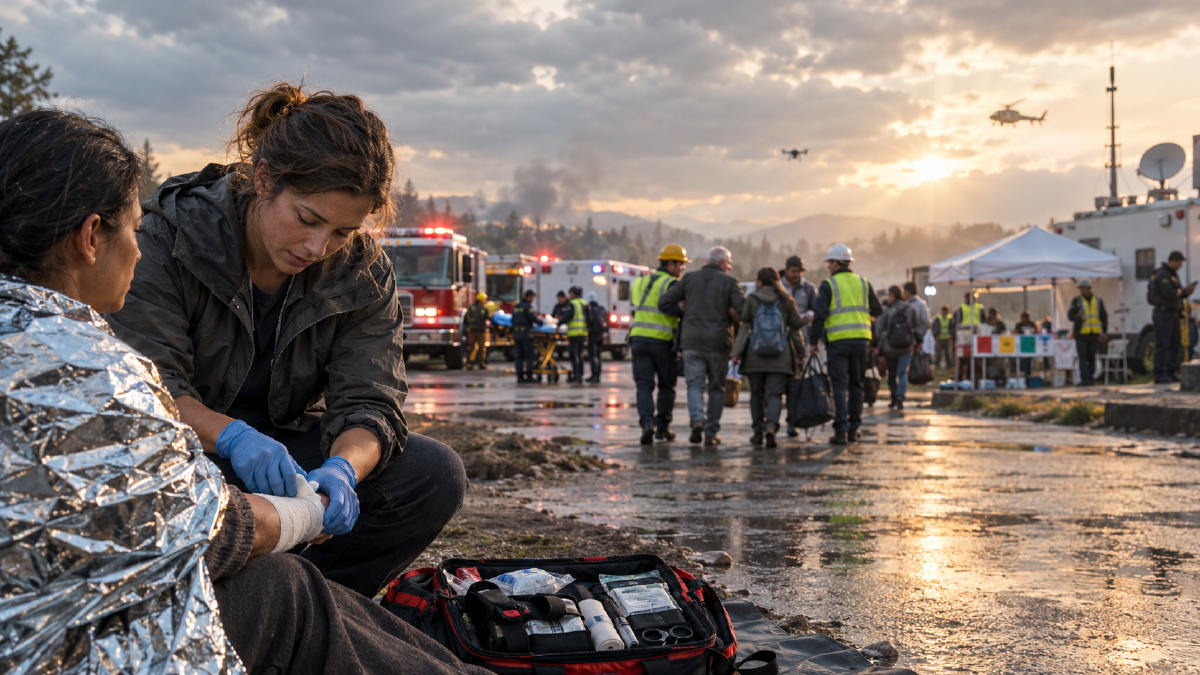
Introduction#
Mass casualty events occupy an uncomfortable place in ordinary life. They are the earthquakes that split a city’s streets open without warning, the hurricanes that drown a coastline, the explosions in a chemical plant that level a neighborhood block, the shootings that turn an ordinary afternoon into a horror. They make front pages and dominate evening broadcasts for days, and then, for most of us, they recede into the background noise of distant catastrophe — things that happen somewhere else, to other people, on a scale no normal life could ever absorb. The psychological defense is understandable. Living in a permanent state of vigilance against unlikely horrors is exhausting and unproductive. But the defense carries a hidden cost: it trains ordinary people to see themselves as permanent bystanders in events where, in reality, the first and often most consequential decisions will be made by them — the shoppers, the teachers, the commuters, the neighbors who happen to be standing there when everything changes.
This essay is about closing that gap. It is an argument, developed at length and in layers, that ordinary, everyday people are neither powerless nor irrelevant when a mass casualty event occurs, and that the difference between chaos and survivable order in the first minutes of a disaster is made long before the first professional responder arrives. That difference is made by preparation: by what people know, what they carry, what they have practiced, what they have planned with their families, how they relate to their neighbors, and how effectively the organizations around them are trained to take over once the scale of the event becomes clear. Preparation of this kind is not a hobby for pessimists or a lifestyle for the fearful. It is a civic competence, as ordinary in principle as knowing how to drive or how to vote, and it can be built by anyone willing to invest the time.
A mass casualty event, in the most useful working definition, is any incident that produces so many casualties, so quickly, that the local emergency response and healthcare system is overwhelmed by the demand. That definition deliberately spans an enormous range. It includes natural disasters: earthquakes, hurricanes, floods, wildfires, and the cascading failures they set off. It includes deliberate acts of violence: terrorist bombings, mass shootings, vehicle attacks. It includes industrial accidents and transportation disasters — refinery fires, train derailments, structural collapses — and it includes pandemics, where the casualties accumulate not in hours but over weeks and months, stretching the healthcare system in a slower but equally punishing way. What these very different events share is a common structure: suddenness, scale, an inversion of the normal ratio between need and resources, and a period of confusion in which official help exists but is necessarily delayed, distributed, and initially insufficient. The 2010 earthquake in Haiti killed something on the order of a quarter of a million people and left the country’s health infrastructure in ruins; the September 11 attacks killed nearly three thousand in a single morning in one of the most response-rich cities on Earth. Scale alone does not determine outcome. Preparedness — of individuals, of institutions, of entire communities — does.
The essay that follows proceeds in four parts, each building on the last. Part One establishes the foundations: what mass casualty events actually are, why education and risk awareness are the base layer of all preparedness, and how individuals and families translate awareness into concrete plans — communication strategies, evacuation routes, meeting points, and emergency kits. Part Two turns to the prepared citizen as an individual: the mental conditioning that allows people to function under extreme stress, the portable tools that meaningfully expand what a bystander can do, the core skills — first aid, hemorrhage control, situational awareness, crisis communication — that turn a willing bystander into a useful one, and the legal and ethical frameworks that govern assistance. It closes with what happens when the event actually begins: staying calm, adapting, helping others without becoming a victim. Part Three moves from the individual to the professional and organizational response: the competencies expected of trained responders, the medical training and triage systems that decide who is treated first and how, the Incident Command System that imposes order on a chaotic multi-agency response, the planning and interagency coordination that make large-scale response possible, psychological first aid for the traumatized, and the technology that increasingly multiplies the effectiveness of all of it. Part Four widens the lens to the level that ultimately determines how well a society weathers disaster: community engagement, public education, and the culture of continuous learning that converts every hard-won lesson into better future performance.
Several themes run through all four parts. The first is that preparedness is layered. No single layer substitutes for another: a skilled bystander without a plan improvises badly, a perfect family plan collapses in an unsupportive community, and the best-trained professional responders in the world cannot be everywhere at once. The second is that competence reduces fear. Panic is not a fixed reaction to horror; it is the predictable consequence of not knowing what to do, and it yields reliably to knowledge, practice, and rehearsal. The third is that preparedness is inherently social. Everything worth doing in this domain — learning, planning, training, responding, recovering — is done better together, and the communities that recover fastest from disaster are almost always the communities that were connected before it. The fourth is that none of this is a one-time accomplishment. Skills decay, kits expire, plans outgrow the households that made them, and the threats themselves evolve. Preparedness is a practice, not a possession.
Nothing in this essay asks the reader to become a paramedic, a command officer, or a survivalist. It asks something more modest and, in the end, more demanding: to take the ordinary responsibilities of adult life — the ones we already accept in the form of seat belts, smoke detectors, and insurance — and extend them deliberately into the domain of mass casualty events. What follows is a map of that territory, from the first step of understanding what can happen where you live to the last step of building a community that treats readiness as a shared value. The events themselves will remain unpredictable. The response to them does not have to be.
Part One — Foundations of Preparedness#
Chapter 1: Understanding Mass Casualty Events#
Every emergency response system is designed around an assumption of ordinary load: a steady stream of calls, a manageable number of patients, hospital beds that can absorb a difficult night, and crews that can be back in service before the next alarm. A mass casualty event is precisely the event that breaks that assumption. The working definition used throughout this essay is straightforward: a mass casualty event is an incident that produces casualties in such volume and such concentration that local emergency response and healthcare capacity is overwhelmed. The defining feature is not the cause of the incident but the mismatch between the number of people who need immediate care and the care that is immediately available. A factory explosion, a collapsed building, a bridge failure, a shooting in a crowded public space, or a hurricane sweeping an entire coastline can all produce the same operational condition — more injured people than the system can treat in the window in which treatment matters.
Because the definition is relative to capacity, the same event may qualify in one location and not in another. A multi-vehicle collision that a large city’s EMS system can absorb with routine efficiency might overwhelm a rural county whose nearest trauma center is an hour away. What distinguishes a mass casualty event, then, is not only the raw count of the injured but the sudden influx of victims requiring immediate medical attention against the backdrop of a particular community’s personnel, supplies, infrastructure, and transport. Recognizing this threshold is the first step toward understanding why such events demand a different kind of response — coordinated, scalable, and rehearsed — rather than simply a larger version of an ordinary one.
The Broad Categories of Mass Casualty Events#
Although mass casualty events vary widely in origin, they fall into a few broad categories, and preparedness efforts generally organize themselves around them.
Natural disasters form the first and most familiar category: earthquakes, hurricanes, floods, and wildfires can cause widespread destruction, displacing populations and producing enormous numbers of injuries and fatalities in a very short period. The 2010 Haiti earthquake illustrates the category at its most severe. The earthquake caused an estimated 230,000 deaths and left millions injured and homeless, overwhelming what remained of the country’s healthcare infrastructure almost instantly. In events of that scale, the local capacity to respond is not merely strained; it is partially destroyed along with the buildings, roads, and utilities that a response depends on.
The second category is deliberate attack — acts of violence intentionally designed to cause mass harm and public panic. The September 11, 2001, attacks in the United States and the 2004 Madrid train bombings are the examples most often cited, and both share a grim operational signature: casualties produced all at once, in places chosen to maximize disruption, against a backdrop of continuing threat that complicates the rescue itself. Deliberate attacks add a security dimension to the response, since responders must operate in an environment where the danger may not have passed and the possibility of a secondary attack has to be managed alongside the medical one.
Industrial and transport accidents make up a third category. Refinery and chemical plant explosions, hazardous material releases, train derailments, and major road or aviation disasters can generate large numbers of casualties from a single event, often accompanied by hazards that complicate access — fire, toxic plumes, structural instability, or debris that blocks the routes rescuers need. These incidents frequently sit at the intersection of multiple jurisdictions and regulatory systems, which makes coordination between private operators and public agencies a recurring challenge.
Pandemics form the fourth category, and they differ from the others in tempo rather than in severity. The COVID-19 pandemic demonstrated how an infectious disease outbreak can produce a high number of casualties over an extended period rather than in a single moment. The pressure on healthcare systems is sustained instead of sudden: beds fill over days and weeks, staff fall ill at the same time they are most needed, and supplies are consumed faster than they can be replenished. The response required is not a sprint but a marathon, and it depends heavily on coordination with public health authorities and on the ability of hospitals to expand capacity deliberately over time.
Defining Characteristics and the Challenges They Create#
Despite these differences in origin, mass casualty events share a set of characteristics that create predictable challenges for responders.
Scale and complexity is the first. The sheer number of casualties can overwhelm local resources, forcing the mobilization of additional personnel and equipment from surrounding areas, and sometimes from much farther away. Complexity compounds scale: a single incident may simultaneously involve fire, structural collapse, and hazardous materials, and each additional hazard multiplies the decisions that must be made. The response is rarely a straight line from alarm to resolution; it branches, and the branches must be managed.
Time sensitivity is the second defining characteristic. The need for rapid assessment and intervention is critical, because delays in response translate directly into increased mortality and morbidity. This is the reason triage exists as a discipline: when there is not enough time or enough help to treat everyone at once, care must be prioritized so that resources go where they will do the most good. Under time pressure, imperfect information is the norm, and responders must act decisively anyway.
Resource limitations follow naturally. Mass casualty events frequently occur in environments where resources are already compromised. Hospitals may be damaged, roads may be impassable, communications networks may be congested or down, and supplies of blood, medication, and equipment may be consumed faster than they can be resupplied. The shortage is rarely limited to one thing; shortages tend to arrive together, and each one constrains the others.
Finally, communication and coordination breakdowns represent a challenge that is as much organizational as it is technical. Effective management requires a clear command structure, shared information, and coordinated deployment of resources across agencies that may not routinely work together. When every agency follows its own procedures on its own radio system, the result is duplication in one place and gaps in another. Much of modern disaster training is, at its core, an attempt to prevent that outcome.
The Broader Impact Beyond Immediate Casualties#
The impact of a mass casualty event on a community is profound and multifaceted, and it does not end when the last victim is transported. Beyond the immediate physical injuries and loss of life, such events can produce long-term psychological trauma among survivors, witnesses, families, and responders alike. Fear and grief do not respect the boundary of the incident scene; they persist in schools, workplaces, and neighborhoods long after the emergency vehicles have gone.
Economic disruption is a parallel consequence. Businesses close, employment is interrupted, property is destroyed, and the costs of emergency response and reconstruction compete with every other demand on public and private budgets. Social strain often follows displacement: families are separated from their homes and support networks, essential services are interrupted, and communities must absorb the practical and interpersonal pressures of shared loss and unequal recovery. Communities may face challenges in rebuilding infrastructure, restoring public services, and addressing the mental health needs of survivors and responders for years afterward. The ripple effects of such events can be felt long after the incident itself, which is why the broader consequences — not just the casualty count — must shape how preparedness is measured.
The Roles of First Responders and Healthcare Systems#
Managing a mass casualty event falls first to first responders: emergency medical technicians, paramedics, firefighters, and police officers. They are typically the first on the scene, and their responsibilities begin before any hospital is involved. They assess the situation, establish the boundaries of the scene, provide initial medical care, and coordinate with other arriving agencies. Paramedics and EMTs perform the first systematic evaluation of victims and begin treatment in the field; firefighters contend with the environmental hazards — fire, collapse, entrapment — that determine whether rescuers can reach the injured at all; police secure the scene, control access and traffic, and, in the case of deliberate attacks, address the ongoing security threat. Their training in triage, trauma care, and incident management is what converts a chaotic scene into an organized flow of patients moving toward care.
Healthcare systems carry the response from the other end. Hospitals and medical facilities must be prepared to handle a sudden influx of patients, which means implementing surge capacity plans that expand the number of treatment spaces and available staff well beyond normal operations. It also means ensuring the availability of critical supplies and equipment — blood products, medications, imaging, operating room time — and coordinating with public health agencies so that patient distribution, disease surveillance, and resource requests move in the same direction. Healthcare professionals must be trained in mass casualty protocols, including triage, trauma care, and infection control measures, because the hospital phase of the event is where many of the most consequential decisions about survival are ultimately realized.
Understanding mass casualty events, then, means recognizing the diversity of their causes, the shared characteristics that make them difficult, and the extended consequences they leave behind. An effective response to any of them depends on four elements working together: trained everyday citizens who can act in the first minutes, professional responders who stabilize and transport, disciplined command structures that keep agencies aligned, and communities whose planning and relationships allow them to absorb the shock and rebuild afterward. The remainder of this essay examines each of those elements in turn, beginning with the people who must carry them out.
Chapter 2: Education and Awareness: The Foundation of Preparedness#
Every other layer of disaster preparedness — the kit in the hall closet, the family communication plan, the tourniquet in the backpack, the volunteer work with a local response team — rests on a layer beneath all of them: knowledge. Education is the foundation because it is the thing that determines what all the visible preparations will contain. A family that has never thought about what can actually happen where they live will pack a generic kit for a generic emergency; a family that understands its regional risk profile will pack for the specific event that is most likely to arrive. The difference is not trivial. It is the difference between preparedness that matches reality and preparedness that is mostly theater, and it begins with an unglamorous exercise: studying the ground under your own feet.
Regional Risk Awareness#
Every region of the country has a disaster signature. Coastal areas live with hurricanes and flooding; the Gulf and Atlantic coasts have named seasons, warning systems, and evacuation protocols that residents are expected to understand as a condition of living there. Preparation in these regions has a specific shape: learning to read hurricane warning systems and the staged alerts that precede landfall, knowing the evacuation routes out of your area before the day they are needed, and understanding how to secure a property against high winds and water damage — shutters, sandbags, elevated utilities, the removal of loose objects that become projectiles. A hurricane preparedness plan is not a vague intention to leave in time; it is a dated checklist, a stocked supply of non-perishable food and water, a set of important documents moved to a waterproof container or a cloud account, and a clear understanding of when the window for safe travel closes.
Earthquake country requires an entirely different vocabulary. There is no seasonal warning to prepare around; the event arrives without notice, which shifts the emphasis from logistics to reflex. Residents of seismically active regions are taught the “Drop, Cover, and Hold On” response from childhood, and the reason it is drilled is that it works: falling objects and structural collapse cause most earthquake injuries, and the trained response protects the parts of the body that kill fastest when struck. Earthquake preparedness also includes the unexciting physical work of a house — securing heavy furniture, bookcases, water heaters, and appliances to wall studs so that they do not become the instruments of injury; identifying safe spots in each room; and maintaining the same emergency kit and family communication plan that every other hazard demands. The hazard differs; the underlying discipline of self-sufficiency for a period of days does not.
The same pattern repeats across the hazard map. Tornado-prone regions emphasize interior rooms and the ability to receive warnings wherever people are — at work, in schools, in cars. Wildfire country teaches defensible space around structures, evacuation triggers tied to wind and humidity, and go-bags kept ready through fire season. Northern and mountain regions plan for winter storms, power outages that last days rather than hours, and the specific hazard of being stranded in a vehicle in freezing conditions. Flood-prone inland areas face flash flooding that makes roads impassable in minutes, with the well-established rule that most flood deaths occur in vehicles driven into water that is shallower — and far more powerful — than it looks. None of this knowledge is exotic or difficult to obtain. Local government websites and community centers publish region-specific hazard maps, guidelines, and updates; emergency management agencies run public information campaigns; organizations such as the Red Cross offer workshops and seminars tailored to local conditions. The barrier is rarely access. It is attention — the willingness to spend an evening reading about the thing one hopes will never happen.
Regional awareness also means knowing the local infrastructure of help. Where is the nearest hospital, and does it have a trauma center? Where are the designated evacuation shelters, and how would you reach one? Does your community have a siren system, and what do its different tones mean? Which roads are evacuation routes, and which become parking lots in a storm? These are questions with local answers, and knowing them transforms abstract risk into operational knowledge. A person who can answer them has already taken the first step from passive exposure to active preparedness.
First Aid and CPR Training#
If regional awareness tells a person what is likely to happen, medical training determines what they can do about it when it does. In the chaos following a mass casualty event, professional emergency services are by definition delayed and overwhelmed — that is what makes the event a mass casualty event rather than a routine emergency. The nearest ambulance may be across town, the nearest hospital may be diverting patients, and the interval between injury and professional care can stretch from minutes into hours. In that interval, the outcome of many injuries is decided. Uncontrolled bleeding can kill in minutes; an obstructed airway can kill in seconds; a person who stops breathing and receives no assistance for four to six minutes may suffer irreversible brain damage even if they are ultimately revived. These are not marginal effects. Immediate assistance from bystanders is, in a measurable sense, the first link in the chain of survival — and unlike every other link in that chain, it is available before any professional arrives.
First aid training covers the practical middle ground between doing nothing and improvising dangerously: how to clean and dress cuts and burns, how to immobilize fractures, how to recognize and respond to shock — the pale, clammy, rapid-pulse state that signals the body is failing to perfuse its own organs — and how to respond to environmental emergencies such as heatstroke and hypothermia, both of which can kill without leaving an obvious injury behind. CPR training addresses the cardiac and respiratory emergencies that strike without regard to age, fitness, or circumstance: cardiac arrest in adults, drowning in children, suffocation and airway obstruction. The statistics on bystander CPR are among the most cited in emergency medicine because they are among the most consistent: immediate CPR by a bystander can double or even triple a victim’s chance of survival. Most cardiac arrests happen at home, which means the person most likely to need CPR is someone the bystander loves.
The training infrastructure for these skills is extensive and increasingly accessible. The American Red Cross and the American Heart Association both certify courses in first aid, CPR, and the use of automated external defibrillators — the portable devices that read a heart’s rhythm and, when a shockable rhythm is present, deliver a controlled electric shock to restart it. Local health departments, fire departments, and community colleges add their own offerings, and many are free or low-cost precisely because the public health return on widespread bystander certification is so high. Courses are available in person, where hands-on practice with mannequins and equipment builds the muscle memory that matters under stress, and online for the didactic portion, which has made basic certification far more reachable for people with demanding schedules. The American College of Surgeons’ Stop the Bleed initiative deserves particular mention here: a short, focused course that teaches direct pressure, wound packing, and tourniquet application, and that exists specifically because uncontrolled hemorrhage rose in prominence as a leading cause of preventable death in trauma.
Training of this kind has a property that is easy to underestimate: it expires. Certification lapses, techniques are revised, and — most importantly — skills that are never used and never rehearsed fade. A person who took a CPR course a decade ago and has not thought about it since is better positioned than someone with no training at all, but far less positioned than they imagine. The discipline that matters is cyclical: take the course, practice the skill, refresh on a schedule, and treat medical training the way a driver treats a license — as a competence that must be maintained rather than achieved.
Empowerment Through Education#
There is a psychological dimension to all of this that deserves to be stated directly. Education empowers. The mechanism is straightforward: fear in a crisis is largely the experience of not knowing what to do, and knowledge supplies the missing variable. A person who understands the risk profile of their region, who has held a first aid kit and used its contents in a training scenario, who has walked through the family evacuation plan out loud — that person meets a siren or an alert or a strange shudder in the ground with a fundamentally different internal state than a person encountering all of it for the first time. They may still be afraid. They will, however, be afraid with a task in hand, and a task in hand is what converts panic into action. This is not optimism; it is the observed behavior of people trained for high-stress response, and it is the reason that scenario-based drills, tabletop exercises, and hands-on practice are emphasized over passive instruction in every serious preparedness curriculum.
Education also multiplies. The person who learns these things does not learn them alone, and does not keep them alone. They become, within their own household, the person who knows where the documents are and when to leave; within their neighborhood, the person who can direct others to safety and start basic first aid; within their community, the informal resource that a nervous neighbor thinks to call before calling 911. In the minutes before a professional response is on scene, a community’s outcome is often decided by how many such people happen to be distributed through it. Every additional trained person raises the floor for everyone around them. In times of crisis, educated individuals take on leadership roles almost without intending to — directing traffic away from a collapsed structure, organizing the evacuation of a building, calming a crowd by being visibly calm themselves, keeping a bleeding victim still and pressure on the wound until someone with more training can take over.
This is the sense in which education is foundational rather than merely useful. Planning without knowledge is guesswork; equipment without training is clutter; community goodwill without capability is sentiment. Knowledge is the input that gives all of the others their direction. It is also the cheapest and most widely available of all the preparedness investments: the local emergency management website is free, the Red Cross workshop is free or nearly so, the library shelf on disaster preparedness costs nothing but an afternoon. The returns, however they are measured — in lives saved, in injuries that do not become disabilities, in communities that recover in months rather than years — are out of all proportion to the investment. The remainder of this essay is, in effect, a map of what to do with that foundation once it is laid.
Chapter 3: Planning and Preparation for Individuals and Families#
Knowledge becomes capability only when it is converted into a plan. The distinction matters: a person who knows in principle that they should evacuate in an orderly fashion has not made any decisions, and decisions made under pressure without prior thought are reliably worse than decisions made at a kitchen table on a quiet evening. An emergency plan is precisely that — a set of decisions made in advance, in the calmest conditions available, so that when the siren sounds or the alert arrives, the household’s task is not to think but to execute. The plan provides structure where circumstances provide none, and its principal value is not that it is perfect but that it exists, that everyone in the household knows it, and that it has been practiced enough to be more than a document in a drawer.
Communication Strategies#
The first thing a mass casualty event severs is communication. Cell networks congest within minutes as everyone calls everyone; power outages take down the infrastructure that keeps networks running; roads close and separate family members who were expecting to meet at home. Every sound family communication plan begins with a clear-eyed view of that reality and builds around it.
The most important structural decision is the designation of an out-of-town contact. A single family member or trusted friend located well outside the affected area serves as a central relay point — the person whom every family member calls or texts to report their status and location, and from whom every family member takes instructions. The logic is practical: calls and texts to a distant number frequently succeed when local ones fail, and a central point of contact prevents the frantic, duplicative communication that consumes both battery and network capacity. A secondary contact, closer but still outside the immediate area, provides redundancy for the redundancy.
The second decision concerns method. Families should agree in advance on the order of preference: text messages before voice calls, because text messages and small data packets penetrate congested networks far more reliably than voice circuits; messaging applications where data is available; and, where neither works, an agreed fallback — a time to try again, a voicemail to leave, a social media channel to check. Every family member should know how to reach the others across at least two independent channels, and every family member should understand why the plan assumes that the first channel will not work.
The third decision concerns information. Every adult and older child in the family should carry, in written form or in a phone that may or may not have charge, a small set of essentials: the out-of-town contact’s number (memorized if at all possible — a phone that cannot be unlocked is a phone full of unreachable people), the family meeting points, the evacuation routes, and the addresses of extended family who could take people in. A shared document in a cloud account and a family group chat make this easy to maintain; a physical card in a wallet makes it immune to the dead-battery scenario that every plan must assume. The plan should also specify when to communicate — an immediate attempt, then periodic retries at agreed intervals — because the instinct to call every thirty seconds is universal and counterproductive.
Evacuation Routes and Meeting Points#
A communication plan answers the question “how do we find each other.” An evacuation plan answers the harder question “how do we get out, and where do we go.” Both require decisions made on a map rather than in a hallway.
Evacuation routes should be identified in multiples, from every location where family members routinely are: the home, each workplace, each school. The plan should not assume the obvious route is open. Coastal evacuation plans must account for the well-documented reality that the main routes clog first and completely; inland flood plans must account for roads that become impassable at surprisingly shallow depths; earthquake plans must assume bridges and overpasses may be unusable. Two or three distinct routes from each location, chosen with a look at a real map, convert a potential trap into a solvable problem. These routes should be driven or walked before they are needed — familiarity matters, because the person navigating out of a burning building or a darkened, flooded street at night has no spare attention for learning a new route.
Designated meeting points serve the inverse function: not how to leave, but where to reunite if the family is separated — which, in any event serious enough to matter, is likely. The standard practice is to establish two. The first is close to home: a neighbor’s front porch, a mailbox at the end of the street, the corner beyond the block. Its purpose is the most common separation scenario, in which family members are scattered around the neighborhood but nearby. The second is outside the immediate area: a relative’s house in another part of town, a place of worship, a library in the next municipality. Its purpose is the serious scenario, in which the neighborhood itself is the hazard and no one is going back. Every family member, including children old enough to understand, should be able to describe both without prompting, and younger children should be taught the practical version — what to do, who to ask for help, and how to recognize the person who will come for them.
Regular Practice and Review#
A plan that has never been rehearsed is a hypothesis. The purpose of practice is not ceremony; it is discovery. Family drills — walking the evacuation route, timing it, having each person say out loud what they would do and where they would go — routinely surface weaknesses that no amount of reading would reveal: a door that sticks, a teenager who does not know the out-of-town contact’s number, an assumption that someone will be awake, a route that passes a hazard the family had not considered. The drill also does something subtle but important under stress: it converts instructions into familiarity, so that in the event the plan is remembered as a sequence already performed rather than a document to be recalled.
Review is the companion discipline. Plans decay as households change. A route mapped when the children were small may not account for a new school across town; a kit assembled five years ago contains medications that have expired and batteries that have corroded; the contact who was designated has changed phone numbers. The plan should be revisited at least annually and after any significant life change — a move, a change in family size, a new health condition, the acquisition of a pet, a change in work location. The review need not be elaborate. An hour at the kitchen table, a walk through the kit, a fresh look at the map, and the household is current again.
Emergency Contacts#
The contact list is the least glamorous element of a family plan and one of the most frequently missing. It should include, at minimum, the non-emergency numbers for local police, fire, and emergency management agencies — the numbers to call when something is wrong but not yet a 911 situation, which in the early stages of a developing event is often where a household will find itself. It should include the nearest hospitals and, where relevant, the nearest trauma center; the family’s doctors and pharmacies; and a record of any specific medical conditions, medications, and allergies that responders would need to know if a family member cannot speak for themselves. This information — conditions, medications, blood types, insurance carriers, doctor names — should exist in written form in the emergency kit as well as in phones, because a person who arrives at a triage point able to answer these questions immediately receives care faster and more accurately than one who cannot.
Assembling an Emergency Kit#
The emergency kit is where planning becomes physical. Its purpose is defined by the situation: for at least the first 72 hours after a major disaster, the systems that sustain ordinary life — piped water, grid power, stocked stores, open pharmacies, functioning roads — may not be functioning, and the household will be sustaining itself. The kit is therefore built backward from that requirement.
The basic layer is survival: non-perishable food sufficient for three days for every member of the household; water at a rate of at least one gallon per person per day for the same period, which for a family of four means twelve gallons — a quantity that shapes how the kit is stored more than any other single item; a flashlight with spare batteries; a battery-powered or hand-crank radio capable of receiving emergency broadcasts; a competent first aid kit with, ideally, a tourniquet and the training to use it; and a multi-tool. The second layer is identity and continuity: prescription medications rotated to keep them current, cash in small denominations (card networks fail with the power grid, and ATMs need electricity), and important documents — identification, insurance policies, medical records, deeds — either in a waterproof container or duplicated in a cloud account. The third layer is household-specific: infant formula and diapers, feminine hygiene products, glasses and spare hearing-aid batteries, pet food and a leash and vaccination records, comfort items for small children, and a change of clothes and sturdy shoes for each person.
Storage and accessibility complete the kit. It belongs in a designated, easily accessible location — near an exit, not at the back of a basement shelf — and every member of the household should know where it is and have physically handled its contents at least once. A kit no one can find is not a kit. A companion vehicle kit — smaller, focused on the immediate needs of being stranded — extends the same logic to the car, where a surprising share of disasters actually find people.
It is worth naming what the kit is not. It is not a guarantee of comfort, and it is not a substitute for evacuation when evacuation is ordered. Its function is narrower and more important: to keep a household capable of making good decisions for the seventy-two hours in which no one is coming to help them, because during exactly that window, every other element of preparedness — the communication plan, the evacuation routes, the first aid skills, the connections with neighbors — is being exercised for real. The kit is what makes the rest of the plan possible. A household that has thought through its risks, written its plan, drilled it, and packed its supplies has completed the individual foundation of preparedness. What remains is the part that cannot be done alone.
Part Two — The Prepared and Equipped Citizen#
Chapter 4: Mental Readiness and Psychological Preparedness#
Of all the preparations a person can make for a mass casualty event, the ones that happen inside the mind are the least visible and the most frequently neglected. Gear can be purchased in an afternoon, and skills can be accumulated through a series of weekend courses, but psychological preparedness is a quieter and slower discipline. It consists of the habits of attention, the management of fear, and the practiced clarity of thought that allow a person to use their tools and skills when it matters most. The distinction matters because the evidence of emergencies, time and again, is that ordinary people often freeze — not from cowardice, but from the simple cognitive shock of confronting something their minds had never seriously considered. Mental readiness is the work of closing that gap before an event occurs, so that when a crisis arrives, the mind treats it as difficult and terrible rather than as incomprehensible.
This chapter concerns the individual’s own pre-crisis conditioning: how a person trains their attention, regulates their stress, and rehearses their responses in advance. It is distinct from the conduct of one’s actions during an emergency itself, which is treated separately, and from the professional support offered to victims afterward, which is a clinical and humanitarian discipline in its own right. What follows is about the internal architecture of readiness — the preparation that makes every other preparation usable.
Awareness and Anticipation#
Mental readiness begins with awareness: a clear-eyed understanding that mass casualty events, whatever their cause, are possible, and a deliberate willingness to think about them without being paralyzed by the thought. This is not an invitation to anxiety. Anxiety is passive and corrosive; it ruminates without producing action. Awareness is active. It asks concrete questions. What are the plausible hazards in this region — seismic, meteorological, industrial, or criminal? What would the first minutes of such an event look like in the places I frequent most, such as my home, my workplace, my route to work, or the shopping center I visit weekly? What resources would be immediately available, and what would be conspicuously absent, such as communications, ambulance capacity, or road access?
Anticipation also means recognizing personal vulnerabilities honestly. Every individual carries constraints that shape their response: a chronic illness or prescribed medication that limits endurance, a disability that affects mobility, a child or elderly relative who depends on them, a workplace role that either positions them near an exit or far from one. The prepared citizen catalogs these factors not to dwell on them but to plan around them. Someone who knows they cannot run is motivated to identify sheltering options in advance; someone responsible for a small child develops different priorities than someone traveling alone. In psychological terms, this is the beginning of what practitioners call mental models — internal sketches of how a situation works, which allow a person to interpret events quickly and act without having to reason everything out from first principles in the moment.
Decision-Making Under Pressure#
The quality of a person’s decisions under stress is arguably the single most important determinant of outcome in an emergency, and it is also the quality most reliably degraded by stress. Understanding why is essential to preparing for it. Under acute stress, the body floods with hormones that sharpen some responses and blunt others. The sharpened responses are fast and physical: reaction time to a sudden stimulus improves, strength increases, and attention narrows toward the immediate threat. The blunted responses are slow and cognitive: working memory — the mental workspace in which a person holds several facts and weighs options — shrinks markedly. Fine motor control deteriorates. The ability to consider alternatives, to take another person’s perspective, and to inhibit impulsive action all decline.
The practical consequence is that a stressed person does not become stupid so much as become narrow. They fixate on one perception and one course of action, often the first one that occurs to them, and they lose the ability to notice that the situation has changed. Tunnel vision and auditory exclusion — the well-documented narrowing of the visual and auditory field under extreme stress — mean that a person may literally fail to see or hear information that is within arm’s reach. Poor decisions in emergencies are rarely the product of insufficient intelligence; they are the product of an impoverished mental workspace combined with the illusion that it is not impoverished.
Preparation cannot eliminate these effects, but it can substantially mitigate them. The mechanism is familiarity. Decisions that require deliberate reasoning when encountered for the first time become recognition tasks when they have been rehearsed. A person who has already thought through a dozen scenarios does not need to reason their way from “there is an explosion” to “I should move away from the second-story windows and check the exits”; the association is already built and fires without deliberation, conserving precious working memory for the genuinely novel aspects of the situation. This is why planning, which might seem like a substitute for improvisation, is in fact the foundation of good improvisation: it clears the mental deck so that spontaneous reasoning is applied only where it is truly needed.
Stress Management Techniques#
Cultivating the ability to manage stress is less dramatic than it sounds and more disciplined than most people expect. It does not consist of suppressing fear, which is neither possible nor desirable — fear is informative, and its suppression often produces recklessness. Rather, it consists of techniques that keep the body’s arousal within the range in which cognition still functions.
The most fundamental of these is controlled breathing. Slow, deliberate exhalations — breathing out more fully than in, at a measured pace — activate the parasympathetic nervous system and counteract the accelerating effects of the stress response. Because the technique is simple, portable, and entirely inconspicuous, it can be applied in almost any situation, including while helping others. Its greatest value lies in the fact that it can be practiced until it becomes automatic, so that a person under extreme pressure does not need to remember to breathe deliberately; their training does it for them.
Mindfulness and meditation, practiced regularly in calm conditions, build a related capacity: the ability to observe one’s own fear and arousal without being swept away by it. This is not a mystical claim but a practical one. A person who has spent even modest amounts of time watching their own thoughts and returning their attention to a chosen focus has, in effect, been training attentional control. In a crisis, that training manifests as the ability to notice the onset of panic and return to the task at hand, rather than ruminating on consequences or catastrophizing about what might happen next. Visualization — mentally walking through a scenario in vivid detail, including the sights, sounds, and feelings, and rehearsing a calm and effective response — further strengthens these pathways. It is the same technique long used by elite athletes and surgeons, and it is available to anyone willing to spend a few minutes a day on it.
Mental Rehearsal and Scenario-Based Training#
Mental rehearsal deserves emphasis because it is the cheapest and most flexible form of preparation available. Its more structured cousin, scenario-based training, involves deliberately placing oneself in simulated high-pressure situations — a certified first-aid course that drills participants under time pressure, a Community Emergency Response Team exercise, a firearms qualification course conducted under stress, or even a well-run workplace evacuation drill taken seriously rather than as a formality. The point of these exercises is not merely to practice the technical steps of a skill; it is to practice performing those steps while stressed, tired, distracted, and uncertain. A technique that works only under ideal conditions is of limited value in a mass casualty event, and the only way to discover whether a skill survives stress is to practice it under something approximating stress.
The psychological effect of this kind of training is often described as stress inoculation. Just as controlled exposure to a pathogen builds immunity, controlled exposure to simulated pressure builds tolerance. The person who has been startled, time-pressured, and evaluated in training discovers that they can function despite these burdens, and that discovery permanently lowers the perceived magnitude of a real crisis. The first time a person encounters chaos is a terrible time to discover whether they can think within it. Scenario training arranges for that discovery to happen in a setting where the worst consequence of failure is embarrassment rather than death.
Mental rehearsal supplements this when physical training is impractical. A person can, at home and at leisure, walk through a detailed mental script: the alarm sounds, they orient themselves, identify the nearest exits, locate the injured, open their kit, and begin work. Repeated across days and weeks, such scripts become part of a person’s automatic repertoire. They are not predictions — no scenario script will match reality exactly — but they function as a default that reality can depart from, which is far better than starting from nothing.
Building Resilience and Coping With Adversity#
Resilience, in this context, is not an innate trait that some people possess and others lack. It is closer to a set of habits and dispositions that can be cultivated. It rests partly on the stress-management practices described above, and partly on broader patterns of life that determine how much psychological reserve a person has available when a crisis demands it. Adequate sleep, physical fitness, stable relationships, and manageable substance use are not peripheral to emergency preparedness; they are its foundation, because a person who is already depleted has little capacity to absorb an additional shock.
Resilience also has a narrative dimension. People who cope well with adversity tend to share a habit of interpreting setbacks as specific, temporary, and survivable, rather than as permanent and total. This disposition can be deliberately cultivated, and it is reinforced by experience: each successfully weathered difficulty, however small, becomes evidence for the belief that one can function under pressure. This is one of the quieter arguments for seeking out legitimate challenges — demanding training, hard physical pursuits, high-responsibility volunteer roles — rather than organizing a life around comfort. A person who has never been stretched has no evidence about their own capacity, and in a crisis, untested people are more likely to assume the worst about themselves.
Coping with adversity also means accepting, in advance, that one may fail in small ways during a real event: that one’s hands will shake, that one’s voice may not be steady, that one may make a wrong call that must later be corrected. Anticipating these imperfections prevents them from becoming crises in their own right. The person who expects to be frightened but functional is better off than the person who expected to be perfectly calm and is shattered by the discovery that they are not.
Composure as a Public Good#
The final dimension of psychological preparedness is outward-facing. A person who has done this internal work does not merely act more effectively; they change the emotional environment around them. In the minutes before professional help arrives, the behavior of the calmest available person functions as a signal to everyone else about the credibility of the situation. A steady voice, deliberate movements, and clear instructions produce a small but meaningful reduction in the panic of those nearby, and panic, like calmness, is contagious. Conversely, visible terror in one person can undo the composure of dozens.
This is why psychological preparedness is not a self-regarding exercise. The prepared citizen who has rehearsed their breathing, their scenarios, and their emotional responses is carrying something that can be shared without being depleted: a steadiness that others can borrow. In the chaotic opening phase of a mass casualty event, when no one yet knows what has happened or what is coming, such steadiness is not a luxury. It is one of the first and most valuable forms of assistance that one human being can offer another, and it is available only to those who built it in advance.
Chapter 5: The Prepared Citizen’s Toolkit#
Knowledge and training are the substance of preparedness, but in the first minutes of a mass casualty event, the difference between a person who can help and a person who can only wait is often a matter of what they have on hand. The tools discussed in this chapter are the ones a prepared citizen might carry or keep within immediate reach: the small, practical inventory that converts good intentions into effective action during the critical window before professional responders arrive. Tools do not substitute for competence — an untrained person with an expensive kit is still an untrained person — but competence without tools is frequently left with nothing to work with beyond improvised pressure and improvised patience.
The list that follows is deliberately modest. It consists of items that are compact, durable, broadly legal, and useful across a wide range of emergencies rather than specialized for one. None of it requires a fortune, and most of it can be assembled incrementally over months. What matters far more than the quality of any individual item is the discipline of actually having it present, in good condition, and in a place the owner can find in the dark.
The Philosophy of Carrying Emergency Gear#
Before the items themselves, it is worth dwelling on the principles that should govern any such kit, because the most common failures of emergency preparedness are failures of philosophy rather than of equipment.
The first principle is accessibility. A tool that lives in the trunk of a car during an event that occurs in a supermarket aisle might as well not exist. The most valuable kit is the one that is on the person or within a few seconds’ reach at the moment it is needed, which argues for small, distributed kits — one on the belt, one in a bag that is actually carried, one in the vehicle — rather than a single comprehensive cache that never leaves a closet. The second principle is weight and bulk, which are the silent enemies of consistency. Every ounce carried daily is a small tax on the willingness to carry it at all, and gear that is uncomfortable is gear that gets abandoned within a week. A modest kit carried reliably outperforms an elaborate kit carried intermittently. The third principle is legality, which varies considerably by jurisdiction and by context: certain items that are entirely appropriate in one setting may be restricted in another, and the responsible owner checks the rules that apply where they live, work, and travel rather than assuming that purchase equals permission.
The fourth principle is perhaps the most important: familiarity beats ownership. A tool that has never been handled, opened, or practiced with is a puzzle at exactly the moment when puzzles are least affordable. Every item in a kit should have been taken out, examined, and — where relevant — used in training at least once. Gear that is rotated, inspected, and known beats gear that is admired and stored. Preparedness, in the end, is not a shopping exercise. The tools are the beginning of a relationship with them, and the training described later in this essay constitutes the other half of that relationship.
The First Aid Kit#
The first aid kit is the foundation of any personal emergency loadout, and its quality is determined less by its brand than by its contents and their condition. A useful kit contains a variety of bandages and gauze for wound coverage, antiseptic supplies for cleaning, medical tape for securing dressings, and basic over-the-counter medications appropriate to the owner’s known needs. More comprehensive kits add triangular bandages and improvised splinting material for immobilization, burn dressings, and eyewash solution. The contents should suit the person and the context: someone traveling with children has different priorities than a lone commuter, and someone with known allergies or prescriptions should ensure those are reflected in the kit.
Common mistakes with first aid kits are instructive. The most frequent is treating the kit as a one-time purchase whose contents slowly expire unnoticed; sterile supplies degrade, adhesives fail, and medications lose potency, all silently. A periodic inventory — the same discipline applied to a smoke detector’s batteries — prevents the unpleasant discovery that a decade-old kit is a museum piece. The second most common mistake is overstuffing the kit with items the owner cannot use, creating bulk without capability. Every item in a personal kit should be either usable by its owner or deliberately carried for the use of a more trained person. A kit whose contents are all understood and deployable is worth more than a larger one full of mystery.
The Tourniquet#
Among the items a prepared citizen can carry, few are more consequential or more misunderstood than the tourniquet. Its purpose is specific and singular: to occlude blood flow in a limb when direct pressure cannot control life-threatening hemorrhage. Uncontrolled bleeding from extremity wounds is among the most time-critical conditions in all of trauma, and a properly applied tourniquet can hold that clock at bay until surgical care is available. It is, in the most literal sense, a device for buying time.
Choosing one correctly matters. There are counterfeit and imitation tourniquets on the market, some of which fail mechanically under the tension required for real use, and these should be avoided in favor of well-regarded, genuine devices of the kind taught in formal hemorrhage-control courses. A tourniquet should be carried in a manner that permits one-handed self-application — a belt-mounted holder is common — because the most likely candidate for a tourniquet in many scenarios is the carrier themselves.
The most pervasive misconception concerns application technique and its risks. Tourniquets are sometimes avoided out of fear of causing nerve damage or of “worsening” an injury, a hesitation that can be fatal when applied to a limb that is actively exsanguinating. The correct teaching is unambiguous: a tourniquet is applied high and tight or directly over the wound, tightened until bleeding stops, secured in place, and the time of application noted. It is not loosened, adjusted, or removed by bystanders. Nerve injury is a theoretical cost of a device whose alternative in a severe hemorrhage is death, and the fear of causing harm must never outweigh the certainty of it if left untreated. This is precisely the judgment that formal training exists to instill, and a tourniquet carried without training is a tourniquet that will be fumbled when most needed.
The Chest Seal#
The chest seal addresses a narrower but equally lethal problem: penetrating wounds to the chest cavity, from gunshots, stabbings, or shrapnel, through which air can be drawn into the space surrounding the lung. Such wounds can produce a collapsed lung, and under some conditions a tension pneumothorax — a progressively pressurized chest cavity that prevents the lung from re-inflating and compromises circulation — which is immediately life-threatening. A chest seal is a vented or unvented adhesive dressing designed to close the wound site and prevent this mechanism.
Because chest penetration is far less common in everyday emergencies than severe bleeding, the chest seal is the item in this list most dependent on training for its value. The prepared citizen should understand not only how to apply a seal — cleaning the surrounding skin, sealing the entry wound, and monitoring for an exit wound that requires its own seal — but also when chest trauma should be suspected at all, since the visible wound may be small and the dramatic signs of respiratory compromise may develop gradually. Carrying a seal is inexpensive and adds negligible weight; understanding its indications is the real investment. It is worth noting that a chest seal is a specific tool for a specific problem, and improvising substitutes for it in the field is difficult at best. Better to carry the real item and hope never to need it than to need it and be left improvising.
The Firearm#
The firearm occupies a unique and contested place in the discussion of emergency tools, and it demands treatment with care and precision. In some scenarios, a firearm may be relevant to personal protection or to the protection of others. Its inclusion in a preparedness context is not a recommendation that everyone carry one; it is a recognition that for those who do choose to, the responsibilities are uniquely weighty and admit no shortcuts.
The threshold requirements are threefold: legal authorization, comprehensive training, and personal accountability. Legal authorization means far more than the absence of a prohibition. Carry laws differ substantially between and within jurisdictions, and they govern not only possession but where and how a firearm may be carried, transported, and discharged. The responsible carrier keeps current with the rules that apply to them and treats ignorance of a change in the law as a serious dereliction rather than a defense.
Comprehensive training extends well beyond marksmanship. It includes safe handling discipline — treating every firearm as loaded, keeping the muzzle directed away from unintended targets, and keeping the finger off the trigger until sights are on target and the decision to fire has been made — as well as weapon maintenance, malfunction clearing, and the ability to perform reliably under stress rather than only on a quiet range. The ethical dimension is inseparable from the technical one: a person who carries a firearm in public has accepted responsibility for every round that leaves the barrel, in every scenario, including the worst imaginable ones, and the decision to discharge a weapon in a chaotic mass casualty environment carries consequences — legal, moral, and human — that no amount of range time can fully neutralize. Responsible ownership also extends to secure storage when the firearm is not on one’s person, because a weapon accessible to an unauthorized or untrained user is a hazard rather than a safeguard.
The honest summary is that a firearm is the least forgiving item in this chapter. Every other tool on this list fails gracefully; this one does not. Those who choose to carry it owe themselves — and everyone around them — the fullest training, the strictest discipline, and the most candid ongoing self-assessment that they can manage.
Personal Protective Equipment#
Personal protective equipment is the quiet infrastructure of safe assistance. At its most basic, it consists of gloves, a mask, and eye protection — the barrier between a responder’s mucous membranes and a patient’s bloodborne pathogens, bodily fluids, and airborne contaminants. Gloves are the single most underused piece of equipment in bystander response, and their absence is one of the most easily corrected risks. Eye protection matters more than people expect, because splashes are an ordinary feature of wound care, and masks protect both against aerosolized contaminants and, in dust-filled environments, against simple particulate inhalation.
Beyond the basics, protective equipment may include respirators or more comprehensive protective suits in scenarios involving pandemics, chemical spills, or hazardous materials — though the prepared citizen should be candid that chemical and industrial hazards demand specialized training and equipment well beyond the personal scale, and that avoidance and distance are usually wiser responses than improvised protection. The practical guidance is to carry the basics always, to keep more specialized protection proportional to plausible local risks, and above all to use what is carried. Gloves left in a pocket protect nothing.
Communication Devices#
Reliable communication is the thread that connects individual action to organized response. The mobile phone is the obvious primary tool, and its use should be planned for realistically: batteries drain, networks congest precisely when they are most needed, and a phone is only as useful as its charge. A portable power bank, kept charged and carried, is therefore part of the communication kit rather than a separate convenience.
Where conditions warrant, other devices earn their place. Two-way radios function without cellular infrastructure, making them valuable in wilderness settings, large venues, and situations where networks have failed, though their utility depends on knowing their range limitations and having agreed-upon channels and protocols in advance. Satellite communicators or phones extend this independence further for those who travel beyond reliable coverage. Device proficiency is the recurring theme: a radio that has never been programmed, a distress function never tested, and a contact list that exists only on a single lost phone are all points of failure. The prepared citizen keeps essential numbers written down as well as stored, keeps devices charged, and knows how to send a concise location-and-situation message quickly, because in the opening minutes of an emergency, a single well-formed message is worth a dozen panicked attempts.
Flashlight and Batteries#
A durable flashlight is among the most-used and least-glamorous items in any kit. Its purposes are multiple: navigating in darkness or dust, signaling for help, illuminating a wound for treatment, and identifying hazards on the ground before they cause a fall. Emergeries do not wait for daylight, and a power outage combined with a casualty event is a well-worn scenario in which the flashlight becomes the difference between useful action and helplessness.
Modern compact LED lights provide excellent output in a small package and consume far less power than older designs, though raw brightness matters less than reliability, beam shape, and runtime. A light with a low setting that runs for many hours is often more practical than one whose maximum output drains its cells in minutes. Spare batteries, carried and periodically rotated, are not optional; a flashlight checked once a year is a flashlight that fails at the worst moment. Some keepers of kits prefer lights with rechargeable internal cells topped off on a schedule, others prefer replaceable batteries for indefinite storage — either approach works, provided the owner has actually verified that the light functions today rather than assuming it will function whenever needed.
The Multi-Tool or Knife#
A multi-tool or a good knife is the improvisation engine of the kit, useful for cutting seatbelts and clothing, opening sealed packaging, trimming dressings, prying, and dozens of small tasks that no one predicts in advance but everyone encounters. Its versatility is precisely the point: in the unscripted environment of an emergency, the ability to make a cut where one is needed repeatedly proves more valuable than any single-purpose instrument.
Choice here is personal, but two criteria recur. The tool must be one the owner can open and deploy with cold, frightened, or gloved hands — a specification that eliminates many fiddly designs — and it must be maintained. Blades dull, hinges stiff, and small screwdrivers loosen; a tool inspected and cleaned occasionally remains dependable, while one that has sat in a glovebox through several summers may fail at the hinge exactly when forced. Familiarity again proves decisive: the prepared citizen knows which of their tool’s implements they are likely to use and has practiced with them, rather than discovering its capabilities by reading the packaging during an emergency.
The Emergency Blanket#
The emergency blanket — the thin, metallized sheet often called a space or Mylar blanket — addresses a casualty concern that surprises people unfamiliar with trauma: the rapid loss of body heat that accompanies serious injury. Shock and blood loss impair the body’s ability to maintain its temperature, and hypothermia can develop even in mild ambient conditions, particularly in a person lying motionless on a cold ground while help is organized. Preventing that heat loss is a genuine medical intervention, not mere comfort.
The blanket’s virtues are size and weight: it packs down to almost nothing, costs very little, and can be added to any kit without meaningful penalty, which is why many carry more than one. Its limitations should be understood as well. It is fragile, it is nearly impossible to fold back to its original size once opened, and it can be noisy and startling in use — inconveniences that are trivial beside its purpose. Applying one over an injured person, tucking it around them rather than sliding them onto it, is a small act with real physiological consequences, and one of the easiest forms of meaningful assistance an untrained bystander can offer.
Water and Non-Perishable Food#
The final category is sustenance, which matters most in the prolonged and unglamorous aftermath of an event: the hours of waiting at a roadblock, the night spent away from home, the disrupted supply chain that leaves shelves empty and tap water suspect. Access to clean water is the more urgent of the two needs, and the prepared citizen plans for it accordingly — carrying compact water supplies where practical and, importantly, carrying the means to purify water when supply is uncertain, such as purification tablets, which add negligible weight and can make found water usable.
Food is secondary to water but not trivial. Compact, high-energy, non-perishable items — the familiar category of ration bars and similar staples — maintain the blood sugar and morale of both the carrier and anyone they may be assisting, and they require no preparation. As with every item in this chapter, the value lies less in sophistication than in presence: a few hundred calories and a means of purifying water, carried reliably, have quietly carried people through long nights that no one planned for. The tools of the prepared citizen are, in the end, unremarkable objects made remarkable only by the discipline of carrying them, the knowledge to use them, and the willingness to act when the moment arrives.
Chapter 6: Core Skills of the Prepared Citizen#
Equipment without skill is decoration, and in a mass casualty event it can be worse than decoration — a false assurance that substitutes the feeling of readiness for the fact of it. The tools described in the preceding chapter are only as capable as the hands that wield them, and hands become capable through training, practice, and periodic renewal. The skills that follow are the core curriculum of the prepared citizen: a modest set of competencies, each learnable by a dedicated amateur, each perishable without maintenance, and together constituting the difference between a bystander who helps and one who is helplessly present. The emphasis throughout is on practice. Knowledge acquired once and never revisited fades in precise proportion to its importance, and the emergency is exactly the wrong moment to discover how much has been forgotten.
First Aid and CPR#
Basic first aid and cardiopulmonary resuscitation remain the foundational skills of civilian emergency response, and the case for them is straightforward: in the interval between an incident and the arrival of professional help, immediate care is often what determines who survives it. First aid training covers the management of the injuries most likely to be encountered — cuts, burns, fractures, and the recognition and initial treatment of shock, heatstroke, and hypothermia — while CPR and AED training addresses the cardiac and respiratory emergencies in which the heart or breathing has stopped entirely. An automated external defibrillator, guided by spoken instructions once activated, extends the reach of untrained bystanders into a domain that was once the exclusive province of paramedics, and communities that have made these devices widely accessible have effectively delegated a slice of defibrillation to whoever happens to be nearest.
The courses that teach these skills are widely available through organizations such as the Red Cross and the American Heart Association, as well as through local health departments and community programs, and they are offered at a range of levels from short introductory sessions to full certification. Choosing among them is less important than attending one at all, and more importantly, attending the hands-on formats rather than relying on videos or reading. The reason is physiological rather than pedagogical: effective CPR requires the correct depth and rate of chest compressions, a physical parameter that a person cannot learn to gauge from a screen; effective first aid requires the tactile experience of applying pressure, packing a wound, or positioning a casualty. Skills that involve the hands must be learned by the hands.
Equally important is the cadence of refreshers. Certification in these disciplines typically expires after a period of years, and the expiry is not a bureaucratic formality but an honest acknowledgment of skill decay: compressions that were once confident become shallow, sequences once memorized become muddled, and the psychological hesitations that training had smoothed return. The prepared citizen treats recertification as a recurring obligation, and supplements it with occasional informal practice — rehearsing compressions on a pillow, walking through the steps of checking a scene and a casualty — to keep the pathways warm between formal courses.
Stop the Bleed Training#
If there is a single specialized course that the events of recent decades have marked as essential for the general public, it is hemorrhage control training, most widely available under the banner of Stop the Bleed. The rationale is grimly statistical in spirit if not in detail: uncontrolled bleeding is among the leading causes of preventable death in traumatic injury, and the techniques that control it can be taught to laypeople in a matter of hours. A mass casualty event, whatever its cause, is an event in which traumatic injuries are common and professional medical help is, by definition, delayed or overwhelmed. The bystander who can stop a life-threatening bleed is therefore not performing an advanced intervention; they are performing the intervention the situation most needs from the people who are present.
The curriculum is compact and focused on three techniques. The first is direct pressure — sustained, forceful pressure applied to the wound site, which resolves a large share of hemorrhages and requires nothing but hands and gauze. The second is wound packing, used when direct pressure is insufficient or impractical: gauze or clean dressing material is packed tightly into the wound cavity itself, filling the space, and pressure is held over the packed material. The third is tourniquet application for injuries to the extremities that cannot be controlled by the first two methods, applying the principles described earlier — placed correctly, tightened until bleeding stops, secured, and not removed. The training also inoculates against the most dangerous response of all, which is hesitation: the fear of causing harm that delays action while a person bleeds.
What makes this training disproportionately valuable is its integration with the carried kit. The tourniquet and pressure dressings that the prepared citizen carries are inert objects until the trained user deploys them, and the course is where the two halves of preparedness — gear and competence — join. Many courses also permit participants to practice on simulation devices that mimic the resistance of human tissue, closing much of the gap between classroom technique and real-world application. As with CPR, the skills are perishable, and the periodic return to class is not a formality but the maintenance that keeps them usable.
Situational Awareness#
Situational awareness is the skill of perceiving what is happening in one’s environment, understanding what it means, and projecting where it is heading — and it is the discipline upon which every other skill depends, because a person who does not perceive a threat cannot respond to it, and a person who misreads a scene can apply their competence to the wrong problem. Its practical components are observation, interpretation, and timely decision.
Observation is a trained habit rather than a natural gift. It involves deliberately scanning environments rather than moving through them on autopilot: noting the exits on entering a building, observing who is present and what they are doing, and registering the ordinary baseline of a place so that departures from it become noticeable. Interpretation builds on that baseline. Human beings communicate volumes through body language, and the trained observer notices the anomalies — the person whose behavior is markedly different from those around them, the inappropriate clothing for the season that may conceal something, the agitation or freezing that precedes violence, the sounds that do not belong, such as shouting where there should be conversation or a series of sharp reports where there should be silence. Environmental changes matter equally: smoke where there should be none, an unusual odor, the sudden movement or evacuation of a crowd, or the absence of expected activity in a place that should be busy. Threats rarely announce themselves, but they seldom arrive without some detectable disruption of the normal pattern, and the person who has practiced noticing the normal is the person who detects the disruption.
Decision-making under pressure is where awareness translates into action, and the earlier discussion of how stress degrades cognition applies directly here. Training addresses this by compressing the decision loop: rather than reasoning from scratch, the aware person recognizes a category of situation and retrieves a pre-formed response — move away from the source of danger, get others moving with you, identify cover and exit, account for dependents, only then consider assisting others. This ordering is itself a trained default, and it exists because the most common error of the well-meaning bystander is to act before orienting, rushing toward confusion without information. Awareness disciplines action. The citizen who has trained it asks, even in seconds, the sequence of questions — what happened, what is happening now, what is the safest useful thing I can do — that separates help from additional victimhood.
Crisis Communication#
In the first phase of any mass casualty event, information is scarce, rumors are abundant, and the quality of communication among the people present materially shapes the outcome. Crisis communication is the skill of transmitting and receiving information under exactly these conditions, and its governing principles are clarity, timeliness, and accuracy. Clarity means messages stripped of jargon and ambiguity, phrased so that the recipient can act on them without asking for elaboration: “I am at the north entrance of the parking garage, one person with severe leg bleeding” rather than a breathless paragraph. Timeliness means sharing information the moment it is useful rather than waiting to be certain of everything, while accuracy means never letting urgency become an excuse for passing along unverified claims, because misinformation in an emergency propagates faster than correction and directly causes harm — misplaced responders, unnecessary panic, and diverted resources.
The skill has several practical faces. Device proficiency is the first: the ability to operate one’s phone, radio, or satellite communicator quickly and under duress, to send a text when voice circuits are congested, to give a dispatcher a precise location and a concise account of what is seen and what is needed, and to conserve battery when resolution may be hours away. Message crafting is the second — the practiced ability to compress a situation into the handful of facts that a responder or a family member actually needs, tailored to the audience, since what a dispatcher requires is not what an anxious relative requires. Active listening is the third and most neglected face: communicating in an emergency is not only transmission. It is hearing what a frightened person is actually asking, catching a detail in a radio transmission that changes the picture, and understanding the needs and concerns of those nearby well enough to address them. Many of the most useful things a bystander does in the opening minutes are listening tasks — gathering accounts from witnesses, relaying them intact, and resisting the temptation to embellish.
Coordination with emergency services is the ultimate test of these abilities. The prepared citizen understands that their role in relation to the formal response is to be a source of accurate information and a follower of instruction, not an independent operator: to report what is known, follow the directions given by dispatchers and arriving responders, and avoid cluttering channels with duplicates. In some situations, communicating with the public becomes necessary as well — directing confused bystanders, sharing verified instructions, or simply providing the reassurance of authoritative calm — because in the vacuum left by an unfolding event, whoever communicates credibly becomes, briefly, part of the way the community coordinates itself.
Firearm Safety and Handling#
For those who choose to carry a firearm, safe handling is a core competency rather than an accessory, and it rests on a small number of rules held without exception: treat every firearm as if it is loaded; keep the muzzle directed in a safe direction at all times; keep the finger off the trigger until the sights are on the target and the decision to fire has been made; and be certain of the target and what lies beyond it. These rules are absolute precisely because the consequences of each lapse are absolute, and their value lies in their unconditional character: exceptions made on the range become exceptions made under stress, and there is no margin for error in a crowded and chaotic environment.
Handling discipline extends to maintenance and storage as well. A carried firearm is exposed to lint, moisture, and fouling, and a maintenance regimen — regular cleaning, inspection, and functional checking — is what keeps it reliable; a firearm that has never been test-fired after purchase or cleaning is an unknown quantity. Safe storage when the weapon is not on the person is equally essential, secured against unauthorized access, so that a household’s safeguard does not become its hazard. Marksmanship, finally, is a maintained skill rather than an acquired one: recoil management, sight alignment, and the ability to place accurate shots degrade without practice, and for a person who may one day be responsible for every round fired in a crowd, degradation is not an acceptable condition. Legal and ethical responsibility travels with the weapon in all settings — the carrier’s obligations under local law, the judgment required to know when discharge is legally and morally justified, and the acceptance that those questions will be examined for years afterward.
Refresher training is the common thread binding all of these competencies together. Every skill described in this chapter decays, and every one of them is renewed only through deliberate return: the recertification class, the range session, the evening spent practicing radio messages, the honest inventory of what has been forgotten since the last time. The prepared citizen is not a person who trained once, but a person who keeps training — modestly, regularly, and without waiting for permission or crisis.
Chapter 7: Legal and Ethical Dimensions of Response#
The decision to help during a mass casualty event is rarely blocked by a lack of equipment or skill. Just as often, it is blocked by uncertainty — a person frozen between the impulse to act and the question of whether acting is permitted, wise, or safe. Legal and ethical considerations are therefore not peripheral reflections on emergency response; they are practical knowledge that shapes behavior in the first critical minutes. A bystander who understands the law that protects them, the consent that authorizes them, and the ethical principles that should guide them is a bystander who hesitates less and acts more responsibly. This chapter treats both dimensions in turn and closes by explaining why having thought them through in advance is itself a form of preparedness.
Legal Considerations#
Good Samaritan Laws#
The most consequential legal protection for the emergency bystander is the Good Samaritan law, and its purpose is to remove the fear of litigation as an obstacle to urgent assistance. The logic these laws encode is a public policy judgment: a society is better off with imperfect help rendered promptly than with perfect help withheld while someone waits for legal certainty. Accordingly, they shield volunteers who voluntarily provide emergency assistance from civil liability, so long as the assistance was rendered in good faith, within the scope of the helper’s training, and without expectation of payment.
The critical word in that formulation is variation. Good Samaritan laws are not a single national rule but a patchwork of statutes that differ from one jurisdiction to another in their specifics: whom they cover, which settings they apply to, whether they extend to those with advanced medical training acting outside their normal duties, and — most importantly — what they exclude. The most important exclusion is the one every prepared citizen should know by heart: these laws do not protect gross negligence or willful misconduct. A volunteer who acts carelessly and recklessly, or who deliberately harms, stands outside their protection entirely. The practical lesson is that the law protects the good-faith helper who stays within their competence; it is not a blanket indemnity for the careless. Because the precise contours differ by location, the responsible course is to familiarize oneself with the provisions that apply where one lives, works, and travels, rather than to assume that the general principle resolves every question.
Consent and Capacity#
The second legal domain concerns consent, which in emergencies is governed by two related doctrines. Informed consent is the ordinary standard: a competent person is told what is proposed and agrees to it. In a mass casualty event, however, this standard frequently cannot be met — there is no time for explanation, and the person who needs care may be unconscious, in shock, or unable to communicate. In such circumstances the law recognizes implied consent: where a person is unable to give or withhold consent and assistance is urgently needed, the law presumes their agreement to reasonable emergency aid. The justification is intuitive; in no meaningful sense does an unconscious person object to the dressings that keep them alive, and requiring consent from the unable would mean abandoning them.
Capacity to consent is the necessary refinement of this principle, and it applies most often to two populations. The first is minors, whose legal authority to consent varies with age and jurisdiction; in genuine emergencies affecting a child, implied consent is generally extended to reasonable aid, but the prepared citizen should be aware that the presence and wishes of a parent or guardian change the legal landscape where circumstances allow them to be consulted. The second is individuals with impaired decision-making capacity — through intoxication, medication, cognitive impairment, or the acute confusion of injury and shock — whose ability to consent fluctuates and may be absent even when they are awake and speaking. The governing standard in each case is reasonableness: did the helper, in the moment and under genuine pressure, make a sound judgment that the person could not consent and that waiting for consent would risk serious harm?
Authority to Act and Obligations#
A bystander’s legal authority to act is, in most jurisdictions, more circumscribed than popular imagination suggests. The general framework is that a private citizen may provide voluntary emergency assistance to a person in distress, but may not detain, search, treat, or transport others against their will, nor interfere with the lawful operations of police, fire, or medical services. Certain actions — moving an injured person, for instance, or entering a structurally compromised building — carry liability questions that vary with circumstances, and the rule of thumb remains that reasonable actions taken in genuine emergency, in good faith, and within one’s competence sit on the protected side of the line, while reckless or unauthorized ones do not. Once professional responders arrive, the bystander’s role properly shifts to providing information and following instruction; assuming an authority that belongs to the formal response is both a legal risk and an operational interference.
Mandatory reporting is a related obligation that exists in many jurisdictions and that survives the chaos of an emergency. Depending on location, there may be legal duties to report suspected child abuse or neglect, certain infectious disease outbreaks, and other defined conditions to the appropriate authorities. These obligations generally attach to specific categories of people — medical professionals, educators, care workers — more broadly than to the general public, and their exact scope is jurisdictional. The prepared citizen who works in such a profession should know their duties in advance; for others, awareness that these obligations exist prevents the surprise of discovering one after the fact. In every case, reporting is fulfilled through the normal channels of emergency communication — informing responders, contacting the relevant agency — rather than through any self-appointed enforcement.
Ethical Considerations#
Acting Within Competence#
The first ethical principle of bystander response is humility about one’s own capabilities. There is a strong moral duty to help, but there is an equally real duty not to cause harm, and the two are reconciled by acting within the limits of one’s training and competence. A person trained in basic first aid who attempts an advanced intervention beyond their skill risks converting a survivable injury into a fatal one, and the honest assessment — this is beyond what I know how to do; here is what I can do instead — is itself an act of care. This principle also imposes a forward obligation: continuous learning, through refresher courses and expanding training, is the ethical complement of the initial course, because competence that is not maintained is competence that has quietly lapsed.
Duty to Assist and Personal Safety#
The moral expectation that one should help a person in distress is among the most ancient intuitions of human ethics, and in emergencies it is felt powerfully. It must be balanced, however, against an equally binding obligation: not to become a casualty oneself. A bystander who rushes into a collapsing structure, an active hazard zone, or an unsecured scene without protection does not add a rescuer to the situation; they add a second victim, consume the very resources they hoped to contribute to, and may foreclose their own ability to help anyone at all. The ethical calculus is not between helping and not helping but between helping effectively from a position of relative safety and helping impulsively from a position of danger. The triage discipline discussed below formalizes this reasoning at the level of many casualties; at the level of a single decision, the same logic counsels orientation before action, protection before intervention, and the recognition that the most responsible answer is sometimes to organize, communicate, and wait for the right moment rather than to move immediately.
Triage Logic#
Mass casualty events present the hardest ethical problem in this domain directly: when there are more injured people than there is help available, how should one choose whom to help first? The answer emergency systems have adopted is triage, and its logic is counterintuitive precisely because it inverts the ordinary instinct. The instinct is to attend to the most severely injured first, out of compassion. Triage reasoning holds that when resources are scarce, the greatest good is achieved by sorting casualties by the severity of their injuries and the likelihood that intervention will save them, and directing immediate effort toward those whose lives a given intervention can realistically change. The person who is injured but will likely survive without immediate care waits; the person who is barely injured waits; the person who cannot be saved with available resources is, heartbreakingly, not the priority; and the person who will die without immediate intervention receives it first. Applying this logic, even informally and in the earliest minutes, is one of the most difficult and most valuable things an untrained bystander can learn to do, because the alternative — being drawn to the loudest or nearest casualty regardless of need — systematically directs help away from those who need it most.
Confidentiality, Privacy, and Fairness#
Three further ethical obligations survive the disorder of an emergency intact. Confidentiality and privacy require that information about victims — their identity, their injuries, their condition — be shared only to the extent necessary for their care and for coordination with emergency services, and never broadcast for its own sake; a person’s most vulnerable moments are not public property, and the modern temptation to document emergencies on personal devices deserves particular scrutiny. Non-discrimination requires that assistance be offered without regard to race, gender, socioeconomic status, or any other characteristic irrelevant to need; the emergency is one of the few settings in which the equality of human worth is not an abstraction but an operational principle, and those who reach into a crowd to help must reach without sorting. Finally, fair allocation of scarce resources — the tourniquet that will be used once, the seat in the vehicle, the bottle of water in the pack — follows the same triage logic applied to things: distribute them where they will do the most good, record what was done and when where possible, and resist the pull of favoritism or panic.
Why This Knowledge Reduces Hesitation#
It is no accident that bystander inaction is among the most studied and most regretted features of mass casualty events. The reasons for freezing are usually not cowardice; they are the accumulated weight of unanswered questions. Will I be sued? Am I allowed to touch this person? What if I make it worse? What if I am hurt? Every one of those questions, left unresolved in advance, becomes a wall between impulse and action at precisely the moment when action matters most. The purpose of understanding the legal and ethical landscape is to answer those questions before they are asked.
The law, understood properly, is liberating rather than threatening: it protects the good-faith helper who acts within their competence, and it is the reckless and the careless that it excludes. Consent doctrine resolves the most common hesitation — the unconscious casualty — in favor of aid. Ethics, understood properly, is clarifying rather than burdensome: it tells the prepared citizen not that they must do everything, but what they are being asked to do — to help within their competence, to protect themselves so that they remain able to help, to direct effort where it will do the most good, to respect the dignity and privacy of the injured, and to treat all of them equally. A person who has internalized these principles does not have to invent an ethic in the midst of chaos. They have only to execute one they already hold — and that, more than any tool or technique, is what enables a responsible person to act when the moment arrives.
Chapter 8: Response and Adaptability in the Moment#
All of the preparation described so far — the education, the plan, the kit, the training, the mental conditioning — converges on a single window of time: the period when the event is happening and official help is not yet there. This is the phase in which individual behavior has its greatest leverage, and it is the phase for which no amount of reading fully substitutes. What preparation can do, and does, is replace panic with procedure and improvisation with adaptation. The chaos of a mass casualty event is not a reason to abandon the plan; it is the reason the plan exists.
Remaining Calm and Adhering to Plans#
The first discipline is emotional control, and it is a discipline rather than a temperament. Staying calm in a crisis is what allows a person to think in sequences — to assess, to prioritize, to act — while panic collapses all of that into a single overwhelming impulse. Calm is trainable. The same techniques used in every stress-inoculation curriculum apply here: deliberate slow breathing, which mechanically interrupts the stress response; fixation on the immediate task, which denies anxiety the open space it needs to grow; and a mindset oriented toward the next action rather than the magnitude of the event. People who have rehearsed these techniques in low-stakes settings find them available under high stakes; people encountering them for the first time usually discover that adrenaline does not improve untrained performance.
The second discipline is fidelity to the plan. The family communication plan, the evacuation routes, the meeting points — these were designed precisely because they cannot be designed in the moment. Adherence provides structure in an environment that otherwise offers none: instead of generating options under impossible conditions, the responder selects from options already generated, tested, and known to everyone involved. This is not rigidity. Plans encounter reality, and reality frequently obstructs them — but the correct response to an obstructed plan is deliberate adaptation, not abandonment, and the difference between the two is much easier to see in advance than in the moment.
The third discipline is staying informed. Even when the plan is running, conditions evolve: warnings are reissued, evacuation zones are redrawn, reports of hazards arrive from directions no one anticipated. Access to reliable information is a tactical resource. Local news radio, official social media channels, wireless emergency alerts, and the battery-powered radio in the emergency kit are the channels through which authorities communicate, and a responder who is listening while acting makes better decisions than one who is acting on information frozen at the moment the event began. Misinformation proliferates in exactly these conditions, which makes the habit of checking official sources — rather than the loudest source — part of the response itself.
Adaptability and Flexibility#
Mass casualty events are characterized by rapid change. Weather shifts, secondary hazards emerge — a fire following an earthquake, a flood following a storm surge, a structural collapse following an explosion — and the information picture changes faster than anyone can fully track it. Adaptability is the capacity to update the plan as the situation updates, and it rests on having built contingency into the plan from the start. The family that mapped two evacuation routes rather than one does not improvise when the first is blocked; it executes the second. The household that identified both a nearby and a distant meeting point does not debate where to go when the neighborhood is closed; it proceeds to the one that the situation now calls for.
Resourcefulness is adaptability’s practical face. When the ideal resource is unavailable, the question becomes what can be assembled from what is present: improvised shelter from a vehicle, tarps, or whatever structure is sound; alternative communication when networks fail — a agreed check-in time instead of a live call, a written note left with a neighbor, a social media status update instead of a broadcast message; improvised first aid supplies when the kit has been exhausted, using clean cloth for pressure dressings and rigid objects for splinting. None of this is romantic. It is the ordinary problem-solving of competent people under constraint, and it is markedly better when the constraints have been thought about in advance.
Providing Assistance Safely#
The instinct to help is the best instinct in a disaster, and it must be exercised within a single overriding rule: do not become a victim. Every additional casualty created by a well-meaning rescuer subtracts twice — the responder they would have been, plus the load they now place on an already overwhelmed system. Scene safety is therefore the first act of assistance, not a formality preceding it. Before approaching a damaged structure, a downed power line, a flooded roadway, or a fire, the responder must assess whether the hazard is active and whether entering exposes them to it. In a mass casualty event specifically, the definition of safety is dynamic — the scene that was safe a minute ago may not be now — which means the assessment is repeated, not made once.
Within the boundaries of a safe scene, assistance follows training. A person trained in first aid can address the immediately life-threatening: controlling severe bleeding with direct pressure or a tourniquet, managing an unconscious victim’s airway, positioning a conscious victim for shock, keeping an injured person still when spinal injury is suspected. A person without that training is not thereby useless — comfort, pressure on a wound, a blanket against shock, the simple act of staying with someone and keeping them calm are genuine interventions — but the line between helping and harming runs precisely along the edge of competence, and respecting it is itself a form of help.
Evacuation assistance has its own logic. Guiding others to safety means going first toward the hazard to determine the way, then leading people along it — and it means attending deliberately to those who need more than directions: the elderly, people with disabilities, children, anyone whose mobility or sensory or cognitive condition makes independent movement unrealistic. In practice this means knowing who in a building or a neighborhood has such needs before the event, which is one of the reasons neighborhood-level preparedness matters so much; in the moment it means clear, calm instruction, physical assistance where it can be safely given, and the recognition that some rescues require more than one person.
Offering shelter and support afterward is the least dramatic form of assistance and among the most consequential. Opening a home to displaced neighbors, sharing supplies from a kit that was assembled for the household but will not stay in the household, providing the emotional steadiness that frightened people need in order to make their own good decisions — these actions absorb pressure from the formal response system at precisely the point where that system is least able to bear it. Communities that weather mass casualty events well are invariably communities in which this informal layer of mutual support was functioning before the event began.
Prioritizing Personal Safety#
None of the foregoing licenses heroism. Avoiding unnecessary risk is not cowardice; it is arithmetic. The responder who is injured while assisting has doubled the work of the first aid team, consumed a unit of scarce medical resources, and — in the worst case — converted a capable helper into a patient. Personal limits must be recognized honestly: physical strength gives out, training has boundaries, and situations genuinely exceed what a bystander can safely address. Deferring to trained professionals when they arrive is part of the role, not a failure of it — including, when necessary, handing over care of a victim and providing the structured handoff information that lets professionals continue the work faster.
Protective measures matter throughout: gloves before contact with blood whenever they are available, maintaining distance from unstable structures and active hazards, wearing shoes in debris fields, and declining to enter water, fire, or collapsing environments without the equipment and training that make entry survivable. The prepared citizen’s goal in the first minutes of a mass casualty event is not to perform a rescue movie. It is to make a series of small, sound decisions — breathe, assess, act, adapt, help within competence, protect oneself — that compound into a meaningful contribution, and to hand the situation to the professional response system in the best condition their training permits. From that point, a different kind of preparation takes over: the trained, coordinated, institutionally structured response examined in the next part of this essay.
Part Three — Professional Response and Organizational Training#
Chapter 9: Core Competencies for Responders#
Technical skill alone does not determine how well a responder performs during a mass casualty event. The medical procedures and equipment matter enormously, but they are deployed by people who must think clearly while exhausted, communicate precisely while distracted, and keep functioning through hours of sustained pressure. The competencies that make this possible are broader than any single discipline: critical thinking and decision-making under pressure, communication skills for coordination and information dissemination, and psychological resilience and stress management. These capacities are what allow a responder to convert training into effective action when conditions are chaotic, incomplete, and changing by the minute. They are also the competencies that degrade most quickly under stress, which is why they must be developed and maintained deliberately rather than assumed.
Critical Thinking and Decision-Making Under Pressure#
The first demand placed on any responder arriving at a mass casualty scene is rapid assessment and prioritization. The responder must size up the situation almost immediately: identify the hazards still present, evaluate the severity of the injuries in view, determine the most urgent needs, and decide how the available resources — including their own hands — should be allocated. There is rarely time for exhaustive analysis, so this assessment is structured rather than open-ended. It proceeds from the general to the specific: what happened here, what is still happening, what will hurt people next, and where will intervention do the most good. The ability to make swift, informed decisions in these conditions is what keeps the chaos of a mass casualty event from becoming paralysis.
Closely tied to assessment is problem-solving in dynamic conditions. Mass casualty events rarely present a stable puzzle. Entrapment routes close, weather shifts, secondary hazards emerge, a patient’s condition deteriorates during transport, or a resource that was promised does not arrive. Responders must adapt to changing circumstances, develop contingency plans, and implement solutions on the fly — which requires more than improvisation. Effective on-the-spot problem solving rests on a deep familiarity with established emergency protocols; when the situation deviates from the plan, the responder needs to know precisely which parts of the plan still apply and which must be replaced. Creativity without that foundation produces noise; the foundation without adaptability produces rigidity. Both are needed.
Situational awareness is the discipline that ties assessment and problem-solving together. It is the practice of maintaining a continuous, up-to-date mental model of the environment: what the surroundings contain, where the victims are and how their status is changing, what other team members are doing, and what is likely to happen next. Situational awareness allows responders to anticipate problems before they arrive rather than react to them after they strike. It also has a strong social dimension, because a responder who understands the wider picture can pass that understanding to others, keeping the team coordinated rather than merely adjacent. Losing situational awareness — becoming fixated on a single patient while the scene reorganizes around the responder — is one of the most common failure modes in high-pressure operations, and training against it is a core objective of realistic exercises.
Communication Skills for Coordination and Information Dissemination#
Clear and concise communication is the second core competency, and it operates across verbal, written, and technological channels simultaneously. On scene, information is exchanged in brief radio transmissions, shouted instructions, face-to-face handoffs, and written or electronic patient records that travel with victims to the hospital. In every channel, the standard is the same: messages must be straightforward, accurate, and free of jargon that could be misread. Ambiguity in an ordinary setting produces annoyance; ambiguity during a mass casualty response produces duplicated effort, missed patients, and errors of treatment. Responders are trained to structure their reports — what they have, what they need, what they are about to do — so that recipients can act on the information without needing to reconstruct it.
Because mass casualty events involve multiple agencies — emergency medical services, fire departments, law enforcement, public health organizations — interagency collaboration is a communication skill as much as an organizational one. Responders must understand each agency’s roles and responsibilities well enough to anticipate what the others will do, share information across institutional boundaries, and work toward common objectives even when those agencies maintain different cultures, vocabularies, and chains of command. Collaboration of this kind does not emerge spontaneously under pressure; it is built beforehand through joint work and reinforced through a shared command structure during the incident.
Public communication forms a third dimension and is frequently underestimated. Responders may need to address crowds, brief anxious families, or release information through official channels, and this requires the ability to convey complex information in language that non-experts can immediately understand and act upon. The audience is not trained, often frightened, and sometimes exposed to misinformation faster than official corrections can travel. Communicating well in that environment means managing expectations, reducing panic, and giving people simple, concrete instructions — where to go, what to avoid, what to do next — while remaining honest about uncertainty. An effective public message is one that changes behavior in a useful direction.
Psychological Resilience and Stress Management#
The third competency is the capacity to endure the psychological weight of the work. Responders are exposed to high levels of stress during mass casualty events, and stress that is unmanaged degrades precisely the functions responders most need: attention, judgment, memory, and fine motor control. Developing coping mechanisms and stress management techniques is therefore not an indulgence but an operational requirement. Practical approaches include breathing exercises that restore physiological control in the moment, mindfulness practices that keep attention anchored to the task at hand rather than to the scale of the disaster, and structured debriefing sessions that give responders a place to process what they have experienced before it accumulates.
Emotional intelligence underpins all of this. It involves recognizing and regulating one’s own emotions while remaining empathetic toward victims and colleagues. A responder who can name their own stress can compensate for it; one who cannot is likely to carry irritability, withdrawal, or tunnel vision into a team environment where cooperation is essential. Emotional intelligence also expresses itself as compassion — maintaining professionalism without becoming remote, and offering reassurance to the injured without making promises that cannot be kept.
Resilience is not purely an individual trait, however; it is sustained by relationships. Peer support networks give responders access to colleagues who understand the specific character of the work and can recognize warning signs in one another that outsiders would miss. Formal mental health resources — counseling services, employee assistance programs, and professional psychological care — extend that support when the strain exceeds what peers alone can absorb. Access matters little if asking for help is treated as weakness, so organizations must actively cultivate a culture of support: open communication about mental health, leadership that models it, and the expectation that seeking assistance is a sign of professional maturity rather than a failure of toughness. When that culture is in place, responders are more likely to seek help early, recover more fully, and remain available for the next call. The competencies described here are developed through continuous training and reinforcement; they are the human foundation on which every technical capability in the response ultimately rests.
Chapter 10: Medical Training and Triage#
In a mass casualty event, the difference between a manageable incident and a catastrophe often comes down to medical decisions made in the first minutes: who is treated first, what is done for them, and how quickly they are moved toward definitive care. Medical training and triage are therefore foundational components of a responder’s skill set. They provide a common language and a common set of expectations so that dozens of individuals arriving from different agencies can assess, prioritize, and treat victims in a consistent way. This chapter examines advanced medical training across the professions that respond, the triage systems and protocols used to sort large numbers of patients rapidly, the role of drills in making those protocols reliable under stress, and the trauma care and life-saving interventions that translate triage categories into treatment.
Advanced Medical Training Across the Response#
Emergency medical technicians and paramedics are often the first medical professionals at the scene, and their training is differentiated by scope. EMTs are prepared to perform initial assessments, provide basic life support, and stabilize patients for transport — the interventions that keep a patient alive and safe during the journey to a hospital. Paramedics train at a more advanced level, which extends to more complex procedures such as intravenous therapy, advanced airway management, and the administration of medications in the field. In a mass casualty event this difference in scope matters operationally: the mix of EMTs and paramedics on scene determines which interventions can begin immediately and which must wait until patients reach a facility. Field care in these events also depends on the discipline of doing a great deal with limited time — assessment, intervention, and packaging for transport, repeated across many patients rather than performed exhaustively on the first one.
Inside hospitals, nurses and advanced practice providers such as nurse practitioners and physician assistants carry a correspondingly critical role during a surge. Their training covers patient assessment, wound care, and the administration of medications and treatments, and advanced practice providers may also perform procedures such as suturing and intubation. That procedural capacity effectively expands the number of patients a healthcare team can manage at one time, which is exactly what surge conditions demand. When a flood of patients arrives, the hospital’s ability to respond depends less on any single physician than on the distributed competence of the entire clinical staff and on how quickly each member can move between assessment, intervention, and reassessment.
None of these skills remains current on its own. Continuous education and specialization in areas such as trauma nursing, critical care, and disaster medicine are essential for maintaining proficiency and for expanding the capabilities of medical professionals over the course of a career. Structured certification programs anchor this development. Advanced Trauma Life Support (ATLS) provides a systematic approach to the initial evaluation and management of trauma patients, establishing a consistent sequence of care that physicians can apply even when resources are strained. Prehospital Trauma Life Support (PHTLS) extends the same philosophy to the field, teaching prehospital providers how to assess and manage trauma patients before they reach definitive care. Certifications of this kind matter in mass casualty events for a specific reason: they give responders and clinicians who have never worked together a shared framework, so that a patient handed off from the field to the emergency department arrives with care already organized along familiar lines.
Triage Systems and Protocols#
Triage is the mechanism that converts an overwhelming number of patients into a manageable sequence of actions. Two systems dominate mass casualty practice, and every responder must be able to apply the one their agency uses without hesitation.
START, the Simple Triage and Rapid Treatment system, is designed for exactly the conditions its name implies: rapid categorization in chaotic environments where a thorough examination of each patient is impossible. START proceeds through a short sequence of physiological checks that any trained responder can perform in seconds. The first question is whether the patient can walk; those who can are directed to a designated area and categorized as minor injuries, since their ability to ambulate indicates that they are perfusing and conscious enough to follow instructions. For those who cannot walk, responders assess breathing. A patient who is not breathing even after the airway is repositioned is categorized as unsalvageable under prevailing mass casualty conditions; a patient who begins breathing after the airway is opened is prioritized for immediate care. Breathing that is too rapid signals respiratory compromise and also places the patient in the highest-priority category. Circulation and perfusion are then evaluated — the presence of a radial pulse or adequate capillary refill indicates that the heart is sustaining the body — and finally mental status is checked, with an inability to follow simple commands indicating critical injury. Each of these observations maps onto the color-coded categories used worldwide: red for immediate, highest-priority care; yellow for delayed, meaning serious injuries that can wait a short time without worsening; green for minor injuries; and black for the deceased or those whose injuries are incompatible with survival given available resources. The system’s virtue is its speed: it yields a defensible ordering of patients in moments rather than minutes.
SALT — Sort, Assess, Lifesaving Interventions, Treatment/Transport — represents a somewhat broader approach. It begins with a global sorting step, in which responders direct all casualties who are able to come to a designated area, immediately separating the ambulatory from the non-ambulatory and reducing the population that requires hands-on evaluation. Individual assessment follows for those who remain, but SALT embeds life-saving interventions within the assessment itself: rather than categorizing first and treating later, responders perform critical interventions — controlling massive hemorrhage, opening the airway — as soon as they identify a patient who needs them. The final stage, treatment and transport, explicitly considers the likelihood of survival alongside available resources, which makes SALT particularly useful in complex scenarios where resources are limited and where a purely physiological assessment would not by itself reflect what the response can actually deliver. The two systems are not interchangeable in practice; an agency trains to one so that its personnel sort patients identically under stress, without debate about method.
Because triage protocols are only as good as their execution, training in them is continuous and scenario-driven. Regular drills and simulations allow responders to practice categorization against realistic patient loads, to make decisions faster than real incidents usually permit, and to adapt to unfamiliar presentations. These exercises also provide opportunities to evaluate and refine triage protocols based on what the drill reveals — for example, where bottlenecks form in patient movement or where two agencies interpret a category differently. Proficiency in triage decays without practice, and the moment of first application during a real event is the worst possible time to discover that it has decayed.
Trauma Care and Life-Saving Interventions#
Triage determines priority; trauma training determines what responders do once a priority has been assigned. Three domains dominate mass casualty trauma care.
Hemorrhage control leads the list because uncontrolled bleeding is a leading cause of preventable death in trauma. Responders train in a escalating sequence of techniques: direct pressure and pressure dressings for compressible wounds, wound packing for junctional injuries where a tourniquet cannot be applied, and the application of tourniquets to life-threatening bleeding in the limbs. Each technique has specific indications and pitfalls, and competence requires practice rather than reading. The use of hemostatic agents — dressings impregnated with compounds that promote clotting — adds a further option for wounds that cannot be controlled by pressure alone. Mastery of these skills allows responders to stabilize patients and prevent further deterioration before they reach definitive care, which in an event with many casualties is often the entire difference between a survivable injury and a fatal one.
Airway management is the second pillar. Effective airway care ensures adequate oxygenation and ventilation in trauma patients, and without it every other intervention is undermined. Training covers bag-valve-mask ventilation, which requires correct technique and a seal maintained under difficult conditions; endotracheal intubation, an advanced skill performed by credentialed providers that offers the most secure airway; and supraglottic airway devices, which can be placed more rapidly and with less cervical spine movement than intubation and have become a mainstay of prehospital airway management. In a mass casualty setting the choice among these options is driven by the patient’s condition, the provider’s scope of practice, and the time available, and responders train to make that choice quickly.
Advanced trauma care forms the third domain and addresses the injuries that complicate resuscitation. Needle decompression for tension pneumothorax — a rapidly fatal condition in which air traps in the chest cavity and prevents the lung and heart from functioning — is a core skill for paramedics and other advanced providers, as is the recognition of the condition in the first place. Cervinal spine stabilization protects patients with potential spinal cord injuries from worsening damage during movement and transport, and it must be maintained from the point of injury through arrival at the hospital. Finally, the administration of fluids and medications to support hemodynamic stability addresses shock, buying time until surgical or definitive care is available. Together, these interventions represent the technical edge of the response: the point at which rapid assessment becomes active treatment, and at which training is measured in outcomes rather than in minutes.
Chapter 11: The Incident Command System#
No single agency responds to a mass casualty event alone. Emergency medical services, fire departments, law enforcement, public health authorities, hospitals, and often military or federal entities may all converge on the same incident, each with its own culture, terminology, radio system, and chain of command. Without a common management framework, that convergence produces confusion rather than capability: resources duplicate in one area while gaps open in another, and no one holds clear authority over the whole. The Incident Command System exists to solve precisely this problem. It is a standardized management framework designed to enable effective and efficient incident management, particularly in complex, high-pressure situations such as mass casualty events, providing a structured approach to command, control, and coordination so that all responding agencies can work together seamlessly.
The Framework: Standardization, Unity, and Scalability#
The first quality of ICS is the pairing of standardization with flexibility. ICS provides a common language and a common structure for incident management — the same terms, the same organizational forms, the same expectations of documentation and reporting — regardless of which agencies are involved. Because every participating organization learns the same framework, personnel from different jurisdictions can be placed into the same structure and understand their positions and obligations immediately. At the same time, the system is flexible and scalable: it can be expanded or contracted to fit an incident of any size, from a single-vehicle collision to a regional catastrophe. This adaptability is especially important in mass casualty events, where the situation can evolve rapidly and require adjustments in response strategy over hours or days. A small incident may initially be managed by a single incident commander working alone; as the incident grows, sections are activated, positions are filled, and the structure expands without the underlying rules changing.
The second quality is unified command. Rather than forcing multiple agencies to compete for authority or to operate through ad hoc agreements, ICS establishes a unified command structure in which agencies with jurisdictional or functional authority collaborate as a single decision-making body. This is essential in mass casualty events, where emergency medical services, fire departments, law enforcement, and public health organizations must all act on the same incident while retaining their own authorities. Unified command ensures that objectives are set collectively, that the efforts of one agency do not undermine another, and that the public receives a single, coherent account of what is happening rather than contradictory instructions from different responders.
The third quality is disciplined resource management. ICS provides a framework for identifying, ordering, tracking, and demobilizing personnel, equipment, and supplies so that they are allocated where they are needed most. In mass casualty events, resource demands can quickly exceed local capacity, and the ability to see what is on hand, what has been requested, and what is en route becomes a strategic advantage. The system prevents the familiar pathologies of uncoordinated response — the convoy of unused equipment clogging the only open road, the agency with surplus personnel while another is critically short — by making resource decisions visible and accountable.
Roles and Responsibilities Within ICS#
The structure of ICS is defined by a set of roles whose responsibilities are standardized across all incidents.
The Incident Commander holds overall responsibility for incident management and decision-making. The Incident Commander sets objectives, develops strategies, and ensures that all activities are coordinated and aligned with the incident’s goals. In a mass casualty event this means balancing competing priorities under incomplete information: which objective takes precedence, when to shift resources from search to transport, when to request outside assistance. The role demands not omniscience but disciplined prioritization and the willingness to make reversible decisions quickly rather than perfect decisions slowly.
Supporting the commander directly is the Command Staff. The Public Information Officer manages communication with the public and the media, ensuring that a single, accurate, and timely stream of information reaches the people affected by the incident and preventing the rumor and speculation that fill information vacuums. The Safety Officer monitors hazards and the condition of responders, with the authority to stop unsafe operations — a role that carries unusual weight in mass casualty events, where pressure to push forward is constant and where injured responders become additional patients. The Liaison Officer coordinates with the other agencies and organizations participating in the response, serving as the connective tissue of unified command and the point of contact for assisting and cooperating entities.
The General Staff comprises the functional sections that carry out the work of the response. The Operations Section manages tactical operations and implements the incident action plan — it is the branch that actually performs search, rescue, medical treatment, fire suppression, and security. The Planning Section collects and analyzes information, develops plans and the incident action plan itself, and maintains the documentation that allows the response to be tracked and handed over between work periods; in effect, the Planning Section keeps the shared picture of the incident current. The Logistics Section provides the resources and services that support the response — personnel facilities, communications equipment, food, fuel, supply ordering — removing obstacles so that operations can proceed without pausing to solve its own support problems. The Finance/Administration Section manages the financial, administrative, and cost-analysis dimensions of the incident, tracking costs for reimbursement and accountability and handling the contracting and claims issues that large-scale responses inevitably generate. Each section may be subdivided as the incident grows, and each has clearly bounded responsibility, which is what prevents overlap.
Training Pathway and Certification#
Implementing ICS requires training, and the Federal Emergency Management Agency offers a progressive series of courses that build from awareness to command-level competence. ICS-100, Introduction to the Incident Command System, provides a basic overview of the system, including its history, principles, and structure, and is designed for all personnel involved in incident management — the common foundation on which every other participant stands. ICS-200, Basic Incident Command System for Initial Response, builds on that foundation and focuses on applying ICS during initial response operations; it is intended for personnel who will assume supervisory roles, and it shifts the emphasis from understanding the structure to using it while an incident is still developing.
At the intermediate level, ICS-300, Intermediate ICS for Expanding Incidents, addresses the challenges that arise when an incident outgrows its initial response. It covers the development of incident action plans and resource management, the two disciplines that become critical as organizations, work periods, and tactical objectives multiply. ICS-400, Advanced ICS for Command and General Staff, is designed for senior personnel who will assume command and general staff positions, and it focuses on complex incident management and multi-agency coordination — the environment of a large-scale mass casualty event in which the command structure itself spans multiple jurisdictions and levels of government.
Completing these courses and obtaining the associated certifications allows responders to demonstrate their proficiency in incident management and gives agencies confidence that their personnel can be placed into a structure and perform. Certification, however, is a floor rather than a ceiling. ICS knowledge that is acquired only in a classroom will not survive contact with a real incident, so continuous learning through exercises and drills is essential to maintaining the skills and to keeping personnel current with evolving best practices. Participation in exercises also reveals something a course cannot: whether individuals and agencies actually understand how to operate the structure together.
Why ICS Matters in Mass Casualty Events#
Mass casualty events concentrate every coordination problem emergency management faces. They generate simultaneous demands for medical care, scene security, hazard control, public information, and resource mobilization, and they do so on a timeline that punishes hesitation. ICS matters here because it replaces negotiation with structure: authority, objectives, and communication routes are established before they are urgently needed, so the response can begin organizing itself in the first minutes rather than spending those minutes deciding who is in charge. It also creates a predictable framework into which mutual aid resources, arriving agencies, and outside volunteers can be slotted without disrupting the operations already under way. The result is that responders spend their attention on the casualties in front of them and on the tactical decisions only they can make, while the machinery of coordination runs on a shared, rehearsed design.
Chapter 12: Preparedness Planning and Interagency Coordination#
Training gives individuals and agencies the capability to respond; planning and coordination determine whether those capabilities combine into an effective whole. Disaster preparedness and planning are dynamic processes that require continuous evaluation and adaptation to protect communities from the impacts of natural and man-made disasters, and they operate at the organizational level — in the emergency management agencies, hospitals, fire departments, police services, schools, and businesses that must know in advance what they will do, who will do it, and how they will work together. This chapter examines how organizations develop and implement emergency response plans, how they assess risk and vulnerability, how drills test those plans, how agencies train to collaborate, and how mutual aid agreements extend the resources available to any single community.
Developing and Implementing Emergency Response Plans#
An emergency response plan begins with objective setting. The primary goal is to minimize the impact of disasters on people, property, and the environment, and translating that goal into clear objectives gives every subsequent decision a reference point. Objectives establish what the response is trying to achieve and in what order, which allows leaders to make trade-offs explicitly rather than by default. Without them, a response accumulates activity without accumulating progress.
Resource allocation follows from objectives. Organizations must identify and allocate the personnel, equipment, and supplies their plans assume they will need, and — because no organization holds everything — this includes establishing partnerships with local agencies, non-governmental organizations, and private sector entities in advance. A hospital that has identified where additional staff will come from during a surge has a plan; a hospital that has only identified the need has a wish. Communication strategies constitute the third element, ensuring that information is disseminated quickly and accurately to all stakeholders: the public, emergency responders, and government officials. Each audience requires a different channel and a different level of detail, and the strategy must function when normal channels are degraded.
Clearly defined roles and responsibilities are the fourth element. When every involved party knows in advance what falls within its span of control and what belongs to someone else, the response proceeds with far less duplication and far fewer gaps, and confusion during an actual event is measurably reduced. Evacuation plans are a further critical component, developed in organizational terms with designated routes, assembly areas, and shelter arrangements so that large groups of people can be moved safely and accounted for. Finally, recovery and continuity plans look past the incident itself, focusing on restoring normalcy and rebuilding while ensuring that essential services and functions can continue or resume quickly. Planning for recovery at the outset prevents the common pattern in which a community improvises its rebuilding under duress, at higher cost and slower speed than a pre-developed continuity approach would have required.
Risk Assessment and Vulnerability Analysis#
Planning built on assumptions rather than analysis is fragile, which is why risk assessment and vulnerability analysis precede and periodically refresh it. The process begins with identifying hazards — recognizing the earthquakes, floods, hurricanes, industrial accidents, and other events that could plausibly affect the community. Not every hazard is equally likely or equally consequential, so the next step is assessing vulnerabilities: determining which populations, structures, and systems are most exposed to those hazards. Vulnerability concentrates in predictable places — in buildings not designed for local hazards, in infrastructure with single points of failure, and in populations that cannot evacuate or shelter without assistance — and identifying those concentrations allows planning effort to be prioritized where it will do the most good.
Impact analysis then estimates what the identified hazards would actually do to the community, including economic, social, and environmental effects. This is the step that converts an abstract hazard into a concrete picture of demand: how many people might be displaced, which services would fail, how long recovery might take. From that picture follows the development of mitigation strategies — measures taken before an incident to reduce vulnerability and blunt the impact. Building codes and land-use planning are among the most powerful of these, because a structure that cannot be damaged in the expected way removes a category of casualty before an event occurs; infrastructure improvements, redundant systems, and the protection of critical facilities serve the same purpose. Mitigation is often the least visible form of preparedness precisely because its success is measured in disasters that never became catastrophes. The analysis must also be updated regularly to reflect changes in the environment, infrastructure, and population, since a community’s risk profile drifts as it grows, as climates shift, and as industrial activity moves.
Drills and Simulations#
Plans and assessments remain theoretical until they are exercised, and drills and simulations serve several distinct purposes at once. First, they test emergency response plans in a controlled environment, revealing strengths and weaknesses before an incident does so at greater cost. A plan that looks complete on paper frequently contains contradictions — two agencies assigned the same responsibility, a route that cannot accommodate the volume assumed — that only become visible when people attempt to execute it. Second, drills function as training for emergency responders, familiarizing them with their roles and responsibilities under conditions more demanding than a classroom but less chaotic than a real event, and building the muscle memory that makes correct action automatic.
Drills also serve a public dimension. Involving the community in exercises increases public awareness and understanding of emergency procedures, which improves compliance and cooperation when an actual event occurs; people who have participated in a drill follow instructions more readily than those hearing them for the first time. Coordination is a further benefit, since exercises force different agencies to practice working together, exposing friction in communication channels, incompatible equipment, or mismatched expectations while there is still time to correct them. The feedback generated by these exercises then flows back into the plans themselves: observations from participants and evaluators identify what should change, and the plans, training, and resource decisions are refined accordingly. In this way the exercise program functions as a recurring loop in which plans are tested, weaknesses are surfaced, corrections are made, and the next drill verifies the correction — an ongoing improvement cycle rather than a one-time event.
Interagency Training for Collaboration#
Collaboration between agencies cannot be improvised at the scene of a disaster; it has to be built beforehand through deliberate, shared training. Joint training exercises bring police, fire departments, emergency medical services, hospitals, and other relevant agencies together to practice coordinated responses to simulated scenarios. The value of these exercises lies as much in the relationships they create as in the procedures they rehearse: personnel who have worked alongside their counterparts arrive at a real incident with established trust and a shared frame of reference, both of which accelerate decision-making.
Effective joint training addresses several specific ingredients. Communication protocols must be established so that all agencies can share information quickly and accurately, with training focused on common tools and platforms rather than on each agency’s preferred system. Role clarification is equally important; sessions should spell out the roles and responsibilities of each agency so that overlaps are resolved and every necessary task is covered without duplication during an emergency. Alignment on a common command structure — shared fluency in the Incident Command System — gives these agencies a neutral organizational grammar in which to work, since each can map its own personnel into the same structure without surrendering its authority. Finally, cultural competency between agencies deserves explicit attention: police, fire, EMS, hospital, and public health organizations operate with different professional cultures, tempos, and vocabularies, and training that acknowledges and bridges those differences prevents misunderstandings that would otherwise be attributed to incompetence.
Mutual Aid Agreements and Resource Sharing#
Even the largest jurisdictions can be exceeded, so communities prepare for that contingency through mutual aid agreements — formal arrangements under which agencies share personnel, equipment, and facilities during emergencies. The immediate benefit is resource optimization: existing assets are used more fully and response times fall, because help can be drawn from the neighbor with surplus capacity rather than waited for from a distant source. Mutual aid also provides scalability, allowing a response to grow rapidly as an incident grows without any single agency having to maintain a full complement of resources for the worst conceivable day. That scalability produces cost efficiency as well, since agencies can rely on shared pools instead of independently funding redundant capabilities that would sit idle most of the time.
Standardization is a further, often decisive benefit. Mutual aid agreements typically incorporate standardized procedures and protocols, so that a crew arriving from another jurisdiction can be integrated into operations without a lengthy period of orientation — consistency and interoperability are built into the arrangement rather than negotiated under pressure. None of this functions reliably without a legal and administrative framework, and well-constructed agreements address in advance the questions that become contentious during a crisis: liability for the actions of visiting personnel, reimbursement for costs incurred, and jurisdictional authority over who directs the assistance. When those terms are settled beforehand, agencies can commit resources generously; when they are not, hesitation creeps in exactly when generosity is most needed.
Lessons From Coordinated Responses#
Real incidents have repeatedly demonstrated both the necessity of these arrangements and the cost of their absence. The response to Hurricane Katrina in 2005 was initially criticized for poor coordination among agencies, and its later phases highlighted the value of interagency collaboration: the establishment of a Unified Command Group improved coordination among federal, state, and local agencies, leading to more effective resource allocation and recovery efforts. The lesson Katrina imparted was structural — coordination does not coalesce on its own, it has to be organized deliberately, even at the highest levels of government.
The response to the September 11, 2001, attacks in New York City demonstrated the same principle from a different direction. The integration of police, fire, emergency medical services, and federal agencies under a unified command structure facilitated efficient rescue and recovery operations under catastrophic conditions, showing that pre-existing relationships and shared structures could carry a response far beyond what any one agency could have accomplished alone. The California wildfires have repeatedly demonstrated the effectiveness of mutual aid in practice: fire departments from across the state, and at times from other states, have collaborated to combat large-scale fires, sharing resources and personnel to protect communities that no single department could have defended. The 2013 Boston Marathon bombing response offers a further example of interagency coordination functioning smoothly, with local, state, and federal agencies working together, utilizing joint command centers and communication systems to manage the crisis and apprehend the suspects.
Taken together, these cases return to the same conclusion from several angles: agencies that plan together, train together, share resources through agreed frameworks, and operate under a common command structure respond faster, with fewer gaps and less duplication, than agencies that first encounter one another during the incident. Organizational preparedness is therefore not administrative paperwork preceding the real work — it is the real work, performed in advance so that the response, when it comes, has somewhere to stand.
Chapter 13: Psychological First Aid and Mental Health Support#
Mass casualty events inflict wounds that never appear on an X-ray. The physical injuries of such an event are visible, triageable, and treatable, but the psychological injuries — the shock, the terror, the grief, the persistent intrusive memories — are equally real and can persist for years after the debris is cleared and the memorials are held. Any account of preparedness and training that stops at hemorrhage control and incident command is therefore incomplete. Responders who can stabilize a patient but cannot recognize acute distress in that patient, or in themselves, are only half trained. Communities that rebuild their infrastructure but neglect the mental health of survivors and responders are only half recovered.
Psychological first aid (PFA) and the broader system of mental health support that follows an incident address this dimension of mass casualty response. They occupy a distinct place in the response continuum: not psychotherapy, not crisis intervention by clinicians, but the immediate, humane, evidence-informed support that trained responders and volunteers can offer in the first hours and days after an event. This chapter examines what psychological first aid actually involves, how responders are trained to deliver it, how the mental health needs that emerge after an incident are identified and addressed, and what long-term strategies sustain recovery over the months and years that follow.
Understanding psychological first aid#
Psychological first aid is an evidence-informed approach designed to reduce initial distress and foster short- and long-term adaptive functioning. The most important thing to understand about it is what it is not: it is not professional counseling, and it does not involve delving into the details of a person’s trauma, conducting psychological analysis, or requiring the recipient to recount what happened. It is a supportive intervention — a structured way of treating a distressed human being with dignity, calm, and practical help at a moment when their world has been disrupted.
That distinction matters because it makes PFA deliverable by trained responders rather than only by clinicians, who are never numerous enough to reach everyone in the immediate aftermath of a large event. A police officer, firefighter, or emergency medical technician who has completed PFA training can offer meaningful assistance in the critical early period without overstepping their competence or making promises they cannot keep.
The core principles of psychological first aid form a logical sequence. The first and most fundamental is ensuring safety: a person who is still afraid cannot process anything else, so the responder’s initial task is to reduce immediate danger, both physical and psychological. The second is providing comfort — calm presence, reassurance, and practical aid such as blankets, water, or a quiet space away from noise and spectacle. The third is stabilization, helping individuals who are overwhelmed, disoriented, or in acute distress to regain a measure of composure so they can think and act for themselves. The fourth is gathering information on needs and concerns, which means listening rather than interrogating: understanding what the person requires right now, what worries them most, and what support they already have. The fifth is connecting people to social support and services — reunifying families, linking survivors with shelter, medical care, legal assistance, and the people in their lives who will sustain them. Delivered in that order, these principles give responders a simple but powerful framework that can be applied in chaotic conditions without specialized equipment or lengthy consultation.
Training responders to deliver emotional support#
Because police officers, firefighters, and EMS personnel are typically the first professionals on the scene, their training includes the ability to recognize distress and offer immediate emotional support. This is not a soft add-on to technical instruction; it is a competency like any other, taught, practiced, and evaluated. Training in psychological first aid helps responders recognize the signs of acute psychological distress — confusion, agitation, numbness, panic, withdrawal, or an inability to follow simple instructions — and respond to them appropriately rather than dismissing them as uncooperation or overreacting to them as noncompliance.
The same training equips responders to adjust their communication. Someone in acute distress hears differently: instructions must be short, concrete, and repeated calmly; questions should be simple and answerable; and silence, when it occurs, does not need to be filled. Responders learn that the goal in these exchanges is not to talk a person out of their distress but to stand with them in it while restoring a degree of functioning.
Cultural sensitivity is a significant component of this training. People express and cope with distress in ways shaped by language, family structure, religious belief, and prior experience with authority. Some cultures describe psychological suffering through physical symptoms; some view the involvement of mental health professionals with suspicion; some find comfort in communal religious practice that others might find intrusive. A responder who delivers PFA with cultural sensitivity does not assume that comfort looks the same for everyone. They ask what the person needs, respect the person’s frame of reference, use interpreters where necessary, and avoid imposing a single model of coping. Sensitivity of this kind is not merely courteous; it determines whether support is actually received.
Self-care and the risk of secondary traumatic stress#
The same training that teaches responders to support others must also teach them to support themselves. Responders who spend hours amid suffering absorb some of that suffering. Exposure to traumatic material — directly, repeatedly, and over the course of a career — carries the risk of secondary traumatic stress and burnout, conditions that erode judgment, compassion, and health, and that ultimately reduce the quality of care available to victims.
Self-care is therefore treated as an operational requirement rather than a luxury. Training emphasizes practical stress-management techniques that can be used in the field and between shifts: adequate rest, structured decompression after intense assignments, attention to physical health, and honest acknowledgment of emotional strain. Equally important is the development of peer support networks within agencies, so that talking about the emotional toll of the work is normal rather than a sign of weakness. A culture in which responders can say they are struggling — without fear that they will be judged unfit — protects both the responders and the people who depend on them. Debriefing sessions, counseling services, and mental health resources made routinely available to personnel complete this picture, turning self-care from an individual virtue into an organizational practice.
Recognizing and addressing post-incident mental health needs#
Not everyone exposed to a mass casualty event will develop a mental health condition, but enough people will that systems must be prepared to identify them. Early recognition of anxiety, depression, and post-traumatic stress disorder (PTSD) is crucial, because these conditions respond far better to intervention when they are caught early than when they are allowed to harden over months or years. Monitoring for symptoms applies to victims and responders alike.
Screening and assessment by mental health professionals provide the mechanism for early identification. In the immediate aftermath, however, screening capacity is always stretched, which is why immediate support services matter: crisis counseling, support groups, and walk-in services give people somewhere to turn before formal assessment can occur. These services address acute psychological needs — sleeplessness, intrusive thoughts, panic, inability to function — and triage onward those who require more intensive treatment.
Community outreach extends this safety net to people who will never walk into a clinic on their own. After a mass casualty event, some of those most affected are precisely the ones least likely to seek help: people who do not recognize their own symptoms, people who distrust institutions, people who are isolated, and people who believe that struggling is a private matter. Outreach programs — going to neighborhoods, workplaces, places of worship, and gathering points — identify these individuals and bring resources to them rather than waiting for them to arrive. Accompanying outreach is a deliberate effort to reduce the stigma attached to mental health care. Stigma is one of the most reliable predictors of silence, and silence is where depression and PTSD grow worst. Public messaging that frames seeking help as ordinary and sensible, delivered by trusted community figures and by people who have themselves recovered, does tangible work in breaking that pattern.
Long-term strategies for sustained recovery#
Acute support after an event is necessary but not sufficient, because the psychological consequences of a mass casualty incident unfold over time. Long-term mental health support begins with ongoing counseling and therapy — individual or group formats, helping people process their experiences and develop coping strategies suited to their circumstances. Alongside formal treatment, peer support networks provide something therapy cannot fully replicate: the ongoing presence of others who have lived through similar events and who understand without being told. These networks sustain connection long after the crisis counseling teams have departed.
Resilience-building programs extend the horizon further, teaching individuals and communities skills for coping with future stressors rather than only treating the last one. Regular monitoring and follow-up ensure that people who received support are doing as well as they appear to be, and that treatment plans are adjusted when they are not; recovery is rarely linear, and a person who seemed stable at two months may be struggling at six. Mental health support also has to be integrated with the practical services that shape recovery — housing, employment, financial assistance, and reunification with family. Psychological healing is difficult, sometimes impossible, when a person remains homeless, unemployed, or displaced, which is why counselors and social service providers work most effectively when they work together rather than in parallel. Finally, sustained recovery depends on policy and advocacy: mental health funding is easy to promise in the first week after an event and easy to cut in the second year, and communities that want lasting support must press for policies that fund it consistently, embed it in emergency planning, and treat mental health care as core infrastructure rather than optional relief.
The cumulative effect of these strategies is a response system that treats psychological welfare as inseparable from physical survival. A community that plans for both will recover not only faster, but more completely.
Chapter 14: Technology and Innovation in Mass Casualty Response#
Technology has always shaped disaster response, but the current generation of tools has compressed the distance between an event and an effective answer to it. The fundamental problems of mass casualty response — not knowing what has happened, not knowing where the victims are, not knowing which resources are available, and not being able to reach the right expertise in time — are substantially information problems, and information technology addresses them directly. Drones, mapping systems, telemedicine, incident management platforms, and a growing array of medical devices do not replace judgment, training, or courage, but they multiply the effectiveness of all three when they work as intended.
This chapter surveys the technological landscape of mass casualty response, from situational awareness and coordination tools to simulation-based training and advanced medical technology. It also argues a second, less celebratory point: technology is only as good as the systems surrounding it. Equipment that responders have not been trained on, systems that cannot exchange data with one another, and plans that assume continuous power and connectivity will fail at the worst possible moment. Technology multiplies competence; it does not substitute for it.
Situational awareness technology#
The first task in any mass casualty event is to understand what has happened and where. Geographic information systems (GIS) have become central to this task. GIS platforms allow responders to map disaster-affected areas, layering spatial data — topography, road networks, population density, infrastructure, hazard zones — into a single operating picture. This mapping and analysis makes it possible to identify critical infrastructure that has been damaged, locate vulnerable populations such as residents of care facilities or dense housing who may be trapped or immobile, and understand how the event has altered the physical environment.
The practical payoff is in resource allocation. When planners can see where the need is greatest and where the obstacles lie, they can position medical teams, supply caches, and evacuation assets deliberately rather than reactively, optimizing the deployment of resources that are, by definition, never sufficient. Real-time data feeds improve this further: as field reports and sensor data arrive, the map is updated, and the allocation of resources can be adjusted continuously rather than fixed at the moment of initial dispatch.
Drones extend this awareness into the air. Aerial surveillance gives responders a view of a disaster zone without sending personnel into unstable structures, collapsed areas, or contaminated sites, allowing damage assessment, survivor location, and hazard identification at a fraction of the risk. Thermal and imaging payloads can locate survivors in rubble or darkness where ground-level searching would be slow. Drones also carry supplies: medical equipment, food, water, and communications gear can be delivered to areas that are cut off by flood, fire, or structural damage, buying time until ground access is restored. The combination of seeing and delivering makes unmanned aircraft one of the more consequential additions to the responder’s toolkit in recent years.
Telemedicine addresses a different gap — the gap in expertise rather than access. In the field, a clinician may be managing injuries beyond their usual scope, with a specialist hours away. Telemedicine enables remote consultation, bringing trauma surgeons, poison specialists, or burn clinicians into the field environment by video and data link so that they can advise on care in real time. It improves the quality of care available at the point of injury and reduces unnecessary transfers, while also supporting responders themselves, who can consult on the management of both medical and psychological distress.
Coordination, communication, and emergency management software#
Effective response depends on a shared picture of the incident, and modern emergency management software is built to provide one. Platforms such as WebEOC and Crisis Track give agencies tools for tracking resources, personnel, tasks, and incidents as they evolve. Their value lies in data integration: information arriving from field units, hospitals, public works, and public reports is consolidated into a common operating picture rather than scattered across incompatible spreadsheets and radio traffic. When every agency is working from the same picture, decision-making improves and duplication of effort declines.
Communication tools carry that shared picture to the people who need it. Interoperable communication systems — the ability of police, fire, EMS, public health, and neighboring jurisdictions to talk to one another directly — have been a persistent challenge in emergency management precisely because failures of interoperability have so often characterized past responses. Training in these systems matters as much as the hardware: protocols, channels, and common terminology are what make cross-agency communication functional. Alongside radio infrastructure, mobile applications and satellite phones provide real-time updates and coordination when conventional networks are congested or down. Satellite capability in particular serves as the fallback of last resort, maintaining contact when terrestrial infrastructure has failed.
Simulation, virtual reality, and training technology#
Technology’s contribution is not limited to the incident itself; it has become a powerful training tool. Simulation environments and virtual reality systems create realistic scenarios in which responders can practice assessment, triage, communication, and command decisions without risk to anyone. These tools allow for scenario planning as well as skills practice: agencies can test response strategies against plausible but demanding situations, observe how decisions play out, and revise their plans before a real event exposes their weaknesses.
The advantage of simulation is repeatability and controllability. A complex scenario can be run, paused, examined, and re-run with variations, allowing trainees to experience the consequences of particular choices in a setting where failure is instructive rather than fatal. Virtual reality adds immersion, reproducing the sensory overload of a mass casualty scene closely enough that responders can practice maintaining focus and communication under realistic stress. Used well, these technologies bridge the gap between classroom instruction and field experience.
Medical technology in the field#
A parallel wave of innovation is changing what care can be delivered at the point of injury. Portable diagnostic devices bring testing and diagnosis into the field, enabling timely treatment that would otherwise wait for transport to a facility. Point-of-care ultrasound is a striking example: handheld devices allow clinicians to assess internal injuries quickly, detecting bleeding or fluid accumulation that would otherwise require large imaging equipment, and guiding interventions within minutes rather than hours.
Wearable technology adds continuous monitoring to the acute response. Devices that track vital signs provide ongoing data on patients and on responders working in hazardous conditions, alerting to abnormalities that might otherwise go unnoticed during a chaotic scene. Wearables with location tracking improve coordination and safety by showing where personnel and victims are, reducing the risk of responders becoming separated, lost, or unaccounted for in large or complex scenes.
Innovation extends to supplies themselves. Smart bandages can monitor wound healing and deliver medication directly to the injury site, improving recovery while reducing the burden on overextended staff. Portable three-dimensional printers can produce medical supplies and prosthetics on site, reducing dependence on inventories that may be depleted or unreachable. Robotics rounds out the picture: machines equipped with sensors and cameras can navigate hazardous environments to locate victims without endangering human rescuers, while robotic systems can deliver medications and assist with procedures in remote or dangerous locations. Each of these developments shifts capability toward the scene of the incident, where time is the most valuable resource of all.
The conditions for technology to work#
The history of technology in emergency response is also a history of disappointment when conditions were ignored. Three conditions determine whether these tools deliver their promise.
The first is training. Technology only multiplies effectiveness when responders are trained on it. An ultrasound device in an untrained hand is an expensive paperweight; an incident management platform that no one knows how to populate produces a shared picture of nothing. Training programs must include not just initial instruction but recurring practice, so that fluency survives the long intervals between deployments.
The second is interoperability. Systems that cannot exchange data fragment the common operating picture rather than building it. Interoperability requires deliberate attention to standards, protocols, and joint exercises across agencies and jurisdictions — otherwise each organization ends up with a private, incompatible view of the same incident.
The third is planning for failure modes. Power loss, connectivity loss, device failure, and data overload are not edge cases in mass casualty events; they are near-certainties, since disasters damage exactly the infrastructure that technology depends on. Plans must specify fallbacks: satellite communication when networks fail, manual procedures when software is unavailable, redundant power for critical systems, and training that ensures responders can function when the technology does not.
Adoption, finally, must be continuous and deliberate. New tools emerge constantly, and neither wholesale embrace nor reflexive skepticism serves responders well. The sound approach is to pilot new technologies under realistic conditions, evaluate them against actual operational needs, retire what does not work, and scale what does — repeating the process as conditions change. Technology is not a purchase but a discipline, and communities that treat it as one will find that their tools keep pace with their challenges rather than falling behind them.
Part Four — Community, Culture, and Continuous Improvement#
Chapter 15: Community Engagement and Public Education#
Every capability described elsewhere in this essay — individual preparedness, responder competence, command structures, organizational planning — ultimately rests on a foundation that is easy to overlook because it is so ordinary: whether people in a community know one another, trust one another, and have practiced working together. A trained firefighter arriving in a neighborhood of strangers faces a very different task from one arriving in a neighborhood where residents already know where the elderly live, which buildings are unsafe, and who has a generator. Community ties are the multiplier on every individual and professional capability, and like any multiplier, they work on whatever is beneath them. The task of preparedness includes deliberately building that foundation.
Community engagement and public education are therefore not decorative additions to an emergency management program; they are its base layer. This chapter draws together the arguments for community involvement, the structures through which communities organize themselves for disaster response, the training programs that prepare ordinary volunteers, and the public education campaigns that sustain a culture of preparedness over time.
Why community involvement matters#
The case for community involvement begins with local knowledge. Residents possess detailed understanding of their own environment — the geography, the social dynamics, the patterns of daily life, the informal leaders, the places where people gather — that no outside agency can acquire quickly. They can identify local resources such as shelters, supply depots, and willing hosts, and they know which of their neighbors are most vulnerable and most in need of assistance. When this knowledge is incorporated into planning, plans improve; when it is absent, plans are written against an idealized map of the community rather than the real one.
Involvement also builds trust and cooperation between residents and emergency management agencies. Trust is not assumed into existence; it develops through repeated, ordinary contact — meetings, projects, exercises, conversations — long before a crisis. Where that trust exists, the public is more likely to follow official guidance, and agencies are more likely to receive accurate information from the field. Alongside trust grows shared responsibility: people who have contributed to a plan feel ownership of it, and they are more likely to act on it because it is theirs rather than something handed down to them.
Finally, engagement produces tailored and inclusive solutions. Plans developed with community participation reflect the specific needs and vulnerabilities of that place — the languages spoken, the transit options available, the mobility limitations of residents, the cultural practices that shape how people respond to instructions. Inclusive strategies ensure that diverse groups and vulnerable populations are considered deliberately rather than discovered to have been overlooked after the event. A plan that has been shaped by the whole community is a plan the whole community can use.
Organizing volunteers: Community Emergency Response Teams and local programs#
The most established structure for channeling community involvement into response capability is the Community Emergency Response Team (CERT). CERTs are volunteer groups, typically organized at the local level under the guidance of local emergency management agencies, trained to assist professional responders during disasters. Their role includes providing immediate assistance to victims, organizing the spontaneous volunteers who appear after every major incident, and collecting disaster intelligence from the field — functions that extend the reach of professional agencies precisely at the moment when those agencies are most stretched.
CERT programs are built around basic training in practical disaster response skills: fire safety, light search and rescue, team organization, and disaster medical operations. This training gives volunteers a defined role and a shared framework, so that their assistance is coordinated rather than well-intentioned interference. Effective programs pair initial training with continuing education and advanced opportunities, allowing members to expand their skills and stay current with evolving practice. Regular drills and exercises maintain proficiency and improve coordination with local emergency services, while community outreach — public education sessions, participation in local events — turns each CERT into an ambassador for preparedness in its own neighborhood.
Beyond CERT, local preparedness programs provide resources and support networks that strengthen the entire community. These programs give residents access to emergency supplies, communication tools, and educational materials, and they foster networks of individuals and organizations that can support one another when a crisis overwhelms formal services. They also connect communities to wider capacity through partnerships with government agencies, non-profit organizations, and businesses, enabling coordinated response and shared resources. Crucially, local programs ensure that local perspectives and needs are integrated into emergency plans, making those plans more effective and more inclusive. The cumulative result is collective preparedness: a community in which awareness of risk and knowledge of how to respond are widely distributed rather than concentrated in a few officials, and in which individuals are empowered to act rather than waiting to be told.
Relationship-building as preparedness infrastructure#
Not all community preparation happens in formal programs. Strong relationships within a community are fundamental to resilience, and they are built through ordinary, unglamorous activity. Regular interaction — community events, block parties, potlucks — creates the familiarity that allows neighbors to recognize when someone is missing or in trouble. Collaborative projects such as community gardens or neighborhood cleanup days foster teamwork and a sense of shared responsibility, giving people experience of working together toward a common goal before they are called on to do so under pressure. Mutual support networks, in which neighbors agree to assist one another with childcare, transportation, or sharing of resources, create the informal fabric of mutual reliance that holds communities together when formal services are delayed.
Neighborhood watch programs illustrate how an existing structure can serve preparedness purposes. Originally focused on crime prevention, they are natural vehicles for communication among neighbors, for pooling tools, equipment, and skills, and for identifying vulnerabilities in the area — unsafe structures, households lacking emergency supplies, gaps in local knowledge that a disaster would expose. Volunteering with disaster preparedness organizations provides another channel: volunteers support training sessions and drills, help run awareness campaigns and community events, and gain hands-on experience that makes them more capable citizens as well as more effective helpers.
Training programs for community volunteers#
Public education is durable only when it is accompanied by practical training, and a range of programs equips non-professionals with usable skills. Alongside CERT basic training, first aid and CPR instruction gives community members the ability to provide immediate assistance to injured people before professional help arrives — a capability of decisive importance in the minutes after an incident, when emergency services are necessarily delayed. Disaster preparedness workshops educate residents on preparing for specific hazards, including assembling emergency supplies and developing family communication plans, converting abstract awareness into concrete household action. Leadership development completes the set: programs that cultivate coordinators and team leaders within communities ensure that local response efforts have people able to organize them, so that a mobilized community has direction rather than only energy.
Drills and exercises tie these training programs together and give them credibility. A neighborhood that has rehearsed its evacuation routes discovers in advance which instructions were ambiguous, which households were never reached, and which assumptions about transportation were wrong — findings that can be corrected at leisure instead of during an incident. Exercises also demystify the response system for participants: people who have watched a CERT team operate, or who have practiced a shelter registration process, understand what professional responders will actually do and what will be expected of them, and that understanding reduces confusion and friction when the real event comes. Repeated practice likewise normalizes the experience of coordinated action, so that the first time a community organizes itself is not the worst day of its members’ lives.
Public education campaigns and a culture of preparedness#
Sustained preparedness requires sustained communication, and public education campaigns operate across several channels to keep risk and readiness in public view. Awareness campaigns disseminate information about potential hazards, warning signs, and safety measures through media channels, and effective risk communication conveys not only what the danger is but what individuals can do about it — actionable instruction rather than vague alarm. School programs extend this work to the next generation: children who learn about disaster preparedness bring that knowledge home, and interactive activities such as drills give them hands-on experience that no lecture could provide. Community events and preparedness fairs offer direct engagement, allowing residents to meet emergency responders, see equipment demonstrations, and ask questions in a low-pressure setting.
Digital platforms and social media have expanded this reach considerably. Websites, applications, and social accounts provide accessible preparedness resources to broad audiences, and during emergencies they deliver real-time updates and alerts that keep communities informed and connected. The same channels amplify the work of partnerships with local businesses, non-governmental organizations, and faith-based organizations, each of which brings its own audience and credibility to a campaign. A preparedness message delivered by a trusted pastor, employer, or community organization will reach people whom an official notice never touches.
The argument for deliberate culture-building#
None of these elements arises by accident. A culture of preparedness — in which residents know their risks, possess practical skills, trust their neighbors and their agencies, and expect to participate rather than merely be rescued — is built deliberately, through years of consistent investment in relationships, training, and communication. The evidence for this is observable in communities that have done the work: they respond faster, they lose less, and they recover more completely, not because they were spared the worst but because they had practiced.
The strategic conclusion is that community engagement should be treated with the same seriousness as equipment and professional staffing. Budgets, plans, and exercises that include residents as participants rather than audiences are building resilience that no amount of hardware can replicate. Community ties multiply every other capability in this essay — they make individual preparation smarter, professional response faster, and organizational planning more accurate. They are, in the most practical sense, the infrastructure of resilience.
Chapter 16: Continuous Learning and Improvement#
No response to a mass casualty event is perfect, and no training program remains correct indefinitely. The conditions of risk evolve — hazards change, populations shift, technologies arrive, and tactics that succeeded in one incident prove inadequate in the next. The difference between organizations that improve over time and those that repeat their mistakes is not talent or funding; it is whether learning is treated as a formal, continuous discipline rather than an afterthought. The same applies to communities: a public that never examines its performance in drills and real events will not discover what it has forgotten.
Continuous learning and improvement close the loop in emergency preparedness. They convert experience into competence by systematically evaluating what happened, feeding the resulting lessons into training, and staying connected to emerging research and practice. This chapter examines each of these mechanisms — after-action review, the incorporation of lessons learned into training programs, and the habits that keep organizations current — and the resilient, adaptive organizations and communities they produce.
After-action reviews and debriefings#
The raw material of learning is honest assessment, and the standard mechanism for producing it is the after-action review (AAR). An AAR provides an objective assessment of the response to a disaster or emergency, identifying what worked well and what did not. Its value depends on its discipline: an AAR that records only accomplishments is public relations, and one that assigns only blame is censorship of a different kind. The purpose is understanding.
Effective reviews draw on multiple sources of feedback. Debriefings collect perspectives from all participants — professional responders, volunteers, and affected community members — because each group saw a different part of the incident. A dispatcher, a CERT volunteer, and a resident of an evacuated block hold different pieces of the truth, and the picture is incomplete without all of them. From this material, reviews identify both strengths and weaknesses. Recognizing successful strategies and practices is as important as finding faults, because successes that are named and understood can be reinforced and replicated in future responses, whereas successes that go unexamined are merely luck. Gaps and weaknesses — communication breakdowns, shortages of personnel or supplies, coordination failures, unclear decisions — are identified with equal candor, since a gap that is documented can be closed while one that is concealed will recur.
Two further effects make reviews worth the effort they demand. The first is accountability: conducting AARs encourages individuals and organizations to take responsibility for their decisions and actions during the response, which improves the quality of future decision-making when people know their choices will be examined thoughtfully. The second is psychological safety. Debriefings create a safe environment for open communication, allowing participants to raise concerns and suggestions without fear of blame. This distinction is crucial — accountability without blame means that people are responsible for their decisions but not punished for participating in the review. When fear enters the room, the report becomes a defense document, and its usefulness ends.
Incorporating lessons learned into training#
An after-action report that sits on a shelf has documented the past without changing the future. The essential second step is converting lessons into instruction, and this begins with curriculum development. Training programs should be updated regularly to reflect what recent incidents have demonstrated, so that curricula describe current challenges and proven solutions rather than historical assumptions. Outdated material is worse than no material, because it trains confidence in approaches that no longer work.
Scenario-based and case-study learning is the most effective vehicle for these lessons. Real cases carry detail, ambiguity, and consequence in the abstract are absent from generic exercises: trainees must grapple with incomplete information, competing priorities, and the specific failure that prompted the lesson in the first place. Studying a real communication breakdown, for example, teaches the importance of protocol far more vividly than a slide asserting that communication matters.
Effective training also adapts its methods. Flexible approaches tailored to different audiences and learning styles — hands-on practice for some, discussion and analysis for others, refreshed content for experienced personnel versus foundations for newcomers — allow new insights to reach the people who need them. Above all, a continuous feedback loop should connect training with field experience: performance in real incidents and exercises should inform what is taught next, and what is taught should be evaluated against how it performs in the field. This iteration is what prevents curricula from drifting away from reality. Cross-disciplinary learning strengthens the loop further. Lessons learned in one sector — public health, law enforcement, fire service, the private sector, other countries’ emergency systems — often illuminate problems in another, and integrating diverse perspectives produces a more holistic understanding of disaster response than any single discipline can achieve alone.
Staying current with research and best practices#
The second front of continuous learning is the world outside the organization. Practice advances constantly, and organizations must reach out to it deliberately. Academic partnerships are one of the most productive routes: collaboration with universities and research institutions provides access to current findings and innovations, while research translation — the work of converting academic results into practical tools, protocols, and decisions — ensures that new knowledge actually reaches the field instead of remaining in journals. Not every finding is applicable, and translation is where judgment is applied.
Professional development sustains individual currency. Workshops, conferences, and seminars offer opportunities to learn about emerging trends and best practices while building the professional networks that facilitate cooperation during real incidents. Certifications and courses in emergency management and related fields provide structured paths for staying aligned with current standards, and they give organizations a verifiable measure of their personnel’s competence. Knowledge-sharing platforms extend this beyond formal events: online communities and forums allow practitioners to exchange ideas and experiences with peers worldwide, while resource libraries and databases hold accumulated case studies and best practices that no single agency could compile alone.
New technology requires its own discipline of currency. Staying informed about technological advances allows organizations to identify tools that would genuinely enhance their response, but awareness must be followed by evaluation. Pilot testing — running a new tool under controlled, realistic conditions before committing to it — permits assessment of usability, interoperability, and reliability at manageable cost. Technologies that survive piloting can be adopted with training and integration plans already in hand; those that fail can be discarded before they have compromised an operation. This measured approach avoids both the trap of adopting every new gadget and the opposite trap of clinging to obsolete equipment out of familiarity.
Building resilient, adaptive organizations and communities#
Taken together, these practices produce something more valuable than any individual improvement: an organization or community capable of learning faster than its environment changes. After-action reviews ensure that experience is converted into knowledge rather than lost to memory or defensiveness. Integration of lessons into training ensures that knowledge is transmitted to the next generation of practitioners rather than confined to those who were present. Engagement with research and professional networks ensures that the organization’s model of the world keeps pace with reality outside its own walls.
The characteristics of such organizations are recognizable. They revisit their plans often and without embarrassment, because revision signals diligence rather than failure. They treat drills as tests rather than performances, and they report honestly on what the tests revealed. They welcome perspectives from outside their own discipline and from the communities they serve. Their people are current in their skills and curious about better ones. In communities, the same habits appear as broad public knowledge of risk, practiced response in exercises, and a citizenry that expects to be involved in its own protection.
Adaptability is the ultimate output. Mass casualty events are, by their nature, partly unpredictable — no plan survives first contact with a truly novel situation unchanged. What can be prepared is the capacity to adapt: to assess a changing situation, apply sound principles, draw on trained skills, and revise the approach as conditions demand. Continuous learning builds that capacity deliberately, ensuring that past experience informs future action, that mistakes are made once rather than repeatedly, and that each response leaves the organization and the community better prepared than it found them. The commitment is never finished, which is precisely why it is the foundation of resilience.
Conclusion#
The premise of this essay was that mass casualty events, for all their apparent randomness, do not leave ordinary people as helpless as they appear to. The argument has been developed in layers, and the layers are worth naming one final time, because together they constitute a single coherent claim: that the outcome of a disaster is substantially decided before the first professional responder arrives, and that the decisive factors are distributed across an entire society rather than concentrated in any one institution.
The foundation is education. A person who understands the hazard signature of where they live — the hurricane, the fault line, the floodplain, the wildfire corridor — prepares for the event that is actually likely, and knowledge of that kind is the cheapest and highest-return investment available. Layered on it is planning: the family communication plan with its out-of-town relay, the evacuation routes mapped and walked, the meeting points chosen, the drills held, the emergency kit packed and maintained. Planning converts knowledge into behavior that survives the confusion of the moment, because decisions made in advance at a kitchen table reliably outperform decisions made under stress in a hallway.
Above the plan stands the prepared citizen as an individual: mentally conditioned to function under pressure, equipped with a modest toolkit — the first aid kit, the tourniquet, the chest seal, the communication device, the light, the blanket, the water — and trained in the skills that give those tools meaning. First aid and CPR, the hemorrhage control taught by Stop the Bleed, situational awareness, crisis communication: these are the competencies that turn willingness into usefulness, and they are learnable by anyone willing to practice and refresh them. The legal and ethical framework — Good Samaritan protections, the rules of consent, the duty to assist balanced against the duty not to become a victim, the hard triage logic that governs mass casualty medicine — exists to support exactly this kind of responsible action, and knowing it removes the hesitation that uncertainty produces. And when the event begins, all of it converges on the behavior of the first minutes: breathe, assess, adhere to the plan, adapt when the plan meets reality, help within the limits of competence, and protect oneself so that the help continues.
Beyond the individual sits the professional and organizational layer, and one of this essay’s quieter arguments is that citizens and professionals are not separate populations. The volunteer who takes a CERT course, the neighbor who refreshes her CPR certification, the off-duty nurse who introduces herself at a triage point — these are the same people, at a different moment on the same spectrum of preparedness. The professional layer adds what individuals cannot provide: the medical training and triage systems that decide, under impossible constraints, who is treated first and how; the Incident Command System that gives a multi-agency response a single structure, a common language, and a clear chain of responsibility; the preparedness planning and mutual aid agreements that make resources flow across jurisdictional lines before and during a crisis; the psychological first aid that addresses wounds no bandage can reach; and the technology — geographic information systems, drones, telemedicine, interoperable communications, simulation-based training — that multiplies the effectiveness of every one of these functions when it is properly integrated and properly practiced.
None of these layers, however, is self-sustaining. The final layer, and in some ways the deepest one, is community: the neighborhood where people know each other’s names, the volunteer response team trained and drilled, the school that teaches children to prepare and sends that knowledge home, the public campaign that keeps risk legible between disasters, the local partnerships that ensure plans reflect the people who actually live somewhere rather than the people who designed them on paper. And beneath even that lies the discipline of continuous learning — the after-action review that tells the truth about what went wrong, the lessons folded back into training curricula, the research adopted, the new technology piloted before it is trusted. Communities that recover quickly from catastrophe are almost never the communities that were surprised by it; they are the ones that had spent years making readiness a shared expectation.
The call to action that follows from all of this is necessarily plural, because the responsibility is. For individuals, it is concrete and close at hand: learn the hazards of where you live; take a first aid and CPR course, and a Stop the Bleed course after that; write the family plan and drill it; assemble the kit and look at it twice a year; talk with your neighbors about what you would each do. For communities, it is structural: support and join the local emergency response team, press for preparedness education in the schools, organize the drills and the fairs and the campaigns that keep readiness visible, and make particular effort to include the people whose vulnerability is greatest and whose voices are least likely to be heard in planning processes. For organizations and governments, it is a matter of sustained investment: fund training and the facilities that support it, build and maintain mutual aid frameworks, translate research into practice, forge the public-private partnerships that extend reach, and treat preparedness spending not as an insurance premium to be minimized but as the infrastructure of survival it actually is.
There is a final observation worth making about preparedness, which is that it changes the people who practice it — and not only by making them more capable. The person who has taken a CPR class, walked an evacuation route with their children, and met their neighbors at a preparedness fair relates differently to the community they live in. They are more likely to notice what is out of place, more likely to be noticed and trusted in return, more likely to be the person others turn to and the person who turns to others. Preparedness, pursued seriously, is a civic practice in the oldest sense of the term: it produces citizens, in the specific meaning of people who understand that their own safety is bound up with the safety of people they will never meet, and who act accordingly. Mass casualty events will remain, in the deepest sense, unpredictable — no society can abolish earthquakes, or contagion, or the malice of individuals. What a society can abolish is the helplessness that follows them. The distance between a catastrophe and a recoverable disaster is measured in exactly the competencies this essay has described: knowledge, planning, skill, training, coordination, and the willingness of ordinary people to treat the safety of their communities as their own responsibility. Every hour invested in that distance is repaid, someday, to someone — quite possibly to someone the investor will never know.