The Case for Carbon Steel Outdoors#
A Material That Asks for Everything and Gives Back More#
Carbon steel occupies a curious and somewhat contradictory position in the outdoorsman’s kit: it is simultaneously the highest-performing edge material he can carry and the most demanding one to live with. The two traditions examined here — the knife user’s and the field cutlery user’s — arrive independently at the same three virtues, and the reasons behind them are worth unfolding slowly, because understanding why carbon steel cuts the way it does is the first step toward understanding why it must be cared for so attentively. What follows is not merely a preference or a sentimental attachment to old ways; it is a set of consequences flowing directly from the composition of the alloy, consequences that shape every habit of maintenance discussed later in this essay.
Why Carbon Content Changes Everything#
At the heart of the matter is carbon itself. High carbon steel typically contains between 0.5% and 1.5% carbon by weight, a proportion vastly higher than the 0.08–0.15% found in ordinary low-carbon stainless steels. Carbon is the element that allows iron to be hardened: during heat treatment, it dissolves into the crystal structure of the steel and, upon rapid cooling, locks that structure into a hard, metastable form. The more carbon available, the harder the steel can become — and hardness, in a cutting tool, is what permits the edge to be ground to an exceptionally fine acute geometry without immediately collapsing under load. A blade of properly hardened carbon steel can be refined to an edge that is, at the microscopic level, almost a line rather than a surface, and it is this fineness that the user experiences as sharpness.
The practical consequences of that sharpness reach into every task the field demands. A keen edge slices rather than crushes: tomatoes and other soft foods part cleanly instead of squirting their contents across the cutting board, feather sticks gather thin, unbroken curls that catch a spark, and game is skinned and dressed with less tearing and less effort. Sharpness is also a safety property, a point that recurs throughout both source articles. A genuinely keen blade requires little force and follows the hand predictably; a dull one demands pressure, and pressure is what causes a blade to slip off the material and into the hand holding it. In this way the metallurgy of the alloy reaches directly into the safety record of its owner.
Edge Retention and the Economy of the Trail#
Hardness buys not only keenness but duration. A carbon steel edge resists the rolling and deformation that softer steels suffer under repeated contact with wood, bone, and abrasive food surfaces, which means the blade holds its geometry through batoning, filleting, and an evening of food preparation without drifting out of true. For the person camping away from home, where sharpening tools may be absent, light may be failing, and time is measured in dwindling daylight, this endurance is no small comfort. Fewer trips to the stone mean less steel removed over the life of the blade, a steadier working edge through the day, and one less chore competing for attention at the campsite. The blade simply keeps doing what it was made to do, trip after trip, task after task.
The Sharpening Paradox#
Here the material reveals its most welcome irony. One might expect that a steel hardened to such a degree would be correspondingly difficult to abrade, and with many high-chromium stainless steels that expectation is correct — the very alloying elements that confer corrosion resistance also form hard chromium carbides that resist the stone and blur the edge rather than cleanly shearing it. Carbon steel contains almost none of these complications. Its metallurgical structure is comparatively simple, dominated by iron carbide in a ferritic or pearlitic matrix, and ordinary abrasives cut it willingly. The blade therefore responds to the most basic equipment available: a small pocket stone, a ceramic rod, a credit-card sharpener, or in genuine extremity the unglazed base of a camp mug or a smooth, flat river stone. A handful of passes at a consistent angle, finished with a few strokes across leather, returns a working edge in a minute or two, and the same steel that seemed so formidable in its hardness proves almost obliging under the stone. This combination — holds an edge long, returns an edge easily — is precisely what makes the material indispensable far from a workshop.
Feedback: The Conversation Between Hand and Steel#
Beyond the measurable properties, both articles gesture at something harder to quantify, and it deserves open statement rather than dismissal. Experienced users speak of feedback: the way a carbon steel blade transmits the progress of a cut through the handle and into the palm, reporting bite, resistance, and the moment the edge begins to tire. This is not mysticism. A hard, stiff edge deflects less and deforms less than a softer one, so what the hand feels corresponds closely to what the edge is actually doing, and the carver can adjust pressure and angle in real time. Delicate work — shaping a trap trigger, trimming a bandage, filleting along a backbone — benefits from that honest channel of information, because mistakes can be felt before they become visible.
The confidence that follows is a real part of the tool’s value. An outdoorsman who trusts his blade will commit to a cut cleanly, and a committed cut is a controlled one. This trust has accumulated over generations of field use: the Scandinavian puukko, the American Kephart pattern, the classic carbon-bladed table cutlery of a hundred camp kitchens — designs that endured because their steel, for all its demands, performed when performance mattered. What begins as metallurgy ends as habit, and what ends as habit becomes something close to partnership. The blade asks for a wipe, a dry, a thin film of oil; in return it offers an edge no stainless rival quite matches, and a character that deepens with every season of use.
The Trade-Off: A Steel Without Armor#
The Chromium That Isn’t There#
Every virtue enumerated above is paid for with a single missing element: chromium. Stainless steel earns its name honestly — at roughly 10.5% chromium or more, the alloy performs a quiet chemical trick the moment oxygen touches its surface. The chromium reacts first and forms a film of chromium oxide only molecules thick, and this film is passive in the chemical sense: it seals the metal beneath it from further attack, and if a scratch or abrasion breaches it, the film reforms instantly from the chromium still present in the surrounding steel. It is armor that repairs itself, requires no maintenance, and asks nothing of its owner. Rain, humidity, a week forgotten in a wet sheath — stainless tolerates them all, because the protective layer is part of the metal itself rather than something applied to it.
Carbon steel contains little or none of this chromium, and so no such film ever forms. What protects its surface instead is anything the user puts there — a wiped film of oil, a dry cloth, a habit of attention. When that protection is absent, the iron of the steel is free to meet the two elements it meets everywhere outdoors: oxygen and water. The reaction is oxidation, its familiar orange-brown product is rust, and unlike the chromium oxide film it is neither protective nor self-limiting. Rust is porous, it holds moisture against the metal it sits on, and it therefore promotes further oxidation beneath itself. This is why the article’s warning that rust can appear within hours is not hyperbole. A blade left wet on a picnic table through a single humid afternoon can wake the next morning freckled with orange spots, each one the visible crest of a reaction already working into the steel below.
The Field’s Long List of Enemies#
Moisture in All Its Disguises#
The obvious enemy is water, and in the wilderness it is impossible to avoid: rain that soaks a pack, dew that condenses on gear left out overnight, the humidity of a canvas shelter, the sweat of a palm gripping the handle through a hard day’s work, the condensation that forms when a cold morning warms inside a tent. Each of these delivers the same electrolyte to the steel’s surface, and each is sufficient to start the process. Running water is in one way the least dangerous form, because a blade rinsed under a stream can be wiped dry a moment later; it is standing water and atmospheric moisture that do the real damage, precisely because they go unnoticed.
Acids, Salts, and Organic Residue#
More insidious are the substances that do not look like threats at all. The acids in citrus juice, tomatoes, onions, and vinegar attack the iron directly, and their damage begins before any rust is visible — the first symptom is a dull gray etching, a permanent shadow on the steel that no amount of scrubbing will lift. Left long enough, that etching deepens into pitting, small craters that no stone can grind out without hollowing the blade. Plant sap from carving green wood is mildly acidic and sticky enough to cling; animal blood and fats carry salts and enzymes that corrode; soil and grit hold moisture against the edge like a wet poultice. Even the human hand is an agent of corrosion: fingerprints carry both oils and salts, and a blade handled bare-handed and returned to its sheath will often show staining in exactly the pattern of the grip. The field, in short, is saturated with things that want to rust steel, and the outdoorsman moves through it constantly.
What Rust Actually Costs#
It is worth being precise about why any of this matters, because rust is not merely cosmetic. Surface discoloration is the least of it. As oxidation penetrates, it roughens the cutting edge at a microscopic scale, dulling a keen blade far faster than ordinary use; a rusted edge will not take a proper finish no matter how carefully it is honed, because the stone is polishing damaged metal rather than refining sound steel. Deeper still, pitting removes material permanently and creates stress points where a hard carbon steel blade, being relatively brittle, can propagate a chip or even a crack under batoning loads. In the worst case — a blade stored wet for a season — corrosion can eat into the tang and handle fittings, compromising the tool structurally. Prevention is therefore not vanity but economics: every one of these outcomes is far more expensive in steel, in sharpness, and in safety than the minute it takes to wipe the blade dry.
The Discipline That Buys the Performance#
The correct response to this vulnerability is not to abandon carbon steel for something more forgiving — that would be trading the finest edge available for a blade that never quite earns the owner’s attention. The response instead is to accept a discipline, and the discipline compresses into four movements that become automatic within a few trips: wipe the blade the moment the work is done, dry it thoroughly before it goes anywhere near a sheath, oil it with a thin film that bars moisture and oxygen from the steel, and inspect it often enough that any breach is found while it is still a freckle rather than a scar. These are not chores appended to camp life; they are the price of admission to using a superior tool, and like most prices paid regularly, they stop feeling like a cost and start feeling like the rhythm of the craft itself.
Patina: The Reward Side of the Bargain#
A Protective Layer You Earn#
There is, however, a genuine dividend in this arrangement, and it is called patina. Long before rust ever appears, a carbon steel blade in honest use begins to darken. Acids from food, tannins from wood and tea, the faint chemistry of repeated wiping — each leaves a trace of oxide on the surface, and layer upon layer these traces build into a continuous film of gray, blue-black, or deep charcoal. Unlike rust, this layer is coherent and adherent: it sits on sound metal rather than eating into it, and it narrows the steel’s exposure to the very moisture and oxygen that started the reaction. The patina is, in effect, the owner building his own version of the stainless film — not self-healing and not as inert as chromium oxide, but genuinely protective, and improvable with deliberate care.
Distinguishing the Good from the Bad#
Learning to read the blade’s surface is therefore a real field skill. A gray or blue-black patch, evenly spread, is patina and should be left alone; aggressive scrubbing removes it and resets the blade to bare metal, which then re-corrodes more readily. An orange or reddish bloom, by contrast, is active rust and must be addressed the same day, before it can root. The distinction matters because the two look superficially similar in poor light and are treated in opposite ways — one is preserved, the other removed — and the owner who knows the difference keeps both his patina and his edge. A well-tended blade develops an even darkening that some users deliberately encourage with mustard, vinegar, or hot food residues applied in a controlled way at home, seeding the protective layer where they want it before the field decides the matter chaotically.
Character as Documentation#
Beyond protection, patina carries a second value that no new blade can possess: it is a record. The mottling around the heel tells of months of tomatoes; the darker wash near the tip speaks of fish and game; the faint lighter lines show where a thumb habitually rested. Years of such marks accumulate into a surface unique to one tool and one owner, a visible history of trips taken and meals cooked and fires laid. This is why enthusiasts speak of patina as character rather than wear, and why the final sentence of the bargain rings so true: the discipline of wiping, drying, oiling, and inspecting does not merely preserve steel, it manufactures something stainless steel can never offer — a blade that wears its service openly, and becomes more completely itself with every year of hard use.
Before You Leave: Preparation Decides the Trip#
Clean, Sharpen, Inspect#
Field maintenance is far easier when it starts from a known-good baseline, and the reason is simply that the field itself is a poor workshop. Outdoors there is no running water of convenience, no good light, no bench to steady a stone against, no spare parts, and rarely the time — the trip’s whole purpose is to be doing something else. Whatever can be done at the kitchen sink, then, should be. The blade begins its journey washed with warm, soapy water, and the washing deserves more attention than it usually receives: the flat of the blade is the easy part, while the places that hide the last trip’s history are the pivots and thumb studs of a folder, the texture or grain of the handle scales, the lanyard hole, and above all the junction where blade meets handle, a narrow seam that traps old food residue, salt, and moisture and wicks them slowly toward steel that never gets wiped. A soft brush coaxes loose what a cloth cannot reach. The blade is then rinsed clean of soap and dried completely with a lint-free cloth, opening every fold of a folding knife to be sure no water remains inside the mechanism, because water sealed in a pivot will rust unseen and announce itself later as a stiff action or a brown streak.
Inspection follows the washing, and it is best done deliberately rather than glancingly, turning the blade under the best light available. The edge is examined along its whole length for chips and rolled sections — a chip is not merely a dull spot but a stress riser that can run under load, so it belongs at home on a stone, not at a campfire under a baton. The surface is read for the first freckles of rust or the gray etching of an acid stain, both far easier to lift now than after a week of use has driven them deeper. Handle scales are checked for cracks and play, screws and pivots for the slight looseness that use inevitably introduces — a wobbling handle or a play-worn pivot turns every cut uncertain — and any existing rust, however minor, is dealt with where proper tools, abrasives, and a flat surface are at hand. The goal of this entire pass is to begin the trip with nothing already wrong, so that the days ahead are spent maintaining a blade in good order rather than rehabilitating one that was sent out damaged.
Sharpening belongs to this stage too, and it is the part most often postponed — usually with consequences. A sharp knife is a safe knife: a keen edge requires almost no force, follows the hand obediently, and bites where it is placed, while a dull blade demands pressure, and pressure is precisely what causes a blade to skid off the material and into the hand holding it. So the edge is restored before departure, at the conventional 15–20 degrees per side, on a whetstone or a guided system that removes the guesswork from angle holding — the guide is worth its weight for anyone whose freehand angle drifts when tired. Starting coarse enough to reset a damaged bevel and progressing through finer grits, the edge is ground until a burr forms along the opposite side, that thin fold of displaced metal being the true signal that the bevels have met at a clean apex; the burr is then felt for with a thumbnail and worked away by honing, and finally by a few light passes on leather, until it no longer catches. The proof is not the maker’s claim or the grit number but the paper test: a sheet of printer paper held in the air should part silently along its whole length, without tearing or snagging, and a shaving arm hair confirms it. Only when the blade passes this test is the preparation complete, and the field then becomes a place for touch-ups rather than repairs — a handful of light strokes at breakfast keeping an edge true for weeks, instead of a grinding rescue session on the last evening when the light is failing and the steak is waiting.
Coat and Pack#
Once clean and sharp, the blade is oiled, and the oiling is the moment where the whole philosophy of the preceding sections becomes physical. Carbon steel has no armor of its own, so the film the owner applies is the armor: a thin, even coat of food-safe mineral oil or a specialty knife oil — a barely visible sheen rubbed on with a cloth, not a dripping bead wiped roughly across the flats — establishes a barrier that bars both of corrosion’s partners, oxygen and water, from ever reaching the iron beneath. The application rewards a little thoroughness: the bevels and cutting edge take the oil, but so do the spine, the ricasso, the tang where it enters the handle, and any exposed metal of a folder’s interior, since each of these surfaces is as vulnerable as the blade flat and far less likely to be noticed later. The oil should be worked on with a fingertip or folded cloth until the steel looks conditioned rather than wet; excess oil left pooling only collects grit and turns the blade into a paste sander the first time it meets wood.
The choice of oil matters more than most people assume. Food-safe mineral oil is the standard because it is chemically inert, will not go rancid, washes off without residue, and is safe on a knife that will butcher trout or slice bread — it is also cheap and sold in any pharmacy. Specialty knife oils often add a small proportion of corrosion inhibitor or come in applicator bottles for pivots, and these are welcome, though plain mineral oil does the same job. What must be avoided for storage is any vegetable or plant oil: olive oil, canola, and the cooking fats from the trip’s last meal are acceptable only as a temporary expedient, because their unsaturated fats oxidize and polymerize over days into a sticky, varnished film that attracts dirt, gums a pivot, and eventually turns slightly rancid — precisely the opposite of the clean barrier intended. The rule that follows is simple to state and easy to remember: mineral oil for the long term, cooking oil only to get through the night, and the vegetable film washed off at the first proper cleaning.
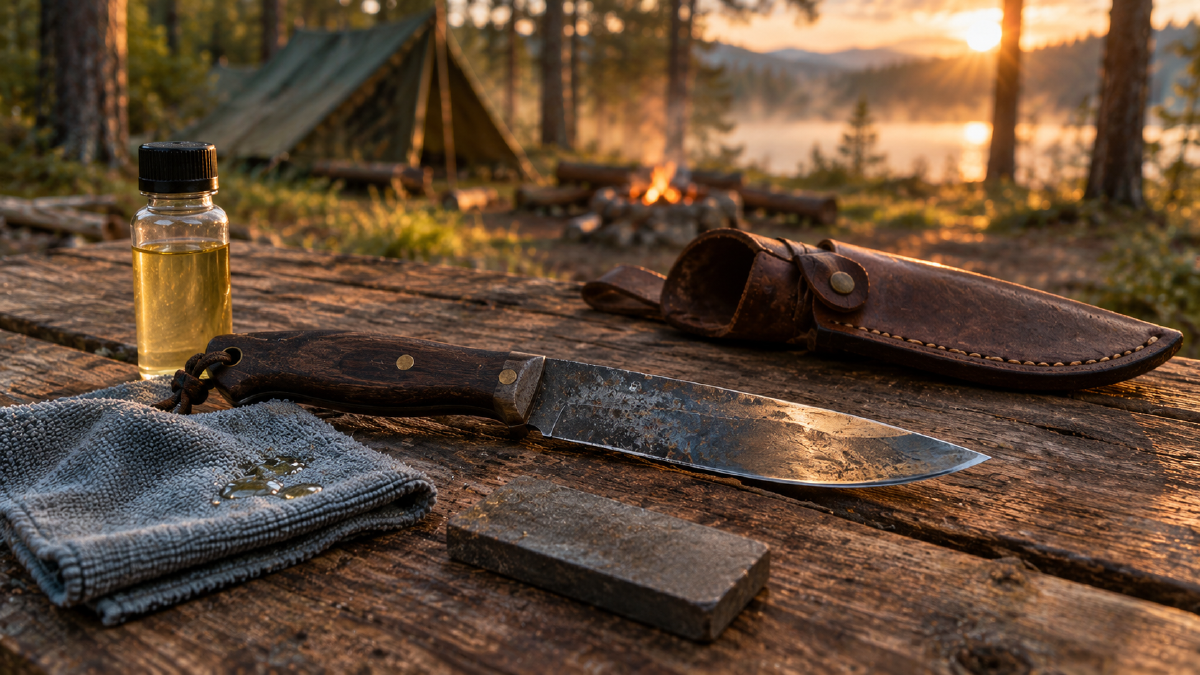
Packing then completes the preparation, and it is less about the knife than about everything around the knife. The blade travels in a dry sheath or blade guard — the guard matters most for an uncased blade loose in a pack, where an unguarded edge can slice through a rain shell, a water bladder, or a hand reaching past it — and the sheath itself must be dry before the knife enters it, since oiling a blade and sealing it in damp leather merely traps tomorrow’s rust against today’s protection. Two small items accompany the knife and quietly make every later section of this essay possible: a compact microfiber cloth, which turns the end-of-meal wipe from a decision into a two-second reflex, and a travel-sized bottle of oil, which makes the evening re-coating ritual available anywhere. These cost almost nothing and weigh less than a matchbook, yet owners who leave them behind discover how quickly a good routine collapses without them. For long trips, humid seasons, or storage that may stretch weeks, a desiccant packet dropped into the pouch is cheap insurance — it absorbs whatever humidity the sheath and cloth cannot, keeping the microclimate around the steel dry enough that the oil film never has to work alone. Preparation, in the end, is not a single act but a small system: clean steel, a keen edge, an unbroken film of oil, a dry enclosure, and the means to renew all of it on the trail.
Daily Discipline in Camp#
Wipe, Rinse, Dry — In That Order, Every Time#
The single most important habit in the field is immediate cleaning after each use, and the operative word is immediate. The corrosive clock does not start when the knife is finally put away; it starts the moment residue meets steel, and the difference between the two moments is where nearly all field corrosion is actually born. A blade used to slice tomatoes and then set aside “for a minute” while the fire is lit, the tent staked, or the fish cleaned has already spent those minutes soaking in an acid whose etching is permanent. The habit, therefore, is to wipe the blade before the next task begins — while it is still in the hand, before it is set down, while the cleaning instinct is still present and the cloth is still within reach. This is less a rule of maintenance than a rule of sequencing: finish the cut, wipe the knife, then move on. Two seconds now, or an evening with steel wool later.
The technique of the wipe deserves a moment, because a careless wipe is how people cut themselves at camp. The safest order is spine first: draw the cloth along the back of the blade, where no edge can bite, then wrap it over the flat and draw gently toward the spine, keeping fingertips behind the edge rather than pinching it through the cloth. On a folder the job is not complete until the blade is partly closed and the cloth is worked into the interior of the handle and around the pivot, where food particles, salt, and grit accumulate invisibly and slowly grind the action while rusting the tang hidden inside. Where water is available, a quick rinse under a stream or from the bottle takes off what wiping smears — sugars, salt films, fine grit — but soaking is never advisable: water works its way into handle scales, swells wood, finds the glue line, and wicks into the blade-handle junction, where it dries last and rusts first. With scarce water, the standard is lowered in method but not in outcome: a damp cloth, a baby wipe, or even a moistened bandana will lift residue adequately, provided the blade is dried thoroughly afterward, because with water discipline the drying is the whole point — the moisture introduced must leave again before it is sealed under the next film of oil.
Acidic foods demand extra vigilance, because they operate on a clock far shorter than rust. A blade used on citrus, tomatoes, onions, vinegar-based dressings, or the marinade splashed from a pan of camp stew should be cleaned within minutes of the cut, since the acids involved attack bare iron directly and their first visible product — a dull gray etching, a ghostly shadow across the bevel — is not dirt sitting on the steel but a change in the steel itself, permanent, unpolishable except by removing metal. Pitting follows if the acid is allowed to dwell, and a single neglected tomato can leave a blade freckled for life. The same urgency applies to the day’s non-food work, though it is easier to forget because the residues look harmless: plant sap from carving green wood is mildly acidic and sticky enough to glue grit to the bevel, blood carries salts and enzymes that corrode briskly, animal fats go rancid and smear, and soil ground into the edge holds moisture against it like a wet poultice. The outdoorsman who has spent the morning batoning and the afternoon slicing onions and thinks he will clean the knife after supper has, in fact, been carrying several different corrosives against the same steel all day.
Particular attention should go, in every one of these cleanings, to the blade-handle junction — the seam where steel enters wood, micarta, or the folded liners of a folder. It is the one place on the knife that never gets watched and never gets wiped, and for exactly that reason it is where hidden rust is most often discovered, months later, as a brown wick of staining creeping out from under the handle or a stiffening pivot that no oil seems to loosen. Moisture reaches it by capillary action: a wet thumb, condensation, rinse water running down the flat, all of it drawn into the narrow gap and held there by surface tension, drying far more slowly than the exposed blade beside it. Drying it deliberately — the corner of the cloth twisted into the seam, a folder opened and the tang cavity blotted — takes five seconds and prevents the only kind of corrosion the owner is unlikely to notice until it has done real damage. The blade tells the world what it has been through on its open surfaces; the junction is where it keeps its secrets, and the daily wipe is how the owner declines to be surprised by them.
The Deep Clean: When Wiping Is Not Enough#
The daily wipe handles the great majority of camp life, but there are days it cannot finish the job alone, and the honest owner schedules deeper cleaning rather than hoping the cloth will suffice. A day of field dressing leaves fat and protein dried into the grind line; an afternoon of carving resinous wood leaves sap hardened like varnish; a coastal trip leaves salt in every seam, and salt deserves particular dread, because it is not merely wet but electrolytic — a single sea-spray crossing or an accidental dunking in brackish water accelerates corrosion several times over, and the residue keeps working even after the blade looks dry. In these cases the blade gets a proper washing: warm water, a few drops of dish soap — chosen for exactly the grease-cutting chemistry that food residue requires — and the soft brush worked again into the junction, around the pivot, along the spine, and into the lanyard hole, until nothing greasy remains. The rinse follows promptly, and then the drying is done with the ceremony it deserves: full disassembly of attention if not of the knife, every fold of a folder opened, the mechanism worked with the cloth, and where the facilities exist a few minutes of open air or a cool hairdryer to drive the last moisture out of the pivot before oiling begins. At home the same wash precedes every storage session, and a compressed-air pass around the pivot and scales finishes what the cloth started.
There are things this cleaning must never include, and the list is short but absolute. The dishwasher is the great enemy of good cutlery of every kind and of carbon steel especially: the caustic detergent strips oil, the sustained heat cooks lubricant out of pivots and can discolor or crack stabilized wood, the prolonged water bath reaches places no drying cycle fully evacuates, and the blade emerges from the ordeal having been simultaneously corroded, loosened, and contaminated. Bleach and ammonia-based cleaners are ruled out for the same reason vinegar is used only under supervision — carbon steel reacts with both, and the staining they leave is chemical, not organic. Abrasive scouring pads and powders belong to the same prohibition as sandpaper in rust removal: they cut the steel, not just the dirt. And the cleaning solution itself asks one small discipline — never leave the blade submerged while chores intervene. The rule against soaking was stated for streams and basins, and it holds at the kitchen sink too: the danger was never the water meeting the blade but the abandonment of the blade to the water, and a wash attended is always brief enough.
Two further habits round out the deep clean. The first is hygiene as well as metallurgy: a blade used on raw game or poultry is washed before it touches salad ingredients or bread, the same standard any kitchen applies to a board, and the carbon steel owner enjoys one quiet advantage here, since a keen carbon edge makes clean cuts through sinew and skin that leave less bacterial smear than a duller stainless one — the sharpness that protects the steel also protects the meal. The second concerns the handle as much as the blade. Wood, the most traditional scale material, reacts to repeated wetting by swelling when wet and shrinking as it dries, and the cycle, over years, can loosen a pin or open a grain that absorbs the next wetting more eagerly than the last; drying the handle deliberately after every wash interrupts the cycle, and a periodic treatment at home — a few drops of linseed or tung oil rubbed into bare wood and wiped off — keeps the fibers fed and water-resistant. Micarta, G10, and synthetic scales need no such tending, and the folder’s pivot, once the grit has been flushed and the blade dried, takes its single drop of oil and comes back to the action it had when new.
Oil as a Daily Ritual#
Cleaning strips the protective film along with the dirt, which means every cleaning, however casual, leaves the steel momentarily bare — and the owner who wipes his blade after lunch and assumes the job is finished has in fact only completed half of it. The pre-trip coating applied at home is a one-time act; the daily oiling is its recurring counterpart, and together they form the two-beat rhythm that keeps carbon steel honest in the field. The logic is worth stating plainly, because it explains the otherwise fussy insistence on frequency: the oil film is not paint and does not persist through handling, abrasion, and moisture. Each wipe removes some of it, each cut abrades it at the very point where it matters most — the edge — and each splash of rain or sweat dissolves what remains. Re-oiling is therefore not an optional finishing touch but the second half of every cleaning, the moment when the barrier is rebuilt over steel that has just been returned to its most vulnerable state, clean, dry, and completely unprotected.
The rhythm both sources recommend is simple enough to survive exhaustion: oil after each cleaning, at minimum once a day — ideally at evening, when the day’s work is done and the knife has no further duties — and whenever the blade has been exposed to rain, river crossings, condensation, or heavy humidity. The technique matches the pre-trip preparation but on a smaller scale: a few drops on a cloth rather than on the steel, wiped evenly over blade, spine, and exposed tang until the surface looks conditioned rather than wet, with particular care to draw the oiled cloth along the edge itself, where the day’s cutting has worn the film thinnest. Excess oil is not generosity but a liability — a heavy coat migrates, pools in the sheath, and collects grit that turns every subsequent sheathing into a light lapping operation. Folding knives additionally want a single drop at the pivot, worked by opening and closing the blade a few times and then wiping away whatever surfaces, since the pivot is simultaneously the joint most in need of lubrication and the dust magnet most easily gummed by over-application. The entire ritual takes less time than reading this paragraph, and it is performed sitting down, at the end of the day, which is precisely why it tends to survive.
The frequency, naturally, scales with conditions, and learning to read those conditions is part of the craft. In wet, humid country — coastal fog, rainforest, a week of September drizzle — the cycle tightens toward every cleaning and sometimes twice a day, because the steel is under near-constant assault from atmospheric moisture and the film erodes faster than the calendar suggests. In dry desert or alpine weather it can loosen somewhat, the air doing part of the oil’s work, though never to the point of neglect: dry country is not safe country, because the danger there is less the ambient air than the cold tent morning when condensation condenses directly onto a blade left out overnight. A useful rule of thumb is that the oiling should follow the exposure rather than the clock — the blade caught in a downpour gets coated the moment it comes inside, not at the scheduled evening session hours later, since those hours are exactly when a water film sitting on bare steel does its work. The exception that proves the rule is the morning after a wet night: whatever confidence the owner took from yesterday’s oiling should be checked against the reality of a damp sheath and a cool dawn, because oil bars water, but only where the oil still is.
What keeps all of this from collapsing into good intentions is habit design rather than diligence, a distinction the sources make almost in passing and that experience confirms. Willpower is a depleting resource, and no one maintains a carbon steel knife through a week of fatigue by remembering to; the habit must instead be anchored to something the outdoorsman already does every evening without fail — after dinner, before bed, while the stove cools or the coffee boils, the same chair, the same patch of ground. Within a few trips the sequence becomes automatic: cloth out, knife out, wipe, drops, wipe again, sheath set open to dry overnight, cloth back in the pouch. At that point the ritual has stopped being maintenance imposed on the day and become part of how the day ends, a quiet minute with the tool that spent the day working, and like most such minutes it returns its value in the form of a blade that, years later, still looks after itself. The oil is the mechanism; the routine is what makes the mechanism real.
How to Oil a Blade: The Technique and the Taboos#
The ritual described above fixes when to oil; the technique deserves its own account, because the difference between a protective film and a liability is entirely a matter of how the oil is applied — and the failures are so natural, so intuition-shaped, that most owners commit at least one of them before learning otherwise. The procedure itself takes under a minute, and it begins with a precondition that outranks everything else: the blade must be clean and, more to the point, completely dry before any oil touches it. Not mostly dry, not wiped-dry, but dry — the junction blotted, the pivot drained, the whole surface given the extra moment that humidity and impatience try to steal. The reason is physical rather than fastidious: oil floats on water, so a film laid over even a thin unseen water layer does not protect the steel at all — it seals the electrolyte against the metal under a waterproof blanket, and the rust that results from oiling a damp blade is the most common form of the “it was oiled, so how did it rust?” freckling that baffles new owners. The film’s entire job is exclusion, and exclusion requires steel meeting oil directly.
Application follows, and the first habit is where the oil goes: on the cloth or the fingertip, never squeezed onto the blade itself. Oil dropped on steel runs exactly where it is not wanted — down to the edge, into the pivot, off onto the pack — and floods the very areas that most need a measured film rather than a bath. Two or three drops onto a folded cloth suffice for the evening coat; the cloth is then drawn along the blade from spine toward edge in long even passes, the bevels and flats taking a sheen that reads as conditioned rather than wet, the spine and ricasso receiving their own pass because they are flat steel like any other, and the tang and junction getting the cloth’s corner worked into the seam. The edge itself comes last and with respect: the oiled cloth folded over the spine-side of the edge and drawn away, or drawn lightly along it with the fold flat, so that the hand doing the oiling is never traveling toward the thing the oil is lubricating. For a folder, one single drop at the pivot — not a running bead down the blade well — then a dozen open-and-close cycles to distribute it, then a wipe of everything that surfaces, including the detent path and the blade flats where the oil weeps out. The finish is a quality check done in raking light: turn the blade low against a lamp or the last daylight, and bare steel flashes bright while properly filmed steel reads dark and even. Any bright sliver along the edge or at the heel is a holiday in the coating, and a holiday is where tomorrow’s rust begins.
What must be avoided runs longer than the procedure, and every item on it is a natural instinct that happens to be wrong. Oil over a wet blade, as established, seals water rather than barring it — the single most consequential error, and the one the precondition exists to prevent. Oil over a dirty blade — one still carrying grit, filings, or the residue of a hasty wipe — seals those particles against the steel too, and the next day’s cutting grinds them into the very surface the oil was meant to protect; likewise, re-oiling evening after evening without the intervening wipe strips nothing, so fresh oil laid over a contaminated film is merely fresh glue for new grit, and the ritual only works because the cleaning precedes it. Then there are the substances that are not oil at all, chief among them the water-dispersant spray found in nearly every garage: it is superb at its actual job, which is driving water out of a soaking mechanism after an immersion, and it is nearly useless as a protectant, because its carrier is a solvent that evaporates within hours and takes almost all of the film with it. A blade sprayed, wiped, and sheathed after a river crossing feels oily for an evening and is bare by morning — the spray earns its place in the kit only as the drying agent that precedes a real oiling, never as the oiling itself. The aerosol habit generally invites the same verdict applied twice: sprayed directly onto a blade, the product oversprays into the pivot and the pack, gives no control over film thickness, and introduces a flammable solvent into a camp where the evening’s business is an open flame.
The remaining taboos share one root — the intuition that more protection must be better protection — and the film’s physics answers them all at once. Grease and heavy globbing are not stronger exclusion but a reservoir: thick oil migrates under its own weight into the sheath and the pivot, gathers every dust particle it passes, and — worst of all — obscures the surface it sits on, so the owner oiling generously over a developing rust freckle has effectively sealed the diagnosis away from his own inspection for weeks. A thin continuous film excludes completely; a thick one excludes nothing it was not already excluding while adding a grit collection system. On the same principle, the blade’s oil must stay on the blade: the evening cloth passed routinely over wooden scales leaves mineral oil darkening and staining the wood unevenly, and the handle has its own proper treatment in its own season, so the oil draw stops at the shoulder of the scales. And finally the category error that turns a well-meaning owner into a chemical risk: household oils of unknown formulation — motor oil, machine lubricants, penetrating sprays with additives — will protect carbon steel perfectly well and belong on no cutlery that will ever touch food, because whatever the blade cuts, the blade also feeds, and the oil on a food knife is an ingredient rather than a finish. Food-safe mineral oil costs a fraction of the alternatives and removes the question entirely, which is the final reason it leads every list in this essay: it is not merely the best protectant available but the only one that requires no second thought when the tomato hits the board.
Storage: The Sheath Problem#
The sheath is where good intentions are most often undone, because a sheath is fundamentally a moisture trap, and its danger lies precisely in its apparent harmlessness. A sheath is a pocket: a closed or semi-closed volume with almost no airflow, lined with a material that touches the steel across a wide area of flat, unhindered contact. Any moisture that enters — rain on the walk in, condensation from a cold night, the damp of a pack that has shouldered through a downpour, sweat soaked into the belt — has nowhere to go. It sits against the blade in a still, humid microclimate, in direct contact with the metal, for hours at a stretch, and the blade, freshly wiped and oiled though it may have been at dusk, encounters that contact patch as an unbroken water film wherever the oil film has been pressed thin by sheathing. The result is the most familiar sight in carbon steel ownership: the knife drawn at dawn freckled with orange in exactly the pattern the sheath pressed against it. Both articles therefore agree on the cardinal rule, and it admits no exceptions: never sheath a wet knife. Not damp, not towel-dried, not “dry enough” — actually dry, or not sheathed at all.
The two sources differ slightly in their verdict on leather, and the difference is worth noting because it turns on a genuine trade-off rather than an error by either. The knife article is harsher, and its objections are cumulative: leather is porous and absorbs water like a saddle blanket, it holds rain and the owner’s sweat, the tanning and finishing chemistry leaves the material mildly acidic — chrome and vegetable tanning alike — and the traditional snug fit seals the blade in a sleeve that permits almost no airflow, so nothing that gets in ever leaves on its own. Its verdict is therefore categorical: leather belongs in daily carry, where the blade goes in and out and the trip home is short, and never in overnight or long-term storage. The cutlery article is kinder, crediting leather with a breathability that synthetics lack — a dry, well-made leather sheath will, it argues, wick moisture away and let it evaporate, provided the sheath itself is kept dry and periodically conditioned with oil or wax so it does not become the reservoir it might otherwise be. Both converge on the same practical guidance: in wet conditions the safer choice is synthetic — Kydex, molded plastic, or nylon — because these materials resist absorption, rinse clean in a stream, shed water instead of drinking it, and often carry drainage holes that let the interior breathe; leather’s romance is real, but romance does not dry a blade at three in the morning.
Yet the synthetic sheath is not a free pass either, and this is the caveat most advice omits. Kydex and hard plastic are waterproof in the way a jar is waterproof: they keep water out, which also means they keep water in. A blade sheathed with even a trace of moisture, or one that sweats as a warm tent cools overnight, meets an impermeable shell that converts the interior into a greenhouse — temperature swings drive condensation directly onto the steel, and the moisture, unable to escape through the material, recirculates between shell and blade until morning. The drainage hole helps, but a hole at the bottom of a pouch protects only against standing water, not against humidity. The wise owner treats every sheath, of either kind, as an environment to be managed rather than a container to be trusted: the synthetic chosen with a vented or slightly loose fit, the leather kept dry and conditioned, and in both cases the knife’s state before sheathing treated as the decisive factor, since a bone-dry, freshly oiled blade survives an imperfect sheath far better than a damp one survives a perfect one.
Beyond material choice, then, the habits are the same, because the problem is the same. The blade and sheath are aired out overnight, the sheath propped open or hung so both interiors can dry, and the knife stored outside it entirely when the camp allows — a tent pocket or a dry bag beside the sleeping bag beats any sheath ever made for the night. If the blade must be carried damp for any reason, it is first wrapped in a lightly oiled cloth, which both excludes fresh moisture and keeps the film replenished during the hours of contact. Inside the pack, the knife keeps a dedicated dry pocket or waterproof pouch, physically separated from rain-soaked clothing, a dripping tarp, the water bladder, and the wet towel, because proximity alone will transfer moisture — pack fabric wicks, and water obeys gravity at the bottom of a bag where the knife inevitably ends up if it has no assigned home. A silica gel packet in that pouch absorbs whatever gets through anyway, quiet insurance against the condensation cycle that no amount of care in sheathing can fully prevent. The sheath, in the end, is not the enemy; unmanaged, it is simply the one piece of the system that works against the owner silently, overnight, in the dark — which is exactly when and how most blades are lost.
When Things Go Wrong#
Removing Rust Before It Becomes Pitting#
Despite best efforts, spots appear — and the response must be immediate, because the entire economics of rust removal rests on a single asymmetry: surface rust is trivial to lift while deep pitting is permanent. The first is a contamination of the surface, a thin crust of oxide sitting on sound metal that an abrasive can remove in a minute; the second is a subtraction, craters where the steel itself has been consumed, and no technique available in the field or the workshop restores material that has oxidized away. The owner’s whole task, then, is to catch the bloom on the wrong side of that line. The first step is therefore diagnostic, and it repays thirty seconds of attention: the blade is held under the best light available and raked at a low angle, so that surface irregularities throw shadows, and each spot is tested with a fingernail. A bloom that feels like dust or a stain and leaves the nail clean is surface rust, fully reversible; a spot where the nail catches in a depression, however shallow, has already begun pitting, and while it must still be treated at once, the owner should understand that the goal has changed from removal to arrest. This is also the moment to reapply the distinction learned earlier: gray and blue-black mottling is patina, the protective film earned through use, and must be preserved, while anything orange or reddish is active rust and must go — the two are treated in opposite ways, and confusing them costs either the blade’s health or its hard-won character.
For light surface rust, fine steel wool — 0000 grade, the finest sold — or a soft abrasive pad such as the non-scratch kind intended for cookware, worked gently and in the direction of the blade’s grind lines rather than across them, lifts the bloom without scarring the steel; the motion is patient rubbing, not scrubbing, and the temptation to press harder must be resisted, since the oxide is softer than the metal beneath it and yields long before the steel does. Field expediencies serve when the proper grade is absent: a pencil eraser abrades just aggressively enough to remove staining while being too soft to scratch steel, and a smooth, flat river stone, wetted, functions as a very fine natural abrasive — both are gentler than the wrong grade of steel wool, which is the one real danger on the bench. Where the rust is heavier, or has begun to stain the surface gray-brown, a paste of baking soda and water, applied thickly and left to sit for ten to fifteen minutes, does its work chemically as well as mechanically: the alkaline paste neutralizes the acids that drove the corrosion and loosens the oxide’s grip, after which a soft brush — an old toothbrush, a fingertip — clears it away with little pressure. Vinegar or lemon juice can dissolve stubborn spots that nothing else will shift, but this is a controlled application of the very chemistry that caused the problem, and it demands discipline: the acid is worked on the spot alone, watched closely, then rinsed and the blade dried at once, because the same reactivity that attacks rust attacks sound steel, and a blade pickled “clean” in a cup of vinegar overnight has merely exchanged its rust for pitting.
Whatever method is used, the sequence afterwards is fixed and admits no shortcuts: the blade is washed to carry away every particle of abrasive residue — grit left on a blade is tomorrow’s scratching — then dried completely, including the junction and any handle fittings, and re-oiled immediately, before the wiped steel has time to meet the air unprotected. The reason for the urgency is one most people overlook: abrasives do not distinguish between rust and the layers beneath it, so the removal has stripped the patina and the protective film along with the corrosion, leaving bare, chemically hungry metal that will begin to oxidize again within hours in humid air. The oil is therefore not a return to routine but the rebuilding of everything that was just removed, and the fresh steel under a new film is precisely how the next patina begins to form — the damaged patch rejoins the blade’s history rather than standing as a permanent wound in it. What is ruled out entirely, in the field or at the kitchen table, are coarse materials: sandpaper, heavy grades of steel wool, files, and diamond plates meant for reshaping. These cut faster than the rust they are meant to remove, leave scratches that no amount of honing will erase, and flatten the blade’s geometry while solving a problem that a minute of patience would have solved cleanly. Rust is a race against time, but it is won with finesse, not force.
Field Improvisation When Supplies Run Out#
Field conditions are unpredictable, and the cutlery article is particularly useful here, cataloguing what to do when the oil bottle is empty or the rain will not stop — because the difference between a well-stocked kit and an improvised one is rarely preparation alone; it is often just distance, weather, or a bottle that fell into the river at the ford. The proper response begins with a shift in mindset: improvised protection is not the maintenance ritual itself but a suspension of it, an agreement to keep the steel survivable until real supplies return. Thinking this way prevents both of the common errors — doing nothing because the proper oil is absent, and doing something drastic because panic has set in — and it fixes the rule that governs everything below: any barrier beats no barrier, provided the owner remembers that it is a barrier borrowed rather than earned.
An oiled cloth, pre-prepared and kept in the kit, is the first line of defense, and it is the item most worth packing twice. A small square of cotton or flannel rubbed thoroughly with mineral oil — squeezed until it is saturated but not staining — is stored in a zip-lock bag or a dry pouch of its own; when supplies fail, the blade is drawn through it two or three times, and the steel leaves with an even film of exactly the right thickness. Because it carries its own oil supply, this cloth works for weeks: it can be re-saturated at any kitchen where a bottle of cooking oil stands on the counter, and it doubles as the evening wipe in a pinch. It costs nothing, weighs almost nothing, and it is the single cheapest form of insurance available to a carbon steel owner — which is why its absence in a kit is so hard to excuse.
Failing even the cloth, the improvisations draw on what the camp kitchen and the landscape provide. Rendered animal fat — tallow from the fire, grease from the pan — rubbed thinly onto the blade gives genuine temporary protection: fat is hydrophobic, adheres well, and will keep surface rust at bay through a wet day or a damp night’s storage. Its caveats must be stated plainly, because they are the reasons it never graduated from expedient to practice: animal fat can go rancid, its breakdown products being mildly acidic in their own right; it is soft and smears, so it collects grit and dust wherever the blade touches; and in warm weather it simply melts off and runs, taking its protection with it. Natural wax is the more stable cousin of the two expediencies: beeswax from a candle end, the paraffin of an ordinary household candle, even the wax scrounged from a cheese wrapper, warmed onto the steel with fingertip or firelight and then buffed thin, gives a harder, water-repellent coat that stays put through handling and heat, and it has the additional merit of remaining inert — wax does not go rancid, does not decompose, and can be left on the blade for weeks without harm. Where only food is available, a smear of butter or cooking oil from the evening’s meal will serve overnight, on the same terms as any vegetable fat: wash it off at the first proper cleaning, before it has time to polymerize into its sticky film. And in the ranks of last resorts, saliva works in the immediate moment — it wets and briefly protects a blade wiped moments before an emergency crossing — but it is salt-bearing and enzyme-rich, belongs to the same category as sweat, and must be treated as something to be rinsed off rather than left as a coating.
All of these, without exception, are stopgaps, and the discipline that matters most is the one that ends them: the moment normal conditions return — the next town, the next resupply, the morning the rain stops — the blade is properly cleaned and re-oiled, the improvised layer stripped away along with the dirt and grit it has gathered, and the familiar mineral film restored. An improvised coat left in place past its welcome is its own kind of damage; tallow that has gone rancid etches, wax that has collected grit abrades, and both hide whatever is happening to the steel beneath them from an owner who can no longer see it. The hierarchy, then, runs from oiled cloth through animal fat to wax to food to nothing at all, and the owner’s task is to use whichever rung the situation offers, know which rung he is on, and climb back down the ladder to proper oil at the first opportunity. Improvisation is a bridge, never a destination.
Maintaining the Edge#
Sharpening: Maintain, Don’t Repair#
Field sharpening is maintenance rather than restoration, and the distinction is the whole section. At home a neglected edge can be rebuilt: coarse stone to reprofile, finer grits to refine, a guided system to guarantee the angle, all the time in the world and a bench to sit at. In the field none of that exists — there is no bench, no steady light, often only the last hour of daylight — and the wise owner arranges his habits so that nothing is ever needed there except maintenance. The blade that left the house sharp and received its small touch-ups on schedule never requires restoration on the trail; the blade that did not will discover, at the worst possible moment, that restoration is precisely what it now needs, and that it cannot be done well with cold hands and a failing light. The stone in the pack is therefore less a repair tool than a promise to the preparation done at home: a few light passes keeping true what the whetstone established, so that the trip’s work never accumulates faster than the trip’s maintenance can answer it.
The equipment can be almost comically modest, which is one of carbon steel’s enduring gifts. A compact pocket stone in the 600–1000 grit range handles nearly all general work: coarse enough to refine a working edge in a minute, fine enough to leave it keen rather than merely functional. A ceramic rod — the slim, rod-shaped kind that rides in a sheath loop — serves quick touch-ups between stone sessions, realigning and lightly abrading the edge while removing almost no metal, and it has the great field virtue of requiring no lubrication, no flat surface, and no particular skill beyond holding an angle. In true extremity the unglazed base of a ceramic mug works as a surprisingly competent natural stone — its fired clay is hard enough to abrade steel, provided the user finds the ring of unglazed clay at the bottom and wet it first — and beyond even that lies the oldest expedient of all, a smooth, flat river stone, which will not polish an edge but will restore a working one to a blade that has gone dull against wood all afternoon. The owner who owns none of the proper tools still owns options, because the steel asks so little of the abrasive that meets it.
Technique matters more than equipment, and it reduces to a handful of principles that hold across every one of those tools. The angle — the conventional 15–20 degrees per side, matched as closely as the owner can judge by eye and hand — must be held consistently through each stroke, because an edge sharpened at a wandering angle is a rounded edge, and a rounded edge cuts like a much duller one no matter how many passes it received. Light pressure is the second principle, and the harder one to honor: the abrasive cuts steel willingly, and pressing harder only rocks the edge, loads the stone with filings, and tires the hand that most needs to stay steady. Alternating sides keeps the bevels symmetrical so the blade tracks straight through a cut instead of steering to one side, and a water stone takes a few drops of water as lubrication, which floats away the steel particles that would otherwise clog the surface and glaze it smooth. The stroke that finishes each session is the same everywhere: a few feather-light passes, edge-trailing, to refine the apex, and then the tests — the thumbnail feeling for the last trace of the burr, the edge drawn slowly through paper, the slow familiar ritual that tells the hand the edge is back.
The economics of all this favor frequency with a vengeance. Frequent light touch-ups remove almost nothing — a few strokes at breakfast or after a morning of wood processing — and they keep the blade controllable, keen, and safe through the days that follow; infrequent aggressive sessions remove real metal, shorten the blade’s working life measurably, and demand a precision that tired hands in poor light rarely manage, which is why the panicked end-of-trip sharpening so often ends in a rolled edge and a louder curse. The rule the field imposes is simple: touch up at the first hint of dullness — when the tomato skin resists, when the feather stick curls break — rather than at the first certainty of it, because catching an edge early costs five strokes and catching it late costs an evening. After every session, whatever the tool, the sequence is fixed: the blade is wiped clean of every particle of steel filings and stone grit, since either left on the steel will scratch it or work into the edge during the next cut, and then re-oiled at once, because fresh metal at the apex has just been exposed and is as hungry for protection as a newly wiped blade. Sharpening, oiling, sheathing — the three belong together, and separating them is how edges are lost twice in one trip.
The Sharpening Kit: Choosing and Caring for the Abrasives#
The equipment paragraph above sketches the options; this one chooses among them, because the market for sharpening tools is vast and most of what fills it is either redundant or unsuited to a pack. For carbon steel in the field the sensible core kit is small: one dual-grit pocket stone covering roughly 600 and 1000, one ceramic rod, and — as the compact backup that fits a wallet slot — a credit-card-sized diamond plate. The dual-grit stone earns the center position because 600 handles everything short of reprofiling and 1000 refines a working edge to keenness; anything coarser removes steel faster than field mistakes occur, and anything finer is a luxury the trail has no light to appreciate. Diamond plates deserve their reputation for speed and never needing flattening, and their thinness makes them the natural emergency layer of the kit, though many users find them slightly harsh — they cut quickly and give less feedback than a water stone, so touch work on them wants a lighter hand. The ceramic rod rounds out the trio as the no-surface, no-lubrication tool of last resort before true improvisation, doubling as the honing instrument described in the next section. What does not belong in a field kit is a guided system — invaluable at home for resetting a damaged bevel or training a beginner’s hand, but bulky, fussy with cold fingers, and unnecessary once the angle lives in the muscle memory that a season of touch-ups provides.
One maintenance point about the stones themselves is routinely omitted and then learned the expensive way: sharpening stones dish. Every stroke removes a little more of the stone’s center than its edges, and a dished stone, pressed against a straight edge, cannot help but grind a convex, wandering bevel — the user feels the angle wandering and blames his hands when the culprit is the stone. Flattening is therefore part of sharpening hygiene: at home, a dedicated flattening plate or a sheet of coarse sandpaper on a pane of glass trues the stone’s face in a minute of scrubbing, and the frequency is determined by use rather than calendar — a stone used weekly wants truing every few months, a stone used rarely only when the dish becomes visible to a raking eye. In the field, the substitute for a flattening plate is awareness: work the pocket stone toward its less-worn end, and if the edge refuses to come despite honest technique, suspect the stone before suspecting the steel. Stones also want simple care in the pack — tapped or blown free of filings after each session, washed with soap and water occasionally to clear the metal load that glazes the surface, and carried in its own pouch or wrap, because loose stone grit in a pack finds every other piece of gear and abrades all of it.
Grit numbers themselves deserve one honest word, because they flatter more than they inform. A 1000-grit finish is not “sharper” than a 600-grit finish in any way the trail can detect — it is smoother, and smoothness matters mainly at home, where it becomes the base for polish and for the refinement that food preparation rewards. Outdoors, where the work is wood, rope, fish, and fire, a 600-grit edge with a clean apex will outperform a mirror-polished 8000-grit one within an hour, because the coarser surface severs fibers more eagerly and the polish simply burns away. The field owner who internalizes this stops mourning his lack of finishing stones and keeps his attention where it belongs: on the apex, and on the angle.
Geometry, finally, is the one place where the conventional 15–20 degrees per side deserves a footnote rather than a decree. The default serves slicing cutlery and general camp work well, but the blade’s actual duty may argue for adjustment: a knife that spends its days batoning, prying at hard knots, or cutting against bone takes less damage from a slightly steeper apex, and the elegant answer is not to regrind the bevel but to add a microbevel — a narrow secondary edge at perhaps 22–25 degrees per side, laid on with a few steeper passes at the end of an ordinary sharpening session. The primary bevel keeps its slicing geometry, the apex gains the strength its work demands, and the touch-up cost is trivial, since only the microbevel ever needs refreshing afterward. True Scandinavian grinds, like those on the puukko mentioned earlier in this essay, present the opposite case: a single wide bevel with no secondary edge at all, sharpened at its own established angle and never at the shopworn 15 degrees of generic advice — the rule for any unknown or unusual geometry is the oldest one in sharpening: follow what is already there, and let the stone meet the bevel the maker intended rather than the one the manual assumed.
Honing and Stropping#
Sharpening grinds metal; honing only realigns the microscopic edge, and understanding what happens at that scale is what turns the distinction from a technicality into a daily habit. An edge apex, keenly sharpened, is a fin of steel only a few molecules thick at its very tip, and every cut bends it: slicing bread rolls the apex to one side, carving hard wood folds it back and forth, and the sum of thousands of such tiny folds is an edge that feels dull though no metal has actually been lost. The blade has not become blunt — its geometry is intact beneath the damage — it has become waviness itself, and light no longer reflects off a line but off a fringe of bent steel. This is why a blade can feel dead in the hand at breakfast and keen again after a minute on leather: the dullness was largely a matter of alignment, and alignment can be restored without removing anything. Honing is the family of techniques that exploit this, and stropping is its gentlest member — which is why, for carbon steel, it is the daily default and the stone is the exception.
The tool could hardly be simpler: a leather strop, or the smooth back of a leather belt always available around the waist. The blade is drawn spine-first — edge trailing, never leading, because an edge pressed into leather digs in and cuts the strop rather than being straightened by it — at the same sharpening angle, roughly 15–20 degrees per side, with the lightest pressure that still keeps the leather in contact. Five to ten strokes per side is the usual dose, judged not by count but by feel: each pass should leave the edge measurably keener than the one before, and the moment it stops improving is the moment to stop, since beyond that point only diminishing returns and creeping heat remain. The technique rewards the same consistency the stone demanded — a wandering angle on a strop rounds the apex exactly as it rounds an edge on stone — and it pays a dividend carbon steel users learn to depend on: the hard, stiff apex of a properly heat-treated carbon blade responds to leather almost obediently, realigning in a handful of passes where a softer stainless edge, which deforms more readily and springs back less willingly, asks for more. This is the feedback relationship described earlier made practical, the blade answering the hand’s smallest correction.
Stropping can be done daily, costs almost nothing in effort, and frequently postpones sharpening altogether — after a day of food preparation or an hour of carving, a minute on the belt back restores keenness that would otherwise have required the stone, and over a long trip that arithmetic compounds into weeks of edge life saved. Its one danger is the oldest rule in the craft, learned by everyone once and remembered forever: clean the leather first. Grit embedded in a strop — sawdust from the workbench, trail dust from the belt, the fine metal slurry of its own previous sessions — will dull rather than refine the edge, silently abrading the apex with every stroke meant to save it, so the leather is wiped or stropped-clean before use and the belt kept as a workshop object rather than a sweat rag. Honing on a ceramic rod follows the same logic in a harder medium: light, angled passes that straighten and lightly abrade, useful when the edge has rolled rather than merely tired and a strop alone cannot quite recover it.
There is, finally, a limit worth knowing, because stropping’s gentleness is also its boundary. Realigning a rolled apex is its whole competence; it cannot restore an edge that has genuinely worn away, and the tell is behavioral rather than visible — if the blade keeps improving on the strop and then slips back into dullness after an hour of work, the apex metal itself is fatiguing and fracturing, and no number of additional passes will help; the stone is needed. Nor can stropping rescue a chipped edge, where the damage is a series of notches rather than a bend, or a blade so far gone that it will not catch paper before stropping begins. The wise sequence, then, keeps the three tools in their proper order of escalation: the strop every day or nearly, the ceramic rod when the edge has rolled and the strop no longer quite reaches it, the pocket stone only when realignment fails and metal must honestly be removed — and after all three, the same fixed close as every edge session: wipe the filings and dust away, and re-oil the apex that has just been worked.
When the Edge Fails Mid-Trip#
Even on a well-kept blade, the trail occasionally delivers a genuine edge failure, and the first task when the knife suddenly stops cutting is diagnosis rather than despair, because the two failures that account for almost every case behave differently and want opposite treatments. A rolled edge is the common one: the apex has folded sideways against hard use — a knot in the wood, a bone, a hidden nail in a windfall — and the blade now feels dull rather than damaged, often dull on one side more than the other. It is corrected exactly as stropping and honing were described above, a few passes at a slightly increased angle on leather or ceramic, and the keenness returns in under a minute with no metal lost. A chipped edge is the other: the apex has lost small bites of itself entirely, usually from batoning through something harder than wood or from the impact of a drop, and it announces itself by catching and snagging where a rolled edge merely slides. A chip cannot be polished out and must not be ground out at the chip alone — spot-grinding a notch creates a flat, and a flat creates a divot, and the chase ends with a serrated blade and a shortened life. The only honest response is to resume normal sharpening at normal angles until the whole edge has been ground past the depth of the deepest chip, which in the field may mean accepting a slightly lower edge than yesterday and finishing on the stone at camp rather than at breakfast.
Between the two lies a third, milder category worth knowing because it so often precedes the other two: the fatigued apex. A blade worked hard all day — batoning in the morning, food preparation at noon, feather sticks at night, with touch-ups but no rest — will sometimes develop an edge that keenness refuses to hold, sharpening up beautifully and then dulling again within the hour. This is the apex metal itself crumbling at its thinnest line, and no amount of stropping reverses it; the steel is asking for a coarser reset and, eventually, for the home bench. The wise responses are practical rather than heroic: for the rest of the trip, a slightly steeper touch-up angle gives the tired apex a little more support; hard work takes priority over fine work, so the blade shifts to batoning and rough cutting while its food duties go to a folding backup or the camp pot knife if one exists; and every failure mode ends with the same reflex, since the damaged edge is now more vulnerable than ever — clean the session’s filings away, oil generously, guard the blade against drops and prying, and let the trip finish the argument at home, where the stones are coarse, the light is good, and there is time enough to do it right.
The Rhythm of Care#
A Field Routine at a Glance#
The entire discipline of carbon steel care resolves into a single cycle of phases that repeats at every scale: once before the trip, once during every meal, once at the close of each day, and once when the trip itself ends. Presented as a table it fits on a page; internalized, it fits in a habit. The table below is offered not as a summary to be skimmed but as a reference to be memorized until its rows need no reading — each cell compresses an argument made at length above, and the cautions column is where the real knowledge lives, because the actions are easy to remember and the ways of ruining them are not.
| Phase | Core Actions | Key Cautions |
|---|---|---|
| Pre-trip | Wash with warm soapy water and dry completely; sharpen on stone and strop; inspect edge, pivots, and handle under good light; coat with food-safe mineral oil; pack cloth, oil bottle, desiccant | No vegetable oil for storage; deal with existing rust, chips, and loose screws at home where the tools exist |
| Arrival in camp | Choose a dry, level storage spot; keep knife, cloth, and oil together in one dedicated dry pouch away from wet gear | The knife’s home is not the pack’s bottom; set the sheath open to air before anything else |
| After each use | Wipe spine first, then flats and edge; rinse if water is available; dry thoroughly, drawing the cloth through the blade-handle junction and folder interior | Never leave acidic residues, sap, blood, or grit on the blade; rinse but never soak |
| Acid or game contact | Clean within minutes of cutting citrus, tomatoes, onion, or dressing; wash blood and fat off after field dressing | Etching is permanent and begins before any rust is visible; one neglected tomato marks a blade for life |
| End of day | Inspect the whole surface by raking light; re-oil thin and even, edge included; drop oil at the pivot of a folder; air blade and sheath separately overnight | Never sheath wet, not even towel-dried; oil follows exposure, not the clock |
| Wet-weather exposure | Re-oil the moment the blade comes out of rain, river, or fog; check condensation at dawn after a cool night | Yesterday’s oil protects only where the oil still is; dry country is not safe country |
| Rust found | Test with a fingernail; lift surface rust with 0000 steel wool or baking-soda paste; wash, dry, re-oil at once | No sandpaper or coarse abrasives; a nail that catches means pitting — treat to arrest, not remove |
| Edge maintenance | Strop daily on leather or belt back; rod for a rolled edge; pocket stone for real wear; wipe and re-oil after | Consistent angle, light pressure, touch up at the first hint of dullness, never the last certainty |
| Improvised protection | Draw the blade through a pre-oiled cloth; failing that, thin animal fat or warmed wax as a temporary coat | Temporary only — any improvised layer is a bridge back to proper oil, never a substitute for it |
| Post-trip | Deep clean; disassemble a folder if the screwdriver fits; lift any fresh rust; fresh oil on every surface; loose storage | Store out of the sheath, cool and dry, with a desiccant; never sealed in oil or wrapped damp |
Read down the first column and the philosophy of the essay is visible in the sequence itself: prepare once, attend constantly, respond immediately, restore at the close. Read across any single row and the same three-part logic appears — an action, the reason it exists, and the failure mode it prevents — which is why the cautions column so often mentions things the core actions do not: the sheath that undoes a good evening, the oil applied too heavily, the rust left one day too long. The table cannot teach judgment, and it cannot replace the arguments above it; what it can do is sit at the bottom of a pack in the mind, recoverable in three seconds at the campfire, when the blade is in one hand and the cloth is in the other and the light is going. That is the whole purpose of a glanceable routine: not to know the discipline, but to still be doing it correctly when tired, wet, and half-thinking about dinner.
The Habit Behind the Hardware#
None of these steps is difficult, and none takes more than a minute. That fact deserves to be sat with rather than skimmed past, because it is the whole argument’s quiet punchline: everything this essay demands — the wipe, the dry, the two drops of oil, the glance under the light, the few strokes on leather — costs less in time than reading a single page of it, and less than the coffee the outdoorsman drinks while doing most of them. The difficulty of carbon steel care has never been temporal or physical; it is entirely a matter of attention, which is the one resource genuinely scarce in the field, where the mind is occupied by weather, terrain, fire, food, company, and the plain pleasure of having walked far. The blade competes for that attention and usually loses — not because its owner is careless, but because a blade is patient, and patient things are easy to postpone. Rust, by contrast, is never patient, and it is precisely the deferred maintenance, the wipe saved for later, the oiling saved for tomorrow, that the corrosion has been waiting for all along.
Their value lies entirely in consistency, then, in making cleaning, drying, oiling, and inspecting an ordinary part of camp life rather than a chore deferred until rust makes the decision for you — and the surest sign that the discipline has taken hold is that it stops feeling like maintenance at all. A habit that requires a reminder has already half-failed; a habit welded onto something done every evening without fail — the stove cooling, the dishes washed, the fire settled — costs nothing extra in attention because it borrows attention that was already being spent. Within a few trips the sequence stops being a list of obligations and becomes, instead, the way the evening ends: cloth out, knife out, wipe, drops, wipe again, sheath open to the air, cloth away. What began as rules has become rhythm, and rhythm is what makes any craft sustainable across seasons — the potter’s throw, the rower’s stroke, the woodsman’s sharpening before the first cut of the day.
The two source articles, reaching the same conclusion from their different starting points, frame this rhythm in two complementary ways, and it is worth naming both, because each catches what the other misses. The knife article frames it as ritual and responsibility — a lineage of outdoorsmen who trusted carbon steel with shelter, food, and survival, who kept their edges because a dull knife at the wrong moment was not an inconvenience but a danger, and who passed down the care along with the craft. To oil a blade with that framing is to join a very old conversation, and the small act acquires the weight of the tools that made camps and carved canoe paddles and dressed a hundred winters’ game. The cutlery article frames the same acts as prevention, the engineer’s view: small, cheap, scheduled efforts that preempt large, expensive, unscheduled problems — the rust spot caught at a freckle instead of the pitting that would have retired the blade. Both are describing the same truth from opposite sides of it, and the truth is this: carbon steel does not forgive neglect, but it rewards attention with performance no stainless blade can match. The stainless knife asks nothing and gives a little; the carbon blade asks a minute a day and gives everything it has. Between those two bargains, once the rhythm is established, there is no real contest — only the choice, made fresh every evening, to keep showing up for the tool that shows up for you.
Coming Home: The Off-Season#
The Post-Trip Reckoning#
The trip ends at the trailhead, but the maintenance cycle ends at the kitchen sink, and the owner who skips this stage sends the next trip out with debt already accruing. The post-trip session begins with the same wash the blade received before departure — warm water, dish soap, the soft brush through the junction, the folds of a folder opened and flushed — because a week of use accumulates exactly the residues the pre-trip wash was clearing: salt, fat, sap, grit, and the fingerprints that were handled in a hurry. Then comes the inspection, and it is the most valuable one of the entire cycle, because it happens in the best conditions the hobby ever offers: a clean bench, a good lamp, a magnifier if the owner owns one, and no campfire waiting. Every mark found is read against the standards set in the field: gray and blue-black mottling is patina, to be left; any orange is rust, to be lifted now with the gentle methods already described while it is still hours old rather than months; the gray ghosting of an acid stain is recorded, not mourned, since it is permanent and the blade’s history rather than its failure. The edge receives the paper test it earned, and any chip, roll, or tired spot that the trip’s touch-ups could not fully answer is noted for the session that follows, with the blade’s condition triaged honestly — sound, serviceable, or due for a proper regrind.
The cleaning and inspection done, the blade gets the home-grade version of the evening ritual: a fresh, thorough oiling on every surface, more generous than the field coat but still a film rather than a bath, worked into the junction, around the pins, into the pivot, and along the spine. Handles get their own look in this light: wooden scales that have shrunk slightly in dry heat are due for a drop of linseed oil, loose screws are tightened to their proper torque and no further — overtightening strips threads and loosens pivots into play — and a folder washed at the sink is worked open and closed a dozen times to confirm that the action came through the trip clean. This is also the moment for the home-only tasks the field could not host: a full reprofiling session if the edge geometry drifted over years of touch-ups, a proper flattening and finishing progression on stones the size of a briefcase, and, for the enthusiast, the deliberate patina applications — a mustard mask, a soak in strong tea or coffee — that seed the protective darkening evenly across the bare steel that rust removal may have exposed.
Putting the Blade to Bed#
Storage, at this scale, means months rather than nights, and the principles are the same ones the sheath section established, simply taken to their conclusion. The blade, clean, dry, and freshly oiled, is wrapped in a light cloth or in wax paper — the material of choice because it breathes while still excluding the airborne moisture a bare blade would meet — and placed in a drawer, a shelf box, or a dedicated knife case. What it must not meet is the sealed plastic bag beloved of display cases and online sellers: plastic excludes nothing permanently, and the small humidity trapped inside with the blade has nowhere to escape when the garage cools at night, producing exactly the condensation cycle the synthetic sheath was criticized for — only now running for a season instead of a night. If a sealed container is genuinely unavoidable, it earns its place only with a generous desiccant packet inside and the blade wrapped separately from the container walls; otherwise, breathable beats airtight, and a dry drawer beats either. The storage location itself matters as much as the enclosure: a climate-controlled interior closet is ideal, a basement or unheated garage is not, because the temperature swings there drive condensation on bare metal repeatedly through the year, and a knife forgotten in a damp shed for a winter can emerge pitted through its oil film despite every ritual that preceded it. Desiccant packets in the storage box are changed or recharged on the same schedule as the blade is checked, and that check — a two-minute look after the first month, then once a season — catches the bloom that any storage arrangement can still produce, caught early it lifts in a minute and the blade goes back to bed.
The Sheath’s Own Rest#
The sheath deserves its own retirement care, because a neglected sheath becomes the agent of exactly the damage the rest of the routine exists to prevent, and its materials want different treatments. Leather, stored damp or dirty, stiffens, mildews, and concentrates its tanning acids against whatever blade it next receives: at home it is wiped clean of the trip’s sweat and dirt, dried at room temperature away from any direct heat source — a radiator or a dashboard warps and cracks it — and once or twice a year fed with a leather conditioner or a rubbed-in coat of oil or wax that keeps the fibers supple and restores the surface’s water resistance; stored lightly stuffed with paper to hold its shape, in a dry place, it will outlast the knife. Nylon and canvas sheaths go through warm soapy water, inside and out, to lift the salt and grit that abrade a blade on every draw, and are air-dried completely before anything is placed back inside. Kydex and plastic need only a wipe and an inspection: cracks at the mouth, loose rivets, a mouth worn oversize from a thousand draws — all of these signal a sheath that no longer grips safely and should be remolded or replaced rather than trusted. Whichever type it is, the sheath spends the storage season empty and dry, and ideally apart from the knife, so that neither can quietly donate its moisture to the other in the dark.
Then the cycle simply begins again. The first trip of a new season opens with the pre-trip sequence from this essay’s first practical section — wash, inspect, sharpen, oil, pack — and any bloom the winter produced lifts in the first five minutes under the cloth, a reminder that the whole apparatus of care was never about heroics but about small things done while they are still small. The blade that comes out of storage keen, clean, and dark with honest patina has been kept the way the material demands, and it is ready, exactly as it was the autumn before, for whatever the first morning out asks of it.
Conclusion#
Choosing carbon steel for the field is choosing a tool that asks something of its owner, and the asking is the first thing to understand clearly, because it is neither negotiable nor small. The blade arrives sharper than any stainless rival — keen at a geometry that softer steels cannot safely hold — it holds that edge longer through batoning, filleting, and a season of meals, and it can be returned to keenness with a stone the size of a playing card, or a ceramic rod, or the unglazed ring of a camp mug. All of this is real, and it is why the material has outlived every attempt to replace it. But the blade arrives without armor. Where stainless performs its quiet chemical trick — chromium meeting oxygen, the passive film reforming itself endlessly against rain, sweat, and neglect — carbon steel offers no such trick, and every drop of water, every splash of citrus, every hour in a damp sheath, every fingerprint left on a wiped blade is an open door to oxidation. The outdoorsman who carries carbon steel therefore carries an arrangement, not an object: a standing agreement between his attention and the steel’s performance, renewed in small acts, broken only by neglect.
The answer, then, is neither to hide the steel away — a blade stored in fear is a blade that never earns its keep, and the finest edge in the world cuts nothing in a drawer — nor to pretend the risk is absent, which the first wet week disproves emphatically. It is to live inside the arrangement deliberately: to prepare before the trip, washing and sharpening and inspecting until the blade starts from a known-good baseline; to wipe and dry and oil during it without thinking, the ritual folded into the evening so completely that it survives fatigue, weather, and distraction; to catch and lift rust while it is still a spot rather than a scar, finesse where force would only compound the damage; to store the blade dry and apart from the wet gear that would undo the day’s care; and to improvise faithfully when the kit runs short, any barrier over none, with the honesty to replace every borrowed coat with proper oil at the first opportunity. None of this is heroic. All of it is learnable in an afternoon and complete within a minute a day.
Do this, and the bargain resolves into its dividend. The patina that forms over years of use — the gray wash of a thousand tomatoes, the blue-black mottling of fish and game, the faint lines where a thumb habitually rested — becomes exactly what it should be: proof, worn openly, of a tool carried hard and cared for well, a record no new blade can possess and no stainless steel can ever earn, since armor takes nothing and therefore gives the surface nothing to remember. What was, at the first page, a question of alloy and crystal structure has become, at the last, a matter of habit — and habit, repeated across enough evenings, approaches partnership: the blade answering the hand, the hand answering the blade, each season deepening a conversation that started with a single wipe after the first meal. The trail, in the end, asks only that the steel be kept worthy of the work, and the work, in return, keeps the steel worthy of the trail: keen, sound, and ready to cut cleanly wherever it goes next.